
Biological Approach to Abnormality Causes of Abnormality The
Biological Approach to Abnormality
Causes of Abnormality • The biological model of abnormality assumes mental disorders as illnesses with a physical cause. The medical explanations of abnormality are: o Neuroanatomy (structure of brain) o Brain biochemistry (function of brain) These may be the result of: o Genetic factors o Brain damage (infection or lesions)
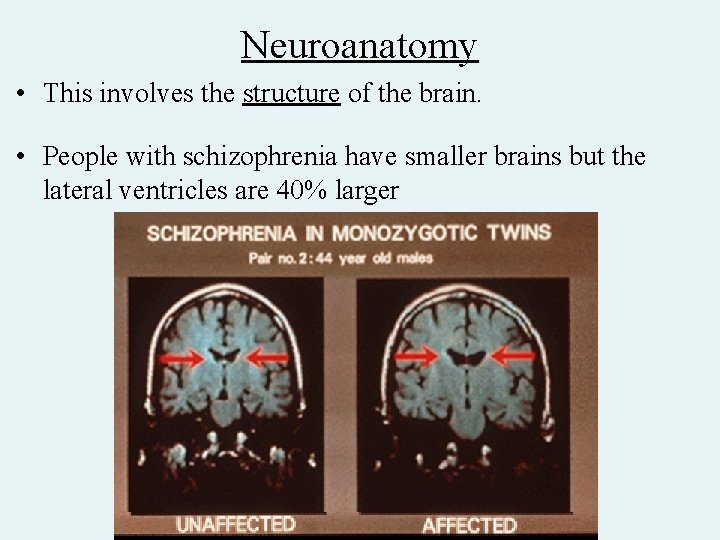
Neuroanatomy • This involves the structure of the brain. • People with schizophrenia have smaller brains but the lateral ventricles are 40% larger
Brain Biochemistry • Abnormality may lie in a person’s biochemistry, e. g. – Schizophrenia is associated with high levels of the neurotransmitter Dopamine (important roles in behaviour and cognition, incl. mood, attention, working memory) – Depression is associated with low levels of serotonin (the “happiness hormone”) • However, these are correlations, so can not tell whether this is a cause or an effect of the disorder
Genetics • Patients may inherit genes which cause mental disorders. . • Although it can be hard to decide whether they developed the illness through genetics or being in a similar environment to that person. • Kendler et al (1984) - relatives of someone who had schizophrenia were 18 times more likely to develop it. • Concordance rates in twins: do monozygotic (MZ or identical) have higher concordance rates than dizygotic (DZ or unidentical) twins?

Results Of Twin Studies Dizygotic Twins Monozygotic Twins 17% 48% 20% 46% Schizophrenia Gottesman (1991) Depression (Moore & Jefferson, 2004) • Need to differentiate between ‘genetics’ and ‘biology’ - Watson et al (1998) – Monkeys in social isolation show low serotonin levels ain depression symptoms Ø So ‘life’ matters!
Evaluation of the Biological Model • Well established: evidence from science such as biochemistry and scans. • Drug therapies: based on the biological model and have often proved effective in reducing symptoms BUT • Disorders appear to have a biological vulnerability factor which triggers the disorder when stress is encountered – a. k. a. ‘Diathesis Stress’ theory • Biological factors seem to play a greater role in some disorders e. g. Schizophrenia than others, e. g. phobias • Model ignores social and psychological factors
Biological Treatments Psychosurgery Electroconvulsive Therapy (ECT) Drug Therapy
Psychosurgery • Surgically lesioning part of the brain to control symptoms of patient (in 1930 s & 40 s); e. g. – Lesion to amygdala to control aggression/violence – Frontal lobotomy to ‘cure’ schizophrenia • No evidence is cured anything, just made patient more manageable • Now VERY rarely used, for very severe epilepsy (by severing corpus callosum)
Electroconvulsive Therapy • In 1930’s, explanatorily used for schizophrenia but seemed to help depression • Reason for its success is unknown, but presumably ‘resetting’ neurotransmitter activity helps break some cognitive/‘thought’ cycles • Still used in treating depression (though only for very severe and treatment resistant cases) – Can lead to some memory issues
Drug Therapy ~Schizophrenia~ • In 1950’s, chlorpromazine -a. k. a. Thorazine- (a sedative!) was found to reduce hallucination & delusions • We now know it reduces dopamine activity • Newer drugs -such as clozapine- also target additional neurotransmitters (incl. serotonin); more effective with less side effects • BUT only works on 50 -60% of patients • Suppresses not cures; 80% relapse of those who go off

Drug Therapy ~Depression~ • First wave of drugs in 1960 s, both raised serotonin levels: – Monoamine-oxidase inhibitors (MAOIs) • Interact badly with certain foods & medicines – Tricyclic anti-depressants (TCAs) • Long term usage related to heart problems • 1990’s brought Selective Serotonin Reuptake Inhibitors (SSRIs, eg. Prozac); safer and more effective • 60 -70% success rate, but placebo has ~30% success rate! • Target bio-processes, but not deal with cognitive biases • Dependence & side effects (incl. aggression & suicide)
Biological Model Evaluation (AO 2) • Scientifically testable and supported, BUT not conclusive (however there is a clear system for improvement) • Efficacy depends on degree of biological causation • Model overlooks environmental/cognitive factors • Side effects & issues of dependence • Ethical issues of informed consent & stigmatisation
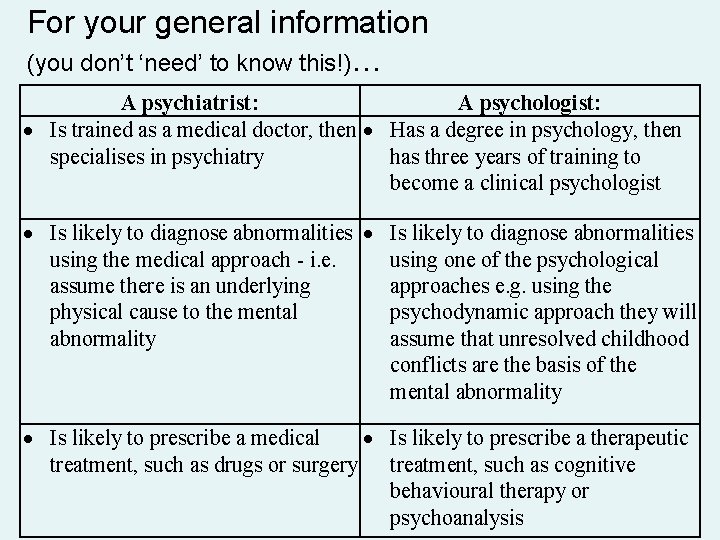
For your general information (you don’t ‘need’ to know this!)… A psychiatrist: A psychologist: Is trained as a medical doctor, then Has a degree in psychology, then specialises in psychiatry has three years of training to become a clinical psychologist Is likely to diagnose abnormalities using the medical approach - i. e. using one of the psychological assume there is an underlying approaches e. g. using the physical cause to the mental psychodynamic approach they will abnormality assume that unresolved childhood conflicts are the basis of the mental abnormality Is likely to prescribe a medical Is likely to prescribe a therapeutic treatment, such as drugs or surgery treatment, such as cognitive behavioural therapy or psychoanalysis
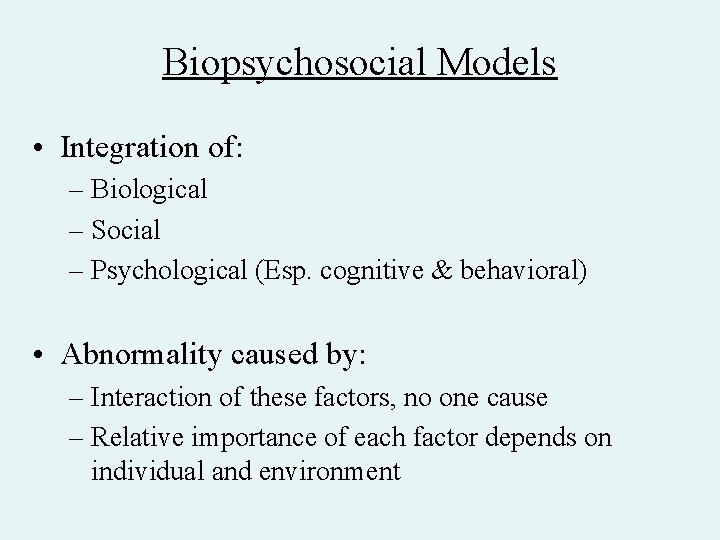
Biopsychosocial Models • Integration of: – Biological – Social – Psychological (Esp. cognitive & behavioral) • Abnormality caused by: – Interaction of these factors, no one cause – Relative importance of each factor depends on individual and environment
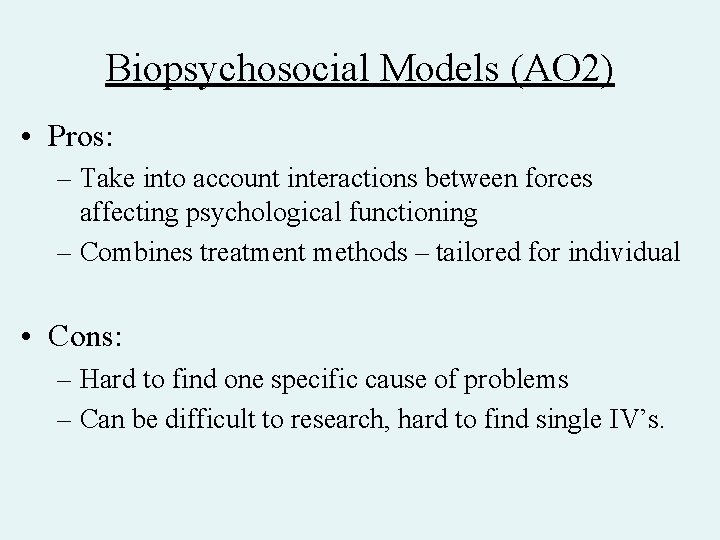
Biopsychosocial Models (AO 2) • Pros: – Take into account interactions between forces affecting psychological functioning – Combines treatment methods – tailored for individual • Cons: – Hard to find one specific cause of problems – Can be difficult to research, hard to find single IV’s.
- Slides: 16