
Biological Anthropology Primates Humans as Primates In order
Biological Anthropology Primates
Humans as Primates �In order to understand the place of humans in nature, it is first necessary to understand the group of mammals to which humans belong– the primates
Methods of Classification �May have inherited the trait form a common ancestor Humans and monkeys both have 5 digits on each limb because they inherited this trait from a distant common ancestor �The two species may have developed the same trait independently in their evolution The canary and bat are both small animals capable of flight because their species evolved flight independently
�Homologous traits: traits that show similar structure but may or may not show the same function Arm bones of a human, bird and whale �Analogous traits: traits that have the same function but not the same structure Wings of a bird and a flying insect
�Primitive traits: trait has been inherited from an earlier form �Derived: traits that have changed from an ancestral state �Example- 1 st mammals had 5 digits on each hand foot. Humans have retained this condition. Horses have developed a single digit (toe).
Human Taxonomy � Kingdom: Animal � Phylum: Chordata Subphylum: Vertebrata � Class: Mammals Reproduction: placental mammals Parental Care: prenatal and postnatal patterns Temperature Regulation: homoiotherms Teeth: deciduous teeth/permanent teeth ▪ 4 types: incisors, canines, premolars, molars Skeletal structure: orientation of limbs of 4 legged mammals are tucked under body Behavior: larger forebrain which includes cerebrum � Order: Primates
Primate Characteristics �Many features are related to living in trees � 2 most important ability to use hands and feet to grasp branches Ability to perceive distance and depth
�Prehensile (capable of grasping) hands and feet �Expanded tactile pads �Generalized skeletal structure that can be used in a variety of ways �Binocular stereoscopic vision (eyes are located on front of skull so vision overlaps) �Larger, more complex brains associated with learning, intelligence, body control, and coordination �Small number of offspring, strong mother-infant bond, extended period of growth, variable paternal care
�Social creatures- but social structures vary greatly �Social groups �Solitary group �Monogamous family group �Polyandrous group �Uni-male group �Multimale/multifemale group (most common non-human primate group) �Social organization by dominance (non-human)
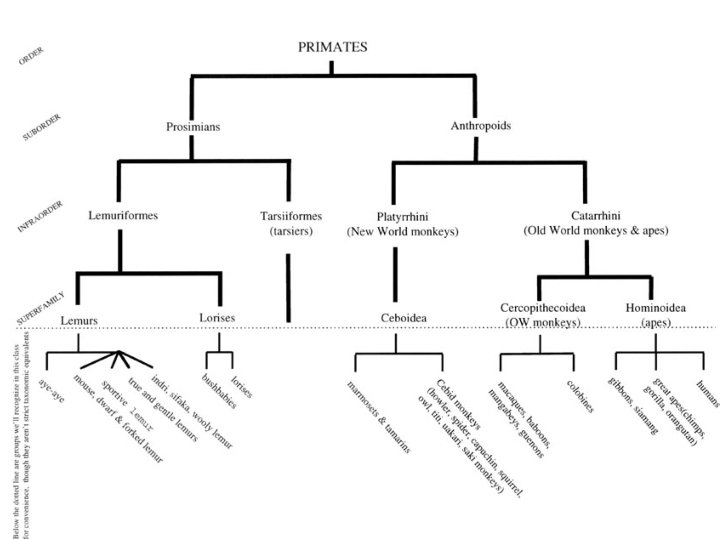
Prosimians �“before simians” (monkeys and apes) �More primitive �Usually lack one or more primate characteristic (i. e lack color vision) �Rely more on smell �Brains are generally smaller relative to body size �Many are nocturnal �All living species are found in Old World � 3 different groups: Lorises- small, solitary, nocturnal in Asia and Africa Tarsiers- small, solitary, nocturnal in Indonesia Lemurs- biologically and socially diverse

Tarsier Lemur
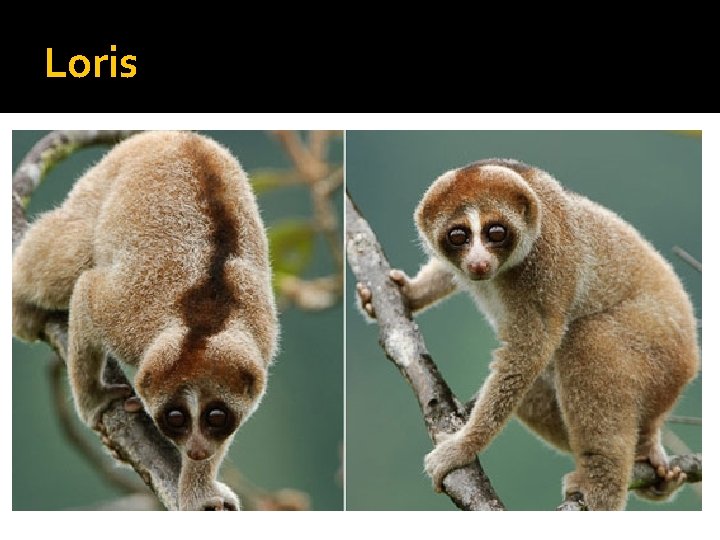
Loris
Anthropoids �Monkeys and hominoids (apes and humans) �Generally larger bodies �Larger and more complex brains �Rely more on visual abilities �More complex social structures �Almost all diurnal �Both arboreal and terrestrial species �Found in Old World and New World
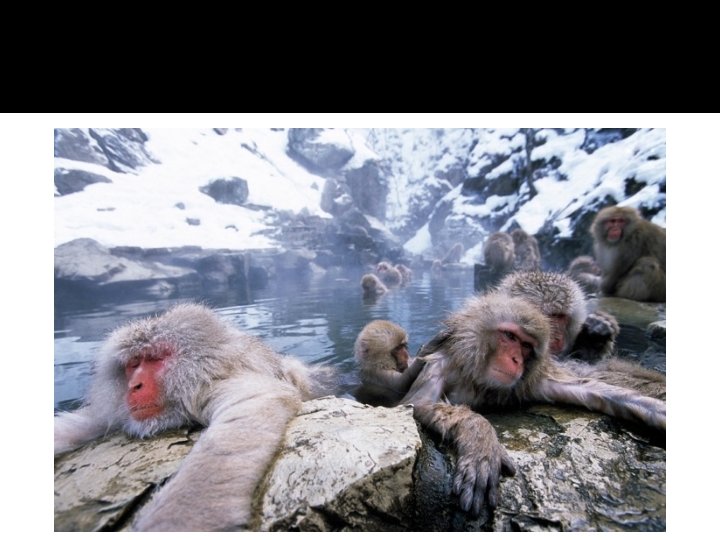
Monkeys �Tails! �Smaller brains relative to body size �Quadrapedal �Arms and legs similar length �New World Prehensile tails and four more premolars More proficient in acrobatic agility �Old World Biochemically and physically more similar to humans (i. e. same number of teeth) More adaptable to different environments (rainforest, savanna, snowy mountains)
Hominoids �Do not have tails �Larger than monkeys �Brain is more complex and larger than monkeys �Invest the most time in raising their young �Can raise arms above head �Anatomy allows different type of movement from monkeys- adept at climbing and hanging from branches- suspensory climbers
3 Categories of Hominoids �Lesser apes �Great apes �Humans
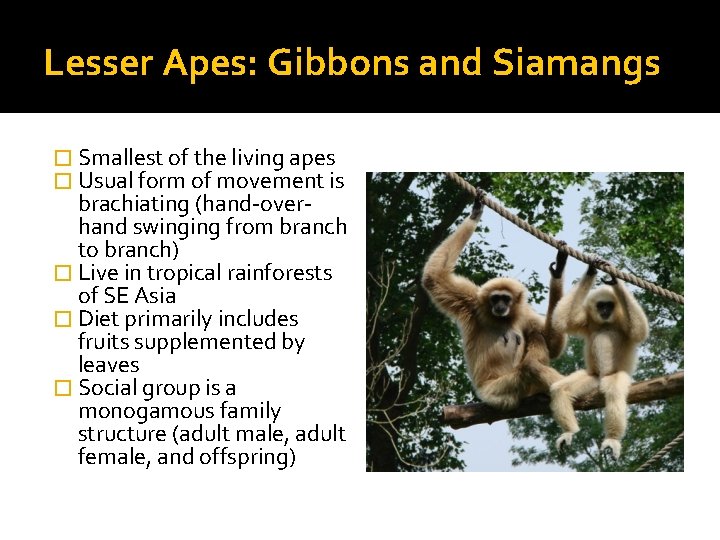
Lesser Apes: Gibbons and Siamangs � Smallest of the living apes � Usual form of movement is brachiating (hand-overhand swinging from branch to branch) � Live in tropical rainforests of SE Asia � Diet primarily includes fruits supplemented by leaves � Social group is a monogamous family structure (adult male, adult female, and offspring)
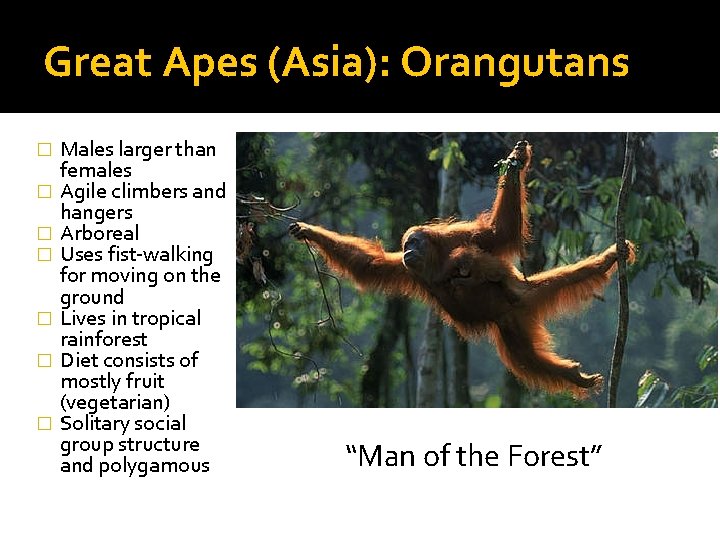
Great Apes (Asia): Orangutans � � � � Males larger than females Agile climbers and hangers Arboreal Uses fist-walking for moving on the ground Lives in tropical rainforest Diet consists of mostly fruit (vegetarian) Solitary social group structure and polygamous “Man of the Forest”
Great Apes (Africa): Gorillas �Largest living primate �Found only in equatorial Africa �Males larger than females �Males have larger canine teeth and large crests of bone on top of skulls �Most have blackish hair, but some mature males have silver gray hair on backs “silverbacks” �Predominately terrestrial �Use knuckle-walking to move about on all fours �Arms longer than legs �Live in small social groups (about a dozen)- one adult male, several females and offspring
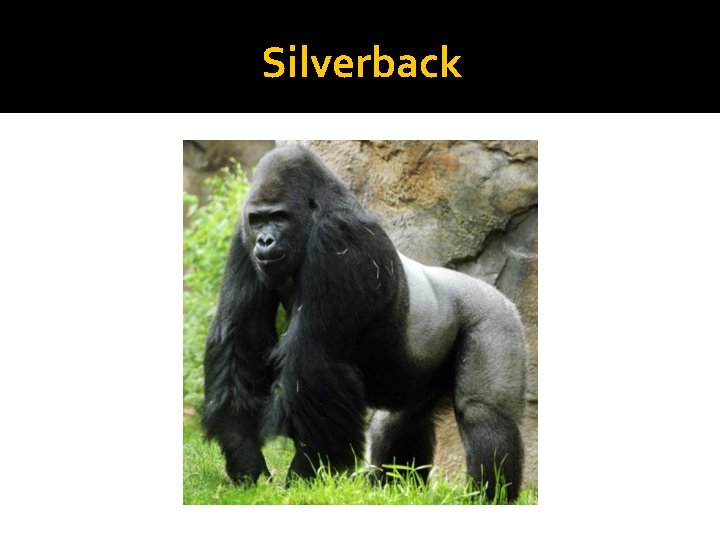
Silverback
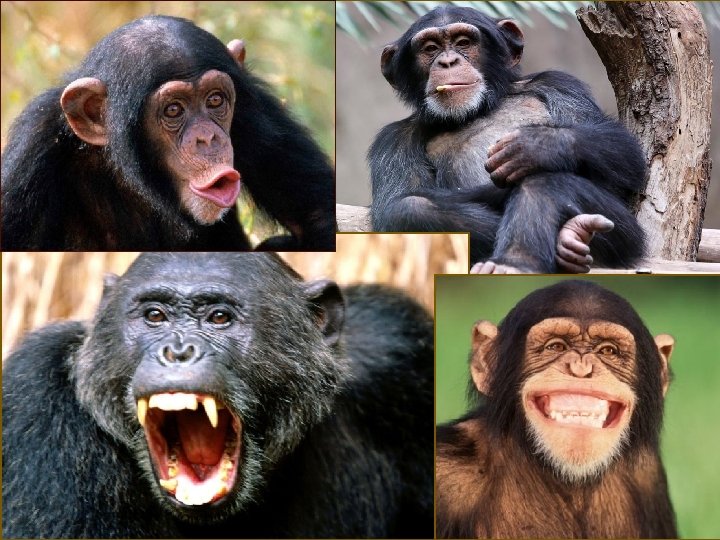
Great Apes (Africa): Chimpanzees �Live mostly in African rainforests �Slight sexual dimorphism �Knuckle walkers �Terrestrial and arboreal �Diet consists of mostly fruit; some leaves, seeds, nuts, insects, and meat �Have been observed hunting in planned coordinated groups �Live in large communities of 50 or more where males are dominant over females �Show great variation in facial features and physical appearance
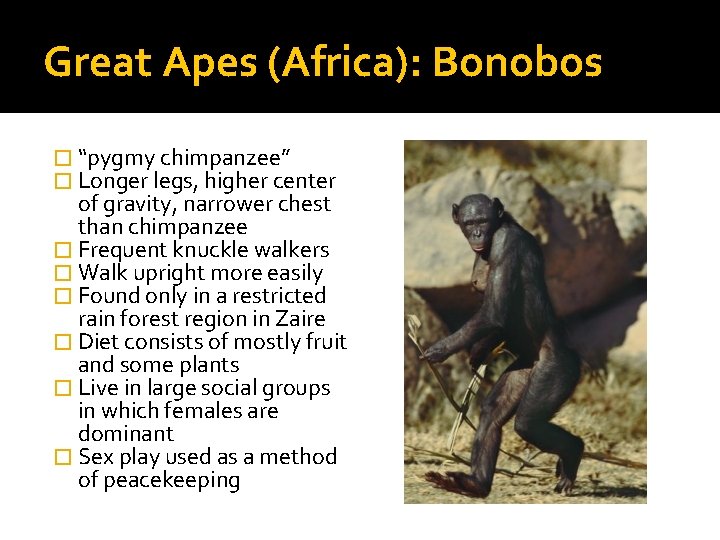
Great Apes (Africa): Bonobos � “pygmy chimpanzee” � Longer legs, higher center of gravity, narrower chest than chimpanzee � Frequent knuckle walkers � Walk upright more easily � Found only in a restricted rain forest region in Zaire � Diet consists of mostly fruit and some plants � Live in large social groups in which females are dominant � Sex play used as a method of peacekeeping

- Slides: 26