
BIOL 3316 Chapter 19 Domain Eukarya Kingdom Plantae
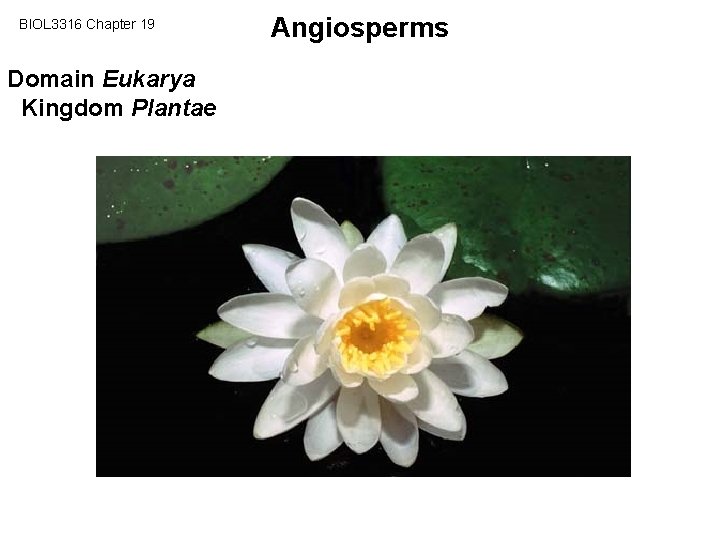
BIOL 3316 Chapter 19 Domain Eukarya Kingdom Plantae Angiosperms
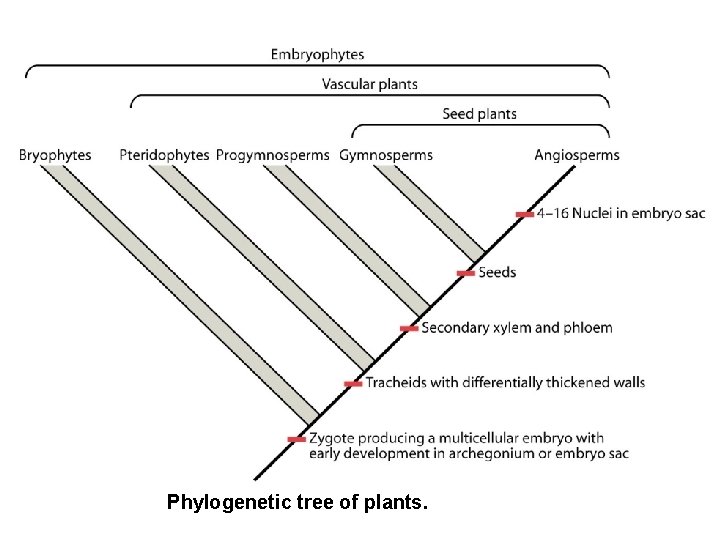
Phylogenetic tree of plants.
Angiosperm Classification Synapomorphies that link the angiosperms (These characters were present in the common ancestor of all angiosperms): § Flowers § Fruit § Rolled and closed megasporophylls (carpels) § Double fertilization (and the resulting triploid endosperm) § Three-nucleate microgametophyte (pollen) § Eight-nucleate megagametophyte § Absence of archegonia in megagametophyte § Anthers with two pairs of pollen chambers § Sieve tubes and companion cells in the phloem
4. Flowering Plants Phylum Anthophyta (angiosperms, or flowering plants) Largest phylum of photosynthetic organisms. All have: § Flowers that provide a means of exchanging genetic information. Both male and female reproductive structures are much smaller than the gametophytes of non-flowering plants: • Stamens are the reproductive structures found in flowers that produce pollen grains that carry the male genetic information. These are small more easily spread from flower to flower. • Smaller female reproductive parts allow them to produce seeds more quickly. • Allows the process of fertilization and seed formation to occur rapidly. § Carpels enclose developing seeds and may turn into a fruit. § Production of endosperm (a material that forms after fertilization and serves as an initial food source for the
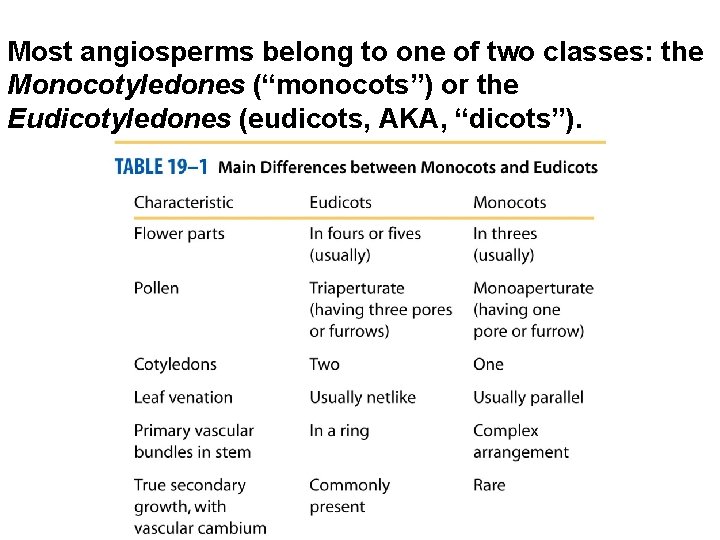
Most angiosperms belong to one of two classes: the Monocotyledones (“monocots”) or the Eudicotyledones (eudicots, AKA, “dicots”).
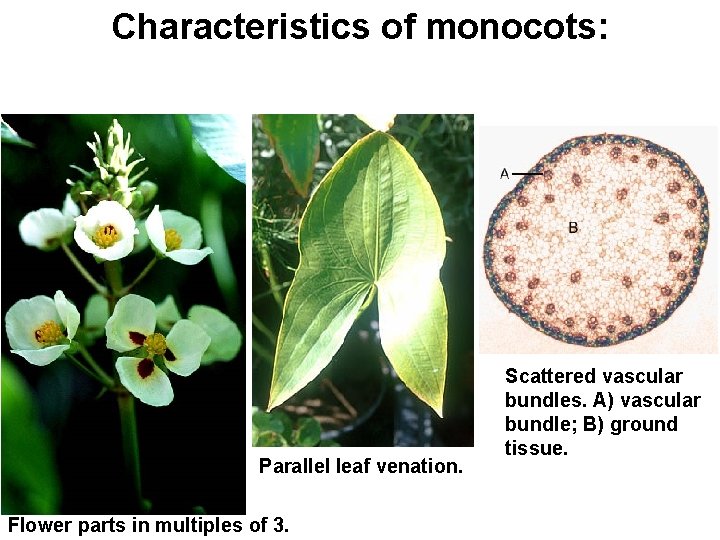
Characteristics of monocots: Parallel leaf venation. Flower parts in multiples of 3. Scattered vascular bundles. A) vascular bundle; B) ground tissue.
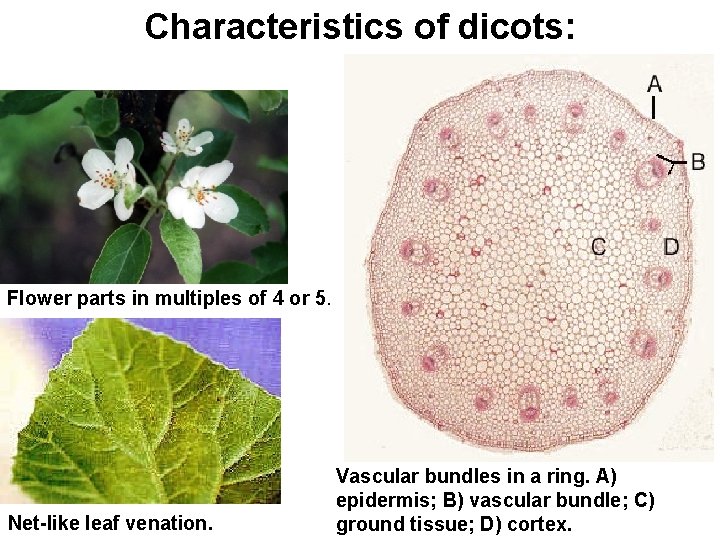
Characteristics of dicots: Flower parts in multiples of 4 or 5. Net-like leaf venation. Vascular bundles in a ring. A) epidermis; B) vascular bundle; C) ground tissue; D) cortex.
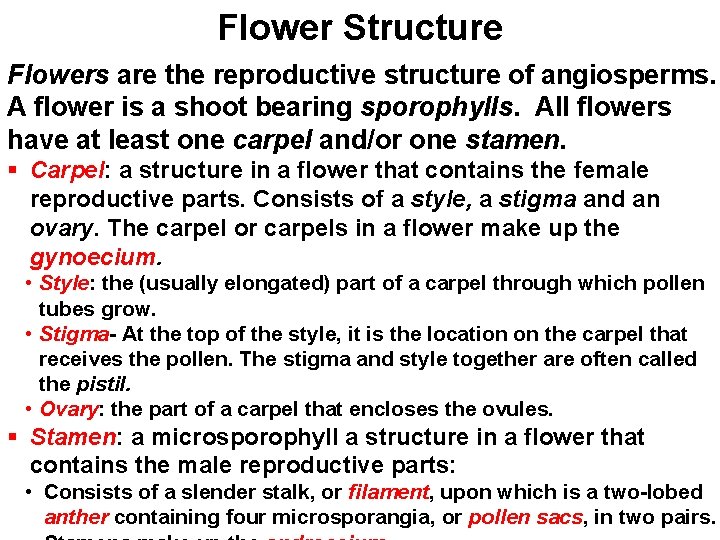
Flower Structure Flowers are the reproductive structure of angiosperms. A flower is a shoot bearing sporophylls. All flowers have at least one carpel and/or one stamen. § Carpel: a structure in a flower that contains the female reproductive parts. Consists of a style, a stigma and an ovary. The carpel or carpels in a flower make up the gynoecium. • Style: the (usually elongated) part of a carpel through which pollen tubes grow. • Stigma- At the top of the style, it is the location on the carpel that receives the pollen. The stigma and style together are often called the pistil. • Ovary: the part of a carpel that encloses the ovules. § Stamen: a microsporophyll a structure in a flower that contains the male reproductive parts: • Consists of a slender stalk, or filament, upon which is a two-lobed anther containing four microsporangia, or pollen sacs, in two pairs.
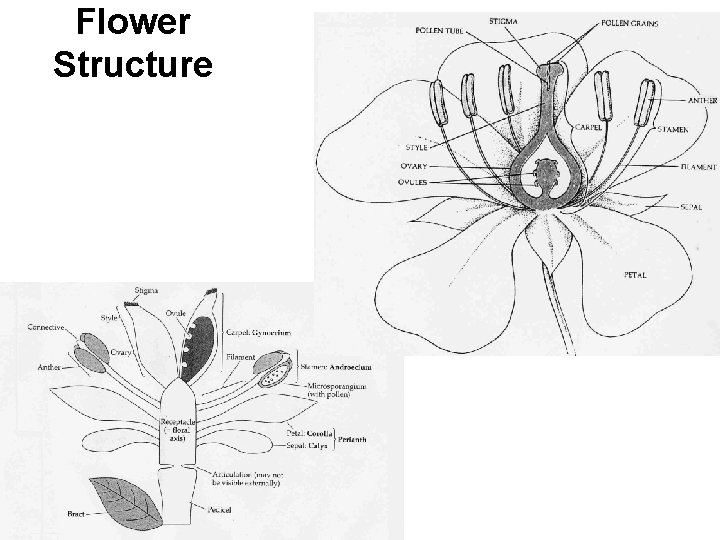
Flower Structure
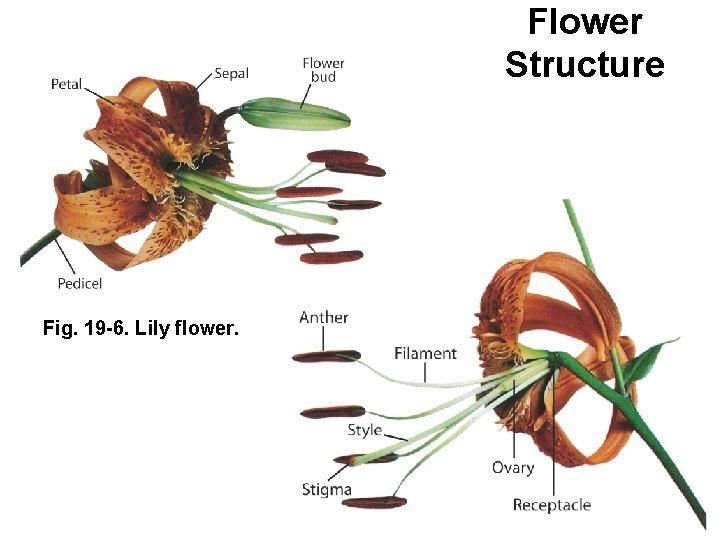
Flower Structure Fig. 19 -6. Lily flower.
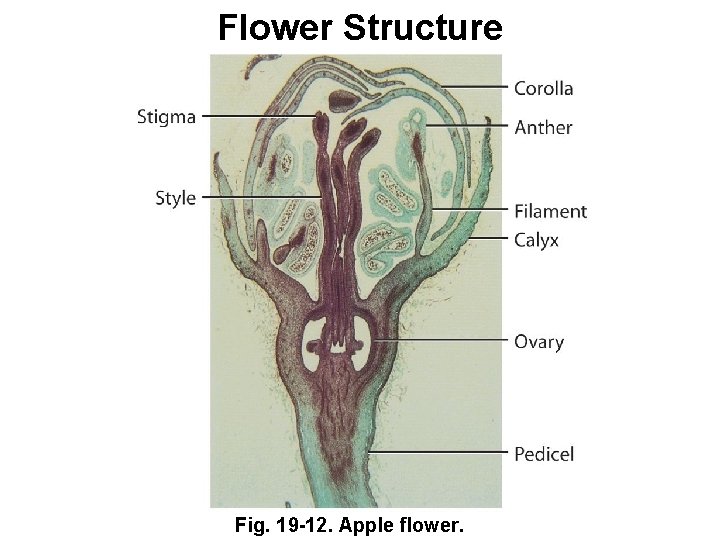
Flower Structure Fig. 19 -12. Apple flower.
Flower Structure Flowers are categorized by describing the presence/absence of flower parts: § A complete flower contains a perianth (calyx and corolla), an androecium, and a gynoecium: • The calyx has all of the sepals in the flower. • The corolla has all of the petals in the flower. § A bisexual (“perfect”) flower contains both an androecium and gynoecium. § A unisexual (“imperfect”) flower contains either an androecium or gynoecium: • Staminate: the flower contains the androecium. • Carpellate: the flower contains the gynoecium. A monoecious plant contains both staminate and carpellate flowers on the same individual. In a dioecious plant, the staminate and carpellate flowers are on different individual plants.
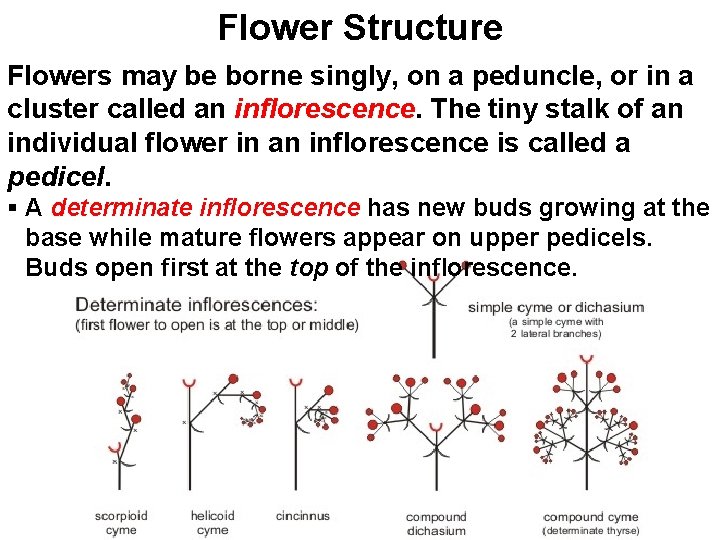
Flower Structure Flowers may be borne singly, on a peduncle, or in a cluster called an inflorescence. The tiny stalk of an individual flower in an inflorescence is called a pedicel. § A determinate inflorescence has new buds growing at the base while mature flowers appear on upper pedicels. Buds open first at the top of the inflorescence.
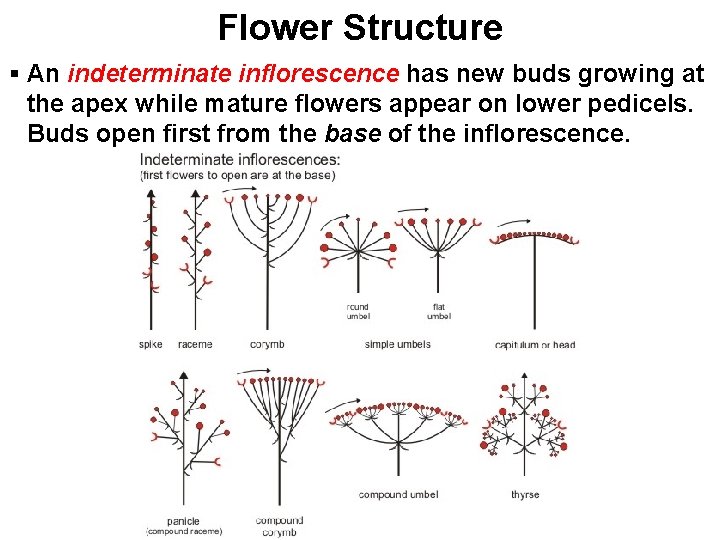
Flower Structure § An indeterminate inflorescence has new buds growing at the apex while mature flowers appear on lower pedicels. Buds open first from the base of the inflorescence.
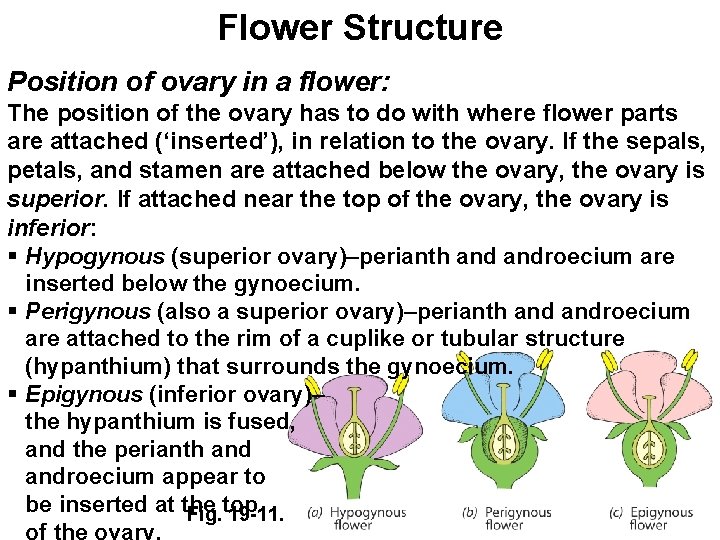
Flower Structure Position of ovary in a flower: The position of the ovary has to do with where flower parts are attached (‘inserted’), in relation to the ovary. If the sepals, petals, and stamen are attached below the ovary, the ovary is superior. If attached near the top of the ovary, the ovary is inferior: § Hypogynous (superior ovary)–perianth androecium are inserted below the gynoecium. § Perigynous (also a superior ovary)–perianth androecium are attached to the rim of a cuplike or tubular structure (hypanthium) that surrounds the gynoecium. § Epigynous (inferior ovary)– the hypanthium is fused, and the perianth androecium appear to be inserted at the Fig. top 19 -11. of the ovary.
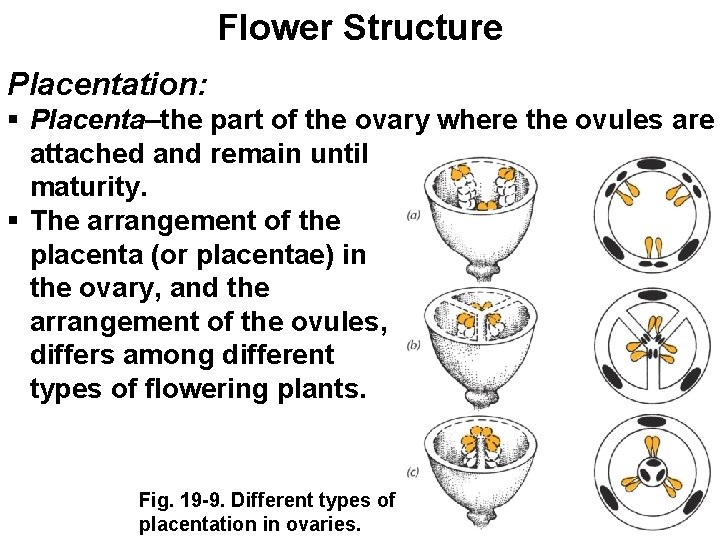
Flower Structure Placentation: § Placenta–the part of the ovary where the ovules are attached and remain until maturity. § The arrangement of the placenta (or placentae) in the ovary, and the arrangement of the ovules, differs among different types of flowering plants. Fig. 19 -9. Different types of placentation in ovaries.
Angiosperm Diversity There are more than 60 Orders of Angiosperms, and more than 300, 000 known species. § Traditionally, the orders are arranged by flower structure, plus some other morphological characters. § Evidence from molecular biology is rearranging the taxonomy. For example, ‘monocot’ and ‘dicot’ are no longer valid descriptors. Plant reproduction by means of flowers has long been thought to promote the success and diversification of angiosperms. § The major source of angiosperm diversity is floral specialization: adapting the flower to specific pollinators. Ostensibly, this limits wasted reproductive effort.
Angiosperm Diversity The exact reasons for angiosperm success are unclear: § Do specialized anatomies and functions, increase speciation rates or decrease extinction rates? § The role of flowers in the diversification and increased phenotypic diversity may depend on the system: • Plants such as orchids have packets of pollen and high pollination precision. • Other plants with granular pollen are less precise. Hedging against extinction likely represents a tradeoff between enhancing local reproductive success and occupying new locations or
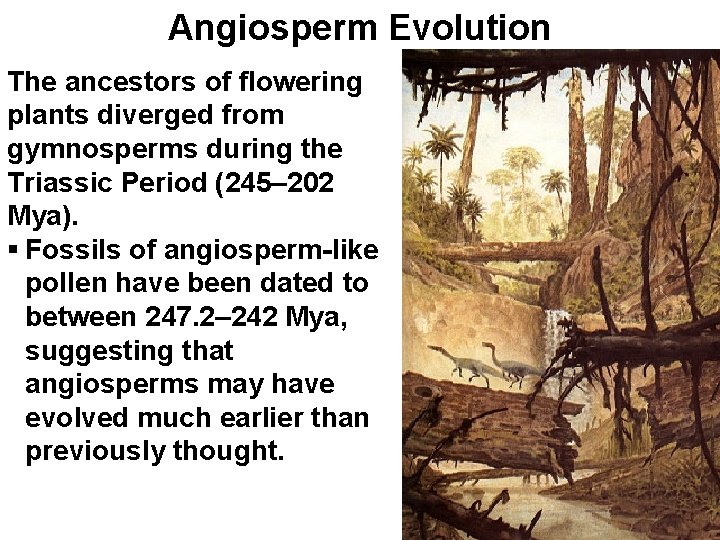
Angiosperm Evolution The ancestors of flowering plants diverged from gymnosperms during the Triassic Period (245– 202 Mya). § Fossils of angiosperm-like pollen have been dated to between 247. 2– 242 Mya, suggesting that angiosperms may have evolved much earlier than previously thought.
Angiosperm Evolution § Although disputed, the early Jurassic Nanjinganthis dendrostya from China seems to have had several exclusively angiosperm features, e. g. , a thickened receptacle with ovules. § The early-middle Jurassic Schmeissneria, which as been considered to be a type of ginkgo, may be the earliest known angiosperm (or a close relative).
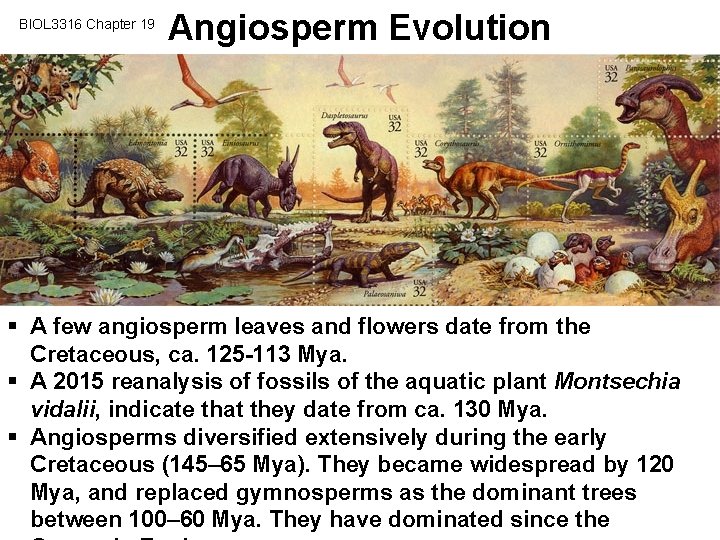
BIOL 3316 Chapter 19 Angiosperm Evolution § A few angiosperm leaves and flowers date from the Cretaceous, ca. 125 -113 Mya. § A 2015 reanalysis of fossils of the aquatic plant Montsechia vidalii, indicate that they date from ca. 130 Mya. § Angiosperms diversified extensively during the early Cretaceous (145– 65 Mya). They became widespread by 120 Mya, and replaced gymnosperms as the dominant trees between 100– 60 Mya. They have dominated since the
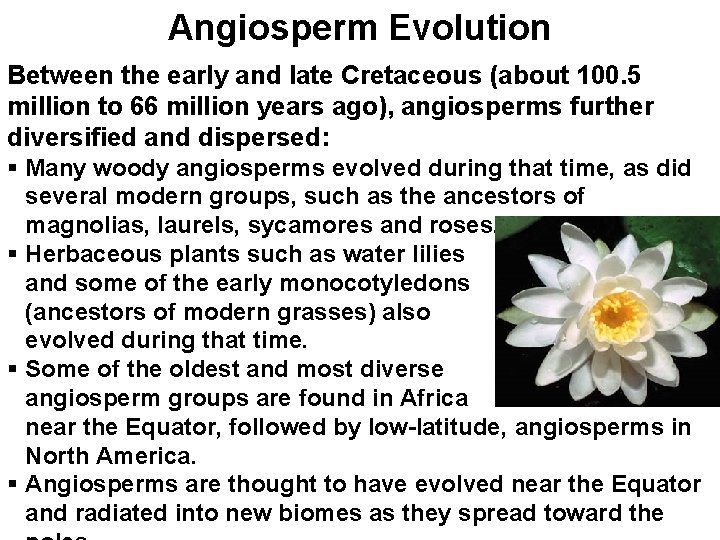
Angiosperm Evolution Between the early and late Cretaceous (about 100. 5 million to 66 million years ago), angiosperms further diversified and dispersed: § Many woody angiosperms evolved during that time, as did several modern groups, such as the ancestors of magnolias, laurels, sycamores and roses. § Herbaceous plants such as water lilies and some of the early monocotyledons (ancestors of modern grasses) also evolved during that time. § Some of the oldest and most diverse angiosperm groups are found in Africa near the Equator, followed by low-latitude, angiosperms in North America. § Angiosperms are thought to have evolved near the Equator and radiated into new biomes as they spread toward the
Angiosperm Evolution § Between ca. 100. 5– 93. 9 Mya, angiosperms probably dominanted vegetation along many coastal tropical and, following the coasts northward and southward. § During this time, angiosperms also spread to low-elevation warm temperate and inland continental areas. § Between ca. 95 million– 93. 9 Mya, therefore, angiosperms became the predominant form of vegetation in many areas of the world.
Angiosperm Evolution § The evolution of seed plants and later angiosperms appears to be the result of two distinct rounds of whole genome duplication. This paleopolyploidy could either: • Double the genome of a single species (autopolyploidy) • Combine the genome of two species (allopolyploidy). § Because of functional redundancy, genes were rapidly silenced or lost from the duplicated genomes. Most paleopolyploids have lost their polyploidy by a process called diploidization, and are currently considered diploids. § These events occurred ca. 319 Mya and ca. 192 Mya. Another possible event ca. 160 Mya perhaps created the ancestral line that led to all modern flowering plants: • This last event was studied by sequencing the genome of Amborella trichopoda (addresses Darwin’s “abominable
Angiosperm Evolution During the early Cretaceous, angiosperms underwent rapid genome downsizing, while genome sizes of ferns and gymnosperms remained unchanged. § Smaller genomes (with smaller nuclei) allow for smaller cells and faster cell division rates. § Species with smaller genomes can contain more smaller cells (particularly veins and stomata within their leaf volume. • Facilitates faster growth and higher rates of leaf gas exchange (transpiration and photosynthesis). • Increased uptake of CO 2 (despite concurrent decrease in atmospheric [CO 2]) was a competitive advantage.
Angiosperm Diversity and Coevolution Angiosperms developed a close association with insect pollinators early in their evolution: § This promoted outcrossing, resulting in genetically vigorous offspring. § The short generation time in which angiosperms reproduce relative to gymnosperms allows rapid population growth and easier colonization of disturbed habitats. § The seeds of angiosperms are small and can be eaten and otherwise transported to new areas by animals. § Fruits further refine seed dispersal.
Flower Color and Pollinator About 75% of all flowering plants require the help of pollinators. Because most pollinators fly, the colors of a flower must attract them. The brighter the flower, the more likely it will be visited. § Bees are attracted to bright blue and violet colors. § Hummingbirds prefer red, pink, fuchsia or purple flowers. § Butterflies prefer bright colors such as yellow, orange, pink and red. § Night-blooming flowers are generally white they attract moths and bats using odors. § Flowers may have “honey guides” that are visible in the UV range.
Angiosperm Fruits have two major and two minor functions: § Protection of seeds: fruits ripen as the seeds mature. § Dispersal of seeds: Fruits assist in the transportation of seeds to new areas by animals and other mechanisms. § Rotting fruits may help fertilize the soil around seeds (relatively rare). § Some fruits (e. g. , black walnuts) have allelopathic substances that prevent seedlings from growing too close to the
Types of Fruits § Drupe (or stone fruit) is a fruit in which an outer fleshy part (exocarp, or skin; and mesocarp, or flesh) surrounds a single shell (the pit, stone, or pyrene) of hardened endocarp with a seed (kernel) inside, e. g. , plum, peach, avocado. § Pome: composed of one or more carpels surrounded by accessory tissue, e. g. , apple, pear, quince. The core is the true fruit. § Berries: are the most common type of fleshy fruit. The entire outer layer of the ovary wall ripens into a potentially edible pericarp. May be formed from one or more carpels from the same flower. • Botanical and common definitions differ: grapes, tomatoes, cucumbers, eggplant, chili peppers, and bananas are berries, while blackberries and raspberries are not. § Nuts: a fruit composed of an inedible hard shell and a seed, which is generally edible. • In general usage, a wide variety of dried seeds are called nuts, but in a botanical context ‘nut’ implies that the shell does not open to release
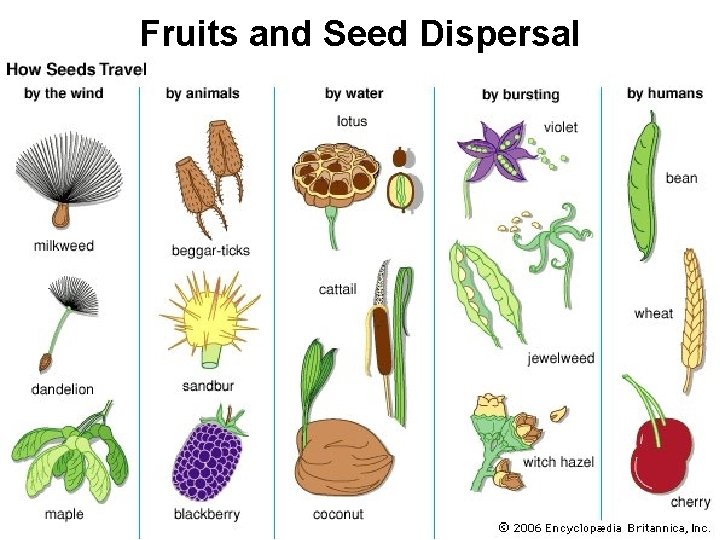
Fruits and Seed Dispersal
- Slides: 30