
BIOL 2416 Chapter 1 Genetics An Introduction Course
BIOL 2416 Chapter 1: Genetics: An Introduction
Course Information • • • Lecture Lab Attendance Exams Paper
Introduction to Genetics • Genetics = study of heredity. • (structural) gene = chunk of meaningful DNA that codes for production of a cellular protein. • 4 sub-disciplines: – – Transmission Genetics (a. k. a. Classical Genetics) Molecular Genetics Population Genetics (a. k. a. Evolutionary Genetics) Quantitative Genetics
Transmission/Classical Genetics • • Mendelian inheritance Mitosis and meiosis Pedigree analysis Controlled breeding Mutational analysis Cytogenetics (chromosomal alterations) Gene mapping
Molecular Genetics • • DNA structure and function DNA replication Transcription and translation Control of gene expression Recombinant DNA / Genetic Engineering Genomics DNA mutation Extrachromosomal inheritance

Population/Evolutionary Genetics • Deals with 1 or few genes • Measure changes in allele frequency within a population over time • evolution • Measure the effects of DNA mutation, migration, selection, and genetic drift on gene frequencies (allele = gene variant) (population = interbreeding, localized group of individuals of same species) (gene pool = alleles in a population)
Quantitative Genetics • Study of of grayscale traits: – Polygenic traits (involves multiple genes) – Environmental factors – Multifactorial traits (multiple genes and environmental factors) (Involves lots of statistics)
Scientific Method • Observation • Hypothesis – Reasonable explanation • Experimentation – – – To test hypothesis only 1 testing variable Involves if…then prediction Use control results to troubleshoot repeat • REJECT or SUPPORT hypothesis
Scientific Theory • Big deal • Collection of related hypotheses that have stood the test of time (always supported, never rejected) • Details may still be worked out
2 Kinds of Research • BASIC: – Builds foundation of knowledge (Encyclopedia A-Z) – No immediate use in mind • APPLIED: – Often based on basic research – Geared towards specific use – Not always concerned with how and why, as long as it works

Model Organism Criteria • • • Easy / cheap to grow and handle Small genome Plentiful offspring from each mating Short life cycle Many marked genetic variations Large genetic history (genetic data bases / genetic mapping data)

Prokaryotic Cells • • Bacteria unicellular Small and simple Single, circular DNA in nucleoid region • No membrane-bound organelles • Fig. 1. 9 Cutaway diagram of a generalized prokaryotic cell
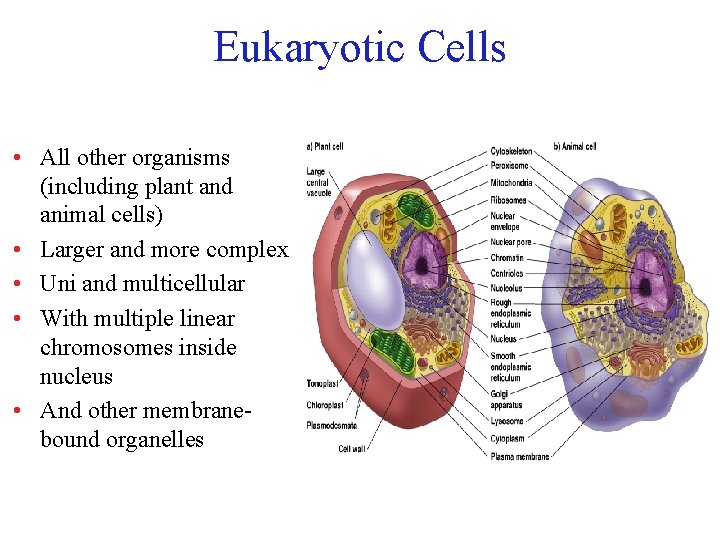
Eukaryotic Cells • All other organisms (including plant and animal cells) • Larger and more complex • Uni and multicellular • With multiple linear chromosomes inside nucleus • And other membranebound organelles

Common Model Organisms • PROKARYOTIC: – Escherichia coli • EUKARYOTIC: – Saccharomyces cerevisiae (unicellular baking yeast) – Drosophila melanogaster (fruit fly) – Caenorhabditis elegans (nematode worm) – Arabidopsis thaliana (mustard weed) – Mus musculus (mouse)

Resources for Genetic Research: Genetic Maps • Locus/loci • Map units/Centi. Morgans

Resources for Genetic Research: Genetic Databases • http: //www. embl. org • http: //www. ncbi. nlm. nih. gov • http: //genetests. org • http: //icomm. ca/geneinfo • http: //www. rarediseases. org
- Slides: 16