
Bioinformatics Biomolecular databases Jacques van Helden Jacques vanHeldenunivamu
Bioinformatics Biomolecular databases Jacques van Helden Jacques. van-Helden@univ-amu. fr Université d’Aix-Marseille, France Lab. Technological Advances for Genomics and Clinics (TAGC, INSERM Unit U 1090) http: //jacques. van-helden. perso. luminy. univ-amu. fr/
Contents n Examples of biological databases q q q n Nucleic sequences: Genbank, EMBL, and DDBJ Protein sequences: Uni. Prot The Gene Ontology (GO) project Issues and perspectives for biological databases
Biomolecular Databases Examples of biomolecular databases
Examples of biomolecular databases n Sequence and structure databases q q q n Genome sequences and annotations q q n Genome-specific databases (SGD, Fly. Base, Ace. DB, Plasmo. DB, …) Multiple genomes (Integr 8, NCBI, KEGG, TIGR, …) Molecular functions q q q n Protein sequences (Uni. Prot) DNA sequences (EMBL, Genbank, DDBJ) 3 D structures (PDB) Structural motifs (CATH) Sequence motifs (PROSITE, PRODOM) Transcriptional regulation (TRANSFAC, Regulon. DB, Interact. DB) Enzymatic catalysis (Expasy, LIGAND/KEGG, BRENDA) Transport (YTPdb) Biological processes q q Metabolic pathways (Eco. Cyc, LIGAND/KEGG, Biocatalysis/biodegradation) Signal transduction pathways (CSNdb, Transpath) Protein-protein interactions (DIP, BIND, MINT) Gene networks (Gene. Net, Fly. Nets)
Databases of databases n n There are hundreds of databases related to molecular biology and biochemistry. New databases are created every year. Every year, the first issue of Nucleic Acids Research is dedicated to biological databases q q n The same journal maintains a database of databases: the Molecular Biology Database Collection q n http: //nar. oupjournals. org/ 2011 Issue: http: //nar. oxfordjournals. org/content/39/suppl_1 http: //www. oxfordjournals. org/nar/database/c/ Some bioinformatics centres maintain multiple database, with cross-links between them. The SRS server at EBI holds an impressive collection of databases. q http: //srs. ebi. ac. uk/
Biomolecular Databases Nucleic sequence databases: Gen. Bank, EMBL, and DDBJ
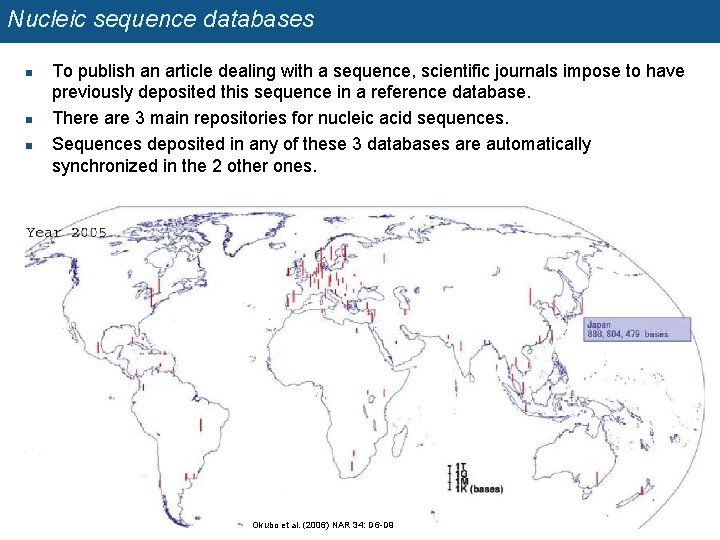
Nucleic sequence databases n n n To publish an article dealing with a sequence, scientific journals impose to have previously deposited this sequence in a reference database. There are 3 main repositories for nucleic acid sequences. Sequences deposited in any of these 3 databases are automatically synchronized in the 2 other ones. Okubo et al. (2006) NAR 34: D 6 -D 9
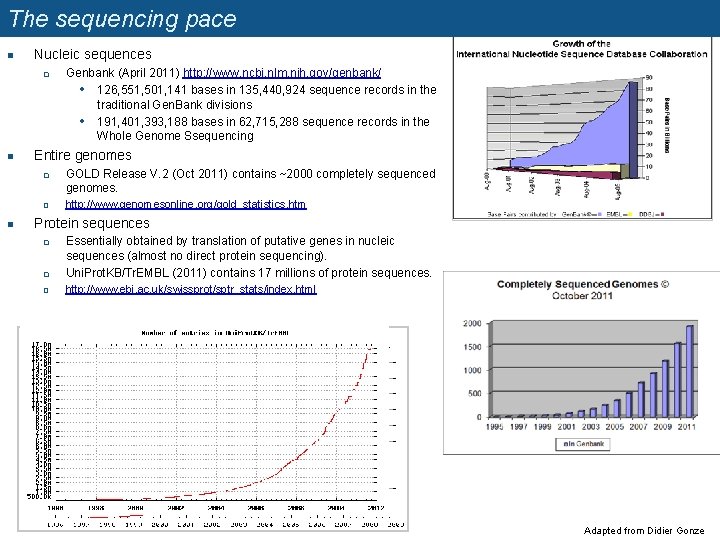
The sequencing pace n Nucleic sequences q n Entire genomes q q n Genbank (April 2011) http: //www. ncbi. nlm. nih. gov/genbank/ • 126, 551, 501, 141 bases in 135, 440, 924 sequence records in the traditional Gen. Bank divisions • 191, 401, 393, 188 bases in 62, 715, 288 sequence records in the Whole Genome Ssequencing GOLD Release V. 2 (Oct 2011) contains ~2000 completely sequenced genomes. http: //www. genomesonline. org/gold_statistics. htm Protein sequences q Essentially obtained by translation of putative genes in nucleic sequences (almost no direct protein sequencing). Uni. Prot. KB/Tr. EMBL (2011) contains 17 millions of protein sequences. q http: //www. ebi. ac. uk/swissprot/sptr_stats/index. html q Adapted from Didier Gonze
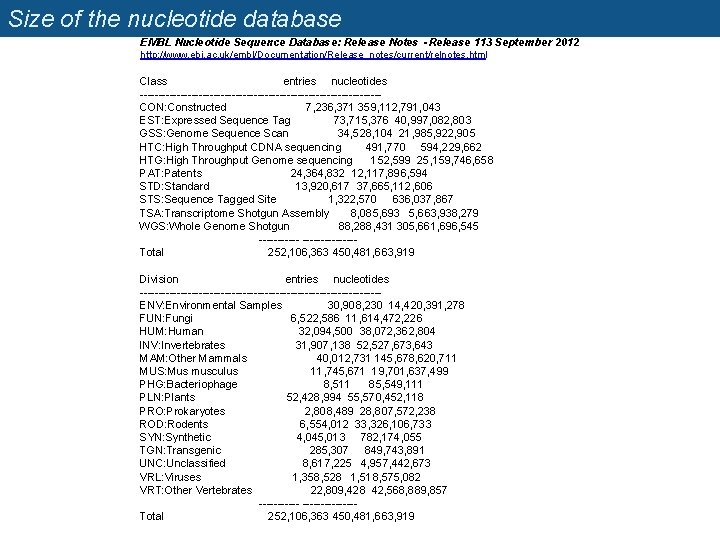
Size of the nucleotide database EMBL Nucleotide Sequence Database: Release Notes - Release 113 September 2012 http: //www. ebi. ac. uk/embl/Documentation/Release_notes/current/relnotes. html Class entries nucleotides ---------------------------------CON: Constructed 7, 236, 371 359, 112, 791, 043 EST: Expressed Sequence Tag 73, 715, 376 40, 997, 082, 803 GSS: Genome Sequence Scan 34, 528, 104 21, 985, 922, 905 HTC: High Throughput CDNA sequencing 491, 770 594, 229, 662 HTG: High Throughput Genome sequencing 152, 599 25, 159, 746, 658 PAT: Patents 24, 364, 832 12, 117, 896, 594 STD: Standard 13, 920, 617 37, 665, 112, 606 STS: Sequence Tagged Site 1, 322, 570 636, 037, 867 TSA: Transcriptome Shotgun Assembly 8, 085, 693 5, 663, 938, 279 WGS: Whole Genome Shotgun 88, 288, 431 305, 661, 696, 545 --------------Total 252, 106, 363 450, 481, 663, 919 Division entries nucleotides ---------------------------------ENV: Environmental Samples 30, 908, 230 14, 420, 391, 278 FUN: Fungi 6, 522, 586 11, 614, 472, 226 HUM: Human 32, 094, 500 38, 072, 362, 804 INV: Invertebrates 31, 907, 138 52, 527, 673, 643 MAM: Other Mammals 40, 012, 731 145, 678, 620, 711 MUS: Mus musculus 11, 745, 671 19, 701, 637, 499 PHG: Bacteriophage 8, 511 85, 549, 111 PLN: Plants 52, 428, 994 55, 570, 452, 118 PRO: Prokaryotes 2, 808, 489 28, 807, 572, 238 ROD: Rodents 6, 554, 012 33, 326, 106, 733 SYN: Synthetic 4, 045, 013 782, 174, 055 TGN: Transgenic 285, 307 849, 743, 891 UNC: Unclassified 8, 617, 225 4, 957, 442, 673 VRL: Viruses 1, 358, 528 1, 518, 575, 082 VRT: Other Vertebrates 22, 809, 428 42, 568, 889, 857 --------------Total 252, 106, 363 450, 481, 663, 919
Genbank (NCBI - USA) http: //www. ncbi. nlm. nih. gov/Genbank/
The EMBL Nucleotide Sequence Database (EBI - UK) http: //www. ebi. ac. uk/embl/
DDBJ - DNA Data Bank of Japan http: //www. ddbj. nig. ac. jp/
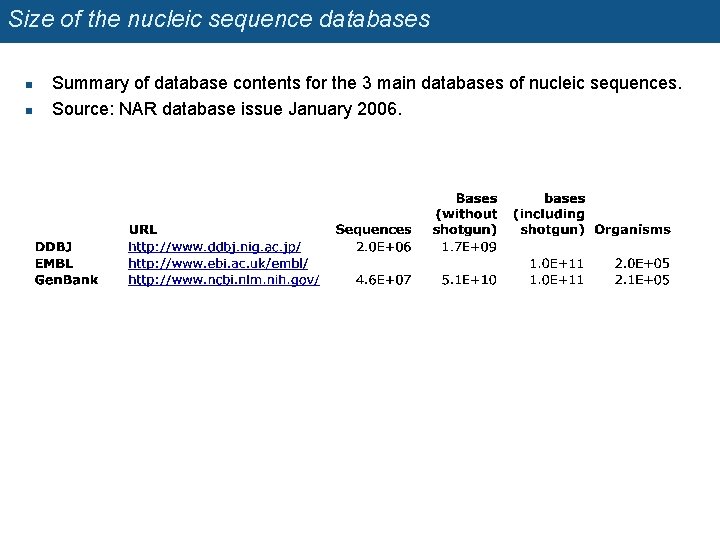
Size of the nucleic sequence databases n n Summary of database contents for the 3 main databases of nucleic sequences. Source: NAR database issue January 2006.
Biomolecular Databases Uni. Prot : protein sequences and functional annotations
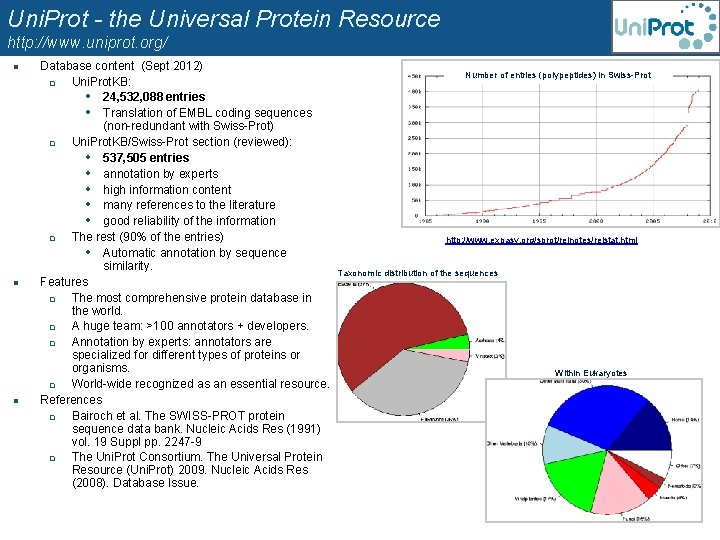
Uni. Prot - the Universal Protein Resource http: //www. uniprot. org/ n n n Database content (Sept 2012) q Uni. Prot. KB: • 24, 532, 088 entries • Translation of EMBL coding sequences (non-redundant with Swiss-Prot) q Uni. Prot. KB/Swiss-Prot section (reviewed): • 537, 505 entries • annotation by experts • high information content • many references to the literature • good reliability of the information q The rest (90% of the entries) • Automatic annotation by sequence similarity. Features q The most comprehensive protein database in the world. q A huge team: >100 annotators + developers. q Annotation by experts: annotators are specialized for different types of proteins or organisms. q World-wide recognized as an essential resource. References q Bairoch et al. The SWISS-PROT protein sequence data bank. Nucleic Acids Res (1991) vol. 19 Suppl pp. 2247 -9 q The Uni. Prot Consortium. The Universal Protein Resource (Uni. Prot) 2009. Nucleic Acids Res (2008). Database Issue. Number of entries (polypeptides) in Swiss-Prot http: //www. expasy. org/sprot/relnotes/relstat. html Taxonomic distribution of the sequences Within Eukaryotes
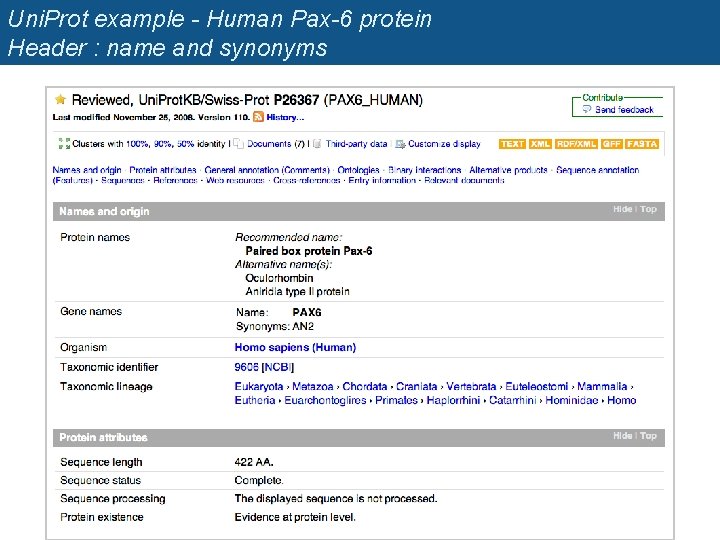
Uni. Prot example - Human Pax-6 protein Header : name and synonyms
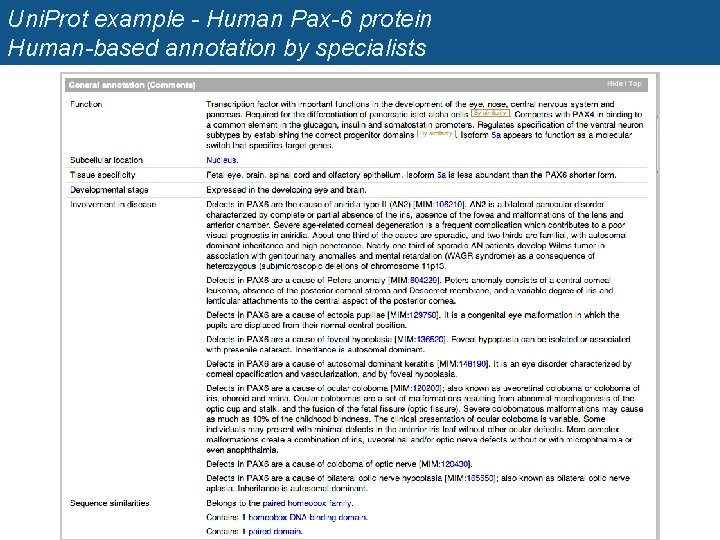
Uni. Prot example - Human Pax-6 protein Human-based annotation by specialists
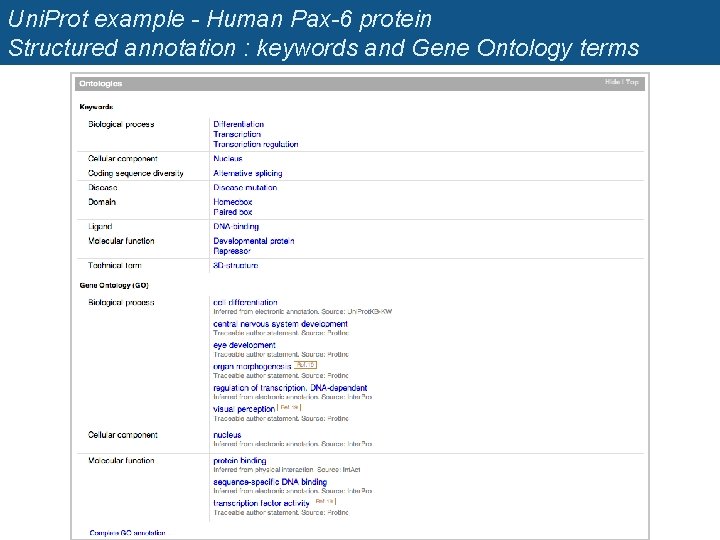
Uni. Prot example - Human Pax-6 protein Structured annotation : keywords and Gene Ontology terms
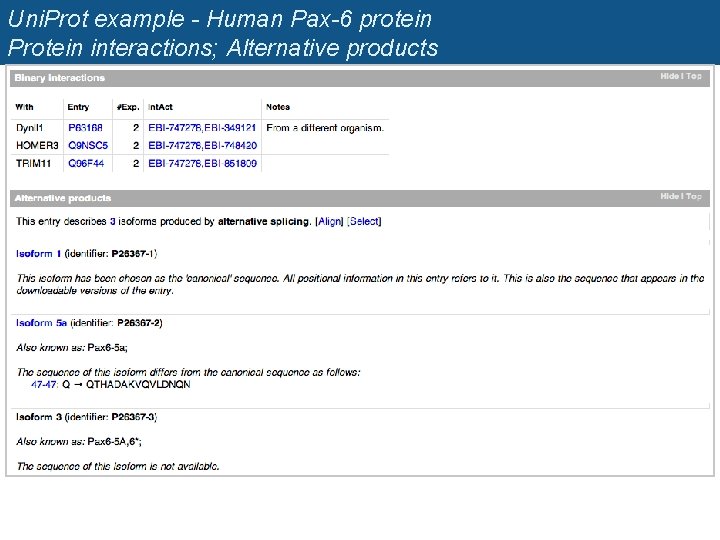
Uni. Prot example - Human Pax-6 protein Protein interactions; Alternative products
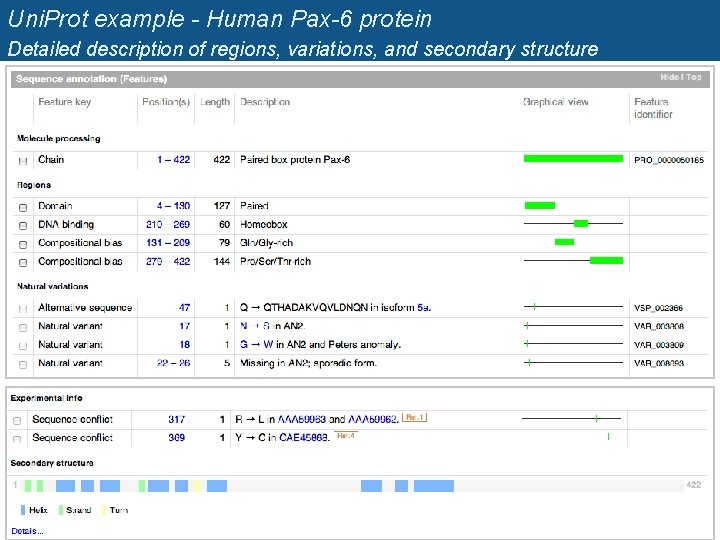
Uni. Prot example - Human Pax-6 protein Detailed description of regions, variations, and secondary structure
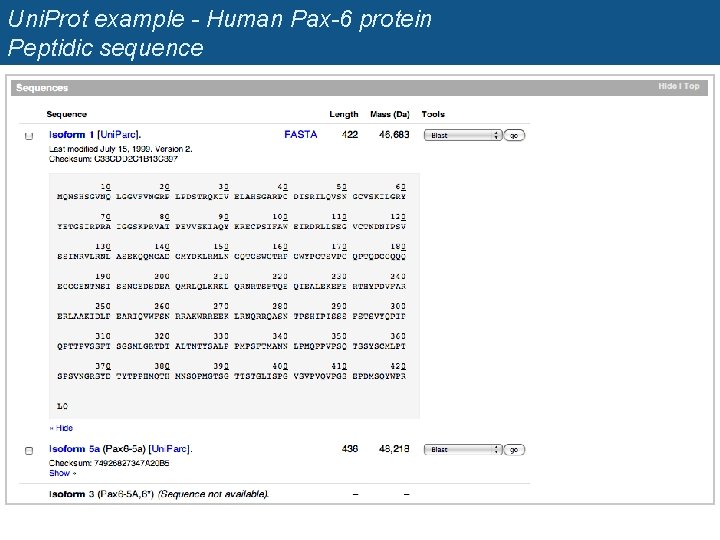
Uni. Prot example - Human Pax-6 protein Peptidic sequence
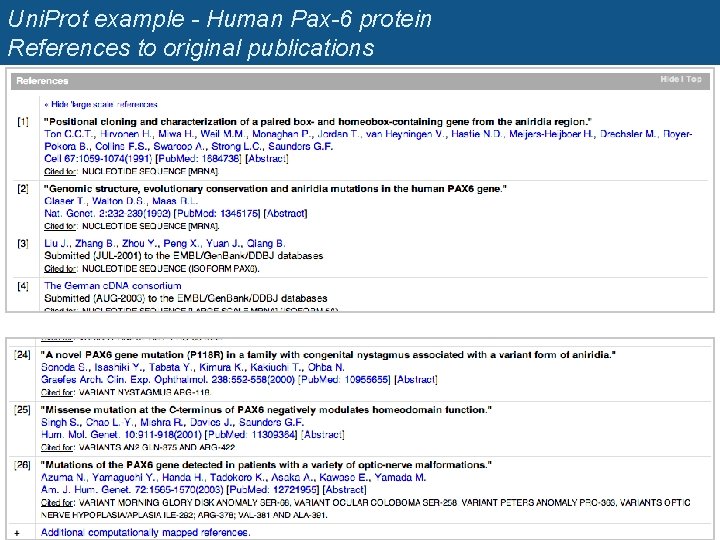
Uni. Prot example - Human Pax-6 protein References to original publications
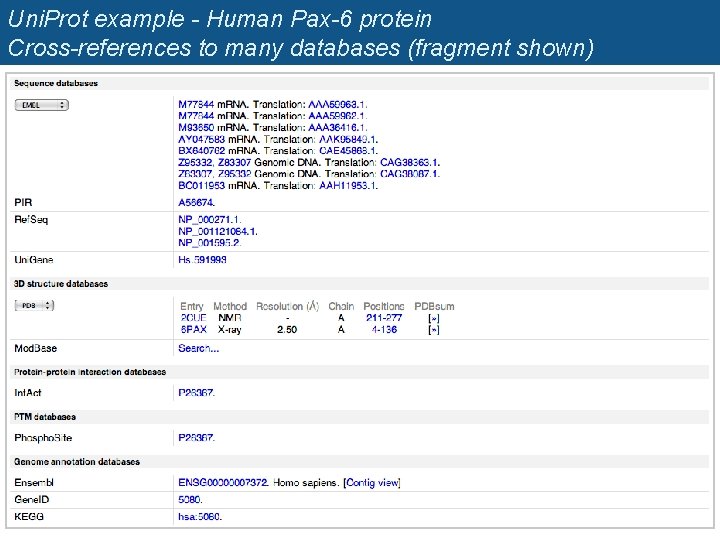
Uni. Prot example - Human Pax-6 protein Cross-references to many databases (fragment shown)
3 D Structure of macromolecules
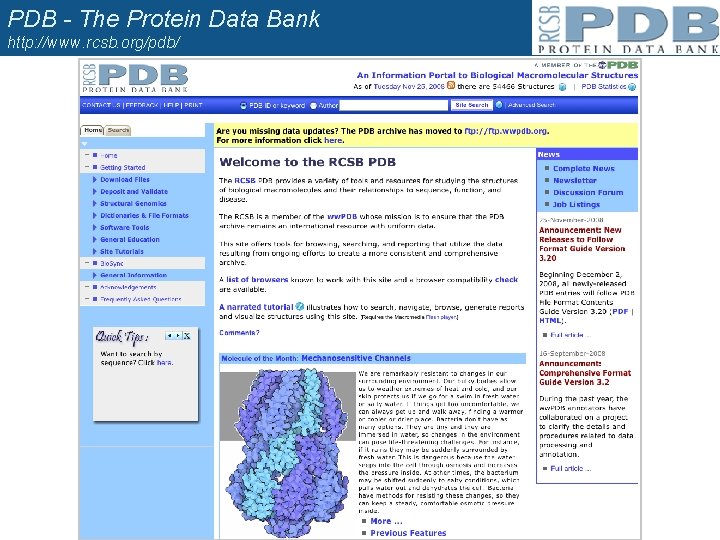
PDB - The Protein Data Bank http: //www. rcsb. org/pdb/
Genome browsers
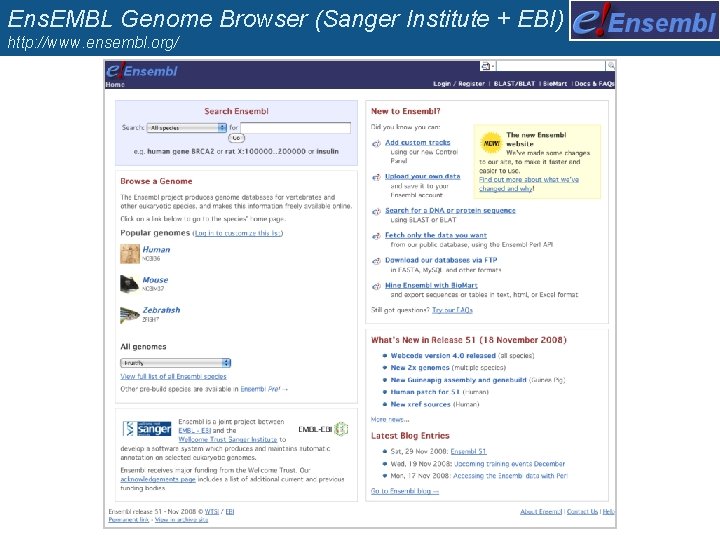
Ens. EMBL Genome Browser (Sanger Institute + EBI) http: //www. ensembl. org/
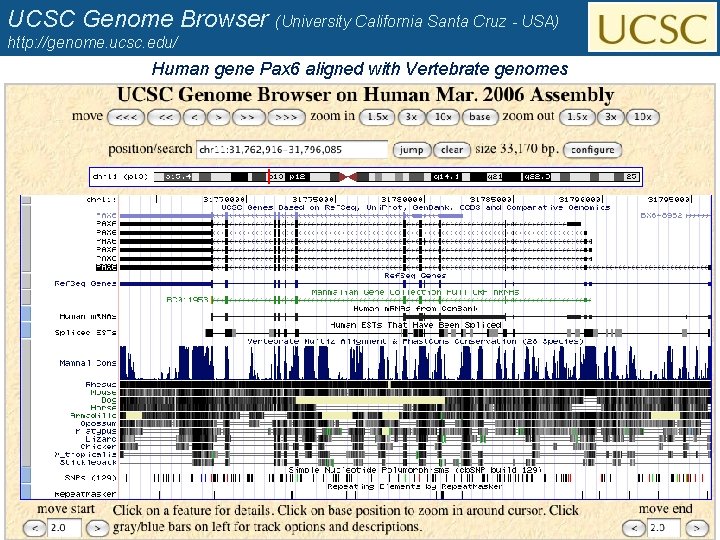
UCSC Genome Browser (University California Santa Cruz - USA) http: //genome. ucsc. edu/ Human gene Pax 6 aligned with Vertebrate genomes
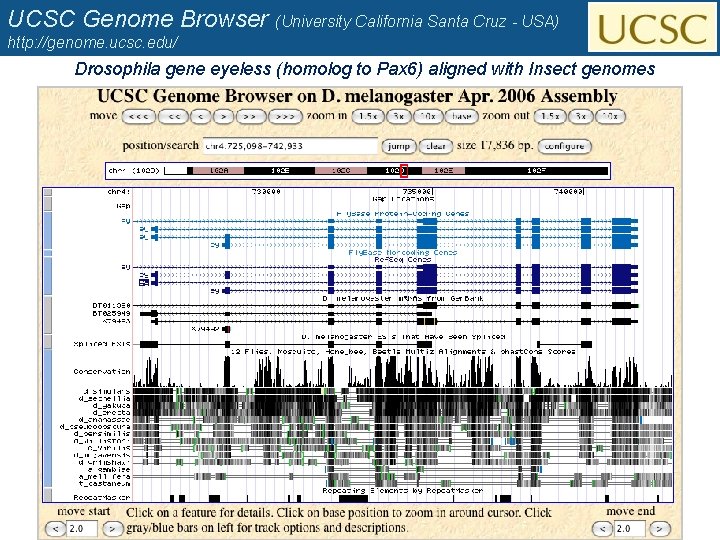
UCSC Genome Browser (University California Santa Cruz - USA) http: //genome. ucsc. edu/ Drosophila gene eyeless (homolog to Pax 6) aligned with Insect genomes
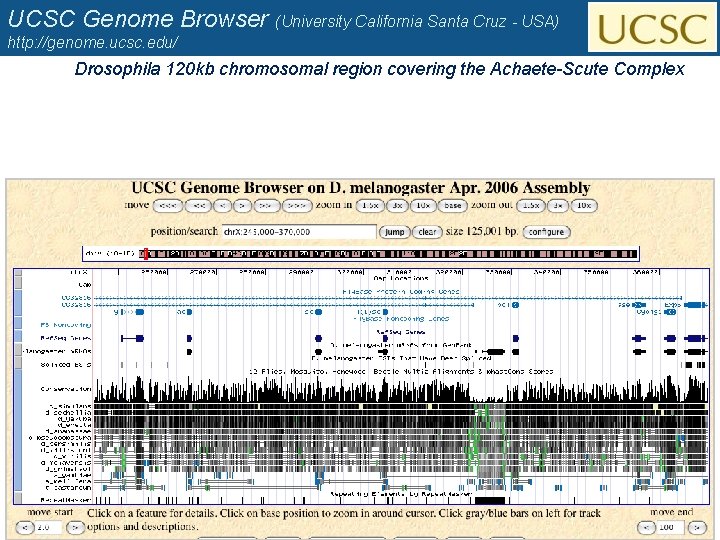
UCSC Genome Browser (University California Santa Cruz - USA) http: //genome. ucsc. edu/ Drosophila 120 kb chromosomal region covering the Achaete-Scute Complex
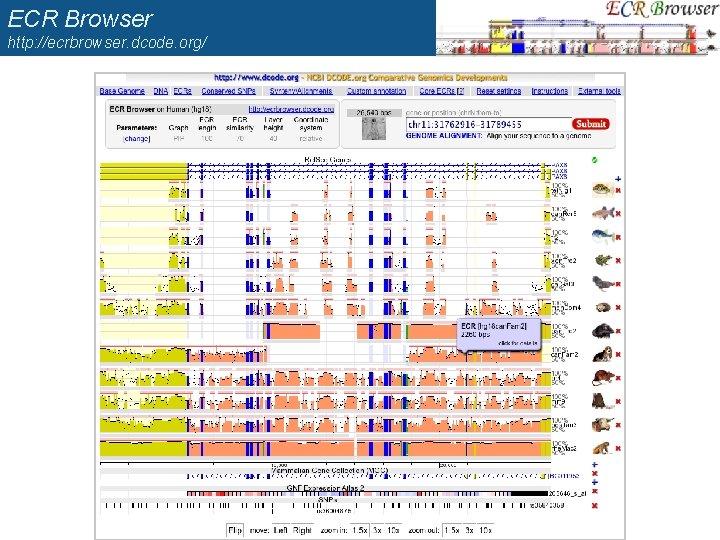
ECR Browser http: //ecrbrowser. dcode. org/
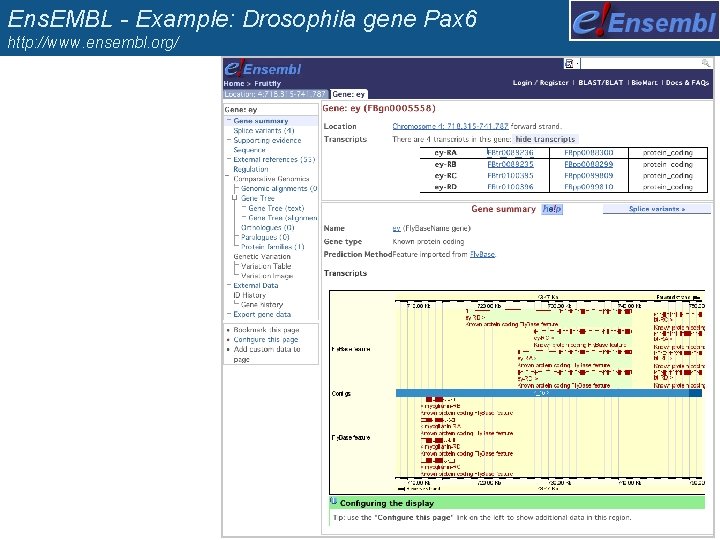
Ens. EMBL - Example: Drosophila gene Pax 6 http: //www. ensembl. org/
Comparative genomics
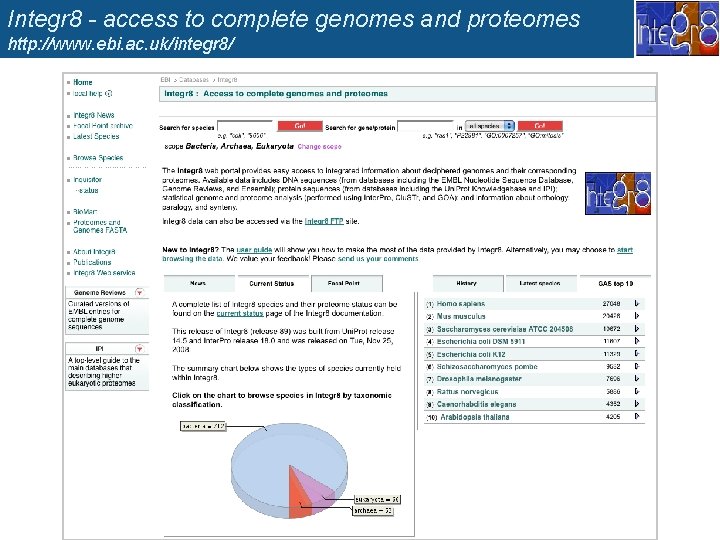
Integr 8 - access to complete genomes and proteomes http: //www. ebi. ac. uk/integr 8/
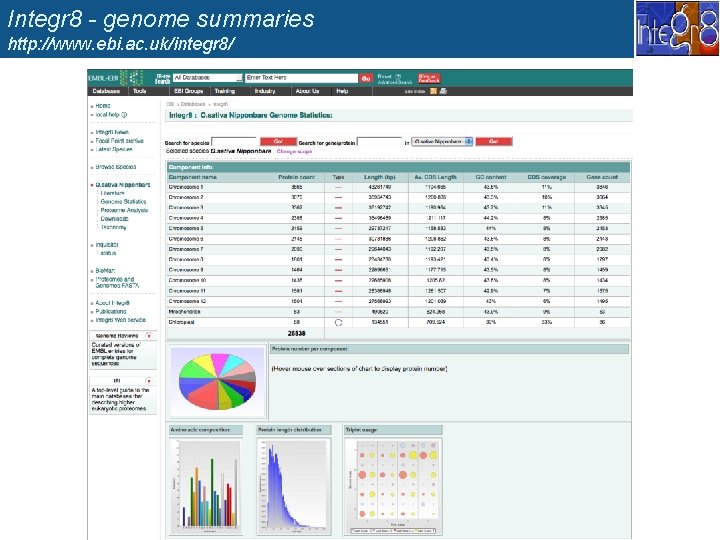
Integr 8 - genome summaries http: //www. ebi. ac. uk/integr 8/
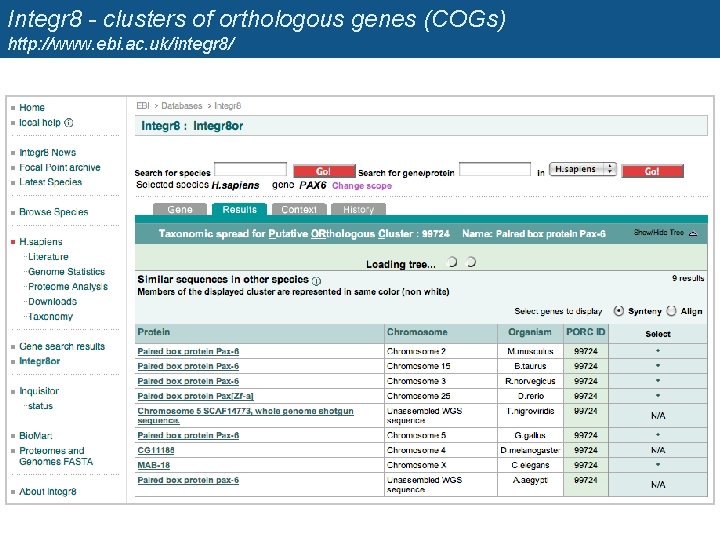
Integr 8 - clusters of orthologous genes (COGs) http: //www. ebi. ac. uk/integr 8/
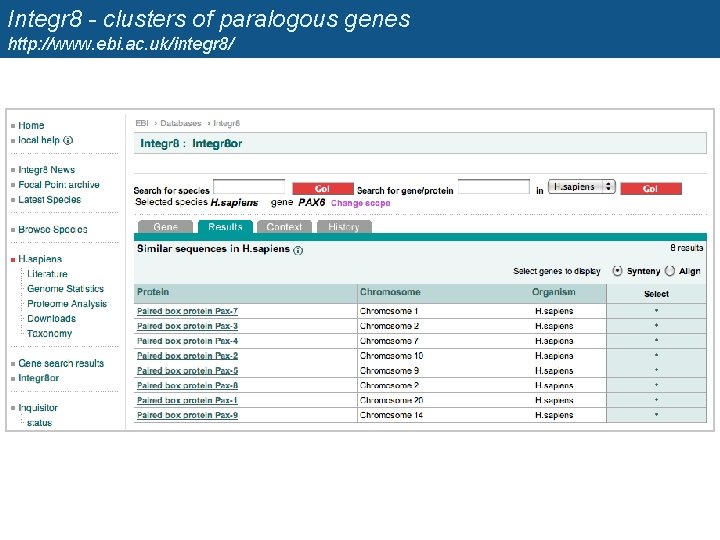
Integr 8 - clusters of paralogous genes http: //www. ebi. ac. uk/integr 8/
Databases of protein domains
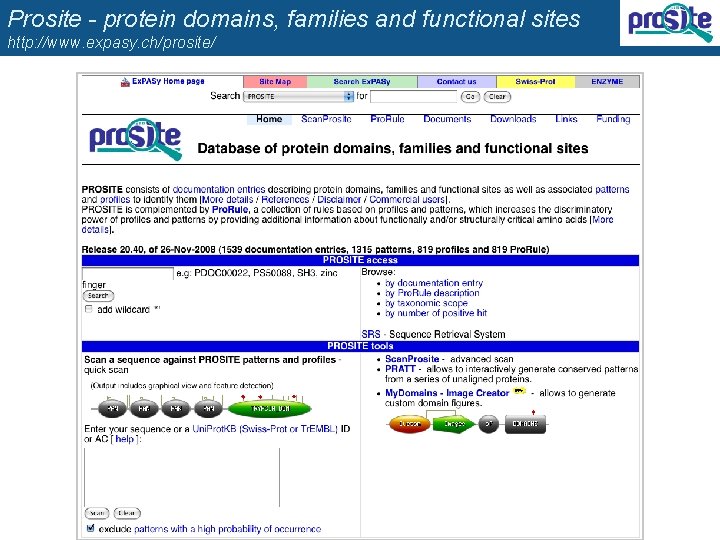
Prosite - protein domains, families and functional sites http: //www. expasy. ch/prosite/

Prosite - aligned sequences and logo http: //www. expasy. ch/prosite/ n n n Some of the sequences that were used to built the Prosite profile for the Zn(2)-C 6 fungal-type DNAbinding domain (ZN 2_CY 6_FUNGAL_2, PS 50048). The Sequence Logo (below) indicates the level of conservation of each residue in each column of the alignment. Note the 6 cysteines, characteristic of this domain.

Prosite - Example of profile matrix http: //www. expasy. ch/prosite/
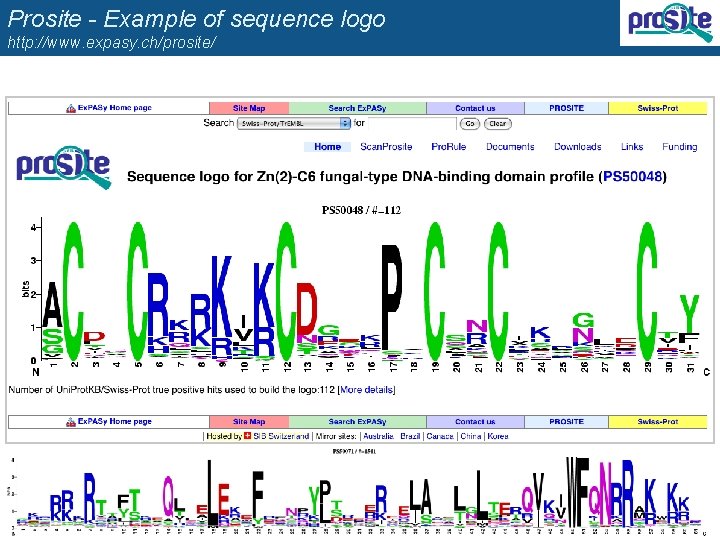
Prosite - Example of sequence logo http: //www. expasy. ch/prosite/

Prosite - Example of domain signature http: //www. expasy. ch/prosite/ n The domain signature is a string-based pattern representing the residues that are characteristic of a domain.
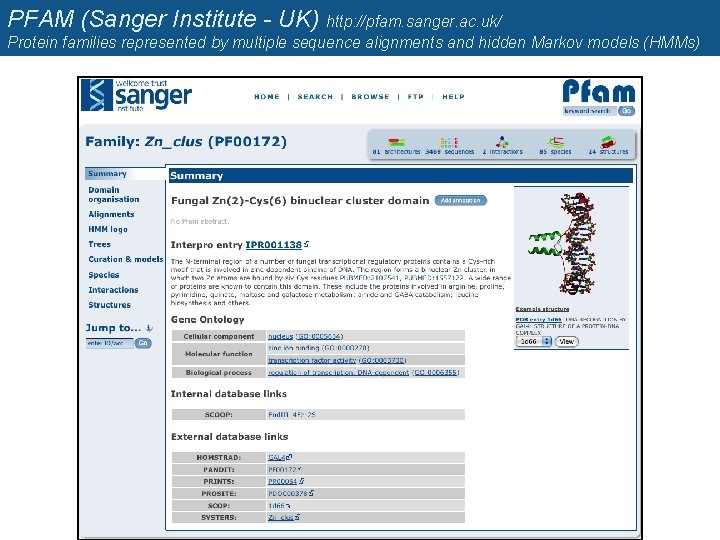
PFAM (Sanger Institute - UK) http: //pfam. sanger. ac. uk/ Protein families represented by multiple sequence alignments and hidden Markov models (HMMs)
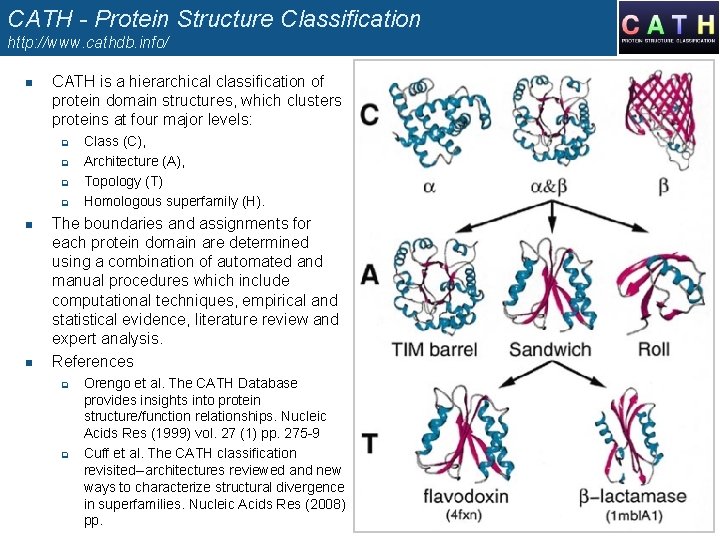
CATH - Protein Structure Classification http: //www. cathdb. info/ n CATH is a hierarchical classification of protein domain structures, which clusters proteins at four major levels: q q n n Class (C), Architecture (A), Topology (T) Homologous superfamily (H). The boundaries and assignments for each protein domain are determined using a combination of automated and manual procedures which include computational techniques, empirical and statistical evidence, literature review and expert analysis. References q q Orengo et al. The CATH Database provides insights into protein structure/function relationships. Nucleic Acids Res (1999) vol. 27 (1) pp. 275 -9 Cuff et al. The CATH classification revisited--architectures reviewed and new ways to characterize structural divergence in superfamilies. Nucleic Acids Res (2008) pp.
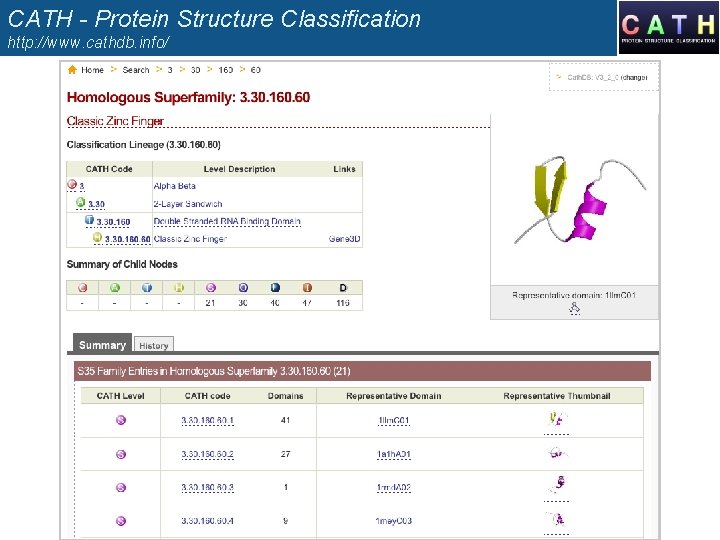
CATH - Protein Structure Classification http: //www. cathdb. info/
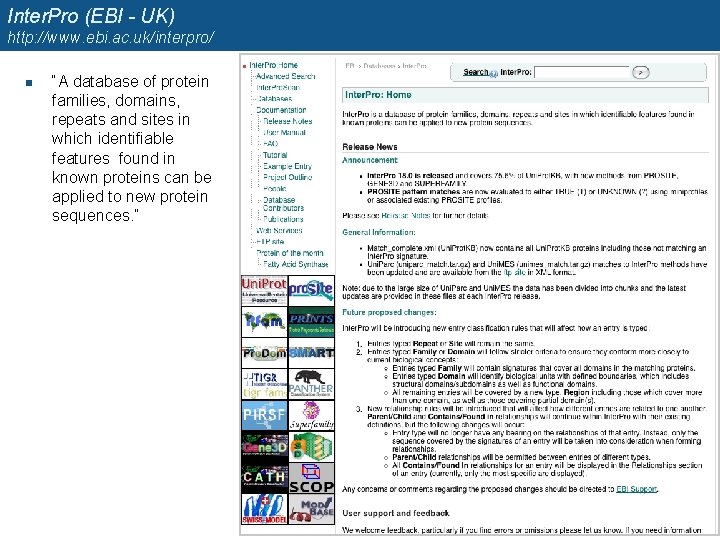
Inter. Pro (EBI - UK) http: //www. ebi. ac. uk/interpro/ n “A database of protein families, domains, repeats and sites in which identifiable features found in known proteins can be applied to new protein sequences. ”
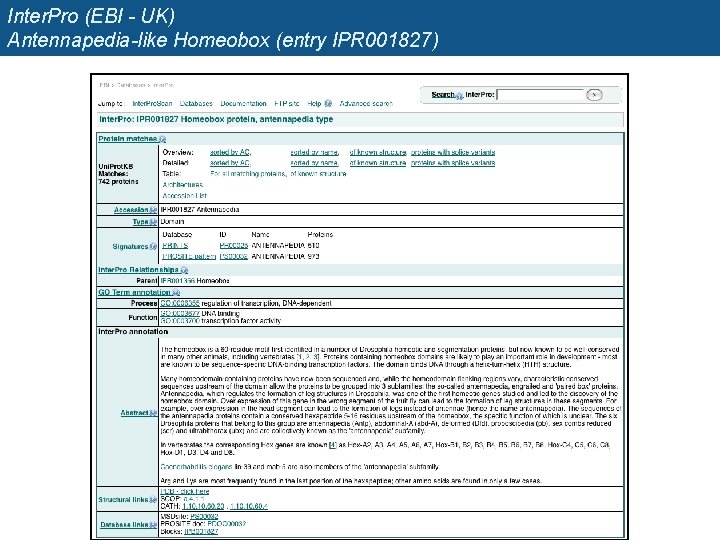
Inter. Pro (EBI - UK) Antennapedia-like Homeobox (entry IPR 001827)
Biomolecular Databases The Gene Ontology (GO) database
Ontology definition n n Ontologie: partie de la métaphysique qui s'intéresse à l'être en tant qu'être, indépendamment de ses déterminations particulières Ontology: part of the metaphysics that focusses on the being as a beging, independently of its particular determinations Le Petit Robert - dictionnaire alphabétique et analogique de la langue française. 1993
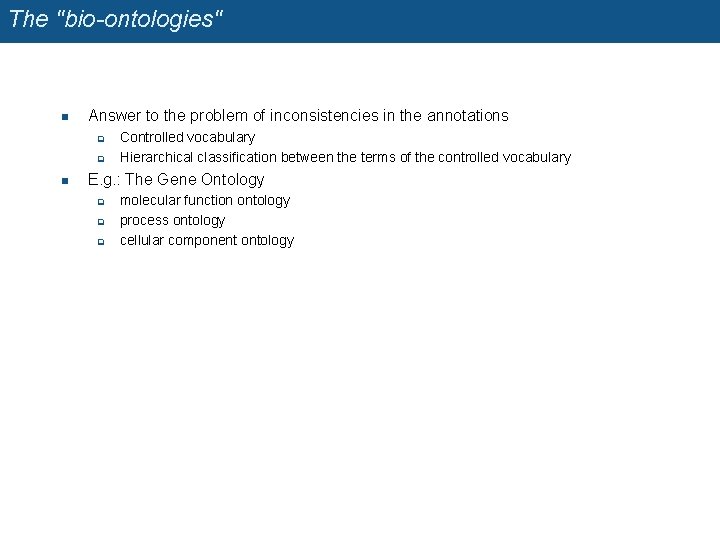
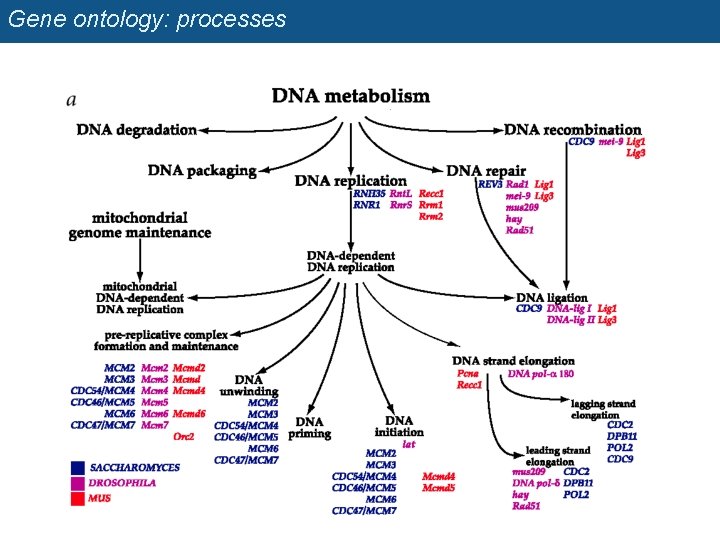
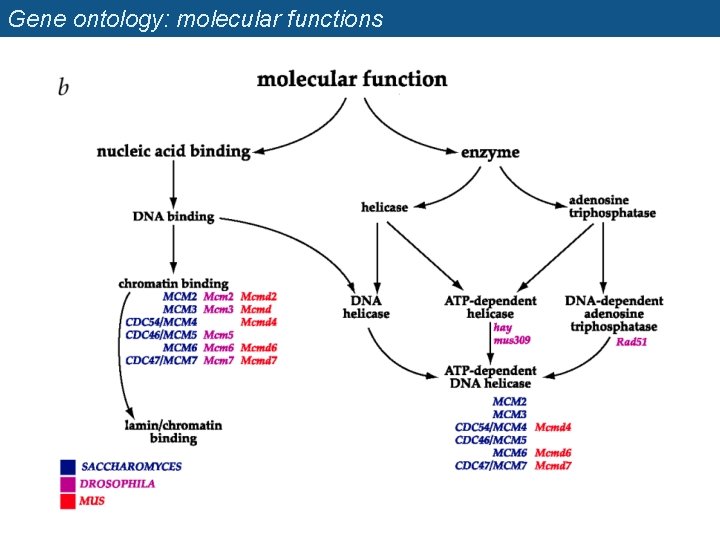
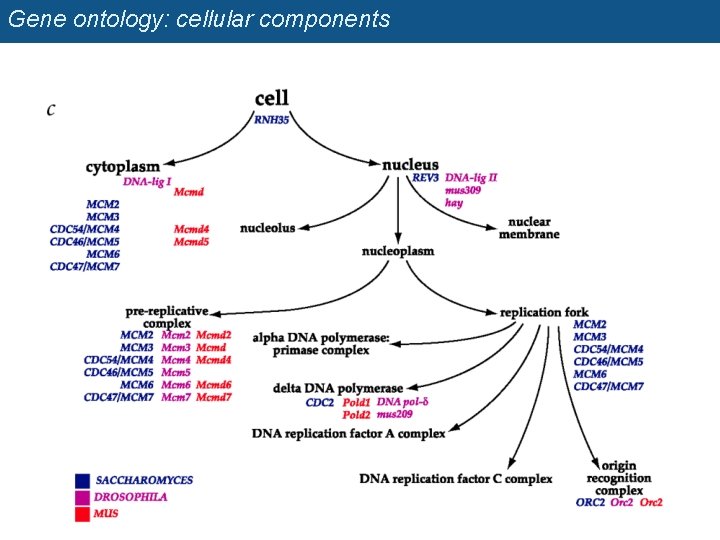
The "bio-ontologies" n Answer to the problem of inconsistencies in the annotations q q n Controlled vocabulary Hierarchical classification between the terms of the controlled vocabulary E. g. : The Gene Ontology q q q molecular function ontology process ontology cellular component ontology
Gene ontology: processes
Gene ontology: molecular functions
Gene ontology: cellular components
Gene Ontology Database http: //www. geneontology. org/
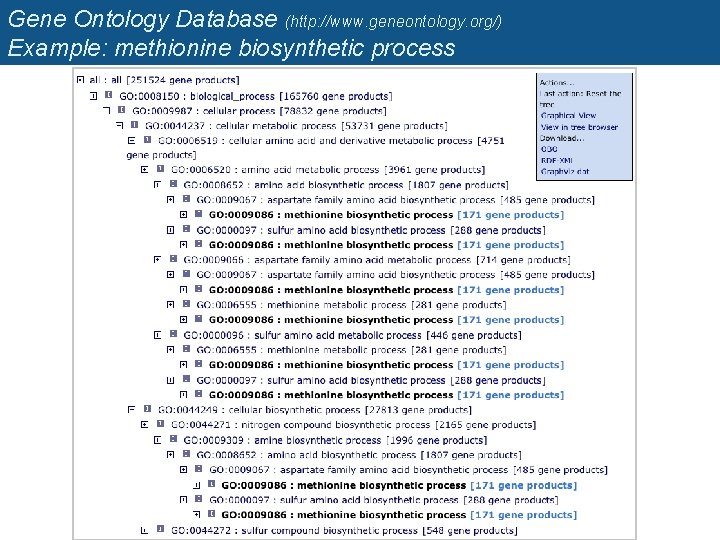
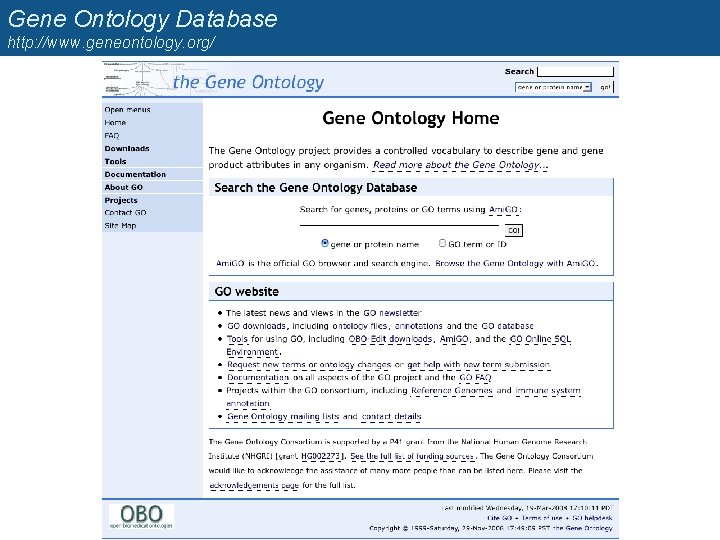
Gene Ontology Database (http: //www. geneontology. org/) Example: methionine biosynthetic process
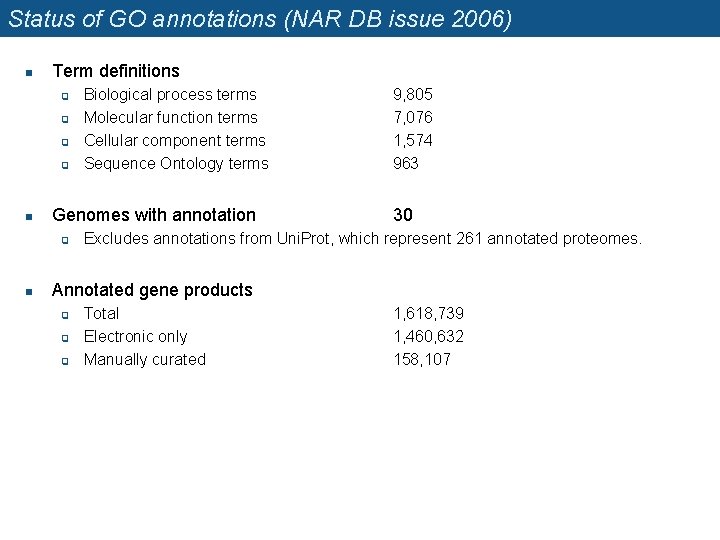
Status of GO annotations (NAR DB issue 2006) n Term definitions q q n Genomes with annotation q n Biological process terms Molecular function terms Cellular component terms Sequence Ontology terms 9, 805 7, 076 1, 574 963 30 Excludes annotations from Uni. Prot, which represent 261 annotated proteomes. Annotated gene products q q q Total Electronic only Manually curated 1, 618, 739 1, 460, 632 158, 107
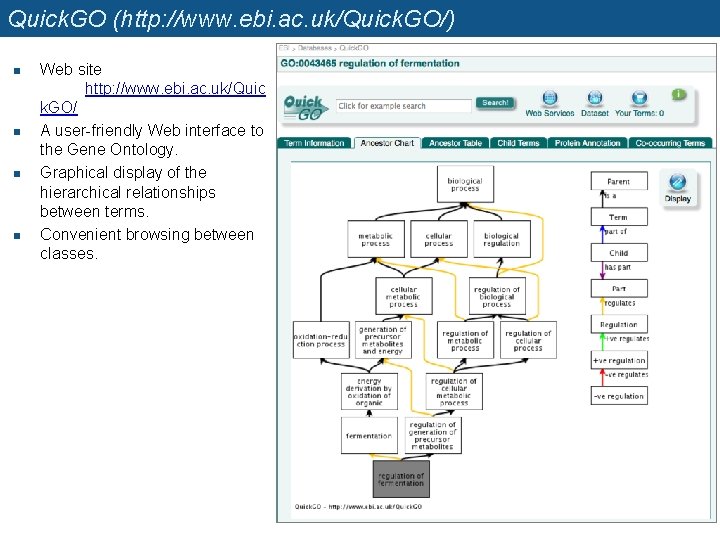
Quick. GO (http: //www. ebi. ac. uk/Quick. GO/) n n Web site http: //www. ebi. ac. uk/Quic k. GO/ A user-friendly Web interface to the Gene Ontology. Graphical display of the hierarchical relationships between terms. Convenient browsing between classes.
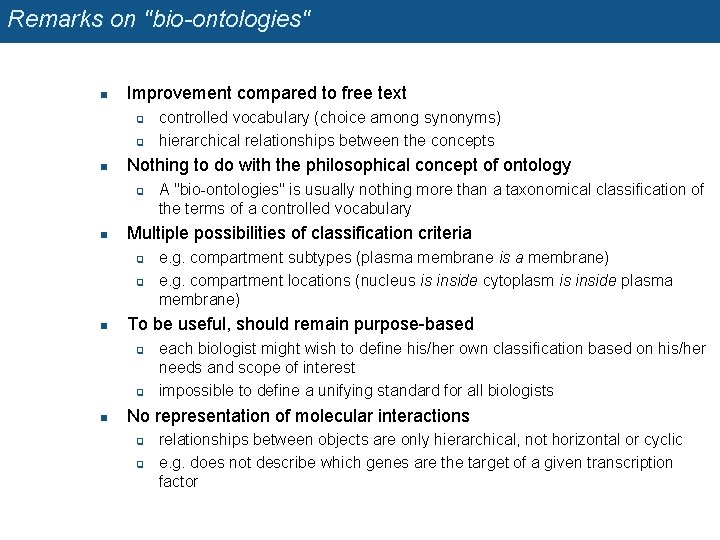
Remarks on "bio-ontologies" n Improvement compared to free text q q n Nothing to do with the philosophical concept of ontology q n q e. g. compartment subtypes (plasma membrane is a membrane) e. g. compartment locations (nucleus is inside cytoplasm is inside plasma membrane) To be useful, should remain purpose-based q q n A "bio-ontologies" is usually nothing more than a taxonomical classification of the terms of a controlled vocabulary Multiple possibilities of classification criteria q n controlled vocabulary (choice among synonyms) hierarchical relationships between the concepts each biologist might wish to define his/her own classification based on his/her needs and scope of interest impossible to define a unifying standard for all biologists No representation of molecular interactions q q relationships between objects are only hierarchical, not horizontal or cyclic e. g. does not describe which genes are the target of a given transcription factor
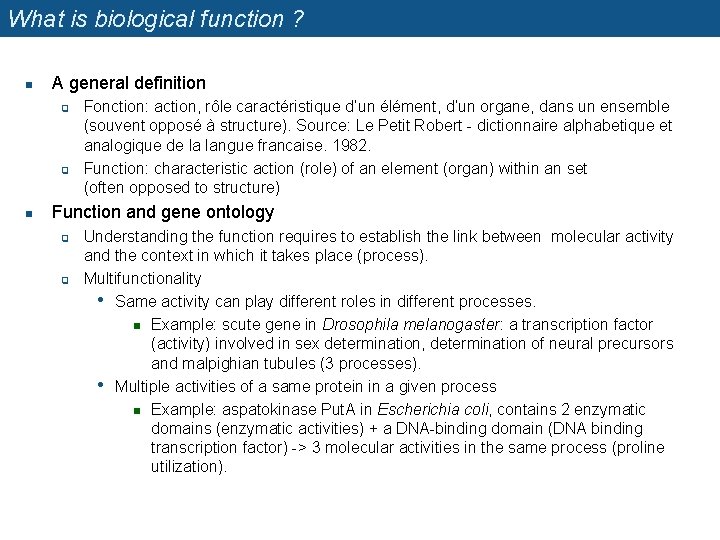
What is biological function ? n A general definition q q n Fonction: action, rôle caractéristique d’un élément, d’un organe, dans un ensemble (souvent opposé à structure). Source: Le Petit Robert - dictionnaire alphabetique et analogique de la langue francaise. 1982. Function: characteristic action (role) of an element (organ) within an set (often opposed to structure) Function and gene ontology q q Understanding the function requires to establish the link between molecular activity and the context in which it takes place (process). Multifunctionality • Same activity can play different roles in different processes. n Example: scute gene in Drosophila melanogaster: a transcription factor (activity) involved in sex determination, determination of neural precursors and malpighian tubules (3 processes). • Multiple activities of a same protein in a given process n Example: aspatokinase Put. A in Escherichia coli, contains 2 enzymatic domains (enzymatic activities) + a DNA-binding domain (DNA binding transcription factor) -> 3 molecular activities in the same process (proline utilization).
Biomolecular Databases Small compounds, reactions and metabolic pathways
LIGAND - Small compounds and metabolic reactions
KEGG - Kyoto Encycplopaedia of Genes and Genomes
Ecocyc, Bio. Cyc and Metacyc - Metabolic pathways
Biomolecular Databases Protein interaction networks and transduction pathways
Biomolecular Databases Microarray databases
Human genome resources
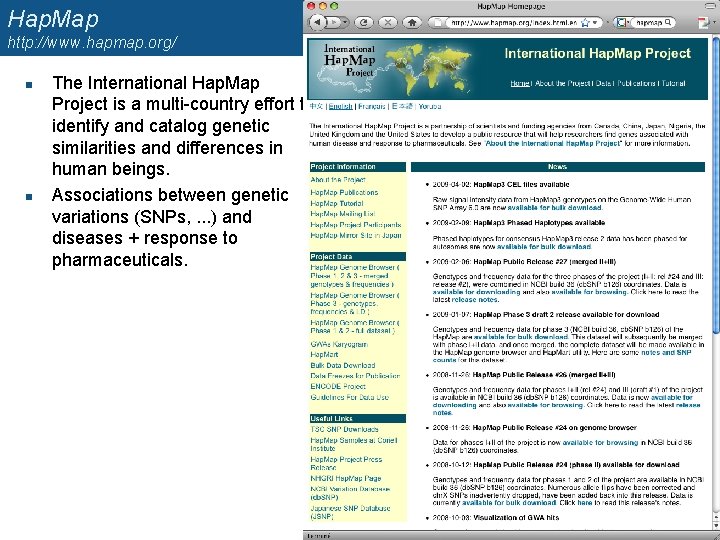
Hap. Map http: //www. hapmap. org/ n n The International Hap. Map Project is a multi-country effort to identify and catalog genetic similarities and differences in human beings. Associations between genetic variations (SNPs, . . . ) and diseases + response to pharmaceuticals.
- Slides: 68