
Bioinformatic Ph D course Bioinformatics Xavier Messeguer Peypoch
Bioinformatic Ph. D. course Bioinformatics Xavier Messeguer Peypoch (http: //www. lsi. upc. es/~alggen) LSI Dep. de Llenguatges i Sistemes Informàtics BSC Barcelona Supercomputing Center Universitat Politècnica de Catalunya
Contents 1. Biological introduction 2. Comparison of short sequences ( up to 10. 000 bps) Dot Matrix Pairwise align. Multiple align. H 3. Comparison of large sequences ( more that 10. 000 b Data structures Suffix trees 4. String matching Exact Extended Approximate 5. Sequence assembly 6. Projects: PROMO, MREPATT, … MU
2. Comparison of short sequences (<10. 000 bps) Summary (more or less) • 2. 1 Dot matrix • 2. 2 Pairwise alignment. • 2. 3 Hash algorithms. • 2. 4 Multiple alignment.
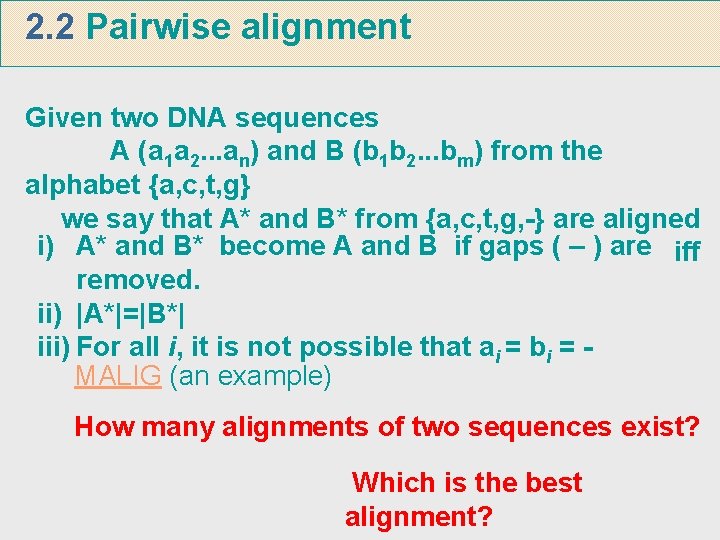
2. 2 Pairwise alignment Given two DNA sequences A (a 1 a 2. . . an) and B (b 1 b 2. . . bm) from the alphabet {a, c, t, g} we say that A* and B* from {a, c, t, g, -} are aligned i) A* and B* become A and B if gaps ( – ) are iff removed. ii) |A*|=|B*| iii) For all i, it is not possible that ai = bi = MALIG (an example) How many alignments of two sequences exist? Which is the best alignment?
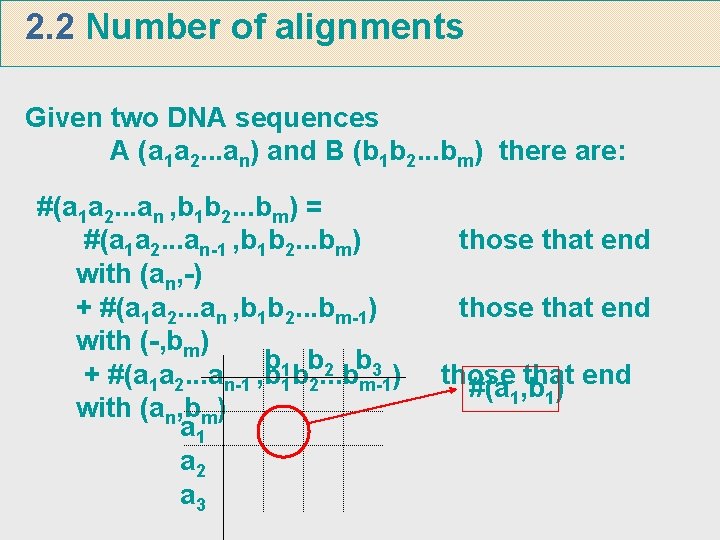
2. 2 Number of alignments Given two DNA sequences A (a 1 a 2. . . an) and B (b 1 b 2. . . bm) there are: #(a 1 a 2. . . an , b 1 b 2. . . bm) = #(a 1 a 2. . . an-1 , b 1 b 2. . . bm) with (an, -) + #(a 1 a 2. . . an , b 1 b 2. . . bm-1) with (-, bm) b b 2 b 3 + #(a 1 a 2. . . an-1 , b 11 b 2. . . b m-1) with (an, bm) a 1 a 2 a 3 those that end #(a 1, b 1)
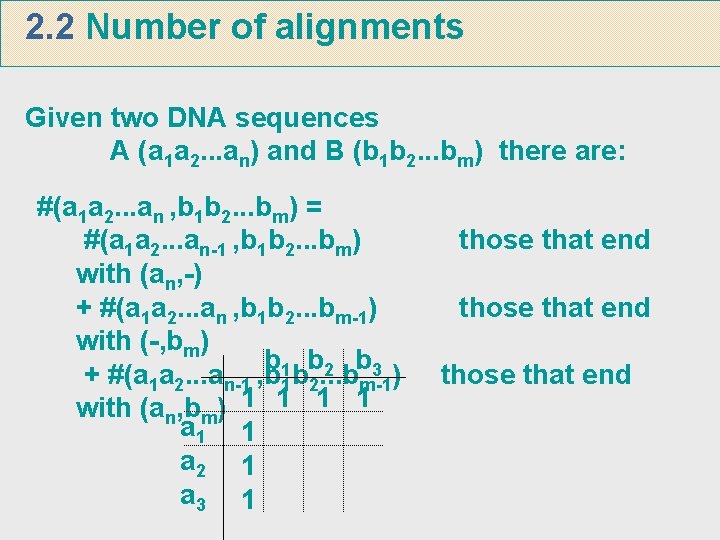
2. 2 Number of alignments Given two DNA sequences A (a 1 a 2. . . an) and B (b 1 b 2. . . bm) there are: #(a 1 a 2. . . an , b 1 b 2. . . bm) = #(a 1 a 2. . . an-1 , b 1 b 2. . . bm) with (an, -) + #(a 1 a 2. . . an , b 1 b 2. . . bm-1) with (-, bm) b b 2 b 3 + #(a 1 a 2. . . an-1 , b 11 b 2. . . b m-1) with (an, bm) 1 1 a 2 1 a 3 1 those that end
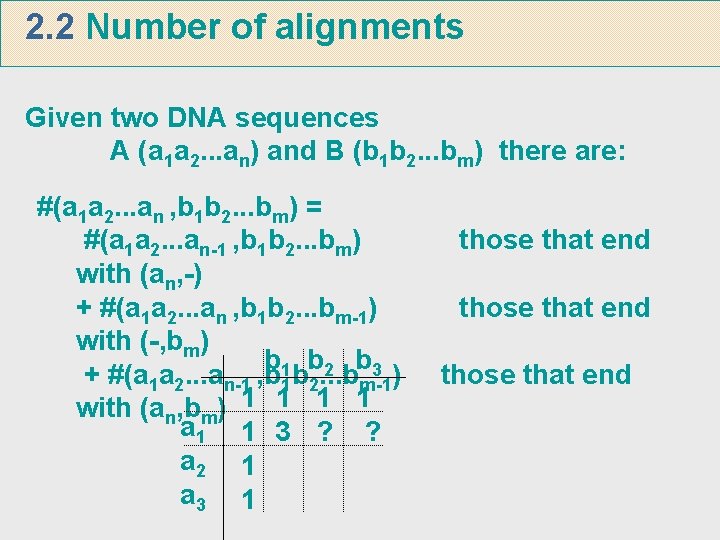
2. 2 Number of alignments Given two DNA sequences A (a 1 a 2. . . an) and B (b 1 b 2. . . bm) there are: #(a 1 a 2. . . an , b 1 b 2. . . bm) = #(a 1 a 2. . . an-1 , b 1 b 2. . . bm) with (an, -) + #(a 1 a 2. . . an , b 1 b 2. . . bm-1) with (-, bm) b b 2 b 3 + #(a 1 a 2. . . an-1 , b 11 b 2. . . b m-1) with (an, bm) 1 1 a 1 1 3 ? ? a 2 1 a 3 1 those that end
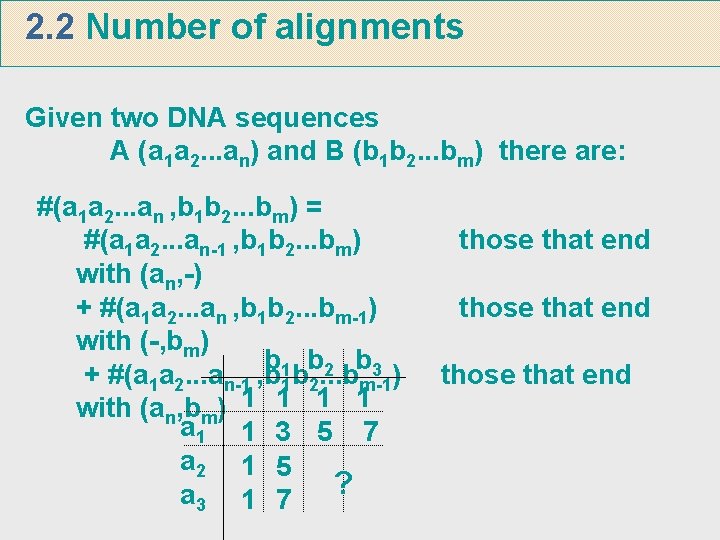
2. 2 Number of alignments Given two DNA sequences A (a 1 a 2. . . an) and B (b 1 b 2. . . bm) there are: #(a 1 a 2. . . an , b 1 b 2. . . bm) = #(a 1 a 2. . . an-1 , b 1 b 2. . . bm) with (an, -) + #(a 1 a 2. . . an , b 1 b 2. . . bm-1) with (-, bm) b b 2 b 3 + #(a 1 a 2. . . an-1 , b 11 b 2. . . b m-1) with (an, bm) 1 1 a 1 1 3 5 7 a 2 1 5 a 3 1 7 ? those that end
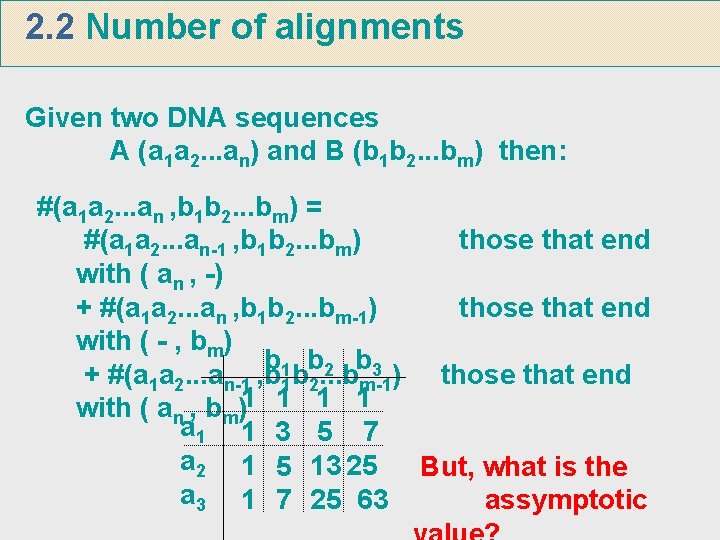
2. 2 Number of alignments Given two DNA sequences A (a 1 a 2. . . an) and B (b 1 b 2. . . bm) then: #(a 1 a 2. . . an , b 1 b 2. . . bm) = #(a 1 a 2. . . an-1 , b 1 b 2. . . bm) those that end with ( an , -) + #(a 1 a 2. . . an , b 1 b 2. . . bm-1) those that end with ( - , bm) b b 2 b 3 + #(a 1 a 2. . . an-1 , b 11 b 2. . . b those that end m-1) with ( an , bm)1 1 a 1 1 3 5 7 a 2 1 5 13 25 But, what is the a 3 1 7 25 63 assymptotic
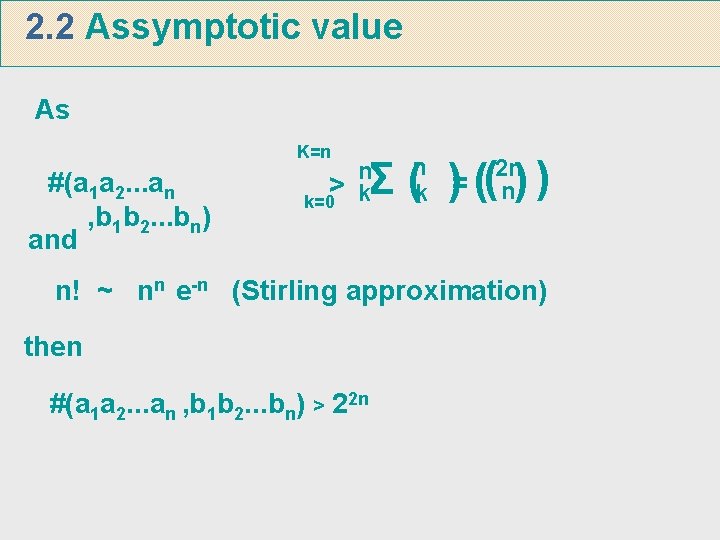
2. 2 Assymptotic value As K=n #(a 1 a 2. . . an , b 1 b 2. . . bn) and Σ ( )= (( ) ) n > k=0 k n k 2 n n n! ~ nn e-n (Stirling approximation) then #(a 1 a 2. . . an , b 1 b 2. . . bn) > 22 n
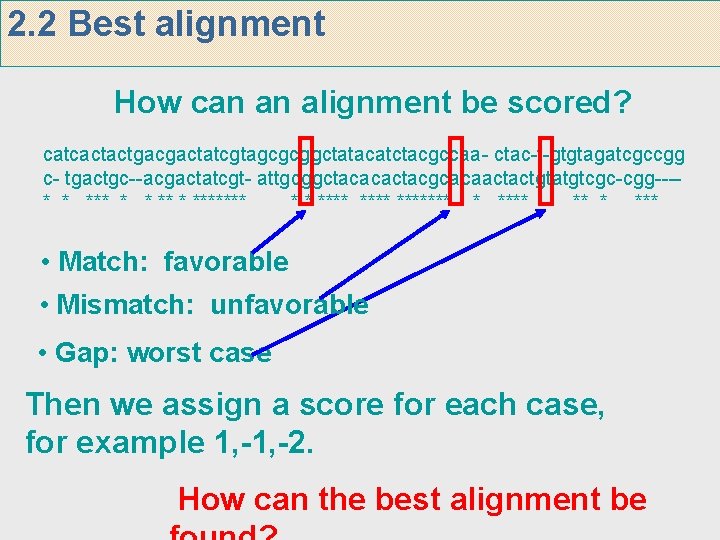
2. 2 Best alignment How can an alignment be scored? catcactactgacgactatcgtagcgcggctatacatctacgccaa- ctac-t-gtgtagatcgccgg c- tgactgc--acgactatcgt- attgcggctacacactacgcacaactactgtatgtcgc-cgg---* * ******* * * ******* * **** *** • Match: favorable • Mismatch: unfavorable • Gap: worst case Then we assign a score for each case, for example 1, -2. How can the best alignment be
2. 2 Edit distance and alignment of strings The best alignment of two strings … …is related with the edit distance, first discussed in 1966. . . The most efficient algorithm was proposed in 1968 and in 1970 using the technique called “Dynamic programming”
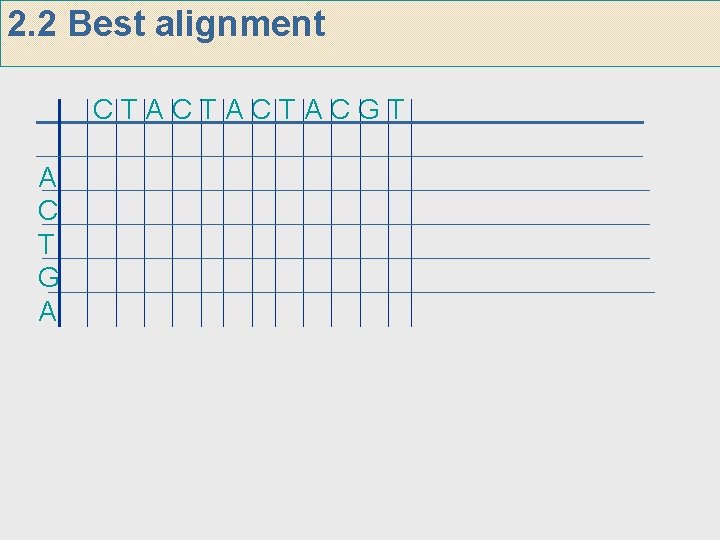
2. 2 Best alignment CTACTACTACGT A C T G A
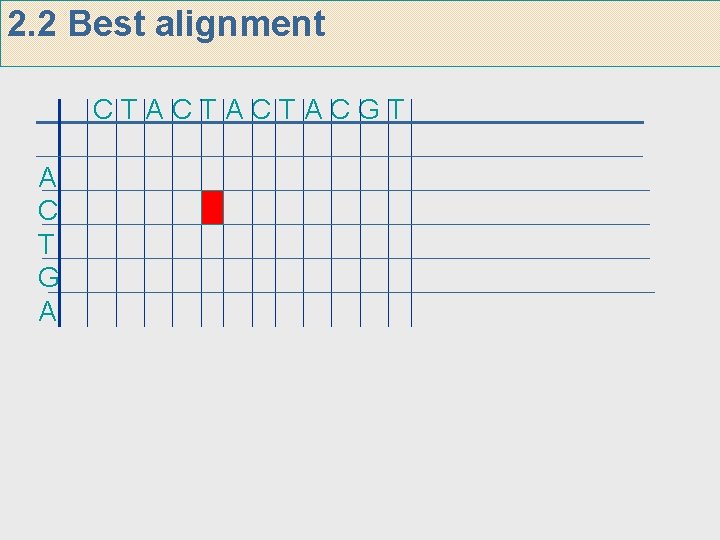
2. 2 Best alignment CTACTACTACGT A C T G A
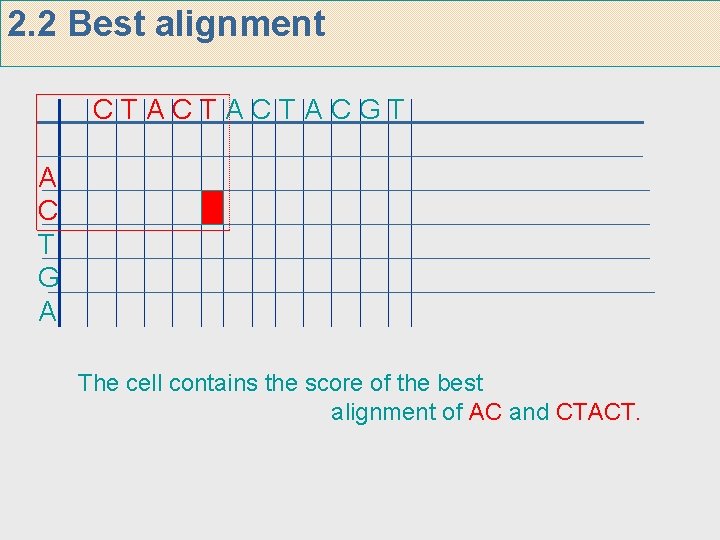
2. 2 Best alignment CTACTACTACGT A C T G A The cell contains the score of the best alignment of AC and CTACT.
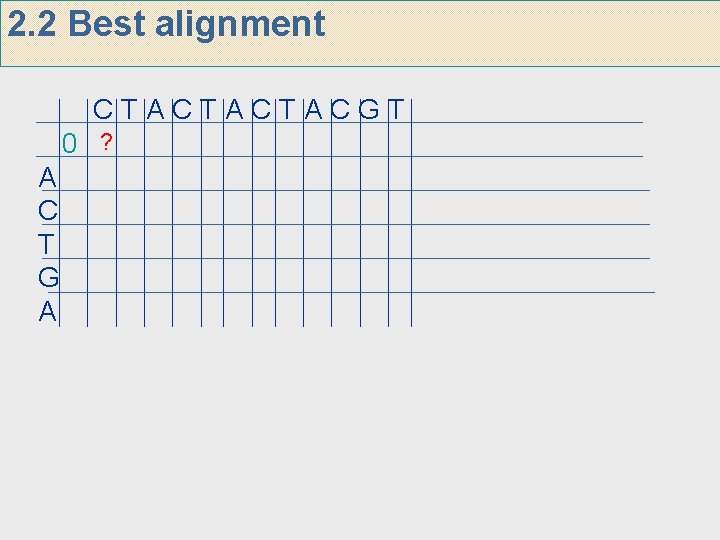
2. 2 Best alignment CTACTACTACGT 0 ? A C T G A
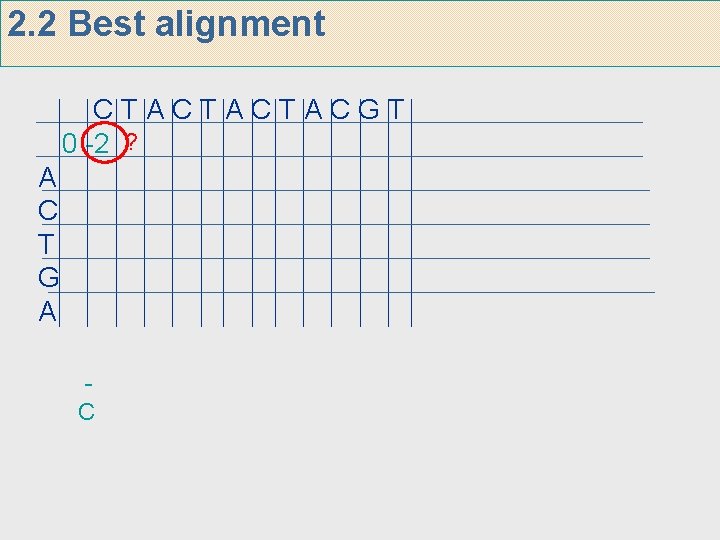
2. 2 Best alignment CTACTACTACGT 0 -2 ? A C T G A C
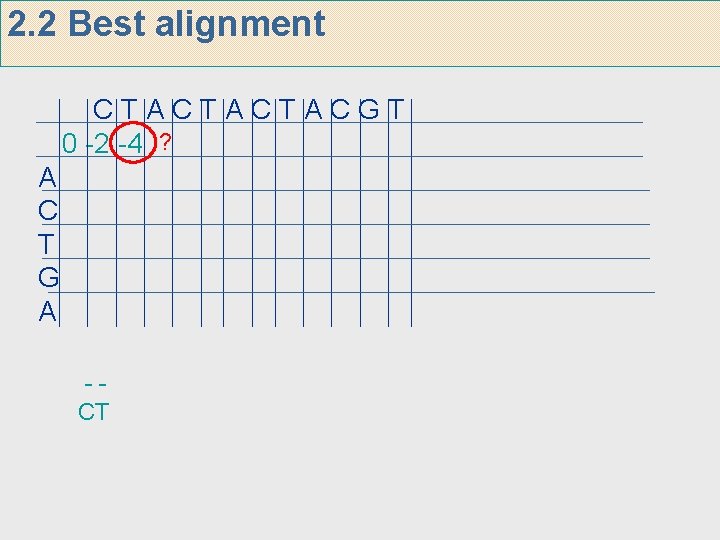
2. 2 Best alignment CTACTACTACGT 0 -2 -4 ? A C T G A -CT
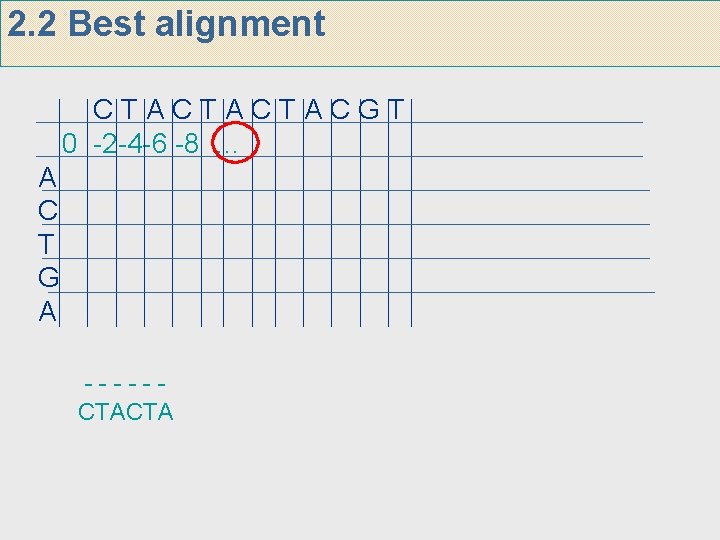
2. 2 Best alignment CTACTACTACGT 0 -2 -4 -6 -8 … A C T G A -----CTACTA
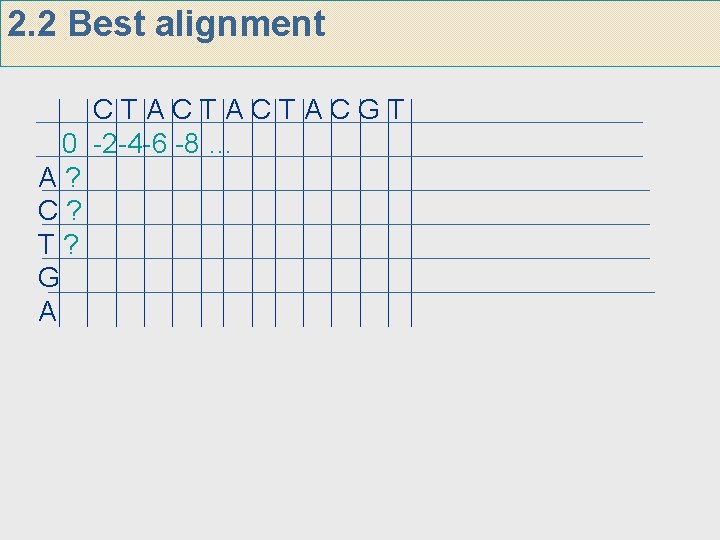
2. 2 Best alignment CTACTACTACGT 0 -2 -4 -6 -8 … A? C? T? G A
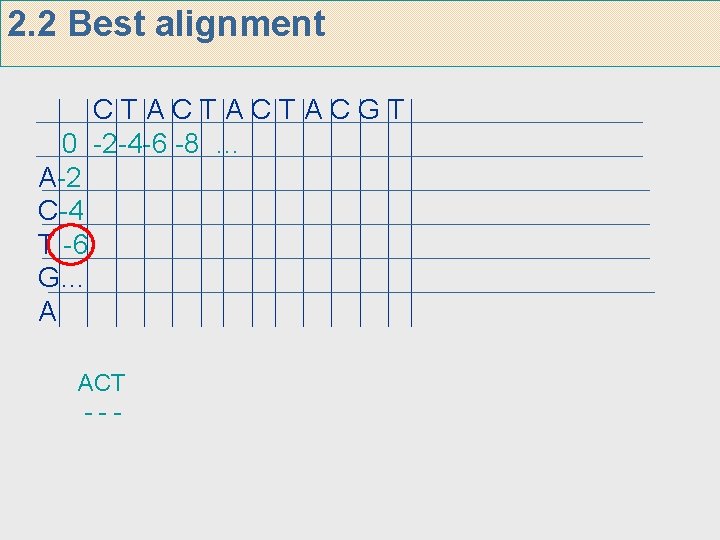
2. 2 Best alignment CTACTACTACGT 0 -2 -4 -6 -8 … A-2 C-4 T -6 G… A ACT ---
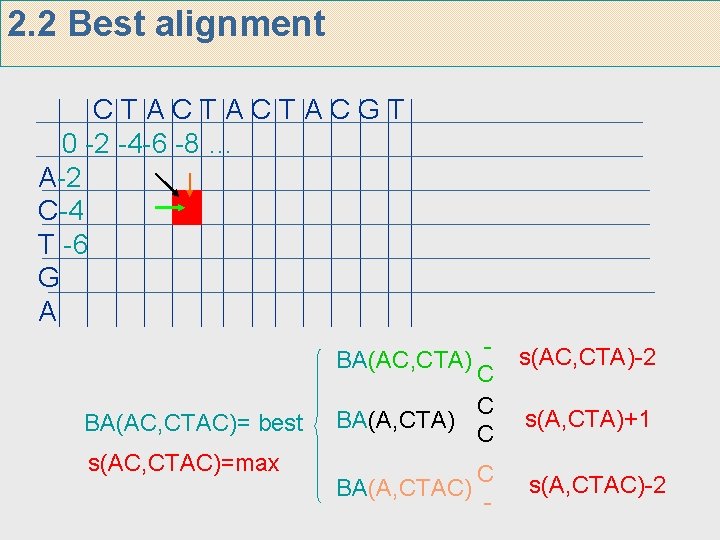
2. 2 Best alignment CTACTACTACGT 0 -2 -4 -6 -8 … A-2 A C-4 C T -6 G A C C BA(A, CTA) C BA(AC, CTA) BA(AC, CTAC)= best s(AC, CTAC)=max BA(A, CTAC) C - s(AC, CTA)-2 s(A, CTA)+1 s(A, CTAC)-2
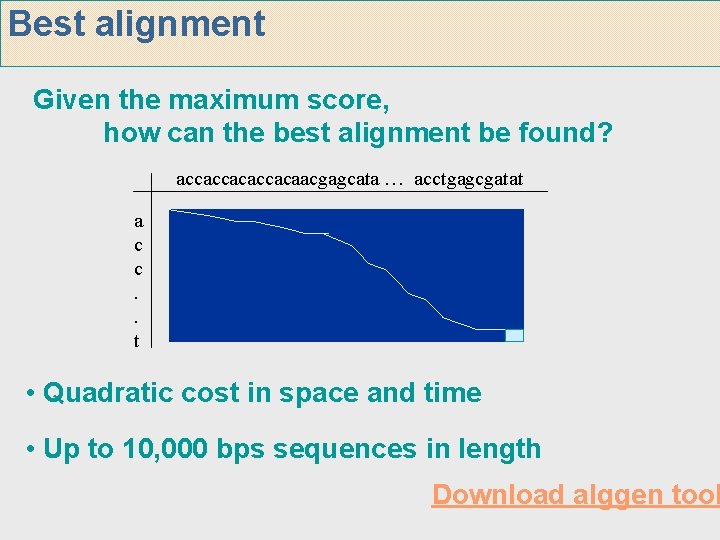
Best alignment Given the maximum score, how can the best alignment be found? accaccacaacgagcata … acctgagcgatat a c c. . t • Quadratic cost in space and time • Up to 10, 000 bps sequences in length Download alggen tool
2. 2 Some slides revisited We have developed theory according to the following principles: 1) Both sequences have a similar length (global). 2) The model of gaps is linear If there are k consecutive gaps the penalty scores k(-2).
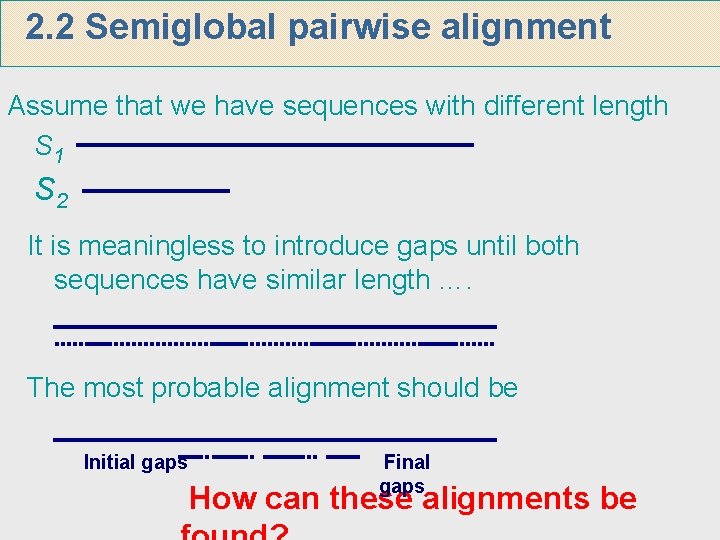
2. 2 Semiglobal pairwise alignment Assume that we have sequences with different length S 1 S 2 It is meaningless to introduce gaps until both sequences have similar length …. The most probable alignment should be Initial gaps Final gaps How can these alignments be
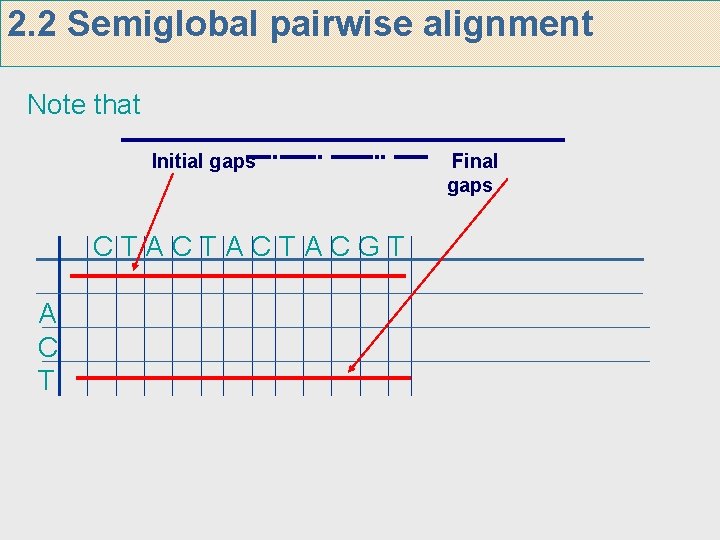
2. 2 Semiglobal pairwise alignment Note that Initial gaps CTACTACTACGT A C T Final gaps
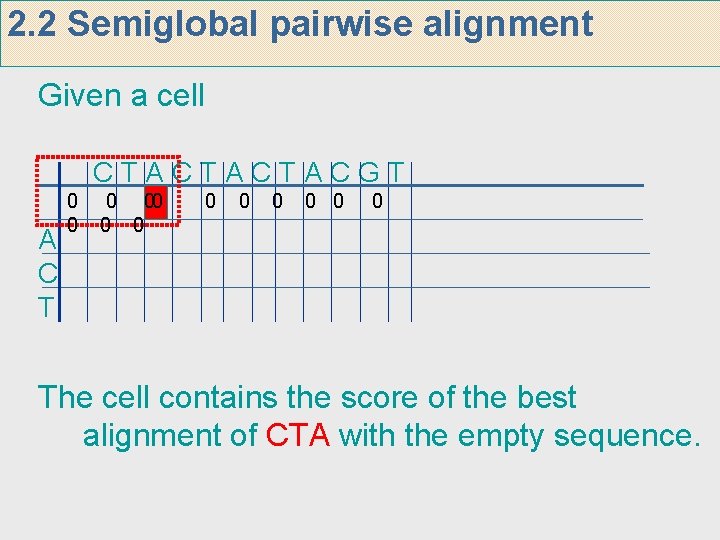
2. 2 Semiglobal pairwise alignment Given a cell CTACTACTACGT A C T 0 00 0 0 0 0 The cell contains the score of the best alignment of CTA with the empty sequence.
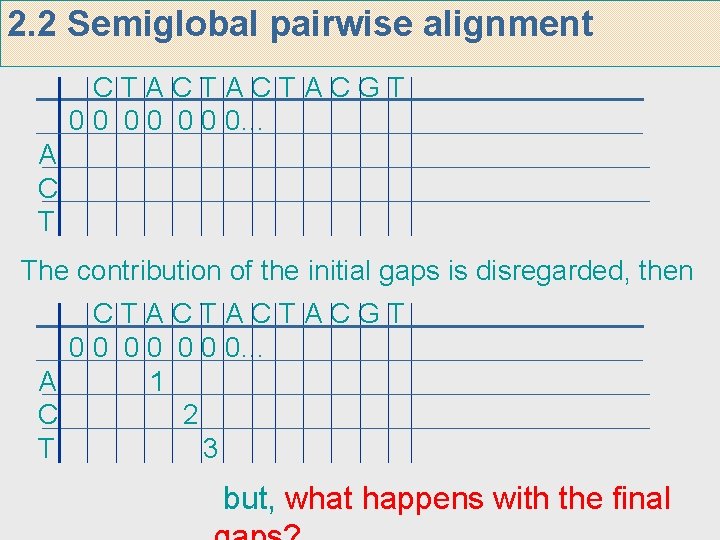
2. 2 Semiglobal pairwise alignment CTACTACTACGT 0 0 0 0… A C T The contribution of the initial gaps is disregarded, then CTACTACTACGT 0 0 0 0… A 1 C 2 T 3 but, what happens with the final
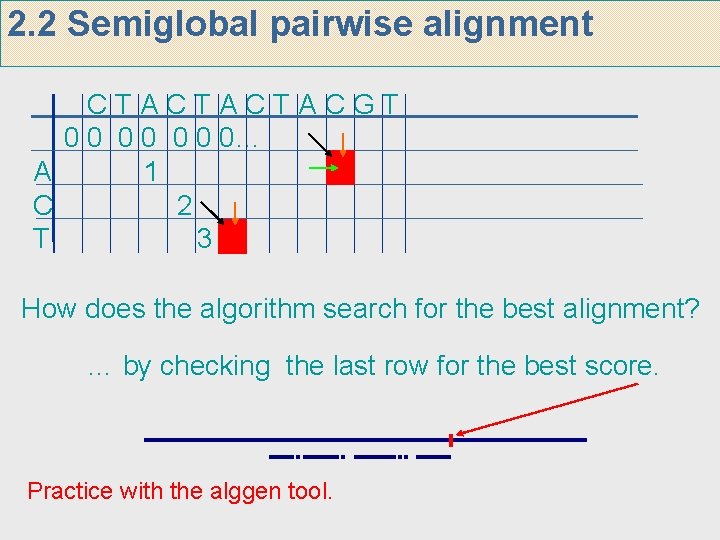
2. 2 Semiglobal pairwise alignment CTACTACTACGT 0 0 0 0… A 1 C 2 T 3 How does the algorithm search for the best alignment? … by checking the last row for the best score. Practice with the alggen tool.
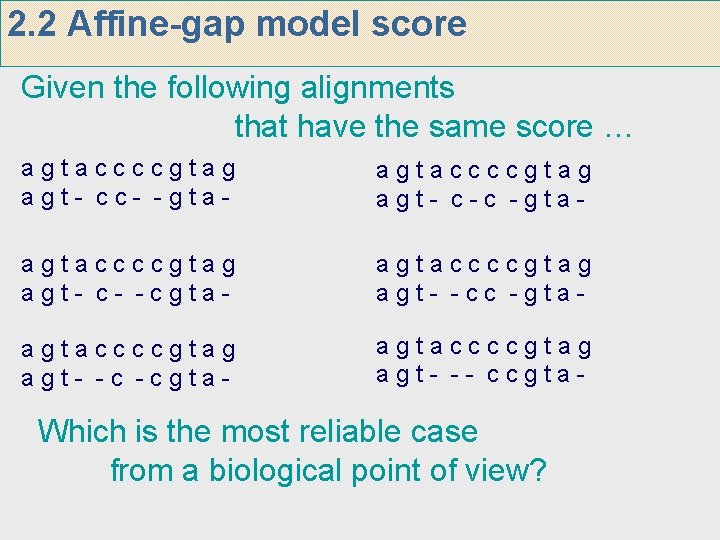
2. 2 Affine-gap model score Given the following alignments that have the same score … agtaccccgtag agt- cc- -gta- agtaccccgtag agt- c-c -gta- agtaccccgtag agt- c- -cgta- agtaccccgtag agt- -cc -gta- agtaccccgtag agt- -c -cgta- agtaccccgtag agt- -- ccgta- Which is the most reliable case from a biological point of view?
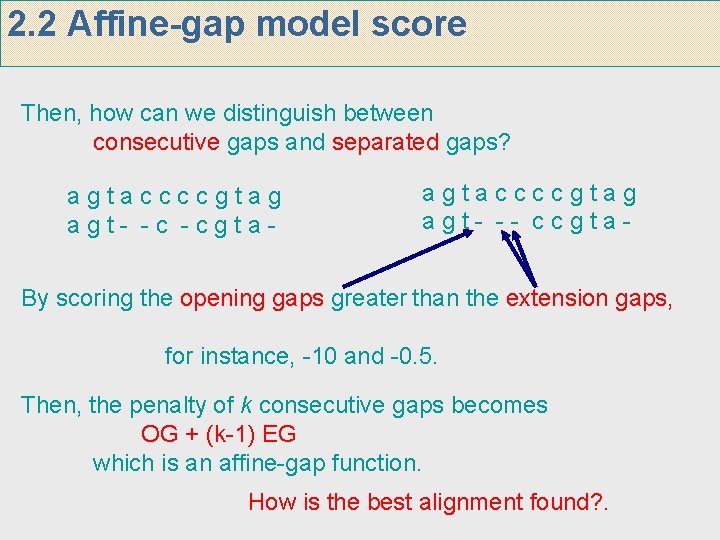
2. 2 Affine-gap model score Then, how can we distinguish between consecutive gaps and separated gaps? agtaccccgtag agt- -c -cgta- agtaccccgtag agt- -- ccgta- By scoring the opening gaps greater than the extension gaps, for instance, -10 and -0. 5. Then, the penalty of k consecutive gaps becomes OG + (k-1) EG which is an affine-gap function. How is the best alignment found? .
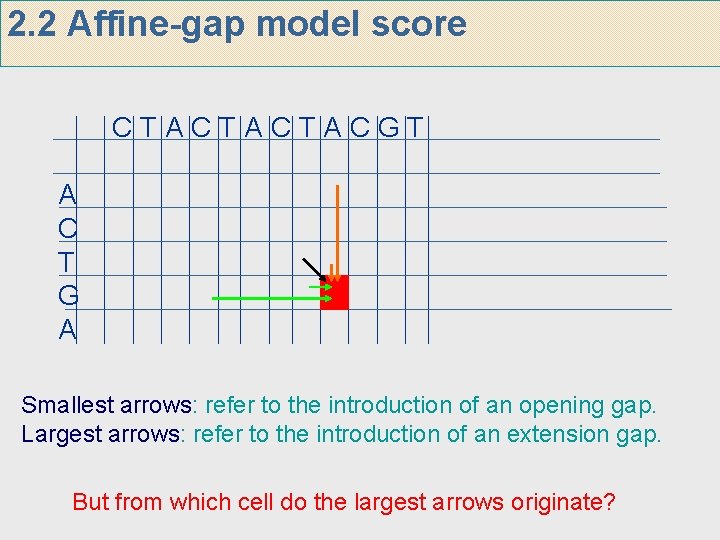
2. 2 Affine-gap model score CTACTACTACGT A C T G A Smallest arrows: refer to the introduction of an opening gap. Largest arrows: refer to the introduction of an extension gap. But from which cell do the largest arrows originate?
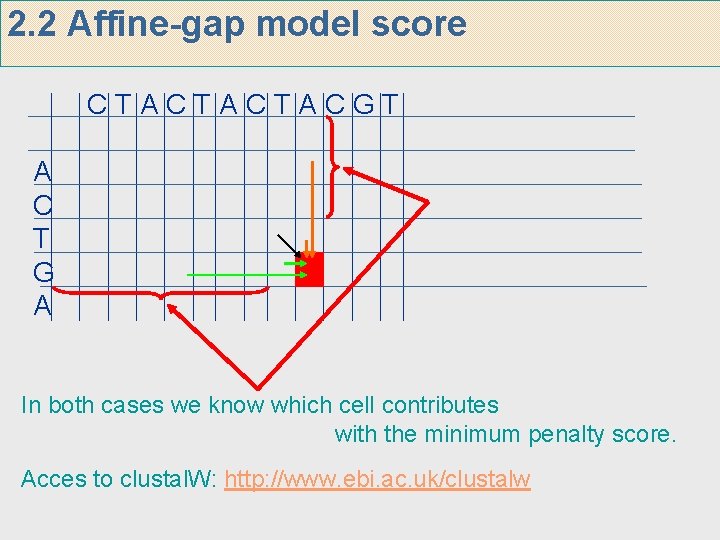
2. 2 Affine-gap model score CTACTACTACGT A C T G A In both cases we know which cell contributes with the minimum penalty score. Acces to clustal. W: http: //www. ebi. ac. uk/clustalw
2. 2 Local alignment Given two sequences, we can consider the alignments of all their substrings… …how can the best of them be found? Two questions arise: - how can the alignments be compared? - how can the best one be selected?
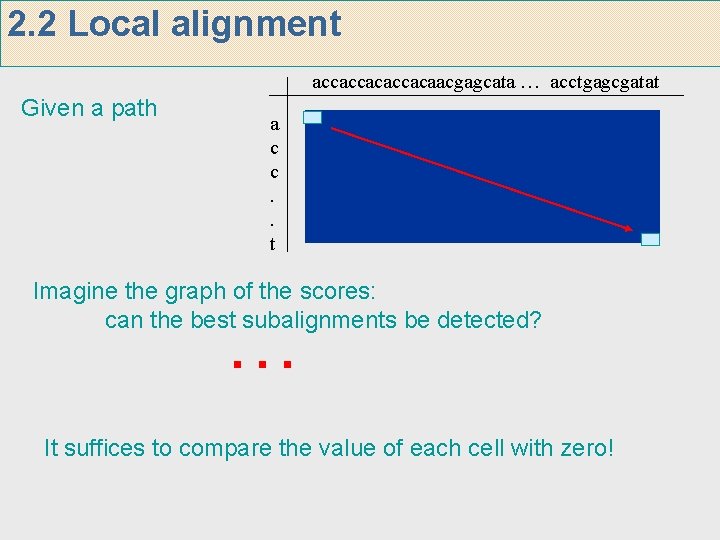
2. 2 Local alignment accaccacaacgagcata … acctgagcgatat Given a path a c c. . t Imagine the graph of the scores: can the best subalignments be detected? … It suffices to compare the value of each cell with zero!
- Slides: 35