
Biography Teck Ming Terence Tan D sc Assistant
Biography Teck Ming (Terence) Tan D. sc. • Assistant Professor of Marketing at Oulu Business School • 8 years experience in consumer research • Main areas of expertise: brand equity, selfpresentation, construal level theory, self-concept, brand betrayal, humanizing brands • His research findings have been published in the Journal of Business Research, European Journal of Marketing, Electronic Commerce Research, Journal of Retailing and Consumer Services, and Advances in Consumer Research. teckming. tan@oulu. fi 044 9235 960 1 Oulun yliopisto
Humanizing Brands: Past, Current, and Future Teck Ming Tan Assistant Professor, Marketing
What is Brand? What is your favorite brand? Oulun yliopisto
University of Oulu Meanings of Brand American Marketing Association: “Name, term, design, symbol, or any other feature that identifies one seller’s good or service as distinct from those of other sellers” Seth Godin: “The set of expectations, memories, stories, and relationships that, taken together, account for a consumer’s decision to choose one product or service over another” Heidi Cohen: “Composed of intangible elements related to its specific promise, personality, and positioning and tangible components having identifiable representation including logos, graphics, colors and sounds” Oulun yliopisto
University of Oulu Meanings of “Humanize” Cambridge dictionary: “make someone or something kinder, gentler, or more agreeable” Oxford dictionary: “to make (something) more humane or civilized. ” Merriam-Webster dictionary: “to represent as human or attribute human qualities to” American Heritage dictionary: “to portray or endow with human characteristics or attributes” Oulun yliopisto
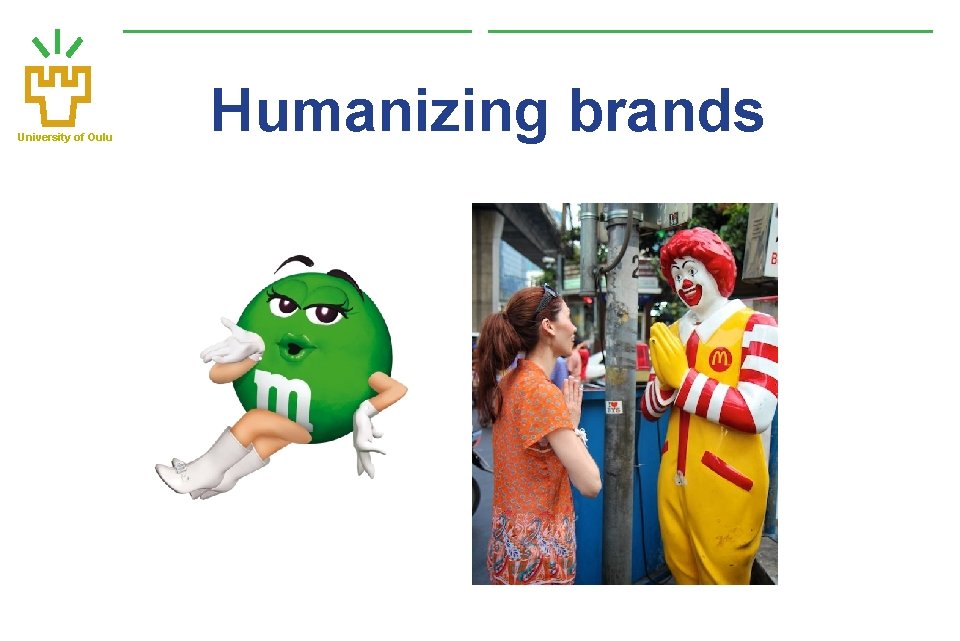
University of Oulu Humanizing brands Oulun yliopisto
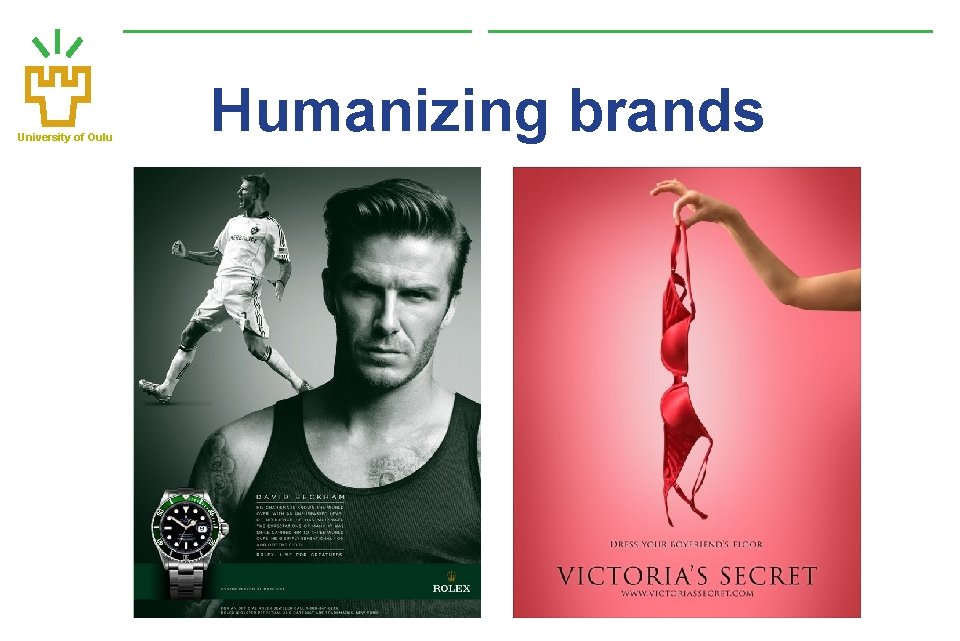
University of Oulu Humanizing brands Oulun yliopisto
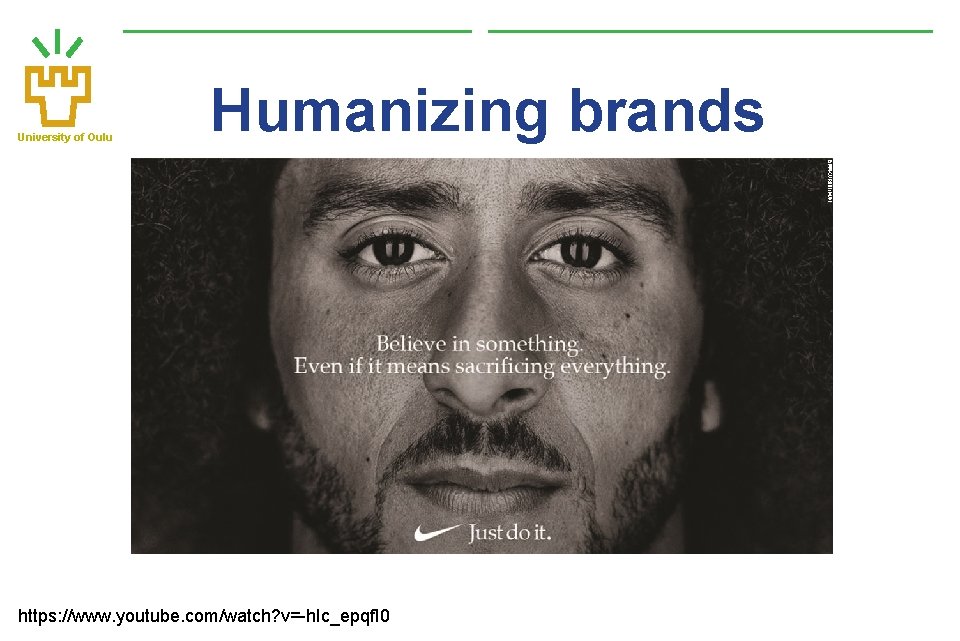
University of Oulu Humanizing brands https: //www. youtube. com/watch? v=-h. Ic_epqf. I 0 Oulun yliopisto
5 minutes Nor dic 9 5. 3. 2021 bran ds Oulun yliopisto
The Domain of Humanizing Brands University of Oulu 1. Human-focused Brand as having human-like… • Features • Mind • Personalities/Traits Source: Mac. Innis & Folkes (2017) Oulun yliopisto
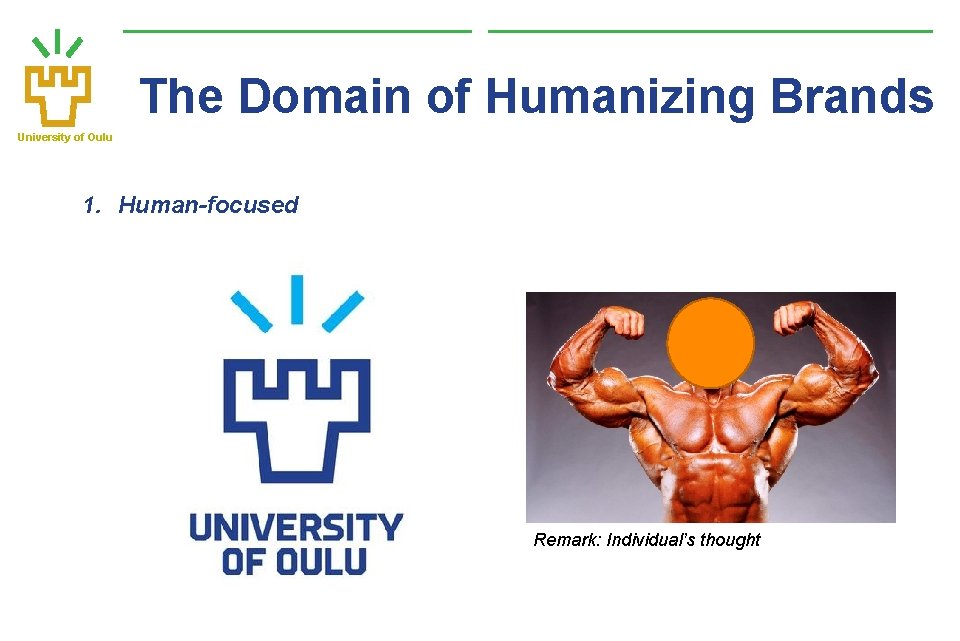
The Domain of Humanizing Brands University of Oulu 1. Human-focused Remark: Individual’s thought Oulun yliopisto
The Domain of Humanizing Brands University of Oulu 1. Human-focused The new logo honours our history but at the same time communicates dynamism, open-mindedness, goahead attitude, and our triple duty in the service of science, education and societal influence. Oulun yliopisto
The Domain of Humanizing Brands University of Oulu 2. Self-focused Brand as like me/connected to me… • Brand-self congruity • Brand-self connections Source: Mac. Innis & Folkes (2017) Oulun yliopisto
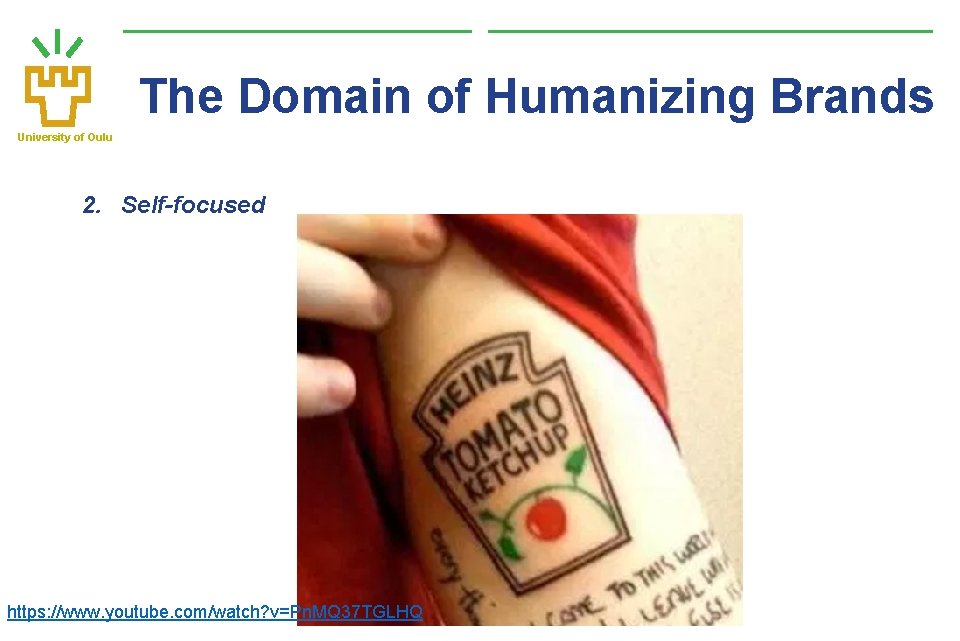
The Domain of Humanizing Brands University of Oulu 2. Self-focused https: //www. youtube. com/watch? v=Pn. MQ 37 TGLHQ Oulun yliopisto
The Domain of Humanizing Brands University of Oulu 3. Relationship-focused Brand as relationship partners… • Brand relationship (e. g. , apps? ) • Brand attachment and aversion from betrayal Source: Mac. Innis & Folkes (2017) Oulun yliopisto
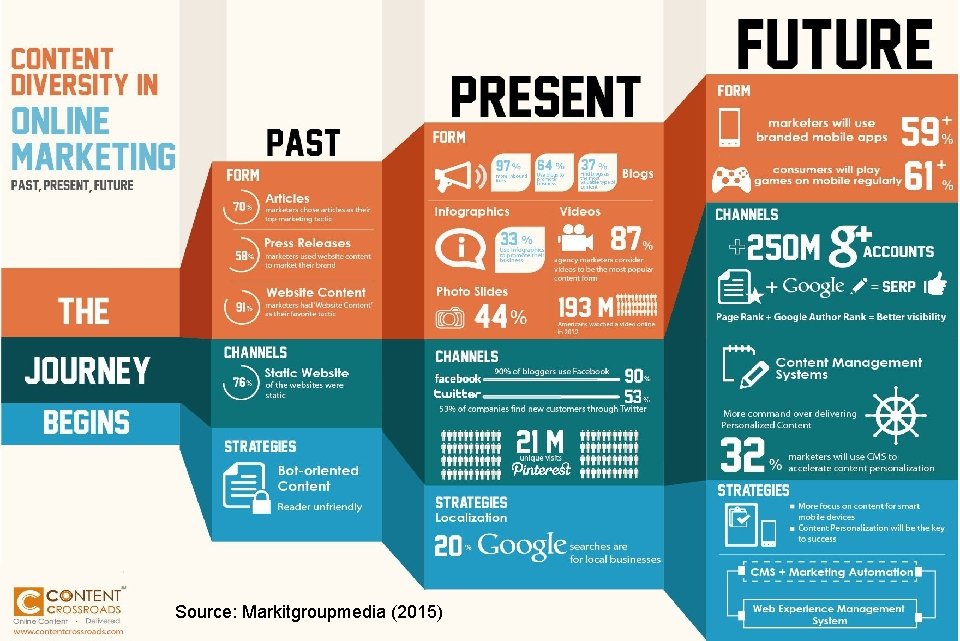
Source: Markitgroupmedia (2015) Oulun yliopisto
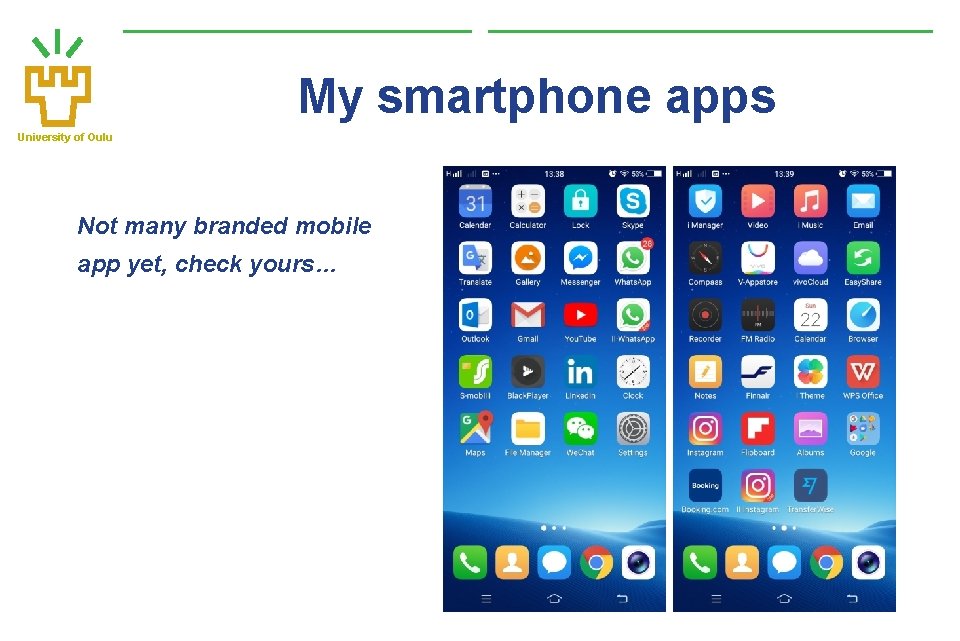
My smartphone apps University of Oulu Not many branded mobile app yet, check yours… Oulun yliopisto

Oulun yliopisto

19 Oulun yliopisto
https: //www. youtube. com/watch? v=Os. Xed. Jq 1 a. WE https: //www. youtube. com/watch? v=jrpa. QN 8 TN 6 o Oulun yliopisto
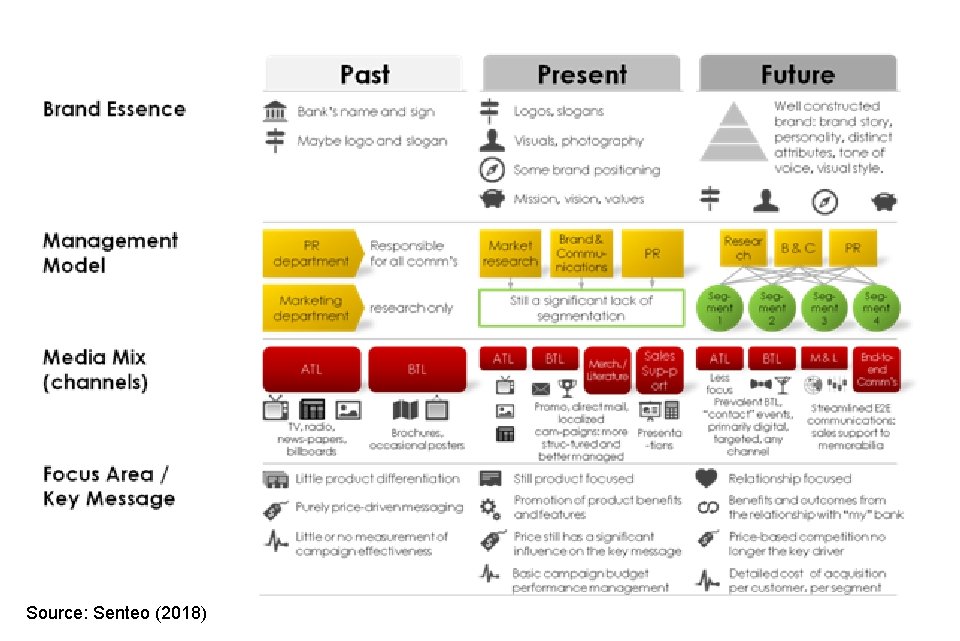
Source: Senteo (2018) Oulun yliopisto
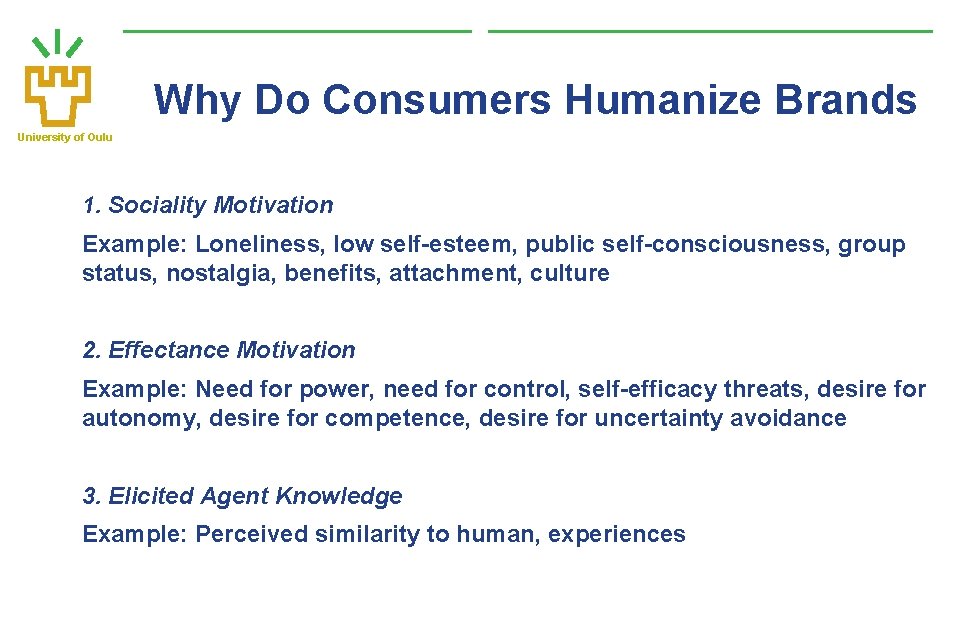
Why Do Consumers Humanize Brands University of Oulu 1. Sociality Motivation Example: Loneliness, low self-esteem, public self-consciousness, group status, nostalgia, benefits, attachment, culture 2. Effectance Motivation Example: Need for power, need for control, self-efficacy threats, desire for autonomy, desire for competence, desire for uncertainty avoidance 3. Elicited Agent Knowledge Example: Perceived similarity to human, experiences Oulun yliopisto
Oulun yliopisto
Reasons for Brand Crisis/ Transgression University of Oulu When the brand (examples): • does not satisfy consumers’ expectation (Grégoire & Fisher, 2008) • fairness violation (Grégoire & Fisher, 2008) • disloyalty (Luedicke & Pichler-Luedicke, 2015) • unethical behavior (Schmalz & Orth, 2012) • misleading information (Parmentier & Fischer, 2015) Other reasons? Oulun yliopisto
Examples Oulun yliopisto
University of Oulu Brand Recovery (As a consumer, what are your expectations for a brand’s recovery strategy? ) Oulun yliopisto
University of Oulu Today Guest Lecture: Is relevant to brand management from the consumer perspective Oulun yliopisto
University of Oulu Thank you Oulun yliopisto
References University of Oulu § Grégoire, Y. , & Fisher, R. J. (2008). Customer betrayal and retaliation: When your best customers become your worst enemies. Journal of the Academy of Marketing Science, 36(2), 247 -61. § Luedicke, M. K. , & Pichler-Luedicke, E. A. (2015). The unfaithful brand: When flirting with new customer segments, make sure you are not already married. In S. Fournier, M. Breazeale, & J. Avery (Eds. ), Strong brands, strong relationships (pp. 203 -215). New York, NY: Routledge. § Mac. Innis, D. J. , & Folkes V. S. (2017). Humanizing brands: When brands seem to be like me, part of me, and in a relationship with me. Journal of Consumer Psychology, 27(3), 355 -374. § Parmentier, M. -A. , & Fischer, E. (2015). Things fall apart: The dynamics of brand audience dissipation. Journal of Consumer Research, 41(5), 1228 -51. § Schmalz, S. , & Orth, U. R. (2012). Brand attachment and consumer emotional response to unethical firm behavior. Psychology & Marketing, 29(11), 869 -84. Oulun yliopisto
- Slides: 29