
Biogas Upgrading and Bottling Technology Developed for Vehicular
Biogas Upgrading and Bottling Technology Developed for Vehicular Applications Prof. Virendra K. Vijay Centre for Rural Development & Technology Coordinator- BDTC IIT Delhi vkvijay@rdat. iitd. ernet. in

BIOGAS • Energy source produced from biodegradable /organic wastes by anaerobic digestion process • Possible feedstock material: All good biodegradable organic materials ü Digester sludge ü Manure (liquid & solid) ü Organic waste (Household waste, restaurant waste, food industry ü waste, etc. ) ü Energy crops (silage of maize, grass, corn, etc. ) • Additional benefit of digested slurry - can be dried and sold as high quality compost. • Biogas belongs to the same gas-family as natural gas • After upgrading biogas, calorific value, density and Wobbe Index are almost similar to natural gas • Biogas can be adapted to the quality of natural gas

Biogas in INDIA • An estimate indicates that India has a potential of generating 6. 38 X 1010 m 3 of biogas from 980 million tones of cattle dung produced annually from 300 million cattle population. • The heat value of this gas amounts to 1. 3 X 10¹² MJ. In addition, 350 million tones of manure would also produce along with biogas. • Apart from the 4. 5 million domestic biogas plants installed in India against the potential of 12 million, there is a huge potential of installation of medium and large scale biogas plants installation in India in small scale industries, animal rearing farms, poultry farms, distilleries, tanneries, hotels, restaurants, military barracks etc.
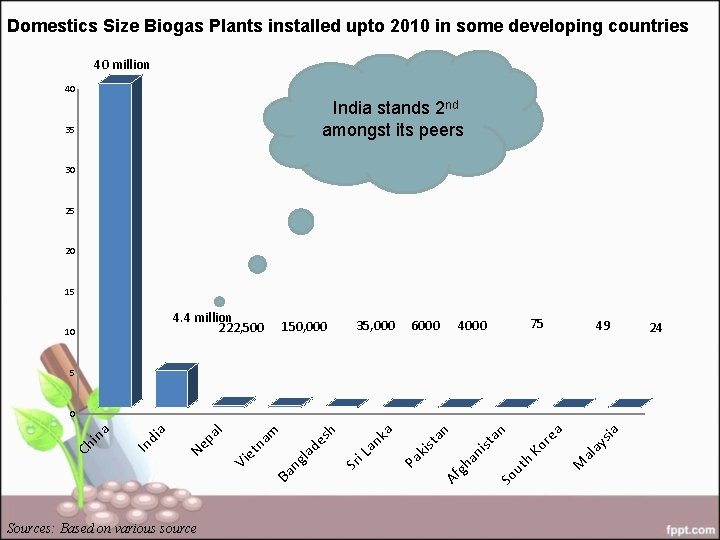
Domestics Size Biogas Plants installed upto 2010 in some developing countries 40 million 40 India stands 2 nd amongst its peers 35 30 25 20 15 4. 4 million 222, 500 10 150, 000 35, 000 6000 75 4000 49 5 Sources: Based on various source So sia ay al M ut h Ko re a ist an an an Af gh kis t Pa an ka Sr i. L de sh Ba n gla am Vi et n l pa Ne a di In Ch i na 0 24
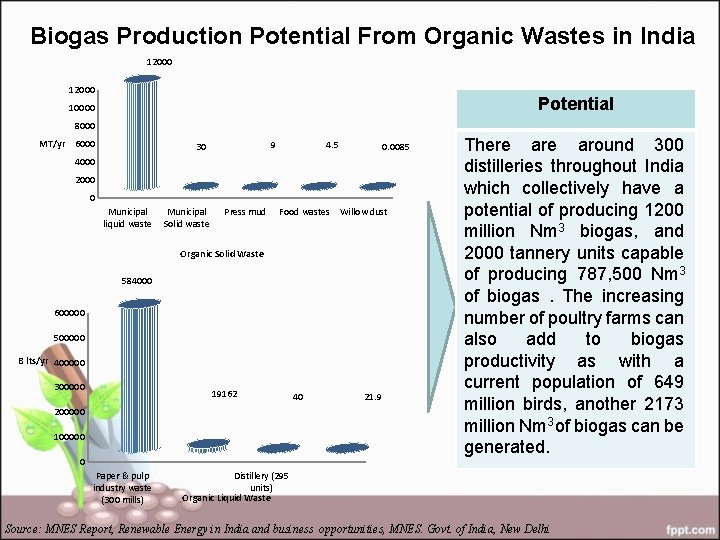
Biogas Production Potential From Organic Wastes in India 12000 Potential 10000 8000 MT/yr 6000 9 30 4. 5 0. 0085 4000 2000 0 Municipal liquid waste Municipal Solid waste Press mud Food wastes Willow dust Organic Solid Waste 584000 600000 500000 B lts/yr 400000 300000 19162 200000 100000 0 Paper & pulp industry waste (300 mills) 40 21. 9 There around 300 distilleries throughout India which collectively have a potential of producing 1200 million Nm 3 biogas, and 2000 tannery units capable of producing 787, 500 Nm 3 of biogas . The increasing number of poultry farms can also add to biogas productivity as with a current population of 649 million birds, another 2173 million Nm 3 of biogas can be generated. Distillery (295 units) Organic Liquid Waste Source: MNES Report, Renewable Energy in India and business opportunities, MNES. Govt. of India, New Delhi
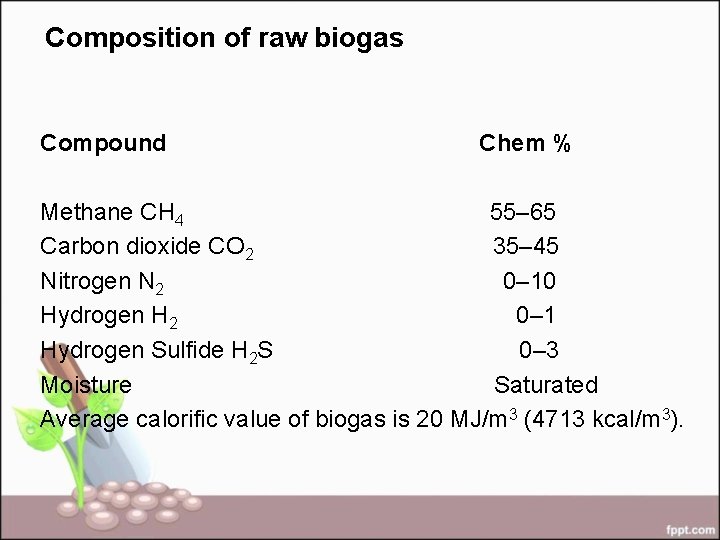
Composition of raw biogas Compound Chem % Methane CH 4 55– 65 Carbon dioxide CO 2 35– 45 Nitrogen N 2 0– 10 Hydrogen H 2 0– 1 Hydrogen Sulfide H 2 S 0– 3 Moisture Saturated Average calorific value of biogas is 20 MJ/m 3 (4713 kcal/m 3).
Unlike conventional natural gas which is composed mostly of hydrocarbons — 70% or more methane (CH 4) plus propane and butane — raw biogas generally contains somewhat less methane, a significant amount of carbon dioxide (CO 2), and lesser amounts of nitrogen, hydrogen, carbon monoxide and a variety of contaminants.
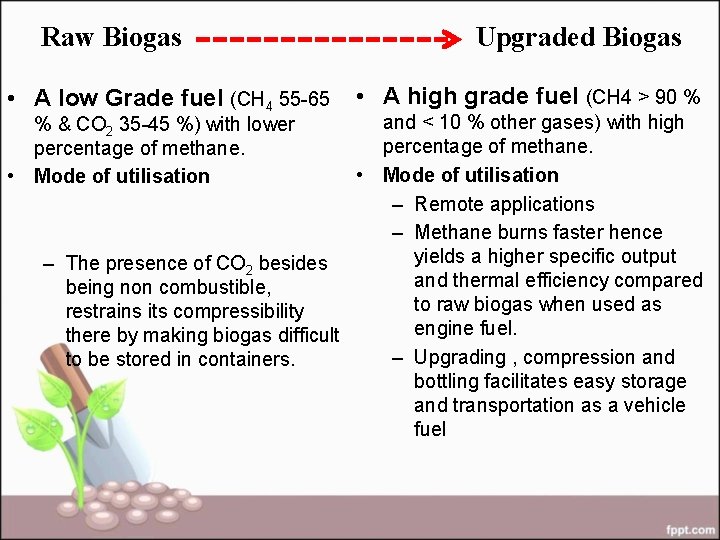
Raw Biogas Upgraded Biogas • A low Grade fuel (CH 4 55 -65 • A high grade fuel (CH 4 > 90 % and < 10 % other gases) with high percentage of methane. • Mode of utilisation – Remote applications – Methane burns faster hence yields a higher specific output – The presence of CO 2 besides and thermal efficiency compared being non combustible, to raw biogas when used as restrains its compressibility engine fuel. there by making biogas difficult – Upgrading , compression and to be stored in containers. bottling facilitates easy storage and transportation as a vehicle fuel % & CO 2 35 -45 %) with lower percentage of methane. • Mode of utilisation
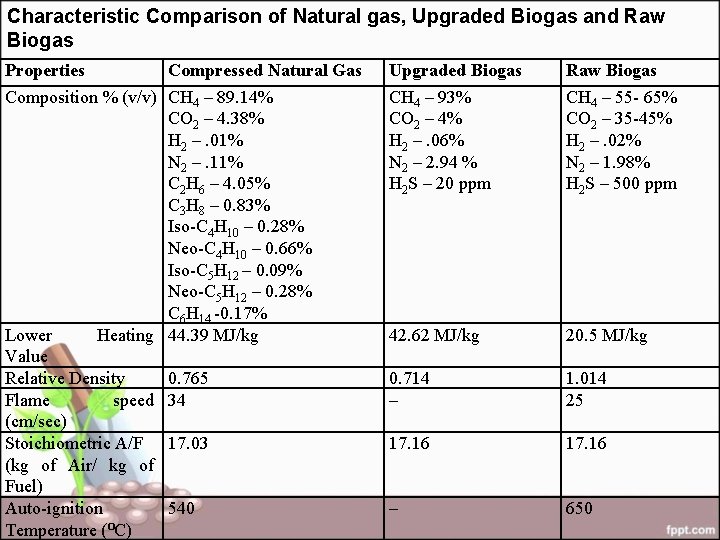
Characteristic Comparison of Natural gas, Upgraded Biogas and Raw Biogas Properties Compressed Natural Gas Composition % (v/v) CH 4 – 89. 14% CO 2 – 4. 38% H 2 –. 01% N 2 –. 11% C 2 H 6 – 4. 05% C 3 H 8 – 0. 83% Iso-C 4 H 10 – 0. 28% Neo-C 4 H 10 – 0. 66% Iso-C 5 H 12 – 0. 09% Neo-C 5 H 12 – 0. 28% C 6 H 14 -0. 17% Lower Heating 44. 39 MJ/kg Value Relative Density 0. 765 Flame speed 34 (cm/sec) Stoichiometric A/F 17. 03 (kg of Air/ kg of Fuel) Auto-ignition 540 Temperature (⁰C) Upgraded Biogas CH 4 – 93% CO 2 – 4% H 2 –. 06% N 2 – 2. 94 % H 2 S – 20 ppm Raw Biogas CH 4 – 55 - 65% CO 2 – 35 -45% H 2 –. 02% N 2 – 1. 98% H 2 S – 500 ppm 42. 62 MJ/kg 20. 5 MJ/kg 0. 714 – 1. 014 25 17. 16 – 650
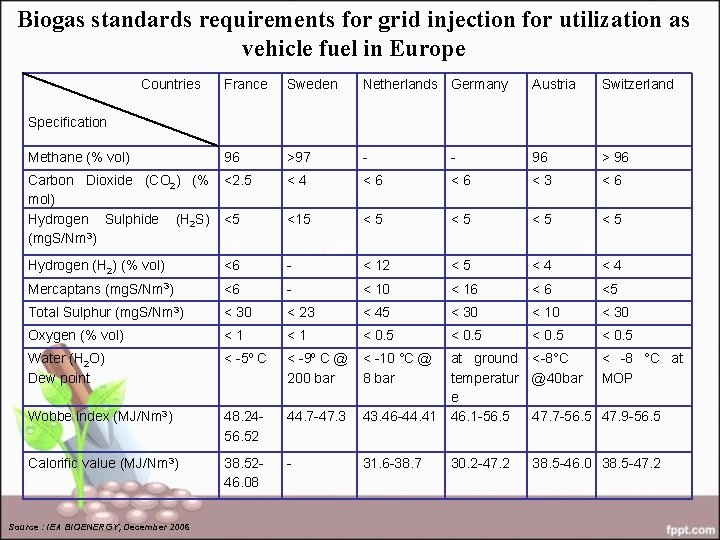
Biogas standards requirements for grid injection for utilization as vehicle fuel in Europe Countries France Sweden Netherlands Germany Austria Switzerland 96 >97 - - 96 > 96 Carbon Dioxide (CO 2) (% <2. 5 mol) Hydrogen Sulphide (H 2 S) <5 (mg. S/Nm 3) < 4 < 6 < 3 < 6 <15 < 5 < 5 Hydrogen (H 2) (% vol) <6 - Mercaptans (mg. S/Nm 3) <6 Total Sulphur (mg. S/Nm 3) Specification Methane (% vol) 97 87 -98. 5 >97 < 12 < 5 < 4 - < 10 < 16 < 6 <5 < 30 < 23 < 45 < 30 < 10 < 30 Oxygen (% vol) < 1 < 0. 5 Water (H 2 O) Dew point < -5⁰ C < -9⁰ C @ < -10 °C @ 200 bar 8 bar Wobbe index (MJ/Nm 3) 48. 2456. 52 44. 7 -47. 3 at ground <-8°C < -8 °C at temperatur @40 bar MOP e 43. 46 -44. 41 46. 1 -56. 5 47. 7 -56. 5 47. 9 -56. 5 Calorific value (MJ/Nm 3) 38. 5246. 08 - 31. 6 -38. 7 Source : IEA BIOENERGY, December 2006 30. 2 -47. 2 < 4 38. 5 -46. 0 38. 5 -47. 2
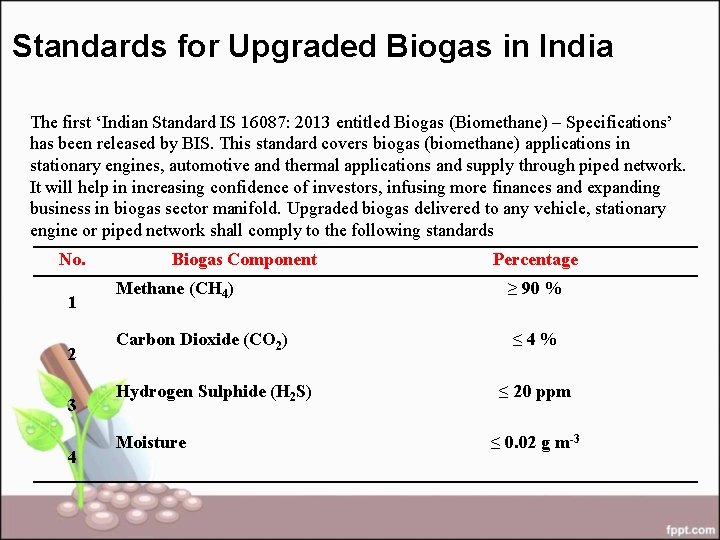
Standards for Upgraded Biogas in India The first ‘Indian Standard IS 16087: 2013 entitled Biogas (Biomethane) – Specifications’ has been released by BIS. This standard covers biogas (biomethane) applications in stationary engines, automotive and thermal applications and supply through piped network. It will help in increasing confidence of investors, infusing more finances and expanding business in biogas sector manifold. Upgraded biogas delivered to any vehicle, stationary engine or piped network shall comply to the following standards No. 1 2 3 4 Biogas Component Percentage Methane (CH 4) ≥ 90 % Carbon Dioxide (CO 2) ≤ 4% Hydrogen Sulphide (H 2 S) Moisture ≤ 20 ppm ≤ 0. 02 g m-3
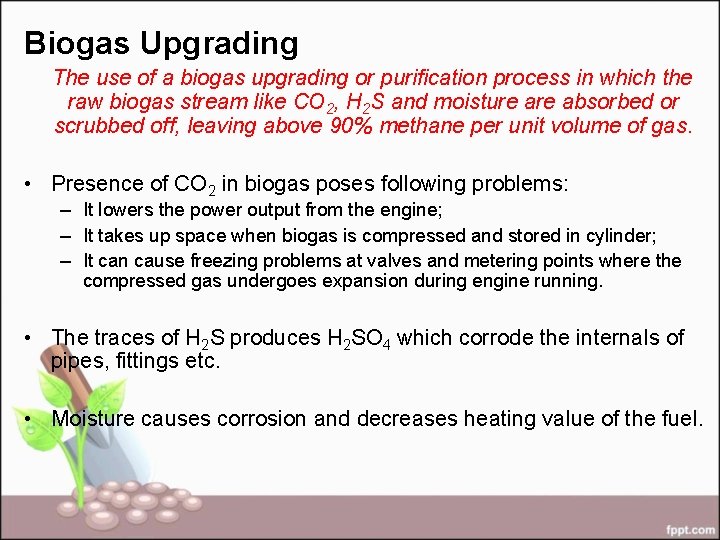
Biogas Upgrading The use of a biogas upgrading or purification process in which the raw biogas stream like CO 2, H 2 S and moisture absorbed or scrubbed off, leaving above 90% methane per unit volume of gas. • Presence of CO 2 in biogas poses following problems: – It lowers the power output from the engine; – It takes up space when biogas is compressed and stored in cylinder; – It can cause freezing problems at valves and metering points where the compressed gas undergoes expansion during engine running. • The traces of H 2 S produces H 2 SO 4 which corrode the internals of pipes, fittings etc. • Moisture causes corrosion and decreases heating value of the fuel.

Compression of Biogas • The energy density of upgraded biogas is comparatively low at ambient pressure and as a result it must be compressed at high pressures (e. g. 200 -250 bar) to allow its sufficient storage in bottles/cylinders. • Compressing biogas • reduces storage space requirements, • concentrates energy content and • increases pressure to the level needed to overcome resistance to gas flow. • Compression can eliminate the mismatch of pressures and guarantee the efficient operation of the equipment.
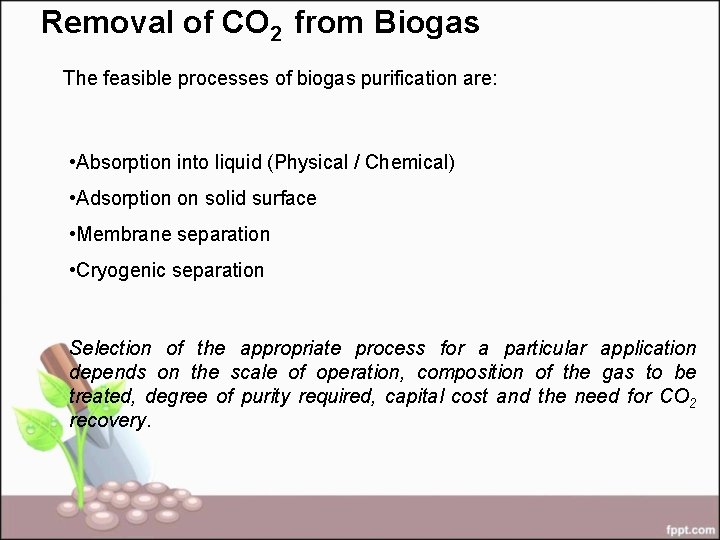
Removal of CO 2 from Biogas The feasible processes of biogas purification are: • Absorption into liquid (Physical / Chemical) • Adsorption on solid surface • Membrane separation • Cryogenic separation Selection of the appropriate process for a particular application depends on the scale of operation, composition of the gas to be treated, degree of purity required, capital cost and the need for CO 2 recovery.
Biogas upgrading using water scrubbing method at IIT Delhi
Water Scrubbing Method • Involves the physical absorption of CO 2 and H 2 S in water at high pressures and regeneration by a release in pressure with very little change in temperature. • Easiest and cheapest method involving use of pressurized water as an absorbent. • The absorption process is, thus a counter-current one. The dissolved CO 2 and H 2 S in water are collected at the bottom of the tower.
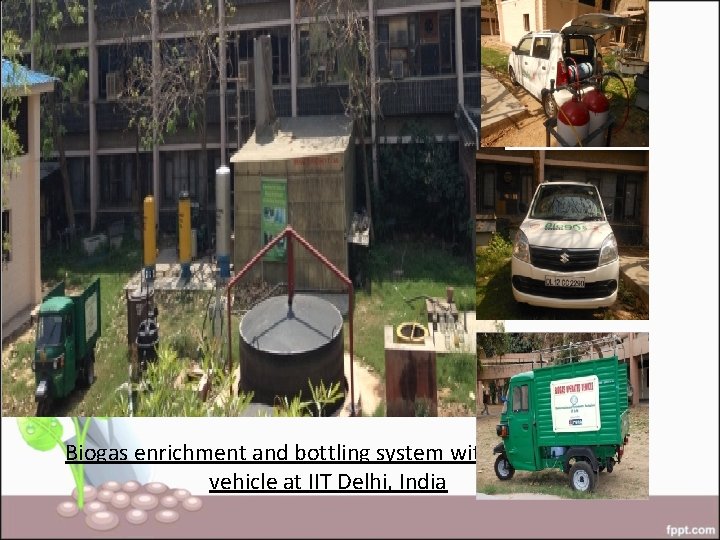
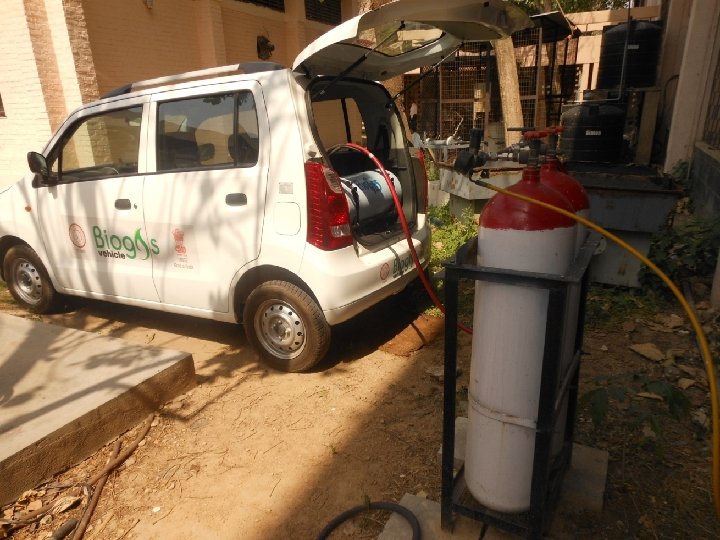
Biogas enrichment and bottling system with biogas vehicle at IIT Delhi, India
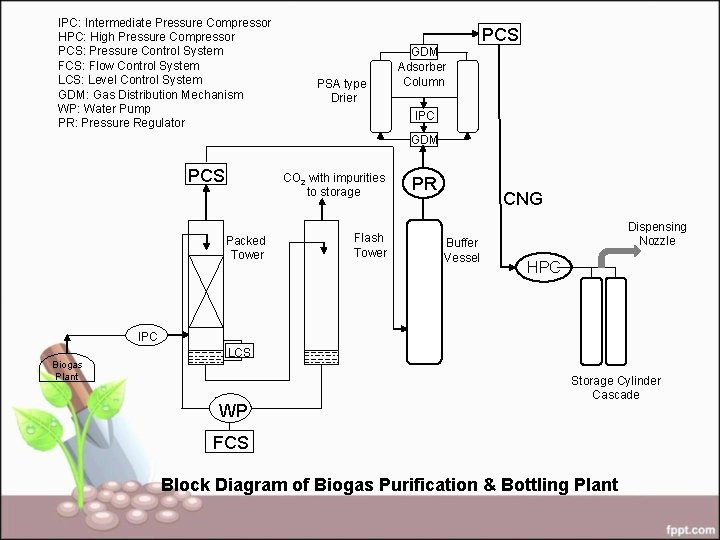
IPC: Intermediate Pressure Compressor HPC: High Pressure Compressor PCS: Pressure Control System FCS: Flow Control System LCS: Level Control System GDM: Gas Distribution Mechanism WP: Water Pump PR: Pressure Regulator PCS PSA type Drier GDM Adsorber Column IPC GDM PCS CO 2 with impurities to storage Packed Tower Flash Tower PR CNG Buffer Vessel Dispensing Nozzle HPC IPC Biogas Plant LCS WP Storage Cylinder Cascade FCS Block Diagram of Biogas Purification & Bottling Plant
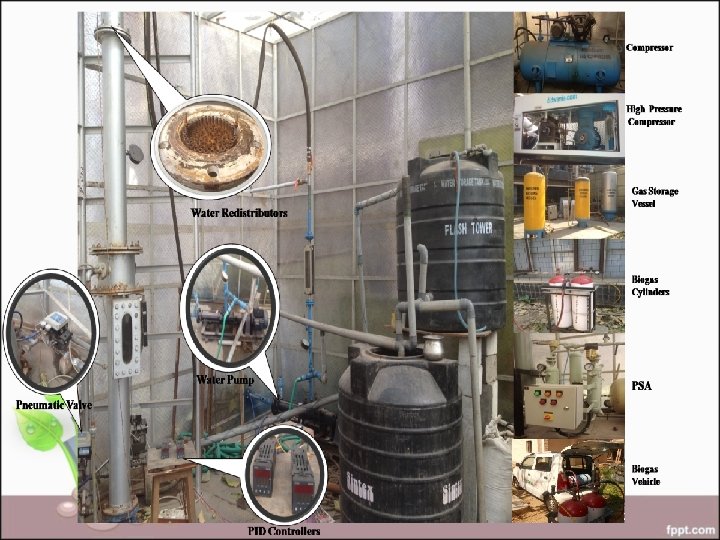
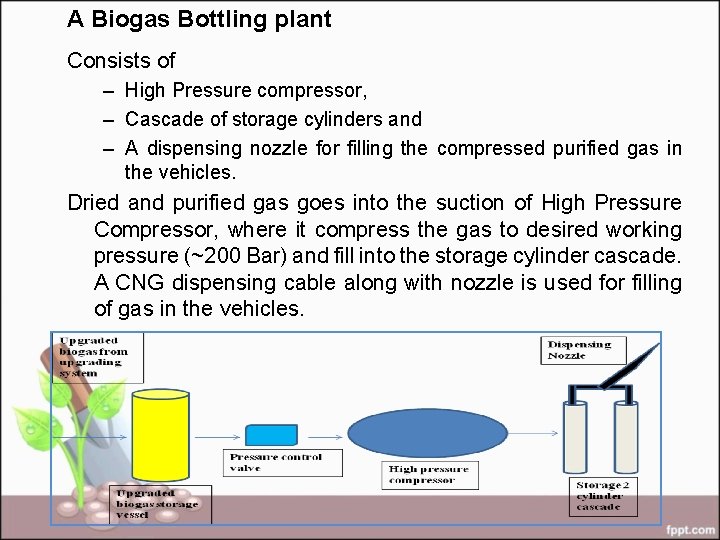
A Biogas Bottling plant Consists of – High Pressure compressor, – Cascade of storage cylinders and – A dispensing nozzle for filling the compressed purified gas in the vehicles. Dried and purified gas goes into the suction of High Pressure Compressor, where it compress the gas to desired working pressure (~200 Bar) and fill into the storage cylinder cascade. A CNG dispensing cable along with nozzle is used for filling of gas in the vehicles.
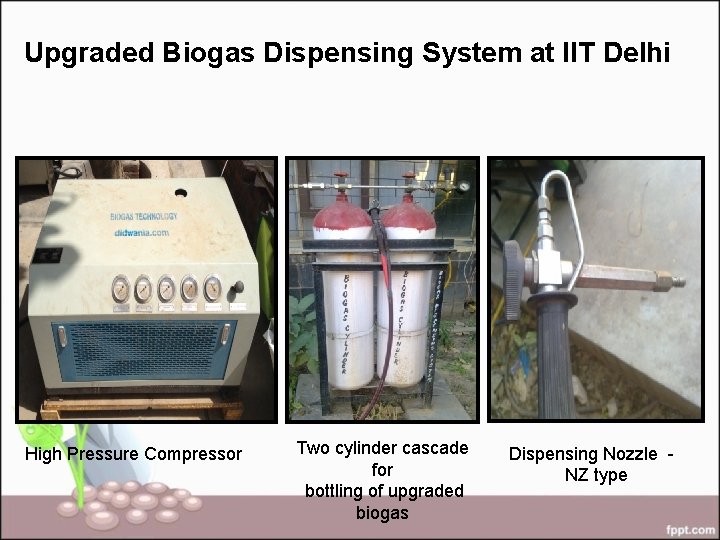
Upgraded Biogas Dispensing System at IIT Delhi High Pressure Compressor Two cylinder cascade for bottling of upgraded biogas Dispensing Nozzle - NZ type
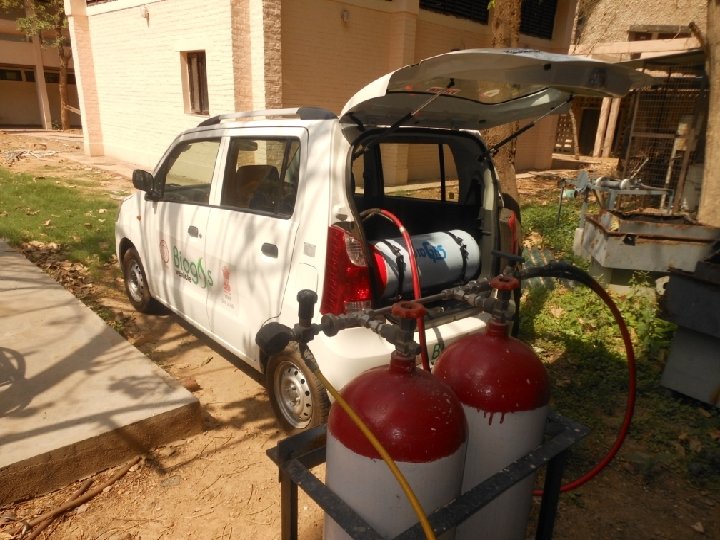
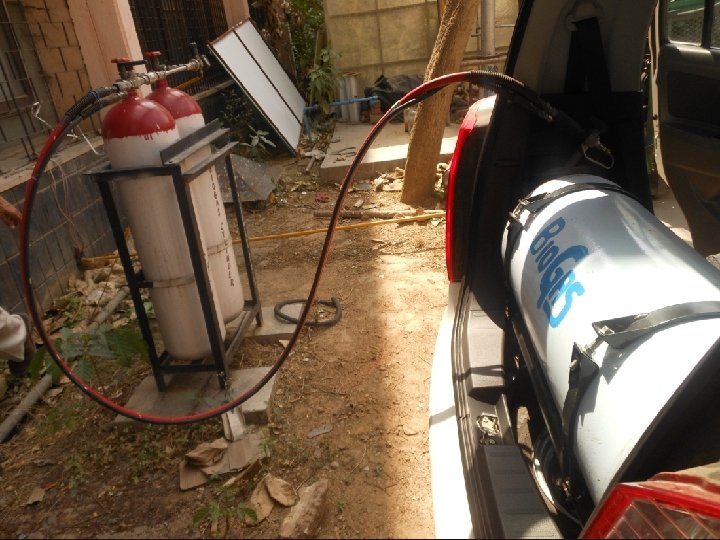

Video
Issues for discussion • Technology for dissemination – scale, suppliers, • Government support – subsidy, incentives • Policy and regulations – use in vehicles, LPG replacement, PESO, BIS • Industry / Green Industry – licensing/land use, environmental certificates etc
THANK YOU
- Slides: 27