
Biofilm detection in CIP systems in realtime 1
Biofilm detection in CIP systems in real-time 1
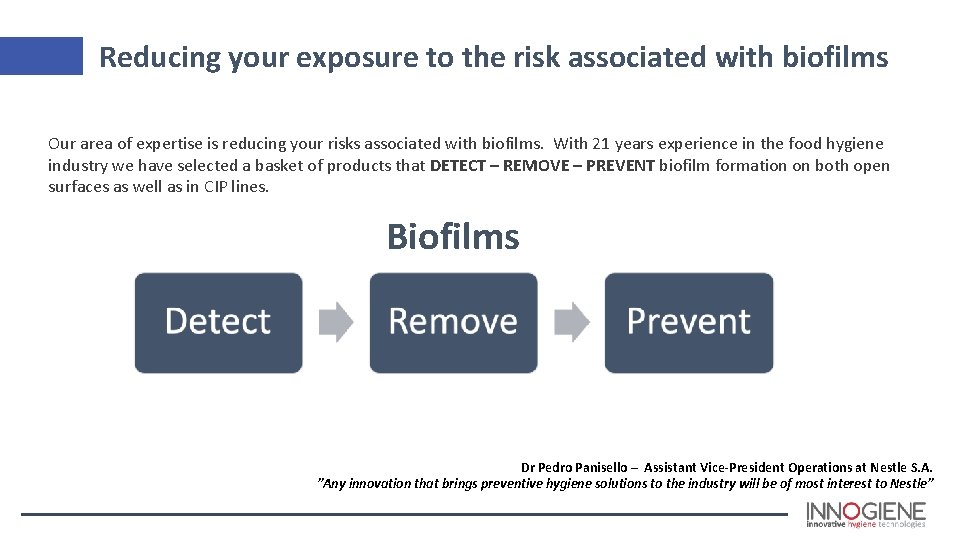
Reducing your exposure to the risk associated with biofilms Our area of expertise is reducing your risks associated with biofilms. With 21 years experience in the food hygiene industry we have selected a basket of products that DETECT – REMOVE – PREVENT biofilm formation on both open surfaces as well as in CIP lines. Biofilms Dr Pedro Panisello – Assistant Vice-President Operations at Nestle S. A. ”Any innovation that brings preventive hygiene solutions to the industry will be of most interest to Nestle”

Biofilms A complex problem A Planktonic bacteria (non-attached bacteria) B Benthonic bacteria or biofilms 99% of all bacterial cells exist as biofilms, and only 1% live in planktonic state. Easy to remove with conventional chemistry Difficult to remove with conventional chemistry 3
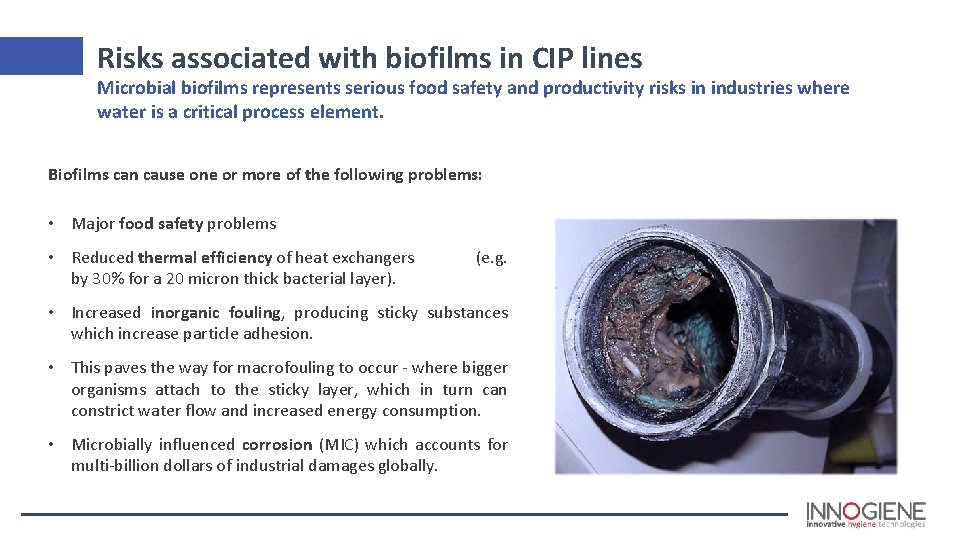
Risks associated with biofilms in CIP lines Microbial biofilms represents serious food safety and productivity risks in industries where water is a critical process element. Biofilms can cause one or more of the following problems: • Major food safety problems • Reduced thermal efficiency of heat exchangers by 30% for a 20 micron thick bacterial layer). (e. g. • Increased inorganic fouling, producing sticky substances which increase particle adhesion. • This paves the way for macrofouling to occur - where bigger organisms attach to the sticky layer, which in turn can constrict water flow and increased energy consumption. • Microbially influenced corrosion (MIC) which accounts for multi-billion dollars of industrial damages globally.

The importance of biofilm removal Biofilm removal treatments must be applied as soon as bacteria start to settle on surfaces exposed to water • It is much more difficult and expensive, both in terms of detergent/disinfectant concentration and contact time, to deal with a mature biofilm than an early-stage biofilm. • The extracellular matrix (EPS) produced by biofilm increases its resistance to disinfectants by three orders of magnitude (x 1000). • Biofilm creates the ideal environment for the survival and growth of pathogens. • When a biofilm is mature, its outermost layers tend to detach and re-attach in other areas of the plant creating a cycle of continuous microbial “spiking”.
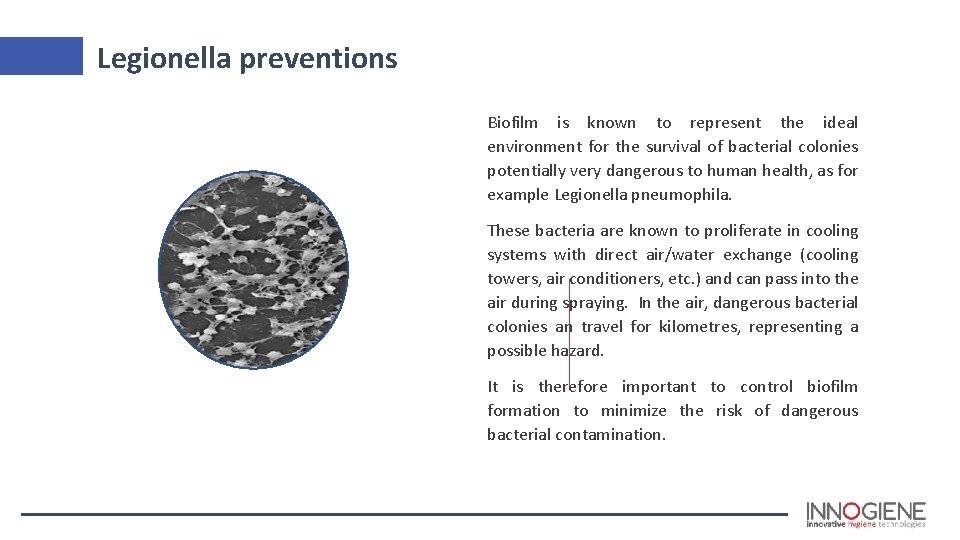
Legionella preventions Biofilm is known to represent the ideal environment for the survival of bacterial colonies potentially very dangerous to human health, as for example Legionella pneumophila. These bacteria are known to proliferate in cooling systems with direct air/water exchange (cooling towers, air conditioners, etc. ) and can pass into the air during spraying. In the air, dangerous bacterial colonies an travel for kilometres, representing a possible hazard. It is therefore important to control biofilm formation to minimize the risk of dangerous bacterial contamination.

Installation

Alvim biofilm detection technology The Alvim biofilm sensor allows for reliable, early-stage biofilm detection. Real-time data on microbial attachment Data-driven decisions about when to apply biofilm treatment Accurate management of chemical consumption Process optimisation: • Evaluation of detergent-disinfection system effectiveness • Timely alerts in case of malfunctioning of detergent and disinfection system • Use of enzymatic treatments in function of the real needs

Alvim biofilm detection technology The Alvim biofilm sensor allows for reliable, early-stage biofilm detection. ”The Alvim technology has helped us optimize biocide injection while at the same time minimize biofilm growth. We are able to compare different biocide treatments: chemicals, protocols, method of injection. The system has helped us detect early upset information such as injection failure, chemical performance issues and we are able to adapt chemical treatments to match changes in operating conditions”

Alvim set up Early-stage biofilm • The Alvim biofilm sensor is inserted into the line at a point or points where biofilms are most likely to occur. • The sensor is attached to a control box and PLC / PC where the data is collected and is ready for interpretation. • Alvim’s technology, detects the bio-electrochemical signal produced by bacteria. • The signal is directly linked to the biological activity of bacteria, and it is proportional to the surface area covered by biofilm. • Therefore the sensor monitors only living bacteria, not other kinds of fouling (e. g. mineral deposit, fats, proteins, etc. ).
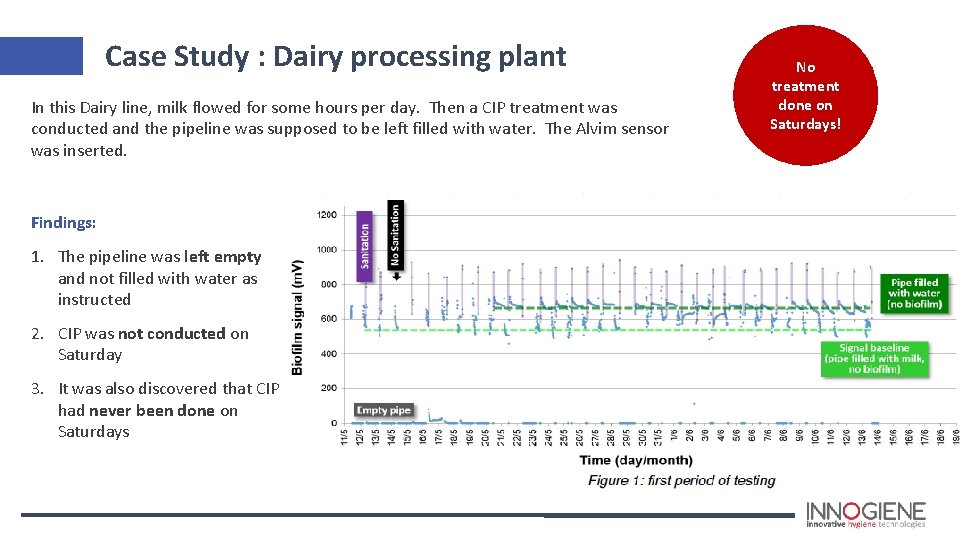
Case Study : Dairy processing plant In this Dairy line, milk flowed for some hours per day. Then a CIP treatment was conducted and the pipeline was supposed to be left filled with water. The Alvim sensor was inserted. Findings: 1. The pipeline was left empty and not filled with water as instructed 2. CIP was not conducted on Saturday 3. It was also discovered that CIP had never been done on Saturdays No treatment done on Saturdays!
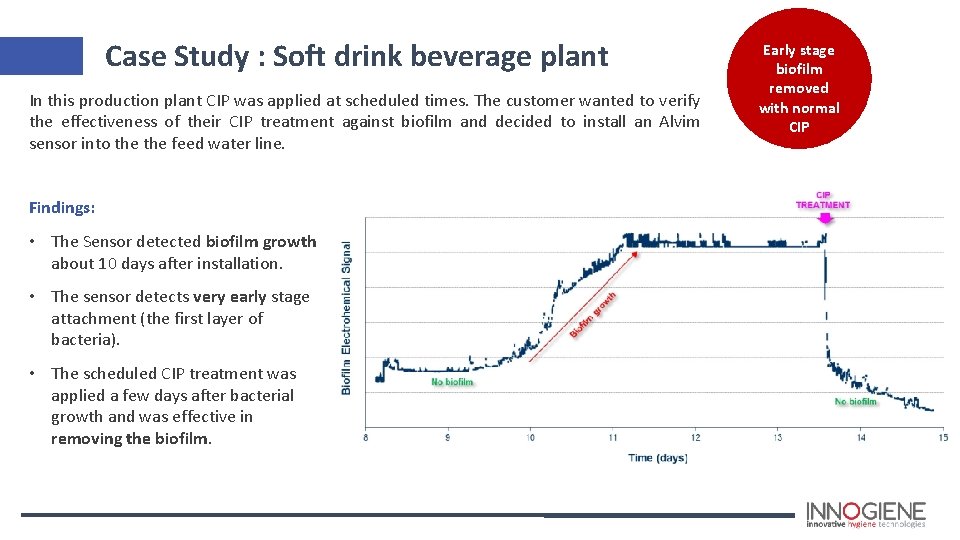
Case Study : Soft drink beverage plant In this production plant CIP was applied at scheduled times. The customer wanted to verify the effectiveness of their CIP treatment against biofilm and decided to install an Alvim sensor into the feed water line. Findings: • The Sensor detected biofilm growth about 10 days after installation. • The sensor detects very early stage attachment (the first layer of bacteria). • The scheduled CIP treatment was applied a few days after bacterial growth and was effective in removing the biofilm. Early stage biofilm removed with normal CIP
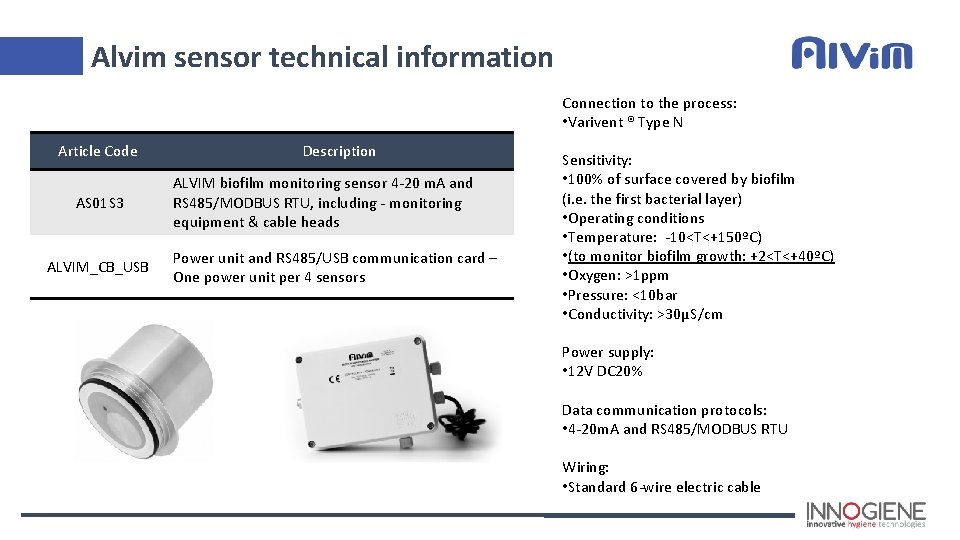
Alvim sensor technical information Connection to the process: • Varivent ® Type N Article Code AS 01 S 3 ALVIM_CB_USB Description ALVIM biofilm monitoring sensor 4 -20 m. A and RS 485/MODBUS RTU, including - monitoring equipment & cable heads Power unit and RS 485/USB communication card – One power unit per 4 sensors Sensitivity: • 100% of surface covered by biofilm (i. e. the first bacterial layer) • Operating conditions • Temperature: -10<T<+150ºC) • (to monitor biofilm growth: +2<T<+40ºC) • Oxygen: >1 ppm • Pressure: <10 bar • Conductivity: >30µS/cm Power supply: • 12 V DC 20% Data communication protocols: • 4 -20 m. A and RS 485/MODBUS RTU Wiring: • Standard 6 -wire electric cable
Alvim FAQ’s CLICK here to get answers to your questions
Contact info@innogiene. co. za +27 (21) 813 -6190 +27 (0) 76 284 7878 www. innogiene. co. za For further technical information & validation certificates contact: Tania Garcia-Warner tania@innogiene. co. za “Nothing is as powerful as an idea whose time has come. ” Victor Hugo
- Slides: 16