
BIOFEEDBACK IN THE TREATMENT OF FRONTAL LOBE DYSFUNCTION
BIOFEEDBACK IN THE TREATMENT OF FRONTAL LOBE DYSFUNCTION Child Psychiatry rounds 02/09/2018 JEFFREY A. CARMEN, PH. D. PRIVATE PRACTICE MANLIUS, NY

My office waiting room (wishful thinking) my office waiting room

CONTACT INFO (for office visit or copy of powerpoint or questions) CARMEN 5272@GMAIL. COM 315. 682. 5272 WWW. STOPMYMIGRAINE. COM
What is biofeedback? • It is just a fancy name for a tool for training the brain using Skinnerian and Pavlovian conditioning. • It includes: – Peripheral biofeedback (such as hand warming) – Brain biofeedback (also called neurofeedback) • EEG biofeedback (electron based neurofeedback) • HEG biofeedback (photon based neurofeedback)
ALL OF THE PREVIOUS DISTINCTIONS ARE ARTIFICIAL!! All feedback using a physiological signal is biofeedback. The term neurofeedback is evoked to create the sense of increased precision, but in fact it is not more precise. However, the signals are messier. It has a lot to do with semantics, status within the field, and marketing. To avoid confusion, I will be using the term biofeedback to describe everything.
Legal qualifications to do biofeedback. Biofeedback is just a therapy tool, like lots of others. You need to have a license to practice in your chosen field such as Psychiatry, Psychology, Physical Therapy, Occupational Therapy. Certification is available. The only officially recognized certification body is: BCIA Ethically, you should obtain training in your chosen techniques (EMDR, insight therapy, biofeedback).
EEG biofeedback (electron based brain biofeedback) is the most difficult to learn. Mostly because it is a very complicated signal and it is prone to electrical artifacts, such as electromagnetic interference and eye blink (eye roll) artifacts. It is also done with minimal skin prep. Clinical EEG’s require careful skin prep. EEG biofeedback should also, but it is too time consuming to do in an office setting. The “solution” is an ultra high impedance amplifier that is more vulnerable to electronic interference. Sometimes EEG biofeedback ends up being blink rate training (slower blink rate is more normal).

HEG biofeedback (hemoencephalography) is photon based brain biofeedback. No skin prep required! Compared to EEG, it is a bit faster, immune to eye roll artifacts, and easily targets the prefrontal cortex. There are two kinds of HEG. nir HEG and p. IR HEG. Neither are new, just not as well known as EEG biofeedback. Near Infrared (nir) HEG was invented by Hershel Toomin in 1994. (1916 – 2011) Passive Infrared (p. IR) HEG was invented by me in 1998. It is what I used exclusively in my office, mostly because I focus on the prefrontal cortex.
Peripheral biofeedback appears to directly train the autonomic nervous system, but does so via CNS regulation, so it is also neurofeedback (brain biofeedback). You are probably more familiar with this type. It includes, finger temperature training, muscle tension training, skin conductance, and general relaxation techniques. Peripheral biofeedback is a time honored tradition, that effectively treats various disorders based on mechanisms that are probably not correct. Example: migraines.

Relaxation training biofeedback Early peripheral biofeedback was directed at training a relaxation response within the frame of reference of folks like Jacobson and Benson. I used to do a lot of relaxation training. Now I don’t. In spite of seeming to be an innocent procedure, relaxation training can backfire because it also quiets the emotional management system. It removes the protective mechanism of tension.
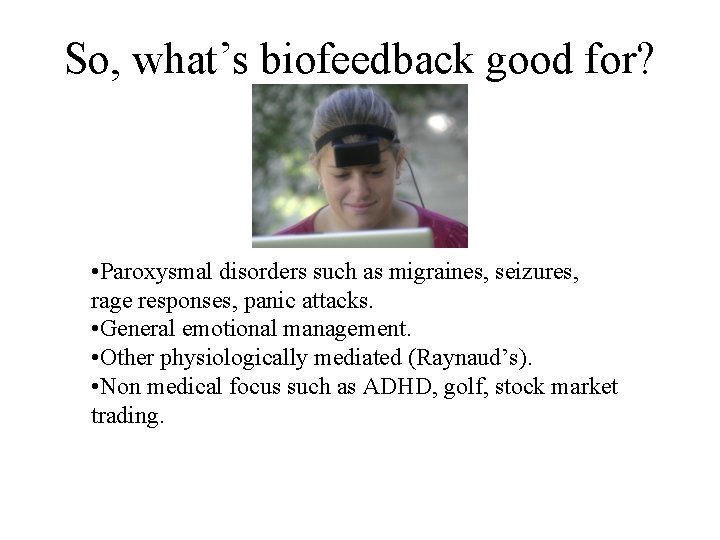
So, what’s biofeedback good for? • Paroxysmal disorders such as migraines, seizures, rage responses, panic attacks. • General emotional management. • Other physiologically mediated (Raynaud’s). • Non medical focus such as ADHD, golf, stock market trading.
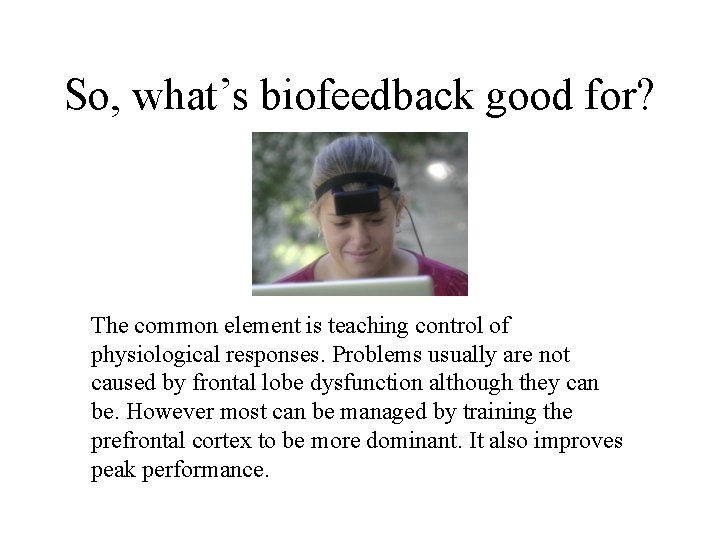
So, what’s biofeedback good for? The common element is teaching control of physiological responses. Problems usually are not caused by frontal lobe dysfunction although they can be. However most can be managed by training the prefrontal cortex to be more dominant. It also improves peak performance.
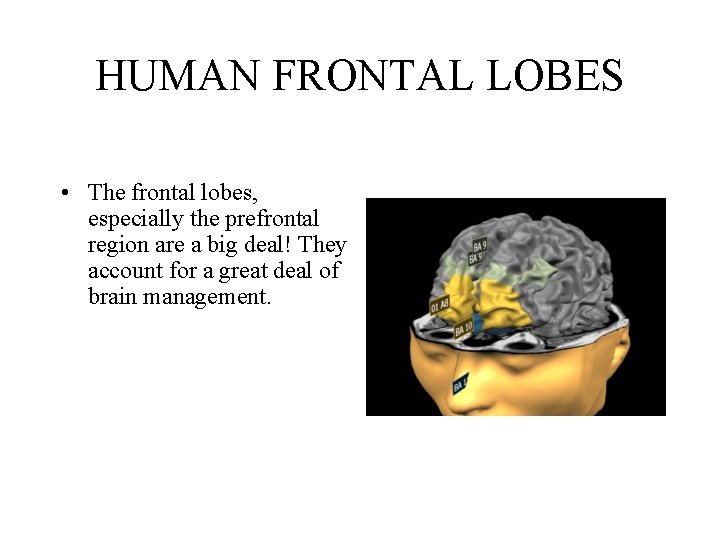
HUMAN FRONTAL LOBES • The frontal lobes, especially the prefrontal region are a big deal! They account for a great deal of brain management.
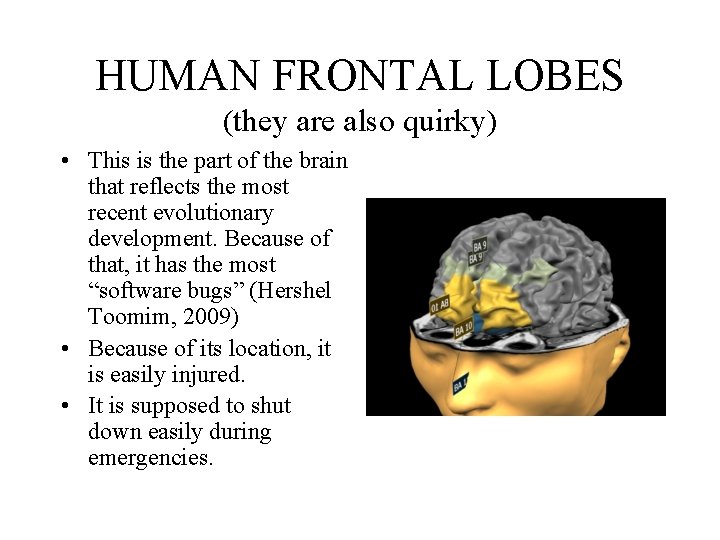
HUMAN FRONTAL LOBES (they are also quirky) • This is the part of the brain that reflects the most recent evolutionary development. Because of that, it has the most “software bugs” (Hershel Toomim, 2009) • Because of its location, it is easily injured. • It is supposed to shut down easily during emergencies.
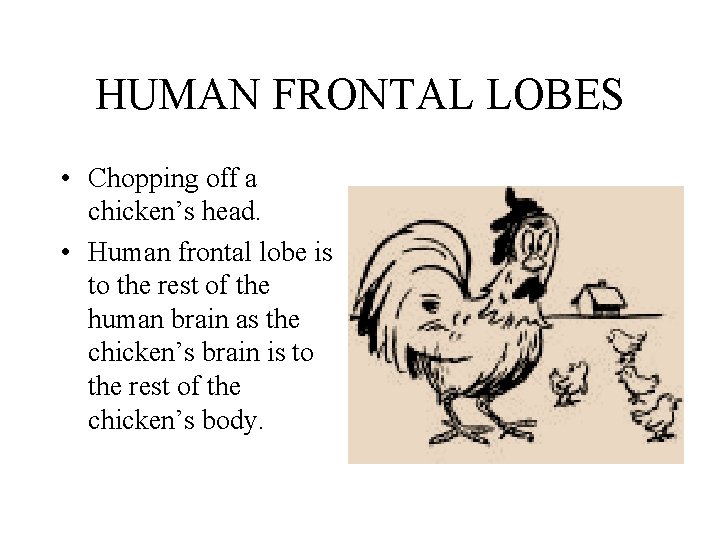
HUMAN FRONTAL LOBES • Chopping off a chicken’s head. • Human frontal lobe is to the rest of the human brain as the chicken’s brain is to the rest of the chicken’s body.
50, 000 YEARS!!! • THE HUMAN BRAIN WAS DESIGNED FOR AN ENVIRONMENT THAT EXISTED 50, 000 YEARS AGO • ADAPTATION TO MODERN LIFE IS ACCIDENTAL
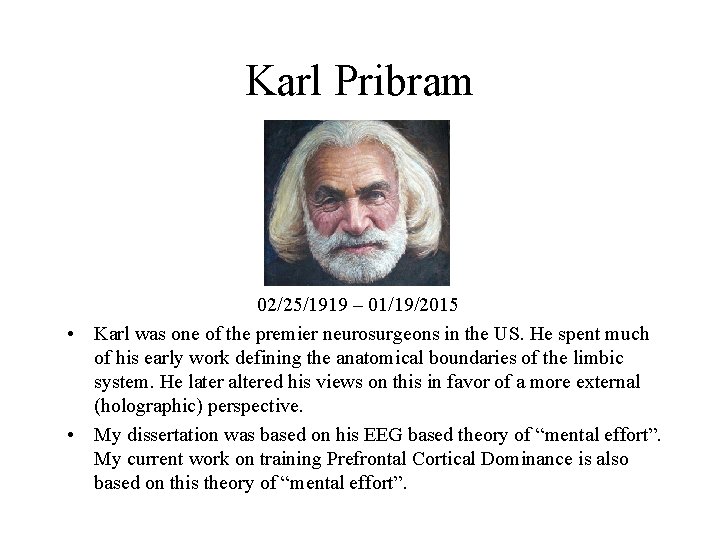
Karl Pribram 02/25/1919 – 01/19/2015 • Karl was one of the premier neurosurgeons in the US. He spent much of his early work defining the anatomical boundaries of the limbic system. He later altered his views on this in favor of a more external (holographic) perspective. • My dissertation was based on his EEG based theory of “mental effort”. My current work on training Prefrontal Cortical Dominance is also based on this theory of “mental effort”.
TYPICAL CLINICAL SYMPTOMS Most dominant clinical symptoms can be viewed as a response that is a mismatch to the social environment. Biofeedback is a way to retrain these response patterns.
ANXIETY • Anxiety is one of those emotions that tends to be incompatible with other emotions. It also tends to impair activity. It shuts down the prefrontal cortex. • Sexual arousal can shut down anxiety (and anxiety can shut down sexual arousal). • Assertive/aggressive behavior can shut down anxiety. • Most purposeful actions can shut down anxiety. • Activating the prefrontal cortex can shut down anxiety.
AGGRESSION • Incompatible with anxiety • Rage is self reinforcing (it feels a lot better than anxiety, and there is a tension release when it is over).
DEPRESSION • As a brain mechanism it is a little bit unique and incompletely understood. • In terms of brain activity, depression localizes itself as low level of activity in the left prefrontal cortex in right handed left lateralized individual. • But what about folks who are reverse lateralized for language? ?
RECIPROCITY • Planning and thinking inhibit emotions. • Emotions inhibit planning and thinking. • One goes up, the other goes down.
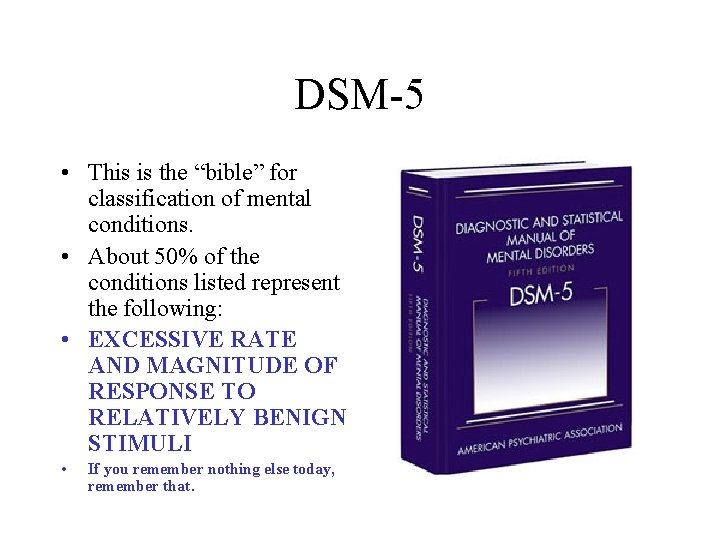
DSM-5 • This is the “bible” for classification of mental conditions. • About 50% of the conditions listed represent the following: • EXCESSIVE RATE AND MAGNITUDE OF RESPONSE TO RELATIVELY BENIGN STIMULI • If you remember nothing else today, remember that.
SOME DISORDERS ASSOCIATED WITH EXCESSIVE RATE AND MAGNITUDE OF RESPONSE TO RELATIVELY BENIGN STIMULI • ADHD • MIGRAINE (and sometimes SEIZURE ACTIVITY) • ANGER (rage) • ANXIETY • DEPRESSION (maybe? ? ? )
PAROXYSMAL DISORDERS SUDDEN ONSET, SHORT DURATION, QUICKLY LEAVING “EVENTS” (rate and magnitude inhibited by frontal dominance) • • MIGRAINE HEADACHES SEIZURES RAGE REACTIONS PANIC ATTACKS
PAROXYSMAL DISORDERS SUDDEN ONSET, SHORT DURATION, QUICKLY LEAVING “EVENTS” These disorders don’t necessarily have their origin in the front of the brain, but frontal inhibiting functions can make it difficult for them to initiate, and limit the rate and magnitude of the event.
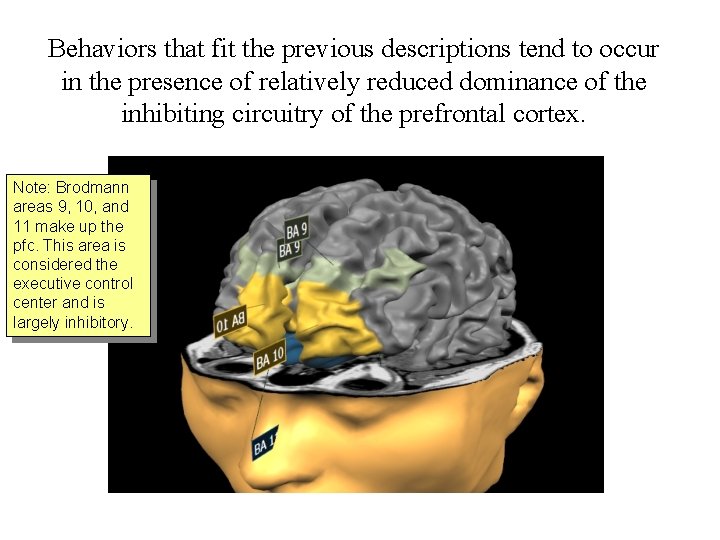
Behaviors that fit the previous descriptions tend to occur in the presence of relatively reduced dominance of the inhibiting circuitry of the prefrontal cortex. Note: Brodmann areas 9, 10, and 11 make up the pfc. This area is considered the executive control center and is largely inhibitory.
THE EVILS OF “POSITIVE FEEDBACK” • The human brain is design to work with powerful negative feedback loops in which the rate and magnitude of excessive activity is monitored and inhibited. • Lack of this inhibition allows “positive feedback”. For example, the howl of a microphone in an auditorium.
MY WORK INVOLVES INFRARED IMAGING OF THE PREFRONTAL CORTEX, AND THEN TRAINING FOR INCREASED PFC DOMINANCE USING p. IR HEG.
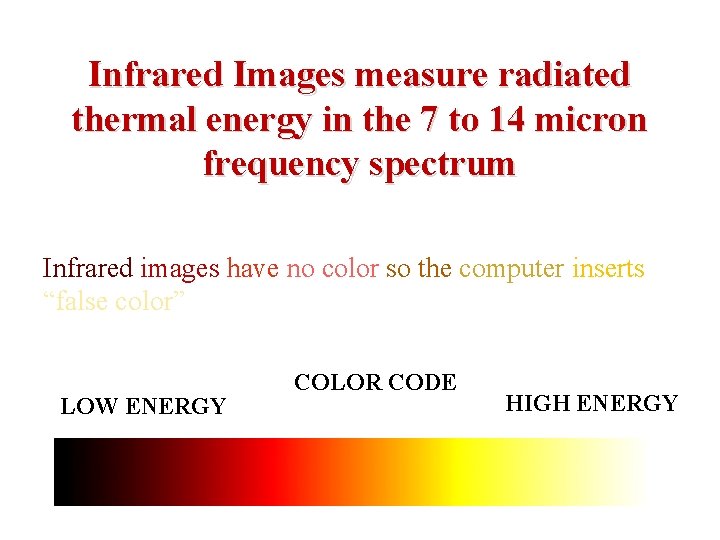
Infrared Images measure radiated thermal energy in the 7 to 14 micron frequency spectrum Infrared images have no color so the computer inserts “false color” LOW ENERGY COLOR CODE HIGH ENERGY
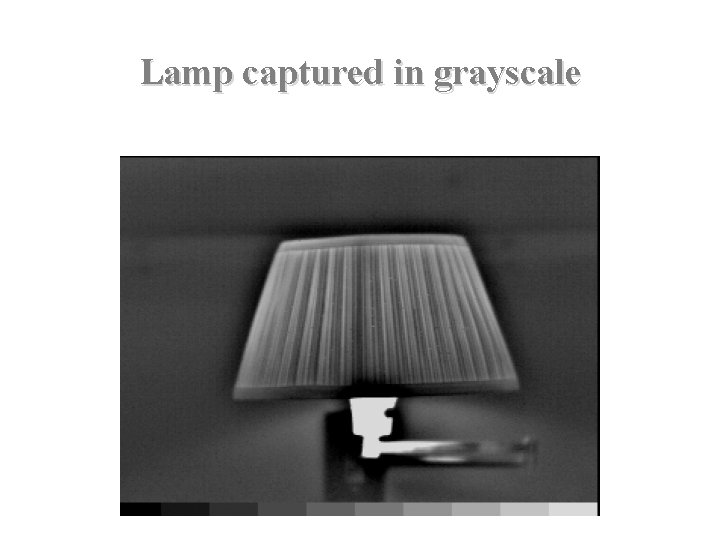
Lamp captured in grayscale
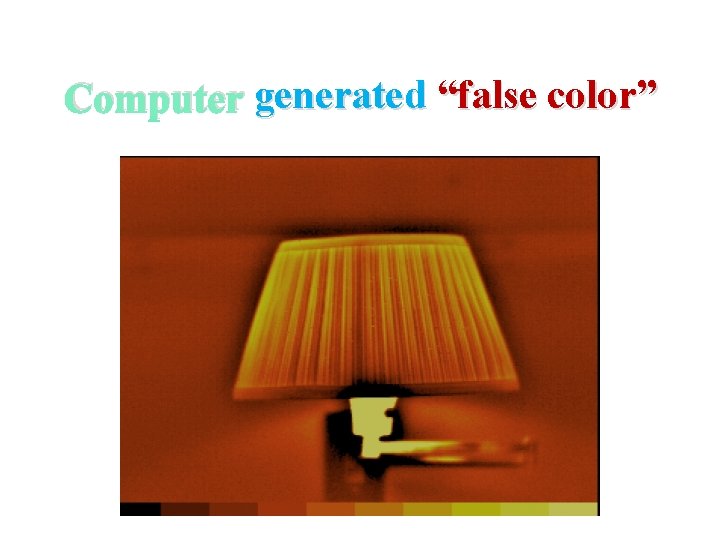
Computer generated “false color”
INTERPRETATION GUIDELINES FOR PREFRONTAL CORTICAL INFRARED IMAGES • Generally, images with high variability in infrared activity (large range from low to high output) are found in people who have severe problems. • Low variability is associated with more normal functioning. • Progress is measured by reduced variability.
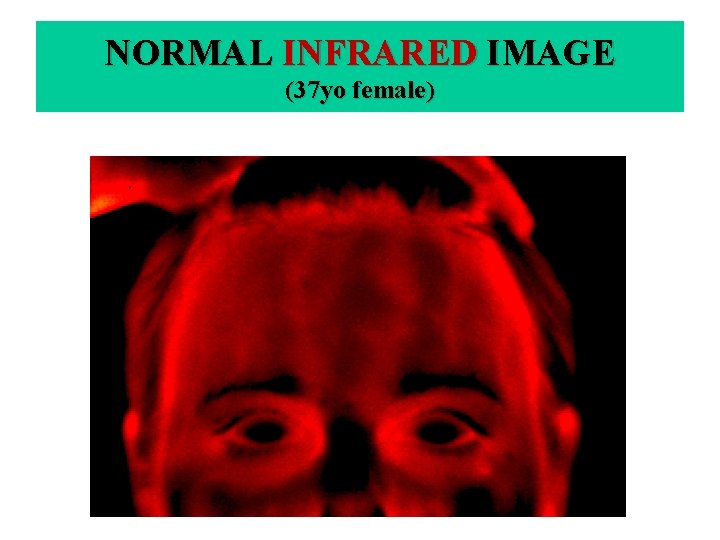
NORMAL INFRARED IMAGE (37 yo female)
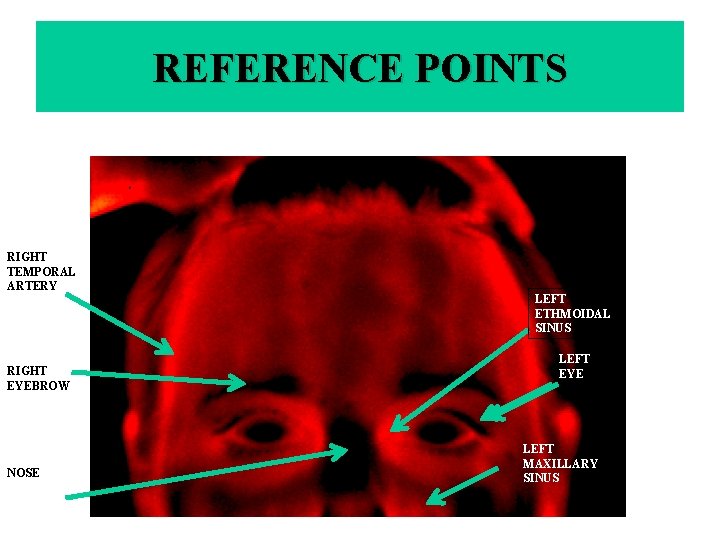
REFERENCE POINTS RIGHT TEMPORAL ARTERY RIGHT EYEBROW NOSE LEFT ETHMOIDAL SINUS LEFT EYE LEFT MAXILLARY SINUS
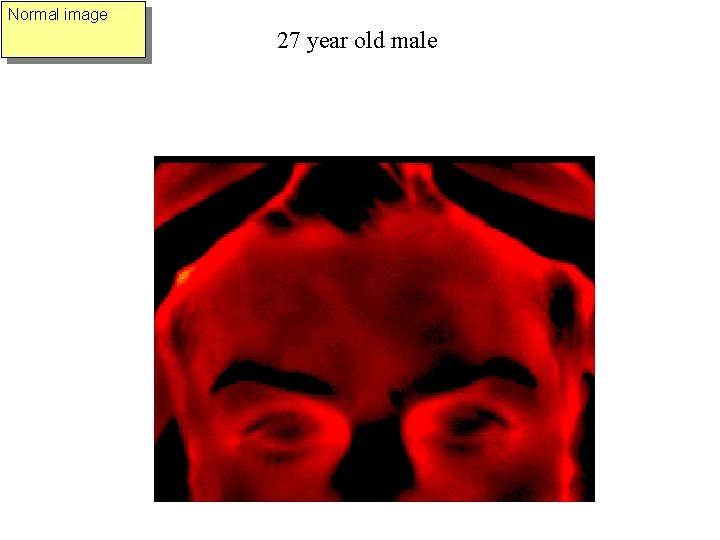
Normal image 27 year old male

IMAGES OF DEPRESSION
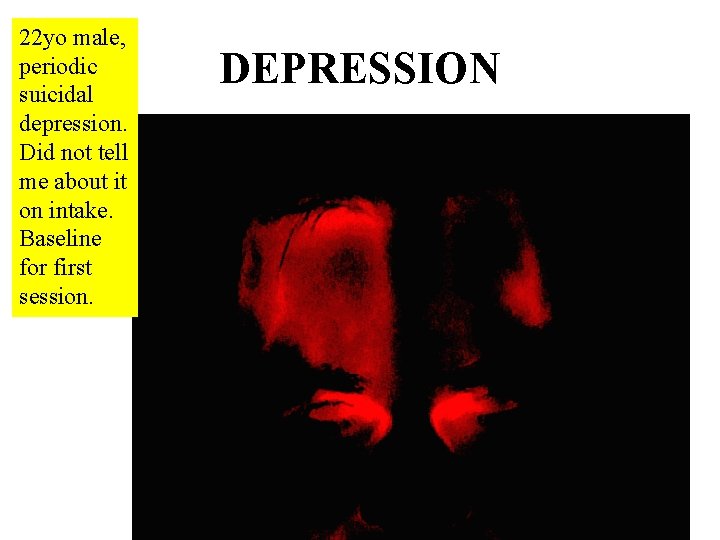
22 yo male, periodic suicidal depression. Did not tell me about it on intake. Baseline for first session. DEPRESSION
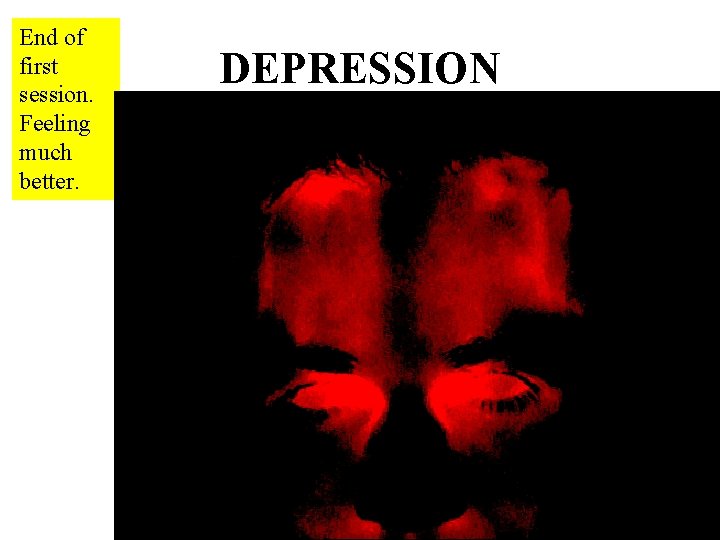
End of first session. Feeling much better. DEPRESSION
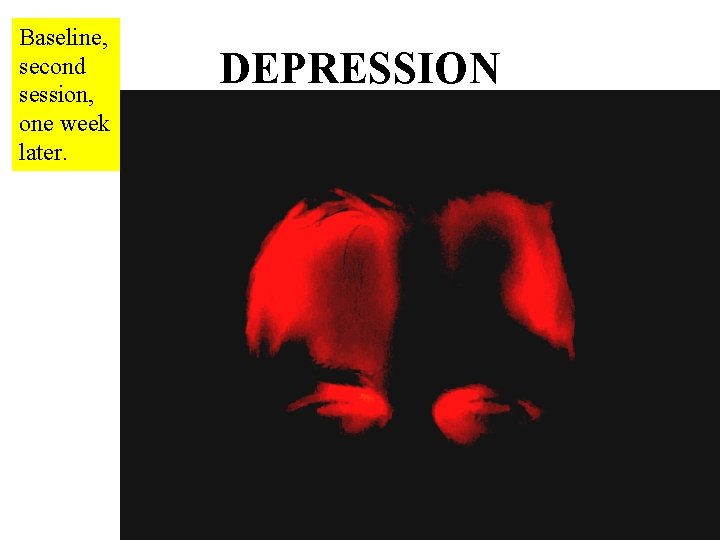
Baseline, second session, one week later. DEPRESSION
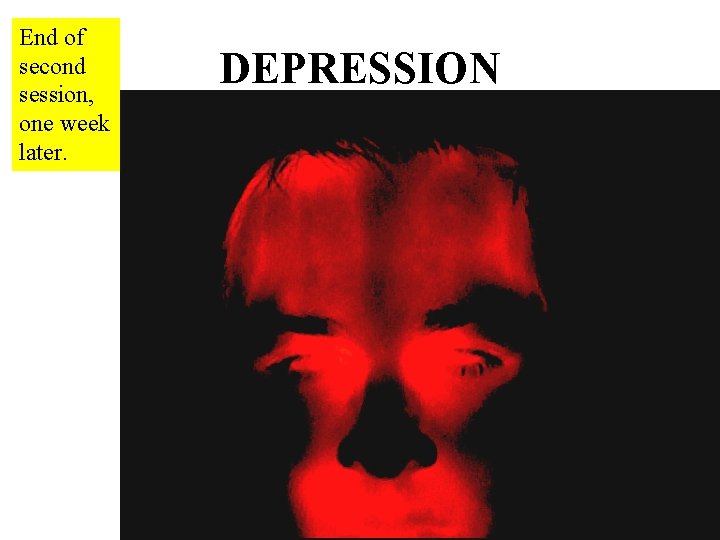
End of second session, one week later. DEPRESSION
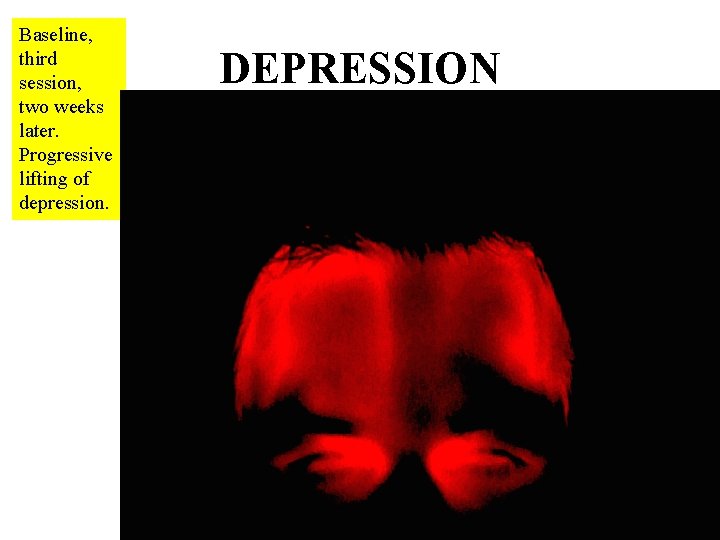
Baseline, third session, two weeks later. Progressive lifting of depression. DEPRESSION
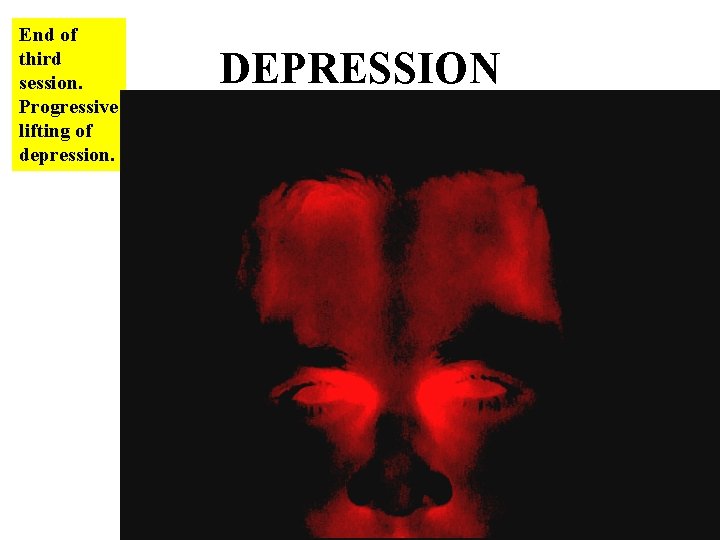
End of third session. Progressive lifting of depression. DEPRESSION
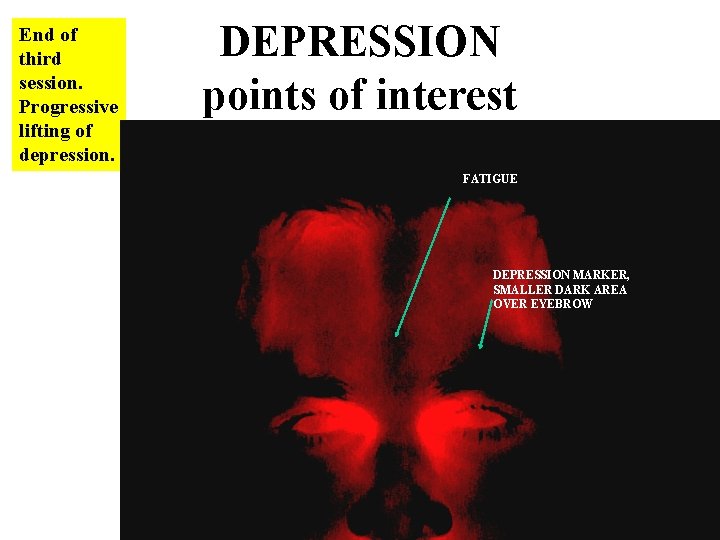
End of third session. Progressive lifting of depression. DEPRESSION points of interest FATIGUE DEPRESSION MARKER, SMALLER DARK AREA OVER EYEBROW
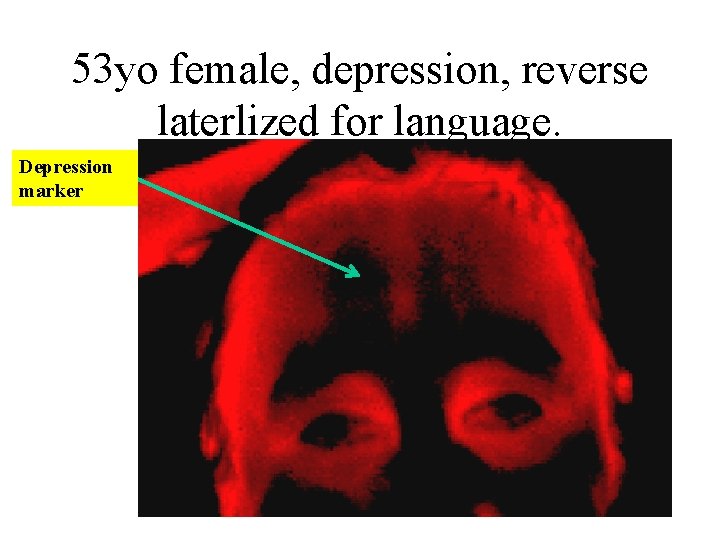
53 yo female, depression, reverse laterlized for language. Depression marker
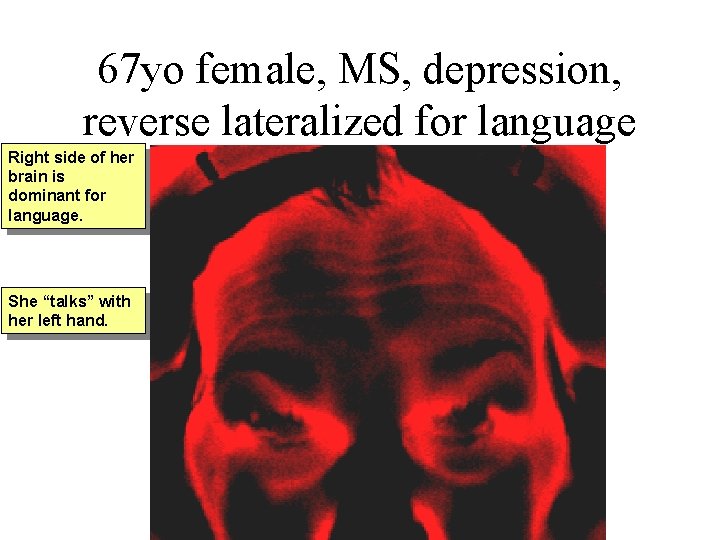
67 yo female, MS, depression, reverse lateralized for language Right side of her brain is dominant for language. She “talks” with her left hand.
IMAGE VARIABLES • A dark area over the left eye can correlate with depression, delusions, or language problems. • If language lateralization is reversed, the meaning of the images is also reversed. For example, depression will be seen on the right side instead.
ANXIETY – CLINICAL IMPRESSIONS • Anxiety does not localize very specifically on infrared imaging, but the images are usually abnormal and typically show a low level of PFC activity. Also, it tends to be present with other emotions, which complicates diagnosis.
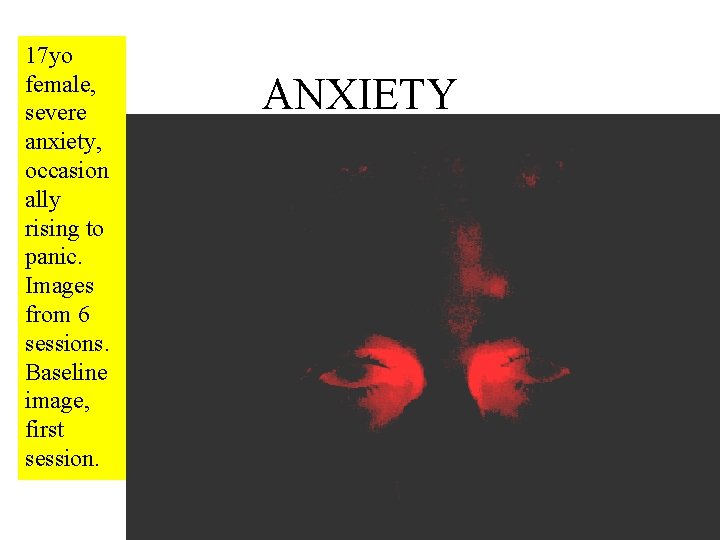
17 yo female, severe anxiety, occasion ally rising to panic. Images from 6 sessions. Baseline image, first session. ANXIETY
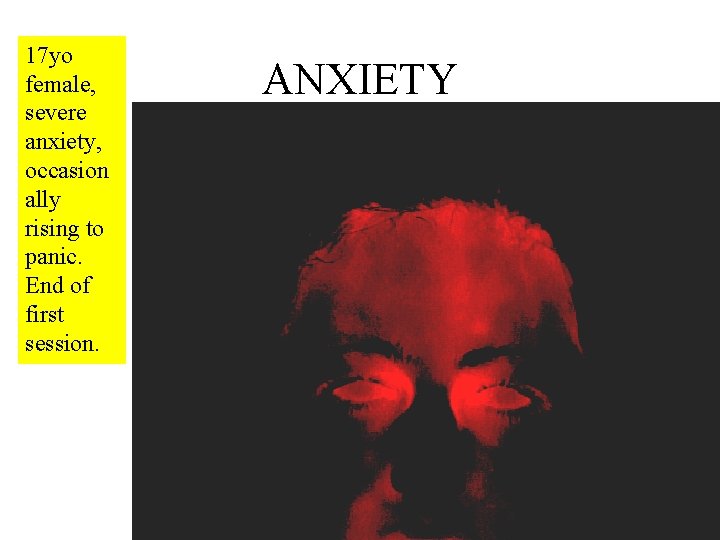
17 yo female, severe anxiety, occasion ally rising to panic. End of first session. ANXIETY
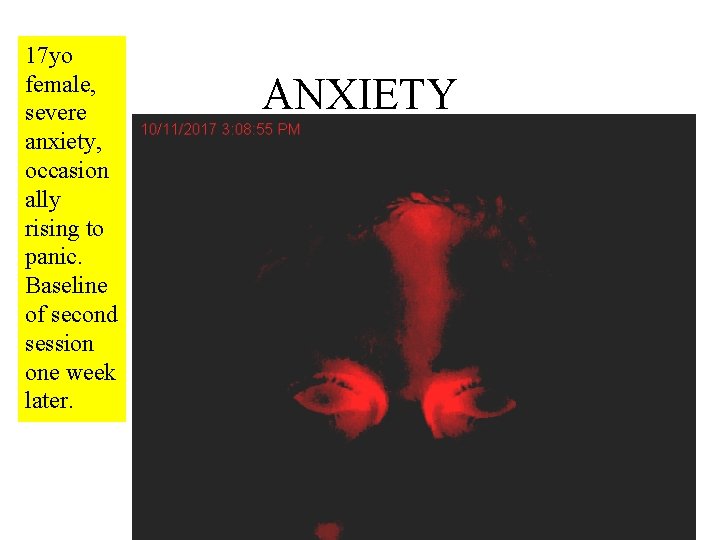
17 yo female, severe anxiety, occasion ally rising to panic. Baseline of second session one week later. ANXIETY
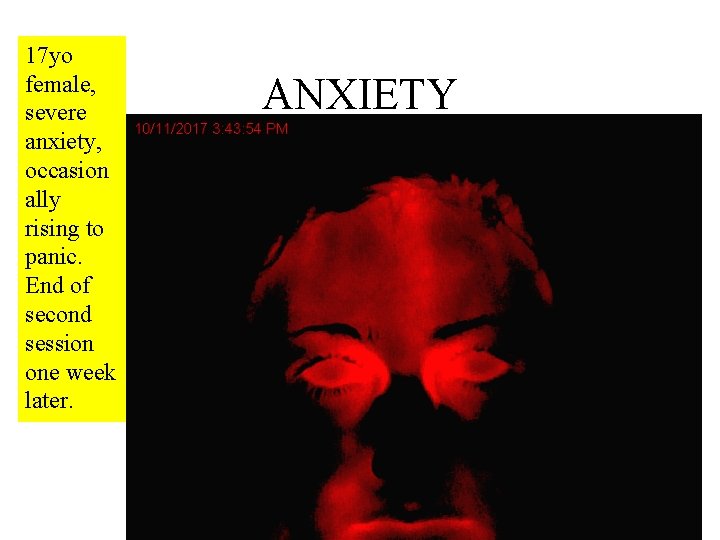
17 yo female, severe anxiety, occasion ally rising to panic. End of second session one week later. ANXIETY
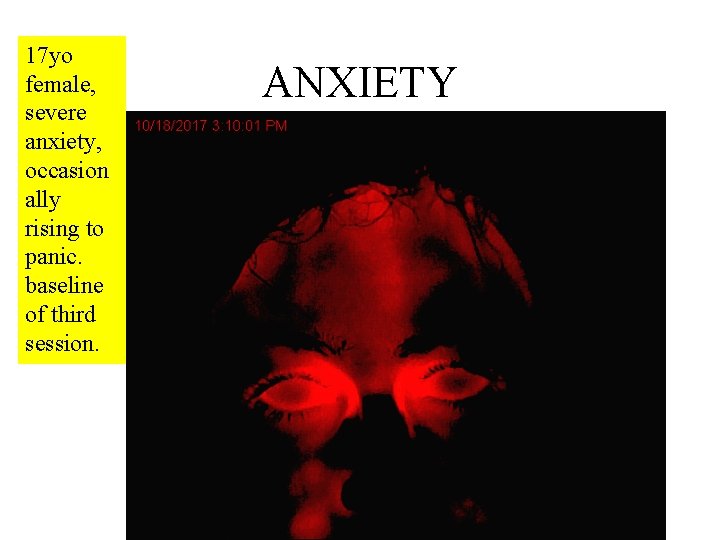
17 yo female, severe anxiety, occasion ally rising to panic. baseline of third session. ANXIETY
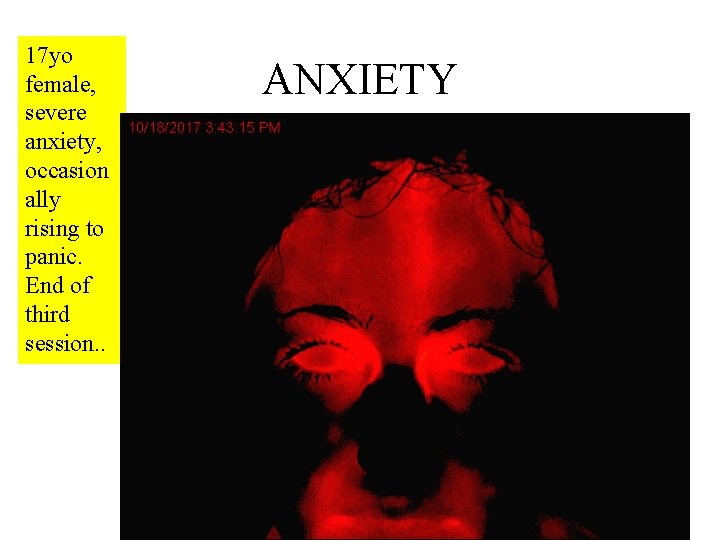
17 yo female, severe anxiety, occasion ally rising to panic. End of third session. . ANXIETY
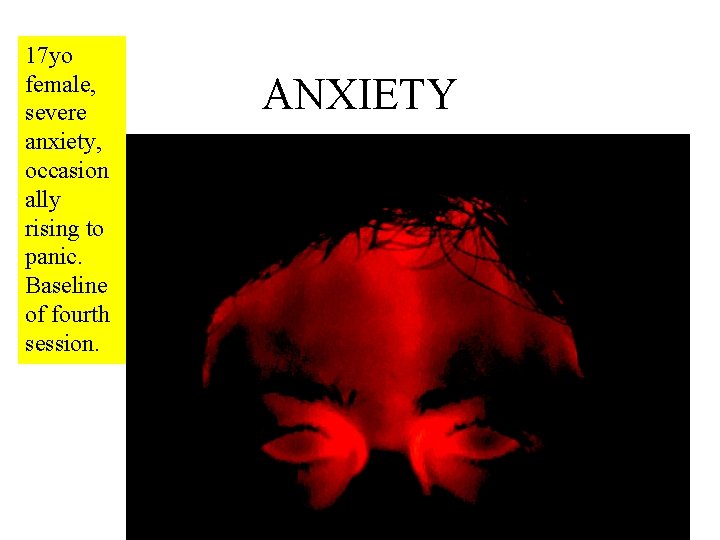
17 yo female, severe anxiety, occasion ally rising to panic. Baseline of fourth session. ANXIETY
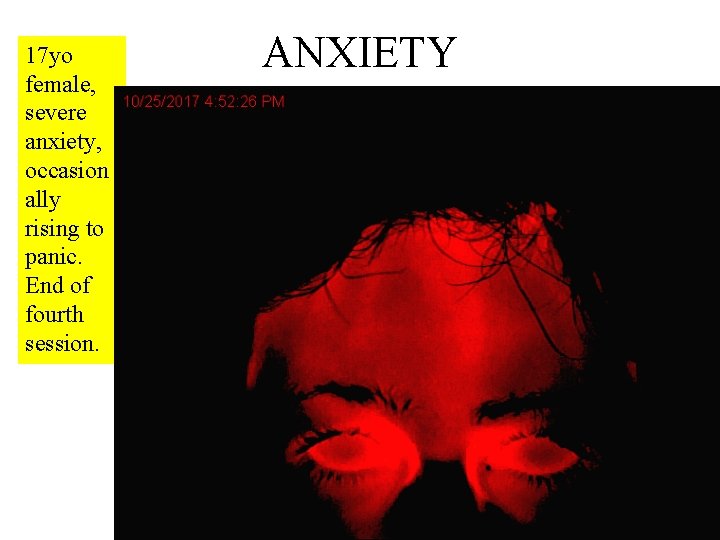
17 yo female, severe anxiety, occasion ally rising to panic. End of fourth session. ANXIETY
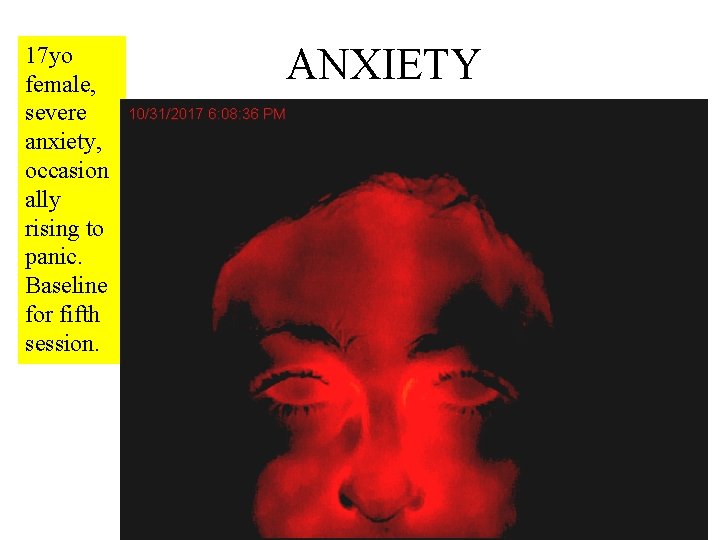
17 yo female, severe anxiety, occasion ally rising to panic. Baseline for fifth session. ANXIETY
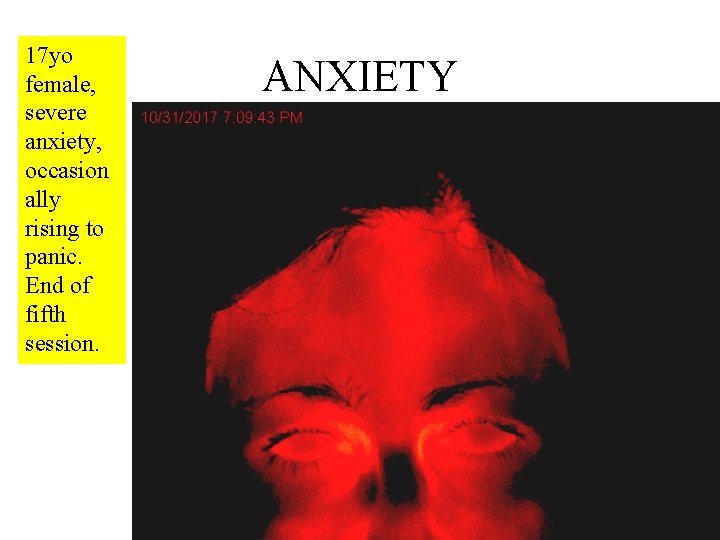
17 yo female, severe anxiety, occasion ally rising to panic. End of fifth session. ANXIETY
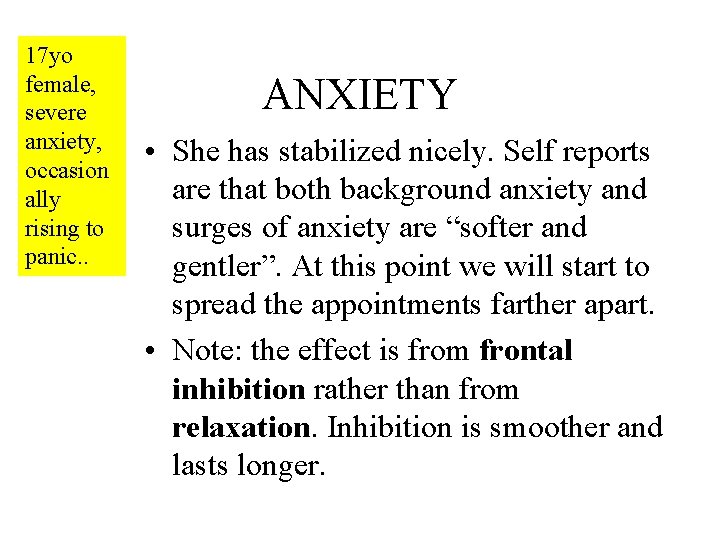
17 yo female, severe anxiety, occasion ally rising to panic. . ANXIETY • She has stabilized nicely. Self reports are that both background anxiety and surges of anxiety are “softer and gentler”. At this point we will start to spread the appointments farther apart. • Note: the effect is from frontal inhibition rather than from relaxation. Inhibition is smoother and lasts longer.
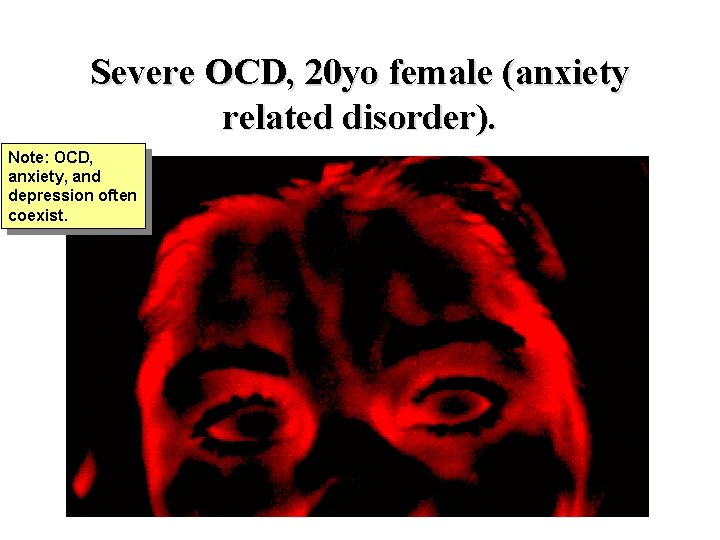
Severe OCD, 20 yo female (anxiety related disorder). Note: OCD, anxiety, and depression often coexist.
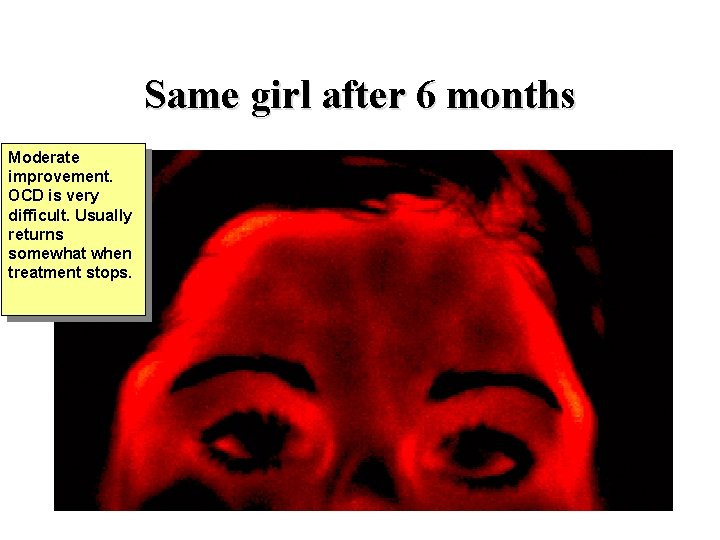
Same girl after 6 months Moderate improvement. OCD is very difficult. Usually returns somewhat when treatment stops.
AUTISM/ASPERGER SPECTRUM Images generally localize to the non-language side of the forehead (usually over the right eye) and present as low level of activity (dark).
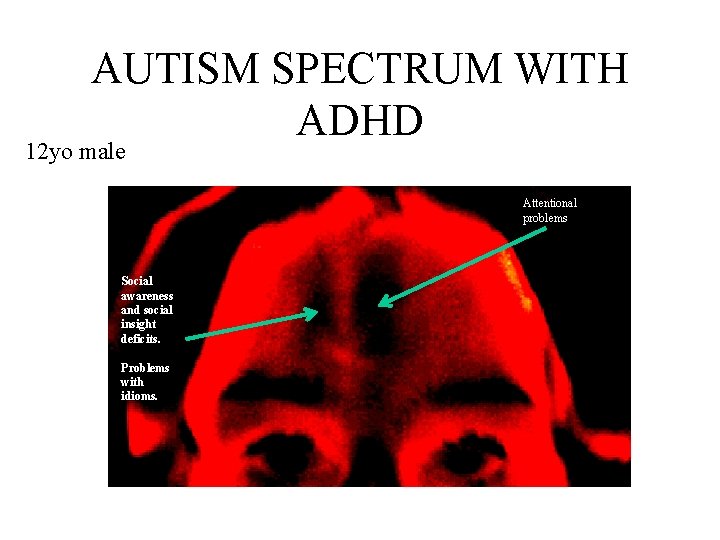
AUTISM SPECTRUM WITH ADHD 12 yo male Attentional problems Social awareness and social insight deficits. Problems with idioms.
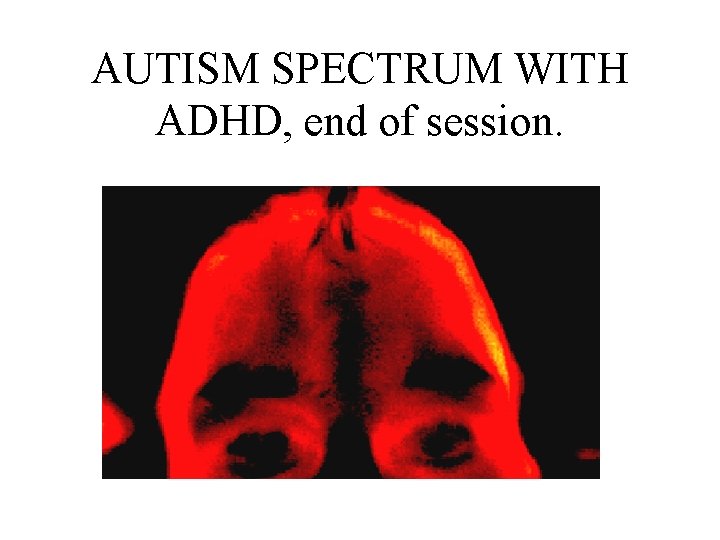
AUTISM SPECTRUM WITH ADHD, end of session.
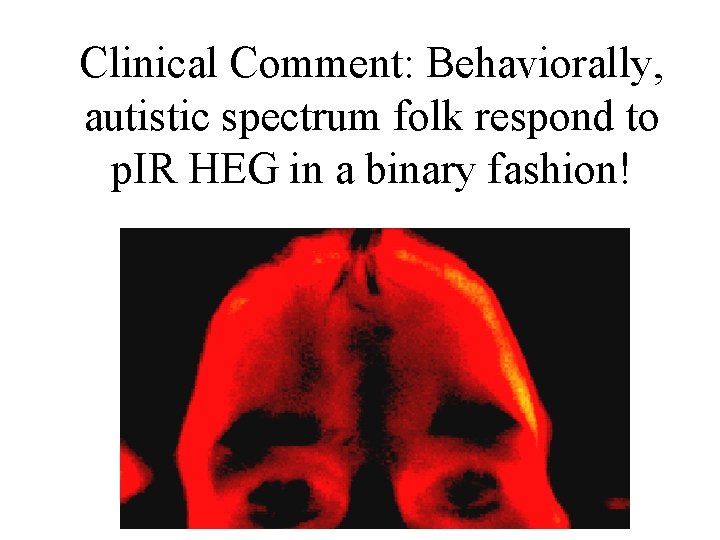
Clinical Comment: Behaviorally, autistic spectrum folk respond to p. IR HEG in a binary fashion!
HEAD INJURIES • Head injuries consistently cause the prefrontal cortex to go offline. • Surprisingly, it is often relatively easy to bring it back online. • These folks also have a very limited ability to sustain mental effort. Often limited to 3 minutes.
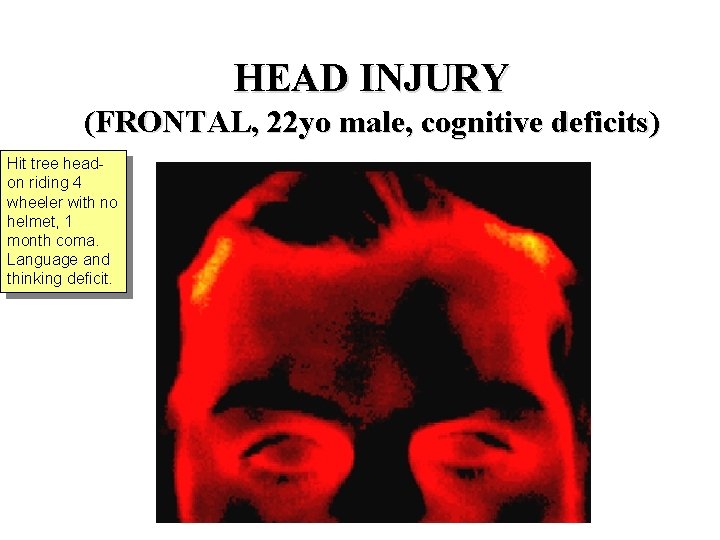
HEAD INJURY (FRONTAL, 22 yo male, cognitive deficits) Hit tree headon riding 4 wheeler with no helmet, 1 month coma. Language and thinking deficit.
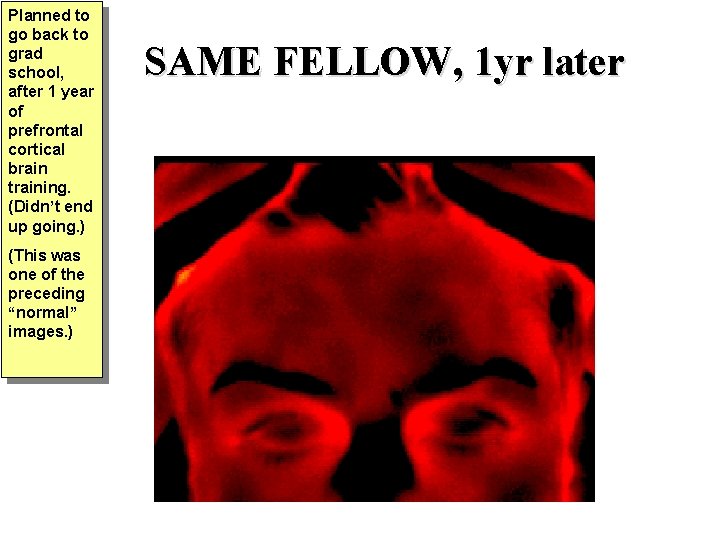
Planned to go back to grad school, after 1 year of prefrontal cortical brain training. (Didn’t end up going. ) (This was one of the preceding “normal” images. ) SAME FELLOW, 1 yr later
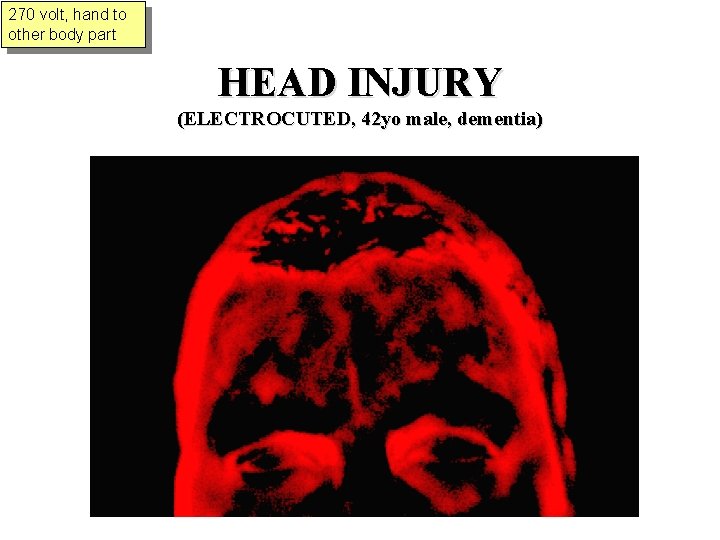
270 volt, hand to other body part HEAD INJURY (ELECTROCUTED, 42 yo male, dementia)
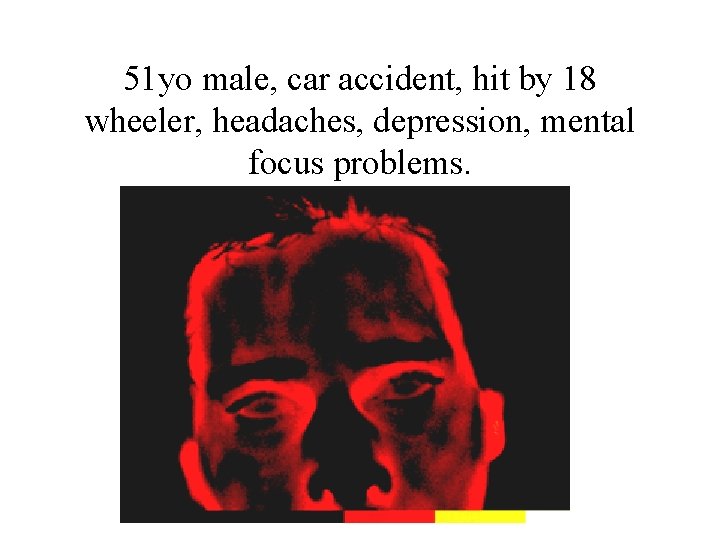
51 yo male, car accident, hit by 18 wheeler, headaches, depression, mental focus problems.
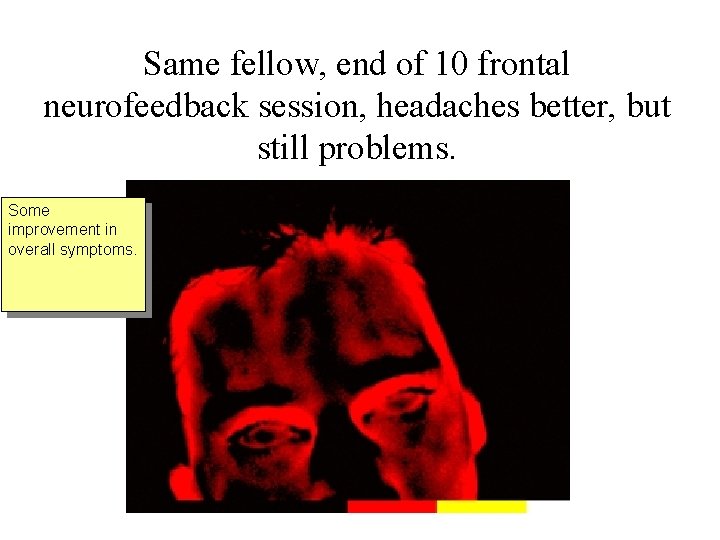
Same fellow, end of 10 frontal neurofeedback session, headaches better, but still problems. Some improvement in overall symptoms.

ANGER / RAGE
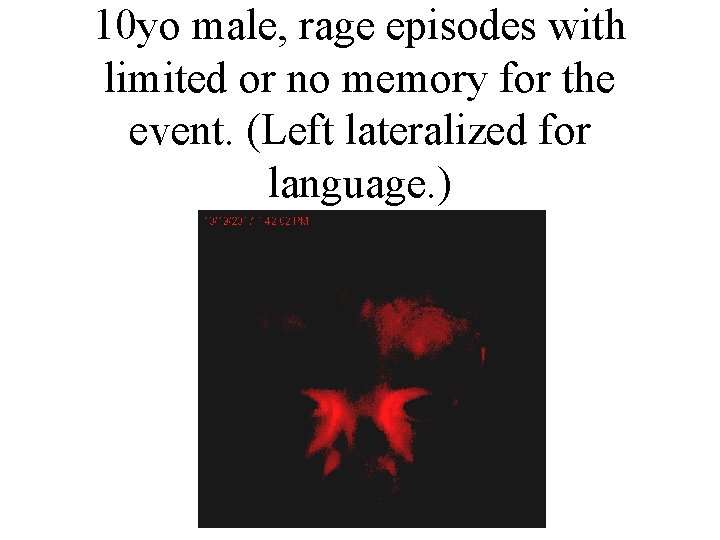
10 yo male, rage episodes with limited or no memory for the event. (Left lateralized for language. )
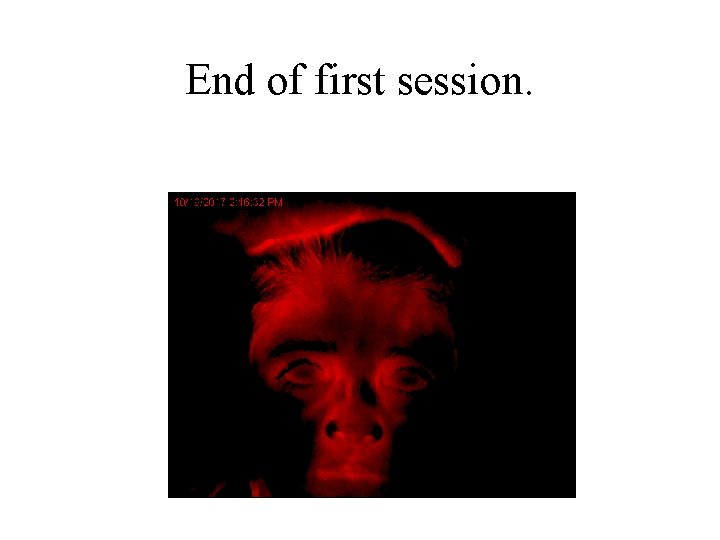
End of first session.
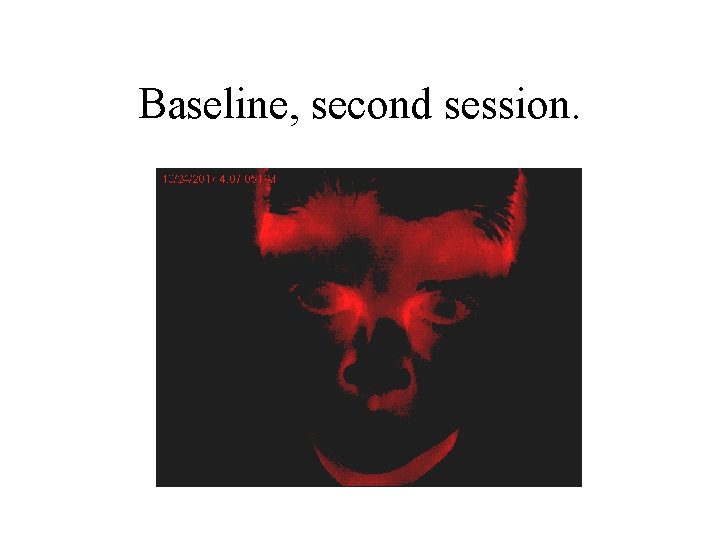
Baseline, second session.
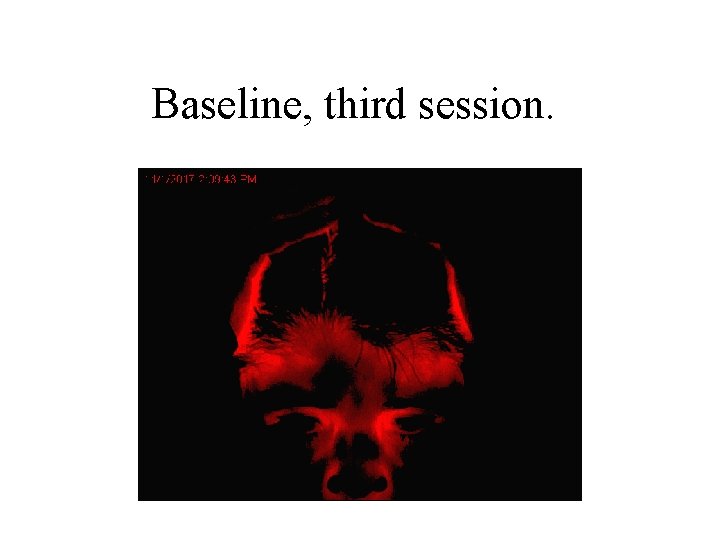
Baseline, third session.
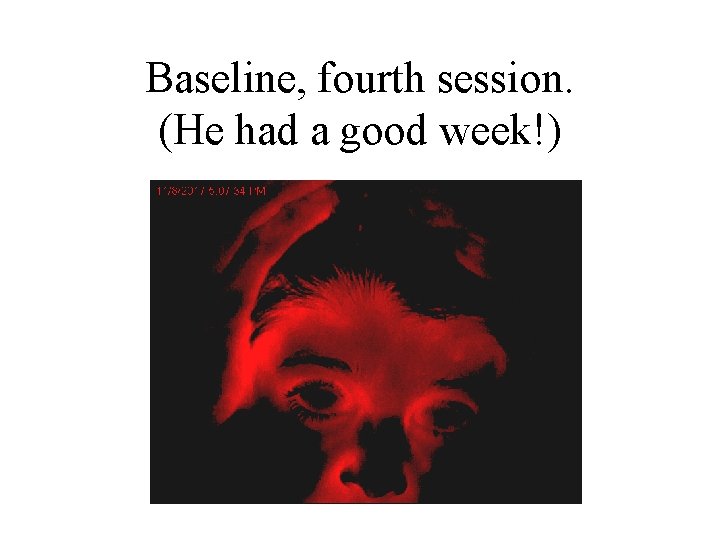
Baseline, fourth session. (He had a good week!)
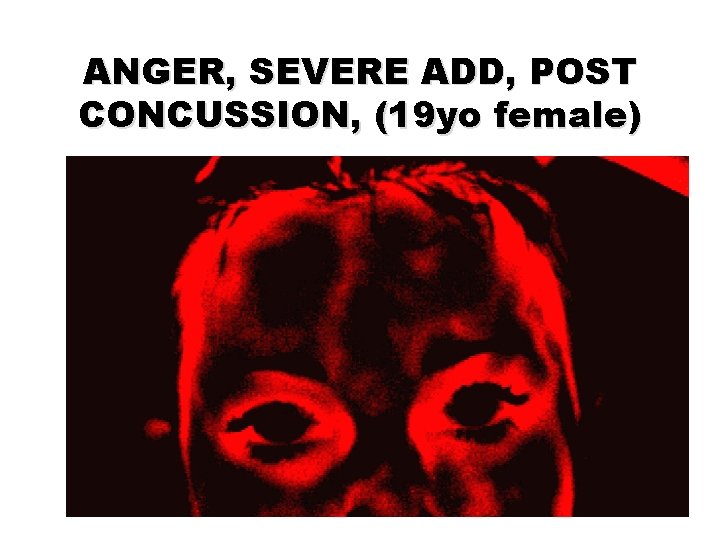
ANGER, SEVERE ADD, POST CONCUSSION, (19 yo female)
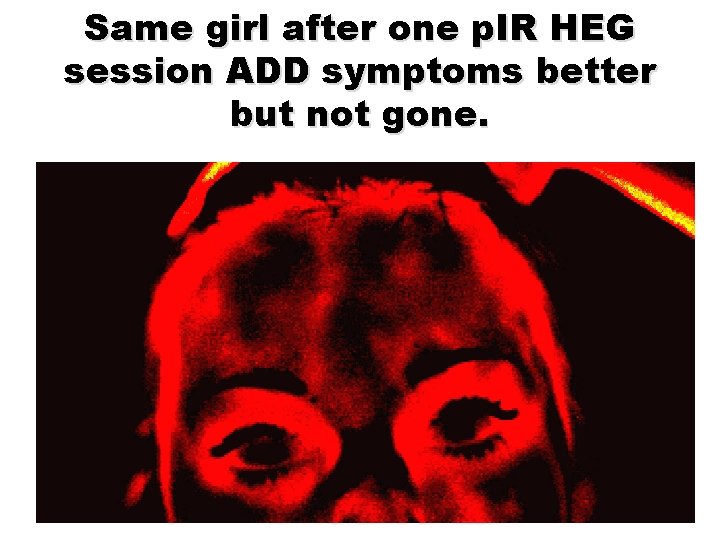
Same girl after one p. IR HEG session ADD symptoms better but not gone.
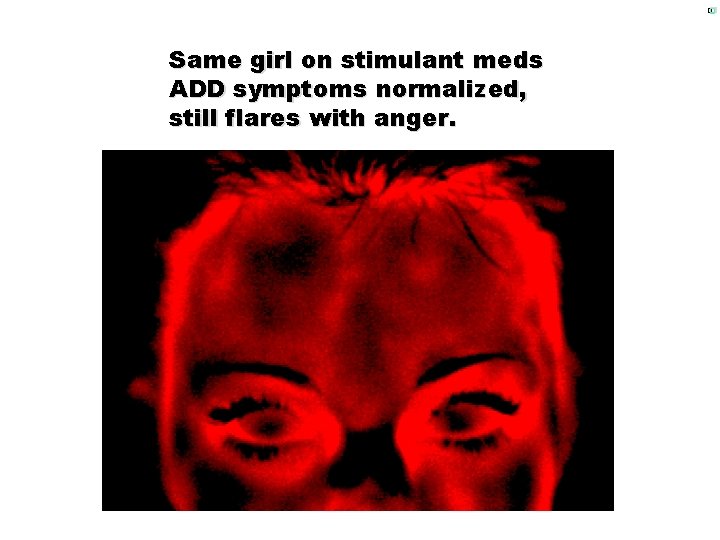
� Same girl on stimulant meds ADD symptoms normalized, still flares with anger.
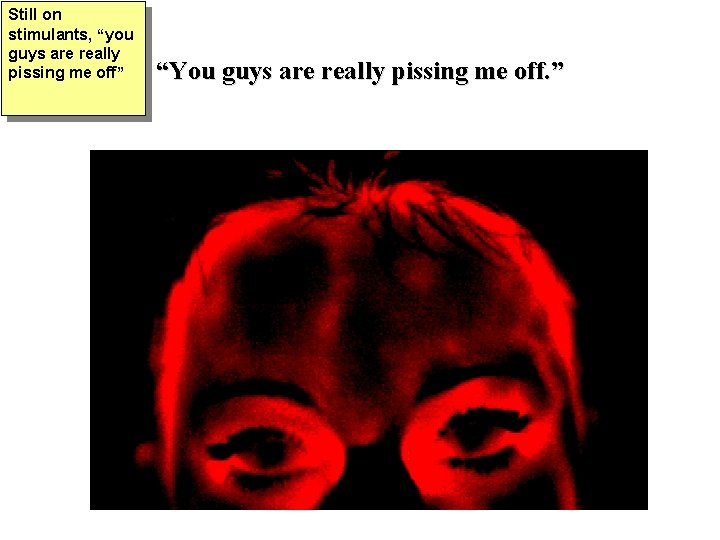
Still on stimulants, “you guys are really pissing me off” “You guys are really pissing me off. ”

OTHER
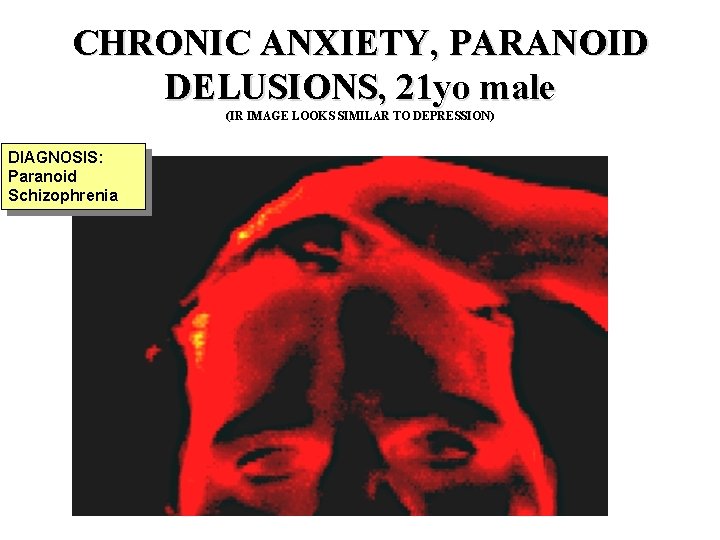
CHRONIC ANXIETY, PARANOID DELUSIONS, 21 yo male (IR IMAGE LOOKS SIMILAR TO DEPRESSION) DIAGNOSIS: Paranoid Schizophrenia
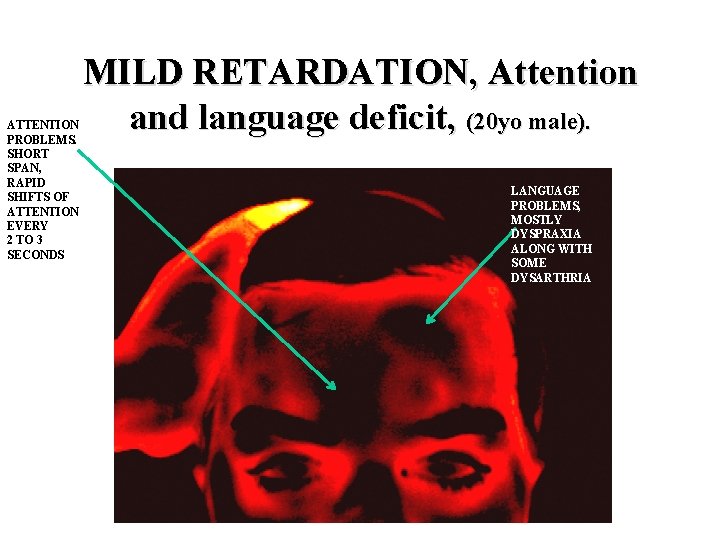
ATTENTION PROBLEMS. SHORT SPAN, RAPID SHIFTS OF ATTENTION EVERY 2 TO 3 SECONDS MILD RETARDATION, Attention and language deficit, (20 yo male). LANGUAGE PROBLEMS, MOSTLY DYSPRAXIA ALONG WITH SOME DYSARTHRIA
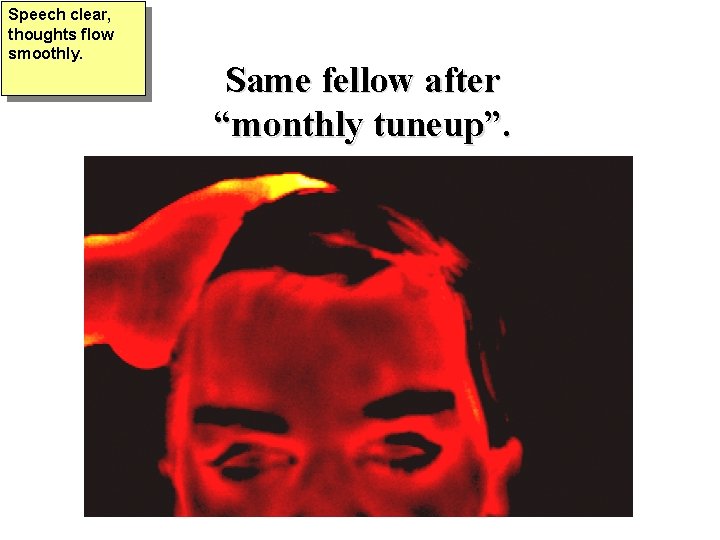
Speech clear, thoughts flow smoothly. Same fellow after “monthly tuneup”.
IR Image Summary High variability is generally not a good sign. Black areas are strongly suggestive of pathology. Reduction of variability is strongly suggestive of improved functioning.
BIOFEEDBACK SUMMARY Biofeedback “feeds back” a physiological signal for the purpose of training improved self regulation.

END
- Slides: 88