
Bioethics in Anatomy Education Resources Clara Cells Description
Bioethics in Anatomy Education Resources: Clara Cells Description: This set of Power. Point slides provides information on the name change of Clara cells to bronchiolar exocrine cells (club cells) due to the association of Dr. Max Clara (1899 – 1966) with the use of human tissues obtained unethically. The first slide can be used alone as a short reference to the issue, while the additional slides provides detail for a more in-depth exploration of the topic. The topics covered by this resource include: Anatomy History Ethics - consent Histology Creator(s): Thomas Champney, Sabine Hildebrandt Contact details: tchampney@med. miami. edu , sabine. hildebrandt@childrens. harvard. edu Further reading: Winkelmann A, Noack T. The Clara cell: a "Third Reich eponym"? . Eur Respir J 36: 722 -727, 2010.

Bronchiolar Exocrine Cells (Club cells) NOT Clara Cells Winkelmann, A and T Noack. 2010. “The Clara Cell: a “Third Reich Eponym”? ” European Respiratory Journal 36: 722 -727. https: //erj. ersjournals. com/content/36/4/722 Comment by Woywodt, Lefrak and Matteson: https: //erj. ersjournals. com/content/36/4/706 Bronchiolar Exocrine Cells -------
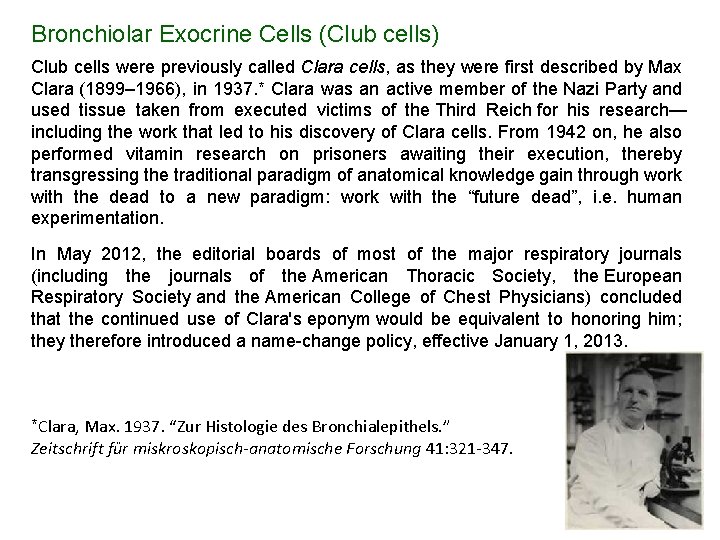
Bronchiolar Exocrine Cells (Club cells) Club cells were previously called Clara cells, as they were first described by Max Clara (1899– 1966), in 1937. * Clara was an active member of the Nazi Party and used tissue taken from executed victims of the Third Reich for his research— including the work that led to his discovery of Clara cells. From 1942 on, he also performed vitamin research on prisoners awaiting their execution, thereby transgressing the traditional paradigm of anatomical knowledge gain through work with the dead to a new paradigm: work with the “future dead”, i. e. human experimentation. In May 2012, the editorial boards of most of the major respiratory journals (including the journals of the American Thoracic Society, the European Respiratory Society and the American College of Chest Physicians) concluded that the continued use of Clara's eponym would be equivalent to honoring him; they therefore introduced a name-change policy, effective January 1, 2013. *Clara, Max. 1937. “Zur Histologie des Bronchialepithels. ” Zeitschrift für miskroskopisch-anatomische Forschung 41: 321 -347.

Bronchiolar Exocrine Cells (Club cells) Counterargument: Eponyms as “teachable moments” in history of medicine If all eponyms, such as Clara’s, are removed, are we “neutralizing” history, forgetting and repeating? Seidelman WE, 2018. The tainted eponym: transgression and memory in medical science. Wiener Medizinische Wochenschrift 130 : S 186 -S 191. https: //link. springer. com/content/pdf/10. 1007%2 Fs 00508 -018 -1343 -y. pdf
- Slides: 4