
BIOELECTRONICS Rahul Sarpeshkar Associate Professor Research Lab of
BIOELECTRONICS Rahul Sarpeshkar Associate Professor Research Lab of Electronics Electrical Engineering and Computer Science Bio-inspired Electronics: Electronics inspired by biology. Biomedical Electronics: Ultra-low-power electronics for medical applications CBA NSF talk. 10/12/06
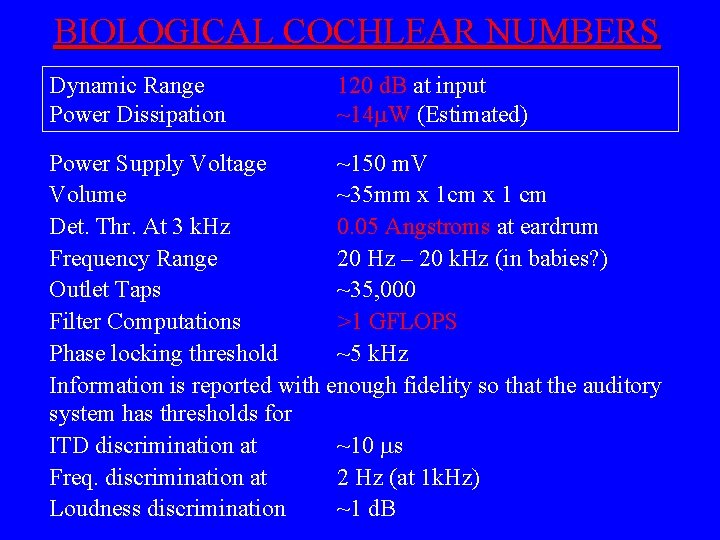
BIOLOGICAL COCHLEAR NUMBERS Dynamic Range Power Dissipation 120 d. B at input ~14 W (Estimated) Power Supply Voltage ~150 m. V Volume ~35 mm x 1 cm x 1 cm Det. Thr. At 3 k. Hz 0. 05 Angstroms at eardrum Frequency Range 20 Hz – 20 k. Hz (in babies? ) Outlet Taps ~35, 000 Filter Computations >1 GFLOPS Phase locking threshold ~5 k. Hz Information is reported with enough fidelity so that the auditory system has thresholds for ITD discrimination at ~10 s Freq. discrimination at 2 Hz (at 1 k. Hz) Loudness discrimination ~1 d. B
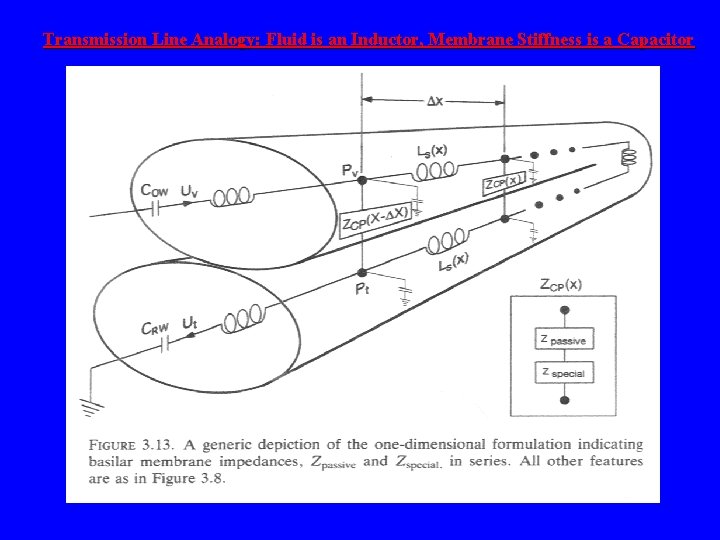
Transmission Line Analogy: Fluid is an Inductor, Membrane Stiffness is a Capacitor
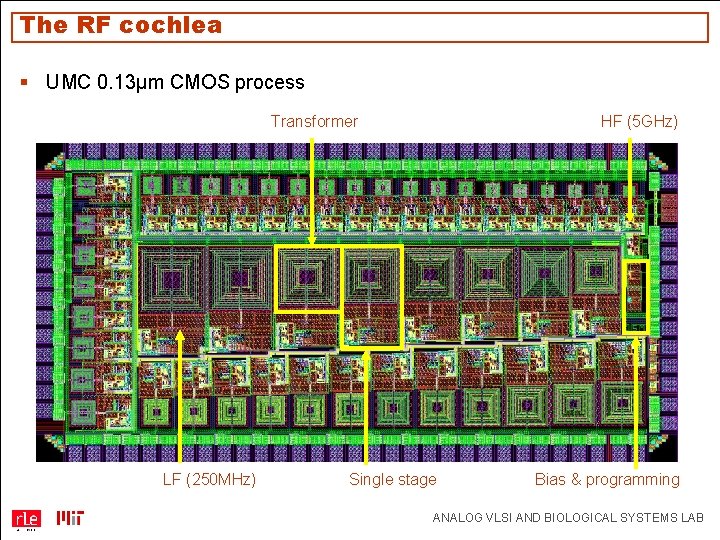
The RF cochlea § UMC 0. 13µm CMOS process Transformer LF (250 MHz) HF (5 GHz) Single stage Bias & programming ANALOG VLSI AND BIOLOGICAL SYSTEMS LAB
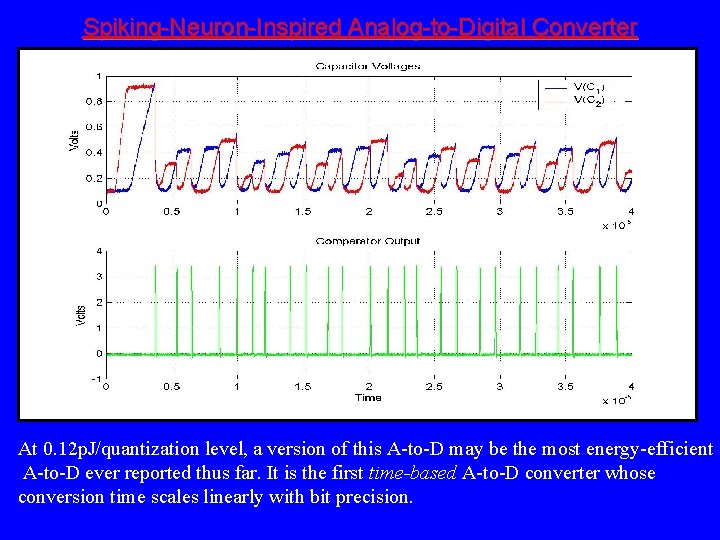
Spiking-Neuron-Inspired Analog-to-Digital Converter At 0. 12 p. J/quantization level, a version of this A-to-D may be the most energy-efficient A-to-D ever reported thus far. It is the first time-based A-to-D converter whose conversion time scales linearly with bit precision.
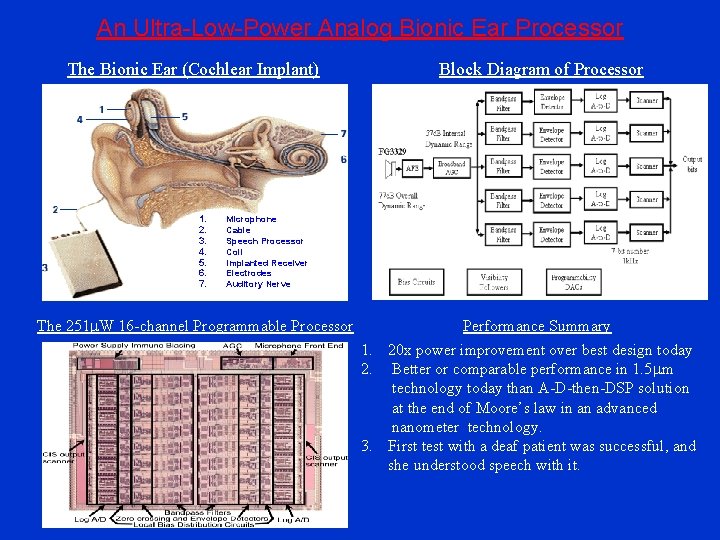
An Ultra-Low-Power Analog Bionic Ear Processor The Bionic Ear (Cochlear Implant) 1. 2. 3. 4. 5. 6. 7. Block Diagram of Processor Microphone Cable Speech Processor Coil Implanted Receiver Electrodes Auditory Nerve The 251 W 16 -channel Programmable Processor Performance Summary 1. 20 x power improvement over best design today 2. Better or comparable performance in 1. 5 m technology today than A-D-then-DSP solution at the end of Moore’s law in an advanced nanometer technology. 3. First test with a deaf patient was successful, and she understood speech with it.
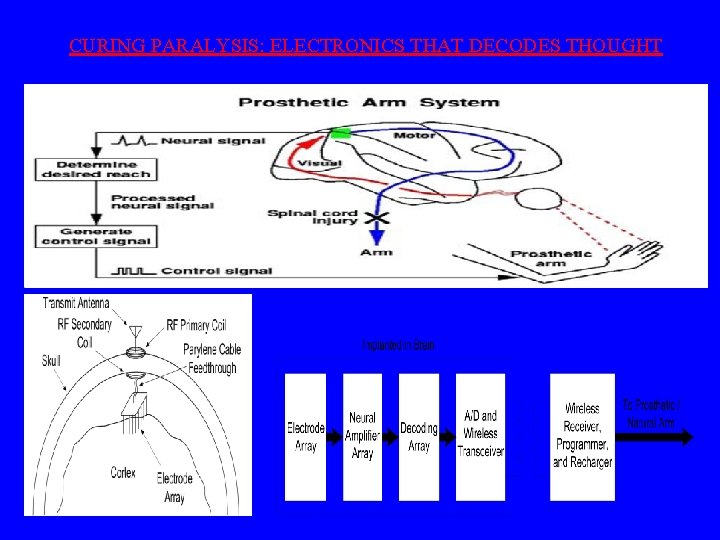
CURING PARALYSIS: ELECTRONICS THAT DECODES THOUGHT
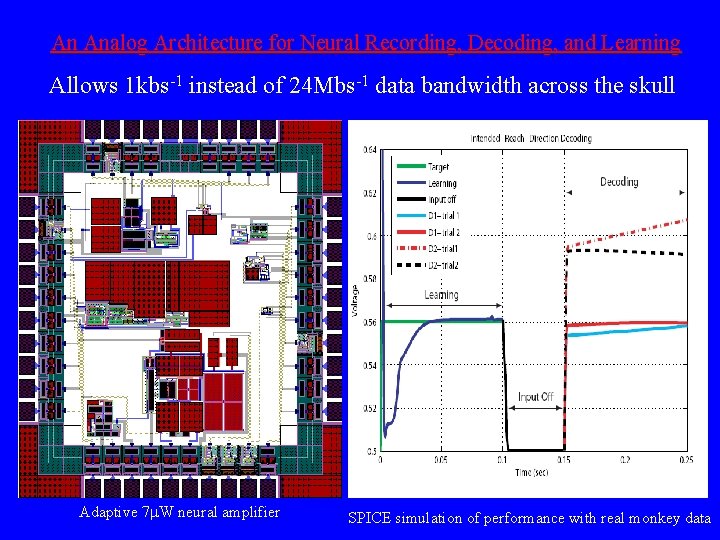
An Analog Architecture for Neural Recording, Decoding, and Learning Allows 1 kbs-1 instead of 24 Mbs-1 data bandwidth across the skull Adaptive 7 W neural amplifier SPICE simulation of performance with real monkey data
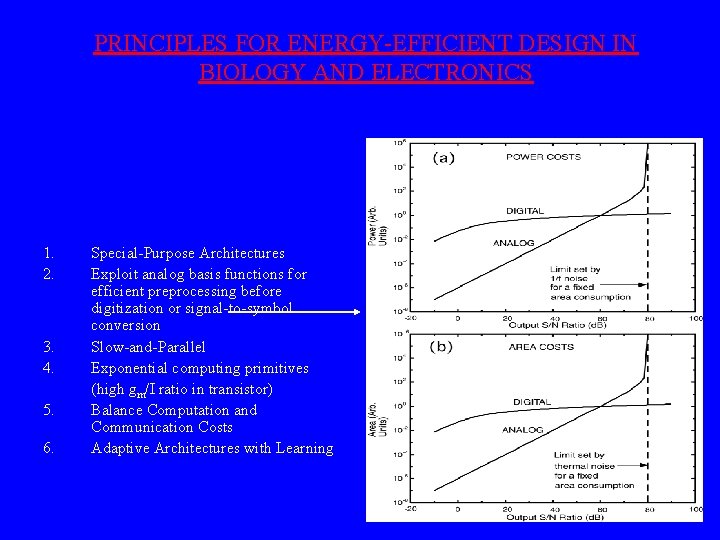
PRINCIPLES FOR ENERGY-EFFICIENT DESIGN IN BIOLOGY AND ELECTRONICS 1. 2. 3. 4. 5. 6. Special-Purpose Architectures Exploit analog basis functions for efficient preprocessing before digitization or signal-to-symbol conversion Slow-and-Parallel Exponential computing primitives (high gm/I ratio in transistor) Balance Computation and Communication Costs Adaptive Architectures with Learning
- Slides: 9