
Biodiversity What is an Ecosystem An ecosystem is
Biodiversity
What is an Ecosystem? �An ecosystem is a biological community of interacting organisms and their physical environment An ecosystem could be any geographic environment you could think of: desert, tropical rainforest, grasslands, etc. �Ecology is the study of how living organisms interact with their environment.

Ecosystem �Characteristics of an ecosystem are identified as biotic factors or abiotic factors �Biotic Factors – living parts The organisms themselves, the number of producers, food chains/food webs, competition for food sources, symbiotic relationships. �Abiotic Factors – non-living chemical and physical parts Storms, natural disasters, geography of the land, water, sunlight, temperature, humidity, and soil
What is natural selection? What is adaptation?
Natural Selection �Natural Selection is the process by which organisms change over time. Those that are best adapted to their environment survive and pass their traits to the next generation. �Ex: Bird beaks of the Galapagos Islands
Adaptation �Adaptation allows for variety (variation) within a species. �Adaptation determines in natural selection who will survive.
Biodiversity �Biodiversity- is the number of different species of plants and animals in an area *Having a high number of species is a good thing!
Asexual vs Sexual Reproduction �Sexual reproduction increases biodiversity �Asexual does not because all offspring are identical= no diversity
Why is Biodiversity important? � Think back to the trees exercise, why is Biodiversity important?
Why is Biodiversity important? �Biodiversity encourages sustainability. �Sustainability- the ability of an ecosystem to keep diverse and productive through time despite humans deriving their needs from natural resources. �The more organisms that can adapt to changes in the environment (ex: disease, weather change, etc. ) the healthier the environment is
Biodiversity and Sustainability �Diverse ecosystems like rain forests and coral reefs have a very wide variety of producers and organisms that depend on those producers for food (high rainfall, moderate temperatures �Limited ecosystems like deserts or tundra do not have a wide variety of living organisms due to harsh abiotic factors (low rainfall, extreme temperatures)
Example 1: �When Mt. St. Helens volcano erupted in 1980, it wiped out the entire mountain life; however, there was one mammal that survived. A small furry gopher species had tunneled underground and eventually found its way to the surface, after the lava cooled. �What allowed for this gopher to survive?
Example 2 �The tundra is a considered cold environments in the north with small amounts of light each day. It can only support a limited number of consumers because the cold climate limits the growth and reproduction cycle of plants. Its biodiversity is limited. -What would happen to the environment if there was a change (humans drill for oil and cause a spill)? Does this ecosystem have a high or low sustainability
What influences biodiversity? �What do you think would increase biodiversity? �What makes an environment “healthy”?
1. ) High number of resources �Good temperature �Food available �Fresh water available �Nutrients (in soil, air, food)
2. ) High number of species �High number of food chains �High number of producers
3. ) Genetic Variation �High number of species �High number of organisms that reproduce sexually vs asexually (allows for adaptation)
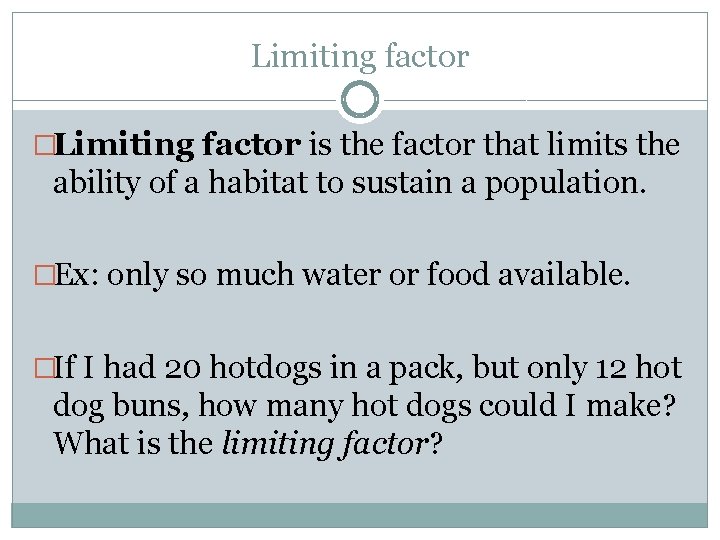
Limiting factor �Limiting factor is the factor that limits the ability of a habitat to sustain a population. �Ex: only so much water or food available. �If I had 20 hotdogs in a pack, but only 12 hot dog buns, how many hot dogs could I make? What is the limiting factor?
- Slides: 18