
BIODIVERSITY OF CORAL REEF S ALONG THE GULF
BIODIVERSITY OF CORAL REEF S ALONG THE GULF COAST OF SAUDI ARABIA) Krishna Kumar, P. K. , Joydas, T. V. , Lindo, R. T. , Magallanes, R. , Cali, N. A. , Saji, P. A. , Manikandan, K. P and Qurban, M. B. Centre for Environment & Water, Research Institute King Fahd University of Petroleum & Minerals, Dhahran 31261, Saudi Arabia. 1
WHY ARE CORAL REEFS SO IMPORTANT? Coral reefs are some of the oldest and most diverse ecosystems on the planet. Living museums and reflect thousands of years of history. Breeding & feeding ground for several marine organisms including fishes. Provide resources and services worth many billions of dollars each year to human societies. Buffers shorelines against waves, storms, and floods, helping to prevent loss of life, property damage, and erosion. Coral reef plants and animals are important sources of new medicines “medicine cabinets” of the 21 st century. 2
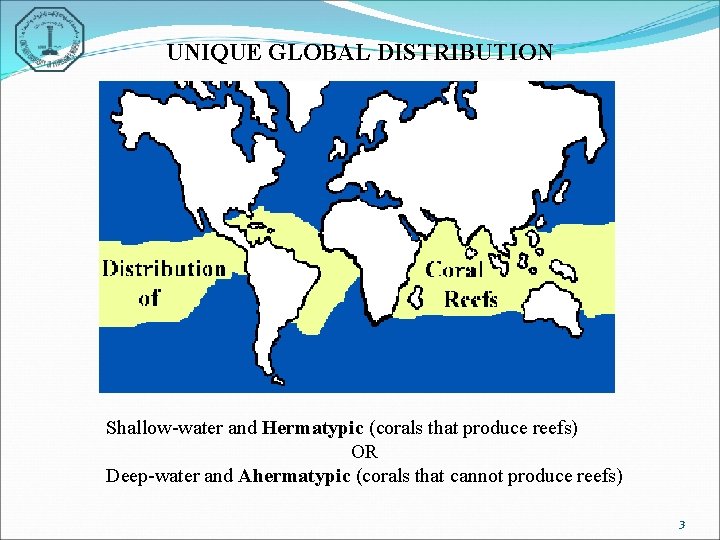
UNIQUE GLOBAL DISTRIBUTION Shallow-water and Hermatypic (corals that produce reefs) OR Deep-water and Ahermatypic (corals that cannot produce reefs) 3
CORAL REEF MONITORING STUDIES BY KFUPM MEPA/ROPME Pilot Research and Monitoring Program, Vol. III - Coral Reef Studies. 1988. For the Australian Trade Commission. Sustaining Research Project- Marine Environmental Studies (1984)- Saudi Aramco 1. Phase –I- 1984 -1990 2. Phase –II- 1990 -1994 3. Phase –III- 1995 -2001 4. Phase –IV- 2001 - 2006 5. Phase –V- 2007 -2012 Coral Reef Survey in Support of the Marine and Coastal Damage Assessment (OSDA) 2003. for the Presidency for Meteorology and Environment. 4
TOPICS OF PRESENTATION • Introduction • Review and assess the biodiversity of coral reefs along the Gulf coast. • Review and assess the biodiversity of coral reef fishes. • Document the present status of coral reefs along the Gulf coast. • Assess the long term impact of natural and anthropogenic stresses on coral reefs. • Threats and management issues. • Conclusion 5
INTRODUCTION Coral reefs of widely differing sizes and structures occur in near shore areas along the eastern coast of Saudi Arabia. Selected coral reefs along the Gulf coast of Saudi Arabia were regularly surveyed by KFUPM/RI since 1985 (Mc. Cain et al. 1984; Coles, 1988; Coles and Tarr, 1990; Coles & Fadllallah 1991). Arabian Gulf coral communities exist in a harsh environment with respect to salinities, SST and extreme low tide (Coles & Fadllallah 1991; Sheppard et al. 1992). A variety of natural and anthropogenic disturbances threaten the survival of coral reefs along the Gulf coast. There is an urgent need to conserve coral reefs 6
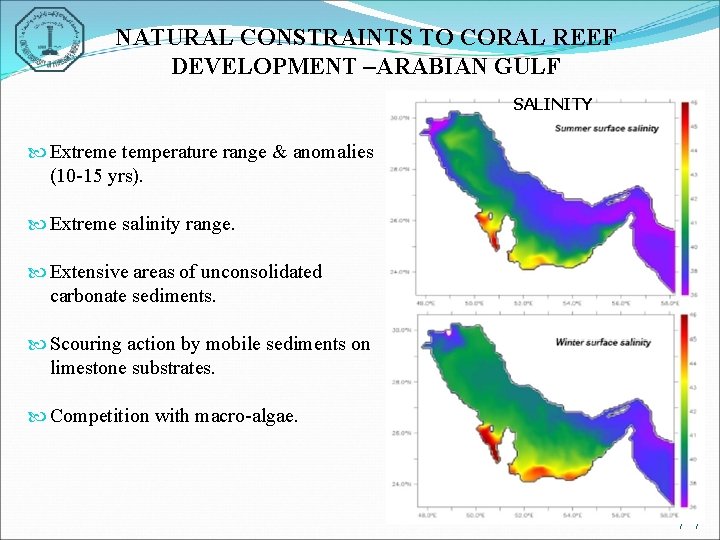
NATURAL CONSTRAINTS TO CORAL REEF DEVELOPMENT –ARABIAN GULF SALINITY Extreme temperature range & anomalies (10 -15 yrs). Extreme salinity range. Extensive areas of unconsolidated carbonate sediments. Scouring action by mobile sediments on limestone substrates. Competition with macro-algae. 7 7
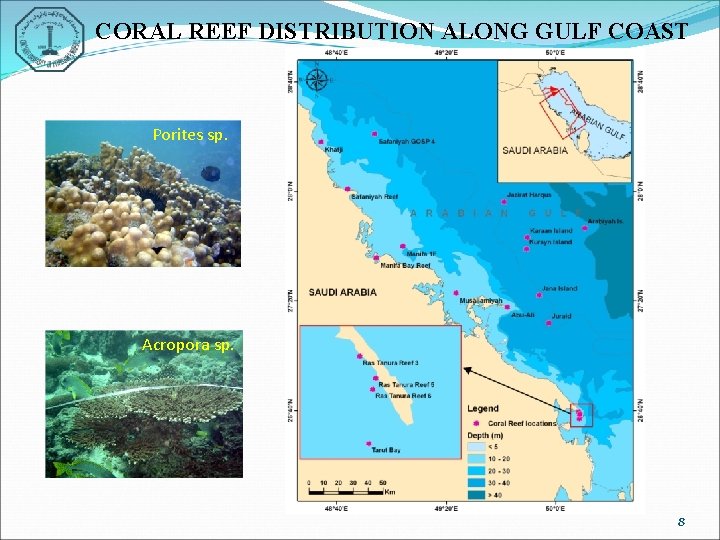
CORAL REEF DISTRIBUTION ALONG GULF COAST Porites sp. Acropora sp. 8
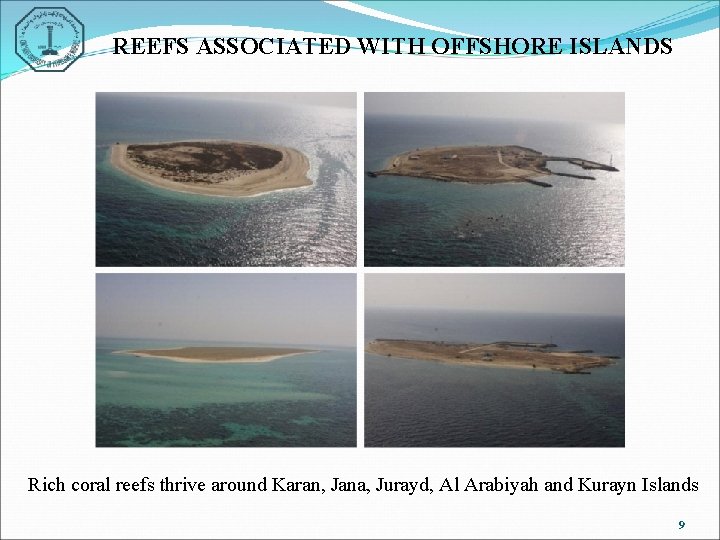
REEFS ASSOCIATED WITH OFFSHORE ISLANDS Rich coral reefs thrive around Karan, Jana, Jurayd, Al Arabiyah and Kurayn Islands 9
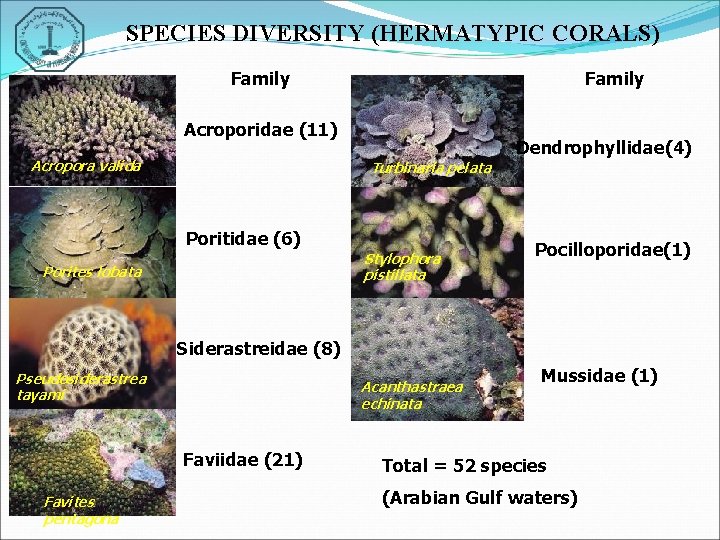
SPECIES DIVERSITY (HERMATYPIC CORALS) Family Acroporidae (11) Acropora valida Dendrophyllidae(4) Turbinaria pelata Poritidae (6) Porites lobata Stylophora pistillata Pocilloporidae(1) Siderastreidae (8) Pseudosiderastrea tayami Acanthastraea echinata Faviidae (21) Favites pentagona Mussidae (1) Total = 52 species (Arabian Gulf waters)
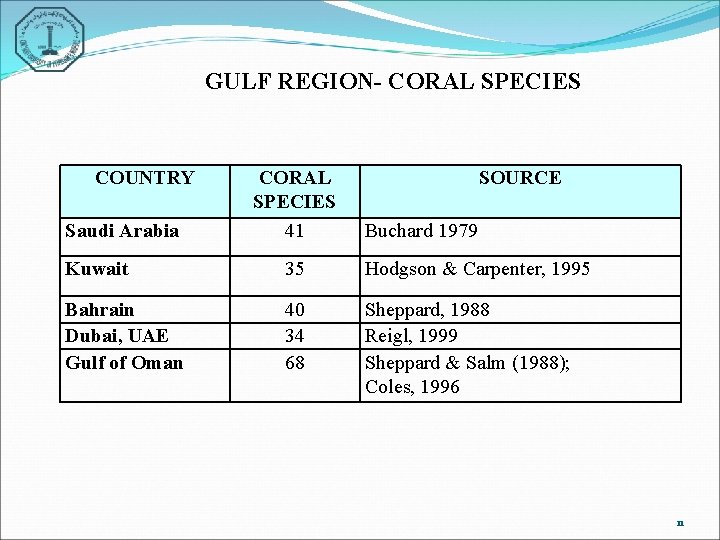
GULF REGION- CORAL SPECIES COUNTRY Saudi Arabia CORAL SPECIES 41 SOURCE Buchard 1979 Kuwait 35 Hodgson & Carpenter, 1995 Bahrain Dubai, UAE Gulf of Oman 40 34 68 Sheppard, 1988 Reigl, 1999 Sheppard & Salm (1988); Coles, 1996 11
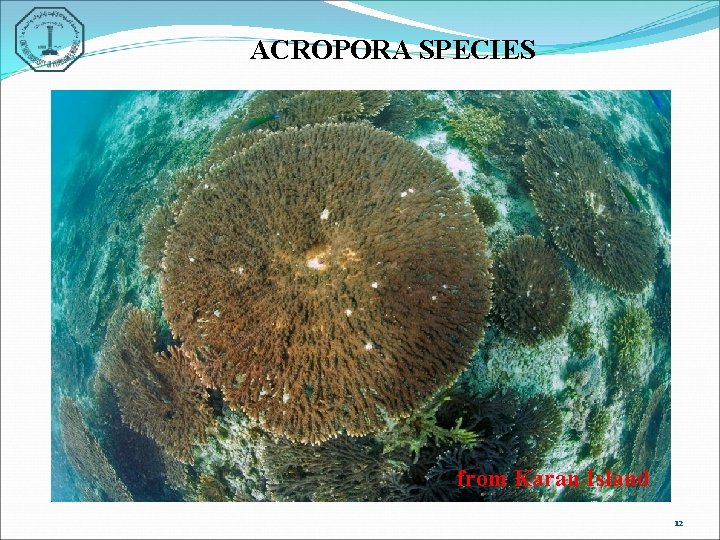
ACROPORA SPECIES from Karan Island 12
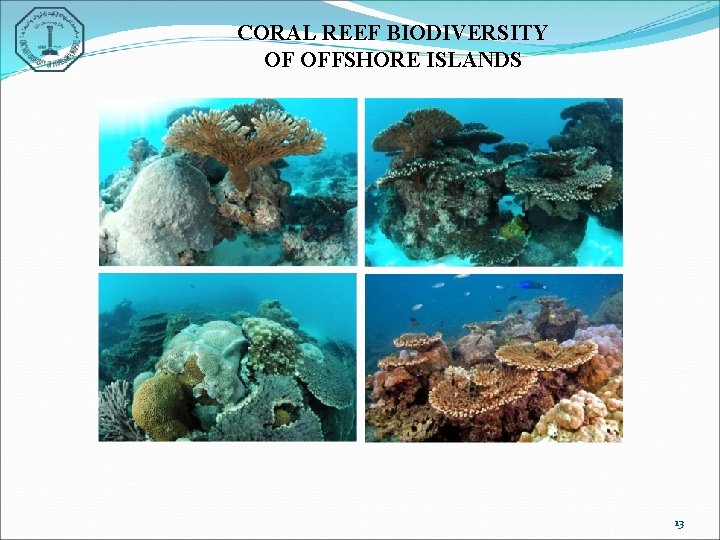
CORAL REEF BIODIVERSITY OF OFFSHORE ISLANDS 13

14

CORAL REEF FISHES- REGIONAL DIVERSITY Region/ Country Saudi Arabia Location/Reef Safaniya Manifa Abu Ali Tarut Bay Kuwait Bahrain UAE Dubai Indian Ocean Indonesia Seychelles Jawa Islands Number of Reference Fish Species 71 KFUPM/RI, 2008 85 83 69 85 71 64 -95 238 196 Downing, 1985 Smith et al. 1987 Riegl, 2002 Pittman, 1996 Suharti, 2006 15
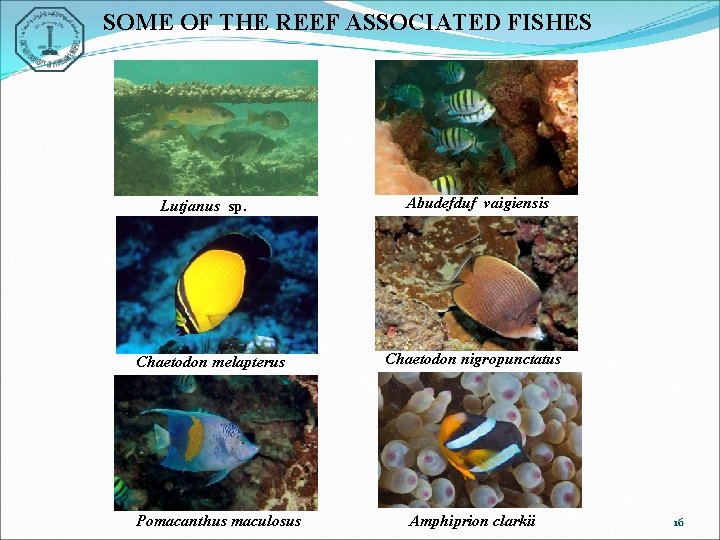
SOME OF THE REEF ASSOCIATED FISHES Lutjanus sp. Chaetodon melapterus Pomacanthus maculosus Abudefduf vaigiensis Chaetodon nigropunctatus Amphiprion clarkii 16
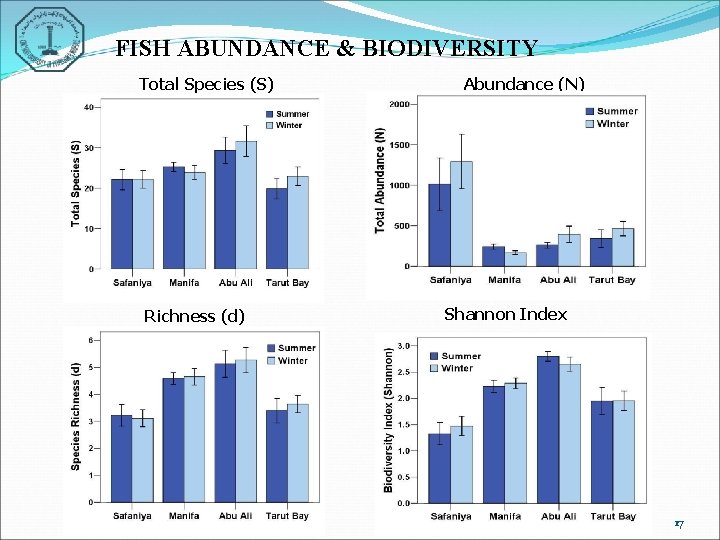
FISH ABUNDANCE & BIODIVERSITY Total Species (S) Richness (d) Abundance (N) Shannon Index 17
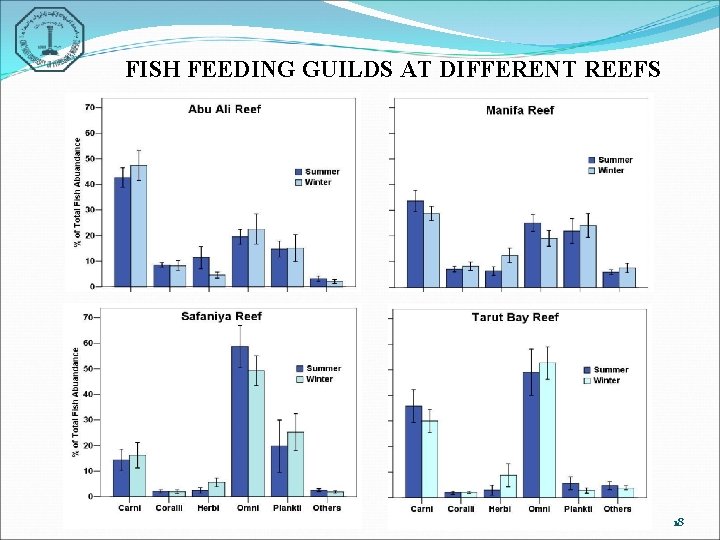
FISH FEEDING GUILDS AT DIFFERENT REEFS 18
THREATS & MANAGEMENT ISSUES NATURAL : Coral Bleaching: Coral mortality (up to 98%) following bleaching events associated with increases in the frequency and prolongation of positive seawater temperature anomalies. Diseases: Yellow-band, Black-band white band diseases present and prevalence maybe increased by anthropogenic stressors. Crown of Thorns: Periodically abundant on East Coast reefs where they have caused extensive damage. ANTHROPOGENIC: Dredging & landfilling Coastal Pollution Fishing Impacts 19
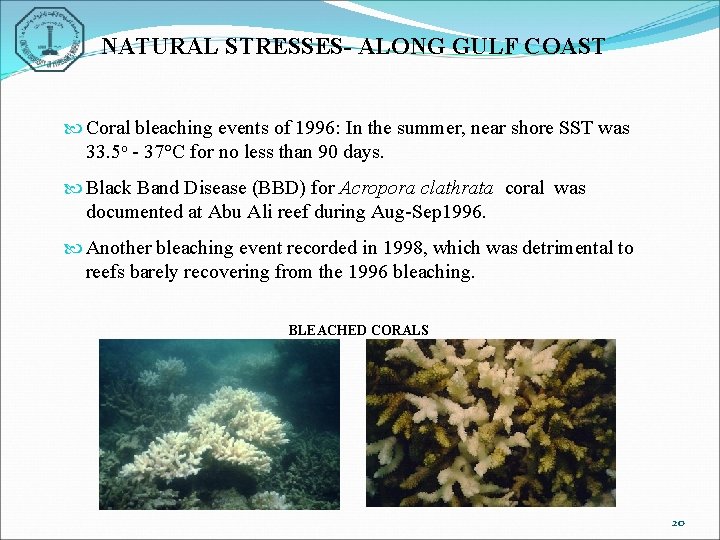
NATURAL STRESSES- ALONG GULF COAST Coral bleaching events of 1996: In the summer, near shore SST was 33. 5 o - 37°C for no less than 90 days. Black Band Disease (BBD) for Acropora clathrata coral was documented at Abu Ali reef during Aug-Sep 1996. Another bleaching event recorded in 1998, which was detrimental to reefs barely recovering from the 1996 bleaching. BLEACHED CORALS 20
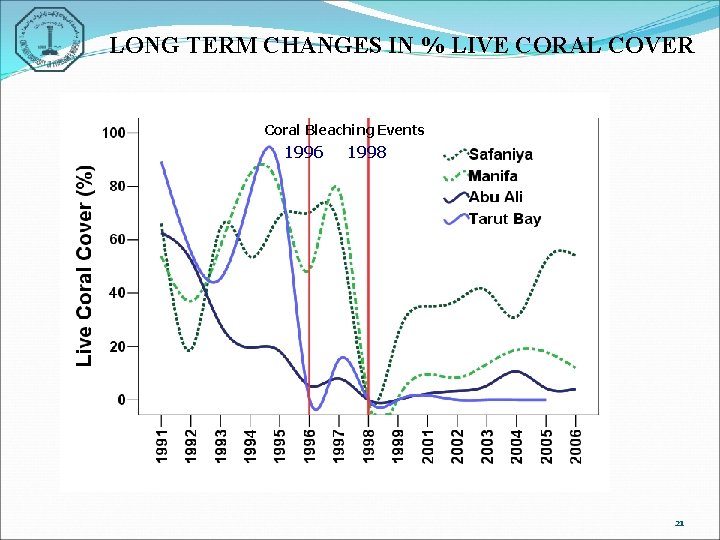
LONG TERM CHANGES IN % LIVE CORAL COVER Coral Bleaching Events 1996 1998 21
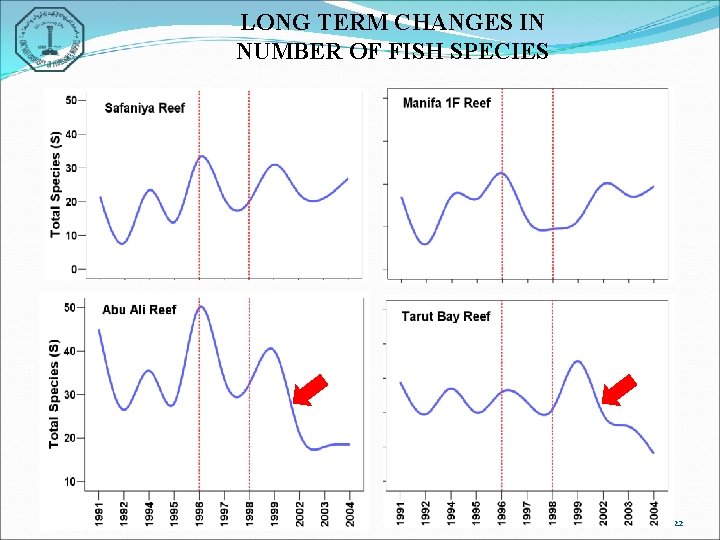
LONG TERM CHANGES IN NUMBER OF FISH SPECIES 22
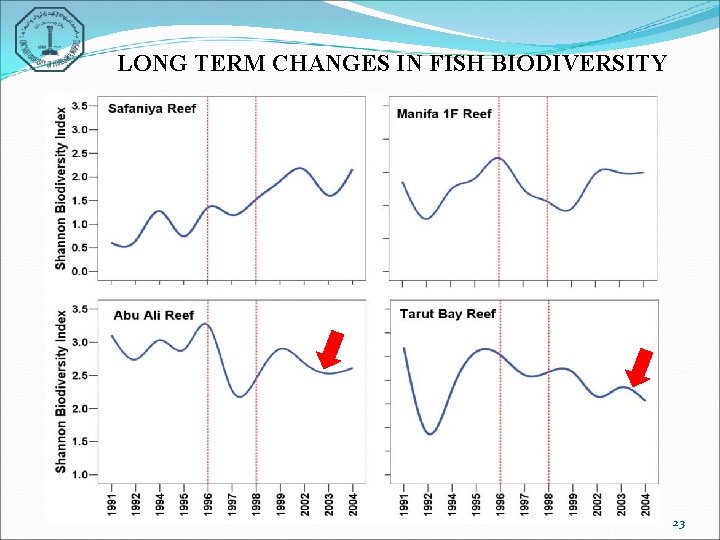
LONG TERM CHANGES IN FISH BIODIVERSITY 23
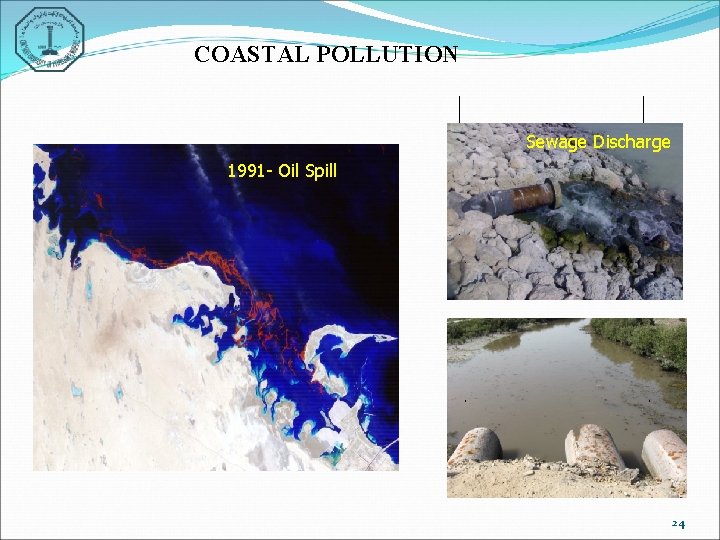
COASTAL POLLUTION Sewage Discharge 1991 - Oil Spill 24
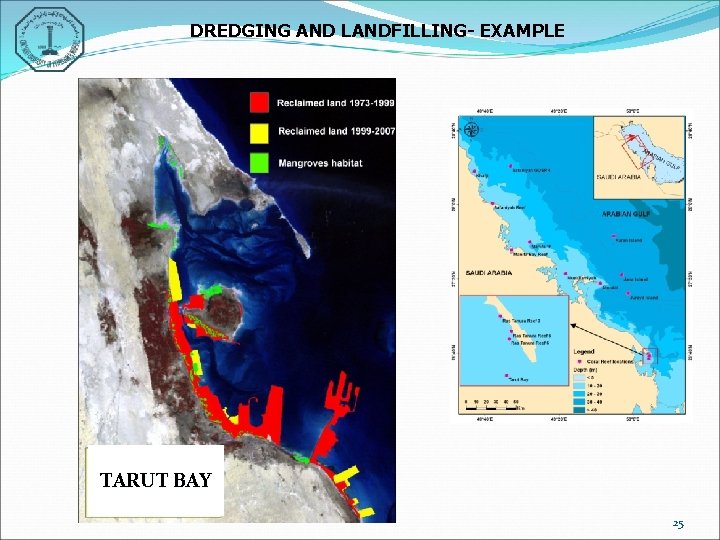
DREDGING AND LANDFILLING- EXAMPLE TARUT BAY 25
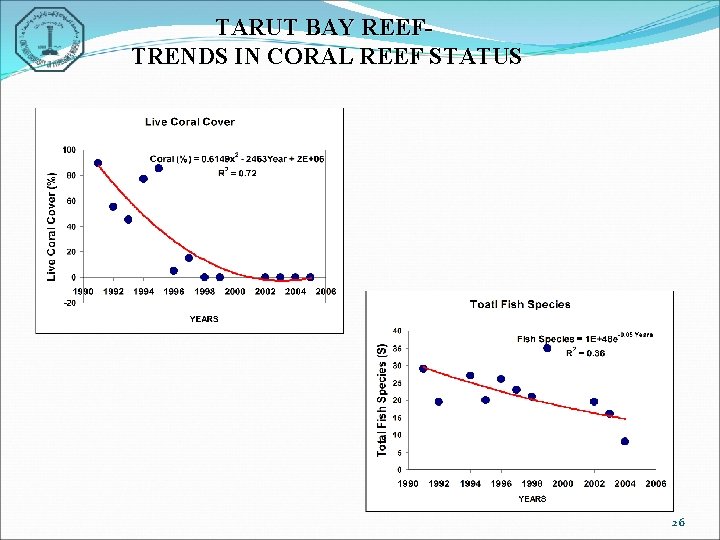
TARUT BAY REEFTRENDS IN CORAL REEF STATUS 26
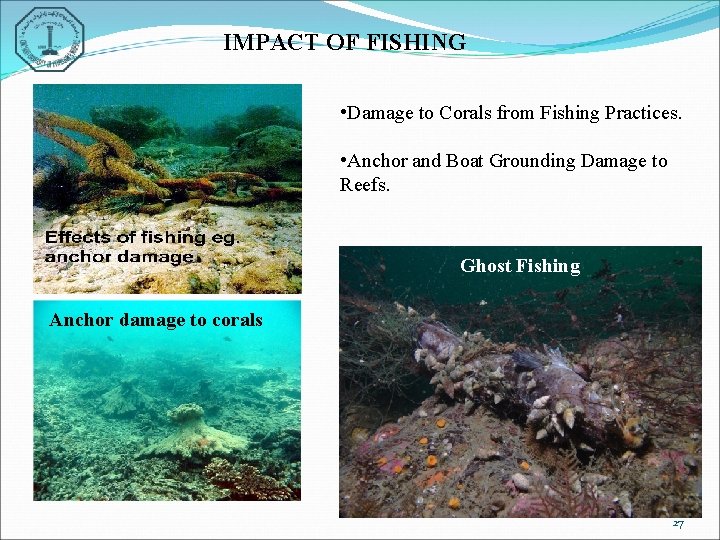
IMPACT OF FISHING • Damage to Corals from Fishing Practices. • Anchor and Boat Grounding Damage to Reefs. Ghost Fishing Anchor damage to corals 27
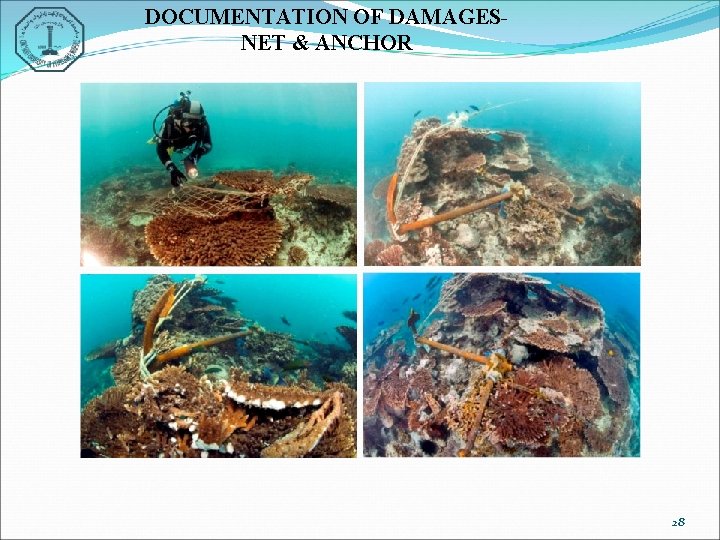
DOCUMENTATION OF DAMAGESNET & ANCHOR 28
CONSERVATION THEMES Legislation Applicable to the Conservation of Coral Reefs, Research, Monitoring and Documentation, Education and Public awareness, Practical Conservation of Coral Reefs. 29
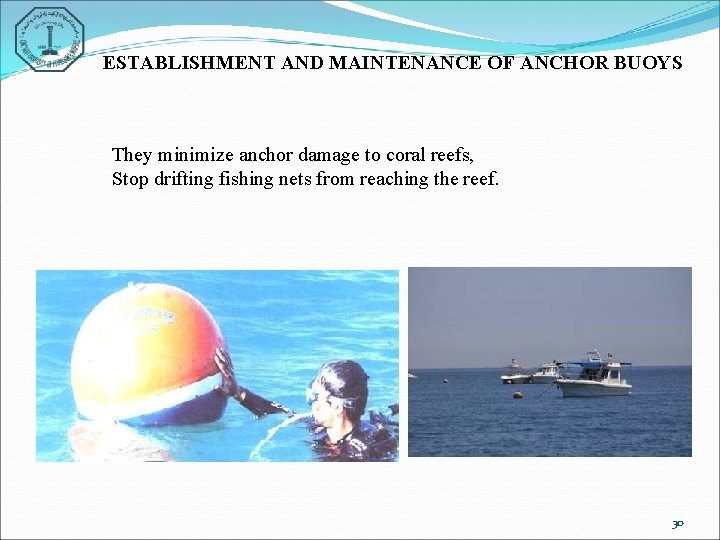
ESTABLISHMENT AND MAINTENANCE OF ANCHOR BUOYS They minimize anchor damage to coral reefs, Stop drifting fishing nets from reaching the reef. 30
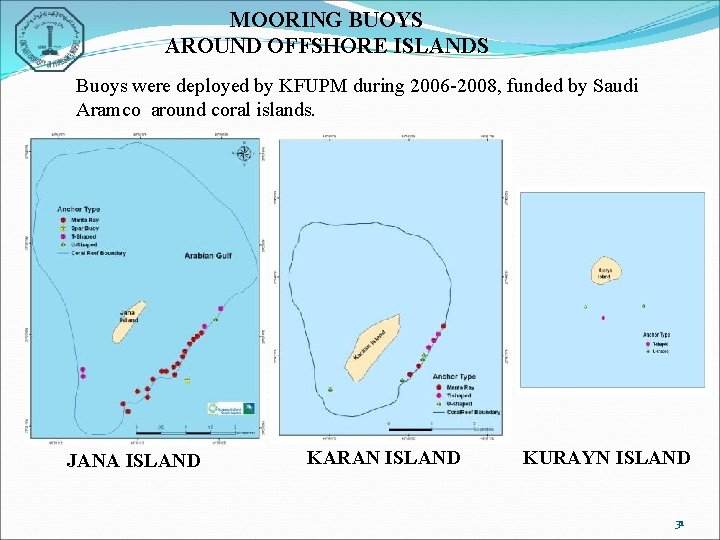
MOORING BUOYS AROUND OFFSHORE ISLANDS Buoys were deployed by KFUPM during 2006 -2008, funded by Saudi Aramco around coral islands. JANA ISLAND KARAN ISLAND KURAYN ISLAND 31
CONCLUSION The coral reefs of the Saudi Arabia have cultural, economic and scientific value. Coral reef monitoring activities in Saudi Arabia started in 1984 by KFUPM. A total of 41 coral species were reported in 1979 and their number has reduced to nearly 20 in 2006. A total of 69 -85 coral fish species belonging to 24 -34 families were observed from reefs, compared to 102 species reported in 1982. Threats to coral are primarily derived from positive seawater temperature anomalies, coastal pollution, dredging and landfill and the effects of fishing. The coral bleaching events in 1996 and 1998 affected the live coral cover and reef associated fishes. A declining trends in live coral coverage, fish species number and biodiversity was observed at Tarut Bay and Abu Ali reefs. 32
Thank You 33
- Slides: 33