
Biodiversity Learning Objectives Understand how to sample plants

Biodiversity
Learning Objectives Understand how to sample plants and animals Success criteria Learners should be able to demonstrate and apply their knowledge and understanding of: (b)(i) how sampling is used in measuring the biodiversity of a habitat and the importance of sampling (ii) practical investigations collecting random and non-random samples in the field To include how sampling can be carried out i. e. random sampling and non-random sampling (e. g. opportunistic, stratified and systematic) and the importance of sampling the range of organisms in a habitat.
Sampling Why do we sample? Important in measuring the biodiversity of a habitat. Individuals too numerous to count all in habitat e. g. bacteria, fungi Time consuming to count everything Study to investigate effects of humans Provide data to give assessments of environmental impact Allow us to reduce our impact
Studying Habitats When studying a habitat, ecologists will first estimate the populations of the species living there. The abundance of each species can never be known exactly, but sampling can give reasonably accurate estimates. So small samples are studied and then scaled up to fit the entire habitat. Reliability – sampling is never entirely representative: Sampling bias Chance
Sampling The approach to sampling can be in one of two ways: 1. Random 2. Non-random Random Sampling: This is usually employed when trying to eliminate bias. Two numbered axis can be laid out over the sample area. Generation of random numbers provides co-ordinates for areas to study.
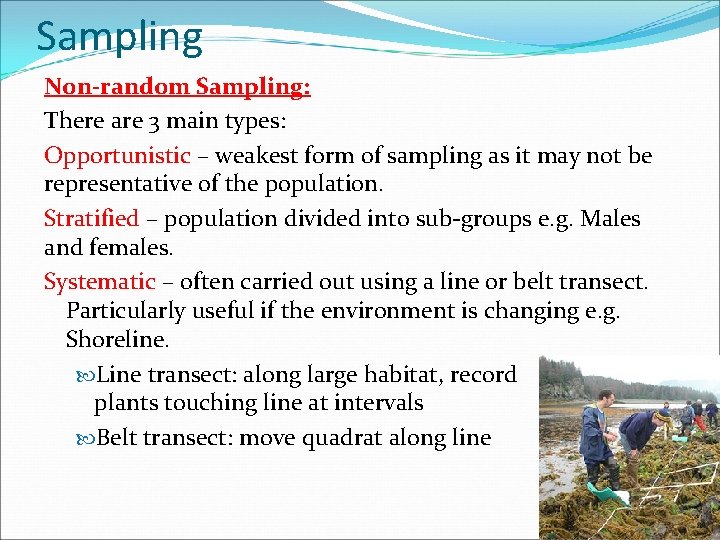
Sampling Non-random Sampling: There are 3 main types: Opportunistic – weakest form of sampling as it may not be representative of the population. Stratified – population divided into sub-groups e. g. Males and females. Systematic – often carried out using a line or belt transect. Particularly useful if the environment is changing e. g. Shoreline. Line transect: along large habitat, record plants touching line at intervals Belt transect: move quadrat along line
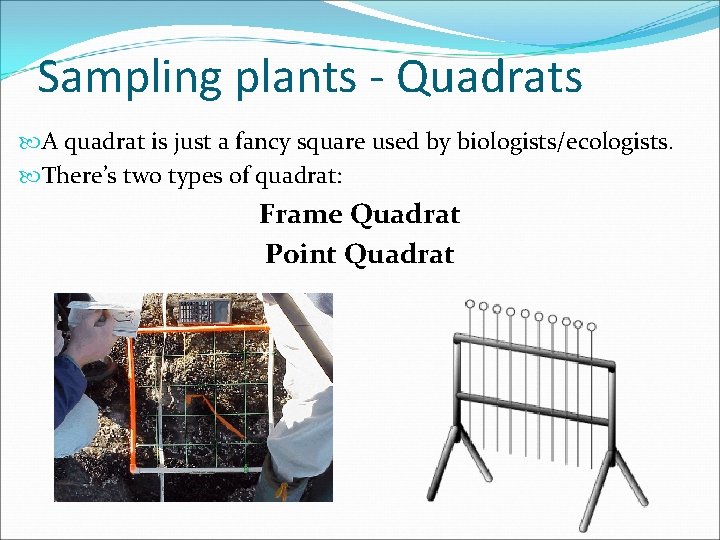
Sampling plants - Quadrats A quadrat is just a fancy square used by biologists/ecologists. There’s two types of quadrat: Frame Quadrat Point Quadrat
Quadrats Three things to consider when using quadrats: 1. The size of the quadrat: Depends on the size of species being investigated, or what kind of groups or colonies the species live in. 2. The number of samples being taken in the area: The more samples you take in the habitat, the more reliable the results will be. . . Depends if time is an issue. 3. The position of each quadrat: Producing unbiased results within a small time-frame is the best idea. Random sampling would work well. A problem that arises during quadrat sampling is the clumping of plants. To get around this. . . We measure the ‘mean density’ or ‘percentage cover’ instead.
Using frame quadrats Density – counting exact numbers of large plants in a 1 m x 1 m quadrat will give density per square metre. Frequency – used when individuals of a species are hard to count. Count the squares within a quadrat to give a percentage cover (ACFOR scale) Percentage cover - used when a species is abundant or difficult to count, estimated by eye. The large the number of samples the more reliable the result. Using results to get total population : Calculate mean of the individual quadrat results to get an average per m 2. Multiply by the total area of the habitat
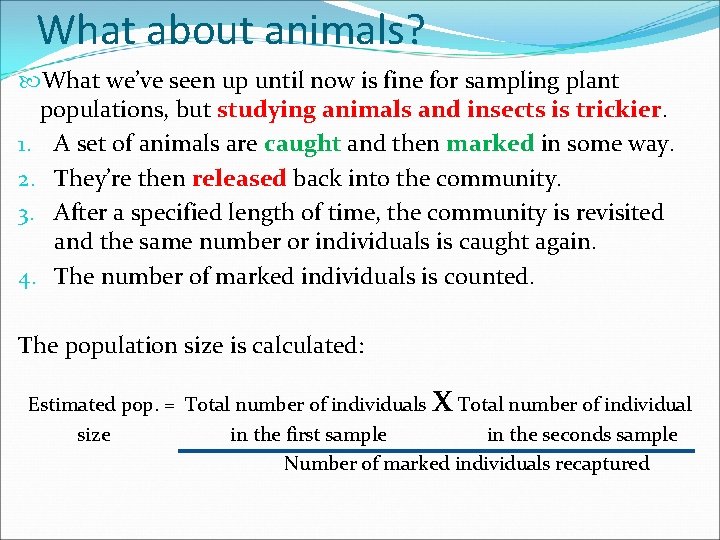
What about animals? What we’ve seen up until now is fine for sampling plant populations, but studying animals and insects is trickier. 1. A set of animals are caught and then marked in some way. 2. They’re then released back into the community. 3. After a specified length of time, the community is revisited and the same number or individuals is caught again. 4. The number of marked individuals is counted. The population size is calculated: Estimated pop. = Total number of individuals size x Total number of individual in the first sample in the seconds sample Number of marked individuals recaptured
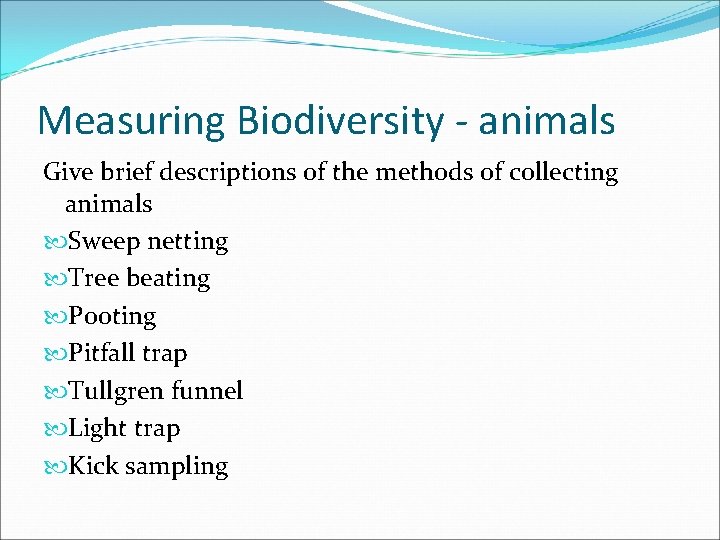
Measuring Biodiversity - animals Give brief descriptions of the methods of collecting animals Sweep netting Tree beating Pooting Pitfall trap Tullgren funnel Light trap Kick sampling
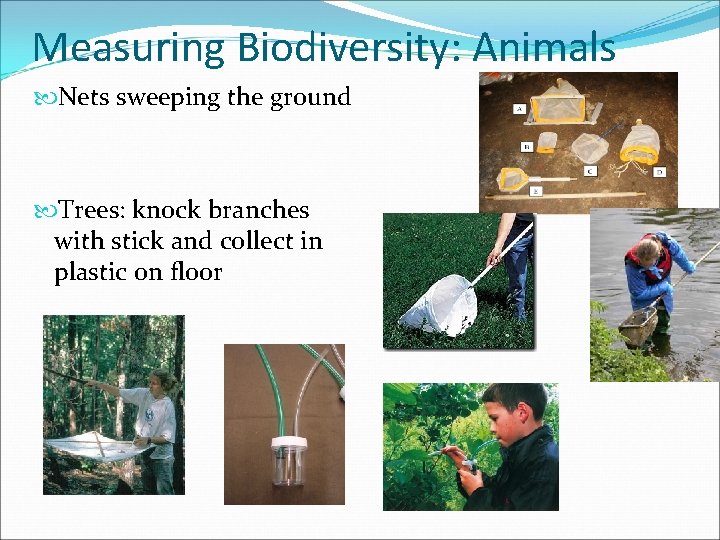
Measuring Biodiversity: Animals Nets sweeping the ground Trees: knock branches with stick and collect in plastic on floor
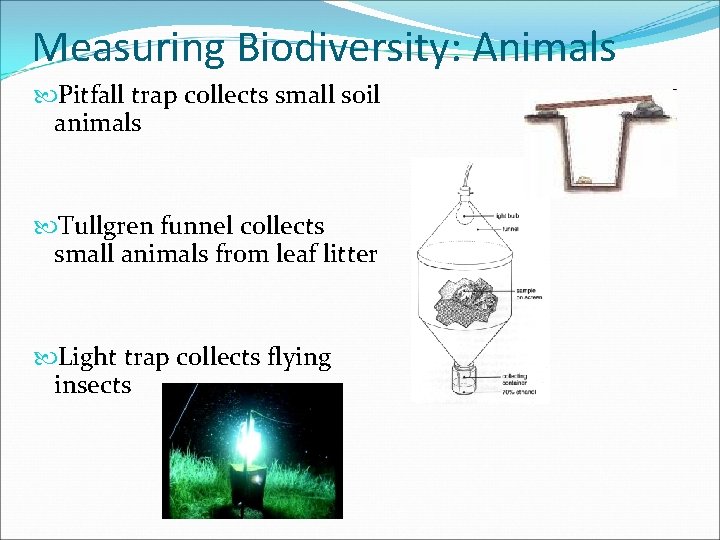
Measuring Biodiversity: Animals Pitfall trap collects small soil animals Tullgren funnel collects small animals from leaf litter Light trap collects flying insects
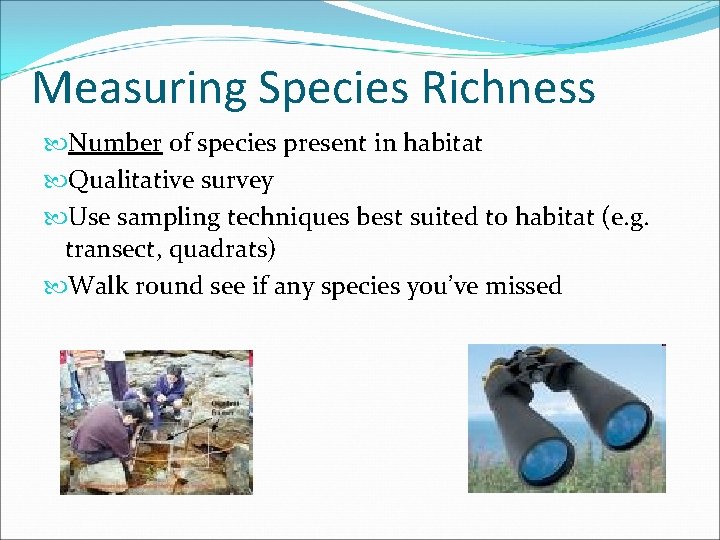
Measuring Species Richness Number of species present in habitat Qualitative survey Use sampling techniques best suited to habitat (e. g. transect, quadrats) Walk round see if any species you’ve missed
Measuring Species Evenness Measure of abundance of individuals in each species Quantitative surveying Plants - use sampling techniques measuring species per unit area or percentage ground cover With large animals use observation With small animals can use mark and recapture method
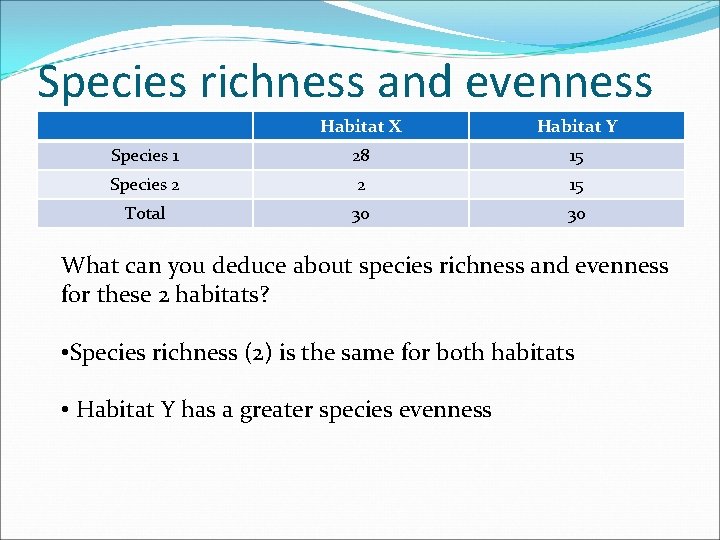
Species richness and evenness Habitat X Habitat Y Species 1 28 15 Species 2 2 15 Total 30 30 What can you deduce about species richness and evenness for these 2 habitats? • Species richness (2) is the same for both habitats • Habitat Y has a greater species evenness
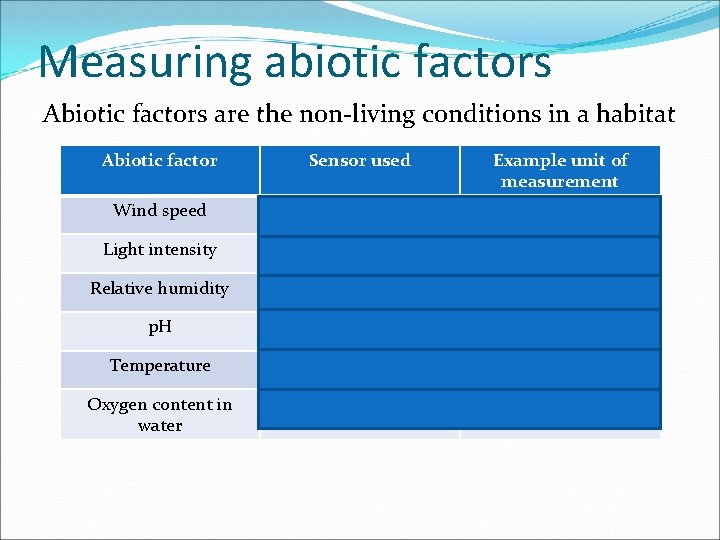
Measuring abiotic factors Abiotic factors are the non-living conditions in a habitat Abiotic factor Sensor used Example unit of measurement Wind speed Anemometer ms-1 Light intensity Light meter lx Relative humidity Humidity sensor mgdm-3 p. H probe p. H Temperature probe o. C Oxygen content in water Dissolved oxygen probe mgdm-3
Measuring abiotic factors Advantages of using sensors: Rapid changes can be detected Human error reduced High degree of precision Data can be stored and tracked on a computer

Task Complete the task Belt transect in a National Park for homework
- Slides: 19