
Biodiversity Learning Objectives Understand biodiversity and how to

Biodiversity
Learning Objectives Understand biodiversity and how to sample plants and animals Success criteria �Define the terms species, habitat and biodiversity �Explain how biodiversity may be considered at different levels; habitat, species and genetic �D �Discuss current estimates of global biodiversity �Explain the importance of sampling in measuring the biodiversity of a habitat �Describe how random samples can be taken when measuring biodiversity
Key Term Definitions �Species �A group of organisms whose members are similar to each other in morphology, physiology, biochemistry and behaviour; who can interbreed to produce fertile offspring �Habitat �Place where an organism or population lives �Biodiversity �Number and variety of living things to be found in the world/ecosystem/habitat
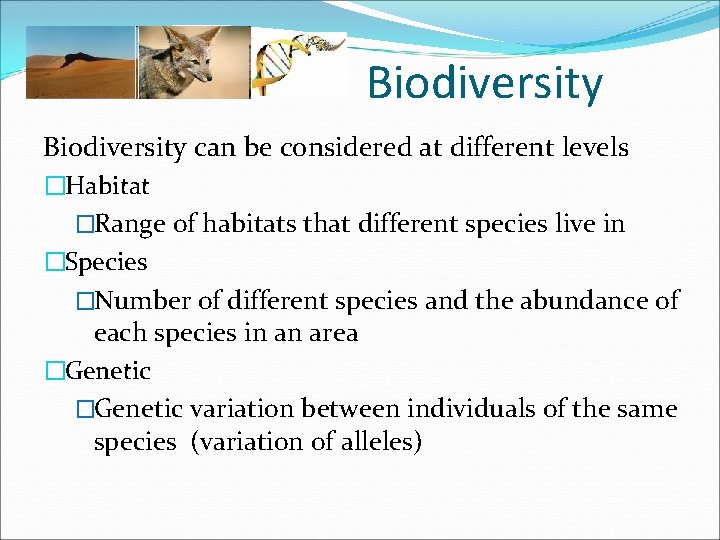
Biodiversity can be considered at different levels �Habitat �Range of habitats that different species live in �Species �Number of different species and the abundance of each species in an area �Genetic variation between individuals of the same species (variation of alleles)
Global Biodiversity Discuss current estimates of global biodiversity �Catalogue of life �Current estimate of known species: 1, 7300, 000 �Some scientist believe this is only 10% of total. Why? �Find new species �Evolution and speciation are continuing �Species becoming extinct �Only takes into account number of species not number of individuals or variation

Sampling �Important in measuring the biodiversity of a habitat �Individuals too numerous to count all in habitat e. g. bacteria, fungi �Select small portion of habitat to study �Multiply number of individuals found by area

Measuring Biodiversity �Method for taking random samples �Take samples at regular distances across the habitat �Use random numbers generated by a computer (assign coordinates to habitat) �Select coordinates from a map of the area and use a GPS to find exact position in habitat �Number of samples depend on size of habitat and biodiversity (if comparing two habitats take same number in each) �Prepare table of results before start

Measuring Biodiversity: Small Plants �Measure percentage ground cover using a quadrat or percentage cover using a point frame (10 needles, each plant touching a needle counts as 1% cover) �Can measure abundance on ACFOR (abundant, common, frequent, obvious, rare) scale, not able to do stats on this �Transect �Line transect: along large habitat, record plants touching line at intervals �Belt transect: move quadrat along line

Measuring Biodiversity: Animals �Nets sweeping the ground �Trees: knock branches with stick and collect in plastic on floor
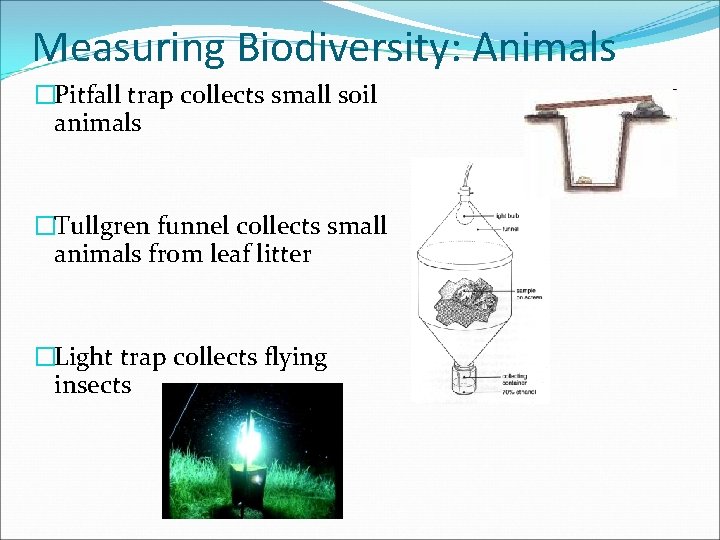
Measuring Biodiversity: Animals �Pitfall trap collects small soil animals �Tullgren funnel collects small animals from leaf litter �Light trap collects flying insects
Why Measure Habitats? �Study to investigate effects of humans �Provide data to give assessments of environmental impact �Allow us to reduce our impact
- Slides: 11