
Biodiversity Inclusive EIA of a Hydropower Project Case
Biodiversity Inclusive EIA of a Hydropower Project: Case study of Narmada Sagar Project Dr. V. B. Mathur Dean, Faculty of Wildlife Sciences Wildlife Institute of India vbm@wii. gov. in
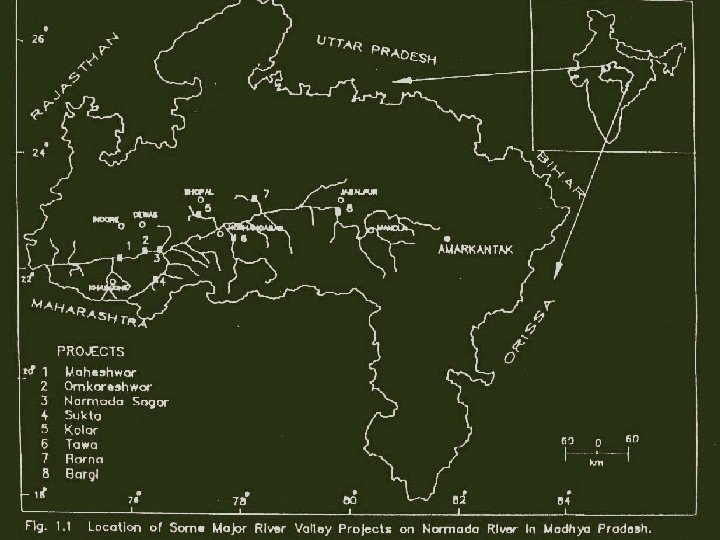
Narmadasagar Dam Project Setting Dam height Dam length : : Irrigation capacity : Power generation : 91. 4 m 576 m 123, 758 ha 1, 000 mw contd…

Narmadasagar Dam Project Setting (cont. ) Forest area submerged : Cultivable area submerged : 91, 348 ha 44, 363 ha Villages affected People affected 254 150, 000 (1981 census) : : Source: Paranjapaye, 1989
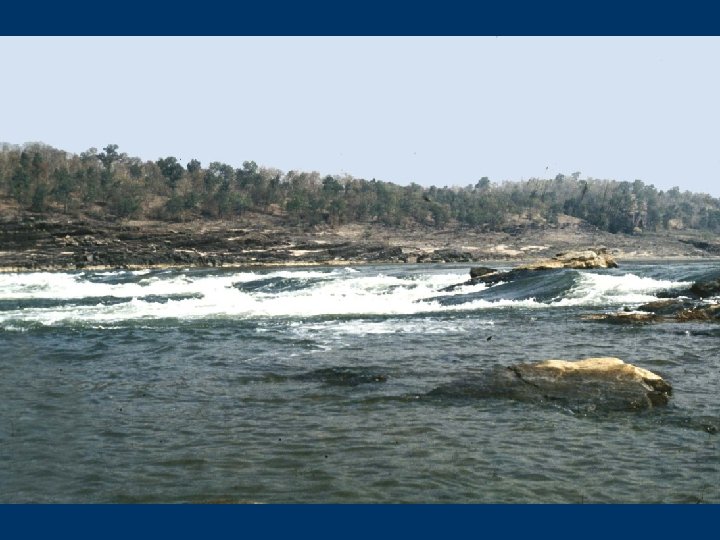

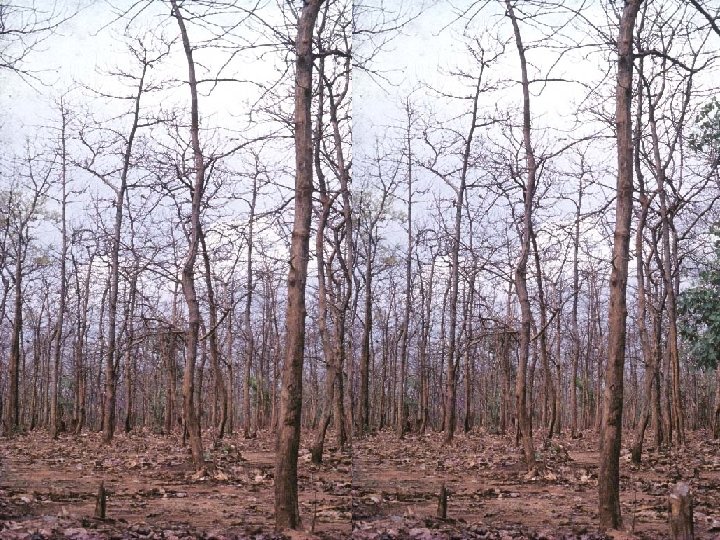
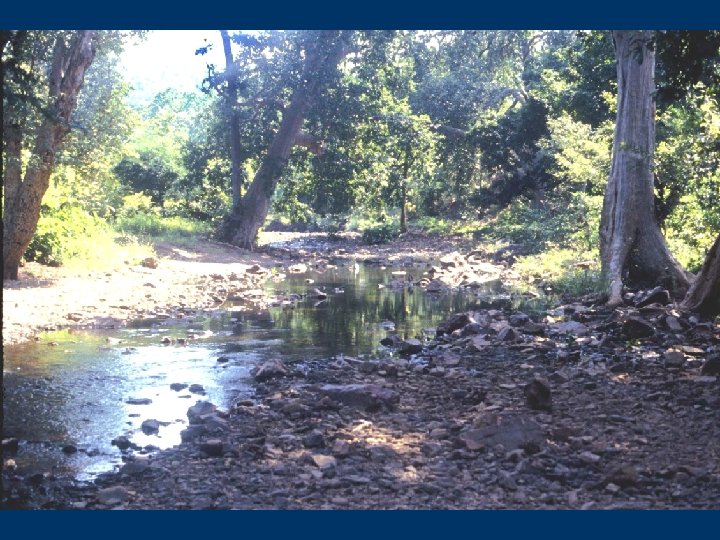
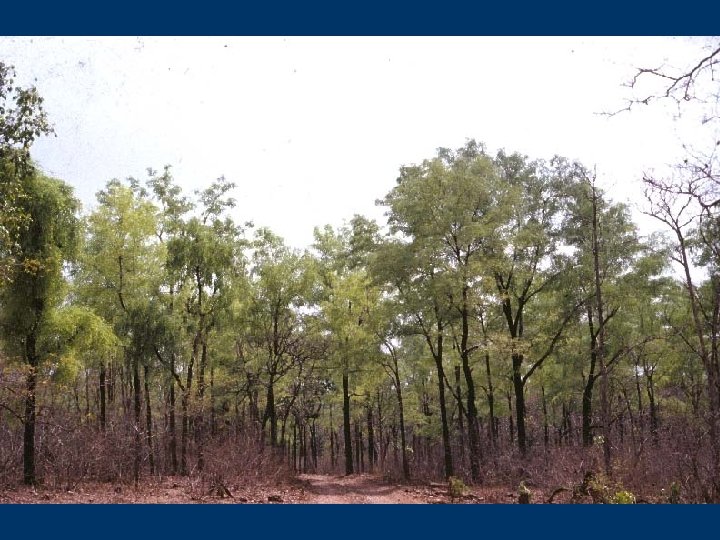
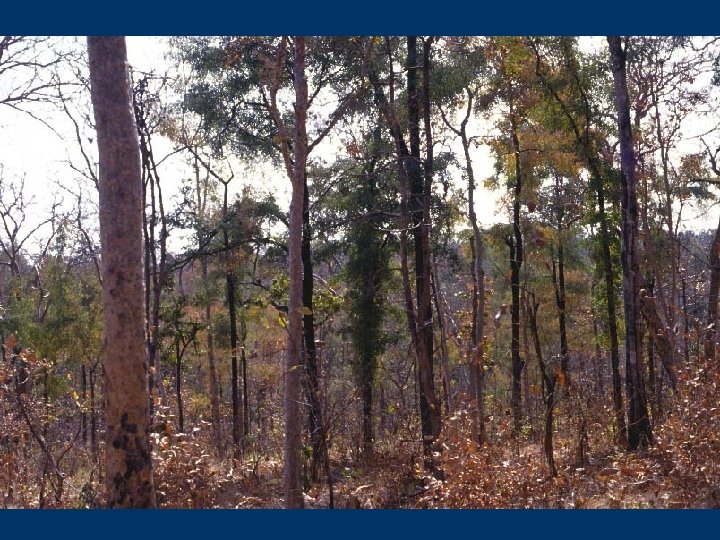
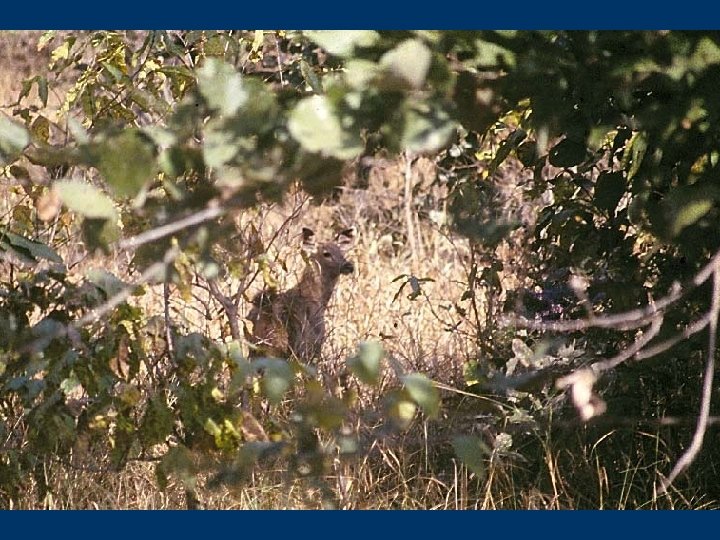

Major Objectives of EIA Study ► Determine baseline status ► Identify nature and extent of impacts ► Suggest mitigatory measures
Identification of Thrust Areas ► Vegetation ► Wildlife habitats ► Terrestrial wild mammals and aquatic vertebrates ► Avifauna ► People of the area
Delineation of the Study Area ► Zone of submergence ► Zone of impact ► Zone of contiguous forests
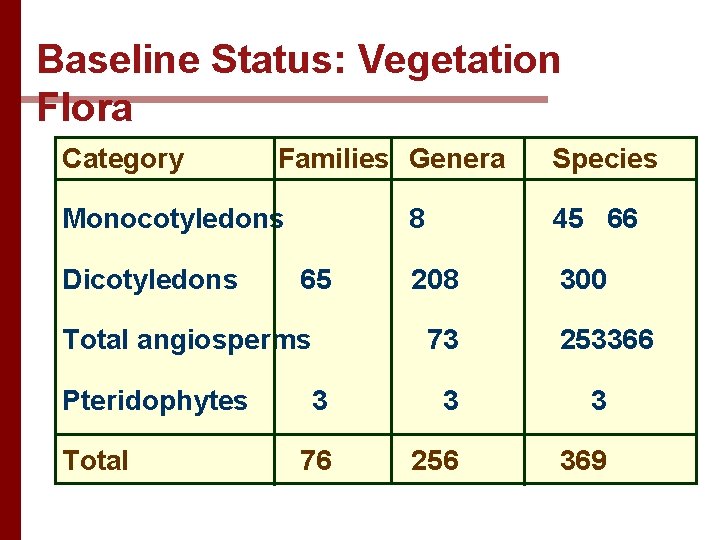
Baseline Status: Vegetation Flora Category Families Genera Monocotyledons Dicotyledons 65 Total angiosperms Pteridophytes Total Species 8 45 66 208 300 73 253366 3 3 3 76 256 369
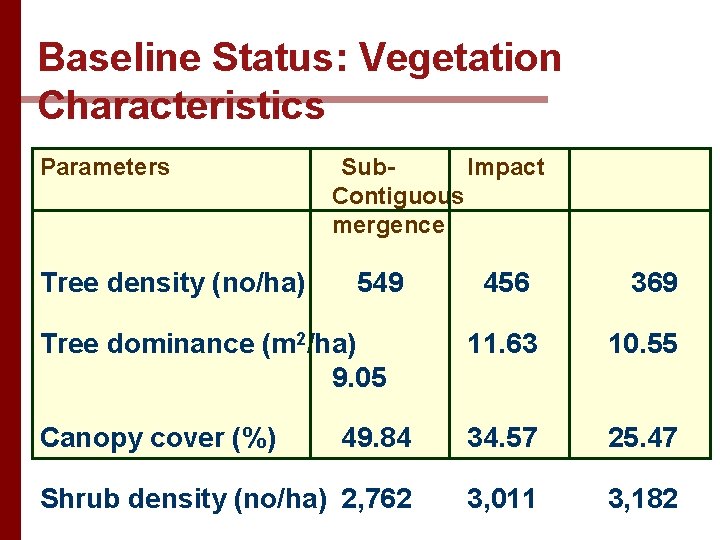
Baseline Status: Vegetation Characteristics Parameters Tree density (no/ha) Sub. Impact Contiguous mergence 549 456 369 Tree dominance (m 2/ha) 9. 05 11. 63 10. 55 Canopy cover (%) 49. 84 34. 57 25. 47 Shrub density (no/ha) 2, 762 3, 011 3, 182
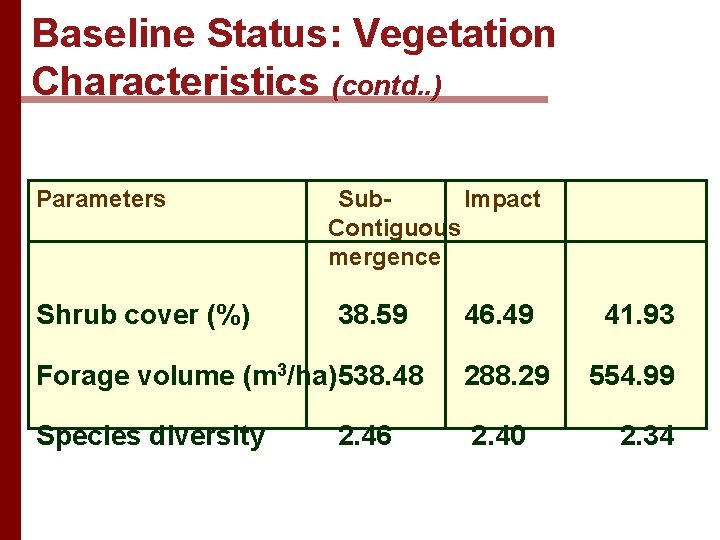
Baseline Status: Vegetation Characteristics (contd. . ) Parameters Shrub cover (%) Sub. Impact Contiguous mergence 38. 59 46. 49 41. 93 Forage volume (m 3/ha)538. 48 288. 29 554. 99 Species diversity 2. 40 2. 46 2. 34
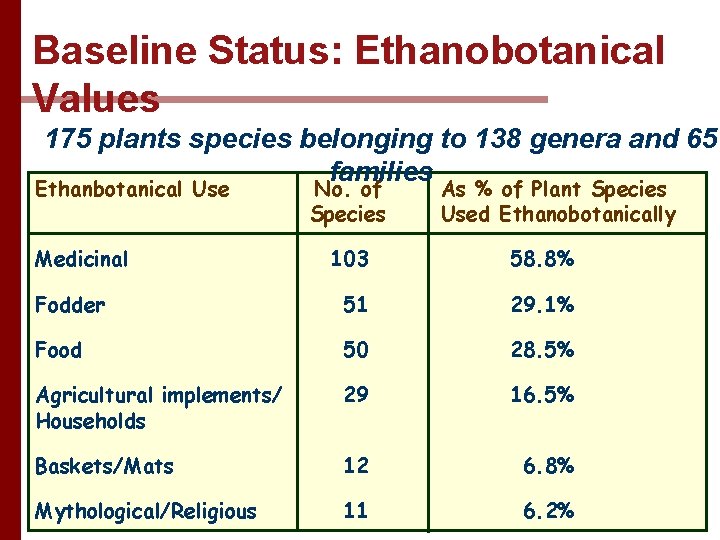
Baseline Status: Ethanobotanical Values 175 plants species belonging to 138 genera and 65 families Ethanbotanical Use Medicinal No. of Species As % of Plant Species Used Ethanobotanically 103 58. 8% Fodder 51 29. 1% Food 50 28. 5% Agricultural implements/ Households 29 16. 5% Baskets/Mats 12 6. 8% Mythological/Religious 11 6. 2%
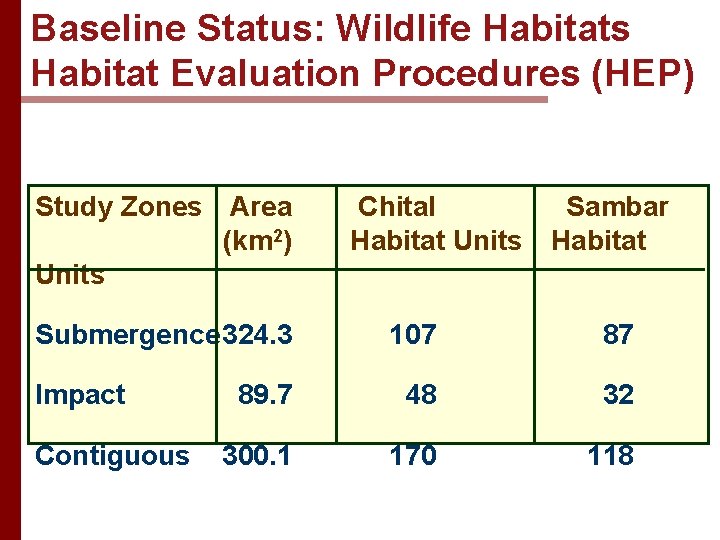
Baseline Status: Wildlife Habitats Habitat Evaluation Procedures (HEP) Study Zones Area (km 2) Units Submergence 324. 3 Impact Contiguous Chital Habitat Units Sambar Habitat 107 87 89. 7 48 32 300. 1 170 118
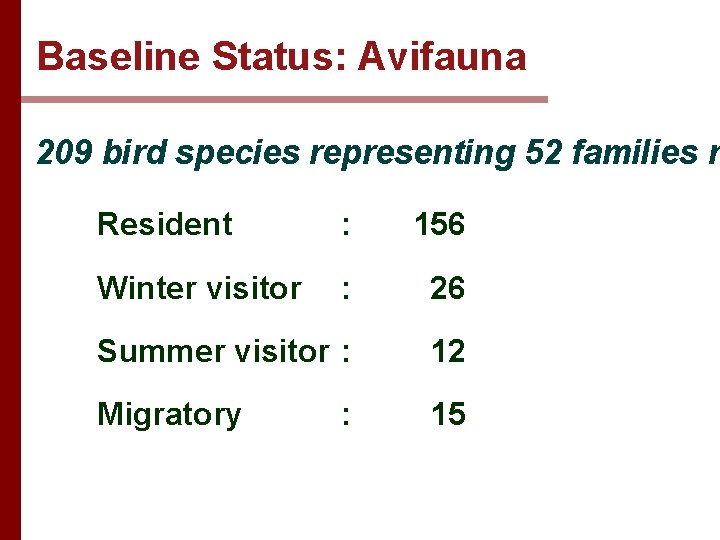
Baseline Status: Avifauna 209 bird species representing 52 families r Resident : 156 Winter visitor : 26 Summer visitor : 12 Migratory 15 :
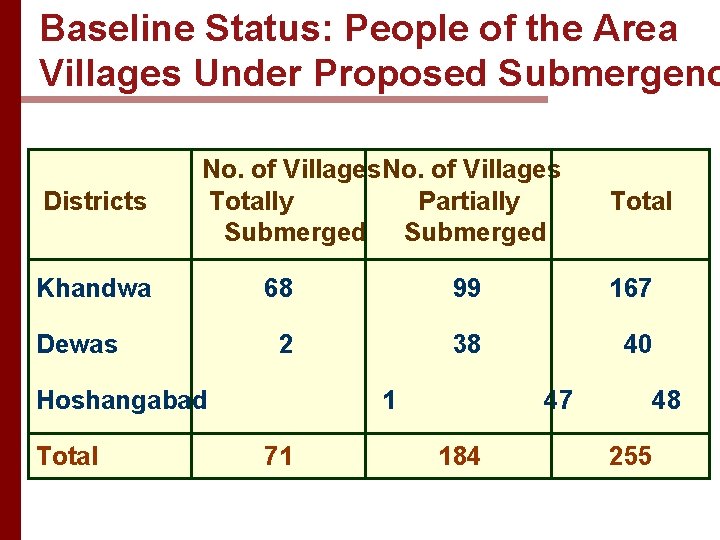
Baseline Status: People of the Area Villages Under Proposed Submergenc Districts No. of Villages Totally Partially Submerged Khandwa Dewas 68 99 167 2 38 40 Hoshangabad Total 1 71 47 184 48 255
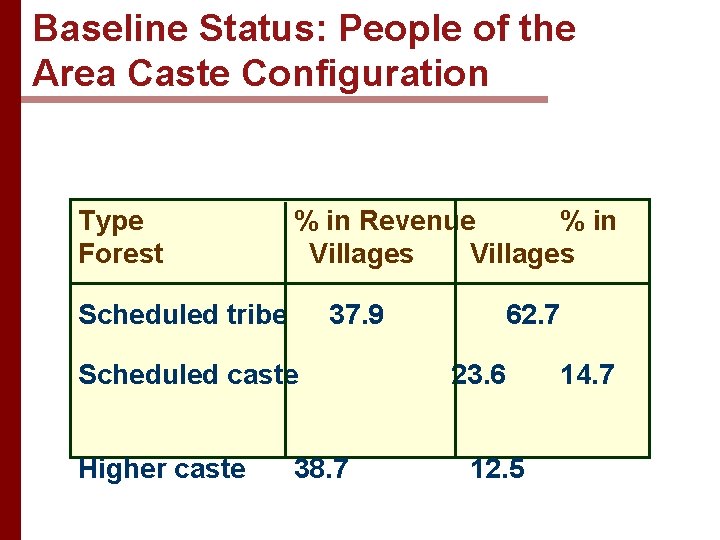
Baseline Status: People of the Area Caste Configuration Type Forest % in Revenue % in Villages Scheduled tribe 37. 9 Scheduled caste Higher caste 38. 7 62. 7 23. 6 12. 5 14. 7
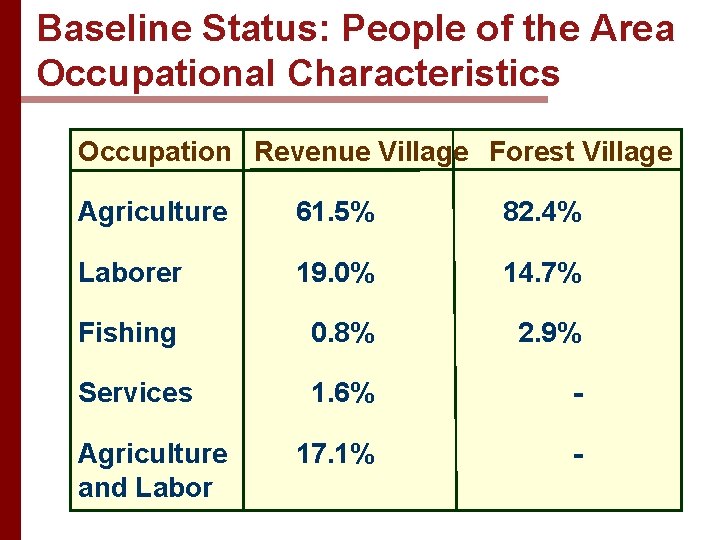
Baseline Status: People of the Area Occupational Characteristics Occupation Revenue Village Forest Village Agriculture 61. 5% 82. 4% Laborer 19. 0% 14. 7% Fishing 0. 8% 2. 9% Services 1. 6% - 17. 1% - Agriculture and Labor
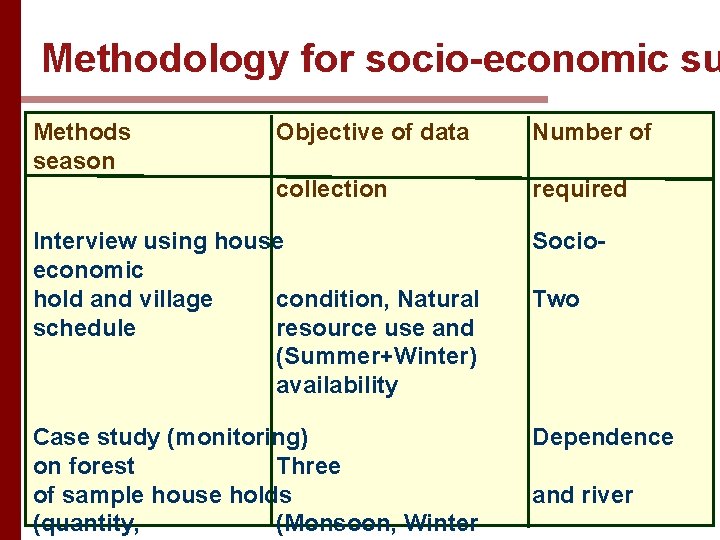
Methodology for socio-economic su Methods season Objective of data Number of collection required Interview using house economic hold and village condition, Natural schedule resource use and (Summer+Winter) availability Socio- Case study (monitoring) on forest Three of sample house holds (quantity, (Monsoon, Winter Dependence Two and river
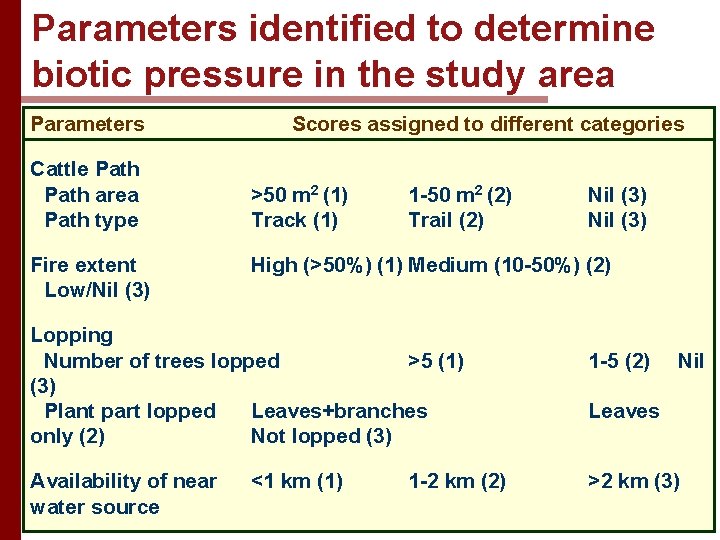
Parameters identified to determine biotic pressure in the study area Parameters Cattle Path area Path type Fire extent Low/Nil (3) Scores assigned to different categories >50 m 2 (1) Track (1) 1 -50 m 2 (2) Trail (2) High (>50%) (1) Medium (10 -50%) (2) Lopping Number of trees lopped >5 (1) (3) Plant part lopped Leaves+branches only (2) Not lopped (3) Availability of near water source Nil (3) <1 km (1) 1 -2 km (2) 1 -5 (2) Nil Leaves >2 km (3)
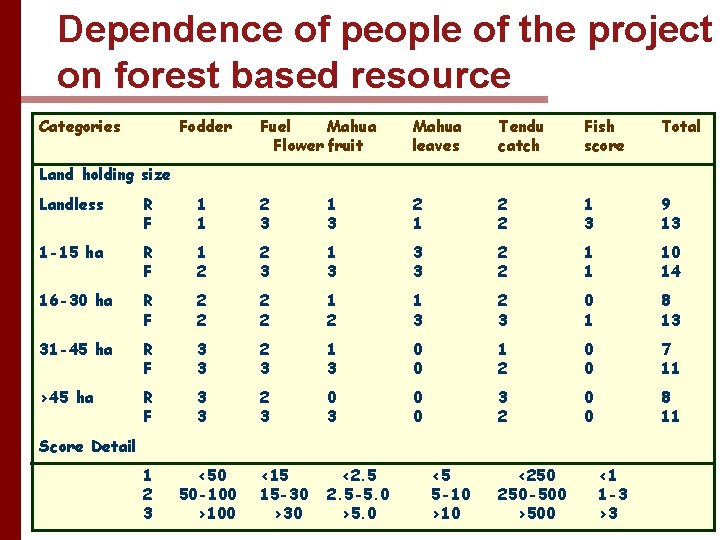
Dependence of people of the project on forest based resource Categories Fodder Fuel Mahua Flower fruit Mahua leaves Tendu catch Fish score Total Land holding size Landless R F 1 1 2 3 1 3 2 1 2 2 1 3 9 13 1 -15 ha R F 1 2 2 3 1 3 3 3 2 2 1 1 10 14 16 -30 ha R F 2 2 1 2 1 3 2 3 0 1 8 13 31 -45 ha R F 3 3 2 3 1 3 0 0 1 2 0 0 7 11 >45 ha R F 3 3 2 3 0 0 3 2 0 0 8 11 <15 15 -30 >30 <2. 5 -5. 0 >5. 0 Score Detail 1 2 3 <50 50 -100 >100 <5 5 -10 >10 <250 250 -500 >500 <1 1 -3 >3
Impacts of Narmadasagar Project ► Primary ► Secondary
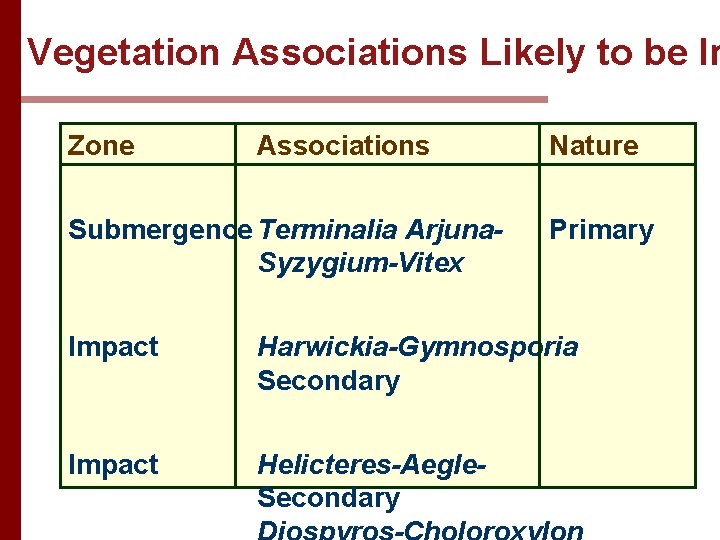
Vegetation Associations Likely to be Im Zone Associations Submergence Terminalia Arjuna. Syzygium-Vitex Nature Primary Impact Harwickia-Gymnosporia Secondary Impact Helicteres-Aegle. Secondary
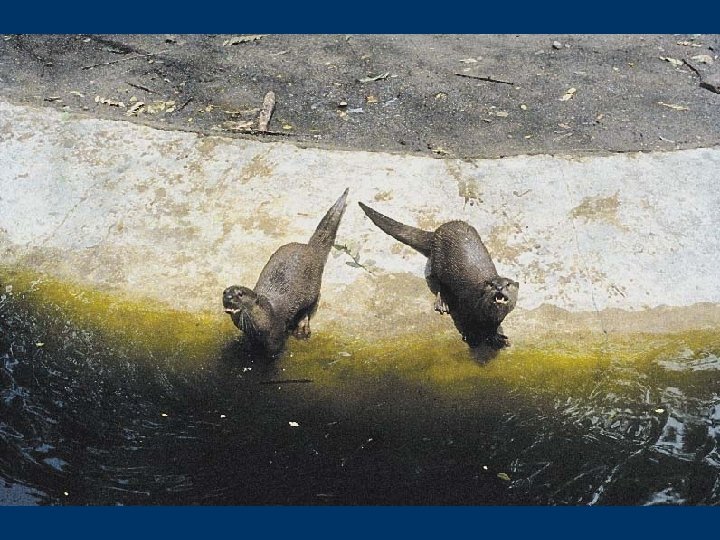
Impacts of Aquatic Vertebrates Local extinction of river otter
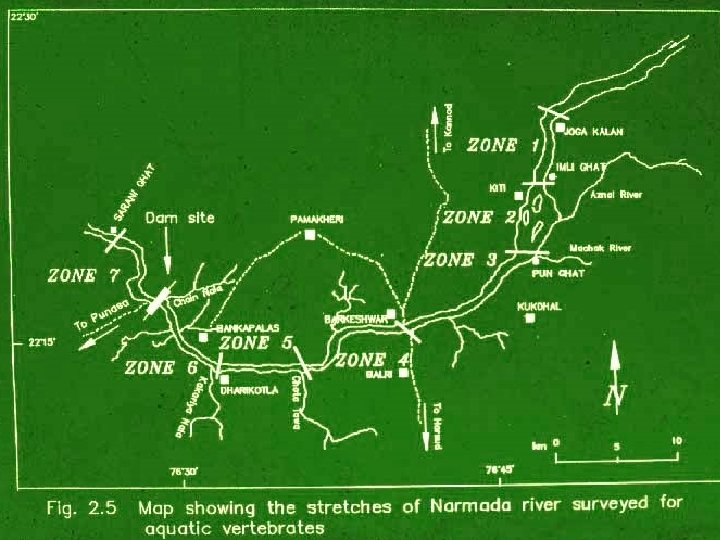
Impacts on Large Mammalian Fauna Ungulates - Carnivores Ungulates: Direct reduction in habitat Chital: Loss of 99 habitat units Sambar: Loss of 80 habitat units Threats to dispersal from south bank Carnivores: Territorial conflicts
Impacts on Avifauna ► Conversion of lotic riverine ecosystem to lentic reservoir ecosystem would impact many riverine birds viz. , cormorants, darters, egrets, herons, storks, ibis and spoonbills ► Changes in the composition of aquatic vegetation would affect the feeding ecology of birds viz. , pintails, contd… gadwalls, spotbill duck and shovellers
Impacts on Avifauna ► Inundation of small rivers and streams will affect herons, eqrets, bitterns, water hens and kingfishers ► Loss of shallow feeding areas on the banks would affect lapwings, plovers, sandpipers contd… and shanks
Impacts on Avifauna (contd…) ► Loss of riverine trees and shrubs will lead to the loss of perching and nesting sites for flycatchers and owls ► Loss of bushes and dense herbaceous vegetation, important for feeding and nesting, may affect warbles, babblers, munias and weaver birds
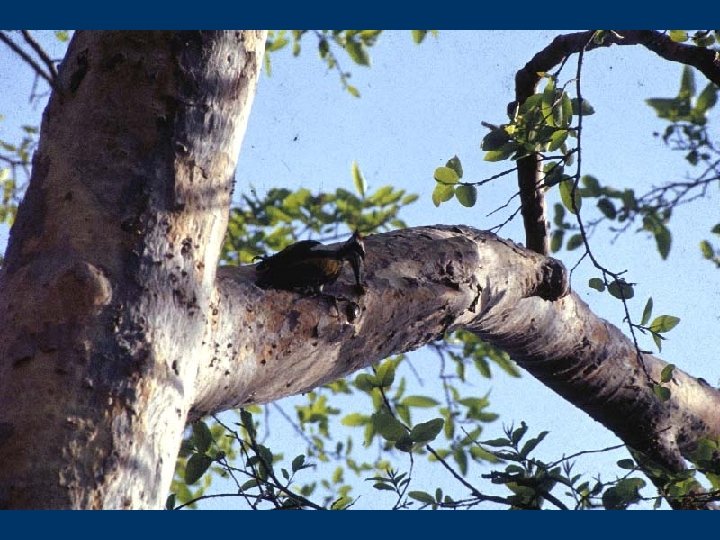
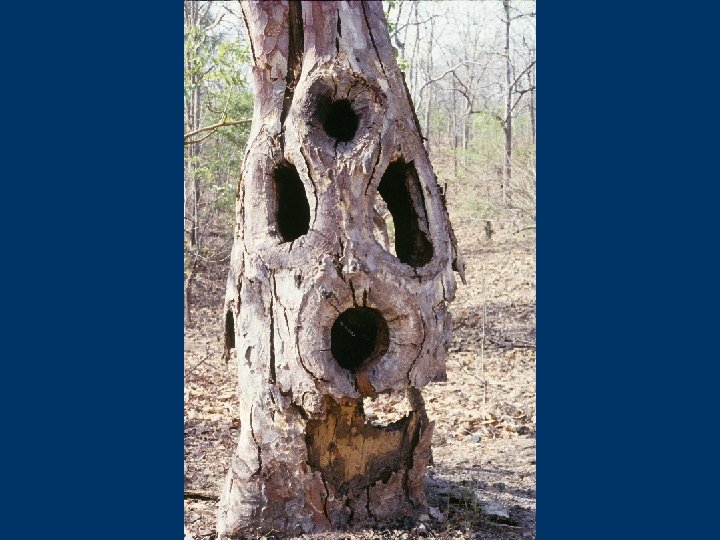
Impacts on Avifauna ► Forest clearing would adversely affect the ground dwelling birds viz. , partridges, quails, peafowls and spurfowls ► Territorial conflicts in buzzards, hawks, eagles and owls may occur ► Loss of old mature trees would affect bark gleaning species viz. , woodpeckers, nuthatches, barbets,
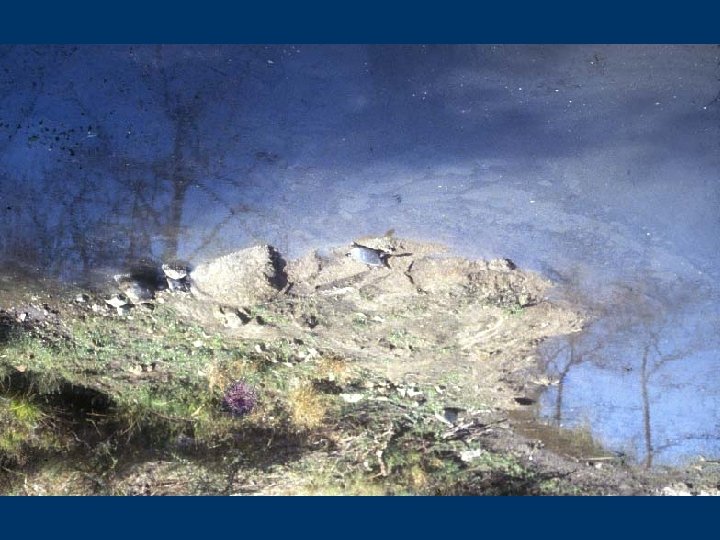
Impacts on Aquatic Reptiles Local extinction of softshell turtle `Chitra indica’
Impacts on the People of the Area ► Loss of occupation, income and livelihood which is presently predominantly agriculture based ► Further economic losses due to reduction in income from non-wood forest produce (NWFP) ► Loss of grazing lands and reduction in income from livestock
Impacts on the People of the Area (contd…) ►Severe impacts on the fishing community (DHIMARS) ►Further vitiation of man to forest to land ratio ►Disruption in the symbiotic relationship between man and nature ►Social cost involved in uprooting?
Mitigation Planning ► Mitigation is the act of mitigating, abatement, or dimunution of something painful, harsh, severe ……alleviation
Is Successful Mitigation of Environmental Impacts of Narmadasagar Possible? $ 64, 000 million question?
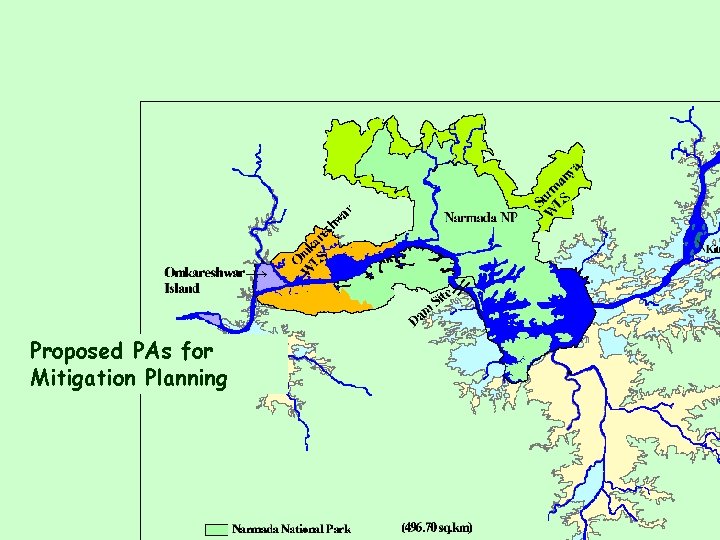
Proposed PAs for Mitigation Planning
Salient Biological Values of New PA ► All vegetation communities being lost in submergence are represented ► All large mammalian species present in the project area have been recorded ► Incorporates the only residual portion of free river portion of
Salient Biological Values of New PA (contd…) ► Contiguity of habitat, low anthropogenic pressures and presence of riparian stretches ► Includes artificially created islands for future ecological studies
Summary of Mitigation Measures ► Ecological Restoration of Affected Species ► Gazettement of Protected Areas (PAs) ► Humane and Equitable Resettlement of Project Affected People (PAP) ► Participatory Buffer Zone Management and Ecodevelopment
Committee on Assessment of Environmental Safeguard measures of Sardar Sarovar and Indira Sagar Projects
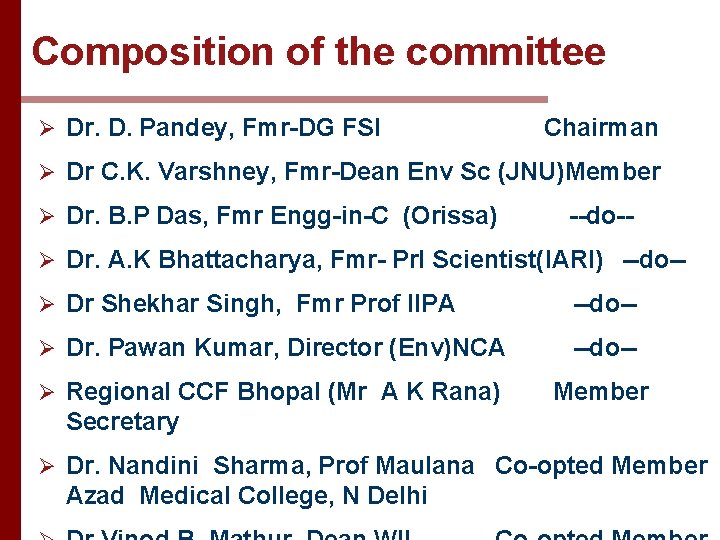
Composition of the committee Ø Dr. D. Pandey, Fmr-DG FSI Chairman Ø Dr C. K. Varshney, Fmr-Dean Env Sc (JNU)Member Ø Dr. B. P Das, Fmr Engg-in-C (Orissa) --do-- Ø Dr. A. K Bhattacharya, Fmr- Prl Scientist(IARI) --do-Ø Dr Shekhar Singh, Fmr Prof IIPA --do-- Ø Dr. Pawan Kumar, Director (Env)NCA --do-- Ø Regional CCF Bhopal (Mr A K Rana) Member Secretary Ø Dr. Nandini Sharma, Prof Maulana Co-opted Member Azad Medical College, N Delhi
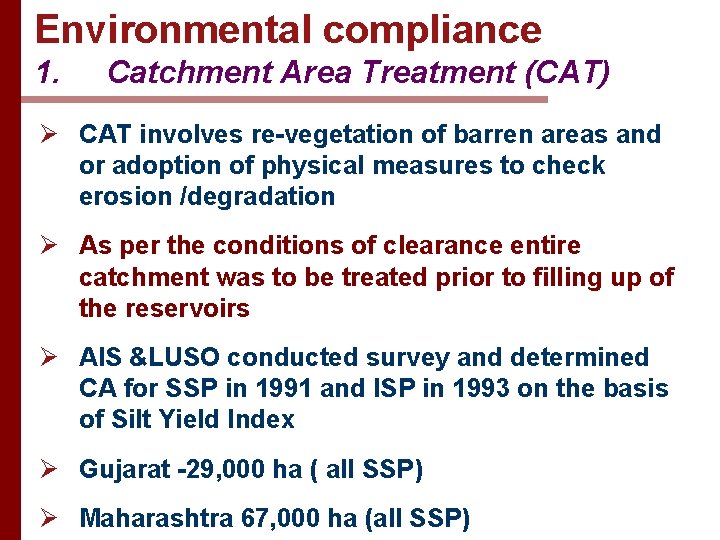
Environmental compliance 1. Catchment Area Treatment (CAT) Ø CAT involves re-vegetation of barren areas and or adoption of physical measures to check erosion /degradation Ø As per the conditions of clearance entire catchment was to be treated prior to filling up of the reservoirs Ø AIS &LUSO conducted survey and determined CA for SSP in 1991 and ISP in 1993 on the basis of Silt Yield Index Ø Gujarat -29, 000 ha ( all SSP) Ø Maharashtra 67, 000 ha (all SSP)
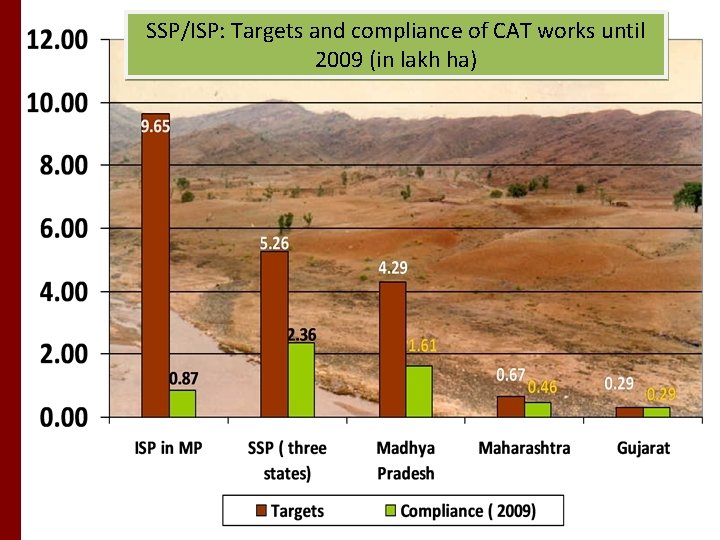
SSP/ISP: Targets and compliance of CAT works until 2009 (in lakh ha)
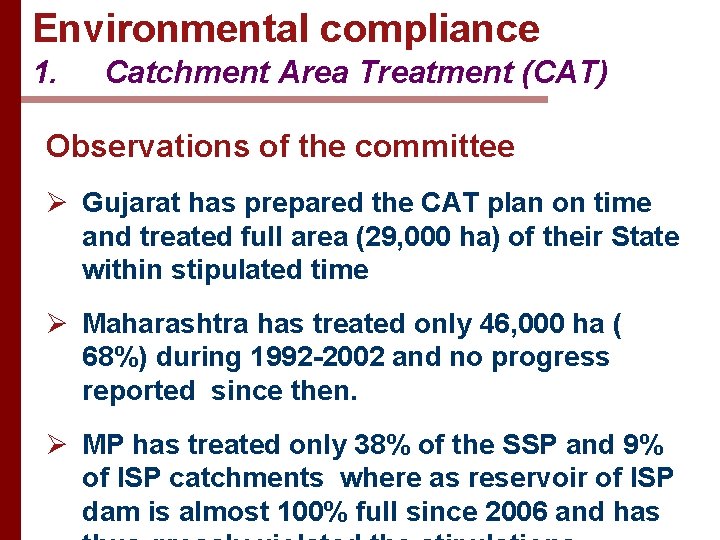
Environmental compliance 1. Catchment Area Treatment (CAT) Observations of the committee Ø Gujarat has prepared the CAT plan on time and treated full area (29, 000 ha) of their State within stipulated time Ø Maharashtra has treated only 46, 000 ha ( 68%) during 1992 -2002 and no progress reported since then. Ø MP has treated only 38% of the SSP and 9% of ISP catchments where as reservoir of ISP dam is almost 100% full since 2006 and has
Environmental compliance 2. Fauna, Flora and Carrying Capacity The key concern in SSP and ISP has been the loss of habitats and biodiversity due to submergence of 128, 500 ha land of which 54, 498 ha was forests. Stipulations included; - survey of flora and fauna including rare and endangered species likely to be affected prior to start of the project, - preparation of the Master Plan to exclude PAs from development works, tree felling plan to avoid trapping of wild animals, planning of
Environmental compliance 2. Fauna, Flora and Carrying Capacity -Stipulations included; -study of the carrying capacity of the surrounding areas where wildlife would disperse from the submerged areas prior to submergence -declaration of WL sanctuaries for rehabilitating endangered species of flora and fauna prior to submergence. The ESG during its various meetings also directed project authorities for declaring Sanctuaries / National Parks as per the recommendation of EIA Study Groups. -declaring islands, being formed during filling of
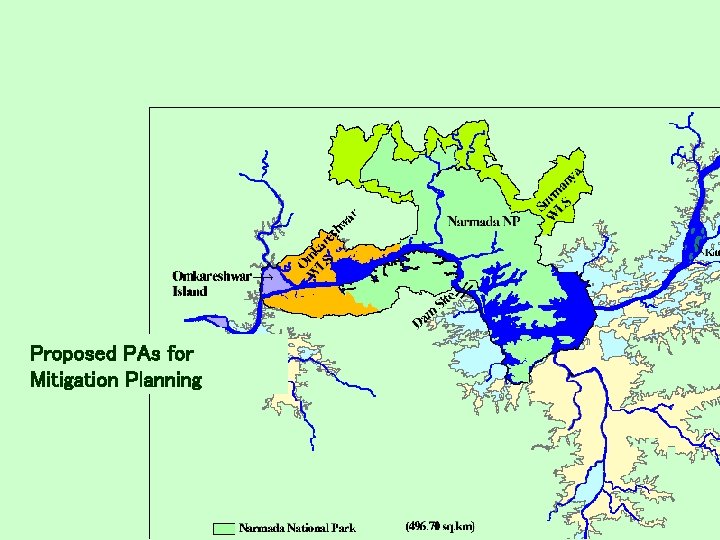
Proposed PAs for Mitigation Planning
Environmental compliance 2. Fauna, Flora and Carrying Capacity Observations of the committee Ø Though identification of rare and endangered species has been completed for SSP and ISP, wildlife census of the area has been inadequate. Ø Further, a Master Plan integrating project wide information of the all relevant aspects, which should have been ready well before the commencement of project activities, has not been prepared till date. Ø MP has not yet notified the three areas identified by the WII as protected areas for rehabilitation of wildlife, involving a total 75, 888 ha area of ISP. Filling up the reservoir at ISP was almost complete
Environmental compliance 3. Command Area Development Stipulations included; Ø The command area of an irrigation project experiences a major change in water environment by way of a shift from rain-fed to irrigated agriculture Ø Approved Environmental Action Plan (EAP) for the Command area (later on identified 2. 124 m ha in Gujarat , 75, 000 ha in Rajasthan and 123, 000 ha in Madhya Pradesh) to be ready before the start of construction of the canal. Ø EAP to be implemented ahead of the start of irrigation
Environmental compliance 3. Command Area Development Observations of the committee Ø Gujarat prepared only CAD concept document in 1989 and Rajasthan in 1990 and no plan by Madhya Pradesh. Ø Gujarat prepared detailed micro (implementable ) plan in 2003 only of 5 blocks comprising 41, 300 ha (2% of the total CA). Submitted another plan in 2008 yet to be approved, but canal network, as in DPR completed in Phase-I and unplanned irrigation started in 2003. Ø Rajasthan’s 1990 CAD plan was revised in 2003 to include EAP but still not approved but the canal network, as in DPR nearly completed and irrigation started in 2008. Ø MP did not even formulate the CAD plan for ISP till mid 2009 but canal network as in DPR is progressing and unplanned irrigation continuing since 2007.
Environmental compliance 4. Compensatory Afforestation Stipulations included; Ø Preparation of afforestation plan on equal area in non forest land on double the area in degraded forest land implement the same, Ø Declare non forest compensatory afforested land as reserve or protected forests and transfer them to state forest department, Ø The project authorities to supply firewood to their labours on the project cost Ø Monitor the afforested areas to find the success rates and ensure maintenance of such afforestation/ reforestations.
Environmental compliance 4. Compensatory Afforestation Observations of the committee Ø Preparation of afforestation plans and their implementation – all the three States (Guj, MH and MP) fully complied, Ø Declare non forest compensatory afforested land as reserve or protected forests and transfer them to State Forest Departmentcomplied partially, Ø The project authorities to supply firewood to their labours on the project cost- fully complied
Environmental compliance 5. Human Health Aspect Stipulations included; Ø Baseline Studies and surveys of water borne diseases and health delivery system to be completed by 1989 Ø Project specific approved environmental action plans on health aspects to be prepared before the implementation of the project Ø Implementation of approved Environmental Health Action Plan including screening arrangement for the workforce, surveillance of diseases and reporting, reinforcement of the existing health delivery system, water quality monitoring of identified parameters, construction of sanitary latrines and IEC campaign – pari-passu.
Environmental compliance 5. Human Health Aspect Observations of the committee Ø All the three States completed the baseline studies and surveys though slightly delayed by M. P. (1991) and Maharashtra (1991) but common protocol was not used. Ø Project specific environmental action plans for ISP approved was by the ESG / ICMR in 2003 but similar approvals lacking (MP, Mh, Guj) and thus partially complied. Ø The compliance on implementation is also partial. Ø Though screening facility created in SSP but no data are available. Ø Similarly, credible evidence for comprehensive
Environmental compliance 5. Human Health Aspect Observations of the committee The compliance on implementation is also partial. Ø Partial infrastructure (buildings ) have come up but no information availability on their functioning. Ø Reports on water quality monitoring (SSP and ISP) is lacking except for some bacteriological testing. Ø Effectiveness of IEC activities have not been reported. Ø Monitoring and evaluation being done only in
Conclusions Ø The project authorities of SSP and ISP have not taken due care of the environmental safeguard measures as stipulated during clearance of these projects. Ø In most of the cases the Pari-Passu clause focusing simultaneous actions on environmental safeguard measures vis-a vis engineering works has not been respected. The compliances have been either partial or delayed and in a few cases not complied till today. Ø The committee therefore recommends that no further reservoir filling either at SSP or at ISP be permitted till the catchment areas of both SSP and ISP are fully treated and all the outstanding requirements to protect and conserve flora and fauna including

The Scales of Justice Maggie Black
- Slides: 72