
BIODIVERSITY HOTSPOTS Core Course No ZOOA P 3

BIODIVERSITY HOTSPOTS Core Course No. ZOOA – P 3 T, Group -A, Unit: 2, Topic No. 1
What’s a Hotspot? A biodiversity hotspot is a biogeographic region that is both a significant reservoir of biodiversity and is threatened with destruction. The term biodiversity hotspot specifically refers to 35 biologically rich areas around the world that have lost at least 70 percent of their original habitat.
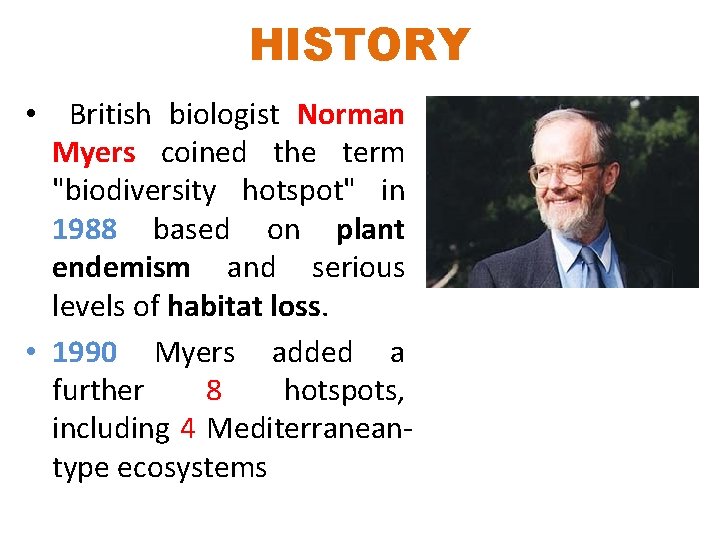
HISTORY • British biologist Norman Myers coined the term "biodiversity hotspot" in 1988 based on plant endemism and serious levels of habitat loss. • 1990 Myers added a further 8 hotspots, including 4 Mediterraneantype ecosystems
HISTORY • Conservation International (CI), USA adopted Myers’ hotspots as its institutional blueprint in 1989 • 1996, undertake a reassessment of the hotspots concept • In 1999, CI identified 25 biodiversity hotspots in the book “Hotspots: Earth’s Biologically Richest and Most Endangered Terrestrial Ecoregions”. • In 2005 CI published an updated titled “Hotspots Revisited: Earth's Biologically Richest and Most Endangered Terrestrial Ecoregions” and mentioned 35 biodiversity hotspots
BASIC CRITERIA According to CI, to qualify as a hotspot a region must meet two strict criteria: 1. It must contain at least 1, 500 species of vascular plants (> 0. 5% of the world’s total) as endemics 2. It has to have lost at least 70% of its original habitat
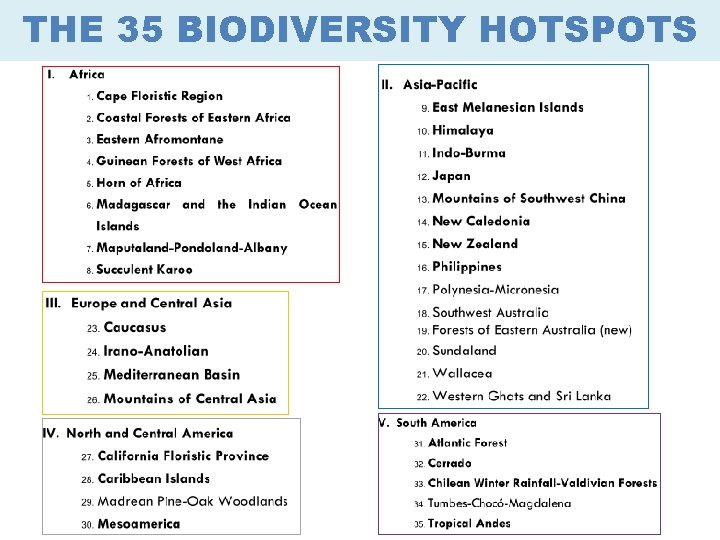
THE 35 BIODIVERSITY HOTSPOTS
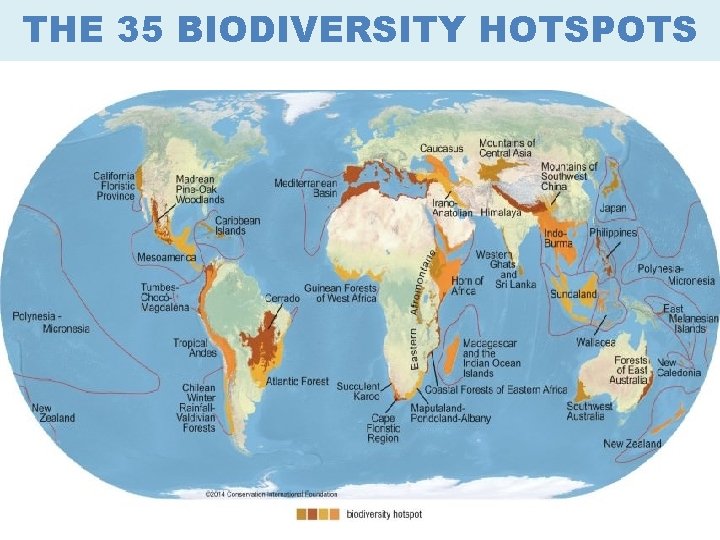
THE 35 BIODIVERSITY HOTSPOTS
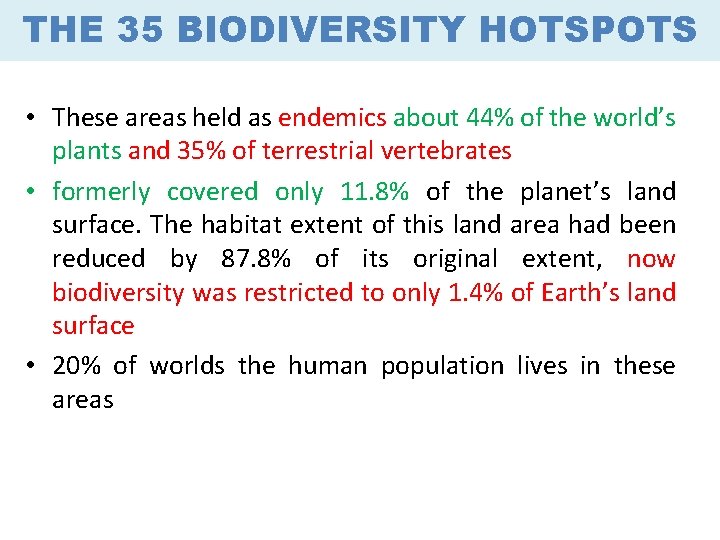
THE 35 BIODIVERSITY HOTSPOTS • These areas held as endemics about 44% of the world’s plants and 35% of terrestrial vertebrates • formerly covered only 11. 8% of the planet’s land surface. The habitat extent of this land area had been reduced by 87. 8% of its original extent, now biodiversity was restricted to only 1. 4% of Earth’s land surface • 20% of worlds the human population lives in these areas
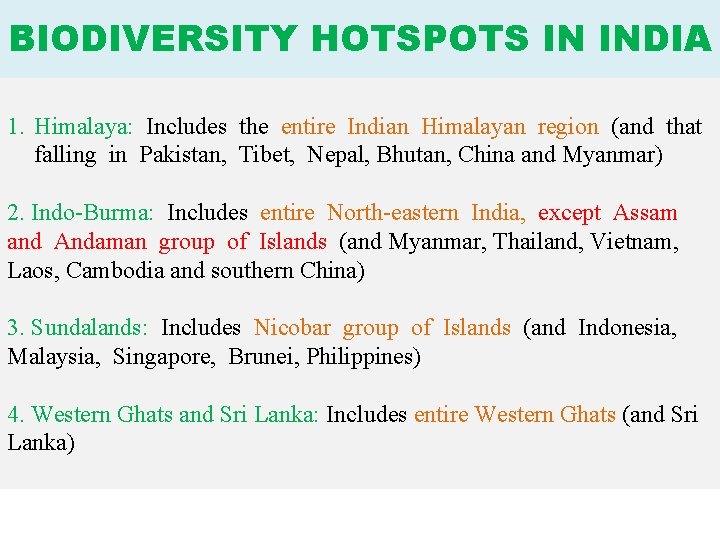
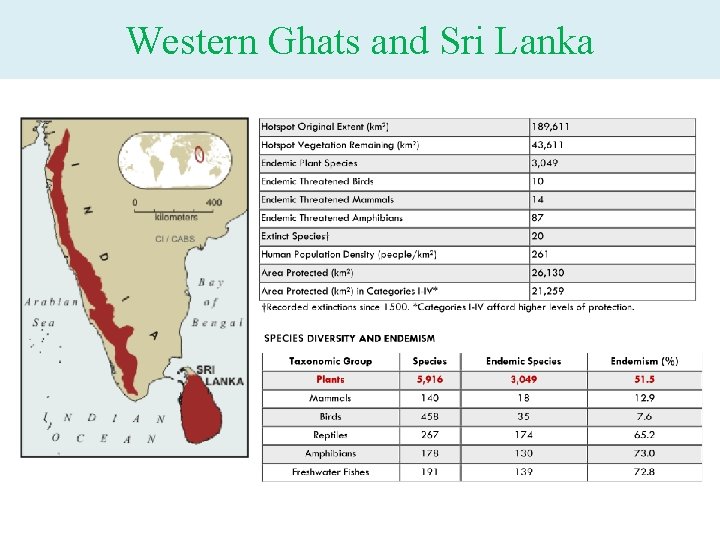
BIODIVERSITY HOTSPOTS IN INDIA 1. Himalaya: Includes the entire Indian Himalayan region (and that falling in Pakistan, Tibet, Nepal, Bhutan, China and Myanmar) 2. Indo-Burma: Includes entire North-eastern India, except Assam and Andaman group of Islands (and Myanmar, Thailand, Vietnam, Laos, Cambodia and southern China) 3. Sundalands: Includes Nicobar group of Islands (and Indonesia, Malaysia, Singapore, Brunei, Philippines) 4. Western Ghats and Sri Lanka: Includes entire Western Ghats (and Sri Lanka)
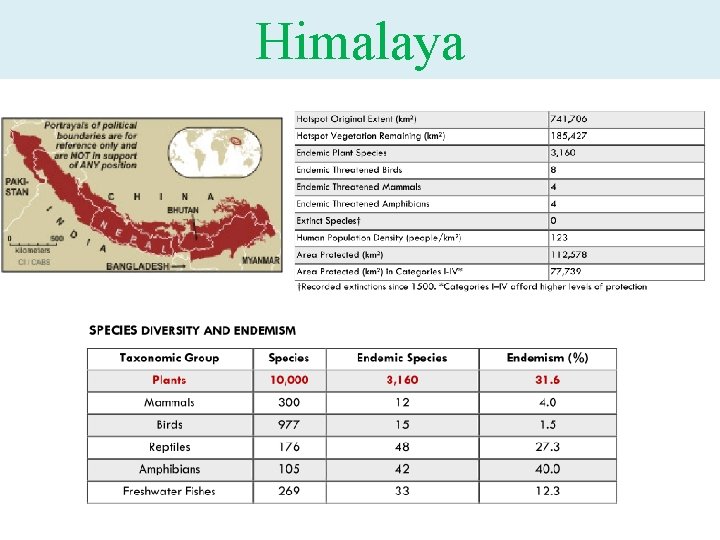
Himalaya
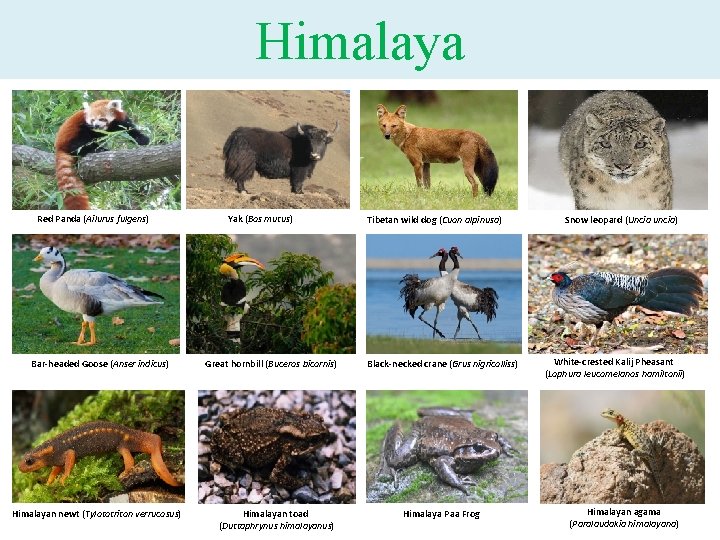
Himalaya Red Panda (Ailurus fulgens) Bar-headed Goose (Anser indicus) Himalayan newt (Tylototriton verrucosus) Yak (Bos mutus) Great hornbill (Buceros bicornis) Himalayan toad (Duttaphrynus himalayanus) Tibetan wild dog (Cuon alpinusa) Black-necked crane (Grus nigricolliss) Himalaya Paa Frog Snow leopard (Uncia uncia) White-crested Kalij Pheasant (Lophura leucomelanos hamiltonii) Himalayan agama (Paralaudakia himalayana)

Indo-Burma
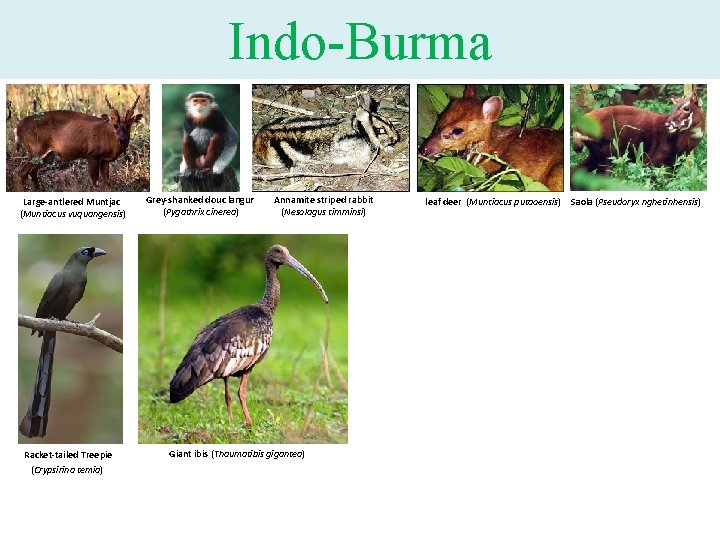
Indo-Burma Large-antlered Muntjac (Muntiacus vuquangensis) Racket-tailed Treepie (Crypsirina temia) Grey-shanked douc langur (Pygathrix cinerea) Annamite striped rabbit (Nesolagus timminsi) Giant ibis (Thaumatibis gigantea) leaf deer (Muntiacus putaoensis) Saola (Pseudoryx nghetinhensis)
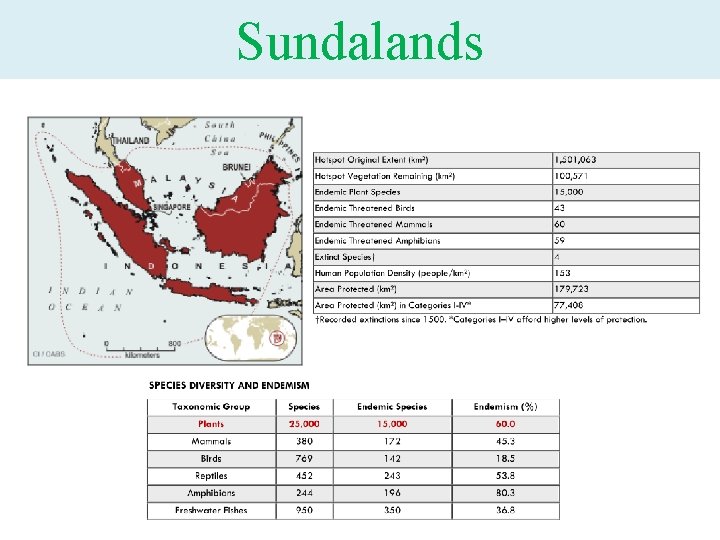
Sundalands
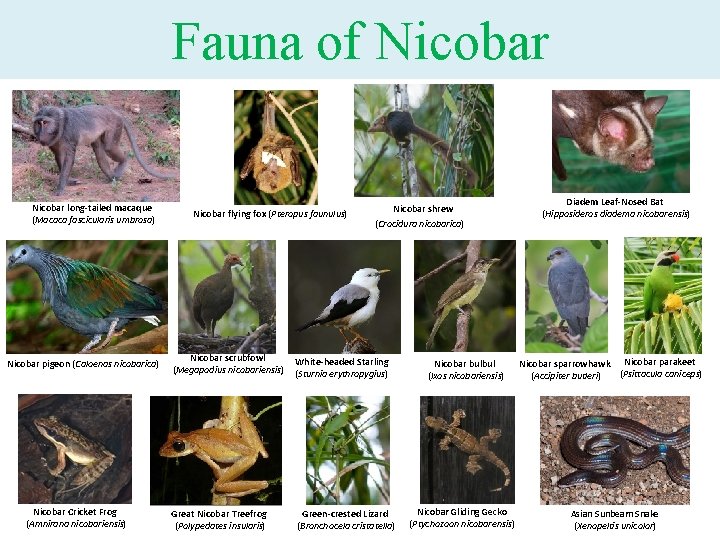
Fauna of Nicobar long-tailed macaque (Macaca fascicularis umbrosa) Nicobar pigeon (Caloenas nicobarica) Nicobar Cricket Frog (Amnirana nicobariensis) Nicobar flying fox (Pteropus faunulus) Nicobar shrew (Crocidura nicobarica) Nicobar scrubfowl (Megapodius nicobariensis) White-headed Starling (Sturnia erythropygius) Great Nicobar Treefrog (Polypedates insularis) Green-crested Lizard (Bronchocela cristatella) Nicobar bulbul (Ixos nicobariensis) Nicobar Gliding Gecko (Ptychozoon nicobarensis) Diadem Leaf-Nosed Bat (Hipposideros diadema nicobarensis) Nicobar sparrowhawk Nicobar parakeet (Psittacula caniceps) (Accipiter butleri) Asian Sunbeam Snake (Xenopeltis unicolor)
Western Ghats and Sri Lanka
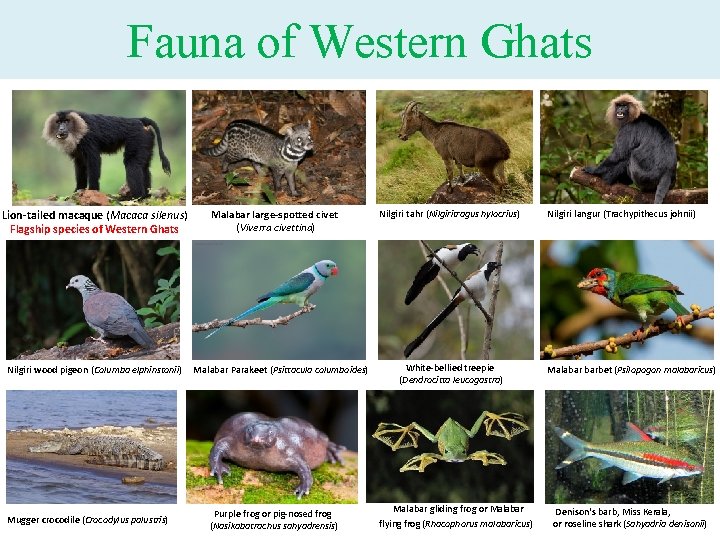
Fauna of Western Ghats Lion-tailed macaque (Macaca silenus) Flagship species of Western Ghats Nilgiri wood pigeon (Columba elphinstonii) Mugger crocodile (Crocodylus palustris) Malabar large-spotted civet (Viverra civettina) Nilgiri tahr (Nilgiritragus hylocrius) White-bellied treepie (Dendrocitta leucogastra) Malabar Parakeet (Psittacula columboides) Purple frog or pig-nosed frog (Nasikabatrachus sahyadrensis) Malabar gliding frog or Malabar flying frog (Rhacophorus malabaricus) Nilgiri langur (Trachypithecus johnii) Malabar barbet (Psilopogon malabaricus) Denison's barb, Miss Kerala, or roseline shark (Sahyadria denisonii)
Reasons for biodiversity loss in hotspots • Habitat destruction • Resource mismanagement • Poaching • Climate change

References • www. conservation. org • www. cepf. net
- Slides: 19