
Biodiversity financing and safeguards lessons learned and proposed
Biodiversity financing and safeguards: lessons learned and proposed guidelines Dr. Claudia Ituarte-Lima, Swed. Bio/Stockholm Resilience Centre CBD-COP 12 side event, Outcomes of the Quito II Dialogue on the value of biodiversity for mainstreaming, financial mechanisms, and Safeguards SCBD and Swed. Bio/SRC, Pyeongchang South Korea 6 th Oct. 2014
Presentation based on: Biodiversity financing and safeguards: lessons learned and proposed guidelines Claudia Ituarte-Lima, Maria Schultz, Thomas Hahn, Constance Mc. Dermott and Sarah Cornell
I. - Background CBD-COP 11 in Hyderabad: - requests the CBD Secretariat to further develop the discussion paper on safeguards (UNEP/CBD/COP/11/INF 7) based on comments of Parties and other stakeholders and requests WGRI 5 to prepare a recommendation for the consideration by the twelfth Conference of the Parties (COP 12). CBD-COP 12 in Pyeongchang: - Draft options for voluntary guidelines, based on the policy report’s proposed guidelines, to be negotiated among the 194 CBD Parties at COP 12.
II. -Biodiversity financing and safeguards Biodiversity Financing Mechanisms (BFMs) • CBD Strategy for resource mobilisation (2008 -2015) • Areas of convergence and divergence on BFMs • Safeguards for addressing divergences and potential challenges in BFMs and contributing to the three CBD objectives Safeguards in BFMs: • Evolving notion • Point of departure: existing legal and policy instruments
Safeguards in existing legal and policy instruments 5
III. - Proposed Guidelines 1. Biodiversity underpins local livelihoods and resilience 2. People’s rights, access to resources and livelihoods 3. Local and country-driven/specific processes linked to the international level 4. Governance, institutional frameworks and accountability
IV. Safeguards and different types of BFMs • Payment for ecosystem services (PES): land tenure rights e. g. access to medicinal plants as part of contractual provisions; legal independent advice/ capacity building. • Environmental Fiscal Reform: reduce perverse incentives such as avoiding subsidies to unsustainable practices. PES are sometimes financed by earmark fiscal reforms. • Biodiversity offsets (BO): Mitigation strategy includes local values of biodiversity. Approval or rejection of BO based on participatory assessments on the potential environmental, social and cultural impacts (e. g. using the CBD Akwe: kon guidelines).
IV. Safeguards and different types of BFMs • International development finance and ODA: although ODA may not be an innovative financing mechanism, it can provide seed money (e. g. PES) and lessons learned. Policy coherence, between trade, environment and ODA. • Markets for green products: synergies between biodiversity and fair trade criteria. Effective communication, education and transparency across different standards. • Climate funding with co-benefits for biodiversity: CBD advice on biodiversity and social safeguards concerning climate funding can contribute to produce co-benefits for biodiversity and people’s livelihoods at project level as well as larger subnational, national and international levels. 8
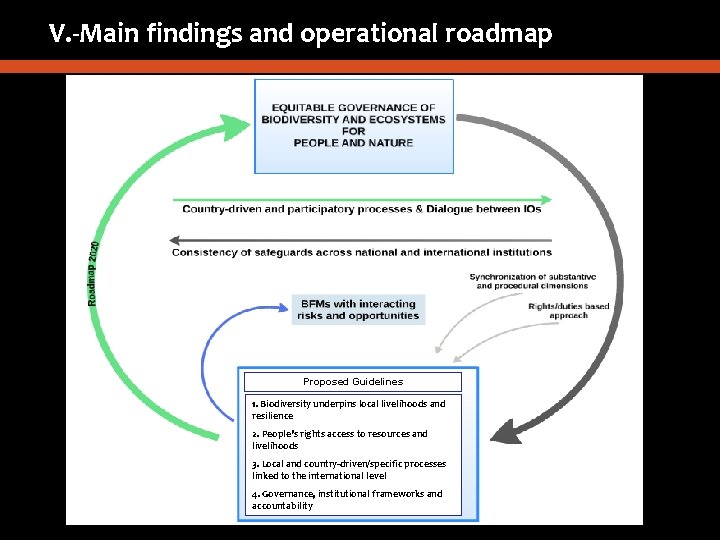
V. -Main findings and operational roadmap Proposed Guidelines 1. Biodiversity underpins local livelihoods and resilience 2. People’s rights access to resources and livelihoods 3. Local and country-driven/specific processes linked to the international level 4. Governance, institutional frameworks and accountability 9
Thank you! Please send comments to: claudia. ituarte@su. se
- Slides: 10