
Biodiversity Conservation This work is supported by a
Biodiversity Conservation This work is supported by a National Science Foundation (NSF) collaboration between the Directorates for Education and Human Resources (EHR) and Geociences (GEO) under grant DUE - 1125331
In this activity, you will explore the current “Sixth Extinction” and biodiversity conservation. By the end, you should be able to: 1. Explain the impacts of humans on biological diversity. 2. Compare and contrast the causes and rates of the sixth extinction with previous mass extinctions from the fossil record. 3. Evaluate criteria for setting species conservation priorities. 4. Distinguish between ex situ and in situ conservation approaches.
What is Biodiversity Conservation? Maintaining the diversity of species, habitats, and the interrelationships between organisms and the environment to keep ecosystems healthy and functioning.

Why Should We Conserve Biodiversity? • Biological Resources – Food, fibers, medicine, wood products, etc. • Ecosystem Services – Decomposition of waste, pollination, water purification, flood control, increased soil fertility, etc. • Social & Spiritual Benefits – Cultural and aesthetic value, recreation & tourism, etc.
How: Ex Situ or In Situ Conservation? Ex situ: Conservation of the components of biological diversity “off-site, ” or outside their natural surroundings. In situ: Conservation of species, habitats, or ecosystems “on-site, ” or in their natural surroundings

Ex situ conservation • Zoos, botanical gardens, aquaria • Storage of tissues, seeds, pollen, semen, ovules, embryos, microbial cultures, DNA • Field gene banks or livestock parks, if materials cannot be dried or frozen Beans at the CIAT gene bank in Colombia. Photo by Neil Palmer (CIAT)
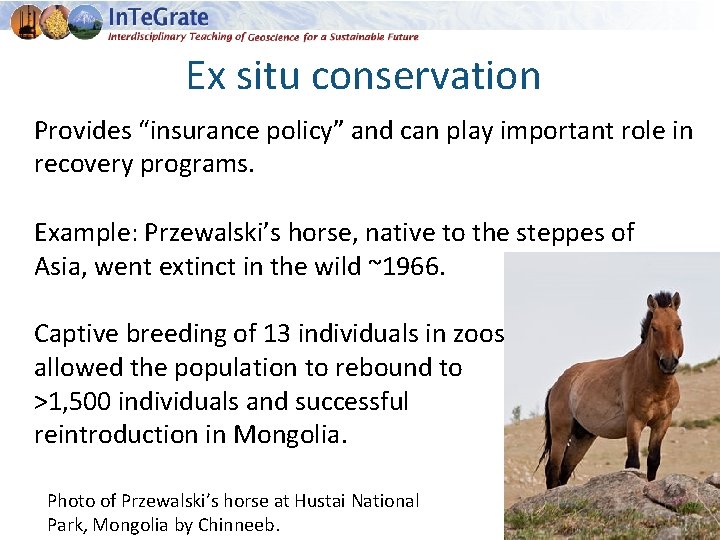
Ex situ conservation Provides “insurance policy” and can play important role in recovery programs. Example: Przewalski’s horse, native to the steppes of Asia, went extinct in the wild ~1966. Captive breeding of 13 individuals in zoos allowed the population to rebound to >1, 500 individuals and successful reintroduction in Mongolia. Photo of Przewalski’s horse at Hustai National Park, Mongolia by Chinneeb.
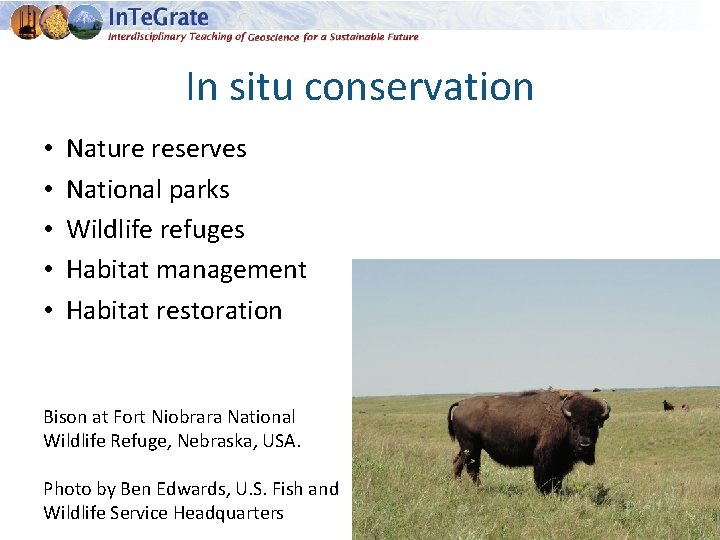
In situ conservation • • • Nature reserves National parks Wildlife refuges Habitat management Habitat restoration Bison at Fort Niobrara National Wildlife Refuge, Nebraska, USA. Photo by Ben Edwards, U. S. Fish and Wildlife Service Headquarters
Setting Priorities for Biodiversity Conservation It is impossible to actively conserve all species because of limited time and money. As a result, humans must make decisions about how to target conservation efforts so limited resources can have the greatest impact. So, how do we decide?
Setting Priorities • Iconic or ambassador species (flagship species) – Examples: Giant pandas, tigers, whales • Large, land-demanding species (umbrella species) – Often large carnivores or migratory species • Ecologically important species (keystone species and ecosystem engineers) – Examples: Wolves, beavers, elephants • Economic value/ecosystem goods or services – Examples: honey bees, wetlands that filter water
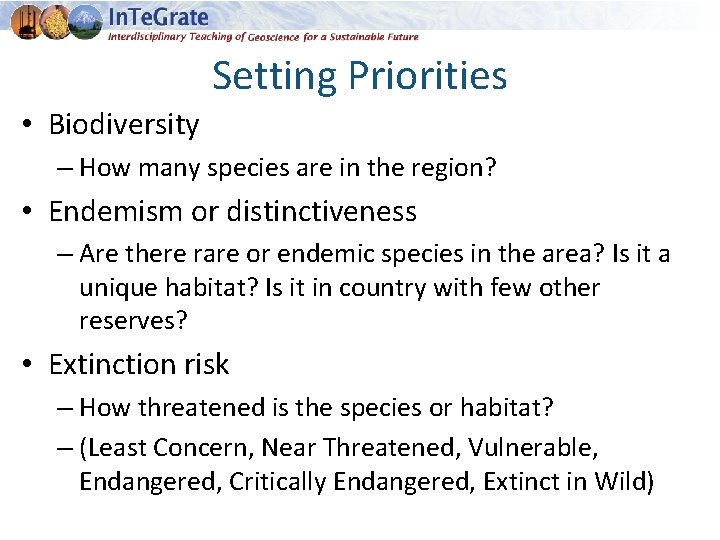
Setting Priorities • Biodiversity – How many species are in the region? • Endemism or distinctiveness – Are there rare or endemic species in the area? Is it a unique habitat? Is it in country with few other reserves? • Extinction risk – How threatened is the species or habitat? – (Least Concern, Near Threatened, Vulnerable, Endangered, Critically Endangered, Extinct in Wild)
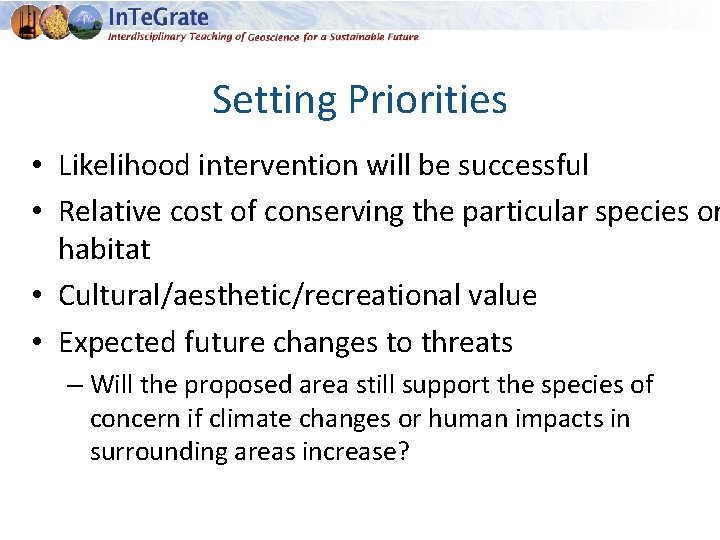
Setting Priorities • Likelihood intervention will be successful • Relative cost of conserving the particular species or habitat • Cultural/aesthetic/recreational value • Expected future changes to threats – Will the proposed area still support the species of concern if climate changes or human impacts in surrounding areas increase?
Evaluating Criteria Think about the criteria for 1 -2 minutes. Write down the five criteria you think are most important for deciding which species or habitats to conserve.
Evaluating Criteria Form groups of 3 -4 and share ideas. As a group, choose your top three priorities and write a short justification for each. Be prepared to share these with the class in ~5 minutes.

Applying Criteria You are members of Conservation World, a large international organization that funds conservation projects. Your task is to evaluate the potential projects in your packet. Resources are limited, so you must choose one that you will recommend to the board of directors for funding. You must include a justification for your recommendation. You will make your recommendation to the Board (class) in 15 minutes.
References • Maxted, N. 2001. Ex situ, in situ conservation. Encyclopedia of Biodiversity, Volume 2. https: //enviro. doe. gov. my/lib/digital/1385455130 -3 -s 2. 0 B 0122268652001152 -main. pdf • Slide 4. Creative Commons Image by Neil Palmer (CIAT) (NP_Genebank 2011_1) [CC BY-SA 2. 0 (http: //creativecommons. org/licenses/by-sa/2. 0)], via Wikimedia Commons • Slide 5. Creative Commons Image by Chinneeb (Own work) [CC BY-SA 3. 0 (http: //creativecommons. org/licenses/by-sa/3. 0) or GFDL (http: //www. gnu. org/copyleft/fdl. html)], via Wikimedia Commons • Slide 6. Creative Commons Image by U. S. Fish and Wildlife Service Headquarters [CC BY 2. 0 (http: //creativecommons. org/licenses/by/2. 0)], via Wikimedia Commons
- Slides: 16