
Biodiversity Conservation in Coffee the Opportunity of Sustainability
Biodiversity Conservation in Coffee - the Opportunity of Sustainability Certification Leif Pedersen Coffee Program Manager/Rainforest Alliance Biodiversity Conservation in Agriculture Symposium Punta Cana, Dominican Republic June 1, 2006 © Copyright 2004. Rainforest Alliance 3/1/2021
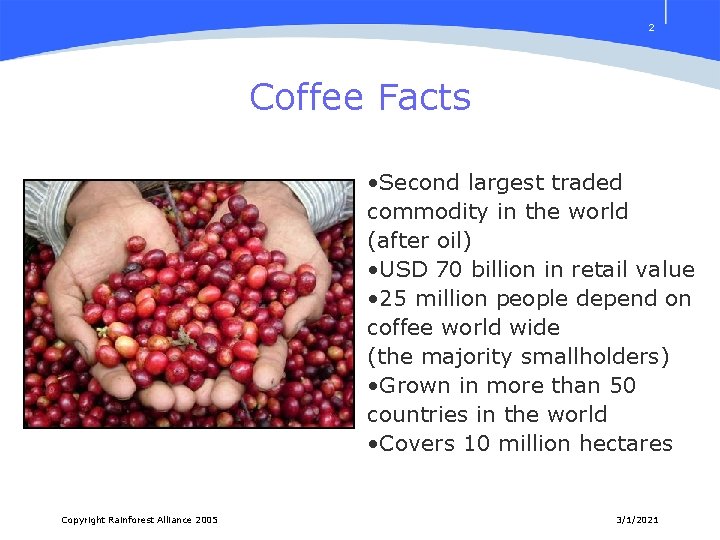
2 Coffee Facts • Second largest traded commodity in the world (after oil) • USD 70 billion in retail value • 25 million people depend on coffee world wide (the majority smallholders) • Grown in more than 50 countries in the world • Covers 10 million hectares Copyright Rainforest Alliance 2005 3/1/2021
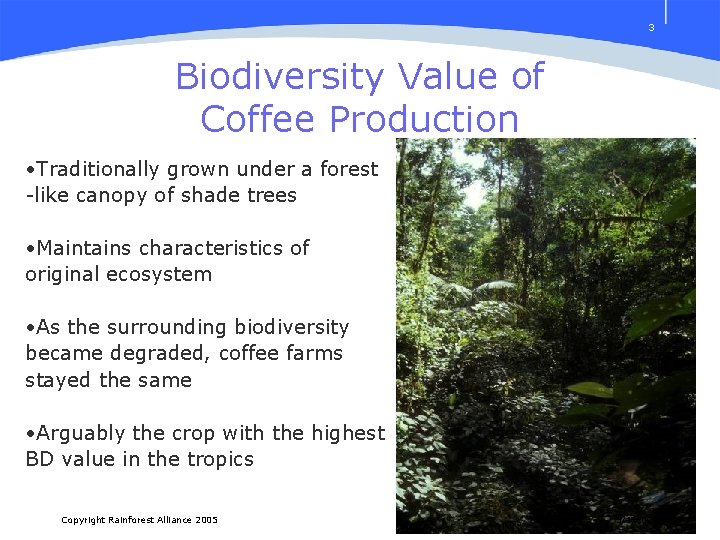
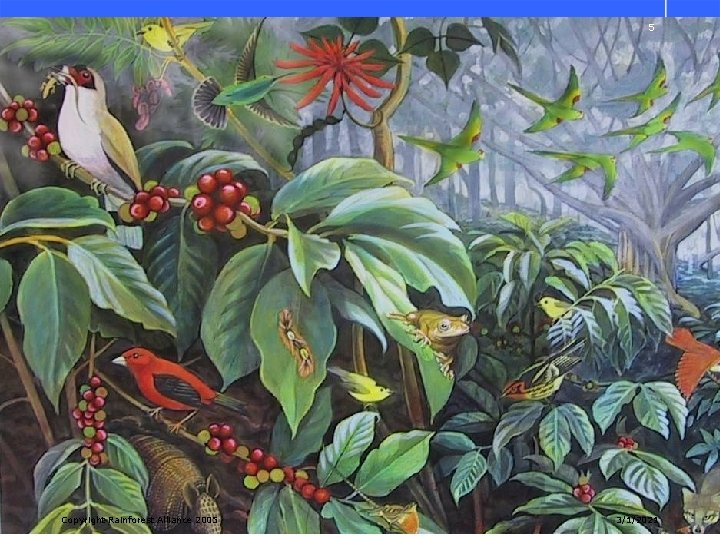
3 Biodiversity Value of Coffee Production • Traditionally grown under a forest -like canopy of shade trees • Maintains characteristics of original ecosystem • As the surrounding biodiversity became degraded, coffee farms stayed the same • Arguably the crop with the highest BD value in the tropics Copyright Rainforest Alliance 2005 3/1/2021
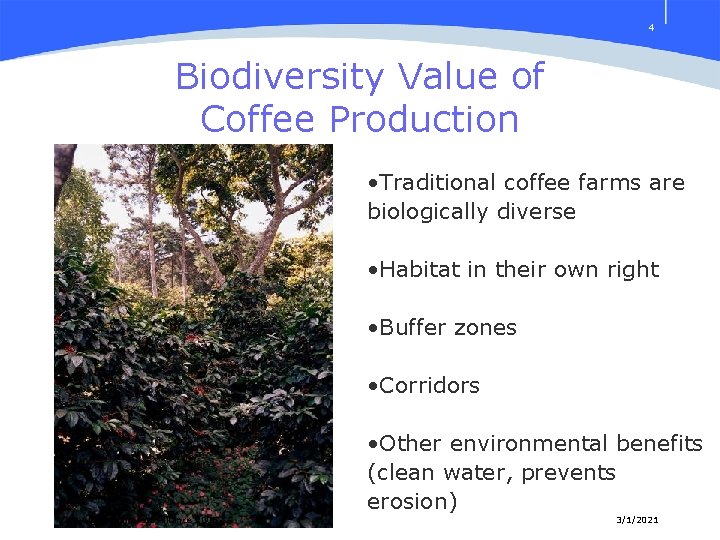
4 Biodiversity Value of Coffee Production • Traditional coffee farms are biologically diverse • Habitat in their own right • Buffer zones • Corridors Copyright Rainforest Alliance 2005 • Other environmental benefits (clean water, prevents erosion) 3/1/2021
5 Copyright Rainforest Alliance 2005 3/1/2021
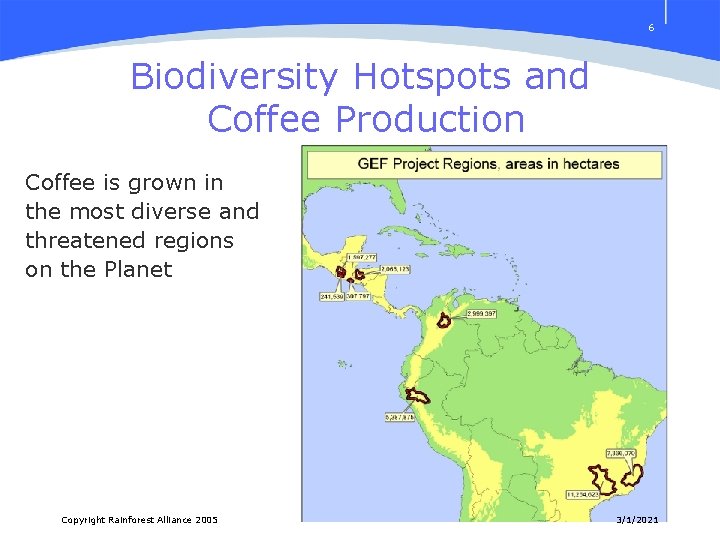
6 Biodiversity Hotspots and Coffee Production Coffee is grown in the most diverse and threatened regions on the Planet Copyright Rainforest Alliance 2005 3/1/2021
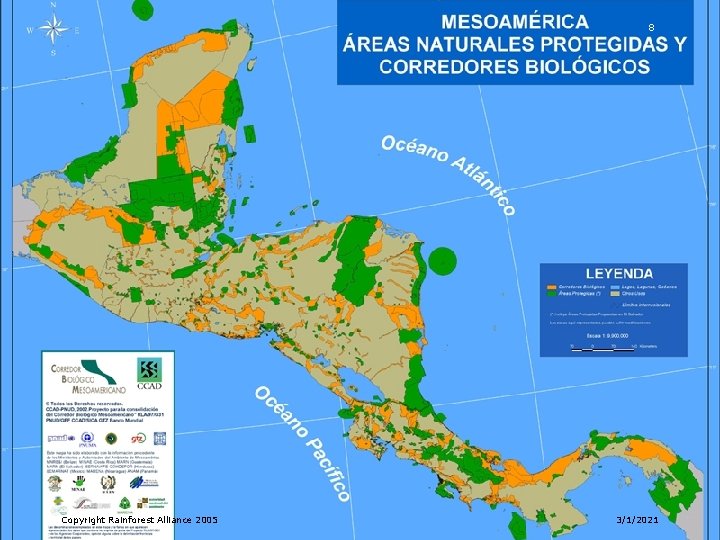
7 Coffee in Conservation in Central America Mesoamerican Biological Corridor: efforts of 8 governments to establish one network of Protected Areas connected by Biological Corridors Coordination between governments has improved through the CCAD Need to transform business practices to ensure onthe-ground impact of the MBC Copyright Rainforest Alliance 2005 3/1/2021
8 Copyright Rainforest Alliance 2005 3/1/2021
9 Coffee Crisis Increased world production (Brazil and Vietnam) -► oversupply of coffee on international markets -► drastically reduced prices -► labor-intensive, biodiversity friendly traditional shade coffee farming not profitable Copyright Rainforest Alliance 2005 3/1/2021
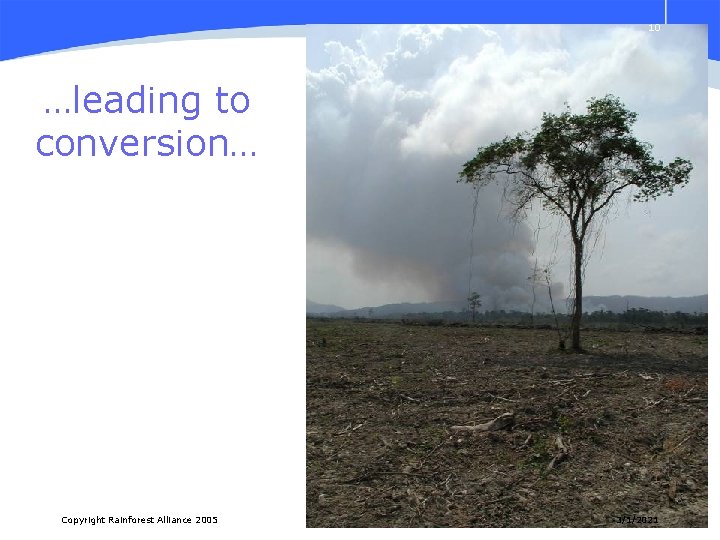
10 …leading to conversion… Copyright Rainforest Alliance 2005 3/1/2021
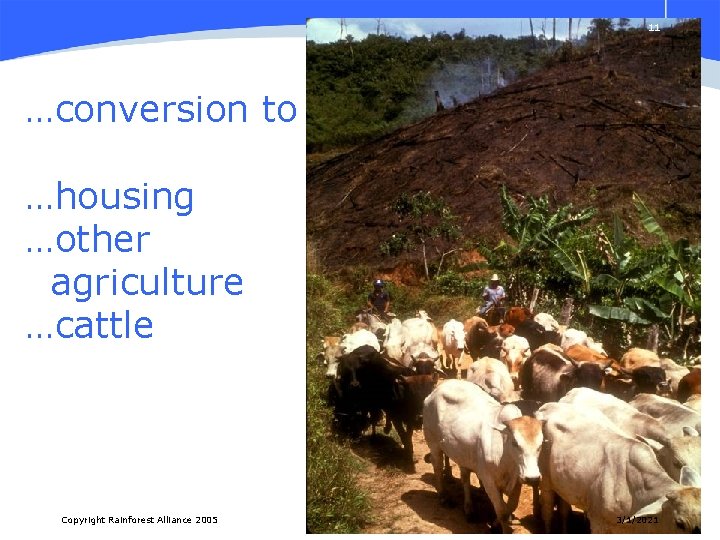
11 …conversion to …housing …other agriculture …cattle Copyright Rainforest Alliance 2005 3/1/2021
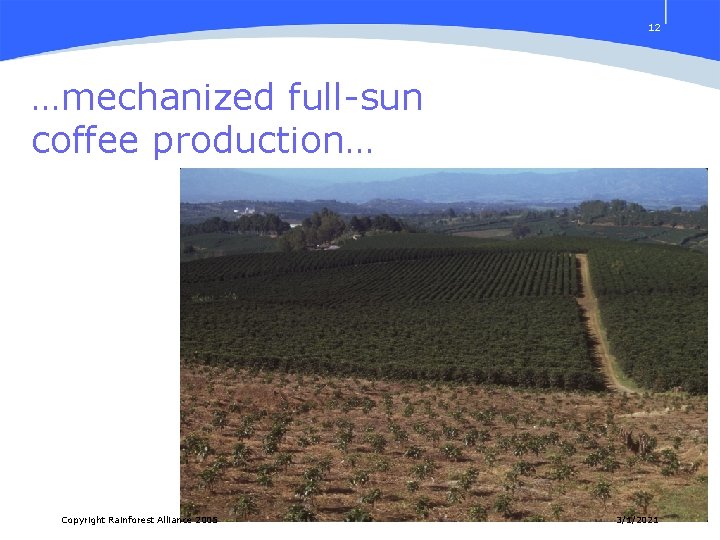
12 …mechanized full-sun coffee production… Copyright Rainforest Alliance 2005 3/1/2021
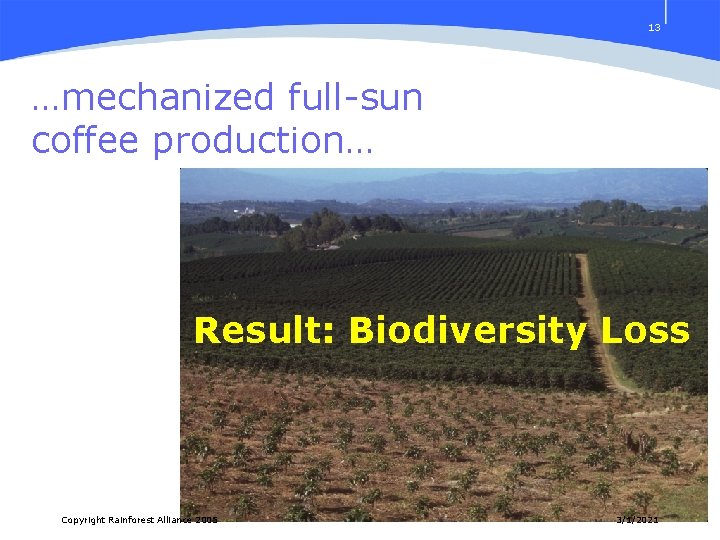
13 …mechanized full-sun coffee production… Result: Biodiversity Loss Copyright Rainforest Alliance 2005 3/1/2021
14 Market Failures Markets fail to recognize best management practices in agriculture n Consumers have no idea under which conditions products are grown. n Focus on price on mainstream market pushes farmers to employ short-term destructive practices n Legislative environment is often at the expense of BD n Donors sometimes contribute: WB in Vietnam n Copyright Rainforest Alliance 2005 3/1/2021
15 Sustainable coffee in aid and conservation projects Traditional development and conservation projects: • Focus on productive practices and farm management • Fail to link producers to markets and address market failures • Fail to provide long-term incentive to maintain improvements • Driven by well-meaning foreign experts. No real local ownership Copyright Rainforest Alliance 2005 3/1/2021

16 Coffee Certification as an alternative What is certification? “A procedure by which a third party gives written assurance that a product, process, service or management system conforms to specific requirements. ” Copyright Rainforest Alliance 2005 3/1/2021
17 Coffee Certification: correcting market failures Certification allows markets to recognize environmental and social benefits • Empowers consumers to give preference for products grown under certain conditions • Provides incentives to companies to make voluntary efforts for the common good • Rewards farmers for implementing sustainable production practices Copyright Rainforest Alliance 2005 3/1/2021
18 Coffee Certification Major (coffee) certification schemes: Fairtrade: protection of small producers from fluctuations on international coffee markets by guaranteeing a minimum price paid to the producer Organic: elimination of synthetic agrochemicals in farming and soil protection measures Utz Kapeh: industry entry-level standards mainly concerned with food safety and product traceability issues Rainforest Alliance: Sustainable (Environmental – Social – Economic). Rigorous standards for wildlife and ecosystem conservation Copyright Rainforest Alliance 2005 3/1/2021
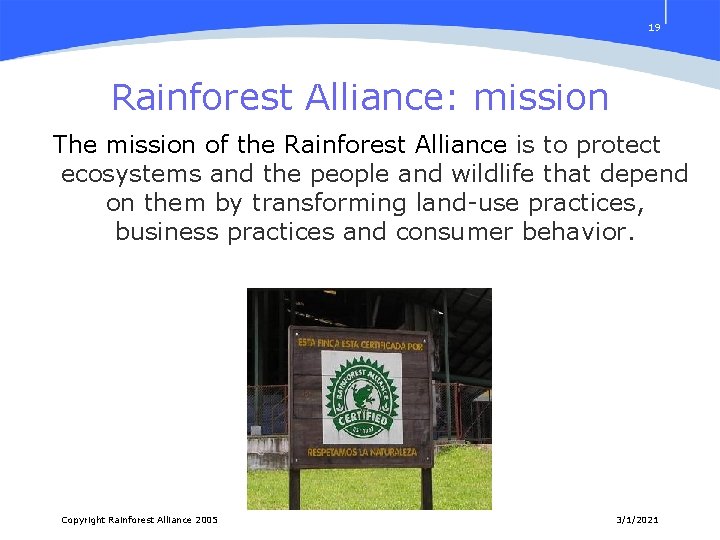
19 Rainforest Alliance: mission The mission of the Rainforest Alliance is to protect ecosystems and the people and wildlife that depend on them by transforming land-use practices, business practices and consumer behavior. Copyright Rainforest Alliance 2005 3/1/2021
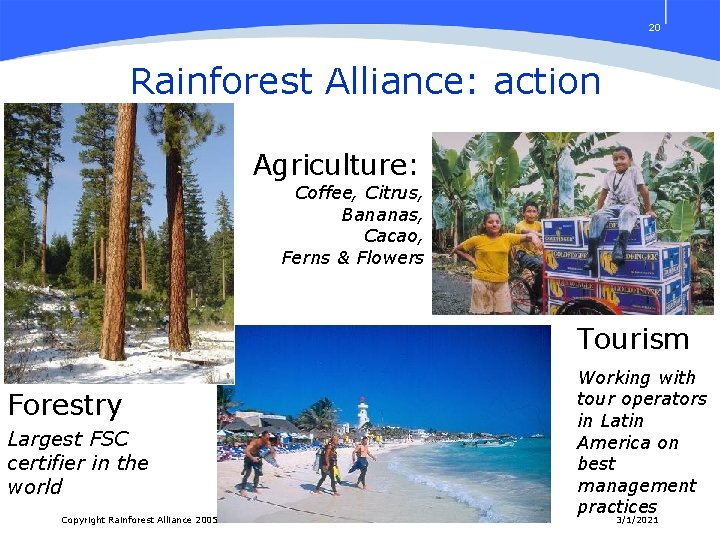
20 Rainforest Alliance: action Agriculture: Coffee, Citrus, Bananas, Cacao, Ferns & Flowers Tourism Forestry Largest FSC certifier in the world Copyright Rainforest Alliance 2005 Working with tour operators in Latin America on best management practices 3/1/2021
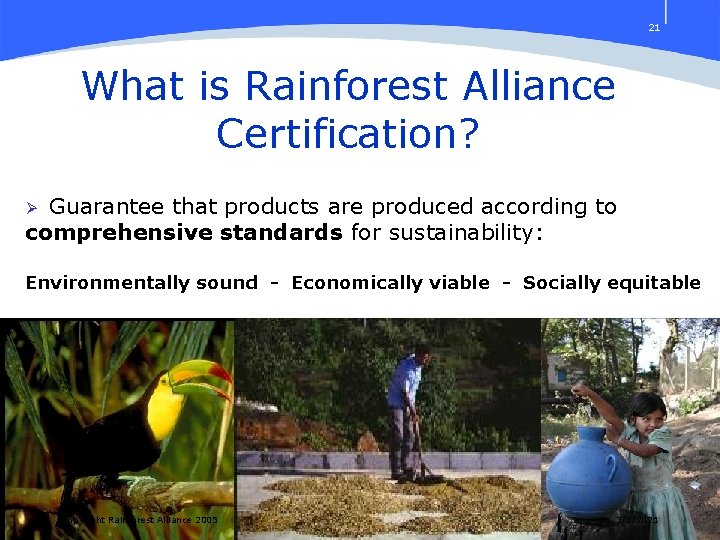
21 What is Rainforest Alliance Certification? Guarantee that products are produced according to comprehensive standards for sustainability: Ø Environmentally sound - Economically viable - Socially equitable Copyright Rainforest Alliance 2005 3/1/2021
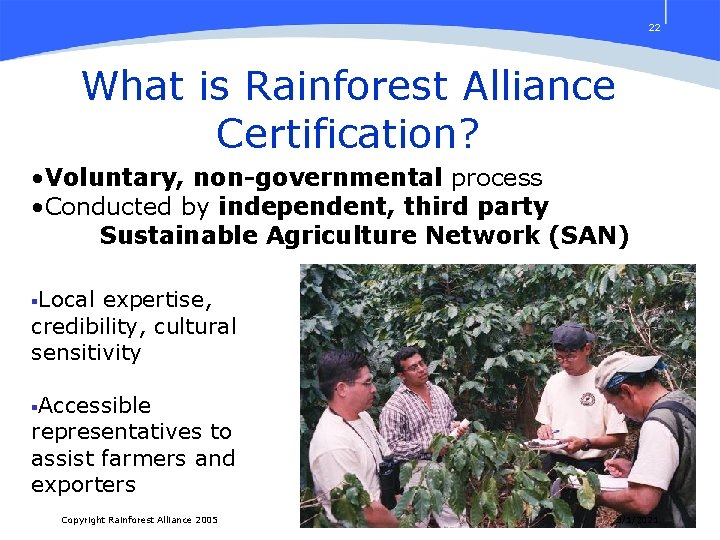
22 What is Rainforest Alliance Certification? • Voluntary, non-governmental process • Conducted by independent, third party Sustainable Agriculture Network (SAN) §Local expertise, credibility, cultural sensitivity §Accessible representatives to assist farmers and exporters Copyright Rainforest Alliance 2005 3/1/2021
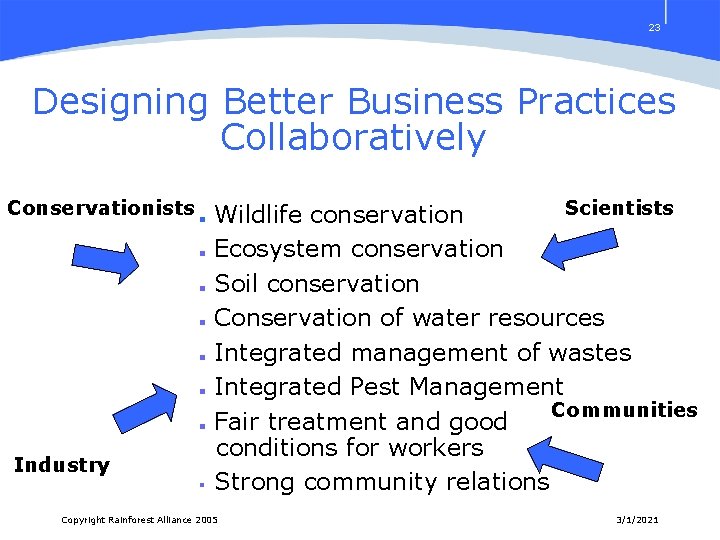
23 Designing Better Business Practices Collaboratively Conservationists n Wildlife conservation Scientists Ecosystem conservation Soil conservation Conservation of water resources Integrated management of wastes Integrated Pest Management Communities Fair treatment and good conditions for workers § Strong community relations n n n Industry Copyright Rainforest Alliance 2005 3/1/2021
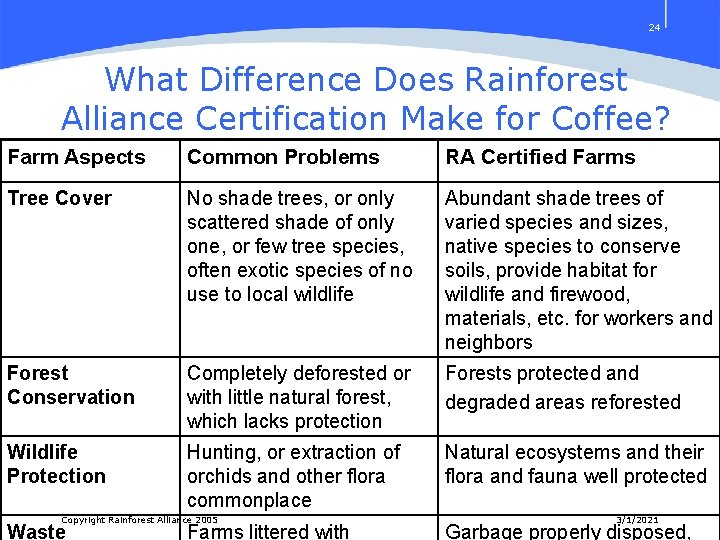
24 What Difference Does Rainforest Alliance Certification Make for Coffee? Farm Aspects Common Problems RA Certified Farms Tree Cover No shade trees, or only scattered shade of only one, or few tree species, often exotic species of no use to local wildlife Abundant shade trees of varied species and sizes, native species to conserve soils, provide habitat for wildlife and firewood, materials, etc. for workers and neighbors Forest Conservation Completely deforested or with little natural forest, which lacks protection Forests protected and degraded areas reforested Wildlife Protection Hunting, or extraction of orchids and other flora commonplace Natural ecosystems and their flora and fauna well protected Copyright Rainforest Alliance 2005 Waste Farms littered with 3/1/2021 Garbage properly disposed,
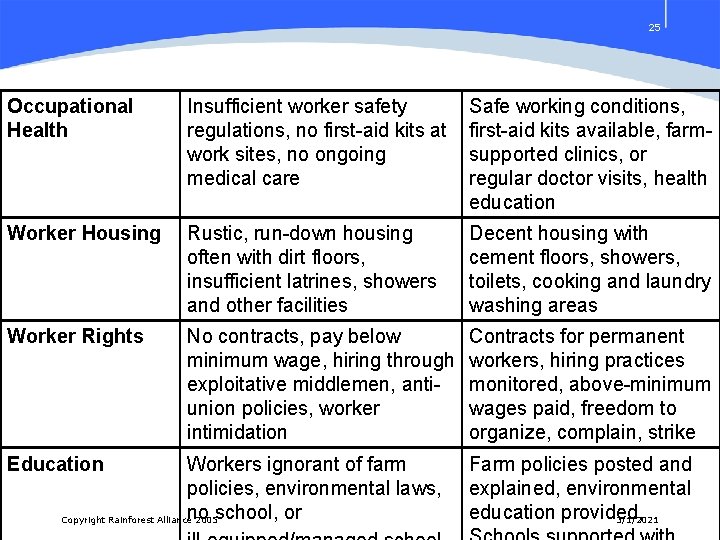
25 Occupational Health Insufficient worker safety regulations, no first-aid kits at work sites, no ongoing medical care Safe working conditions, first-aid kits available, farmsupported clinics, or regular doctor visits, health education Worker Housing Rustic, run-down housing often with dirt floors, insufficient latrines, showers and other facilities Decent housing with cement floors, showers, toilets, cooking and laundry washing areas Worker Rights No contracts, pay below minimum wage, hiring through exploitative middlemen, antiunion policies, worker intimidation Contracts for permanent workers, hiring practices monitored, above-minimum wages paid, freedom to organize, complain, strike Education Workers ignorant of farm policies, environmental laws, no school, or Copyright Rainforest Alliance 2005 Farm policies posted and explained, environmental education provided, 3/1/2021
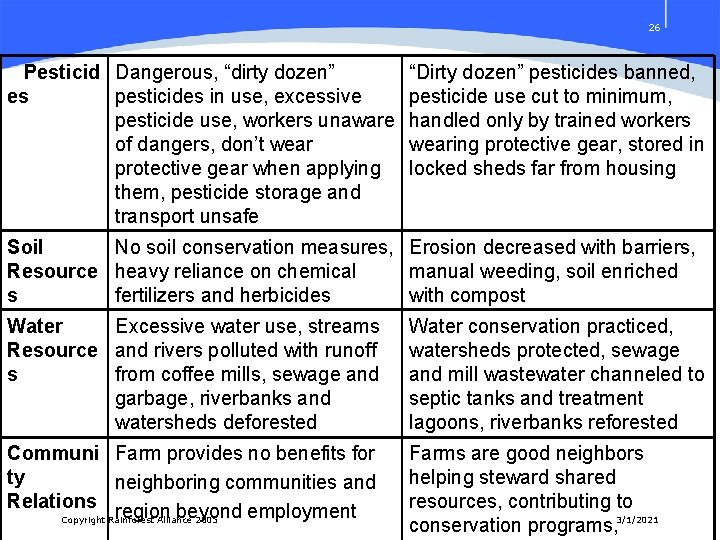
26 Pesticid Dangerous, “dirty dozen” es pesticides in use, excessive pesticide use, workers unaware of dangers, don’t wear protective gear when applying them, pesticide storage and transport unsafe “Dirty dozen” pesticides banned, pesticide use cut to minimum, handled only by trained workers wearing protective gear, stored in locked sheds far from housing Soil No soil conservation measures, Erosion decreased with barriers, Resource heavy reliance on chemical manual weeding, soil enriched s fertilizers and herbicides with compost Water Excessive water use, streams Resource and rivers polluted with runoff s from coffee mills, sewage and garbage, riverbanks and watersheds deforested Water conservation practiced, watersheds protected, sewage and mill wastewater channeled to septic tanks and treatment lagoons, riverbanks reforested Communi Farm provides no benefits for ty neighboring communities and Relations region beyond employment Copyright Rainforest Alliance 2005 Farms are good neighbors helping steward shared resources, contributing to conservation programs, 3/1/2021
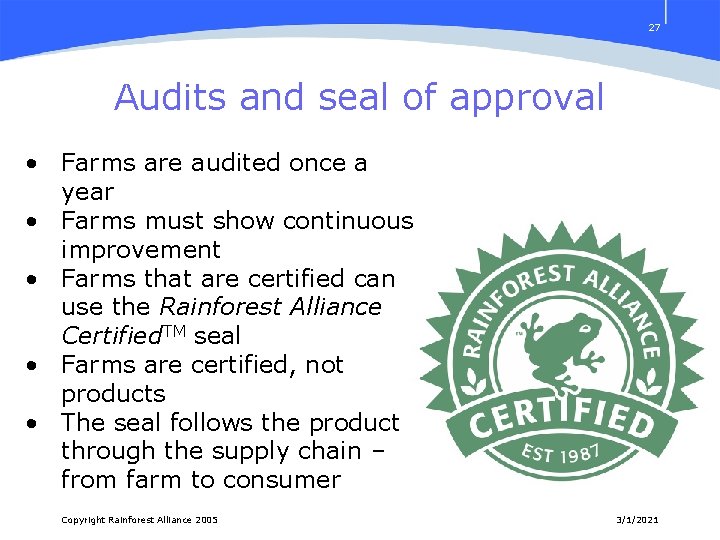
27 Audits and seal of approval • Farms are audited once a year • Farms must show continuous improvement • Farms that are certified can use the Rainforest Alliance Certified. TM seal • Farms are certified, not products • The seal follows the product through the supply chain – from farm to consumer Copyright Rainforest Alliance 2005 3/1/2021
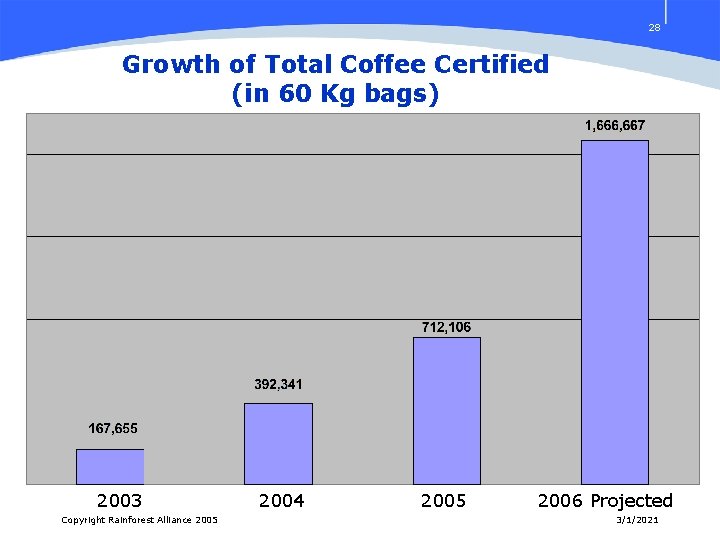
28 Growth of Total Coffee Certified (in 60 Kg bags) 2003 Copyright Rainforest Alliance 2005 2004 2005 2006 Projected 3/1/2021
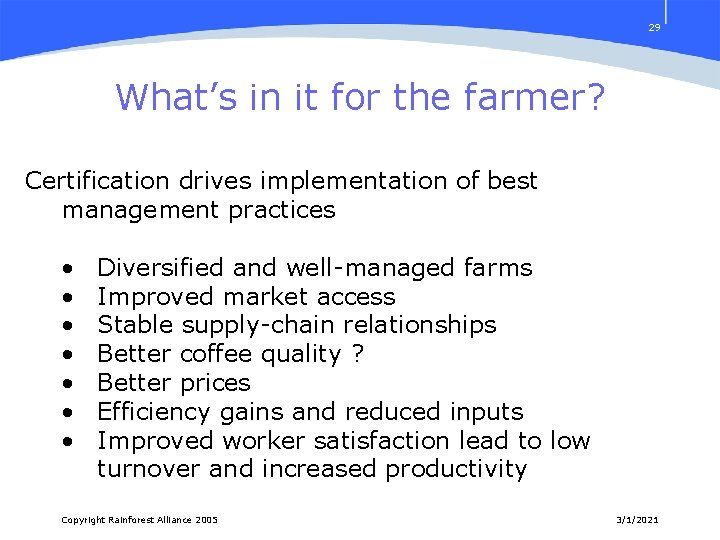
29 What’s in it for the farmer? Certification drives implementation of best management practices • • Diversified and well-managed farms Improved market access Stable supply-chain relationships Better coffee quality ? Better prices Efficiency gains and reduced inputs Improved worker satisfaction lead to low turnover and increased productivity Copyright Rainforest Alliance 2005 3/1/2021
30 What’s in it for companies • Access to new market segments • Traceability and knowledge of origin of product • Risk mitigation • Image improvement • Genuine concern for coffee growers and the environment Copyright Rainforest Alliance 2005 3/1/2021
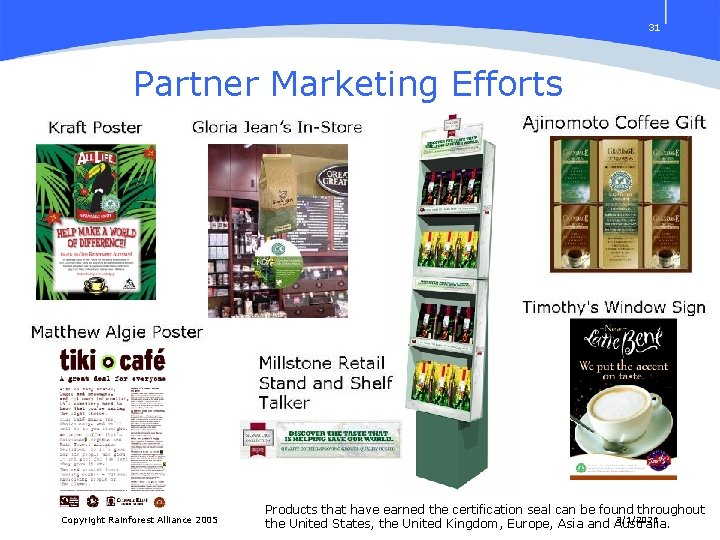
31 Partner Marketing Efforts Copyright Rainforest Alliance 2005 Products that have earned the certification seal can be found throughout 3/1/2021 the United States, the United Kingdom, Europe, Asia and Australia.
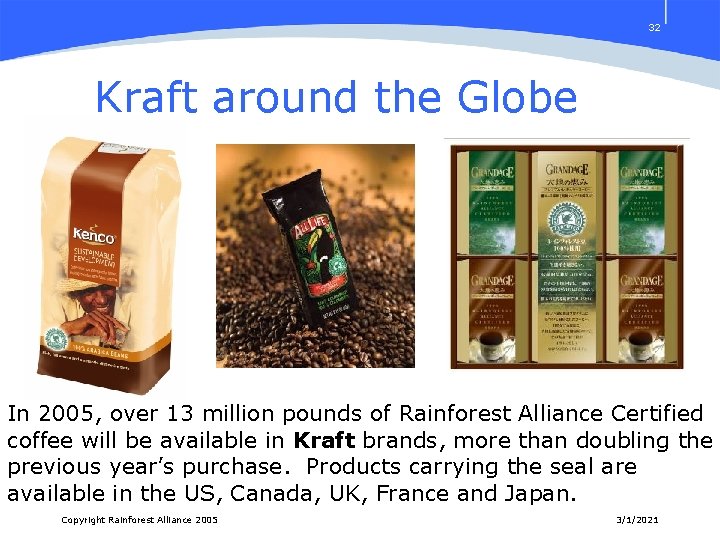
32 Kraft around the Globe In 2005, over 13 million pounds of Rainforest Alliance Certified coffee will be available in Kraft brands, more than doubling the previous year’s purchase. Products carrying the seal are available in the US, Canada, UK, France and Japan. Copyright Rainforest Alliance 2005 3/1/2021
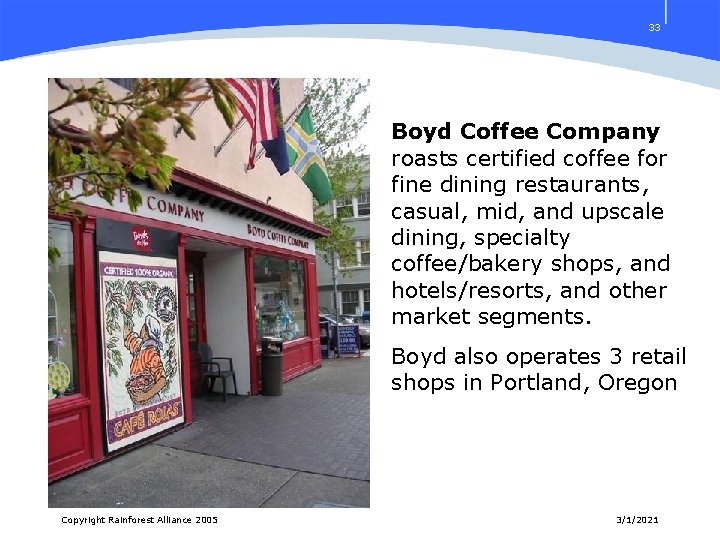
33 Boyd Coffee Company roasts certified coffee for fine dining restaurants, casual, mid, and upscale dining, specialty coffee/bakery shops, and hotels/resorts, and other market segments. Boyd also operates 3 retail shops in Portland, Oregon Copyright Rainforest Alliance 2005 3/1/2021
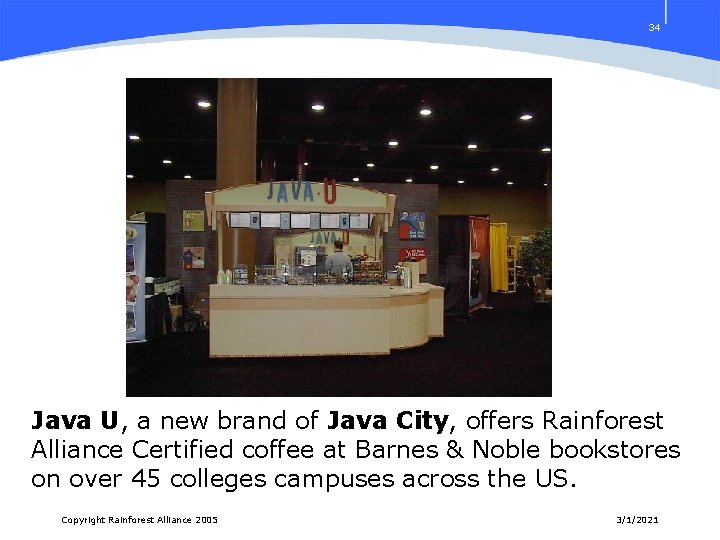
34 Java U, a new brand of Java City, offers Rainforest Alliance Certified coffee at Barnes & Noble bookstores on over 45 colleges campuses across the US. Copyright Rainforest Alliance 2005 3/1/2021
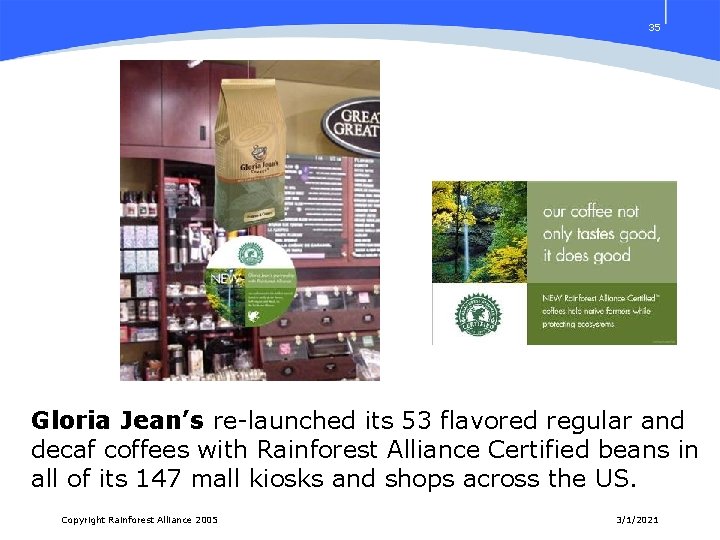
35 Gloria Jean’s re-launched its 53 flavored regular and decaf coffees with Rainforest Alliance Certified beans in all of its 147 mall kiosks and shops across the US. Copyright Rainforest Alliance 2005 3/1/2021
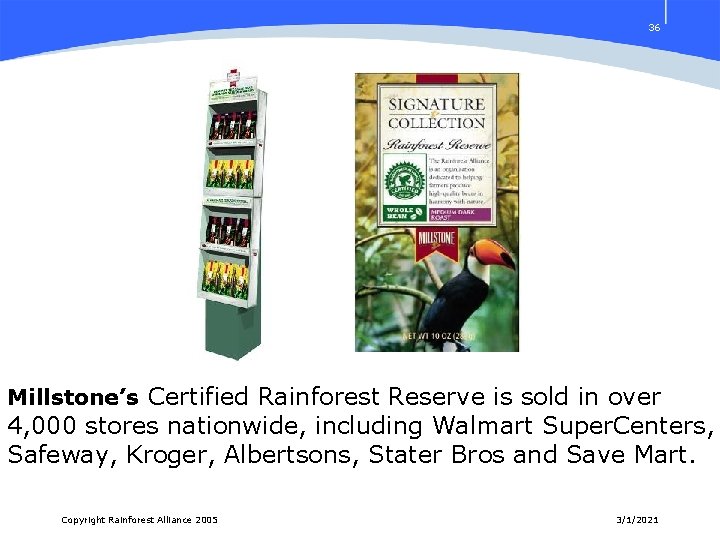
36 Millstone’s Certified Rainforest Reserve is sold in over 4, 000 stores nationwide, including Walmart Super. Centers, Safeway, Kroger, Albertsons, Stater Bros and Save Mart. Copyright Rainforest Alliance 2005 3/1/2021
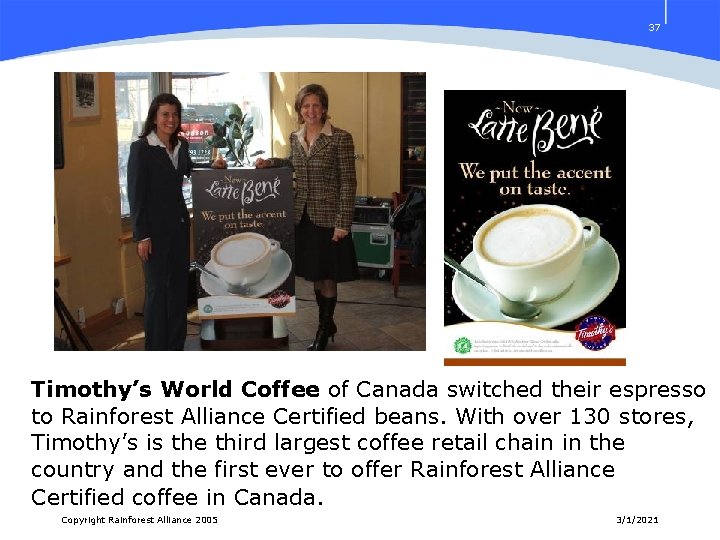
37 Timothy’s World Coffee of Canada switched their espresso to Rainforest Alliance Certified beans. With over 130 stores, Timothy’s is the third largest coffee retail chain in the country and the first ever to offer Rainforest Alliance Certified coffee in Canada. Copyright Rainforest Alliance 2005 3/1/2021
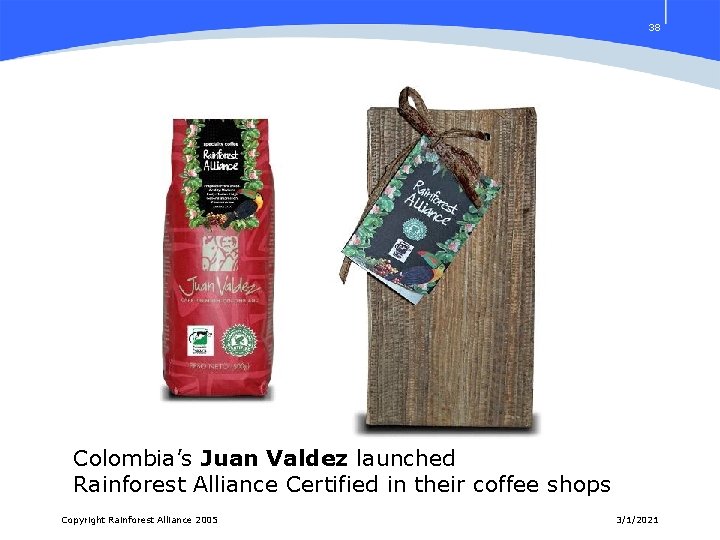
38 Colombia’s Juan Valdez launched Rainforest Alliance Certified in their coffee shops Copyright Rainforest Alliance 2005 3/1/2021
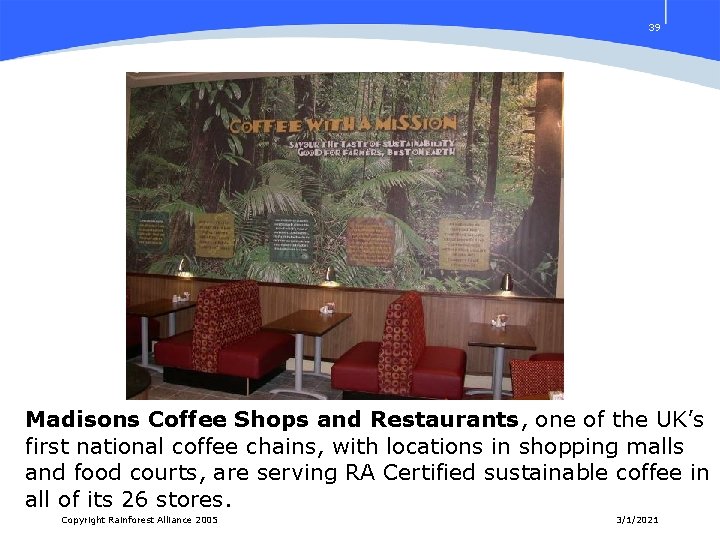
39 Madisons Coffee Shops and Restaurants, one of the UK’s first national coffee chains, with locations in shopping malls and food courts, are serving RA Certified sustainable coffee in all of its 26 stores. Copyright Rainforest Alliance 2005 3/1/2021
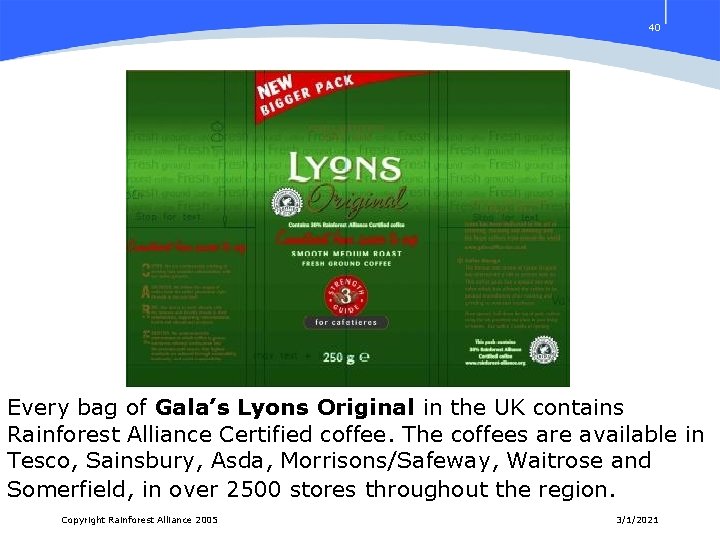
40 Every bag of Gala’s Lyons Original in the UK contains Rainforest Alliance Certified coffee. The coffees are available in Tesco, Sainsbury, Asda, Morrisons/Safeway, Waitrose and Somerfield, in over 2500 stores throughout the region. Copyright Rainforest Alliance 2005 3/1/2021
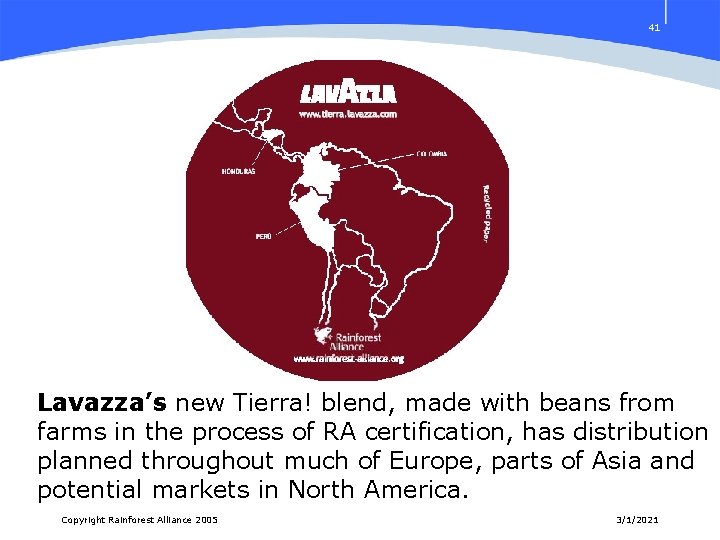
41 Lavazza’s new Tierra! blend, made with beans from farms in the process of RA certification, has distribution planned throughout much of Europe, parts of Asia and potential markets in North America. Copyright Rainforest Alliance 2005 3/1/2021
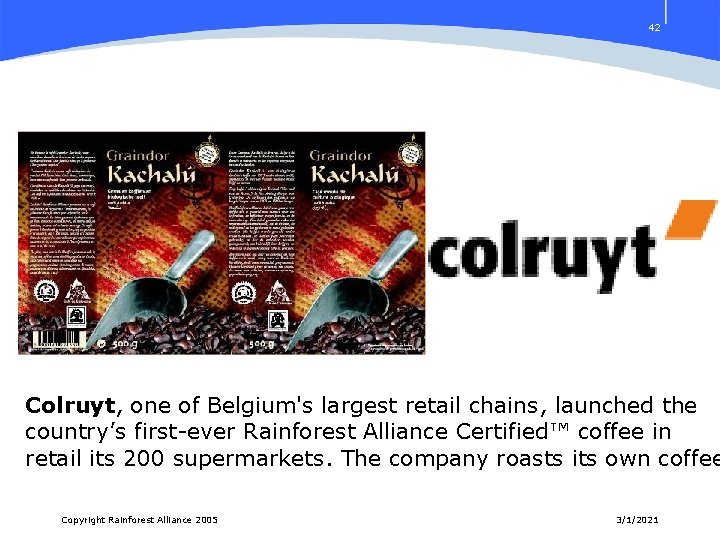
42 Colruyt, one of Belgium's largest retail chains, launched the country’s first-ever Rainforest Alliance Certified™ coffee in retail its 200 supermarkets. The company roasts its own coffee Copyright Rainforest Alliance 2005 3/1/2021
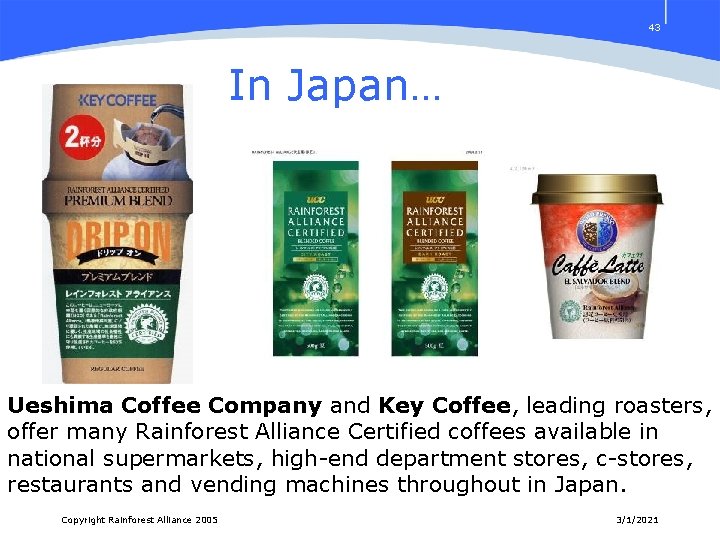
43 In Japan… Ueshima Coffee Company and Key Coffee, leading roasters, offer many Rainforest Alliance Certified coffees available in national supermarkets, high-end department stores, c-stores, restaurants and vending machines throughout in Japan. Copyright Rainforest Alliance 2005 3/1/2021
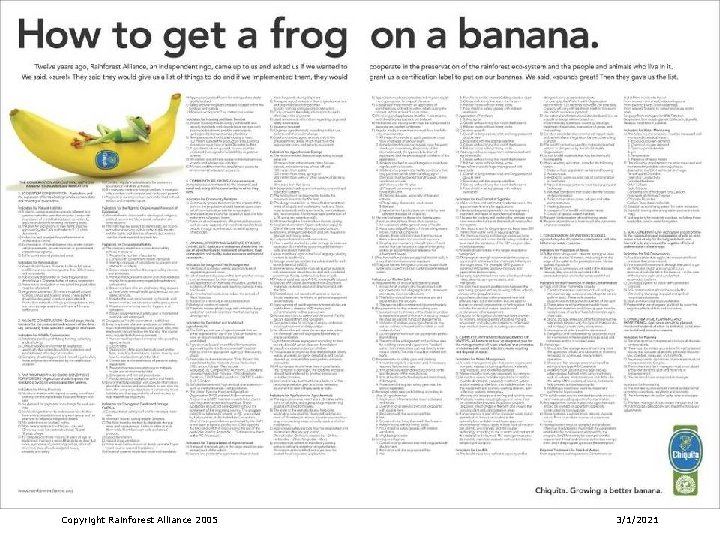
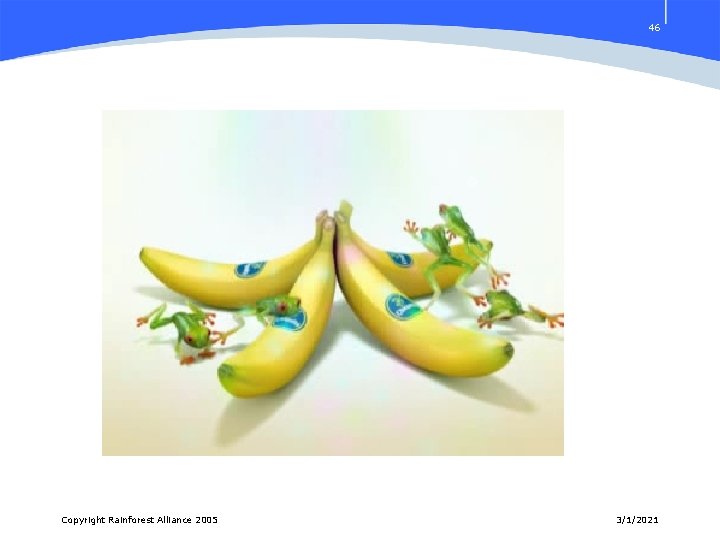
44 Company engagement - an example from bananas In Europe, Chiquita Brands label 50 million bananas a week with Rainforest Alliance Certified logo Copyright Rainforest Alliance 2005 3/1/2021
45 Copyright Rainforest Alliance 2005 3/1/2021
46 Copyright Rainforest Alliance 2005 3/1/2021
47 The Power of Engaging Companies • Changing sourcing patterns to sustainable products • Paying farmers better prices for sustainable products • Leveraging marketing machineries to raise awareness with consumers • Creating incentives for producers that dwarf aid • Long-term sustainability Copyright Rainforest Alliance 2005 3/1/2021
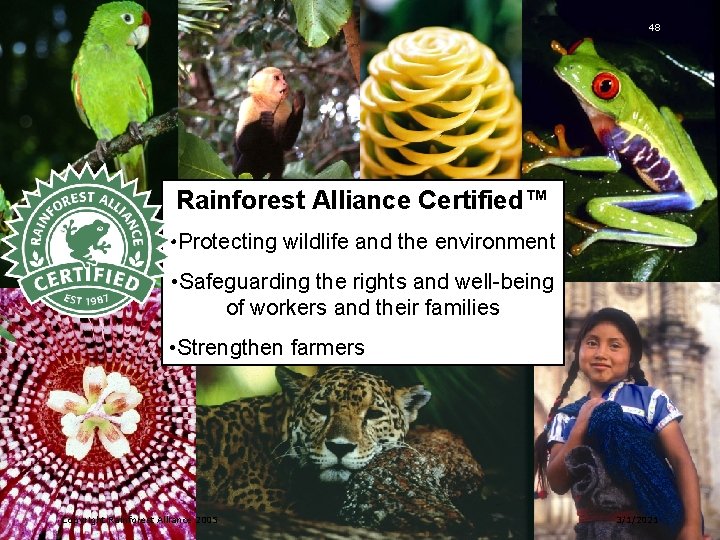
48 Rainforest Alliance Certified™ • Protecting wildlife and the environment • Safeguarding the rights and well-being of workers and their families • Strengthen farmers Copyright Rainforest Alliance 2005 3/1/2021
49 Thank you! www. rainforest-alliance. org lpedersen@ra. org Copyright Rainforest Alliance 2005 3/1/2021
50 Copyright Rainforest Alliance 2005 3/1/2021
- Slides: 50