
Biodiversity and Conservation Environmental Science Upakar Rai Department
Biodiversity and Conservation Environmental Science: Upakar Rai Department of Botany, St. Joseph’s College, Darjeeling
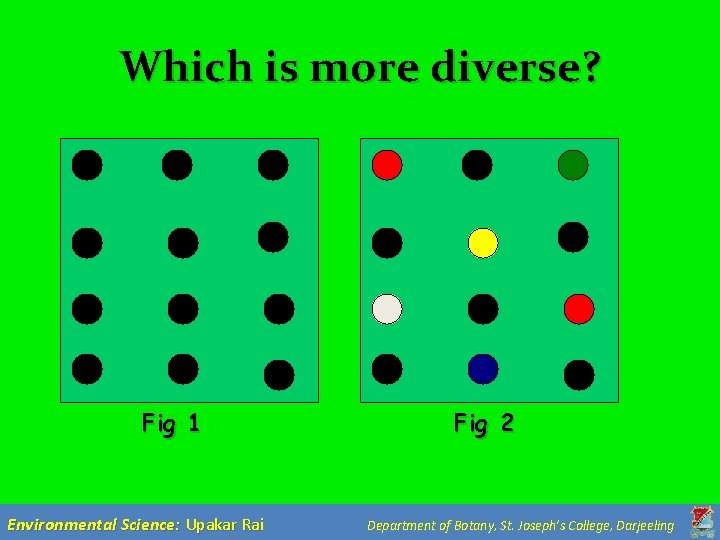
Which is more diverse? Fig 1 Environmental Science: Upakar Rai Fig 2 Department of Botany, St. Joseph’s College, Darjeeling
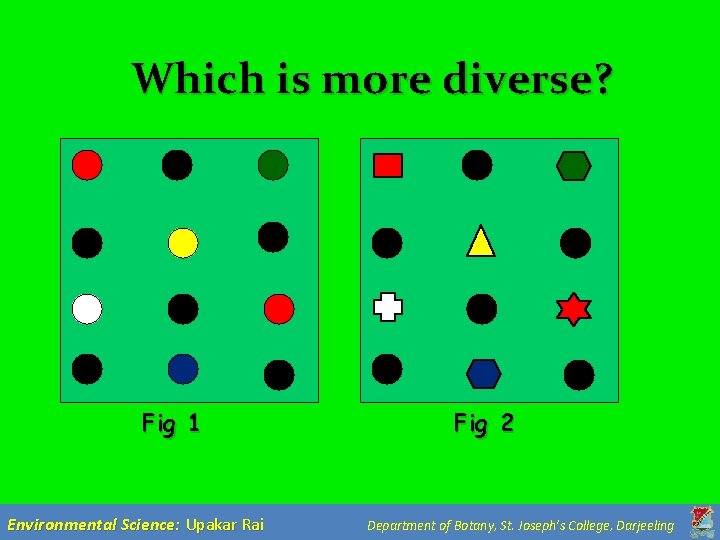
Which is more diverse? Fig 1 Environmental Science: Upakar Rai Fig 2 Department of Botany, St. Joseph’s College, Darjeeling
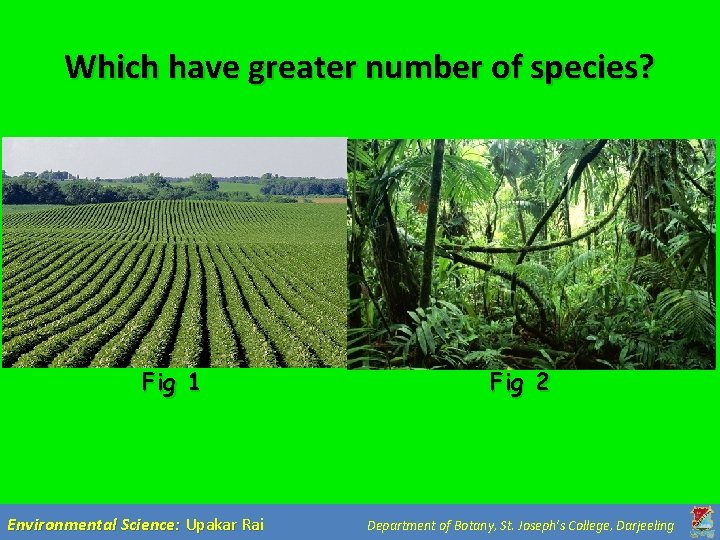
Which have greater number of species? Fig 1 Environmental Science: Upakar Rai Fig 2 Department of Botany, St. Joseph’s College, Darjeeling
BIODIVERSITY What is Biodiversity? It is an umbrella term referring to organisms found within the living world – Life on earth. The term was coined by Walter G. Rosen 1985. It is the variation of all life forms within a species, ecosystem and biomes. It includes genes, species and ecosystems - the 3 fundamental hierarchical levels of biological organization (Genetic diversity; Species diversity and Ecosystem diversity). Recently landscape level diversity: over a larger area encompassing multitude of habitats/ecosystem. Definition: Definition Variations and variability of living organism from all sources including, inter alia terrestrial, marine and other aquatic ecosystems and the ecological complexes of which they are part and this includes diversity within species, between species and of ecosystems’ (Johnson, 1993). Environmental Science: Upakar Rai Department of Botany, St. Joseph’s College, Darjeeling

COMPONENTS OF BIODIVERSITY Genetic Diversity: Variation in the genetic make up in a species. BIOMES Species Diversity: Number of species of plants and animals in a LANDSCAPE region is species diversity. ECOSYSTEM Ecological Diversity: It refers to the variety or difference in ecosystem on earth COMMUNITY POPULATION Landscape Diversity: It refers to a larger area including a heterogeneous land composed of interacting ecosystems e. g. SPECIES mossaic of land forms. GENE Environmental Science: Upakar Rai Hierarchy of Biological Organization Department of Botany, St. Joseph’s College, Darjeeling
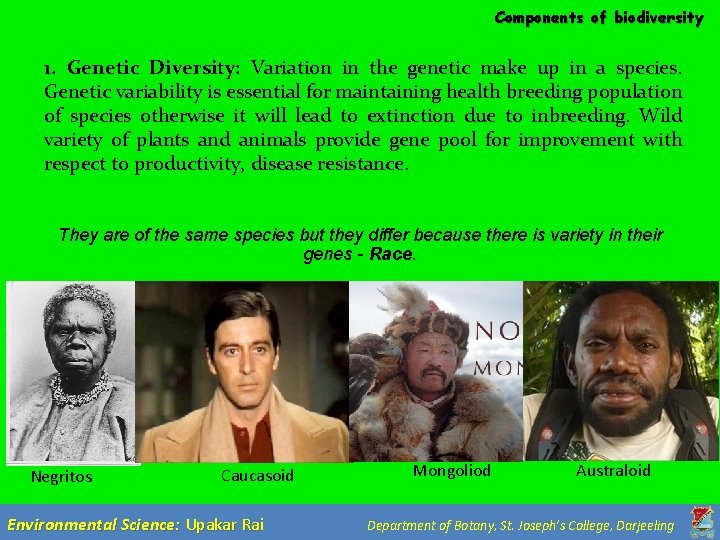
Components of biodiversity 1. Genetic Diversity: Variation in the genetic make up in a species. Genetic variability is essential for maintaining health breeding population of species otherwise it will lead to extinction due to inbreeding. Wild variety of plants and animals provide gene pool for improvement with respect to productivity, disease resistance. They are of the same species but they differ because there is variety in their genes - Race. Negritos Caucasoid Environmental Science: Upakar Rai Mongoliod Australoid Department of Botany, St. Joseph’s College, Darjeeling

Components of biodiversity 2. Species Diversity: Number of species of plants and animals in a region is species diversity. It provides wide array of goods and services to human in the form of food, medicine, shelter, ecological services and many more. There about 1. 5 million plant species distributed throughout the world. What is Species? A group of living organisms consisting of similar individuals capable of exchanging genes or interbreeding population. Sunbird Red Panda Environmental Science: Upakar Rai Amazon frog Daffodil Bromeliads Department of Botany, St. Joseph’s College, Darjeeling

Components of biodiversity 3. Ecological Diversity: It refers to the variety or difference in ecosystem on earth with its characteristic species composition. e. g. pond, river grasslands, desert, mountain etc. What is an Ecosystem? “ A self-contained community of microorganisms, animals and plants, that interact with each other and with their physical environment. ” Forest ecosystem Environmental Science: Upakar Rai Freshwater ecosystem Desert ecosystem Department of Botany, St. Joseph’s College, Darjeeling

Value of Biodiversity 1. Consumptive Use Value 2. Productive Use Value (Ecosystem services) 3. Social Value 4. Ethical and moral Value 5. Aesthetic Value 6. Option Value Environmental Science: Upakar Rai Department of Botany, St. Joseph’s College, Darjeeling

Value of Biodiversity 1. Consumptive Use Value: Direct utilization of plants and animals for the benefit of humans i. Food: Wide varieties of plants, large number of animals, fishes, mushrooms forms the daily diet. ii. Building materials for shelter: Bamboos, different tree species, grasses iii. Medicine: Both animals and plants are used in treating various illness. iv. Timber: Hard wood like, Sal, Teak, Mahogany, Rosewood are used in building furnitures, ship, railway tracks and building materials. v. Fodder: Various grasses, and other plants fed to livestocks Environmental Science: Upakar Rai Department of Botany, St. Joseph’s College, Darjeeling
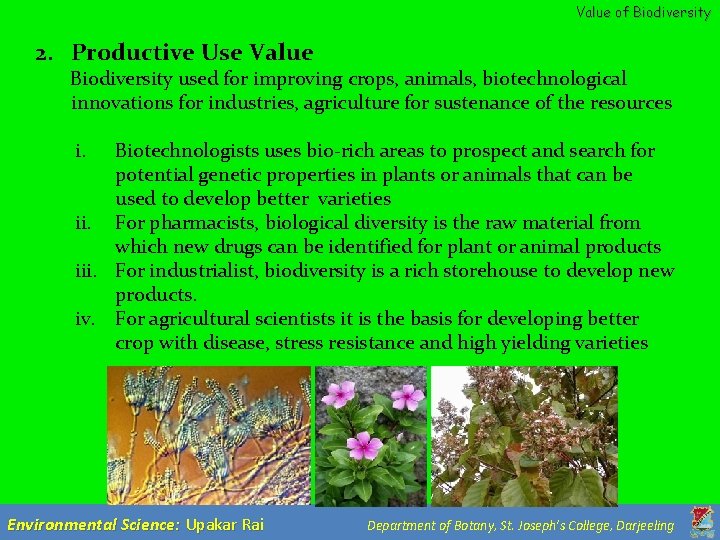
Value of Biodiversity 2. Productive Use Value Biodiversity used for improving crops, animals, biotechnological innovations for industries, agriculture for sustenance of the resources i. Biotechnologists uses bio-rich areas to prospect and search for potential genetic properties in plants or animals that can be used to develop better varieties ii. For pharmacists, biological diversity is the raw material from which new drugs can be identified for plant or animal products iii. For industrialist, biodiversity is a rich storehouse to develop new products. iv. For agricultural scientists it is the basis for developing better crop with disease, stress resistance and high yielding varieties Environmental Science: Upakar Rai Department of Botany, St. Joseph’s College, Darjeeling
Value of Biodiversity 3. Social Value The use of biodiversity as part of culture and tradition by some communities v Values associated with social life, custom, religious and spiritual aspects. (worshiping tulsi, peepal, Bael etc. ) v Tribal people are closely linked with wildlife and forest (sacred groove concept, songs, dance closely woven with wildlife) v Many animals (cow, dog, bulls, crow etc. ) have sacred place in psyco-spiritual space and have special social importance. Environmental Science: Upakar Rai Department of Botany, St. Joseph’s College, Darjeeling
Value of Biodiversity 4. Ethical and Moral Value Protecting all forms of biodiversity and co-existing with them. v Protecting all forms of life as preached by different religion v Ancient Indian philosophy emphasizes on importance of preserving nature through local traditions v Plants and animals have equal right to live and exist on this earth v Conservation of plants and animals through sacred grooves by tribal people acts as gene bank of wildlife. Environmental Science: Upakar Rai Department of Botany, St. Joseph’s College, Darjeeling
Value of Biodiversity 5. Aesthetic Value Appreciating the creation of nature. v Provides peace of mind, ignites imagination and creativity. v Wilderness and Eco-tourism) Environmental Science: Upakar Rai Department of Botany, St. Joseph’s College, Darjeeling
Value of Biodiversity 6. Optional Value Willingness to pay to safeguard an asset for future use. v Each organism is looked upon as potential resource for future use to improve plant or animal. v Improvement of cultivars and domestic livestock in the era of rapidly growing population, we need to return to wild relatives v Preservation of biodiversity must also include traditionally used strains already in existence in crops and domestic animals Environmental Science: Upakar Rai Department of Botany, St. Joseph’s College, Darjeeling
7. Ecosystem services Services provided by ecosystem. services provided by ecosystems like prevention of soil erosion, prevention of floods maintenance of soil fertility cycling of nutrients, fixation of nitrogen cycling of water Their role as carbon sinks, pollutant absorption and reduction of the threat of global warming etc.
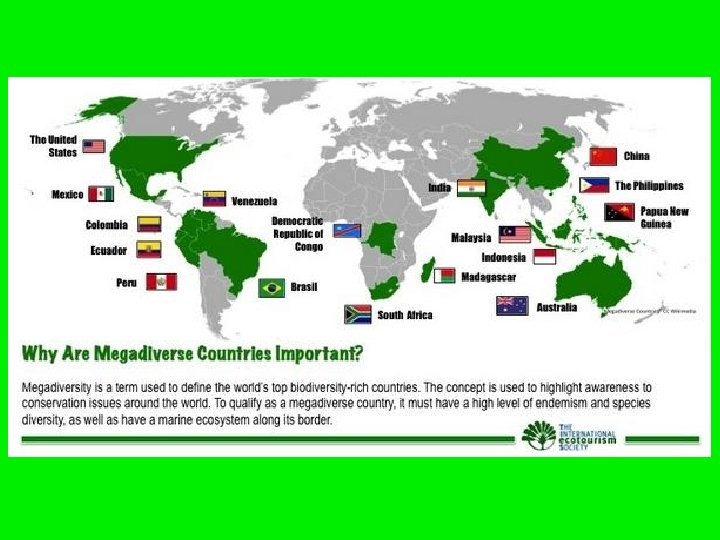
Megadiversity Countries Group of nations that harbours more than 70% of earth biodiversity. These countries lie in the tropics. 17 Megadiversity countries in the world Environmental Science: Upakar Rai Department of Botany, St. Joseph’s College, Darjeeling
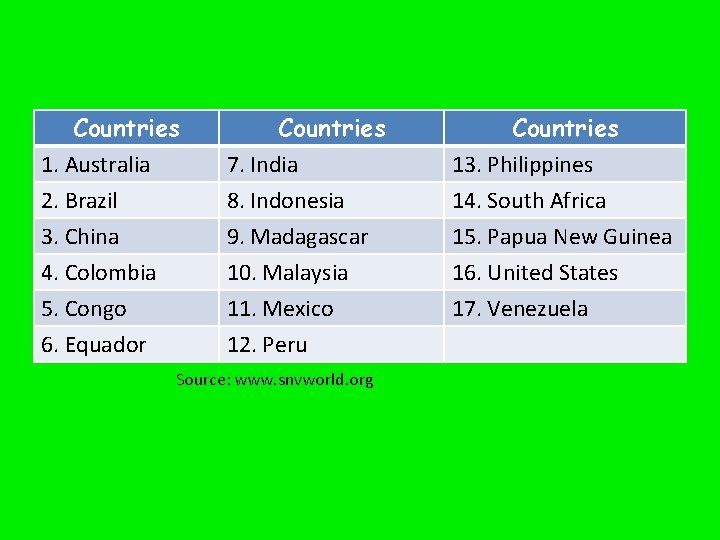
Countries 1. Australia 2. Brazil 3. China 4. Colombia 5. Congo 6. Equador Countries 7. India 8. Indonesia 9. Madagascar 10. Malaysia 11. Mexico 12. Peru Source: www. snvworld. org Countries 13. Philippines 14. South Africa 15. Papua New Guinea 16. United States 17. Venezuela
India as Megadiversity Country • 14 major basins through which numerous rivers drain. • It has three global terrestrial biodiversity hot spots – The Himalaya, Indo-Burma and the Western Ghats. • 10 biogeographic regions • Centre of origin of crop plants • High amount of marine diversity Environmental Science: Upakar Rai Department of Botany, St. Joseph’s College, Darjeeling
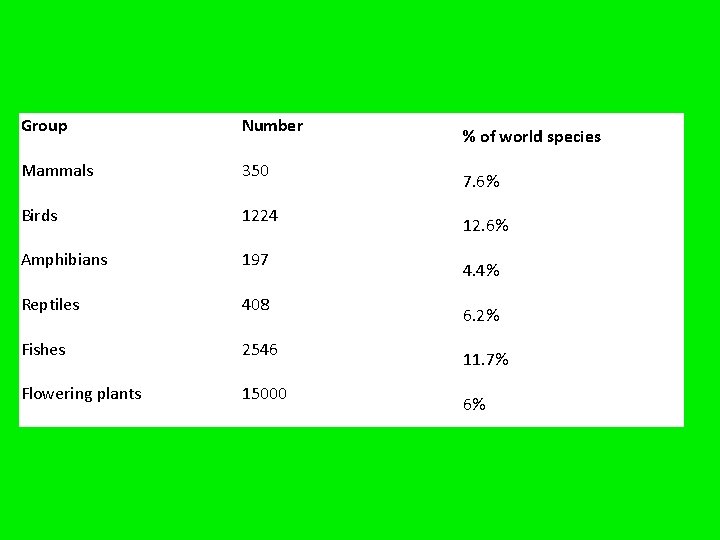
Group Number Mammals 350 Birds 1224 Amphibians 197 Reptiles 408 Fishes 2546 Flowering plants 15000 % of world species 7. 6% 12. 6% 4. 4% 6. 2% 11. 7% 6%
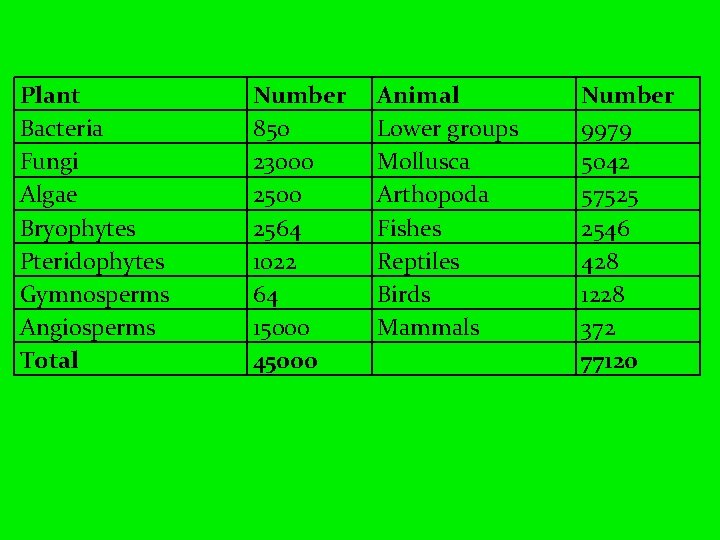
Plant Bacteria Fungi Algae Bryophytes Pteridophytes Gymnosperms Angiosperms Total Number 850 23000 2564 1022 64 15000 45000 Animal Lower groups Mollusca Arthopoda Fishes Reptiles Birds Mammals Number 9979 5042 57525 2546 428 1228 372 77120
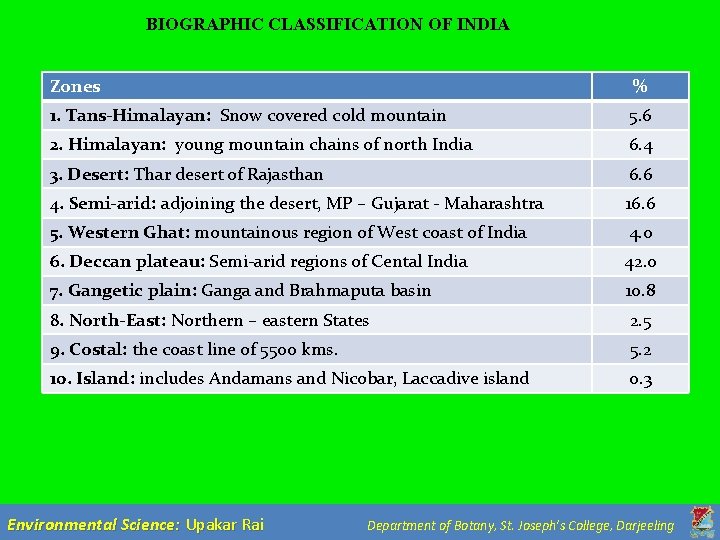
BIOGRAPHIC CLASSIFICATION OF INDIA Zones % 1. Tans-Himalayan: Snow covered cold mountain 5. 6 2. Himalayan: young mountain chains of north India 6. 4 3. Desert: Thar desert of Rajasthan 6. 6 4. Semi-arid: adjoining the desert, MP – Gujarat - Maharashtra 16. 6 5. Western Ghat: mountainous region of West coast of India 4. 0 6. Deccan plateau: Semi-arid regions of Cental India 42. 0 7. Gangetic plain: Ganga and Brahmaputa basin 10. 8 8. North-East: Northern – eastern States 2. 5 9. Costal: the coast line of 5500 kms. 5. 2 10. Island: includes Andamans and Nicobar, Laccadive island 0. 3 Environmental Science: Upakar Rai Department of Botany, St. Joseph’s College, Darjeeling
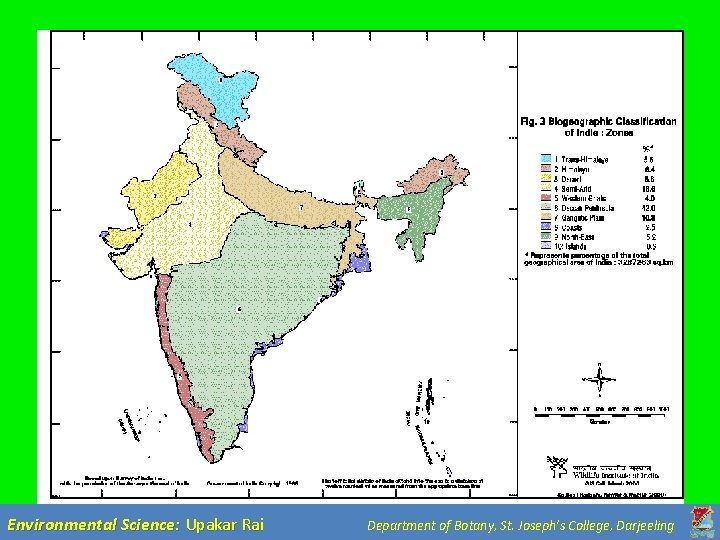
Environmental Science: Upakar Rai Department of Botany, St. Joseph’s College, Darjeeling
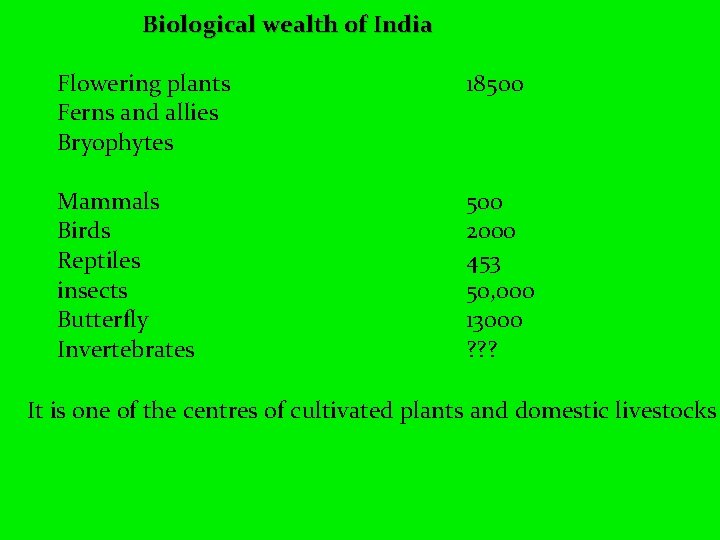
Biological wealth of India Flowering plants Ferns and allies Bryophytes 18500 Mammals Birds Reptiles insects Butterfly Invertebrates 500 2000 453 50, 000 13000 ? ? ? It is one of the centres of cultivated plants and domestic livestocks
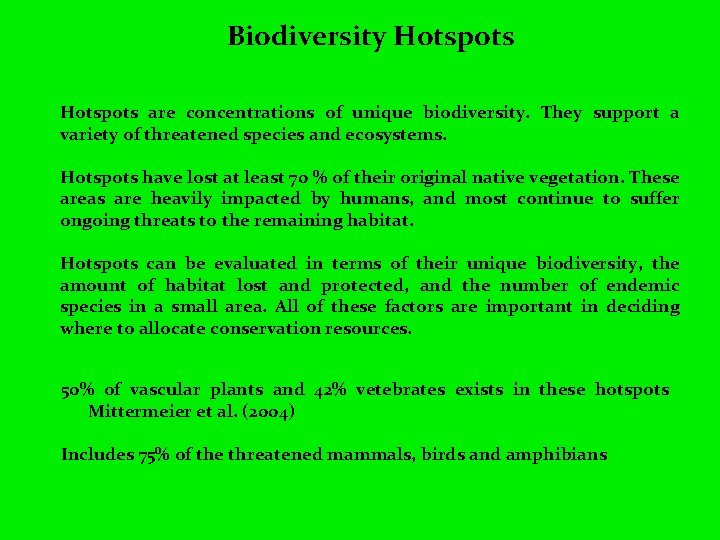
Biodiversity Hotspots are concentrations of unique biodiversity. They support a variety of threatened species and ecosystems. Hotspots have lost at least 70 % of their original native vegetation. These areas are heavily impacted by humans, and most continue to suffer ongoing threats to the remaining habitat. Hotspots can be evaluated in terms of their unique biodiversity, the amount of habitat lost and protected, and the number of endemic species in a small area. All of these factors are important in deciding where to allocate conservation resources. 50% of vascular plants and 42% vetebrates exists in these hotspots Mittermeier et al. (2004) Includes 75% of the threatened mammals, birds and amphibians
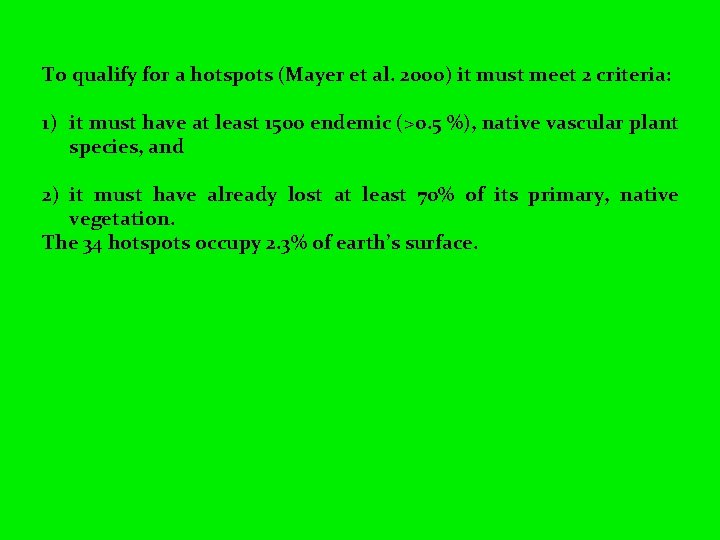
To qualify for a hotspots (Mayer et al. 2000) it must meet 2 criteria: 1) it must have at least 1500 endemic (>0. 5 %), native vascular plant species, and 2) it must have already lost at least 70% of its primary, native vegetation. The 34 hotspots occupy 2. 3% of earth’s surface.
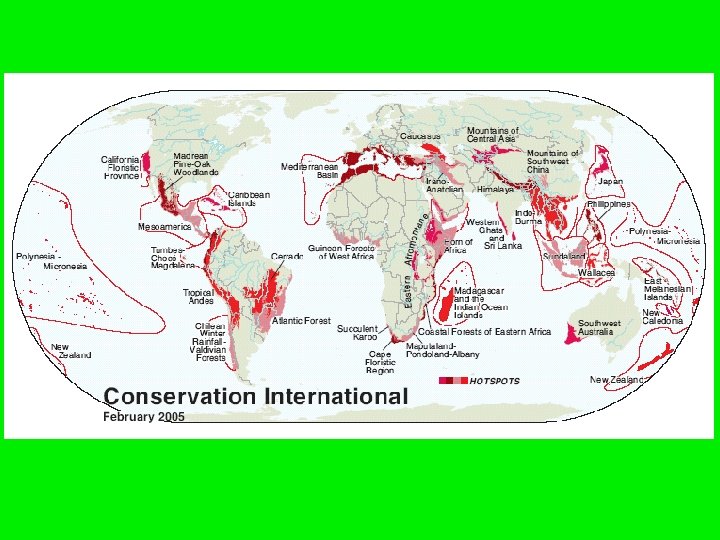
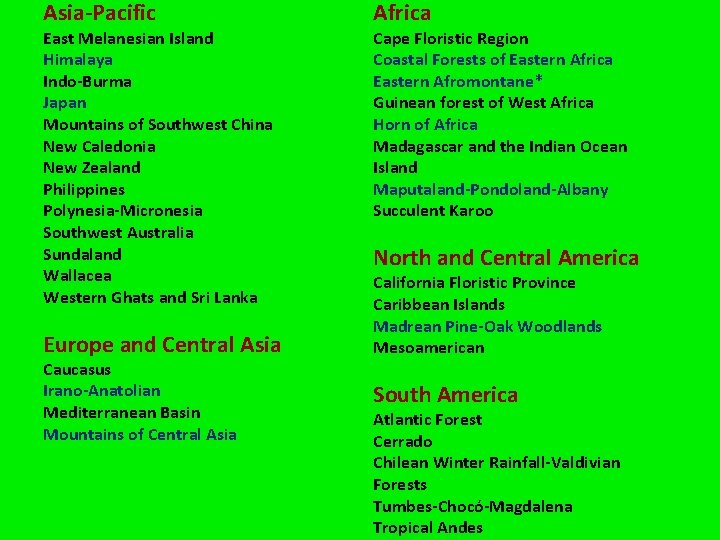
Asia-Pacific East Melanesian Island Himalaya Indo-Burma Japan Mountains of Southwest China New Caledonia New Zealand Philippines Polynesia-Micronesia Southwest Australia Sundaland Wallacea Western Ghats and Sri Lanka Europe and Central Asia Caucasus Irano-Anatolian Mediterranean Basin Mountains of Central Asia Africa Cape Floristic Region Coastal Forests of Eastern Africa Eastern Afromontane* Guinean forest of West Africa Horn of Africa Madagascar and the Indian Ocean Island Maputaland-Pondoland-Albany Succulent Karoo North and Central America California Floristic Province Caribbean Islands Madrean Pine-Oak Woodlands Mesoamerican South America Atlantic Forest Cerrado Chilean Winter Rainfall-Valdivian Forests Tumbes-Chocó-Magdalena Tropical Andes
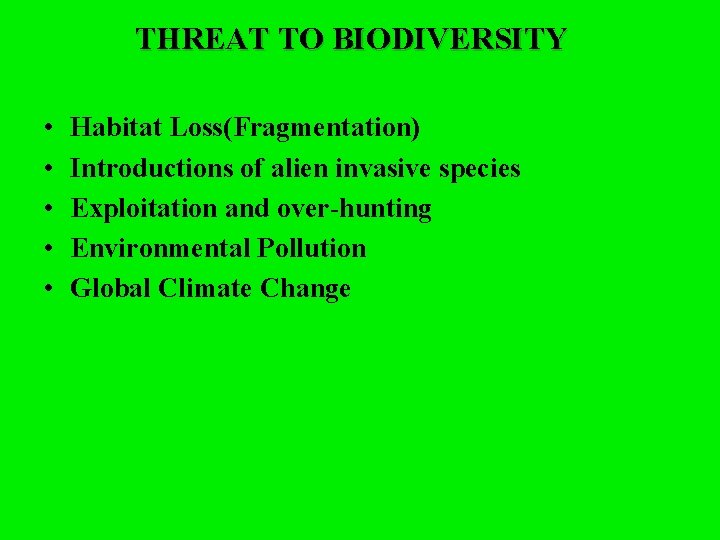
THREAT TO BIODIVERSITY • • • Habitat Loss(Fragmentation) Introductions of alien invasive species Exploitation and over-hunting Environmental Pollution Global Climate Change
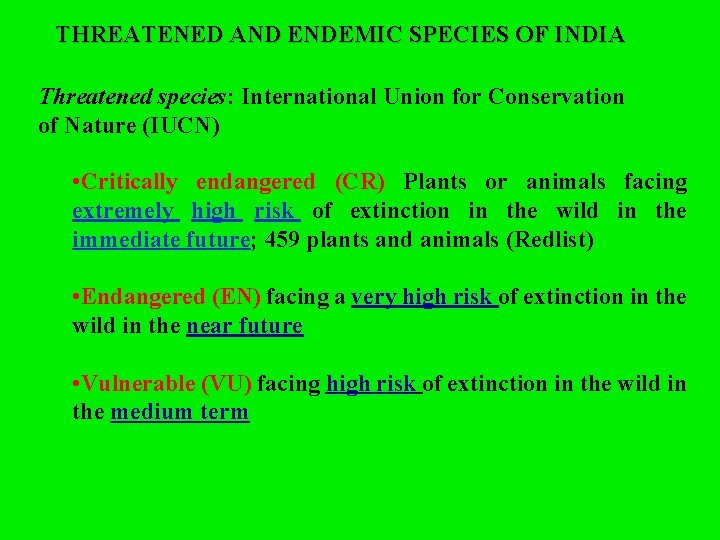
THREATENED AND ENDEMIC SPECIES OF INDIA Threatened species: International Union for Conservation of Nature (IUCN) • Critically endangered (CR) Plants or animals facing extremely high risk of extinction in the wild in the immediate future; 459 plants and animals (Redlist) • Endangered (EN) facing a very high risk of extinction in the wild in the near future • Vulnerable (VU) facing high risk of extinction in the wild in the medium term
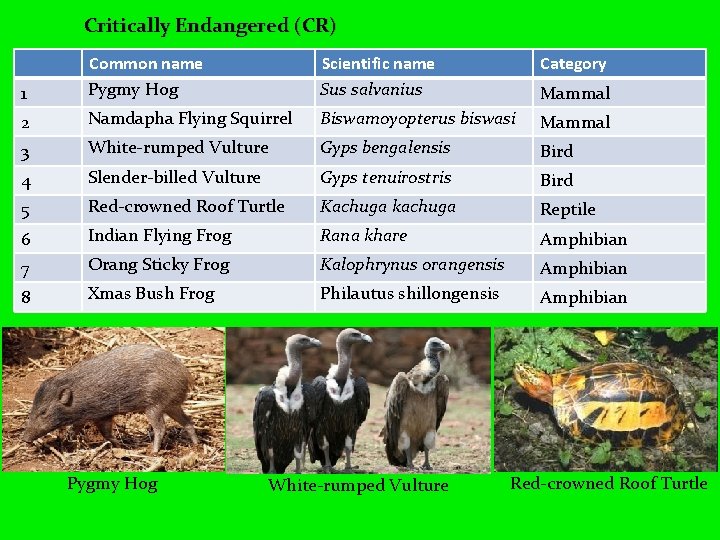
Critically Endangered (CR) Scientific name Sus salvanius Category 1 Common name Pygmy Hog 2 Namdapha Flying Squirrel Biswamoyopterus biswasi Mammal 3 White-rumped Vulture Gyps bengalensis Bird 4 Slender-billed Vulture Gyps tenuirostris Bird 5 Red-crowned Roof Turtle Kachuga kachuga Reptile 6 Indian Flying Frog Rana khare Amphibian 7 Orang Sticky Frog Kalophrynus orangensis Amphibian 8 Xmas Bush Frog Philautus shillongensis Amphibian Pygmy Hog White-rumped Vulture Mammal Red-crowned Roof Turtle
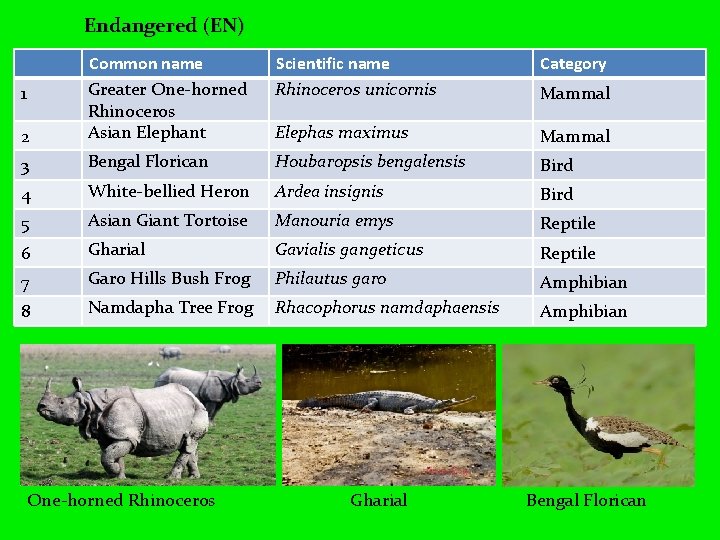
Endangered (EN) Scientific name Rhinoceros unicornis Category 2 Common name Greater One-horned Rhinoceros Asian Elephant Elephas maximus Mammal 3 Bengal Florican Houbaropsis bengalensis Bird 4 White-bellied Heron Ardea insignis Bird 5 Asian Giant Tortoise Manouria emys Reptile 6 Gharial Gavialis gangeticus Reptile 7 Garo Hills Bush Frog Philautus garo Amphibian 8 Namdapha Tree Frog Rhacophorus namdaphaensis Amphibian 1 One-horned Rhinoceros Gharial Mammal Bengal Florican
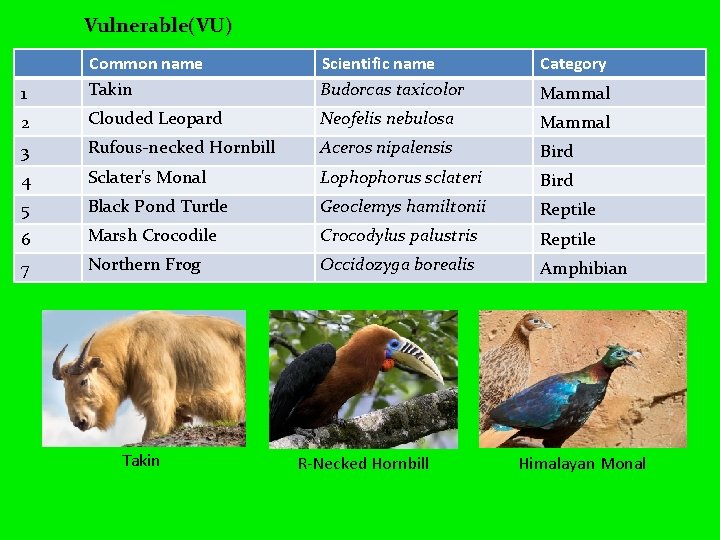
Vulnerable(VU) Scientific name Budorcas taxicolor Category 1 Common name Takin 2 Clouded Leopard Neofelis nebulosa Mammal 3 Rufous-necked Hornbill Aceros nipalensis Bird 4 Sclater's Monal Lophophorus sclateri Bird 5 Black Pond Turtle Geoclemys hamiltonii Reptile 6 Marsh Crocodile Crocodylus palustris Reptile 7 Northern Frog Occidozyga borealis Amphibian Takin R-Necked Hornbill Mammal Himalayan Monal
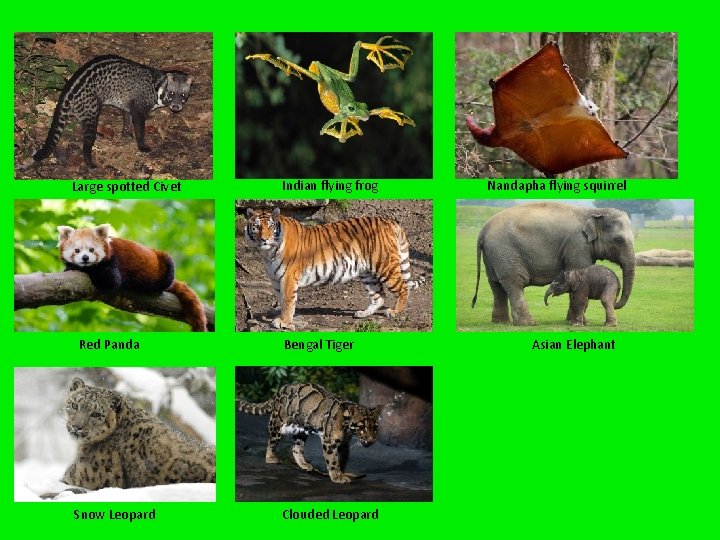
Large spotted Civet Red Panda Snow Leopard Indian flying frog Bengal Tiger Clouded Leopard Nandapha flying squirrel Asian Elephant
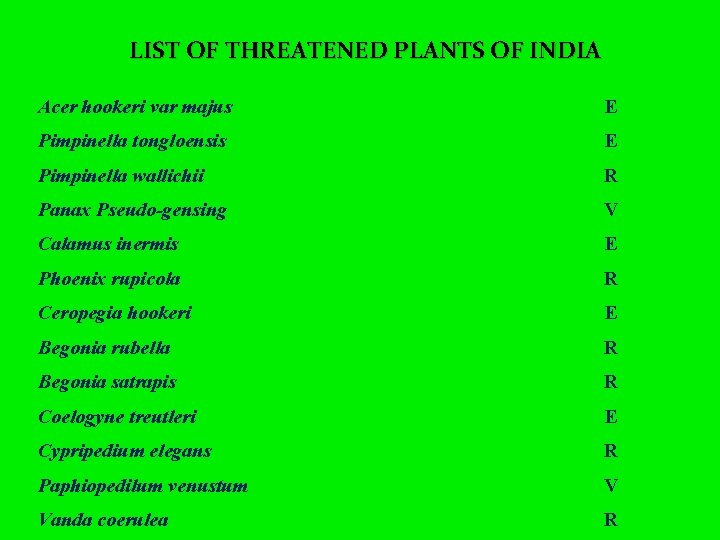
LIST OF THREATENED PLANTS OF INDIA Acer hookeri var majus E Pimpinella tongloensis E Pimpinella wallichii R Panax Pseudo-gensing V Calamus inermis E Phoenix rupicola R Ceropegia hookeri E Begonia rubella R Begonia satrapis R Coelogyne treutleri E Cypripedium elegans R Paphiopedilum venustum V Vanda coerulea R
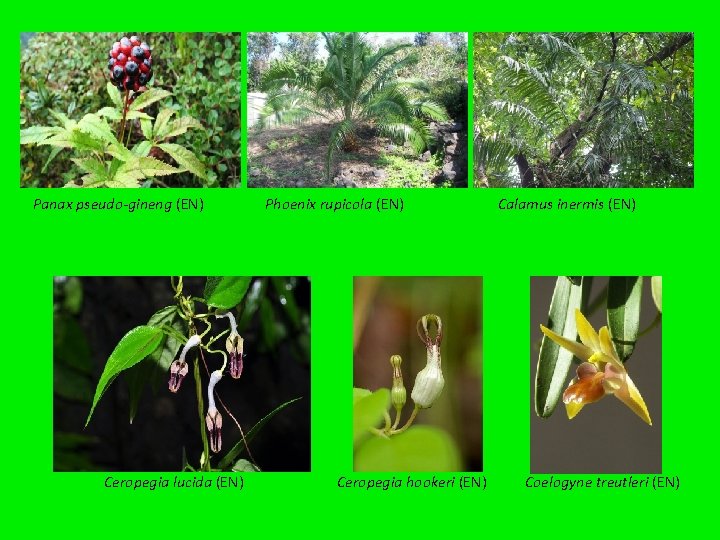
Panax pseudo-gineng (EN) Ceropegia lucida (EN) Phoenix rupicola (EN) Ceropegia hookeri (EN) Calamus inermis (EN) Coelogyne treutleri (EN)
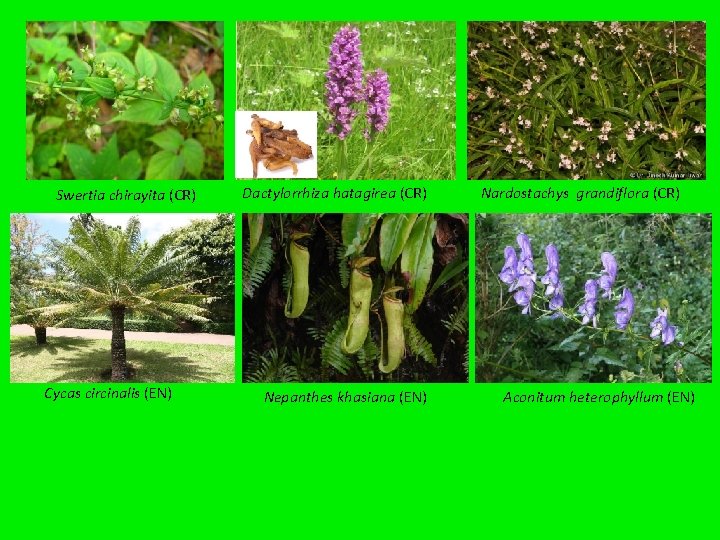
Swertia chirayita (CR) Cycas circinalis (EN) Dactylorrhiza hatagirea (CR) Nepanthes khasiana (EN) Nardostachys grandiflora (CR) Aconitum heterophyllum (EN)
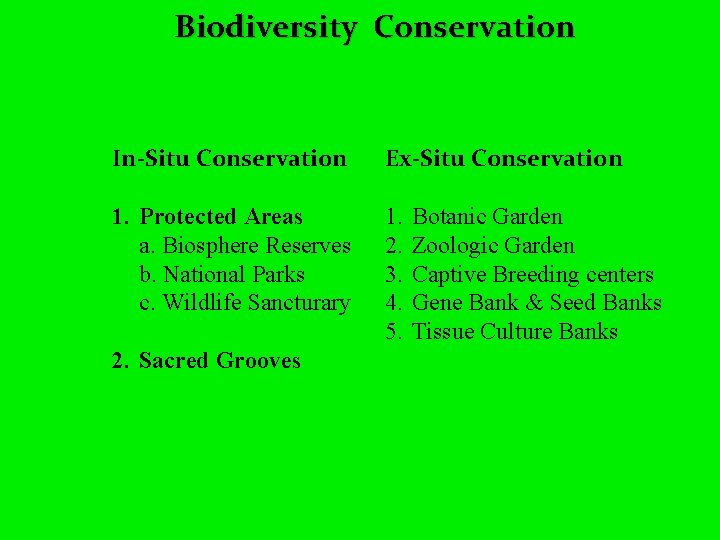
Biodiversity Conservation In-Situ Conservation Ex-Situ Conservation 1. Protected Areas a. Biosphere Reserves b. National Parks c. Wildlife Sancturary 1. 2. 3. 4. 5. 2. Sacred Grooves Botanic Garden Zoologic Garden Captive Breeding centers Gene Bank & Seed Banks Tissue Culture Banks
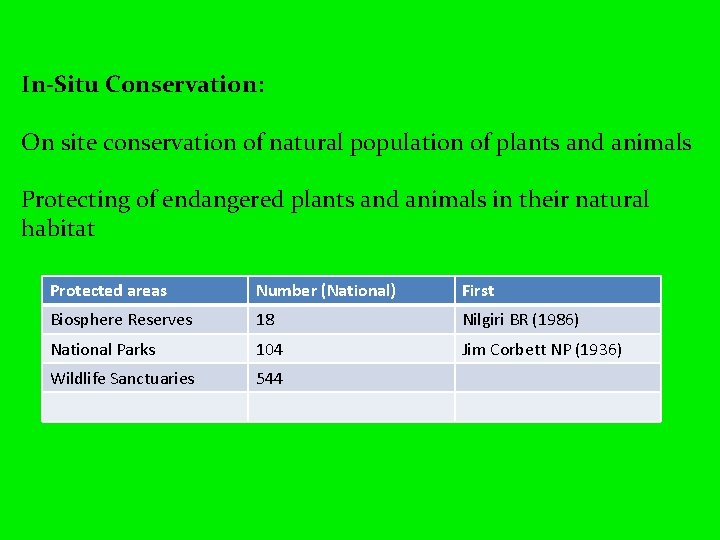
In-Situ Conservation: On site conservation of natural population of plants and animals Protecting of endangered plants and animals in their natural habitat Protected areas Number (National) First Biosphere Reserves 18 Nilgiri BR (1986) National Parks 104 Jim Corbett NP (1936) Wildlife Sanctuaries 544
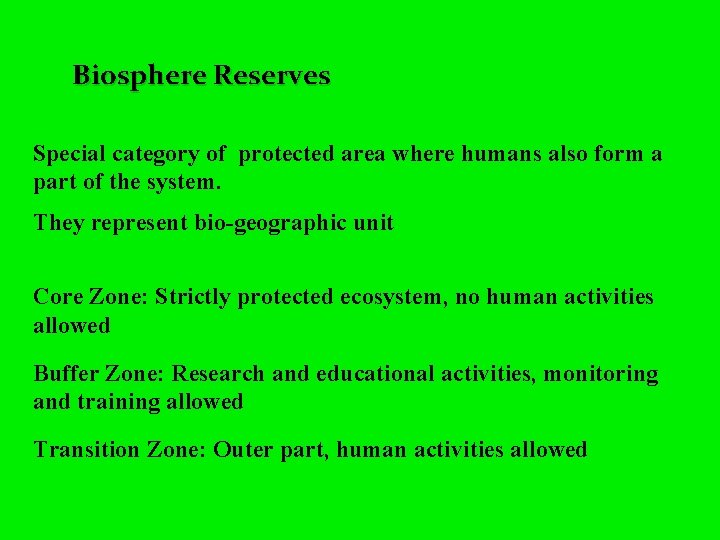
Biosphere Reserves Special category of protected area where humans also form a part of the system. They represent bio-geographic unit Core Zone: Strictly protected ecosystem, no human activities allowed Buffer Zone: Research and educational activities, monitoring and training allowed Transition Zone: Outer part, human activities allowed
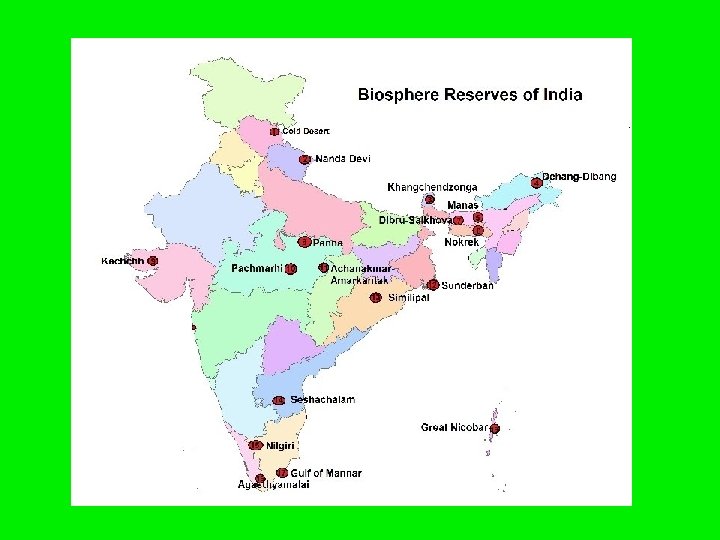
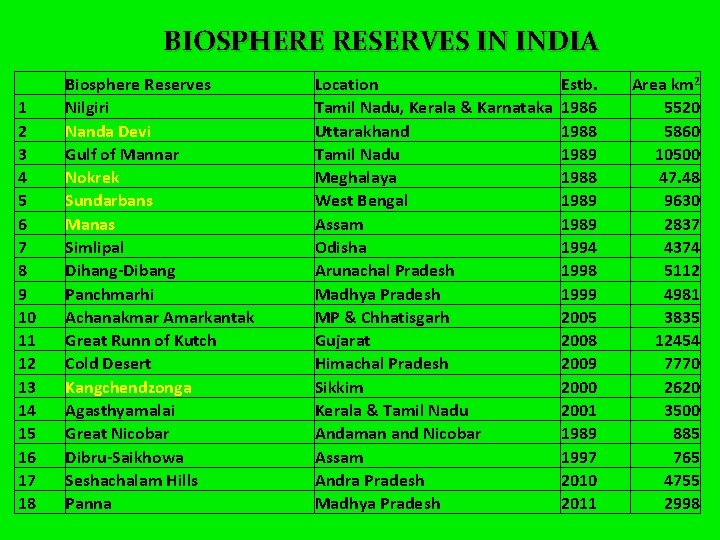
BIOSPHERE RESERVES IN INDIA 1 2 3 4 5 6 7 8 9 10 11 12 13 14 15 16 17 18 Biosphere Reserves Nilgiri Nanda Devi Gulf of Mannar Nokrek Sundarbans Manas Simlipal Dihang-Dibang Panchmarhi Achanakmar Amarkantak Great Runn of Kutch Cold Desert Kangchendzonga Agasthyamalai Great Nicobar Dibru-Saikhowa Seshachalam Hills Panna Location Tamil Nadu, Kerala & Karnataka Uttarakhand Tamil Nadu Meghalaya West Bengal Assam Odisha Arunachal Pradesh Madhya Pradesh MP & Chhatisgarh Gujarat Himachal Pradesh Sikkim Kerala & Tamil Nadu Andaman and Nicobar Assam Andra Pradesh Madhya Pradesh Estb. 1986 1988 1989 1994 1998 1999 2005 2008 2009 2000 2001 1989 1997 2010 2011 Area km 2 5520 5860 10500 47. 48 9630 2837 4374 5112 4981 3835 12454 7770 2620 3500 885 765 4755 2998
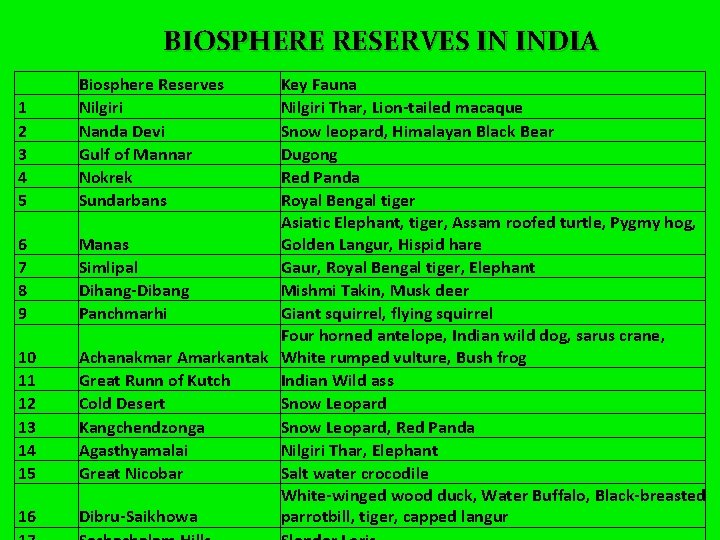
BIOSPHERE RESERVES IN INDIA 1 2 3 4 5 6 7 8 9 10 11 12 13 14 15 16 Biosphere Reserves Nilgiri Nanda Devi Gulf of Mannar Nokrek Sundarbans Key Fauna Nilgiri Thar, Lion-tailed macaque Snow leopard, Himalayan Black Bear Dugong Red Panda Royal Bengal tiger Asiatic Elephant, tiger, Assam roofed turtle, Pygmy hog, Manas Golden Langur, Hispid hare Simlipal Gaur, Royal Bengal tiger, Elephant Dihang-Dibang Mishmi Takin, Musk deer Panchmarhi Giant squirrel, flying squirrel Four horned antelope, Indian wild dog, sarus crane, Achanakmar Amarkantak White rumped vulture, Bush frog Great Runn of Kutch Indian Wild ass Cold Desert Snow Leopard Kangchendzonga Snow Leopard, Red Panda Agasthyamalai Nilgiri Thar, Elephant Great Nicobar Salt water crocodile White-winged wood duck, Water Buffalo, Black-breasted Dibru-Saikhowa parrotbill, tiger, capped langur
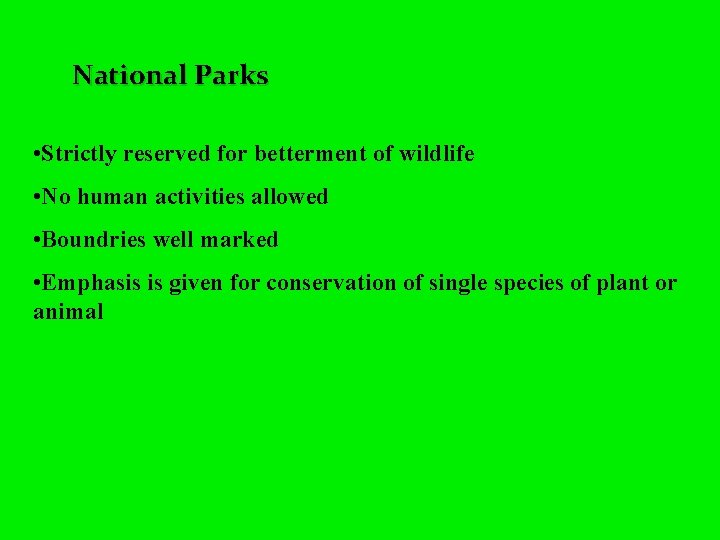
National Parks • Strictly reserved for betterment of wildlife • No human activities allowed • Boundries well marked • Emphasis is given for conservation of single species of plant or animal
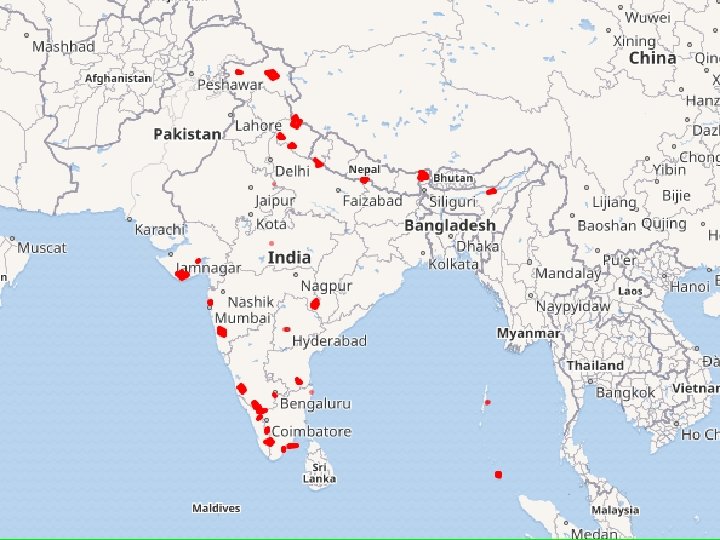
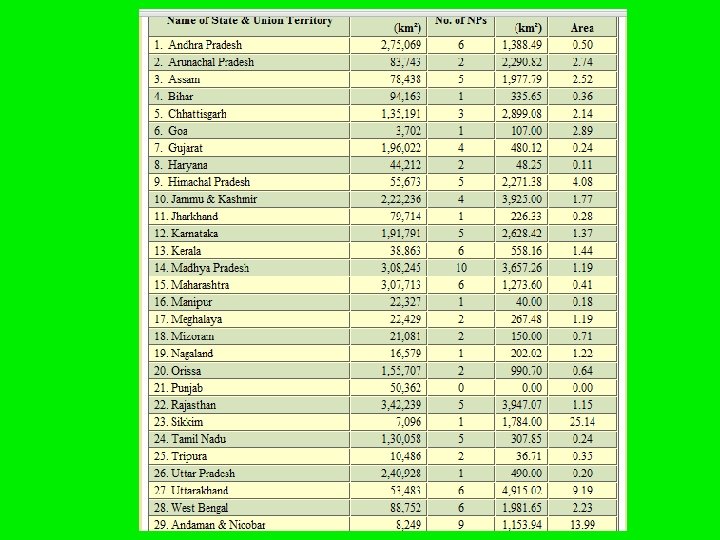
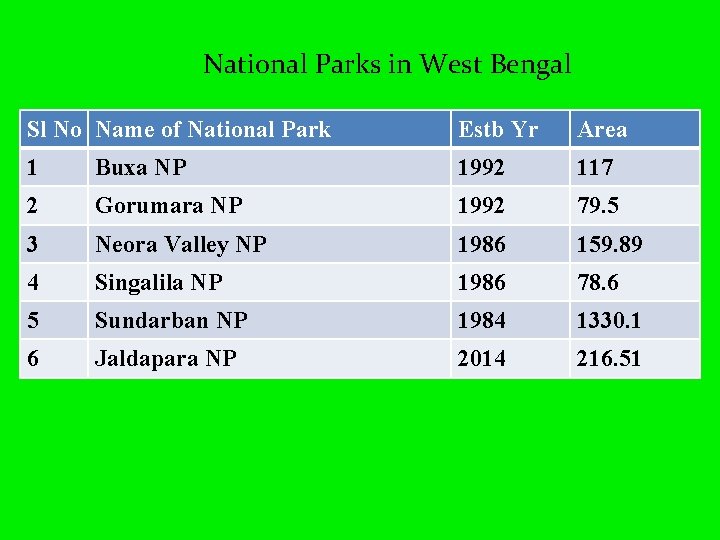
National Parks in West Bengal Sl No Name of National Park Estb Yr Area 1 Buxa NP 1992 117 2 Gorumara NP 1992 79. 5 3 Neora Valley NP 1986 159. 89 4 Singalila NP 1986 78. 6 5 Sundarban NP 1984 1330. 1 6 Jaldapara NP 2014 216. 51
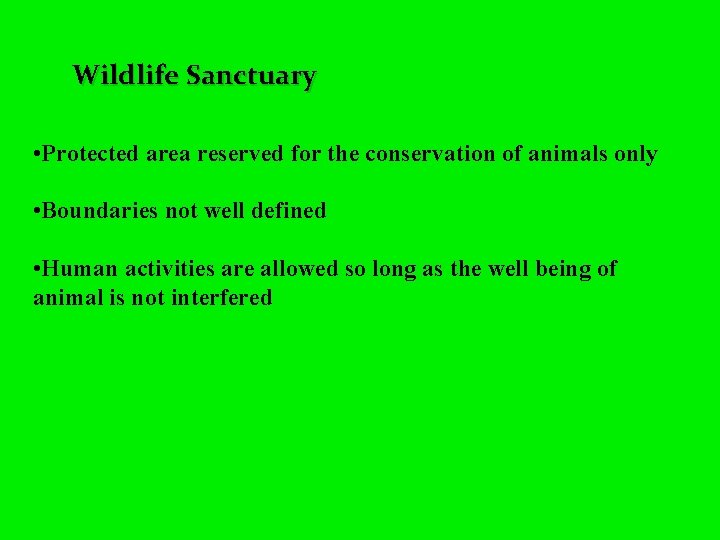
Wildlife Sanctuary • Protected area reserved for the conservation of animals only • Boundaries not well defined • Human activities are allowed so long as the well being of animal is not interfered
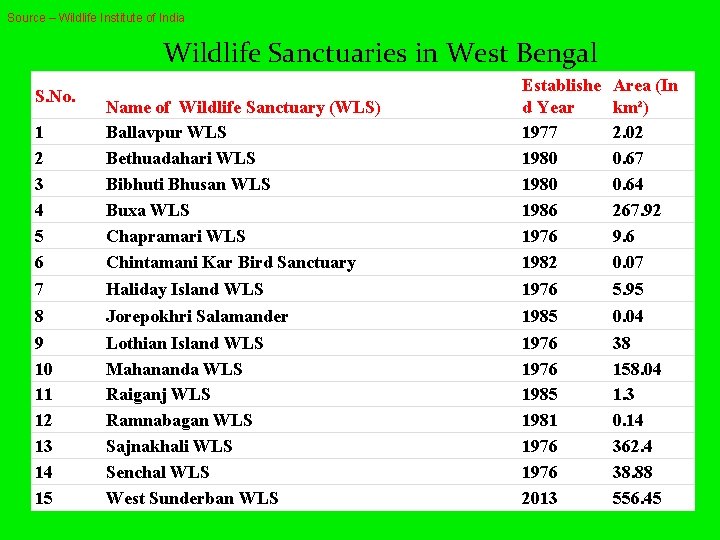
Source – Wildlife Institute of India Wildlife Sanctuaries in West Bengal 1 2 3 4 5 6 7 Name of Wildlife Sanctuary (WLS) Ballavpur WLS Bethuadahari WLS Bibhuti Bhusan WLS Buxa WLS Chapramari WLS Chintamani Kar Bird Sanctuary Haliday Island WLS Establishe d Year 1977 1980 1986 1976 1982 1976 Area (In km²) 2. 02 0. 67 0. 64 267. 92 9. 6 0. 07 5. 95 8 Jorepokhri Salamander 1985 0. 04 9 10 11 12 13 14 15 Lothian Island WLS Mahananda WLS Raiganj WLS Ramnabagan WLS Sajnakhali WLS Senchal WLS West Sunderban WLS 1976 1985 1981 1976 2013 38 158. 04 1. 3 0. 14 362. 4 38. 88 556. 45 S. No.
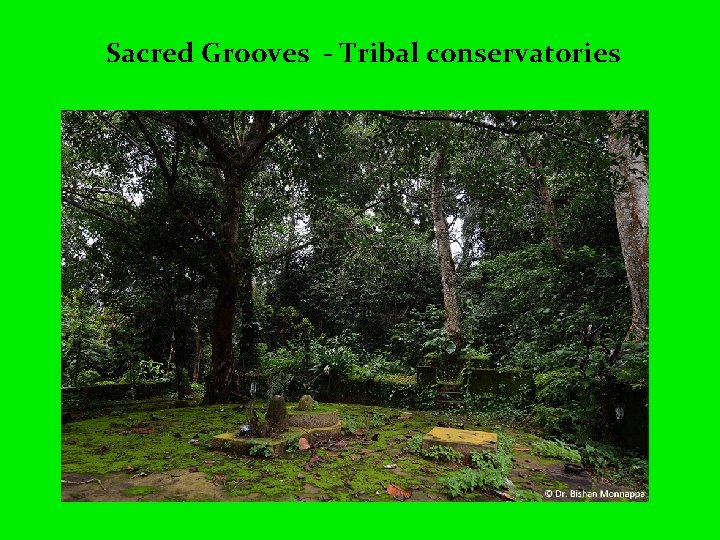
Sacred Grooves - Tribal conservatories
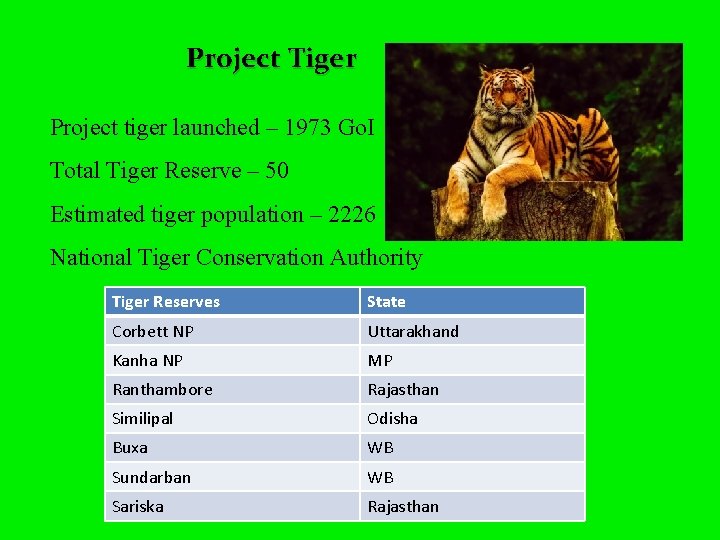
Project Tiger Project tiger launched – 1973 Go. I Total Tiger Reserve – 50 Estimated tiger population – 2226 National Tiger Conservation Authority Tiger Reserves State Corbett NP Uttarakhand Kanha NP MP Ranthambore Rajasthan Similipal Odisha Buxa WB Sundarban WB Sariska Rajasthan
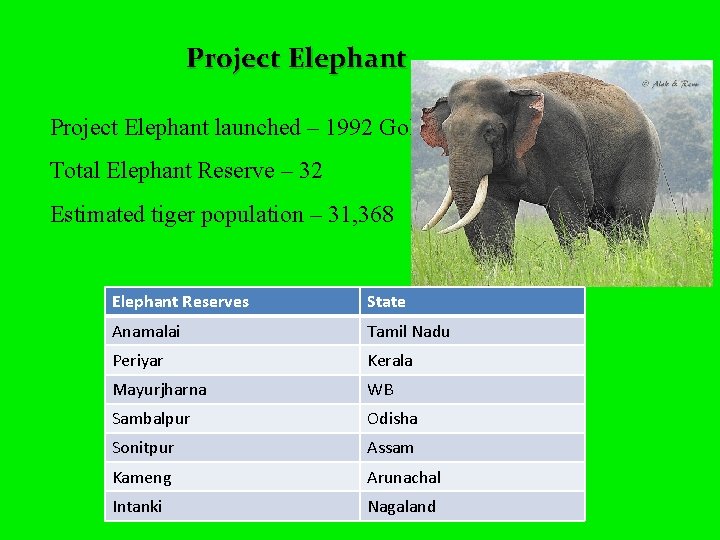
Project Elephant launched – 1992 Go. I Total Elephant Reserve – 32 Estimated tiger population – 31, 368 Elephant Reserves State Anamalai Tamil Nadu Periyar Kerala Mayurjharna WB Sambalpur Odisha Sonitpur Assam Kameng Arunachal Intanki Nagaland
- Slides: 55