
Biodegradation of Polymers Biodegradable Polymers Surface Modifications Processing
Biodegradation of Polymers, Biodegradable Polymers, Surface Modifications, Processing of Polymers and Medical Fibers and Hydrogels By: Dr. Murtaza Najabat Ali (CEng MIMech. E) 1
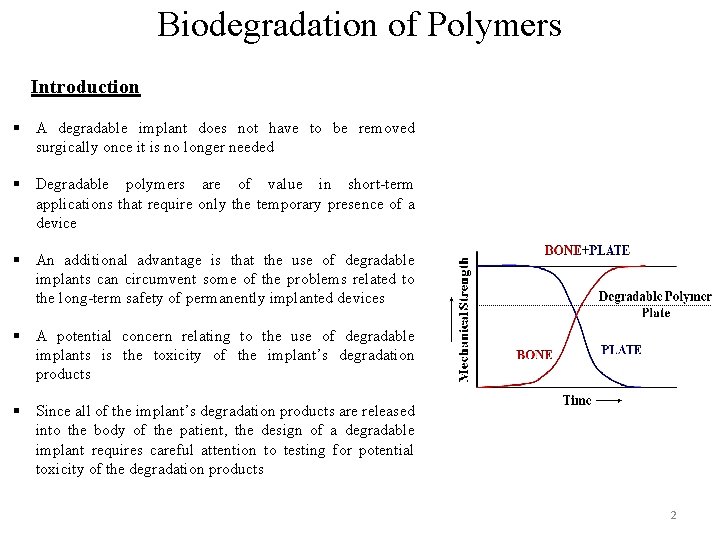
Biodegradation of Polymers Introduction § A degradable implant does not have to be removed surgically once it is no longer needed § Degradable polymers are of value in short-term applications that require only the temporary presence of a device § An additional advantage is that the use of degradable implants can circumvent some of the problems related to the long-term safety of permanently implanted devices § A potential concern relating to the use of degradable implants is the toxicity of the implant’s degradation products § Since all of the implant’s degradation products are released into the body of the patient, the design of a degradable implant requires careful attention to testing for potential toxicity of the degradation products 2
Biodegradation of Polymers Erosion and Degradation (definitions) § Currently four different terms (Biodegradation, Bioerosion, Bioresorption and Bioabsorption) are being used to indicate that a given material/device will eventually disappear, when introduced into a living organism § The term “Degradation” refers to a chemical process resulting in the cleavage of covalent bonds, Hydrolysis is the most common chemical process by which polymers degrade but degradation can also occur via Oxidative mechanism § In contrast, the term “Erosion” refers to the physical changes in size, shape, or mass of a device, which could be the consequence of either Degradation or simply Dissolution § Therefore, it is important to note that Erosion can occur in the absence of Degradation, and Degradation can occur in the absence of Erosion, e. g. sugar cube in water and embrittlement of plastic when exposed to UV light § “Bioerosion” includes therefore both physical processes (such as Dissolution) and chemical processes (such as Backbone Cleavage) 3
Biodegradation of Polymers Bioerosion Process § A “Bioerodible polymer” as a water-insoluble polymer, converts under physiological conditions into water-soluble material without regard to the specific mechanism involved in the erosion process § The Bioerosion process of a solid polymeric implant is associated with macroscopic changes in the appearance of the device, changes in its physicochemical properties and in physical processes such as swelling, deformation, or structural disintegration, weight loss, and the eventual loss of function § It is important to note that the Bioerosion of a solid device is not necessarily due to the chemical cleavage of the polymer backbone or the chemical cleavage of crosslinks or side chains § Rather, simple solubilization of the intact polymer, for instance, due to changes in p. H, may also lead to the erosion of a solid device. 4
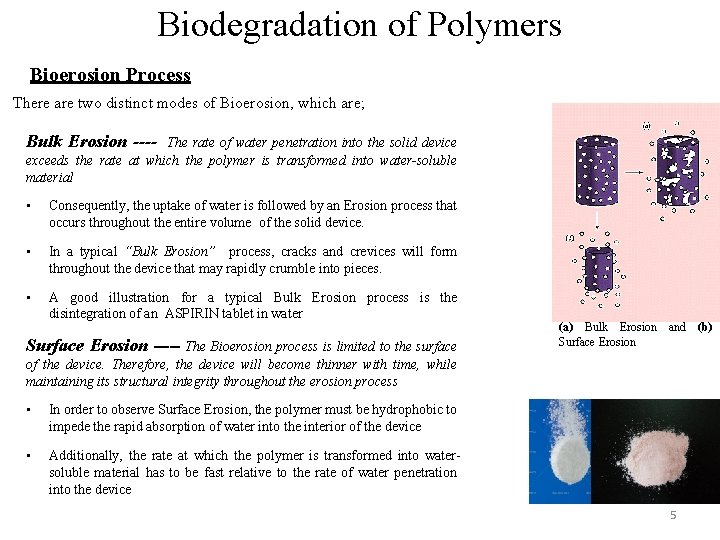
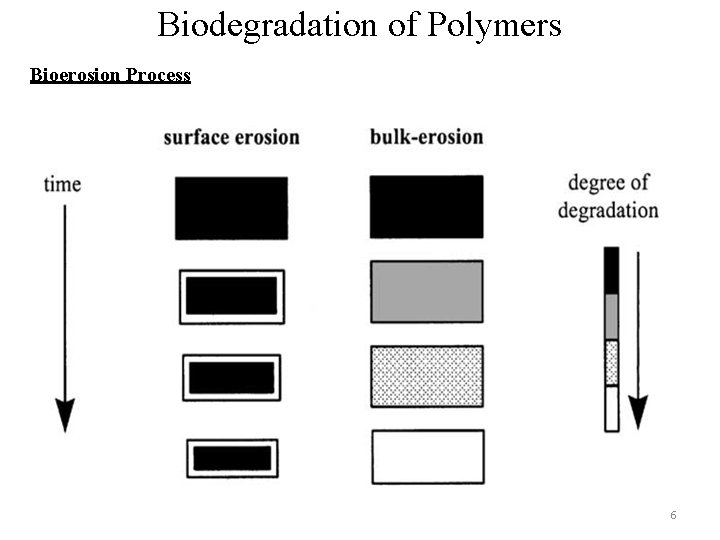
Biodegradation of Polymers Bioerosion Process There are two distinct modes of Bioerosion, which are; Bulk Erosion ---- The rate of water penetration into the solid device exceeds the rate at which the polymer is transformed into water-soluble material • Consequently, the uptake of water is followed by an Erosion process that occurs throughout the entire volume of the solid device. • In a typical “Bulk Erosion” process, cracks and crevices will form throughout the device that may rapidly crumble into pieces. • A good illustration for a typical Bulk Erosion process is the disintegration of an ASPIRIN tablet in water Surface Erosion ----- The Bioerosion process is limited to the surface (a) Bulk Erosion and (b) Surface Erosion of the device. Therefore, the device will become thinner with time, while maintaining its structural integrity throughout the erosion process • In order to observe Surface Erosion, the polymer must be hydrophobic to impede the rapid absorption of water into the interior of the device • Additionally, the rate at which the polymer is transformed into watersoluble material has to be fast relative to the rate of water penetration into the device 5
Biodegradation of Polymers Bioerosion Process 6
Biodegradation of Polymers Bioerosion Process Although Bioerosion can be caused by the solubilization of an intact polymer. But chemical degradation is mostly the underlying cause for the Bioerosion of a solid polymeric device § Chemical degradation process of polymers involves Hydrolysis, Oxidation and Enzymatic degradation schemes § Hydrolytic degradation is the main degradation scheme known and studied, and is very dominant in polymeric devices § There are Three types of Hydrolytic chemical degradation mechanisms which have been discovered analyzed 1) Mechanism I ----- involves the cleavage of crosslinks between water soluble polymer chains 2) Mechanism II ----- involves the cleavage/scission of polymer side chains resulting in polar or charged groups 3) Mechanism III ------ involves the cleavage of polymer backbone followed by solubilization of the low-molecular weight fragments Note: Water is key to all of these degradation schemes. Even enzymatic degradation occurs in aqueous environment 7
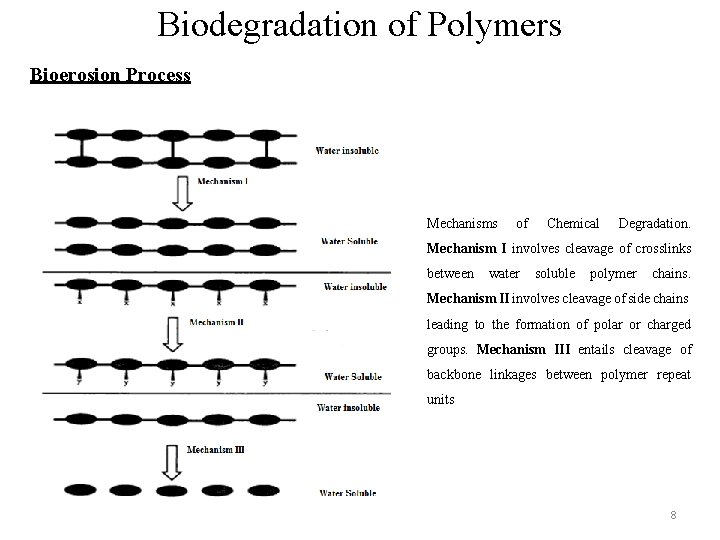
Biodegradation of Polymers Bioerosion Process Mechanisms of Chemical Degradation. Mechanism I involves cleavage of crosslinks between water soluble polymer chains. Mechanism II involves cleavage of side chains leading to the formation of polar or charged groups. Mechanism III entails cleavage of backbone linkages between polymer repeat units 8
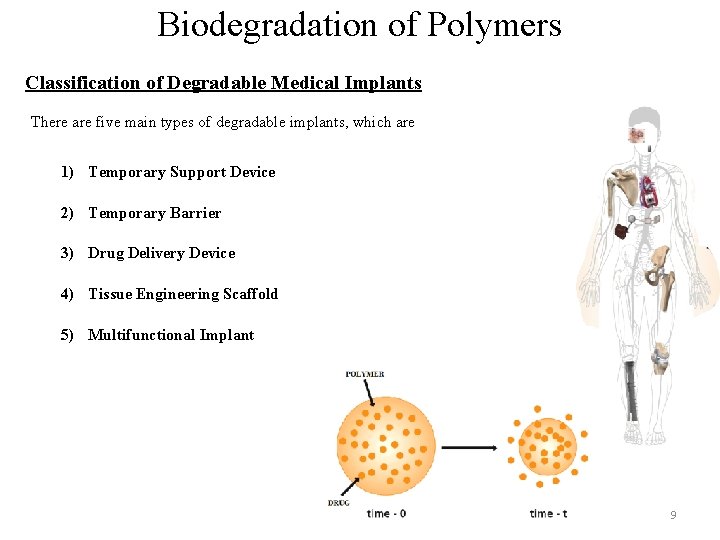
Biodegradation of Polymers Classification of Degradable Medical Implants There are five main types of degradable implants, which are 1) Temporary Support Device 2) Temporary Barrier 3) Drug Delivery Device 4) Tissue Engineering Scaffold 5) Multifunctional Implant 9
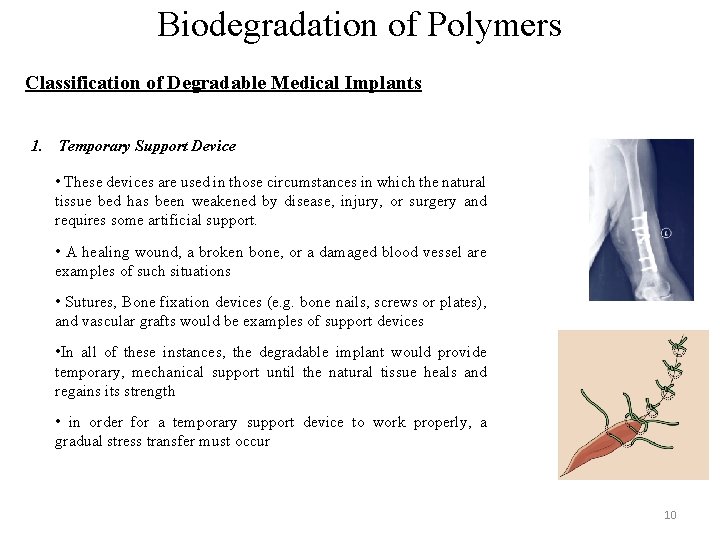
Biodegradation of Polymers Classification of Degradable Medical Implants 1. Temporary Support Device • These devices are used in those circumstances in which the natural tissue bed has been weakened by disease, injury, or surgery and requires some artificial support. • A healing wound, a broken bone, or a damaged blood vessel are examples of such situations • Sutures, Bone fixation devices (e. g. bone nails, screws or plates), and vascular grafts would be examples of support devices • In all of these instances, the degradable implant would provide temporary, mechanical support until the natural tissue heals and regains its strength • in order for a temporary support device to work properly, a gradual stress transfer must occur 10
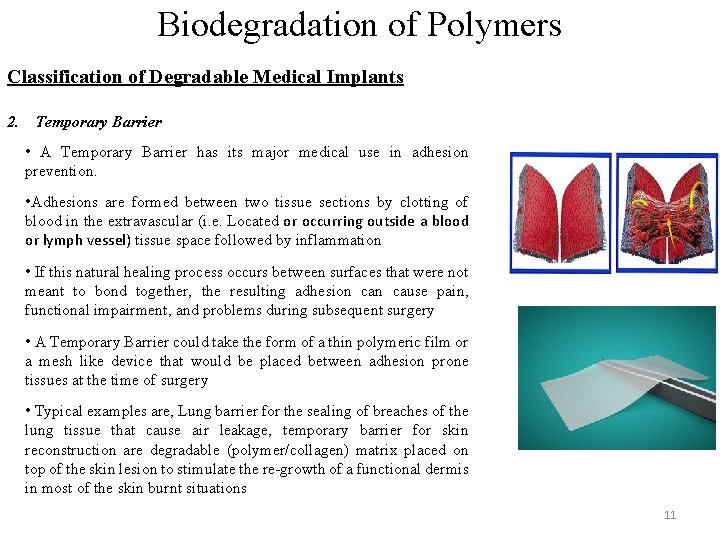
Biodegradation of Polymers Classification of Degradable Medical Implants 2. Temporary Barrier • A Temporary Barrier has its major medical use in adhesion prevention. • Adhesions are formed between two tissue sections by clotting of blood in the extravascular (i. e. Located or occurring outside a blood or lymph vessel) tissue space followed by inflammation • If this natural healing process occurs between surfaces that were not meant to bond together, the resulting adhesion cause pain, functional impairment, and problems during subsequent surgery • A Temporary Barrier could take the form of a thin polymeric film or a mesh like device that would be placed between adhesion prone tissues at the time of surgery • Typical examples are, Lung barrier for the sealing of breaches of the lung tissue that cause air leakage, temporary barrier for skin reconstruction are degradable (polymer/collagen) matrix placed on top of the skin lesion to stimulate the re-growth of a functional dermis in most of the skin burnt situations 11
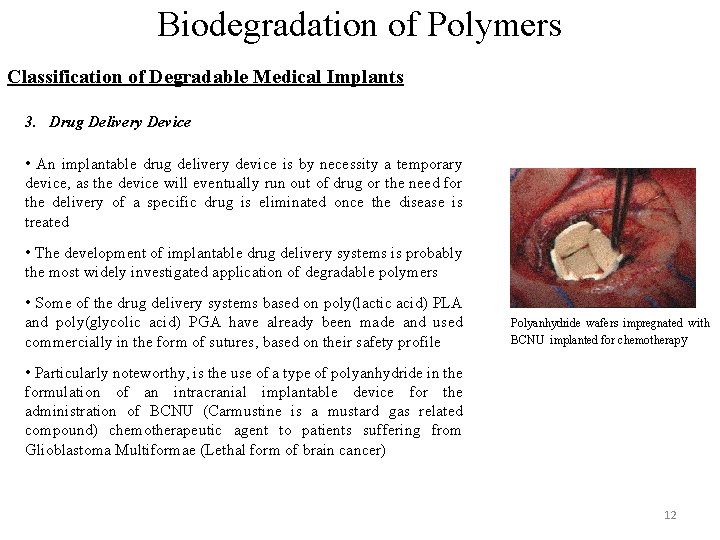
Biodegradation of Polymers Classification of Degradable Medical Implants 3. Drug Delivery Device • An implantable drug delivery device is by necessity a temporary device, as the device will eventually run out of drug or the need for the delivery of a specific drug is eliminated once the disease is treated • The development of implantable drug delivery systems is probably the most widely investigated application of degradable polymers • Some of the drug delivery systems based on poly(lactic acid) PLA and poly(glycolic acid) PGA have already been made and used commercially in the form of sutures, based on their safety profile Polyanhydride wafers impregnated with BCNU implanted for chemotherap y • Particularly noteworthy, is the use of a type of polyanhydride in the formulation of an intracranial implantable device for the administration of BCNU (Carmustine is a mustard gas related compound) chemotherapeutic agent to patients suffering from Glioblastoma Multiformae (Lethal form of brain cancer) 12
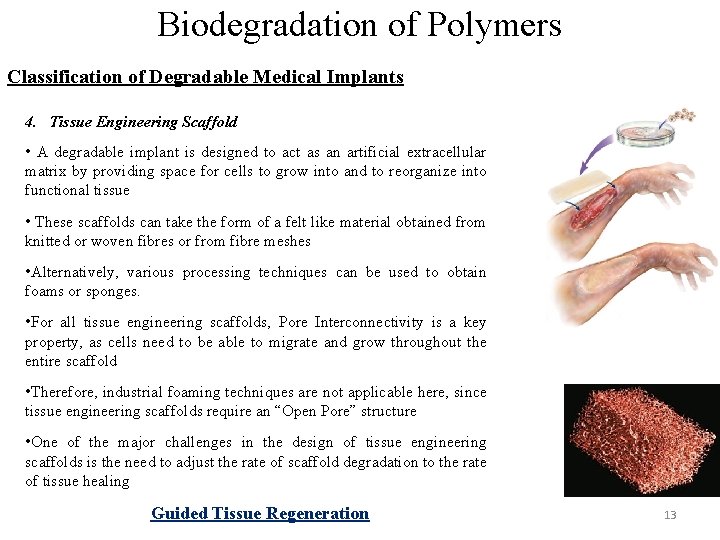
Biodegradation of Polymers Classification of Degradable Medical Implants 4. Tissue Engineering Scaffold • A degradable implant is designed to act as an artificial extracellular matrix by providing space for cells to grow into and to reorganize into functional tissue • These scaffolds can take the form of a felt like material obtained from knitted or woven fibres or from fibre meshes • Alternatively, various processing techniques can be used to obtain foams or sponges. • For all tissue engineering scaffolds, Pore Interconnectivity is a key property, as cells need to be able to migrate and grow throughout the entire scaffold • Therefore, industrial foaming techniques are not applicable here, since tissue engineering scaffolds require an “Open Pore” structure • One of the major challenges in the design of tissue engineering scaffolds is the need to adjust the rate of scaffold degradation to the rate of tissue healing Guided Tissue Regeneration 13
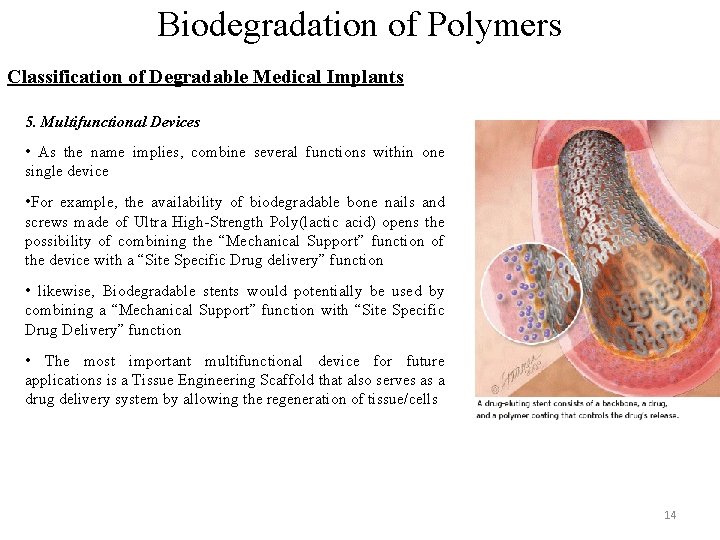
Biodegradation of Polymers Classification of Degradable Medical Implants 5. Multifunctional Devices • As the name implies, combine several functions within one single device • For example, the availability of biodegradable bone nails and screws made of Ultra High-Strength Poly(lactic acid) opens the possibility of combining the “Mechanical Support” function of the device with a “Site Specific Drug delivery” function • likewise, Biodegradable stents would potentially be used by combining a “Mechanical Support” function with “Site Specific Drug Delivery” function • The most important multifunctional device for future applications is a Tissue Engineering Scaffold that also serves as a drug delivery system by allowing the regeneration of tissue/cells 14
Biodegradation of Polymers Some of the common Biodegradable polymers, are • Polyglycolide (PGA) • Polylactide (PLA) • Polydioxanone (PDS) • Poly (Ԑ-caprolactone) (PCL) • Polyhydroxybutyrate (PHB) • Polyester-Polyurethane 15
Processing of Polymers Example 5. 1 A production manager at a biomaterials plant made 40, 000 artificial heart valves leaflets out of a thermosetting polymer resin. The fabrication process involved heat treatment of the leaflets at a high temperature to cure them. Unfortunately, it was discovered after the production run that a calculation error was made, resulting in all of the artificial heart valve leaflets being too large to be used. Interested in lessening the economic impact of the mistake, the production manager asks you (the resident biomaterials expert) of the leaflets can be melted to recycle the polymer in order to produce a new batch of leaflets of the proper dimensions. How would you respond (Justify your answer) ? 16
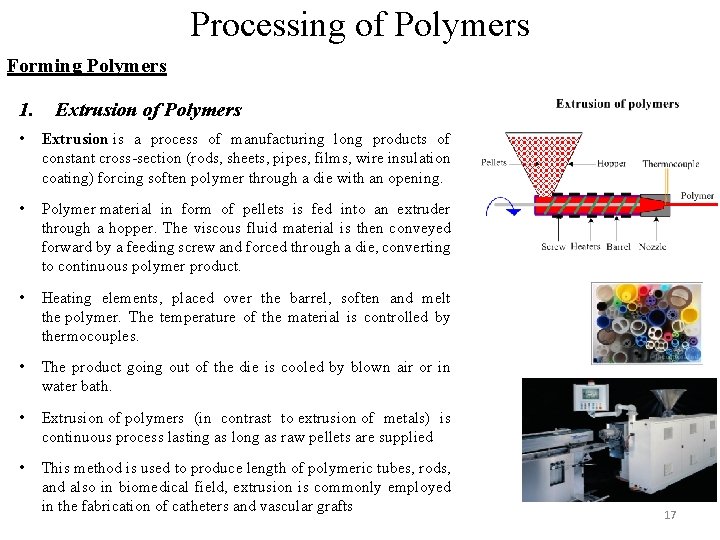
Processing of Polymers Forming Polymers 1. Extrusion of Polymers • Extrusion is a process of manufacturing long products of constant cross-section (rods, sheets, pipes, films, wire insulation coating) forcing soften polymer through a die with an opening. • Polymer material in form of pellets is fed into an extruder through a hopper. The viscous fluid material is then conveyed forward by a feeding screw and forced through a die, converting to continuous polymer product. • Heating elements, placed over the barrel, soften and melt the polymer. The temperature of the material is controlled by thermocouples. • The product going out of the die is cooled by blown air or in water bath. • Extrusion of polymers (in contrast to extrusion of metals) is continuous process lasting as long as raw pellets are supplied • This method is used to produce length of polymeric tubes, rods, and also in biomedical field, extrusion is commonly employed in the fabrication of catheters and vascular grafts 17
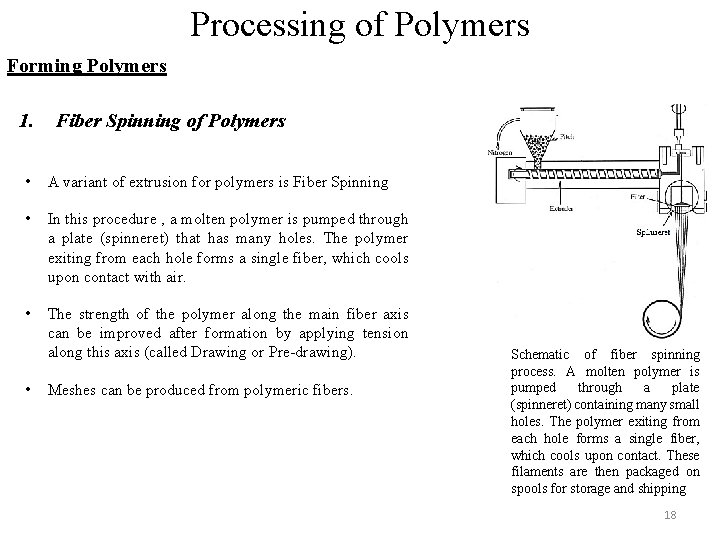
Processing of Polymers Forming Polymers 1. Fiber Spinning of Polymers • A variant of extrusion for polymers is Fiber Spinning • In this procedure , a molten polymer is pumped through a plate (spinneret) that has many holes. The polymer exiting from each hole forms a single fiber, which cools upon contact with air. • The strength of the polymer along the main fiber axis can be improved after formation by applying tension along this axis (called Drawing or Pre-drawing). • Meshes can be produced from polymeric fibers. Schematic of fiber spinning process. A molten polymer is pumped through a plate (spinneret) containing many small holes. The polymer exiting from each hole forms a single fiber, which cools upon contact. These filaments are then packaged on spools for storage and shipping 18
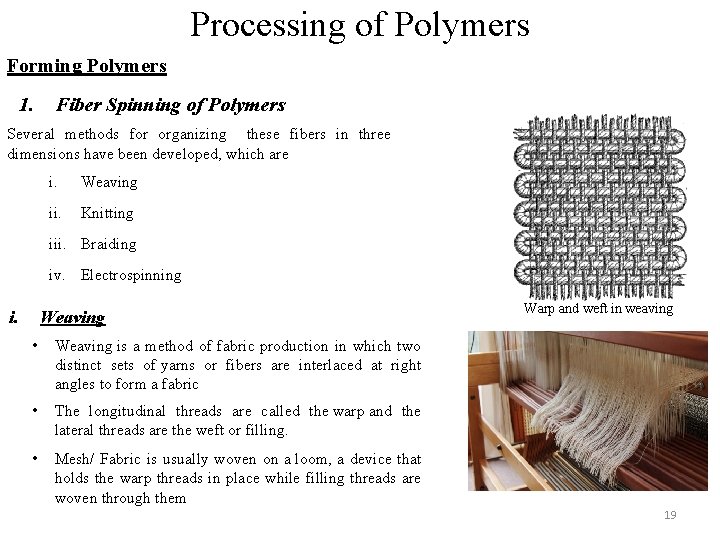
Processing of Polymers Forming Polymers 1. Fiber Spinning of Polymers Several methods for organizing these fibers in three dimensions have been developed, which are i. Weaving ii. Knitting iii. Braiding iv. Electrospinning i. Weaving • Weaving is a method of fabric production in which two distinct sets of yarns or fibers are interlaced at right angles to form a fabric • The longitudinal threads are called the warp and the lateral threads are the weft or filling. • Mesh/ Fabric is usually woven on a loom, a device that holds the warp threads in place while filling threads are woven through them Warp and weft in weaving 19
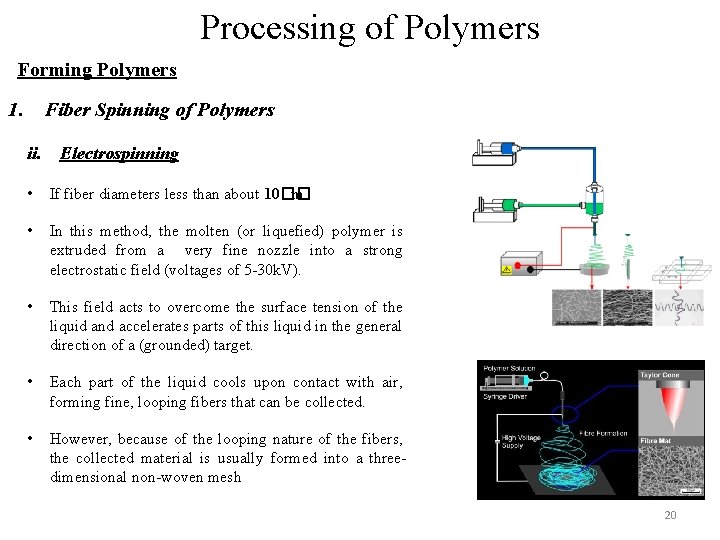
Processing of Polymers Forming Polymers 1. Fiber Spinning of Polymers ii. Electrospinning • If fiber diameters less than about 10�� m • In this method, the molten (or liquefied) polymer is extruded from a very fine nozzle into a strong electrostatic field (voltages of 5 -30 k. V). • This field acts to overcome the surface tension of the liquid and accelerates parts of this liquid in the general direction of a (grounded) target. • Each part of the liquid cools upon contact with air, forming fine, looping fibers that can be collected. • However, because of the looping nature of the fibers, the collected material is usually formed into a threedimensional non-woven mesh 20
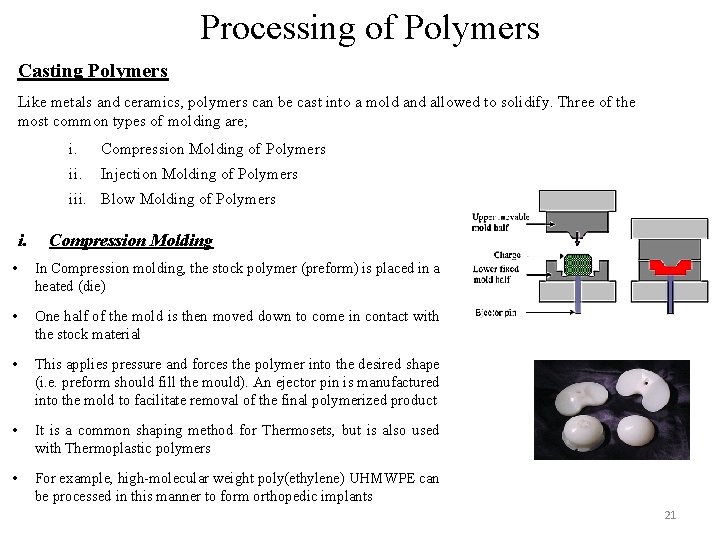
Processing of Polymers Casting Polymers Like metals and ceramics, polymers can be cast into a mold and allowed to solidify. Three of the most common types of molding are; i. Compression Molding of Polymers ii. Injection Molding of Polymers iii. Blow Molding of Polymers i. Compression Molding • In Compression molding, the stock polymer (preform) is placed in a heated (die) • One half of the mold is then moved down to come in contact with the stock material • This applies pressure and forces the polymer into the desired shape (i. e. preform should fill the mould). An ejector pin is manufactured into the mold to facilitate removal of the final polymerized product • It is a common shaping method for Thermosets, but is also used with Thermoplastic polymers • For example, high-molecular weight poly(ethylene) UHMWPE can be processed in this manner to form orthopedic implants 21
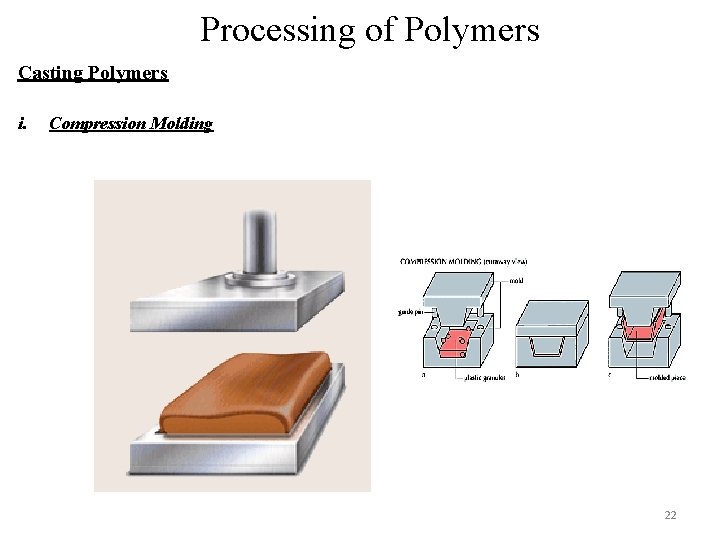
Processing of Polymers Casting Polymers i. Compression Molding 22
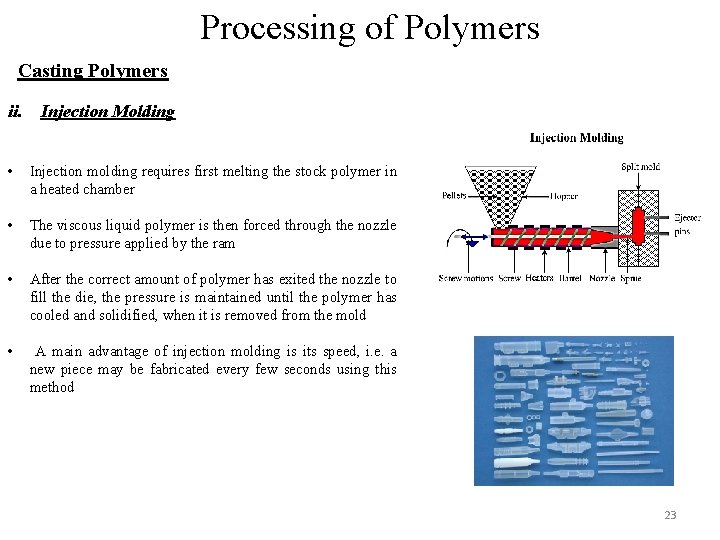
Processing of Polymers Casting Polymers ii. Injection Molding • Injection molding requires first melting the stock polymer in a heated chamber • The viscous liquid polymer is then forced through the nozzle due to pressure applied by the ram • After the correct amount of polymer has exited the nozzle to fill the die, the pressure is maintained until the polymer has cooled and solidified, when it is removed from the mold • A main advantage of injection molding is its speed, i. e. a new piece may be fabricated every few seconds using this method 23
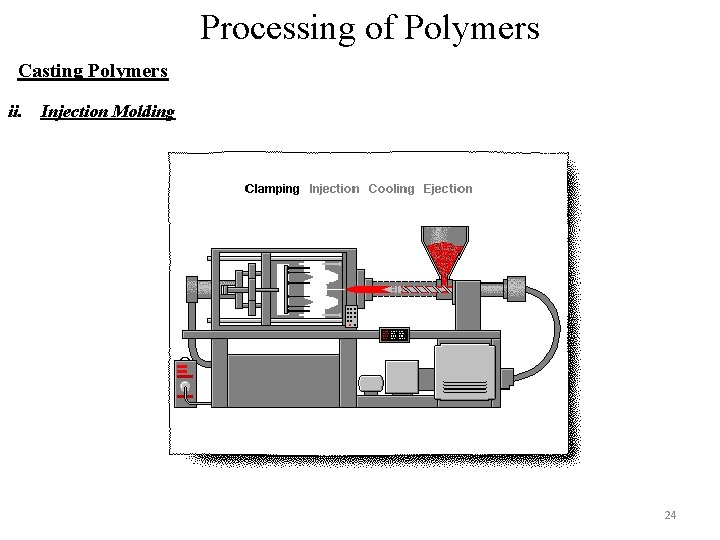
Processing of Polymers Casting Polymers ii. Injection Molding 24
- Slides: 24