
Biocuration Helping Researchers Harness the Data Explosion at
Biocuration: Helping Researchers Harness the Data Explosion at TAIR and the Plant Metabolic Network Kate Dreher curator TAIR/PMN Department of Plant Biology Carnegie Institution for Science Stanford, California kadreher@stanford. edu
Overview p Biological data explosion p Biocurators want to help! p Biocuration practices and resources at two plant databases p n The Arabidopsis Information Resource n The Plant Metabolic Network Request for your help!
Growth of biological data p Over time biological data increases in n Quantity p p Methods improve Costs decrease
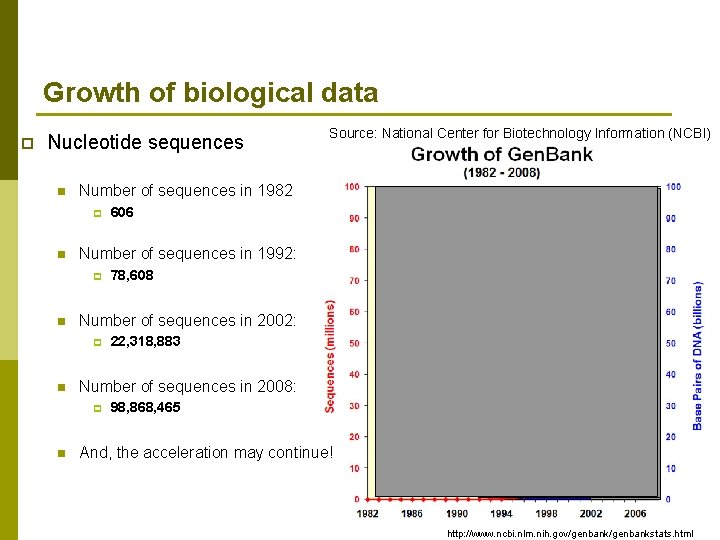
Growth of biological data p Nucleotide sequences n Number of sequences in 1982 p n 22, 318, 883 Number of sequences in 2008: p n 78, 608 Number of sequences in 2002: p n 606 Number of sequences in 1992: p n Source: National Center for Biotechnology Information (NCBI) 98, 868, 465 And, the acceleration may continue! http: //www. ncbi. nlm. nih. gov/genbankstats. html
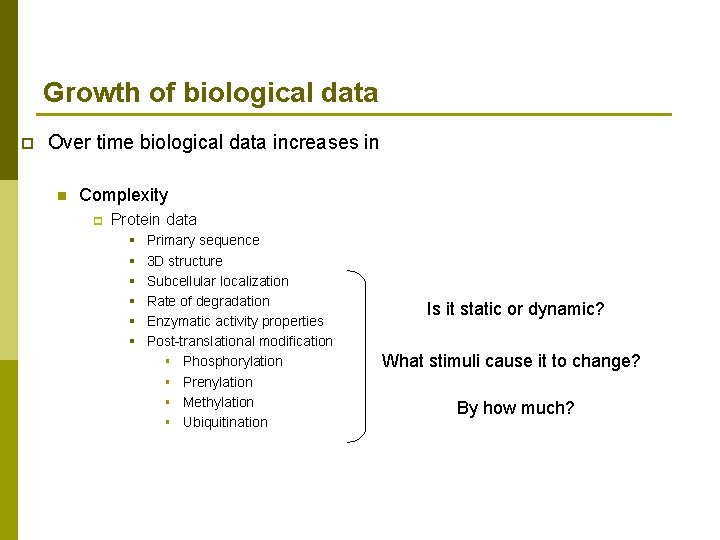
Growth of biological data p Over time biological data increases in n Complexity p Protein data § § § Primary sequence 3 D structure Subcellular localization Rate of degradation Enzymatic activity properties Post-translational modification § Phosphorylation § Prenylation § Methylation § Ubiquitination Is it static or dynamic? What stimuli cause it to change? By how much?
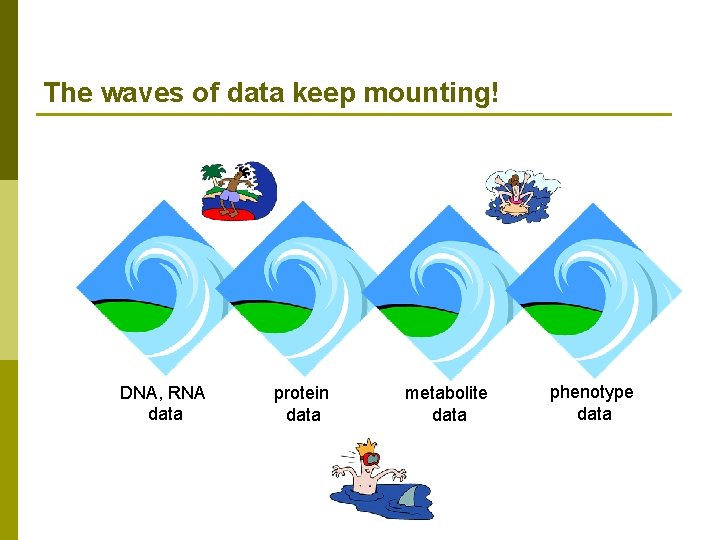
The waves of data keep mounting! DNA, RNA data protein data metabolite data phenotype data
Exploring the sea of biological data p Primary data source n n Articles published in peer-reviewed journals Over 18 million available through Pub. Med by 2008! p p NOT a comprehensive set; many journals are missing Answering scientific questions n Specific focus: p n Broad search: p n Find every single piece of information ever discovered about my favorite gene – XYZ 1 – to figure out exactly what it does Compare the protein sequence of every single transcription factor ever discovered in a prokaryote or a eukaryote to study the evolution of nuclearlocalization signals How do you collect these data from ALL of the relevant research articles? p Data repositories. . . staffed by biocurators. . . try to help! § Computer scientists and bioinformaticians contribute to these efforts as well!
Global data repositories / databases p Centralized data hubs n Many data types Many species n Asia n p n Europe p n Several in Japan, e. g. RIKEN, China is adding new ones European Bioinformatics Institute (EBI) USA p National Center for Biotechnology Information (NCBI)
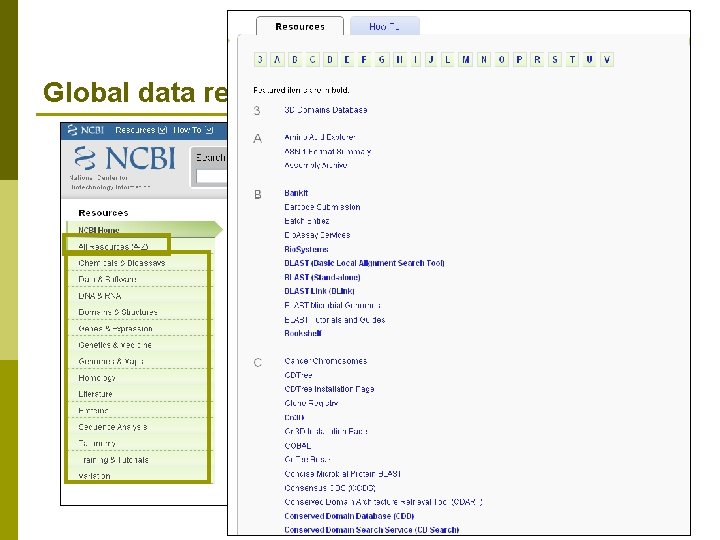
Global data repositories / databases
Specialized data repositories / databases p Model organism databases (MODs) n n p Mouse Genome Informatics (MGI) Flybase (Drosophila) Saccharomyces Genome Database (SGD) (yeast) The Arabidopsis Information Resource (TAIR) Topical databases n n n Worldwide Protein Data Bank (3 D structures) mi. Rbase (micro. RNAs) Plant Metabolic Network (PMN) (metabolic / biochemical pathways)
Roles of biocurators at data repositories p Organize and process raw data n p Review and improve data to generate curated data sets n p Provide a protein interaction viewer Train users n p Manually correct errors in raw nucleotide sequences to make Ref. Seq gene structures Develop tools for accessing data n p Assign unique stable identifiers for nucleotide sequences submitted by researchers Present at conferences and universities Try to help researchers harness the data explosion! n n TAIR Plant Metabolic Network
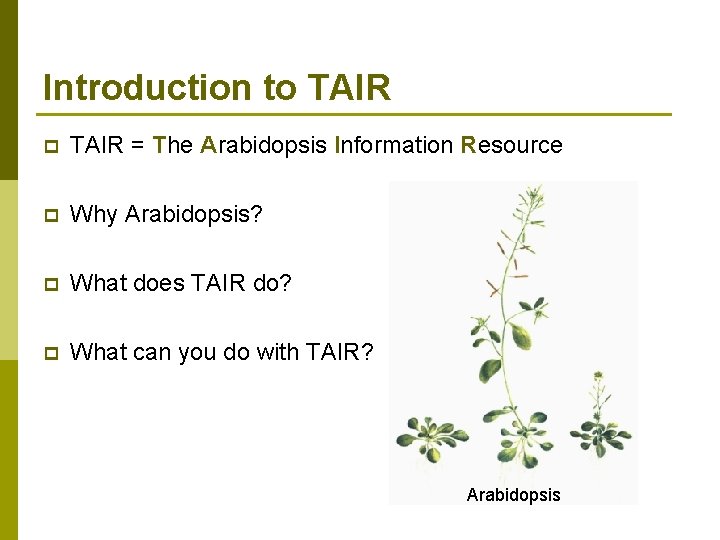
Introduction to TAIR p TAIR = The Arabidopsis Information Resource p Why Arabidopsis? p What does TAIR do? p What can you do with TAIR? Arabidopsis
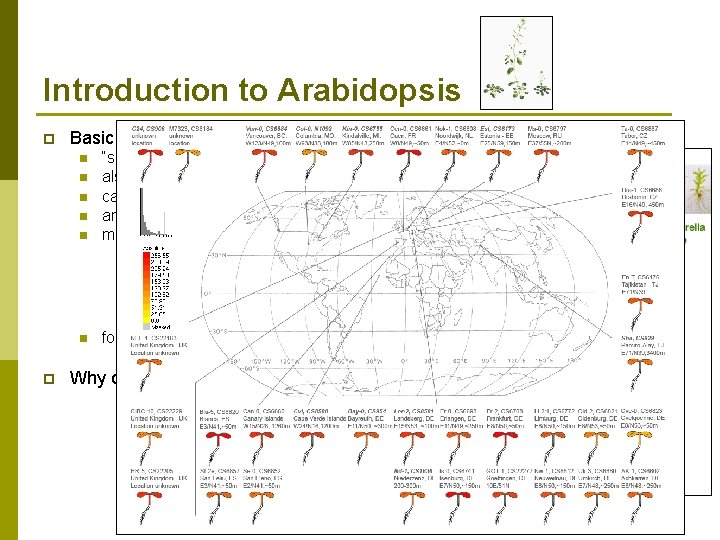
Introduction to Arabidopsis p Basic facts: n n n “small weed related to mustard” also known as “mouse ear cress” can grow to 20 -25 cm tall annual (or occasionally biennial) plant member of the Brassicaceae p p n p broccoli cauliflower radish cabbage found around the northern hemisphere Why do so many people study THIS plant?
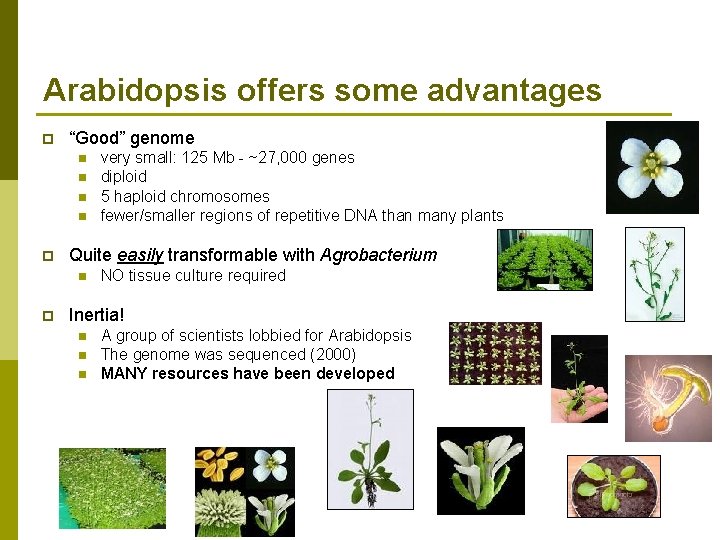
Arabidopsis offers some advantages p “Good” genome n n p Quite easily transformable with Agrobacterium n p very small: 125 Mb - ~27, 000 genes diploid 5 haploid chromosomes fewer/smaller regions of repetitive DNA than many plants NO tissue culture required Inertia! n n n A group of scientists lobbied for Arabidopsis The genome was sequenced (2000) MANY resources have been developed
Arabidopsis research can be applied to “real plants” p Over-expression of the hardy gene from Arabidopsis can improve water use efficiency in rice (Karaba 2007) p A high throughput screen performed using castor bean c. DNAs expressed in Arabidopsis found three c. DNAs that increase hydroxy fatty acid levels in seeds (Lu 2006) p These experiments and many more benefit from the work of curators trying to help harness the Arabidopsis data explosion. . . n ~2400 articles discussing Arabidopsis in Pub. Med per year!
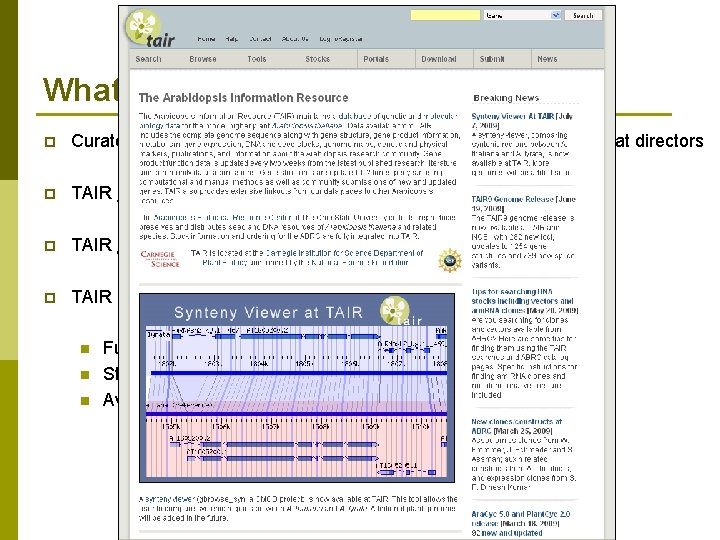
What does TAIR do? p Curators and computer tech team members work together under great directors p p TAIR develops internal data sets and resources Dr. Eva Huala Dr. Sue Rhee Director Co-PI TAIR links to external data sets and resources p Curators TAIR provides free on-line access to everyone n n n Funded by the National Science Foundation of the USA Started in 1999 Available at www. arabidopsis. org Computer tech team members
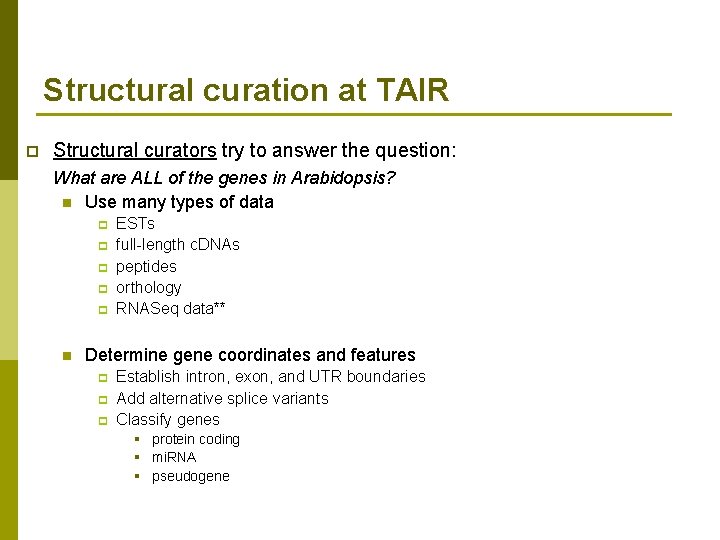
Structural curation at TAIR p Structural curators try to answer the question: What are ALL of the genes in Arabidopsis? n Use many types of data p p p n ESTs full-length c. DNAs peptides orthology RNASeq data** Determine gene coordinates and features p p p Establish intron, exon, and UTR boundaries Add alternative splice variants Classify genes § protein coding § mi. RNA § pseudogene
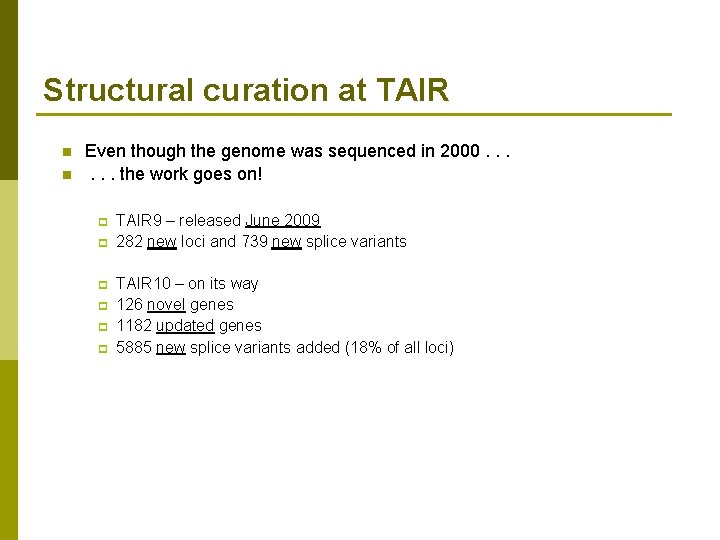
Structural curation at TAIR n n Even though the genome was sequenced in 2000. . . the work goes on! p p p TAIR 9 – released June 2009 282 new loci and 739 new splice variants TAIR 10 – on its way 126 novel genes 1182 updated genes 5885 new splice variants added (18% of all loci)
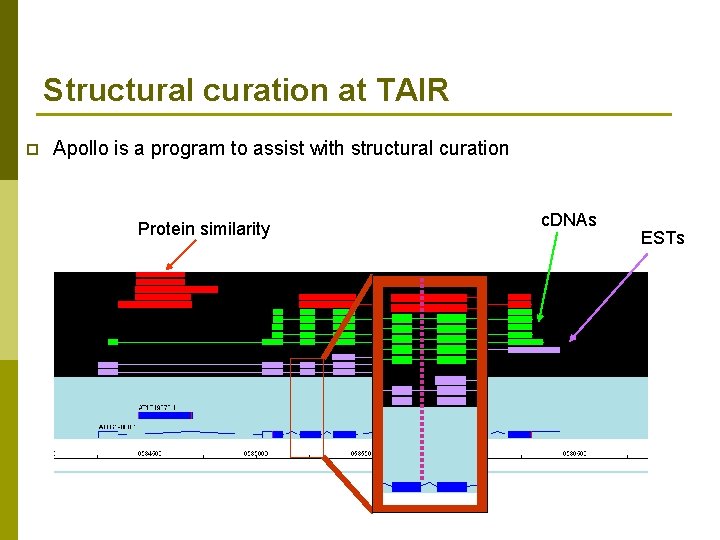
Structural curation at TAIR p Apollo is a program to assist with structural curation Protein similarity c. DNAs ESTs
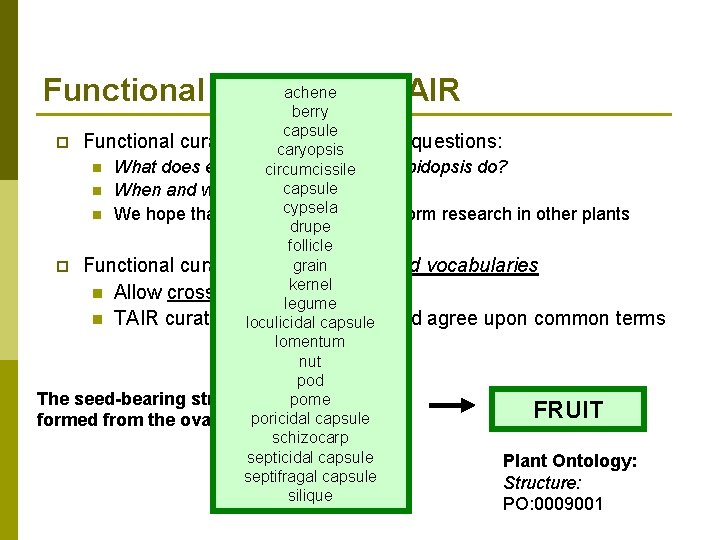
achene at TAIR Functional curation berry capsule p Functional curators trycaryopsis to answer the questions: n What does every gene/protein circumcissile in Arabidopsis do? capsule n When and where does it act? cypsela can inform research in other plants n We hope that this information drupe follicle grain controlled vocabularies p Functional curation requires kernel n Allow cross-species comparisons legume n TAIR curators work to develop loculicidal capsule and agree upon common terms lomentum nut pod The seed-bearing structure inpome angiosperms, FRUIT poricidal capsule formed from the ovary after flowering schizocarp septicidal capsule Plant Ontology: septifragal capsule Structure: silique PO: 0009001
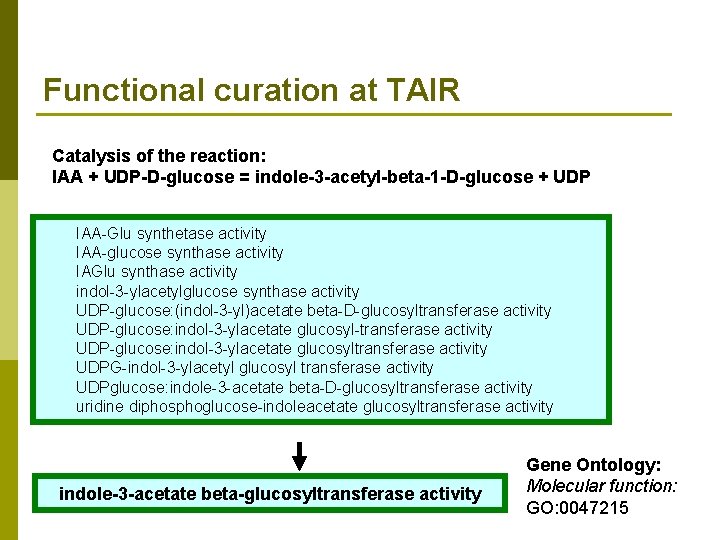
Functional curation at TAIR Catalysis of the reaction: IAA + UDP-D-glucose = indole-3 -acetyl-beta-1 -D-glucose + UDP IAA-Glu synthetase activity IAA-glucose synthase activity IAGlu synthase activity indol-3 -ylacetylglucose synthase activity UDP-glucose: (indol-3 -yl)acetate beta-D-glucosyltransferase activity UDP-glucose: indol-3 -ylacetate glucosyl-transferase activity UDP-glucose: indol-3 -ylacetate glucosyltransferase activity UDPG-indol-3 -ylacetyl glucosyl transferase activity UDPglucose: indole-3 -acetate beta-D-glucosyltransferase activity uridine diphosphoglucose-indoleacetate glucosyltransferase activity indole-3 -acetate beta-glucosyltransferase activity Gene Ontology: Molecular function: GO: 0047215
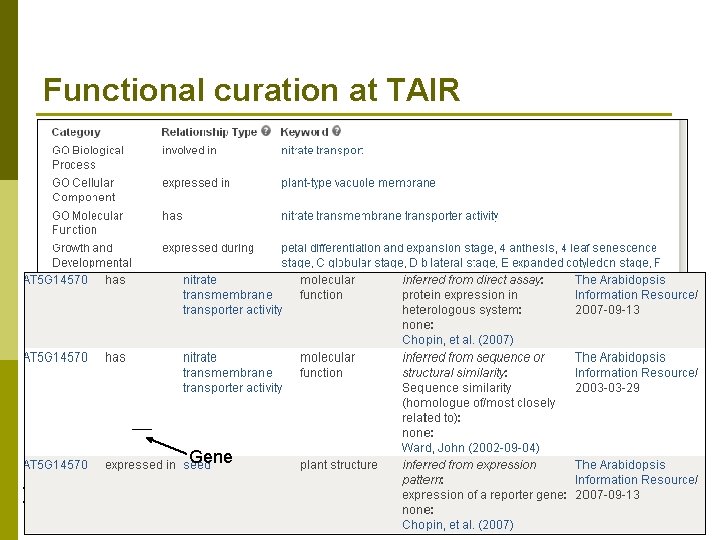
Functional curation at TAIR p Functional curators use controlled vocabularies to annotate genes n Molecular function n Subcellular localization n Biological process n Expression pattern p p n Development stage Tissue / organ / cell type Gene p p Enter common name, e. g. Nitrate Transporter 2. 7, NRT 2. 7 Prefer to track using AGI (Arabidopsis Genome Initiative) Locus Codes n AT 5 G 14570 n Gene Data Sources Position along chromosome (between 14560 and 14580) Arabidopsisp Published Literature Chromosome 5 thaliana p Researchers
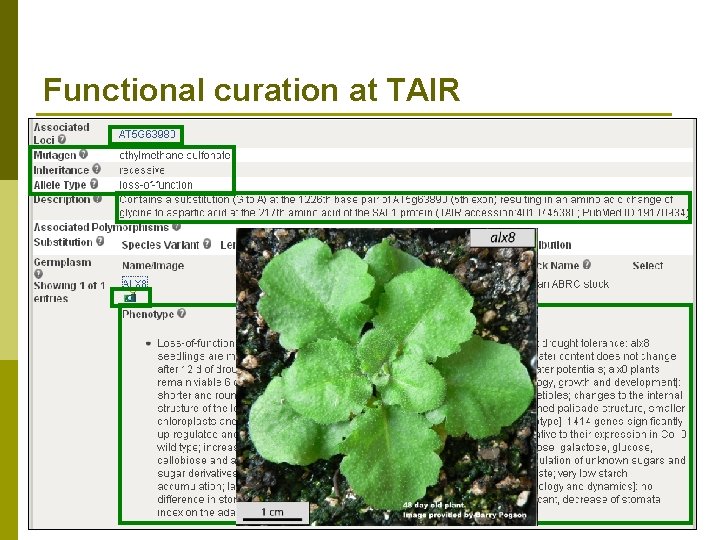
Functional curation at TAIR p Functional curators capture mutant phenotypes n alx 8 mutant – mutation in gene At 5 g 63980
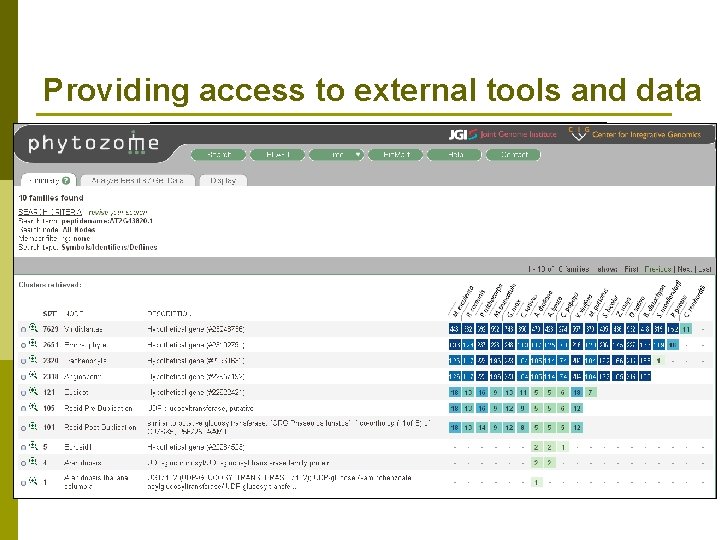
Providing access to external tools and data p Tech team members and curators n Provide links to external databases from every gene page
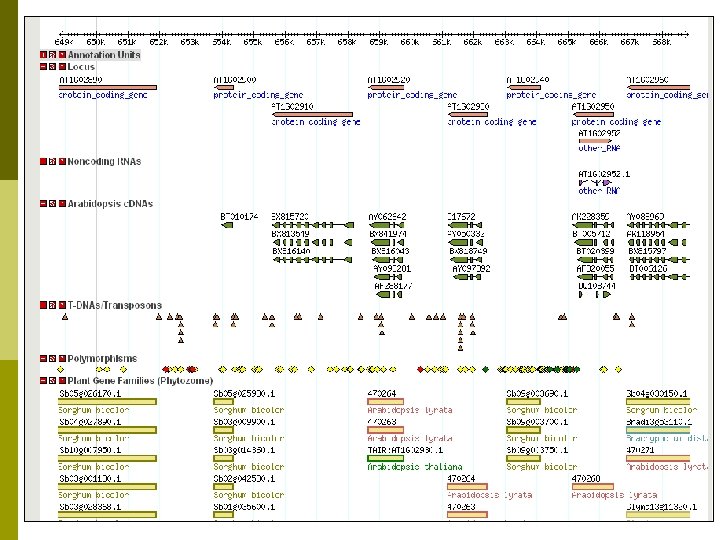
Providing Tools at TAIR p Tech team members and curators n Load data sets into existing tools p BLAST p GBrowse
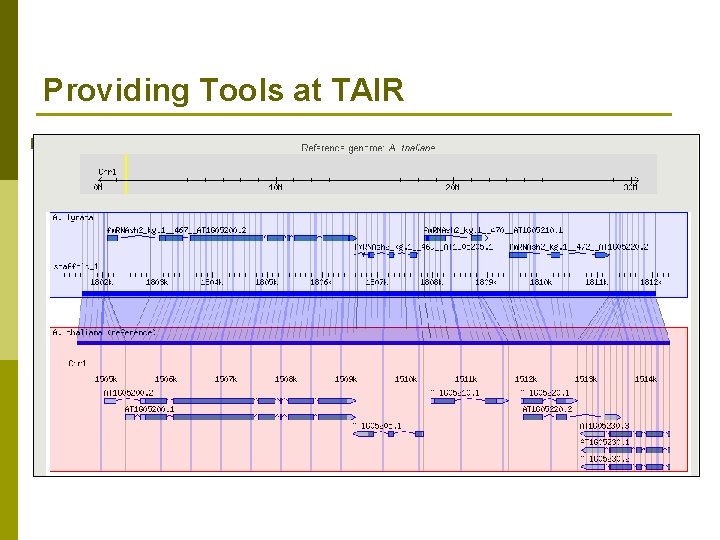
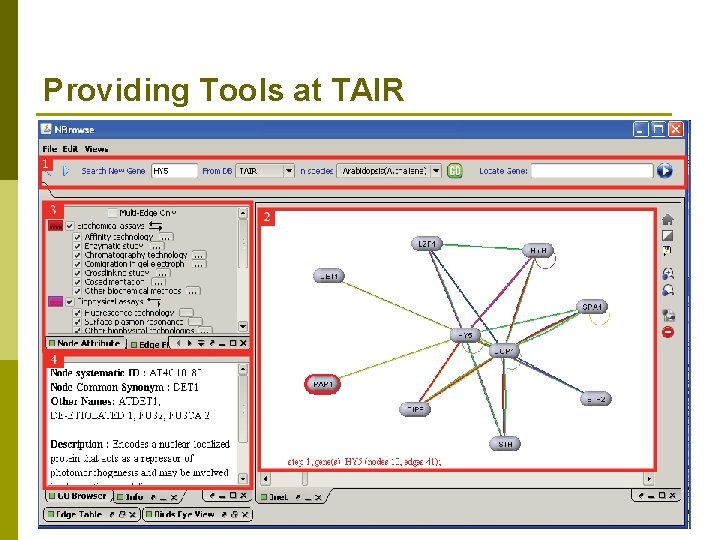
Providing Tools at TAIR p Tech team members and curators n Load data sets into existing tools p BLAST p GBrowse p Synteny Viewer p NBrowse Interaction Viewer (very new)
Providing Tools at TAIR
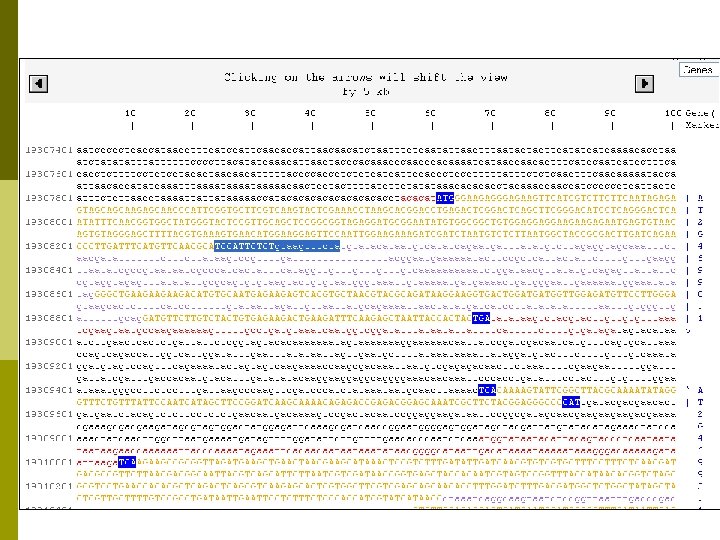
Providing Tools at TAIR p Tech team members and curators n Develop new tools p Seq. Viewer
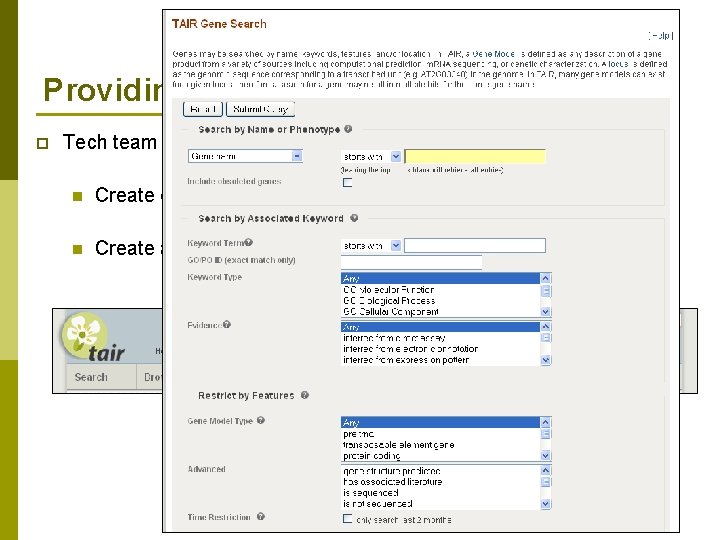
Providing Tools at TAIR p Tech team members and curators n Create quick search options n Create advanced search pages
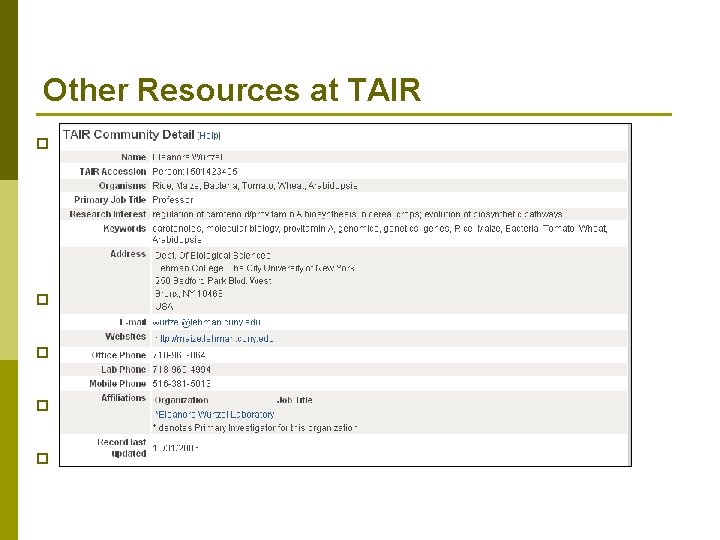
Other Resources at TAIR p Ordering system for the Arabidopsis Biological Resource Center n DNA stocks n Seed stocks p Community member information p Arabidopsis lab protocols p Gene Symbol Registry p Information Portals

Keeping up with TAIR p RSS feeds n n p Twitter n p Breaking news Plant biology jobs, graduate, and post-doc opportunities www. twitter. com/tair_news Facebook n http: //www. facebook. com/tairnews
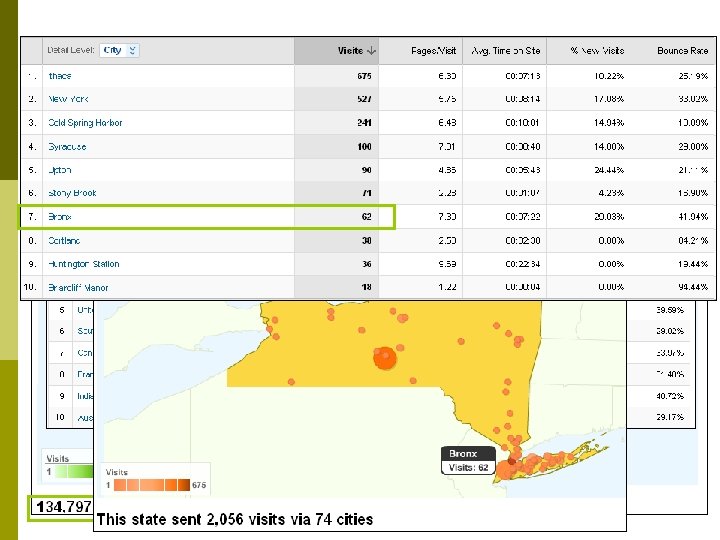
Who uses TAIR? (August 1 – September 1, 2010)
How can TAIR contribute to your work? p If you work on Arabidopsis. . . n n p Find specific information about individual genes and proteins Access large Arabidopsis-specific data sets If you work on another species. . . n n Take your gene / protein of interest and find all the data TAIR contains for its ortholog Look up your favorite: p biological process molecular function subcellular compartment organ or tissue developmental stage mutant phenotype p Indentify many related genes in TAIR and then find orthologs in your species p p p But. . . if you want more on plant metabolism. .
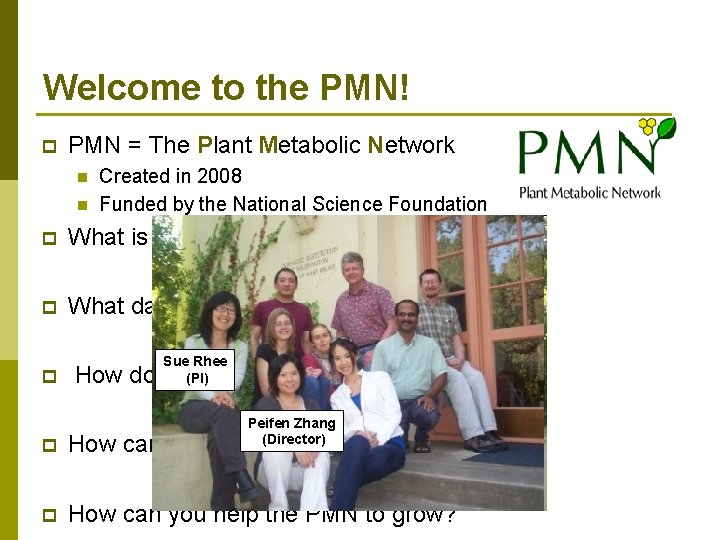
Welcome to the PMN! p PMN = The Plant Metabolic Network n n Created in 2008 Funded by the National Science Foundation p What is the PMN? p What data are in the PMN? p Sue Rhee (PI) How do data enter the PMN? Peifen Zhang (Director) p How can you use the PMN? p How can you help the PMN to grow?
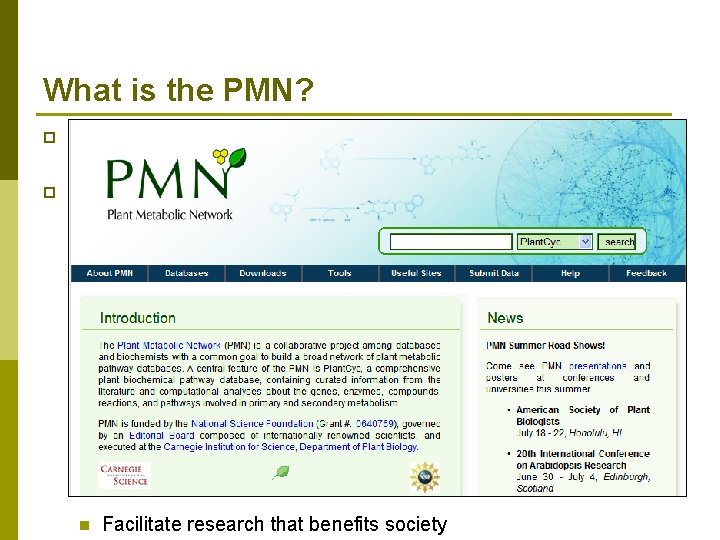
What is the PMN? p “A Network of Plant Metabolic Pathway Databases and Communities” p Major goals: n Create metabolic pathway databases to catalog all of the biochemical pathways present in specific species n Create Plant. Cyc – a comprehensive multi-plant pathway database n Create an automated pathway prediction “pipeline” n Create a website to bring together researchers working on plant metabolism p n PMN website: www. plantcyc. org Facilitate research that benefits society
Connecting the PMN to important research efforts n More nutritious foods p vitamin A biosynthesis, folate biosynthesis. . . n Medicines p morphine biosynthesis, taxol biosynthesis. . . n More pest-resistant plants p maackiain biosynthesis, capsidiol biosynthesis. . . n Higher photosynthetic capacity and yield in crops p chlorophyll biosynthesis, Calvin cycle. . . n Better biofuel feedstocks p cellulose biosynthesis, lignin biosynthesis. . . n Many additional applications relevant to rational metabolic engineering p ethylene biosynthesis, resveratrol biosynthesis. . .
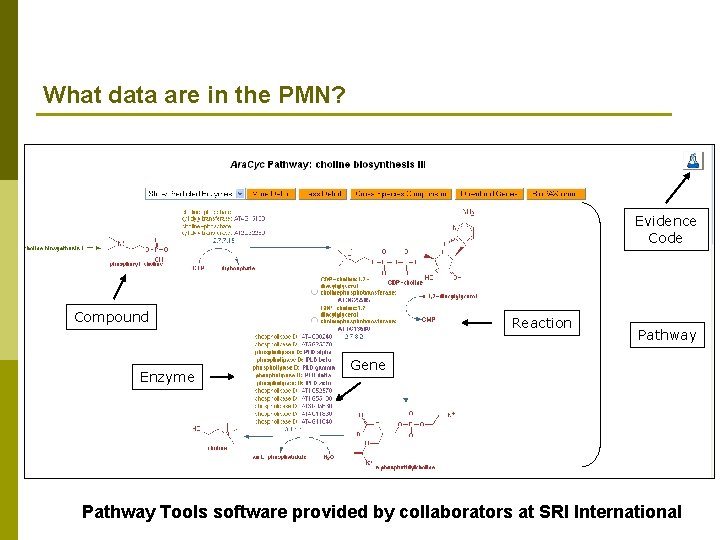
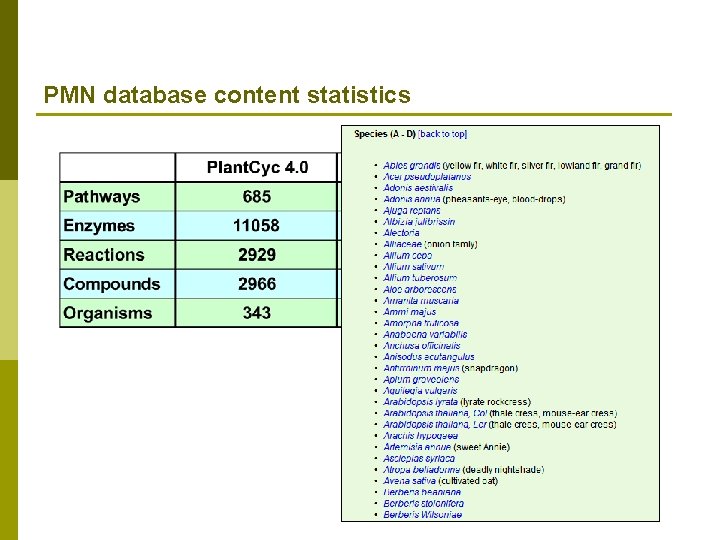
What data are in the PMN? Evidence Code Compound Enzyme Reaction Pathway Gene Pathway Tools software provided by collaborators at SRI International
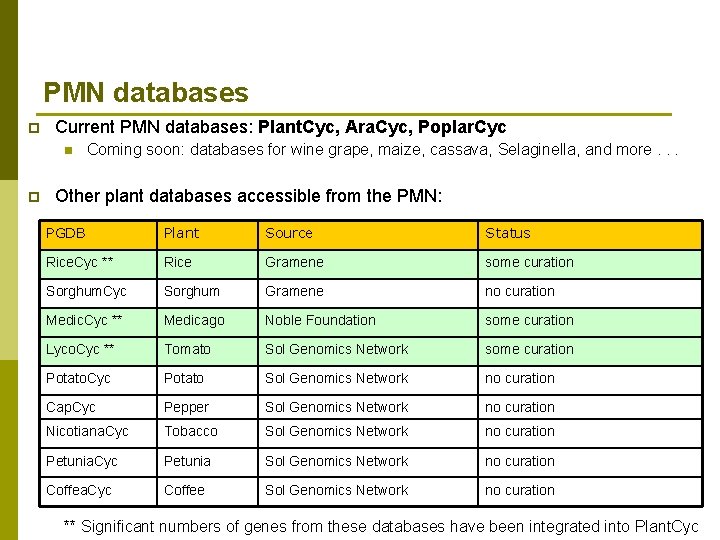
PMN databases p Current PMN databases: Plant. Cyc, Ara. Cyc, Poplar. Cyc n p Coming soon: databases for wine grape, maize, cassava, Selaginella, and more. . . Other plant databases accessible from the PMN: PGDB Plant Source Status Rice. Cyc ** Rice Gramene some curation Sorghum. Cyc Sorghum Gramene no curation Medic. Cyc ** Medicago Noble Foundation some curation Lyco. Cyc ** Tomato Sol Genomics Network some curation Potato. Cyc Potato Sol Genomics Network no curation Cap. Cyc Pepper Sol Genomics Network no curation Nicotiana. Cyc Tobacco Sol Genomics Network no curation Petunia. Cyc Petunia Sol Genomics Network no curation Coffea. Cyc Coffee Sol Genomics Network no curation ** Significant numbers of genes from these databases have been integrated into Plant. Cyc
PMN database content statistics
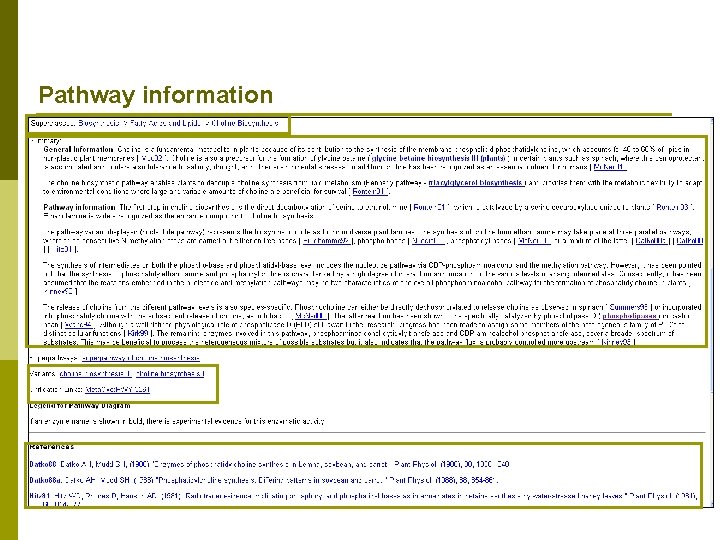
How does experimentally verified data enter the PMN? p Biocurators perform manual curation n Use journal articles to enter information n Receive helpful messages from researchers n Request specific data from experts n Invite editorial board members to review metabolic domains
Pathway information
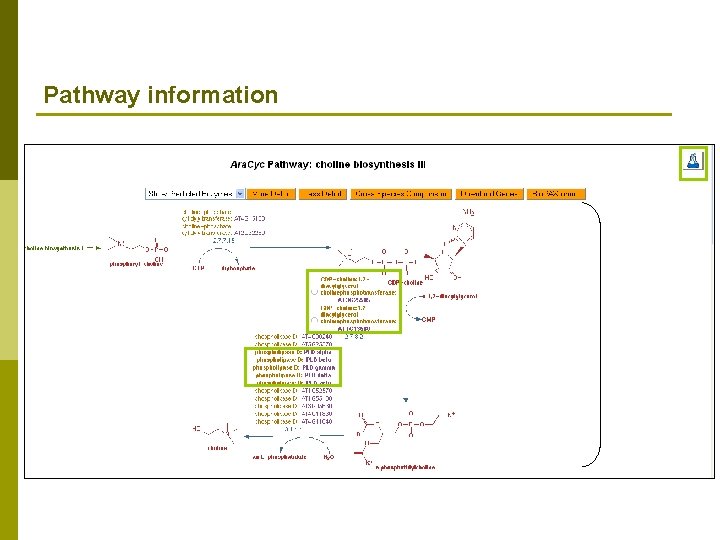
Pathway information
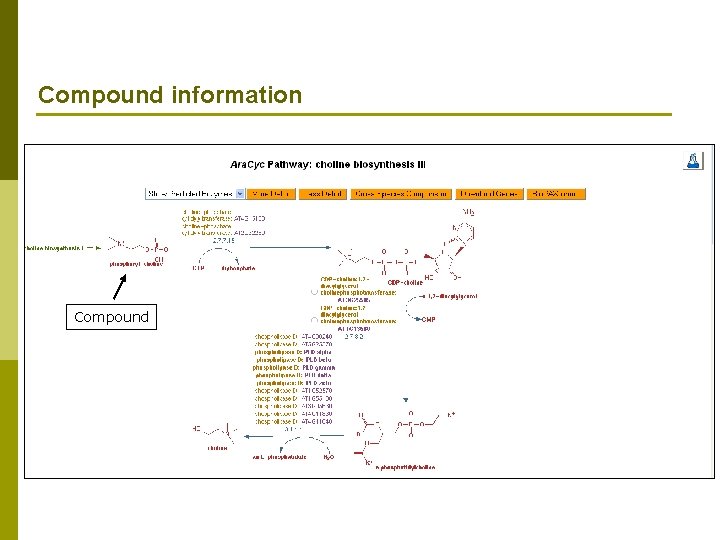
Compound information Compound
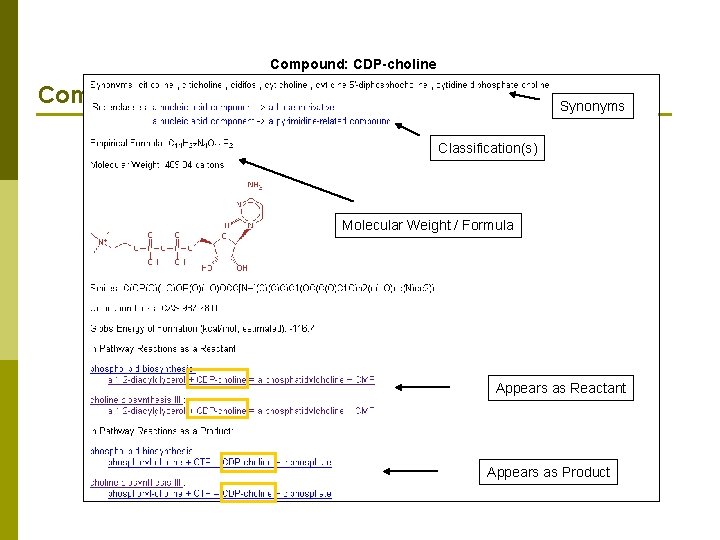
Compound: CDP-choline Compound information Synonyms Classification(s) Molecular Weight / Formula Appears as Reactant Appears as Product
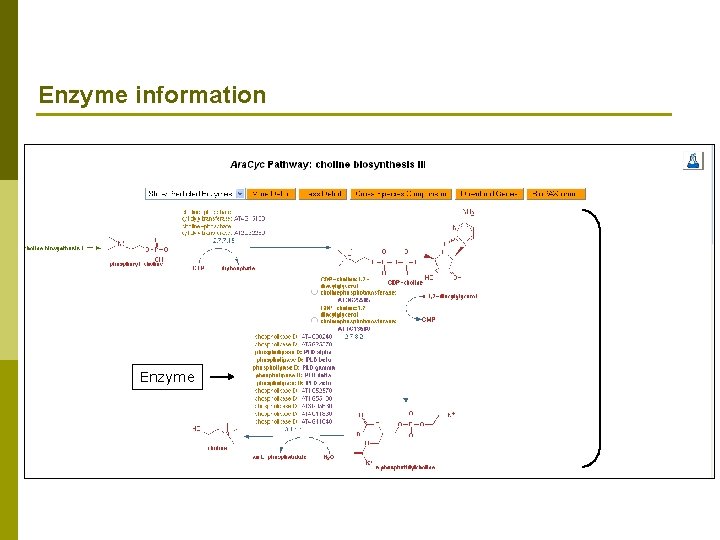
Enzyme information Enzyme
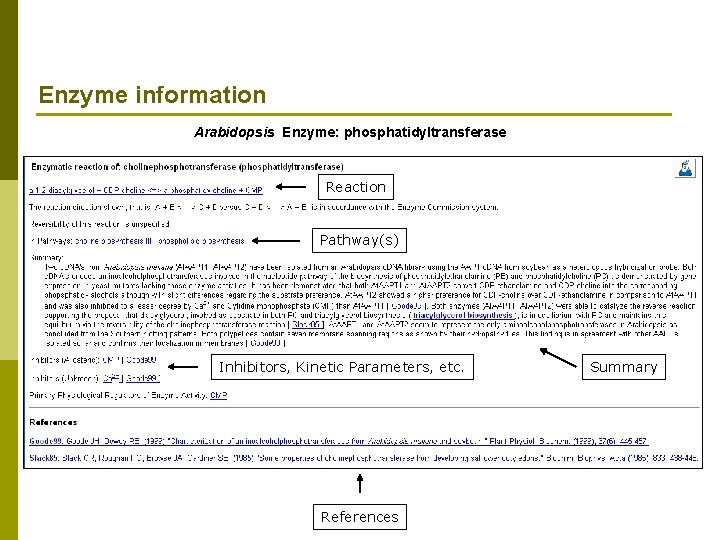
Enzyme information Arabidopsis Enzyme: phosphatidyltransferase Reaction Pathway(s) Inhibitors, Kinetic Parameters, etc. References Summary
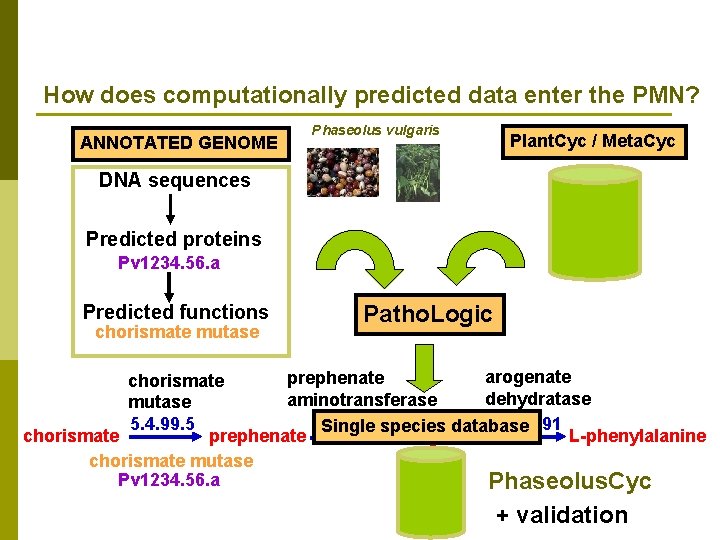
How does computationally predicted data enter the PMN? ANNOTATED GENOME Phaseolus vulgaris Plant. Cyc / Meta. Cyc DNA sequences Predicted proteins Pv 1234. 56. a Predicted functions chorismate mutase Patho. Logic arogenate prephenate chorismate dehydratase aminotransferase mutase 5. 4. 99. 5 4. 2. 1. 91 2. 6. 1. 79 Single species database chorismate prephenate L-arogenate L-phenylalanine chorismate mutase Pv 1234. 56. a Phaseolus. Cyc + validation
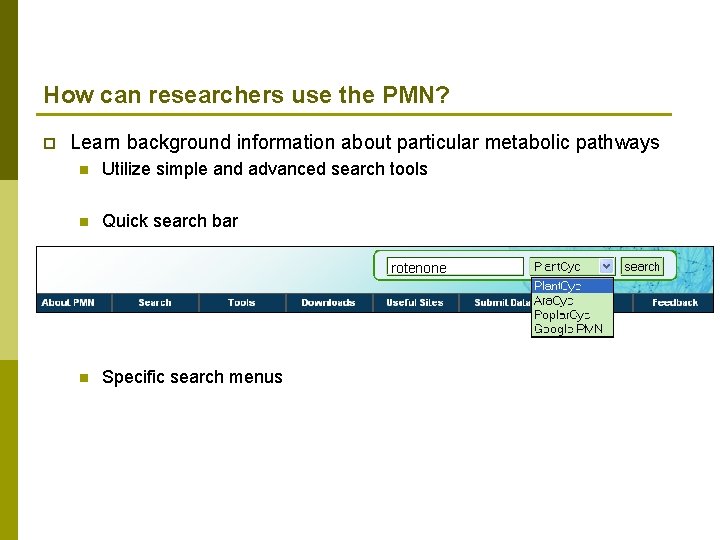
How can researchers use the PMN? p Learn background information about particular metabolic pathways n Utilize simple and advanced search tools n Quick search bar rotenone n Specific search menus
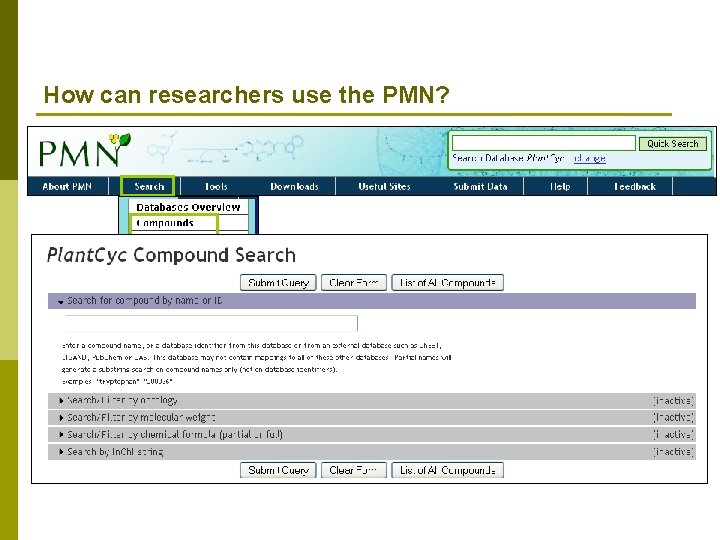
How can researchers use the PMN?
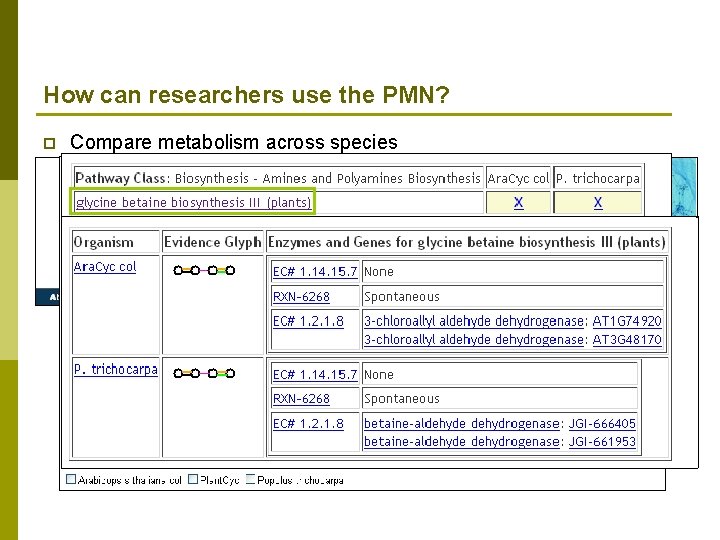
How can researchers use the PMN? p Compare metabolism across species
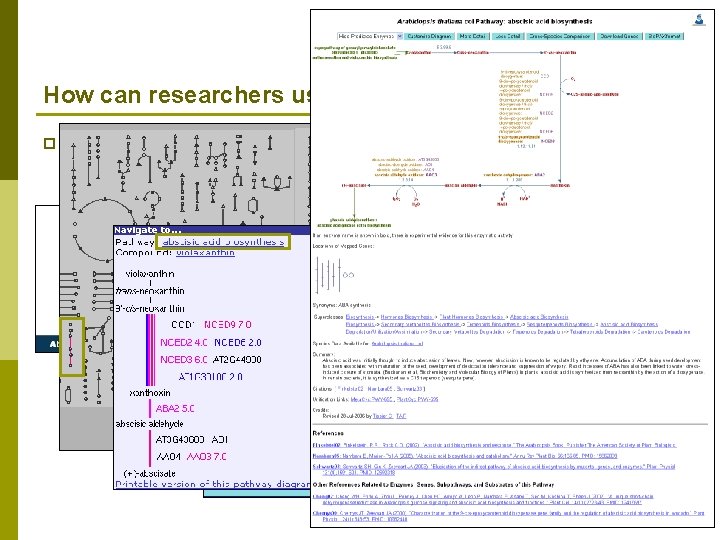
How can researchers use the PMN? p Examine OMICs data in a metabolic context n Look at changes in transcript expression following 2 days of drought stress
How will the PMN grow in the future? p Help from the research community!!! p You are the experts with great knowledge to share!
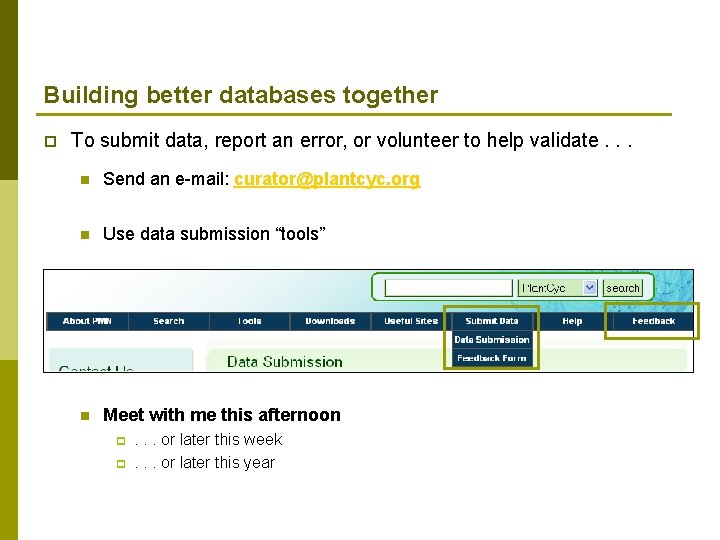
Building better databases together p To submit data, report an error, or volunteer to help validate. . . n Send an e-mail: curator@plantcyc. org n Use data submission “tools” n Meet with me this afternoon p p . . . or later this week. . . or later this year
Building better databases together n Details are very, very welcome!! p Reactions: § All co-factors, co-substrates, etc. § EC suggestions – partial or full p Compounds § Structure – visual representation / compound file (e. g. mol file) § Synonyms § Unique IDs (e. g. Ch. EBI, CAS, KEGG) p Enzymes § Unique IDs (e. g. At 2 g 46480, Uni. Prot, Genbank) § Specific reactions catalyzed
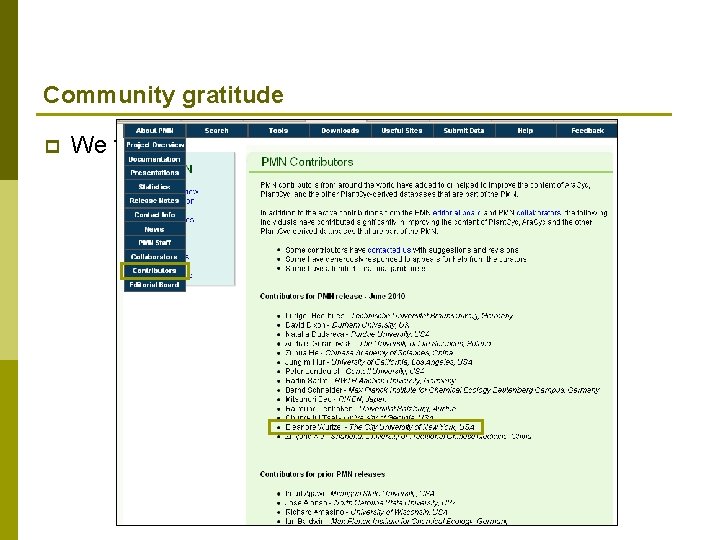
Community gratitude p We thank you publicly!
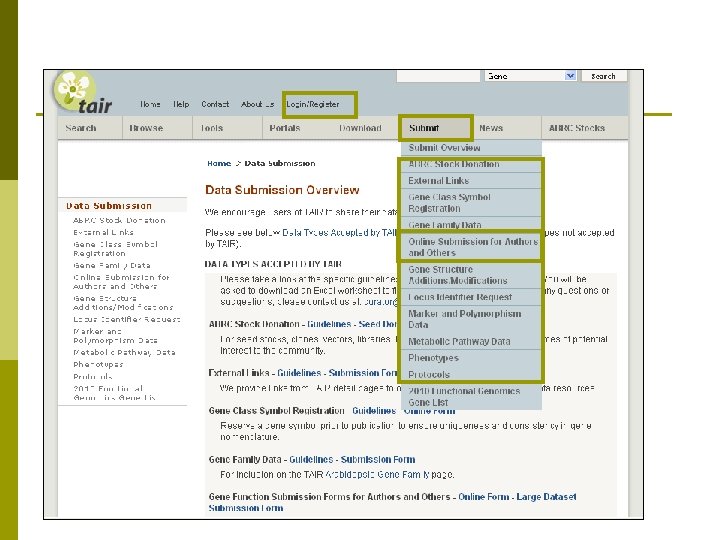
TAIR would like help, too!
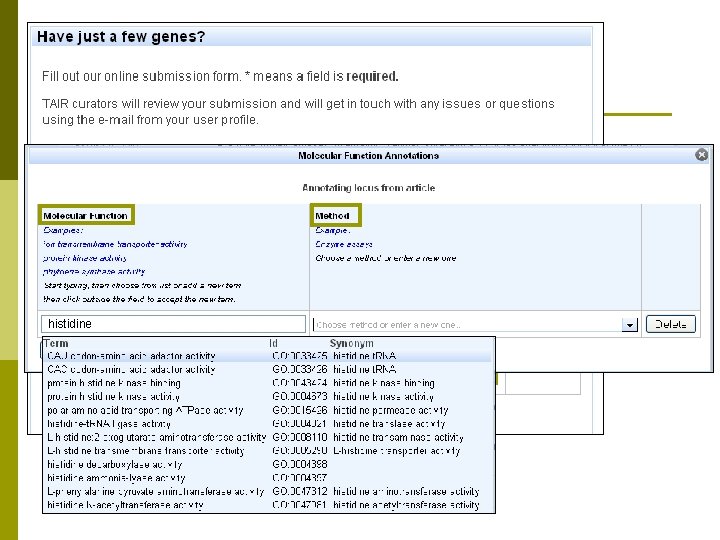
histidine
Biological networking. . . p Please use our data p Please use our tools p Please help us to improve our databases! p Please contact us if we can be of any help! curator@arabidopsis. org curator@plantcyc. org www. arabidopsis. org www. plantcyc. org
TAIR and PMN Acknowledgements Sue Rhee (PI - PMN) Eva Huala (PI-TAIR) Peifen Zhang (Director-PMN) Current Curators: -Tanya Berardini (lead curator) - Philippe Lamesch (lead curator) - Donghui Li (curator) - Dave Swarbreck (former lead curator) - Debbie Alexander (curator) - A. S. Karthikeyan (curator) - Marga Garcia (curator) - Leonore Reiser PMN Collaborators: - Peter Karp (SRI) - Ron Caspi (SRI) - Suzanne Paley (SRI) - SRI Tech Team - Lukas Mueller (SGN) - Anuradha Pujar (SGN) - Gramene and Medic. Cyc Current Tech Team Members: - Bob Muller (Manager) - Larry Ploetz (Sys. Administrator) - Anjo Chi - Raymond Chetty - Cynthia Lee - Shanker Singh - Chris Wilks PMN project post-doc - Lee Chae
Biological networking. . . p Please use our data p Please use our tools p Please help us to improve our databases! p Please contact us if we can be of any help! curator@arabidopsis. org curator@plantcyc. org www. arabidopsis. org www. plantcyc. org
Out-takes p The following slides are relevant but were removed from the presentation due to time constraints curator@arabidopsis. org curator@plantcyc. org www. arabidopsis. org www. plantcyc. org
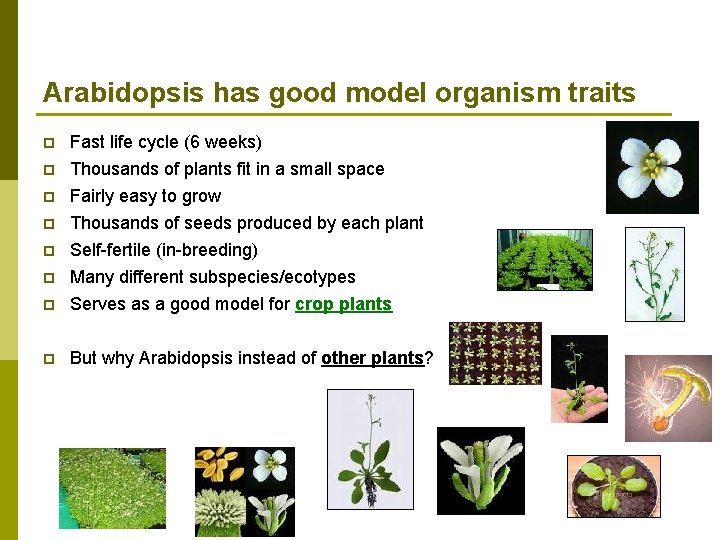
Arabidopsis has good model organism traits p Fast life cycle (6 weeks) Thousands of plants fit in a small space Fairly easy to grow Thousands of seeds produced by each plant Self-fertile (in-breeding) Many different subspecies/ecotypes Serves as a good model for crop plants p But why Arabidopsis instead of other plants? p p p
Arabidopsis data explosion p p TONS of data are generated about Arabidopsis n Over 2400 “Arabidopsis” articles published each year are indexed in Pub. Med n Tens of thousands of mutants have been generated n Hundreds of microarray experiments have been performed n Proteomics and metabolomics studies are becoming popular n “ 1001” Arabidopsis genomes are being sequenced n Large-scale phenotypic studies are scheduled to start soon TAIR tries to bring data together to benefit scientists and society
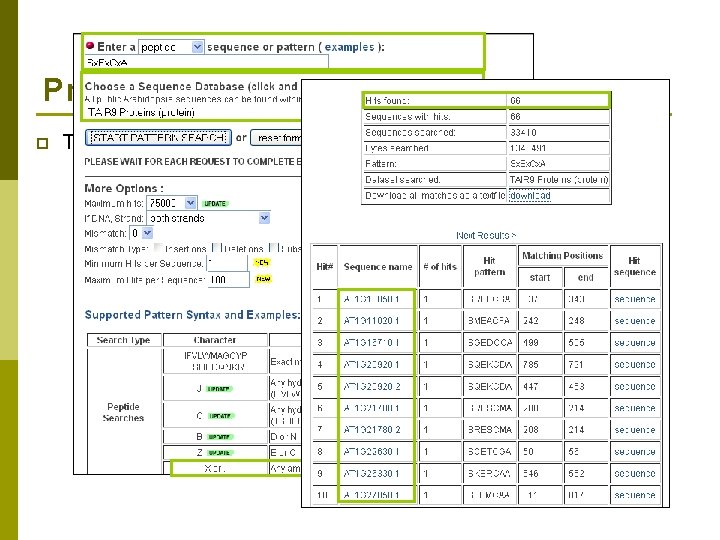
Providing Tools at TAIR p Tech team members and curators n Develop new tools and modify existing tools p Seq. Viewer p Patmatch
What data are in the PMN? p Plants provide crucial benefits to the ecosystem and humanity p A better understanding of plant metabolism may contribute to: n n n n p More nutritious foods New medicines More pest-resistant plants Higher photosynthetic capacity and yield in crops Better biofuel feedstocks Improved industrial inputs (e. g. oils, fibers, etc. ) Enhanced ability to do rational metabolic engineering. . . many more applications How can the PMN help?
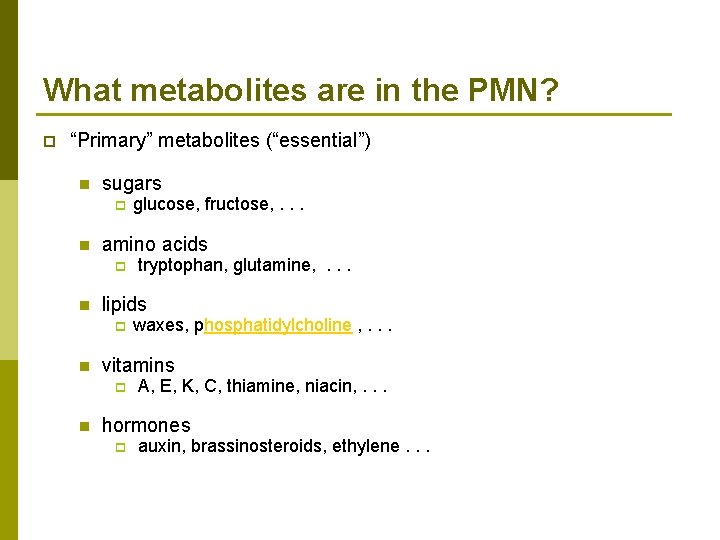
What metabolites are in the PMN? p “Primary” metabolites (“essential”) n sugars p n amino acids p n waxes, phosphatidylcholine , . . . vitamins p n tryptophan, glutamine, . . . lipids p n glucose, fructose, . . . A, E, K, C, thiamine, niacin, . . . hormones p auxin, brassinosteroids, ethylene. . .
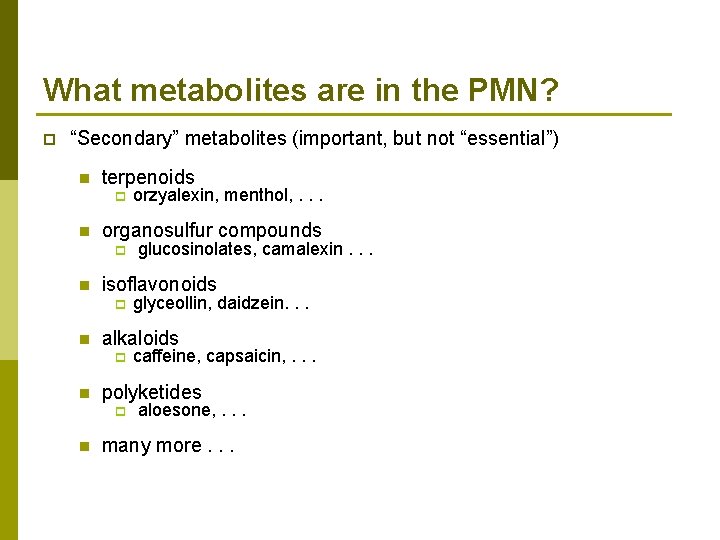
What metabolites are in the PMN? p “Secondary” metabolites (important, but not “essential”) n terpenoids p n organosulfur compounds p n caffeine, capsaicin, . . . polyketides p n glyceollin, daidzein. . . alkaloids p n glucosinolates, camalexin. . . isoflavonoids p n orzyalexin, menthol, . . . aloesone, . . . many more. . .
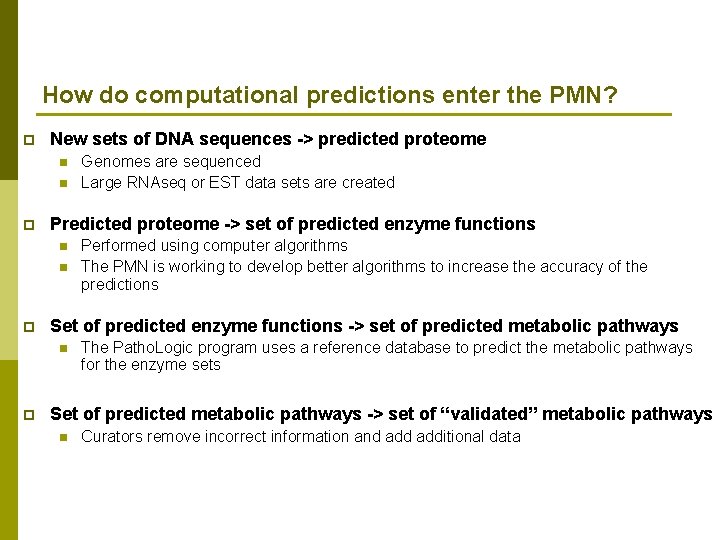
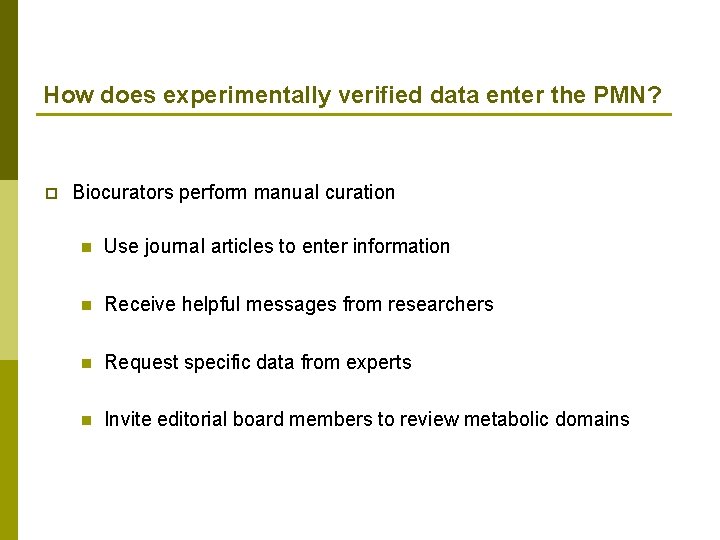
How do computational predictions enter the PMN? p New sets of DNA sequences -> predicted proteome n n p Predicted proteome -> set of predicted enzyme functions n n p Performed using computer algorithms The PMN is working to develop better algorithms to increase the accuracy of the predictions Set of predicted enzyme functions -> set of predicted metabolic pathways n p Genomes are sequenced Large RNAseq or EST data sets are created The Patho. Logic program uses a reference database to predict the metabolic pathways for the enzyme sets Set of predicted metabolic pathways -> set of “validated” metabolic pathways n Curators remove incorrect information and additional data
- Slides: 68