
BIOCONVERSION TECHNOLOGIES OF ANIMAL CELL AND PLANT CULTURE
BIOCONVERSION TECHNOLOGIES OF ANIMAL CELL AND PLANT CULTURE SALEHA SHAMSUDIN 0132081261
Considerations in Using Animal Cell Culture (Chapter 12) a) Structure and biochemistry of animal cells b) Methods used for the cultivation of animal cells c) Products of animal cell cultures

Eukaryotes: Animal cells are eukaryotic cells, or cells with a membrane-bound nucleus that makes up many tissues in animals. . contain other membrane-bound organelles, or tiny cellular structures, that carry out specific functions necessary for normal cellular operation.
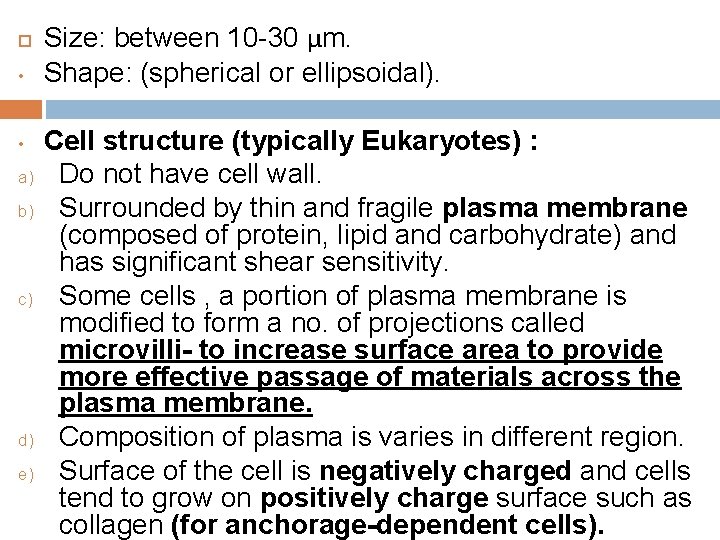
• • a) b) c) d) e) Size: between 10 -30 μm. Shape: (spherical or ellipsoidal). Cell structure (typically Eukaryotes) : Do not have cell wall. Surrounded by thin and fragile plasma membrane (composed of protein, lipid and carbohydrate) and has significant shear sensitivity. Some cells , a portion of plasma membrane is modified to form a no. of projections called microvilli- to increase surface area to provide more effective passage of materials across the plasma membrane. Composition of plasma is varies in different region. Surface of the cell is negatively charged and cells tend to grow on positively charge surface such as collagen (for anchorage-dependent cells).

Structure of animal cell Inside the cytoplasm is an extensive network of membrane-bounded organelles

Structure and function of organelles Organelles Function Nucleus • Regulate synthesis of proteins in cytoplasm through m. RNA • Nucleolus- site of ribosome synthesis • Chromosome: nuclear material (DNA) and some dark granular structures called nucleoli Plasma membrane • selectively permeable to ions and organic molecules and controls the movement of substances in and out of cells Smooth Endoplasmic reticulum • Lipid synthesis Rough endoplasmic reticulum • Critical in protein synthesis and post-translational modification to form a mature protein Mitochondria (Power house of cell) • • Site of respiration and production of ATP. Independent organelles in cytoplasma containing DNA Capable of independent reproduction Surrounded by a double membrane: (1 )smooth outer membrane; (2) highly folded inner membrane (cristae)
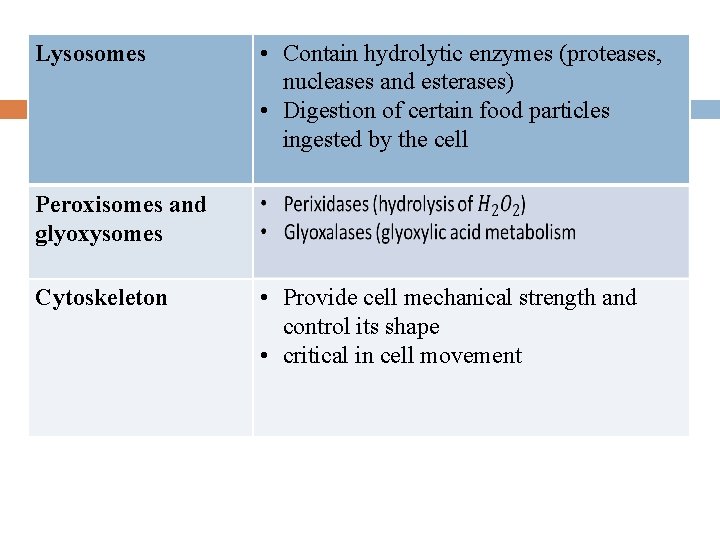
Lysosomes • Contain hydrolytic enzymes (proteases, nucleases and esterases) • Digestion of certain food particles ingested by the cell Peroxisomes and glyoxysomes Cytoskeleton • Provide cell mechanical strength and control its shape • critical in cell movement

Characteristic of animal cell Some animal cells are non-anchorage dependent and grow in suspension culture. Has cytoskeleton or system of protein filaments (actin filaments, intermediate filaments and microtubules)-provide cell mechanical strength, control shape and guide cell movement. Some animal cells contain cilia- used to transport substrate across the cell surface.
Typical growth media culture contains glucose, glutamine, non-essential and essential amino acids, serum (horse or calf), mineral salts (e. g: DME, Dulbecco’s Modified Eagle’s media)
Major metabolic pathways for animal cell in culture (Figure 12. 2)

• Glucose is converted to pyruvate by glycolysis and biomass synthesis through the pentose phosphate pathway. • Pyruvate is converted partly to CO 2 and H 2 O by the TCA cycle, partly to lactic acids and partly to fatty acids. • Part of glutamine is deaminated to yield ammonium and glutamate, which is converted to amino acids to biosynthesis purposes. • Glutamine also enters into the TCA cycle to yield carbon skeletons for other amino acids and to yield ATP, CO 2 and H 2 O. • The release of lactate and ammonia as waste products of metabolisme (toxic to cells) is a problems to high-cell density culture systems.

Methods Used for The Cultivation of Animal Cells
Differ significantly from those used with bacteria, yeast and fungi. Prymary culture: ØTissue excised from specific organs of animal such as lung and kidney, under aseptic conditions are transferred into a growth medium containing serum and small amount of antibiotics in small Tflasks. ØThese cells form primary culture and do not normally form aggregate. ØGrow in the form of monolayer on support surface such as glass surface or flasks. ØUsing the proteolytic enzyme trypsin, individual cells in a tissue can be separated to form single-
Steps in animal cells culture 1)Excised tissues are cut into small pieces (~ 2 mm 3) 2)Placed in an agitated flask containing dilute solution of trypsin (~0. 25% w/v) in buffered saline for 120 min at 37°C 3)The cell suspension is passed through a presterilized filter to clear the solution 4)Cell are washed in the centrifuged 5)Cells are re-suspended in growth medium 6)Placed in T-flasks or roller bottles 7)Cell attach to glass surface and form monolayer

Anchorage-dependent cells : Cells growing on support surfaces Nonanchorage-dependent cells : Cells grow in suspension culture Primary culture: The cells that directly derived from excised tissues Secondary culture: A cell line obtained from the primary culture

Step for removing cell 1. 2. 3. 4. 5. Removal solution for cells : EDTA, TRYPSIN, COLLAGENASE OR PRONASE. The exposure time for cell removal : 5 -30 min (37°C). After cells are removed from surfaces, serum is added to the culture bottle. The serum-containing suspension is centrifuged, washed with buffered isotonic saline solution and used to inoculate secondary culture. Secondary lines can be adapted to grow in suspension.

Mamalian cells are divided by Normal (mortal) and immortal (continuous/transformed). Normal: Divide only for limited of generation (30 generations) Transformed: Can be propagated indefinitely

Characteristic: Contact inhibition: cell division is inhibited when cell’s surface is in contact with other cell No contact inhibition: the cells do not sense the presence of other cells and keep dividing
The culture of Hybridoma Cell are called hybridomas and can be ØProgeny propagated indefinitely, can secrete highly specific antibodies againts antigen. ØObtained by fusing lymphocytes (normal blood cells that make antibodies) with myeloma (cancer) cells. ØLymphocytes producing antibodies grow slowly and are mortal. ØAfter fusion with myeloma cells, hybridomas become immortal, can reproduce and produce antibodies.
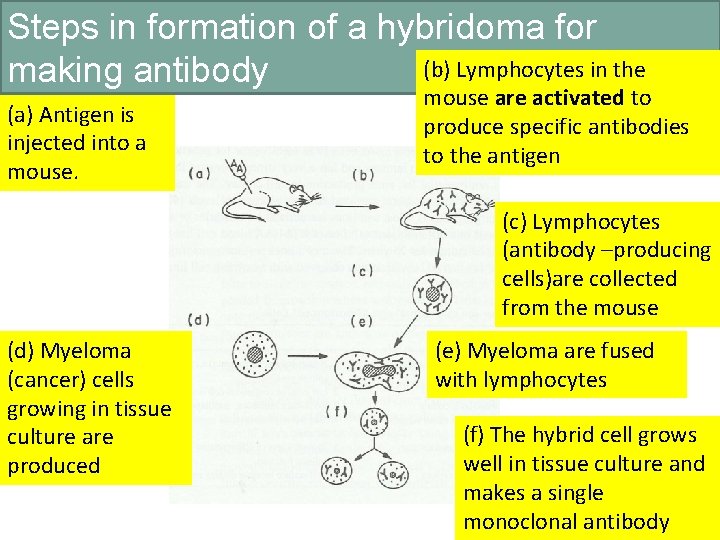
Steps in formation of a hybridoma for (b) Lymphocytes in the making antibody (a) Antigen is injected into a mouse are activated to produce specific antibodies to the antigen (c) Lymphocytes (antibody –producing cells)are collected from the mouse (d) Myeloma (cancer) cells growing in tissue culture are produced (e) Myeloma are fused with lymphocytes (f) The hybrid cell grows well in tissue culture and makes a single monoclonal antibody
Serum ØA typical growth medium for mammalian cells contains serum (5 -20%), inorganic salts, carbon and energy sources, vitamins, trace elements, growth factor and buffer in water. ØSerum is a cell-free liquid recovered from blood (FBS-fetal bovine serum; CS-calf serum; HS-horse serum) ØSerum is known to contain amino acids, growth factors, vitamins, certain protein, hormones, lipids and minerals.
Serum’s function: 1. To stimulate cell growth and other cell activities by hormone and growth factors 2. To enhance cell attachment by certain proteins such as collagen and fibronectin 3. To provide transport proteins carrying hormones, minerals and lipids
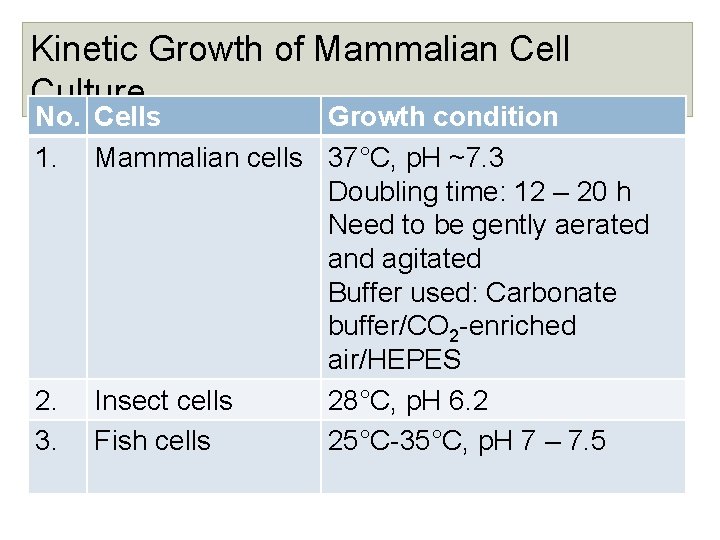
Kinetic Growth of Mammalian Cell Culture No. Cells Growth condition 1. Mammalian cells 37°C, p. H ~7. 3 Doubling time: 12 – 20 h Need to be gently aerated and agitated Buffer used: Carbonate buffer/CO 2 -enriched air/HEPES 2. Insect cells 28°C, p. H 6. 2 3. Fish cells 25°C-35°C, p. H 7 – 7. 5
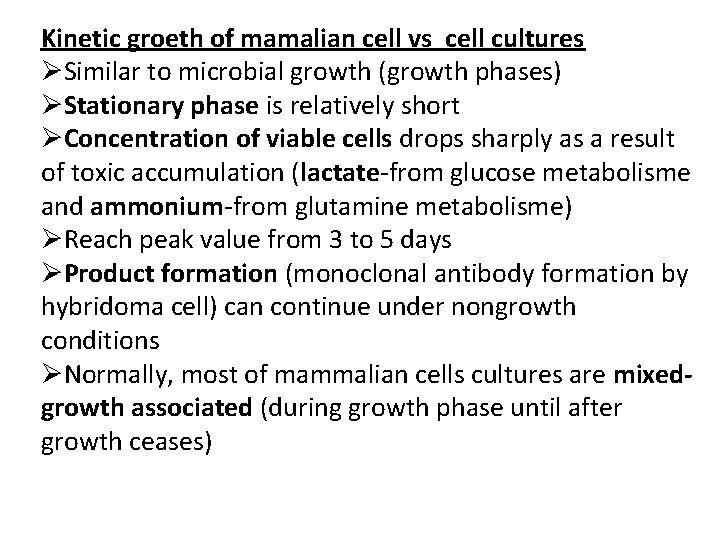
Kinetic groeth of mamalian cell vs cell cultures ØSimilar to microbial growth (growth phases) ØStationary phase is relatively short ØConcentration of viable cells drops sharply as a result of toxic accumulation (lactate-from glucose metabolisme and ammonium-from glutamine metabolisme) ØReach peak value from 3 to 5 days ØProduct formation (monoclonal antibody formation by hybridoma cell) can continue under nongrowth conditions ØNormally, most of mammalian cells cultures are mixedgrowth associated (during growth phase until after growth ceases)


Products of Animal Cell Cultures

ØConsists of high-molecular-weight proteins with or without glycosidic groups ØThere are enzymes, hormons, vaccines, immunobiologicals (monoclonal antibodies, regulators-lymphokines, virus vaccines), anticancer agents etc.
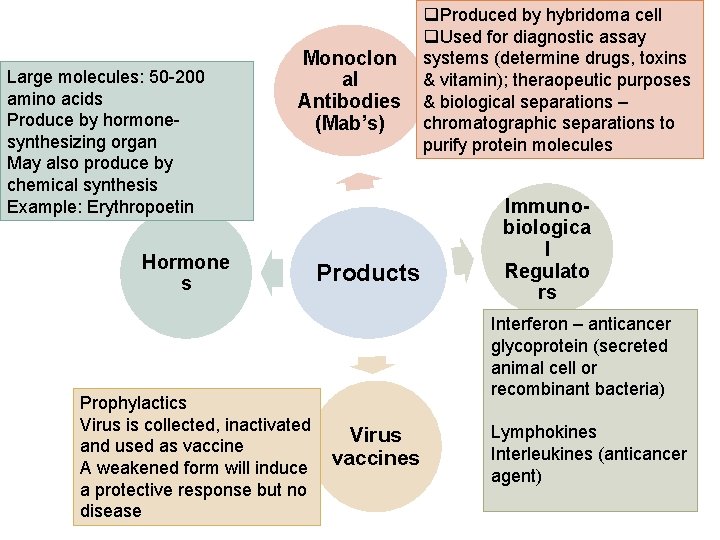
Large molecules: 50 -200 amino acids Produce by hormonesynthesizing organ May also produce by chemical synthesis Example: Erythropoetin Hormone s Monoclon al Antibodies (Mab’s) Products Prophylactics Virus is collected, inactivated Virus and used as vaccines A weakened form will induce a protective response but no disease q. Produced by hybridoma cell q. Used for diagnostic assay systems (determine drugs, toxins & vitamin); theraopeutic purposes & biological separations – chromatographic separations to purify protein molecules Immunobiologica l Regulato rs Interferon – anticancer glycoprotein (secreted animal cell or recombinant bacteria) Lymphokines Interleukines (anticancer agent)
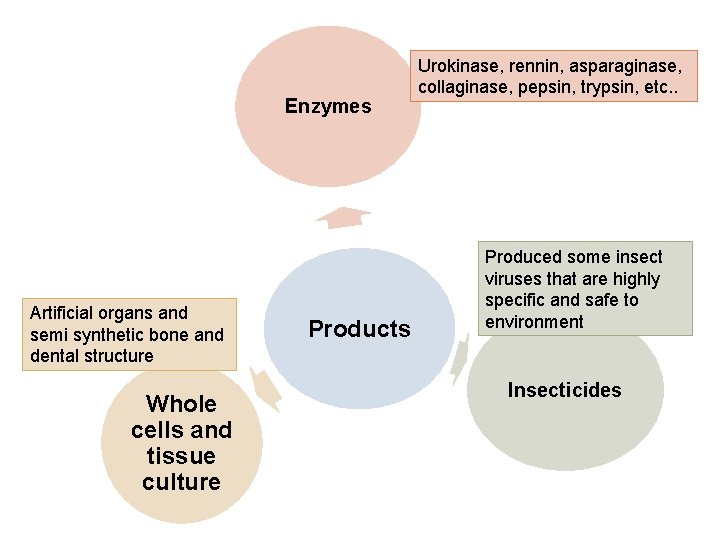
Enzymes Artificial organs and semi synthetic bone and dental structure Whole cells and tissue culture Products Urokinase, rennin, asparaginase, collaginase, pepsin, trypsin, etc. . Produced some insect viruses that are highly specific and safe to environment Insecticides

Considerations in Using Plant Cell Culture (Chapter 13) a) The importance and advantages of plant cell culture b) Plant cells in culture compare to microbes c) Methods used for the cultivation of plant cells Economics of plant cell tissue culture
Many thousands of chemicals are produced only in plant. The great genetic potential of plants to produced compounds has been little exploited and the rapid destruction of forest leading to the extinction of many plants.

ADVANTAGES OF PLANT TISSUE CULTURE OVER CONVENTIONAL AGRICULTURAL PRODUCTION In vitro grown plants is independent of geographical variations, seasonal variations and also environmental factors, therefore it offers a defined production system, continuous supply of products with uniform quality and yield. Novel compounds which are not generally found in the parent plants can be produced in the in vitro grown plants through plant tissue culture. Stereo- and region- specific biotransformation of the plant cells can be performed for the production of bioactive compounds from economical precursors.
Plant products can be classified into: primary plant metabolites essential for the survival of the plant. It consists of sugars, amino acids and nucleotides synthesized by plants and are used to produce essential polymers secondary metabolites the chemicals, which are NOT directly involved in the normal growth and development, or reproduction of an organism. Secondary metabolites are not indispensable for the plants but play a significant role in plant defense mechanisms
Advantages of Plant Cell Culture for Production of Secondary Metabolites Primary metabolites essentially provide the basis for normal growth and reproduction, while secondary metabolites for adaptation and interaction with the environment. The economic importance of secondary metabolites lies in the fact that they can be used as sources of industrially important natural products like colours, insecticides, antimicrobials, fragrances and therapeutics. Therefore, plant tissue culture is being potentially used as an alternative for plant secondary metabolite production. Majority of the plant secondary metabolites of interest to humankind fit into categories which categorize secondary metabolites based on their biosynthetic origin. Secondary metabolism in plants is activated / created only in particular stages of growth and development or during periods of stress, limitation of nutrients or attack by micro-organisms.
Plants produce several bioactive compounds that are of importance in the healthcare, food, flavor and cosmetics industries. Many pharmaceuticals are produced from the plant secondary metabolites. Currently, many natural products are produced solely from massive quantities of whole plant parts. The source plants are cultured in tropical, subtropical, geographically remote areas, which are subject to drought,
- Plant cell cultures are maintained under controlled environmental and nutritional conditions which ensure the continuous yields of metabolites. - Culture of cell may be more economical for those plants which take long periods to achieve maturity (E. g. Papaver bracteatum, the source of the banine , takes two to three seasons to reach maturity).

Steps involved in the production of secondary metabolites from plant cell
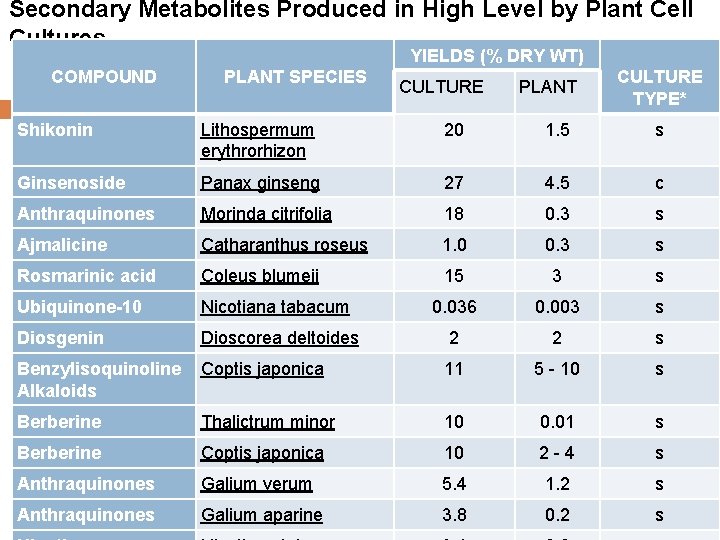
Secondary Metabolites Produced in High Level by Plant Cell Cultures YIELDS (% DRY WT) COMPOUND PLANT SPECIES CULTURE PLANT CULTURE TYPE* Shikonin Lithospermum erythrorhizon 20 1. 5 s Ginsenoside Panax ginseng 27 4. 5 c Anthraquinones Morinda citrifolia 18 0. 3 s Ajmalicine Catharanthus roseus 1. 0 0. 3 s Rosmarinic acid Coleus blumeii 15 3 s Ubiquinone-10 Nicotiana tabacum 0. 036 0. 003 s Diosgenin Dioscorea deltoides 2 2 s Benzylisoquinoline Alkaloids Coptis japonica 11 5 - 10 s Berberine Thalictrum minor 10 0. 01 s Berberine Coptis japonica 10 2 - 4 s Anthraquinones Galium verum 5. 4 1. 2 s Anthraquinones Galium aparine 3. 8 0. 2 s
Plant Cell Culture Plasmodesmata (small pores that linked each cell together)-whole plant are connected to one another by Plasmodesmata. Important for cell-to-cell communication. Allow interchange of lower molecular weight compounds from cytoplasm of one cell to another by diffusion. In large aggregate, there will be concentration gradients of such metabolic products (ethylene) , nutrients(like O 2, hormone). As a result, cells in different position in aggregate may have greatly different biochemical and morphological structure. Cells in suspension can be made to undergo differentiation and organization if correct environmental condition can be formed. (so that adjustment levels of nutrients and hormone should be made). Embryos, shoots and roots can made from aggregates in
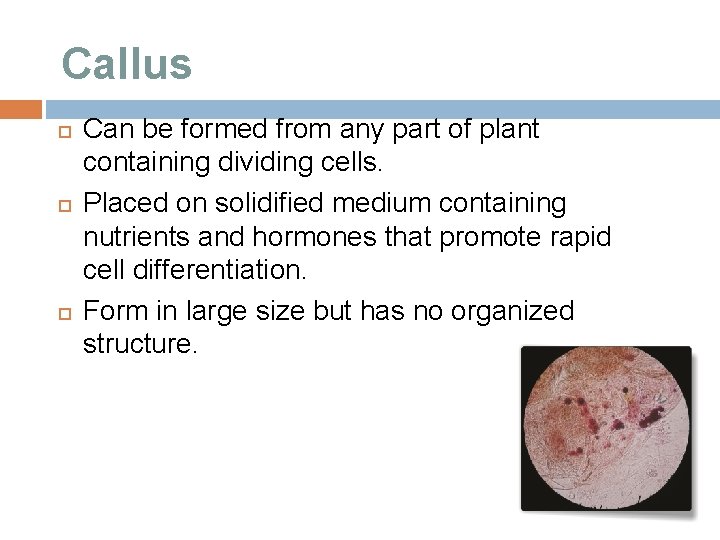
Callus Can be formed from any part of plant containing dividing cells. Placed on solidified medium containing nutrients and hormones that promote rapid cell differentiation. Form in large size but has no organized structure.
Suspension Culture Established from the friable(easily breaks into small pieces) callus which is placed in liquid medium in shake flask. With gentle to moderate agitation , cells or small aggregate of cells slough off at 27°C with p. H 5. 5 under dark condition, then replicate. After 2 or 3 weeks the, suspended cells then transferred to fresh medium, residual culture are discarded.
Method 1 - Callus Culture § Callus is explants that cultured on the appropriate medium, with auxin and a cytokinin, give rise to an unorganised, growing and dividing mass of cells. § Any plant tissue that have dividing cells can be used as an explant. § Exercised plant material is placed on solidified medium containing nutrients and hormones that promote rapid cell differentiation. § Callus forms can be quite large (>1 cm) (Shuler and Kargi, 2002).
Method 2 - Suspension Culture § Callus culture is then transferred into liquid medium to establish suspension culture, which is place on shaker to supply the cells with sufficient oxygen. § With moderate agitation, cells or small aggregates of cells will slough off. § A platform shaker is used to give a circular motion in a viable speed control (30 -150 rpm) (Shuler and Kargi, 2002). § Callus culture is performed in the dark (27°C & p. H 5. 5) as light can encourage differentiation of the callus (Shuler and Kargi, 2002).
Plant Cells in Culture Compared to Microbes

Assignment : Compare Plant Cell Culture and Microbes Culture. Aspect Degree of cellular aggregation Biochemical growth Microbial Culture Usually single cell Typically, cell initially adjust to new medium (lag phase) till they start dividing regularly (log phase). When growth limited, cells stop dividing (stationary phase), eventually show loss of viability (death phase). Plant Cell Culture Usually aggregates
Types of culture media
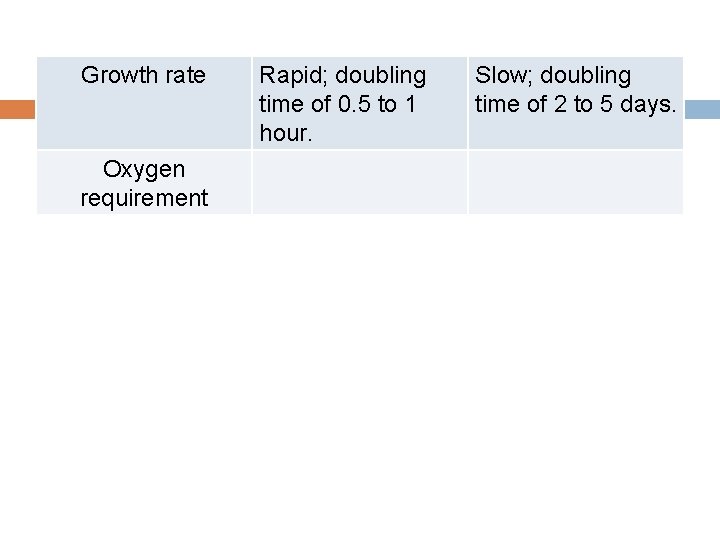
Growth rate Oxygen requirement Rapid; doubling time of 0. 5 to 1 hour. Slow; doubling time of 2 to 5 days.

END
- Slides: 48