
BIOCHEMISTY Course No DTC111 BINITA RANI ASSOCIATE PROFESSOR

BIOCHEMISTY Course No. -DTC-111, BINITA RANI ASSOCIATE PROFESSOR (DAIRY CHEMISTRY) FACULTY OF DAIRY TECHNOLOGY S. G. I. D. T. , BVC CAMPUS, P. O. - BVC, DIST. -PATNA-800014 Credit Hours – 2 (1+1) REGULATORY ENZYMES
A regulatory enzyme => an enzyme in a biochemical pathway which => through its responses to the presence of certain other bio-molecules => regulates the pathway's activity. Ø This is usually done for => pathways whose products may be needed in different amounts at different times => such as hormone production. Ø Regulatory enzymes are usually the enzymes => that are rate-limiting or committed step => in a pathway => meaning that after this step => a particular reaction pathway will go to completion.
Ø Regulatory enzymes are => near initial steps in a pathway, or part of a branch point or cross-over point between pathways (where a metabolite can be potentially converted into several products in different pathways). Ø In general => a cell needs to conserve energy => therefore costly (in metabolic terms) biosynthetic reaction pathways will not be operational => unless a particular metabolite is required at a given time. Ø Regulatory enzymes control => overall quantities of enzyme or concentration of substrates present or => lead to alteration of catalytic efficiency of the enzyme.
Types of Regulatory Enzymes : Regulatory enzymes are of two types • Allosteric enzymes • Covalently modulated enzymes.
Allosteric enzymes Allosteric means => an additional space/site to => active site where => modulator (effector) molecule => interacts with enzyme. • So allosteric enzymes have => additional site to active site where modulator interacts. • The rates of enzyme-catalyzed reactions in biological systems are altered by => activators and inhibitors, collectively known as => effect or molecules or modulators. • Interaction of modulator with enzyme is => reversible and non-covalent. • Allosteric enzymes generally => have two or more polypeptides and are => more complex than non regulatory enzymes.
Ø In allosteric enzymes => binding of a substrate molecule to one active site => affects binding of other molecules of substrate => to other active sites in the enzyme. Ø Thus different active sites behave => cooperatively. Ø Allosteric enzymes are => multi-subunit proteins => with one or more active sites on each subunit. Ø Binding of substrate at one active site induces => a conformational change in the protein => that is conveyed to other active sites => altering their affinity for substrate molecules.
Ø A plot of V 0 against (S) for allosteric enzyme gives => a sigmoidal curve rather than the hyperbolic plots predicted by => Michaelis-Menten equation for non-regulatory enzymes. Ø The sigmoidicity is thought to result from => cooperativity of structural changes between enzyme subunits (again similar to oxygen binding to hemoglobin). NOTE: A true Km cannot be determined for allosteric enzymes, so a comparative constant like S 0. 5 or K 0. 5 is used.
Ø Curve has => a steep section in the middle of the substrate concentration. Ø So there is a rapid increase in the enzyme velocity => which occurs over a narrow range of substrate concentration. Ø This property makes => allosteric enzymes more sensitive towards substrate concentration. Ø These enzymes are controlled by => effectors molecules or modulators (activator/inhibitor) => that bind to the enzyme at a site other than the active site(either on same subunit or on other subunit) => thereby causing a change in => conformation of active site which => alters the rate of enzyme activity.
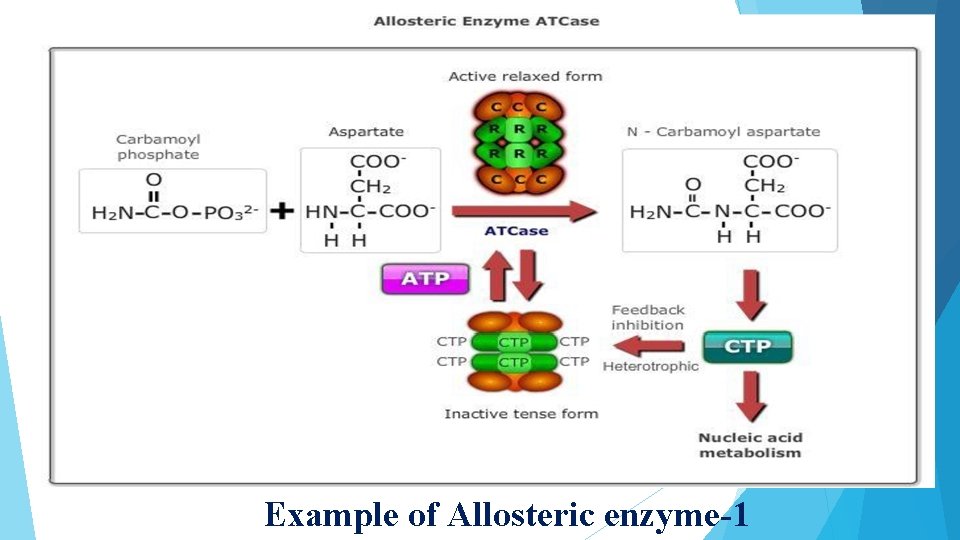
Example of Allosteric enzyme-1
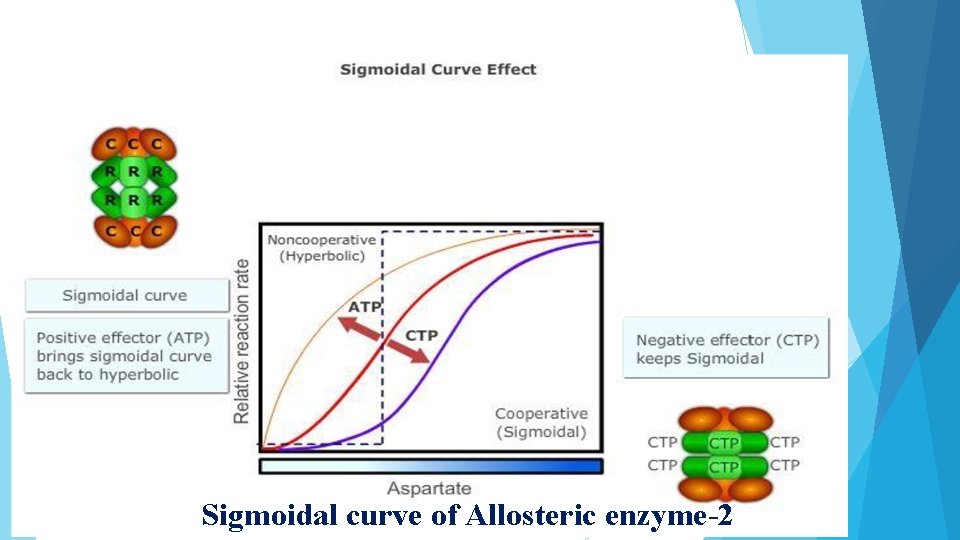
Sigmoidal curve of Allosteric enzyme-2
• in relation to multiple subunit enzymes => changes in conformation of one subunit leads to => conformational changes in adjacent subunits. • These changes occur at => tertiary and quaternary levels of protein organization and => can be caused by an allosteric regulator.
• Homotropic regulation => when binding of one molecule to a multi-subunit enzyme causes => a conformational shift that affects => binding of the same molecule to another subunit of the enzyme. • Hetero tropic regulation => when binding of one molecule to a multi-subunit enzyme affects => binding of a different molecule to this enzyme (Note: These terms are similar to those used for oxygen binding to hemoglobin)
Feedback Inhibitions Ø In metabolic pathway => end products often inhibits the committed step earlier in the same pathway to => prevent the buildup of intermediates and => unnecessary use of metabolites and energy and => the process is known as => feedback inhibition. Ø End product inhibition is => negative feedback used to => regulate the production of a given molecule.
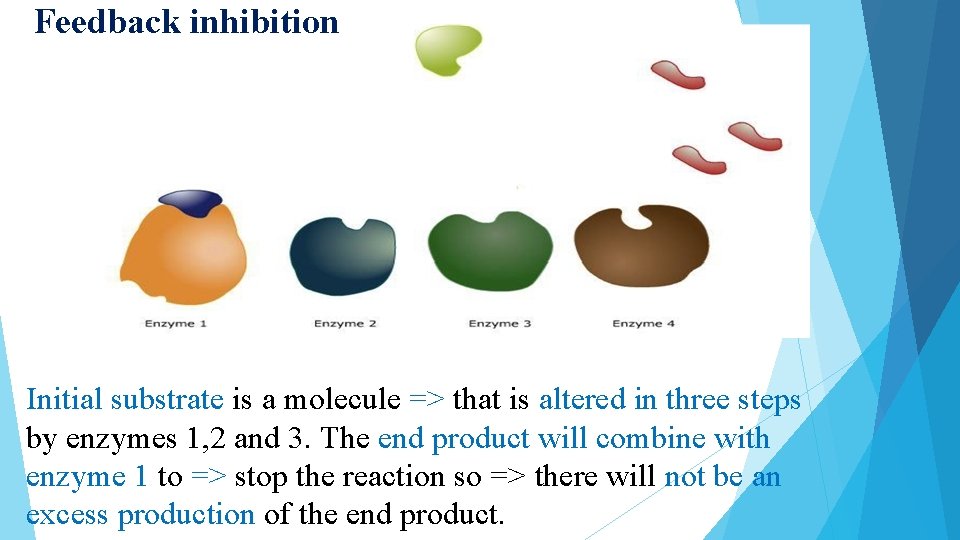
Feedback inhibition Initial substrate is a molecule => that is altered in three steps by enzymes 1, 2 and 3. The end product will combine with enzyme 1 to => stop the reaction so => there will not be an excess production of the end product.
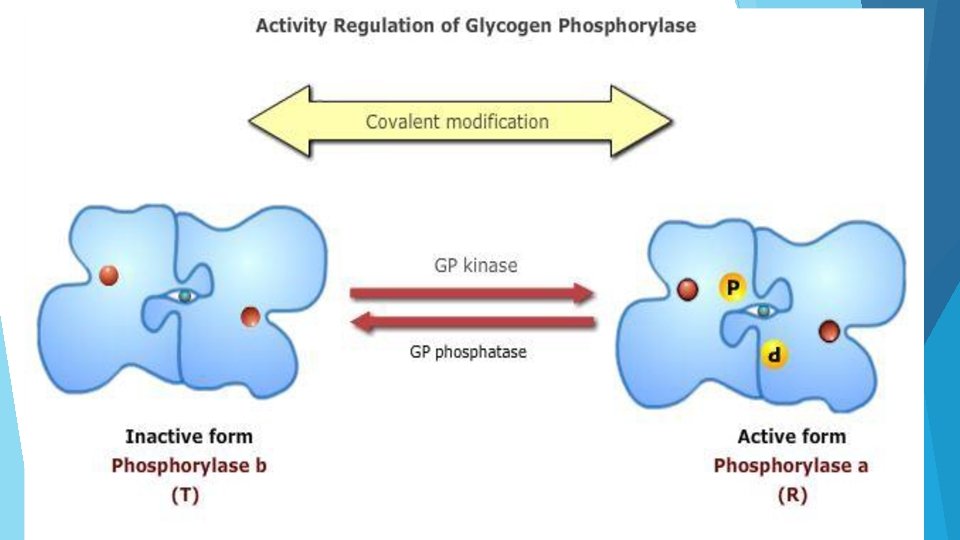
Reversible covalent modification • It involves making or breaking of covalent bond between. => non protein group and an enzyme molecule. • A range of nonprotein groups may be => reversibly attached to enzymes which => affect their activity. • The most common modification is => addition and removal of a phosphate group called => phosphorylation or dephosphorylation, respectively. as
Ø Phosporylation is catalysed by => protein kinases => using ATP as phosphate donar, and deposphorylation is catalysed by => protein phosphatases. Ø Addtion and deletion of phosphate group causes => changes in tertiary structure of enzyme that alter => its catalytic activity. Ø Serine kinases transfer => phosphate groups specifically to => serine residues on target enzyme. Ø Similarly tyrosine kinases transfer phosphate groups => tyrosine residues of target enzymes and make them => active or inactive.
Ø A phosphorylated enzyme may be => either more or less active than => its dephosphorylated form. Ø Thus phosphorylation and dephosphorylation may be used as => a rapid, reversible switch to => turn a metabolic pathway on or off according to the needs of cell. Ø For example glycogen phosphorylase => an enzyme involved in glycogen breakdown is active in => its phosphorylated form and glycogen synthetase => involved in glycogen synthesis is most active in => its dephosphorylated form.
Isozymes Ø An enzyme which has => multiple molecular forms in the same organism => catalyzing the same reaction is known as isozyme. Ø Example => Lactate dehydrogenase (LDH) Ø LDH occur in => five possible forms in organs of most vertebrates => as observed by electrophoretic separation. Ø Basically two different types of LDH occur. Ø One type => which predominates in the Heart, is called heart LDH (H 4). Ø The second types are => characteristic of Muscles (M 4).
Ø Heart LDH consists of => four identical monomers which are called => H subunits. Ø Muscle enzyme consists of => four identical M subunits. Ø The two types of subunits H and M => have same molecular weight (35000) but different amino acid composition. Ø There is genetic evidence that => two subunits are produced by two separate genes. Ø Combination of H and M subunits will produce => three additional types of hybrid enzymes. Ø These possible combinations are => M 4, M 3 H, M 2 H 2, MH 3, H 4. Ø These various combinations have => different kinetic properties => depending on physiological roles which they perform.
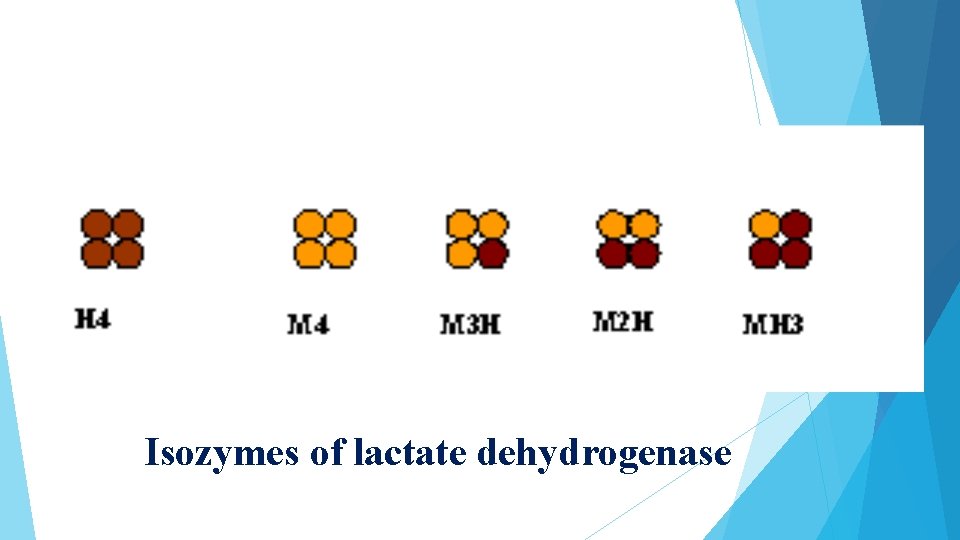
Isozymes of lactate dehydrogenase

THANKS
- Slides: 22