
Biochemistry Overview of Energy Production in Cells Topic
Biochemistry Overview of Energy Production in Cells

Topic 3 SL and Topic 8 HL CELL RESPIRATION (PAPERS 1 AND 2)
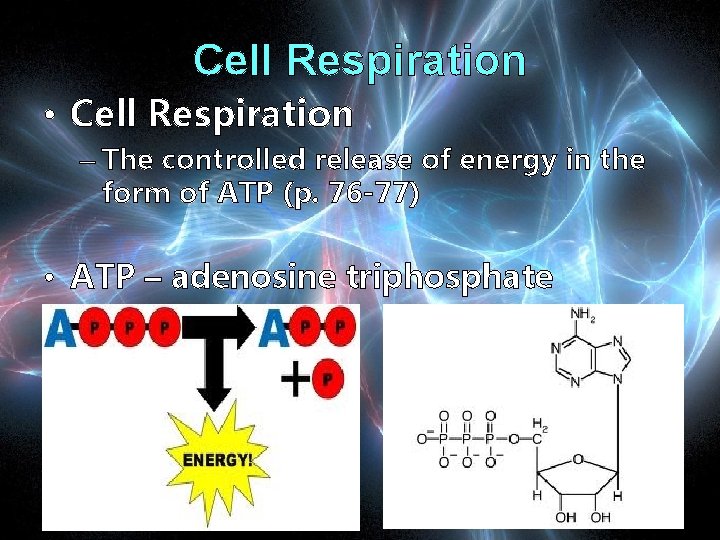
Cell Respiration • Cell Respiration – The controlled release of energy in the form of ATP (p. 76 -77) • ATP – adenosine triphosphate
Cell Respiration • Why is ATP used as an energy source? (p. 77 -78) – Energy Currency – used in different contexts and recycled – Lots of energy locked in the structure – Intermediate between energy yielding and energy requiring reactions – Moves easily in cells – Drives all reactions
Steps of Cell Respiration (p. 78 – 79) • Done in the mitochondria • Based upon oxidation and reduction • LEO the lion says GER • LEO – losing electrons is oxidation, removal of hydrogen, addition of oxygen and Energy out (Exergonic, Exothermic) • GER – gaining electrons is reduction, hydrogen is added, removal of oxygen, and Energy is absorbed (Energonic,
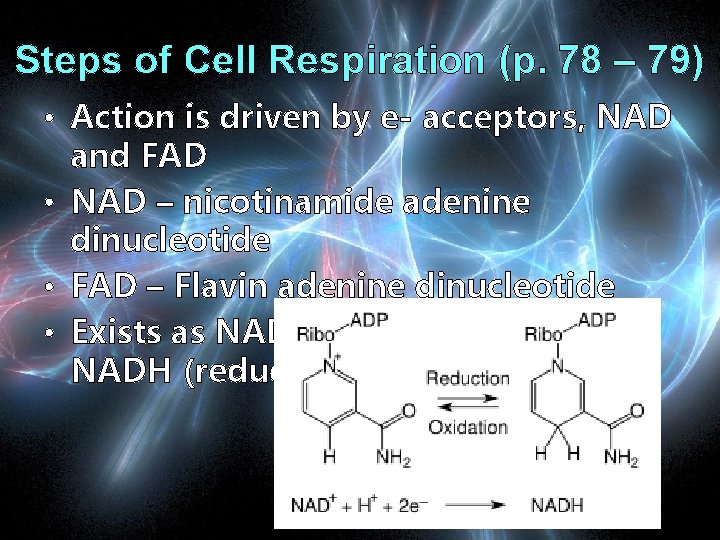
Steps of Cell Respiration (p. 78 – 79) • Action is driven by e- acceptors, NAD and FAD • NAD – nicotinamide adenine dinucleotide • FAD – Flavin adenine dinucleotide • Exists as NAD+ (oxidized form) and NADH (reduced form)
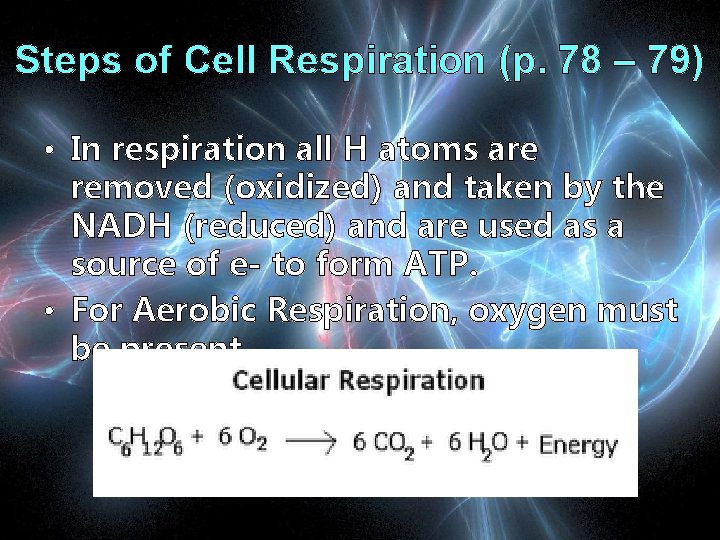
Steps of Cell Respiration (p. 78 – 79) • In respiration all H atoms are removed (oxidized) and taken by the NADH (reduced) and are used as a source of e- to form ATP. • For Aerobic Respiration, oxygen must be present
Anaerobic Respiration • Also called Anaerobic Glycolysis (no oxygen is used) – Ex. Sprinting – not enough time to make E for muscles and take in O 2 • Glucose is broken down to lactic acid or ethanol (in some bacteria) • Only 2 ATP molecules are made and lactic acid builds up • Short term energy production
Steps of Cell Respiration (p. 78 – 79) and (p. 271 – 276) • Glycolysis (Lysis – split) – Done in the cytoplasm of the cell, outside the mitochondrion – Go from glucose (6 C) to 2 pyruvate (3 C) – Produces 2 ATP molecules • Krebs Cycle – In the matrix of the mitochondrion – Pyruvate is made into CO 2 and ATP – Need electron acceptors and lots of NADH are produced – Produces 1 ATP per pyruvate (total = 2)
Steps of Cell Respiration (p. 78 – 79) and (p. 271 – 276) • Electron Transport – Done in the mitochondria between the membranes – Lots of e- released and H+ are removed (REDOX) – Lots of ATP produced (34 molecules) • OVERALL – 38 ATP are produced
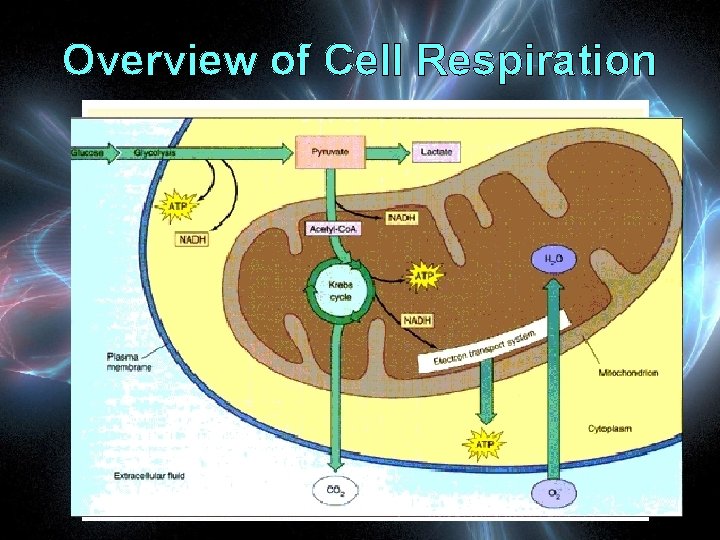
Overview of Cell Respiration
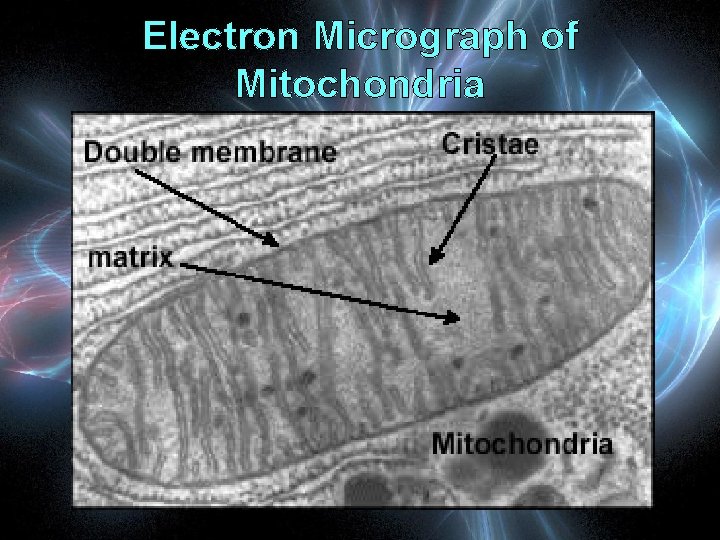
Electron Micrograph of Mitochondria
Glycolysis • 6 C glucose to 3 C pyruvate • No oxygen is needed • Steps – Phosphorylation – Lysis – Oxidation
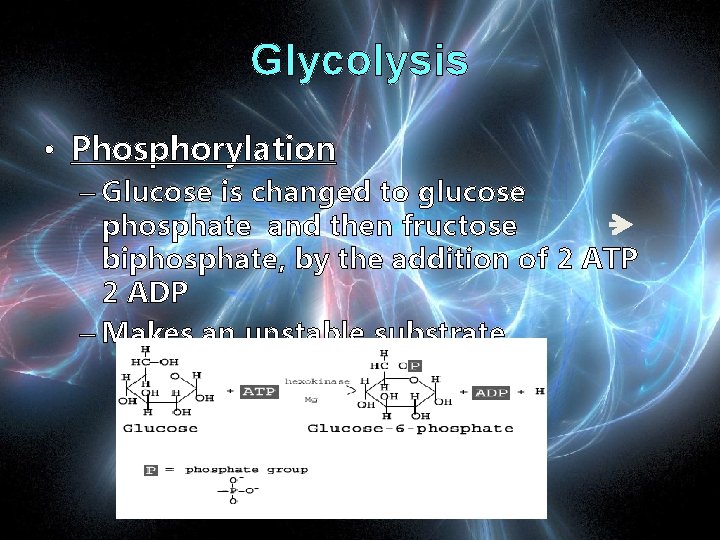
Glycolysis • Phosphorylation – Glucose is changed to glucose phosphate and then fructose biphosphate, by the addition of 2 ATP 2 ADP – Makes an unstable substrate
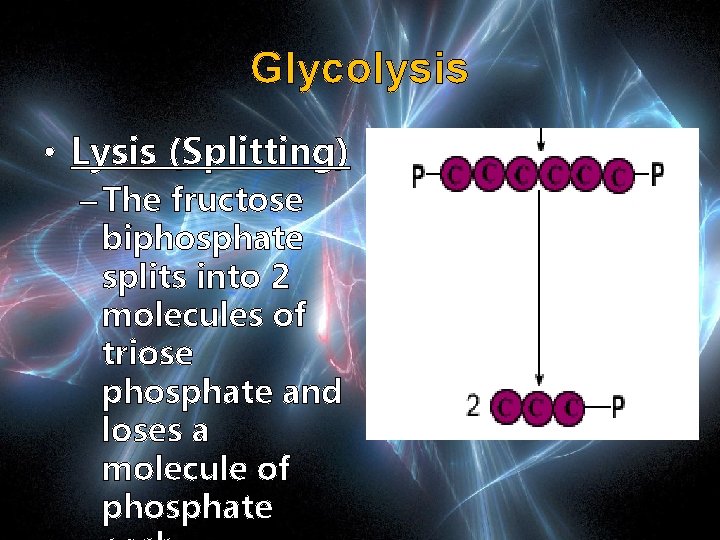
Glycolysis • Lysis (Splitting) – The fructose biphosphate splits into 2 molecules of triose phosphate and loses a molecule of phosphate
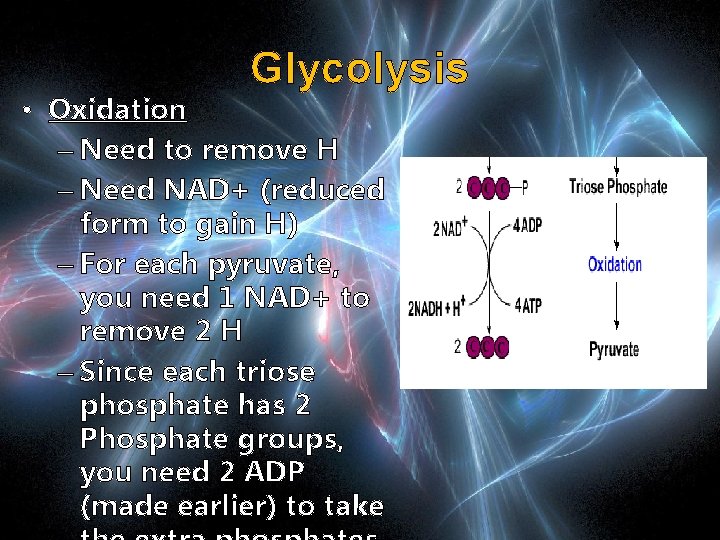
Glycolysis • Oxidation – Need to remove H – Need NAD+ (reduced form to gain H) – For each pyruvate, you need 1 NAD+ to remove 2 H – Since each triose phosphate has 2 Phosphate groups, you need 2 ADP (made earlier) to take
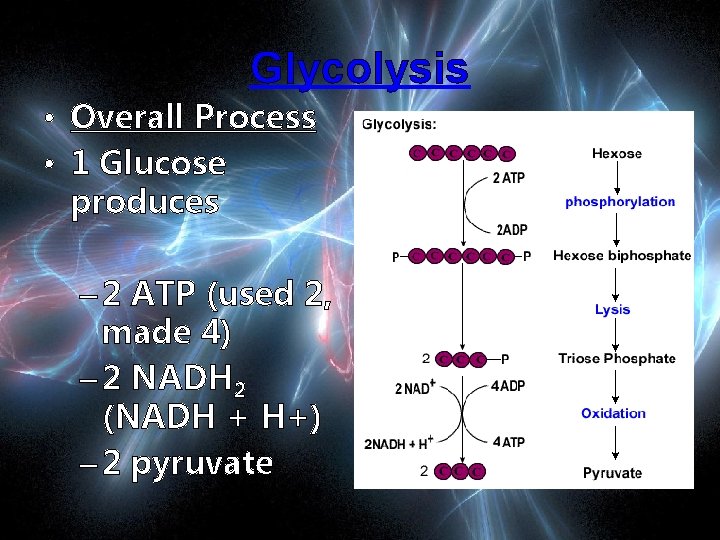
Glycolysis • Overall Process • 1 Glucose produces – 2 ATP (used 2, made 4) – 2 NADH 2 (NADH + H+) – 2 pyruvate
Krebs Cycle (Citric Acid Cycle) • Occurs in the mitochondrial matrix • Oxygen is needed for the pyruvate to enter the mitochondria (link reaction) • Produces very little ATP, but produces CO 2, NADH 2, FADH 2 • For every one pyruvate, one turn of the Krebs Cycle is needed • Therefore, for one glucose, 2 turns of the Krebs Cycle are needed.
Krebs Cycle (Citric Acid Cycle) • Link Reaction (Oxidative decarboxylation) • Gets the pyruvate into the mitochondrion one at a time – Oxygen needs to be available – C and H+ are removed by NAD+ and CO 2 forms (NADH 2 forms) • 2 C intermediate links with co-enzyme A (Co. A) and forms acetyl Co. A and can get into the mitochondrial matrix
Krebs Cycle (Citric Acid Cycle) • Once in the matrix, the Krebs Cycle occurs • Starts with the acetyl Co. A joining with a 4 C intermediate that was produced earlier in the cycle (oxalacetate) – 2 C acetyl group + 4 C oxalacetate = 6 C + Co. A • Co. A leaves to pick up more pyruvate – 6 C structure is called citric acid • Reason why the Krebs Cycle is also called the Citric Acid Cycle
Krebs Cycle (Citric Acid Cycle) • ONE TURN • Citric Acid will lose 1 C and join with O 2 to form CO 2 (decarboxylation) and lose 2 H (form NADH 2) • 5 C structure will go through structural changes and lose another C = CO 2, and pick up more H, forming NADH 2 and FADH 2 • 1 ATP is formed • 4 C oxalacetate is formed and picks up
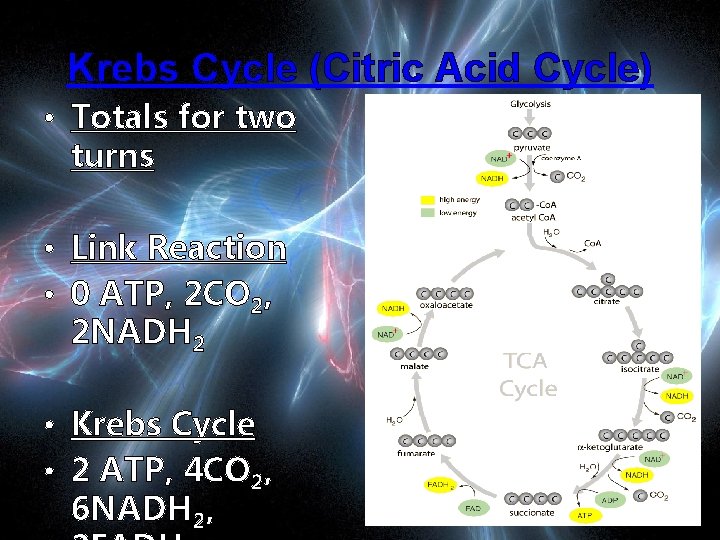
Krebs Cycle (Citric Acid Cycle) • Totals for two turns • Link Reaction • 0 ATP, 2 CO 2, 2 NADH 2 • Krebs Cycle • 2 ATP, 4 CO 2, 6 NADH 2,
Summary of Glycolysis and Krebs Cycle • Only 4 ATP are produced • We make little ATP, but a lot of NADH 2 (reduced) • This carries lots of e- and H+ to the last step (Lots of potential energy)
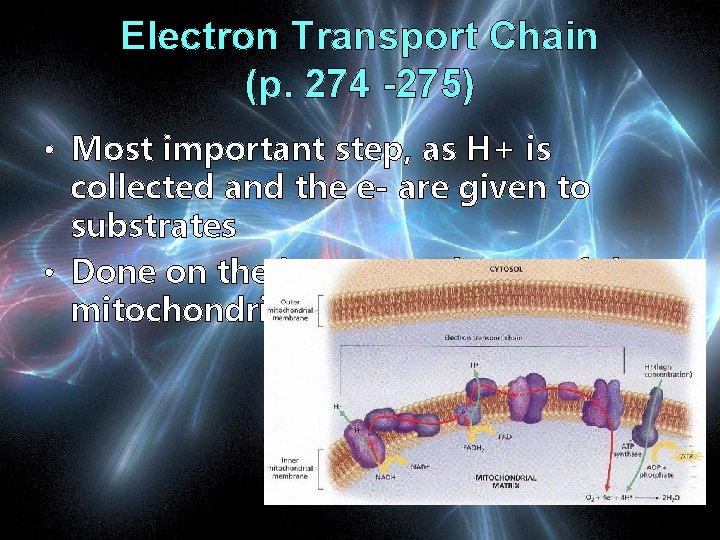
Electron Transport Chain (p. 274 -275) • Most important step, as H+ is collected and the e- are given to substrates • Done on the inner membrane of the mitochondrion
Electron Transport Chain (p. 274 -275) • Events of the ETC • NADH loses 2 e- and 2 H+ to form NAD+ • Oxidation occurs when the cytochromes (e- acceptors) pass 2 eand 2 H+ down a chain to a final acceptor, O 2 • O 2 bonds with the H+ to make water • As the e- are passed through the chain, E is released to produce ATP
Electron Transport Chain (p. 274 -275) • ETC is coupled with oxidative phosphorylation, also called Chemiosmosis. • Outer membrane is a regular membrane, impermeable to H+ ions (separates the cytoplasm from the mitochondrion) • Inner membrane is folded into cristae, to provide maximum surface area for e- carriers and formation of
![Electron Transport Chain (p. 274 -275) • Intermembrane space has higher [H+] due to](http://slidetodoc.com/presentation_image_h2/56c82dc8711dd3b211898e1dffec5f3a/image-27.jpg "Electron Transport Chain (p. 274 -275) • Intermembrane space has higher [H+] due to")
Electron Transport Chain (p. 274 -275) • Intermembrane space has higher [H+] due to the ETC (low p. H = acidic) • e- move through the membrane giving off e- (oxidation) by the cytochromes • e- pass through the membrane, H+ ions are pumped from the matrix to the intermemebrane space, creating a potential difference
Electron Transport Chain (p. 274 -275) • In the membrane is an enzyme ATP Synthetase (pump/channel) • Inside the inner membrane it is (-) and the H+ is between the inner membrane and the outer membrane, creating a (+) charge • The potential difference creates an electrical gradient (proton gradient) • H+ (protons) can only move out through the ATP Synthetase
Electron Transport Chain (p. 274 -275) • H+ flows through the ATP ase, back to the matrix, releasing E • ADP in the matrix, takes the E, and a Phosphate (made earlier) and phosphorylates to ATP. • The H+ flowing into the matrix, combines with e- and oxygen to form water • The pumping of H+ is known as Chemiosmotic Theory, discovered by
Summary of Cell Respiration • From 1 glucose molecule • Glycolysis – 2 ATP 2 NADH • Krebs Cycle • Link Reaction – 2 NADH • Krebs – 2 ATP 6 NADH 2 FADH • ETC • 10 NADH = 30 ATP • 2 FADH = 4 ATP • Total • 38 ATP / glucose
Role of Acetyl Co. A (p. 178 -179) • Links the stage of Glycolysis to the Krebs Cycle • Metabolism of Fatty Acids – Fatty acids contain large amounts of E, that are broken down to 2 C pieces to be used in the Krebs Cycle or Anaerobic Respiration
Topic 3 SL and Topic 8 HL PHOTOSYNTHESIS (PAPERS 1 AND 2)
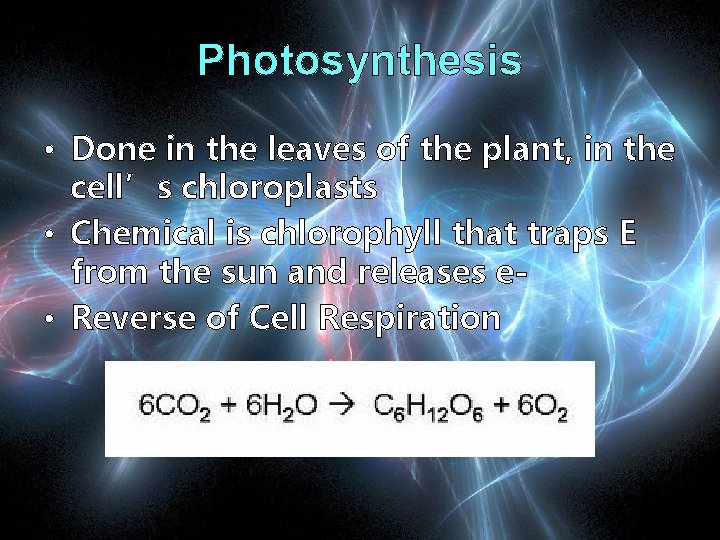
Photosynthesis • Done in the leaves of the plant, in the cell’s chloroplasts • Chemical is chlorophyll that traps E from the sun and releases e • Reverse of Cell Respiration
Photosynthesis • What is light? – Electromagnetic radiation – Acts as a particle or as a wave – White light is made of all colors of the rainbow ROY G BIV – Not all the wavelengths are absorbed, some are reflected and this is how we see color
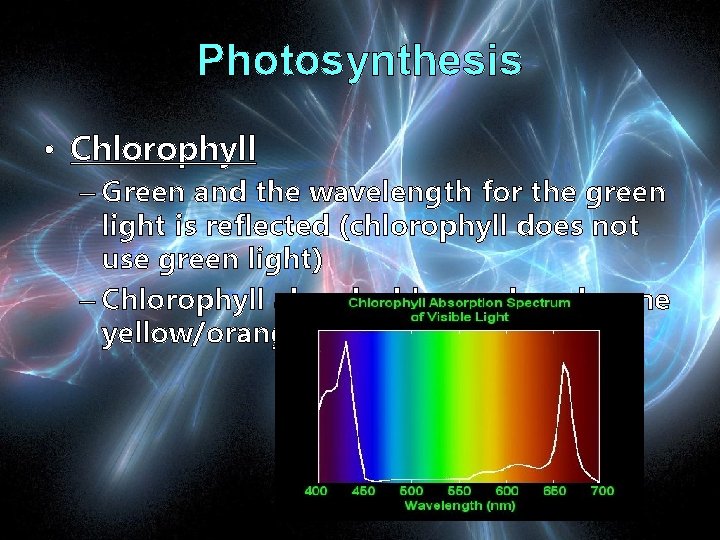
Photosynthesis • Chlorophyll – Green and the wavelength for the green light is reflected (chlorophyll does not use green light) – Chlorophyll absorbs blue, red, and some yellow/orange
Steps of Photosynthesis (p. 87 -89) • There are two reactions: • Light Dependent Reactions – Occur in the grana of the chloroplast • Energy from the sun is used to split water (photolysis) and excite the ein the chlorophyll • H+ added to NADP (P for plant) with ATP, releases oxygen
Steps of Photosynthesis (p. 87 -89) • Light Independent Reactions (Calvin Cycle) – Done in the matrix of the chloroplast, called the stroma • CO 2 bonds to form glucose using ATP and NADP • CO 2 and H+ yields glucose forming starches and cellulose, which is done in the cytoplasm
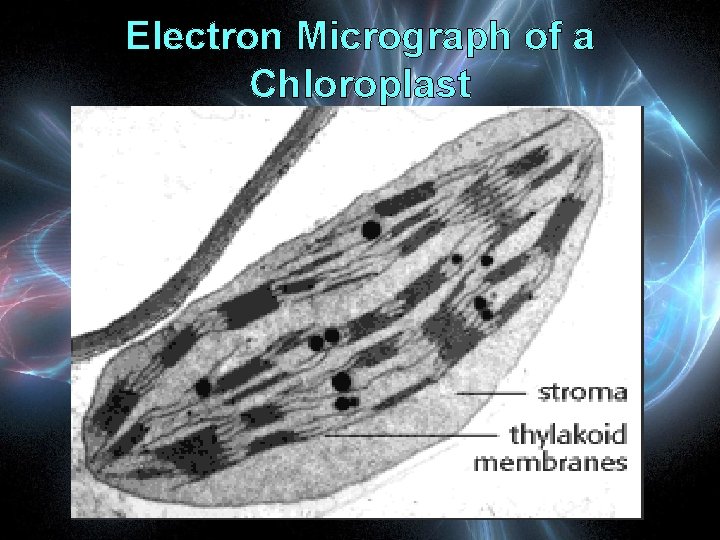
Electron Micrograph of a Chloroplast
Steps of Photosynthesis (p. 87 -89) and (280 – 290) – Light Dependent Reactions • Occurs in the Grana • Light splits water, the H+ is removed by the NADP+ and O 2 goes out • Using the light, photophosphorylation occurs (ADP + P produces ATP) • Cyclic and Non-cyclic photophosphorylation • Light is trapped by chlorophyll, which
Steps of Photosynthesis (p. 87 -89) and (280 – 290) – Light Dependent Reactions • 2 Photosystems • PS I – activated by a wavelength of 700 nm –Called P 700 • PS II activated by a wavelength of 680 nm
Steps of Photosynthesis (p. 87 -89) and (280 – 290) – Light Dependent Reactions • Process • Light hits PS II and the e- in the molecule, which are taken up by an acceptor and goes through the transport chain • Water breaks apart and replaces the lost e-, leaving O and H+ • e- promote the movement of H+ into the thylakoid lumen
Steps of Photosynthesis (p. 87 -89) and (280 – 290) – Light Dependent Reactions • e- are transferred to PS I • e- along with the H+ are transferred to NADP+, forming NADPH 2, which carries e- to the Dark or Light Independent Reactions • The movement of e- also promotes H+ to move through ATP Synthetase, creating E to phosphorylate ADP to ATP, which is used in the Dark
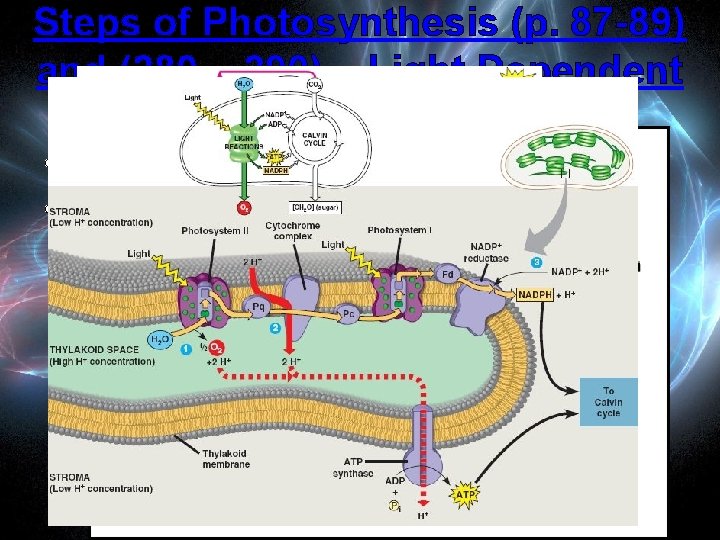
Steps of Photosynthesis (p. 87 -89) and (280 – 290) – Light Dependent Reactions • Reverse of the ETC • Look at page 280, Comparison of Photosynthesis (chloroplast) and Cell Respiration (Mitochondrion)
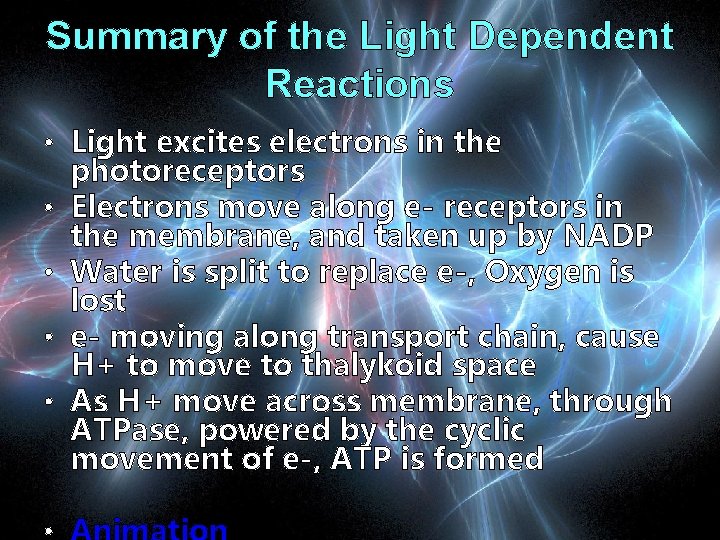
Summary of the Light Dependent Reactions • Light excites electrons in the photoreceptors • Electrons move along e- receptors in the membrane, and taken up by NADP • Water is split to replace e-, Oxygen is lost • e- moving along transport chain, cause H+ to move to thalykoid space • As H+ move across membrane, through ATPase, powered by the cyclic movement of e-, ATP is formed
Light Independent Reactions • Called Dark Reactions or CO 2 Fixation • Done in the stroma • Light is not needed, powered by ATP and NADPH, by oxidizing and giving off e- and H+ • Reverse of the Krebs Cycle, called the Calvin Cycle • Uses a substrate called ribulose biphosphate (Ru. BP) and an enzyme which is a CO 2 acceptor called Ru. BP
Light Independent Reactions – Calvin Cycle • 3 Ru. BP start the cycle and with Rubisco, and 3 CO 2 molecules, form 3 – unstable, 6 C molecules called glycerate 3 -phosphate (GP) • GP immediately breaks to 6 molecules of phosphoglycerate aldehyde • With 6 molecules of ATP, and 6 molecules of NADPH, phophorylation takes place, and 6 molecules of triose
Light Independent Reactions – Calvin Cycle • One triose sugar (3 C) is taken to start a molecule of glucose • The other 5 – 3 C sugars (15 C atoms), use another 3 molecules of ATP, which reform to 3 – 5 C molecules of Ru. BP, to restart the cycle. • To make another triose sugar, another cycle needs to be done • As a result, 2 – triose sugars = glucose
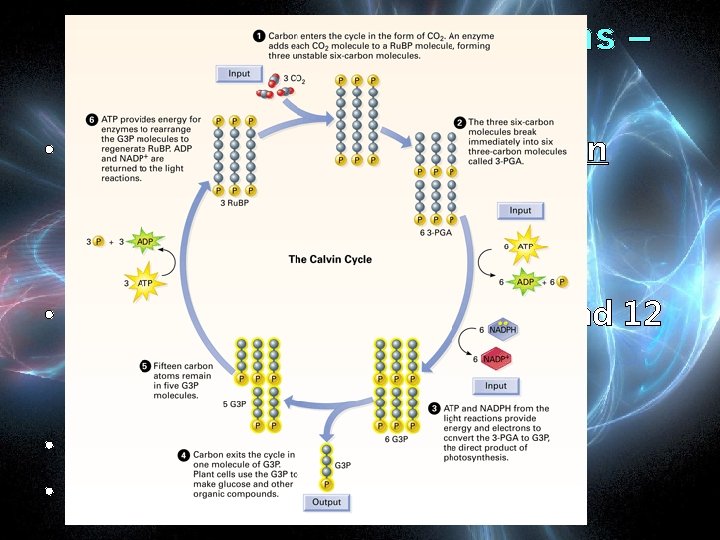
Light Independent Reactions – Calvin Cycle • Totals used per turn of the Calvin Cycle – 9 ATP and 6 NADPH • To make one glucose, 18 ATP and 12 NADPH are needed • Animation 2
Last Stage – Formation of Carbohydrate • 2 – Triose sugars react together to form a 6 C sturcture (Fructose-6 biphosphate) • 2 Phosphate groups are lost = Fructose • 1 phosphate group is lost = glucose 1 -phosphate = starch • Glucose-1 -phosphate loses another phosphate = glucose • Glucose and fructose = sucrose
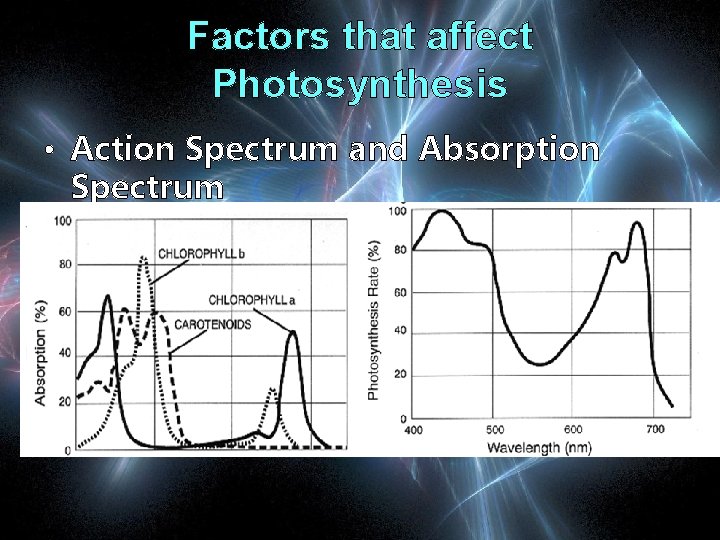
Factors that affect Photosynthesis • Action Spectrum and Absorption Spectrum
Factors that affect Photosynthesis • We can determine PS rate by measuring the: – production of O 2 – increase in biomass – uptake / reduction of CO 2 • Factors that affect the PS rate that are furthest from the optimal level are called Limiting Factors (ex. Low / High Temperatures)
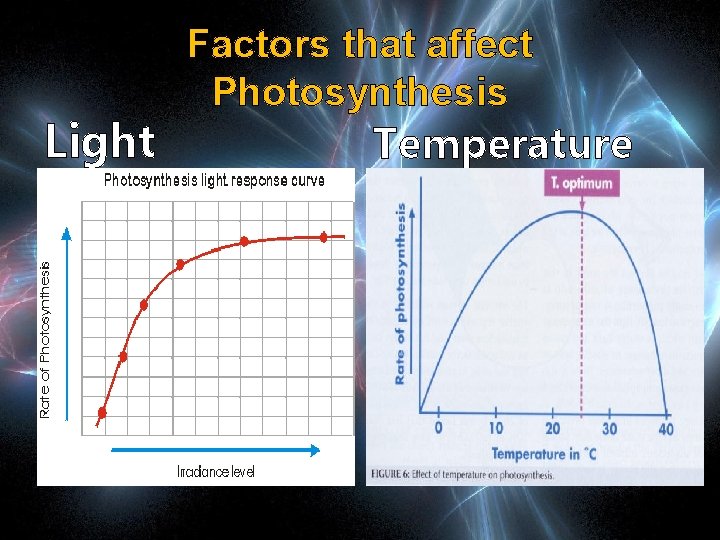
Factors that affect Photosynthesis Light Temperature
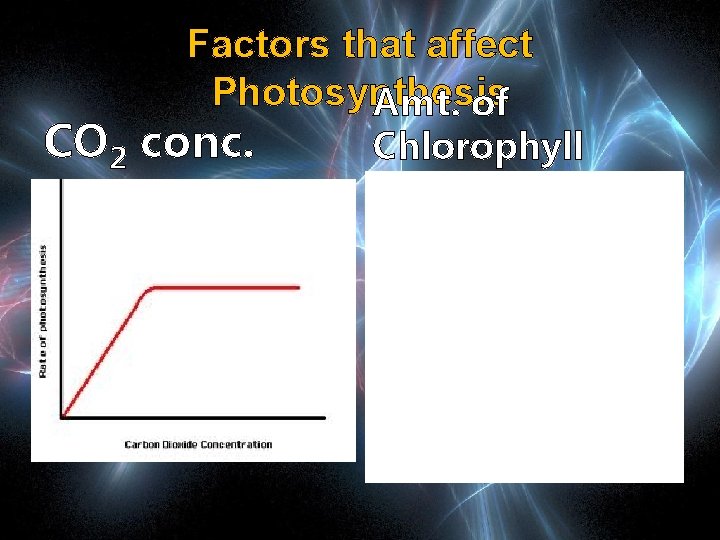
Factors that affect Photosynthesis Amt. of CO 2 conc. Chlorophyll
- Slides: 53