
Biochemistry of Cells 1 Carbonbased Molecules Although a
Biochemistry of Cells 1
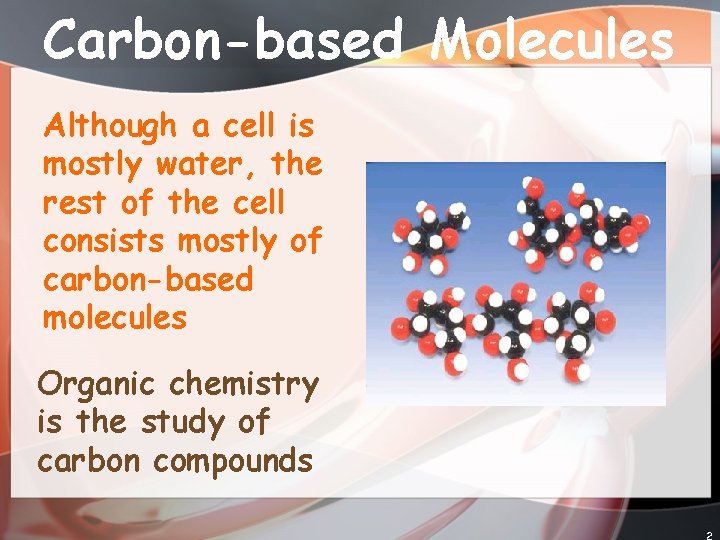
Carbon-based Molecules Although a cell is mostly water, the rest of the cell consists mostly of carbon-based molecules Organic chemistry is the study of carbon compounds 2

Carbon is a Versatile Atom It has four electrons in an outer shell that holds eight Carbon can share its electrons with other atoms to form up to four covalent bonds 3

Hydrocarbons The simplest carbon compounds … Contain only carbon & hydrogen atoms 4
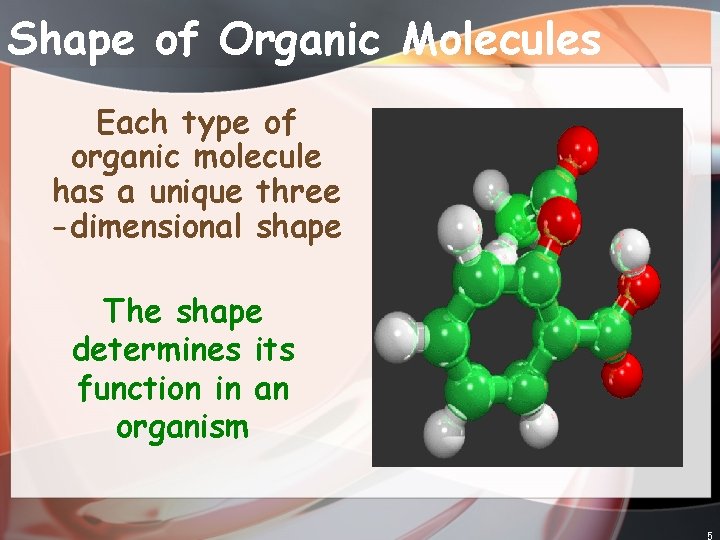
Shape of Organic Molecules Each type of organic molecule has a unique three -dimensional shape The shape determines its function in an organism 5
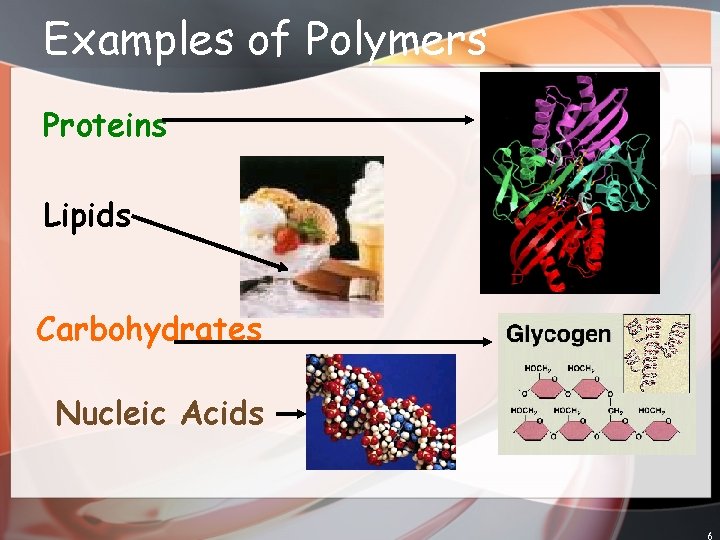
Examples of Polymers Proteins Lipids Carbohydrates Nucleic Acids 6
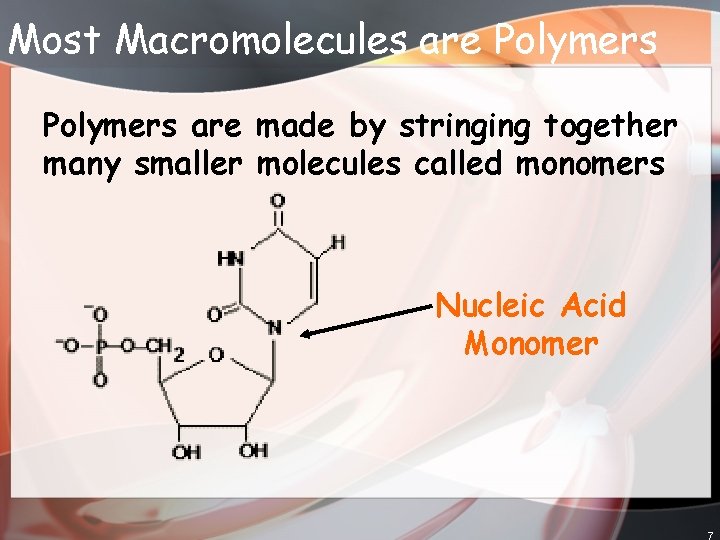
Most Macromolecules are Polymers are made by stringing together many smaller molecules called monomers Nucleic Acid Monomer 7
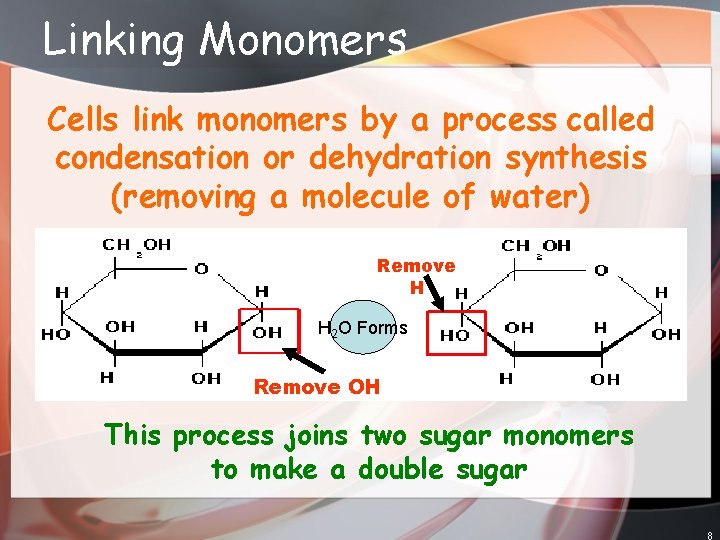
Linking Monomers Cells link monomers by a process called condensation or dehydration synthesis (removing a molecule of water) Remove H H 2 O Forms Remove OH This process joins two sugar monomers to make a double sugar 8
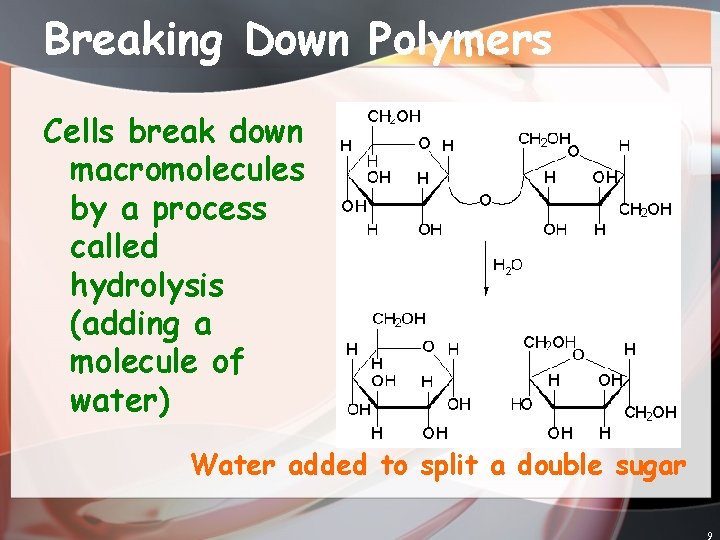
Breaking Down Polymers Cells break down macromolecules by a process called hydrolysis (adding a molecule of water) Water added to split a double sugar 9
Macromolecules in Organisms There are four categories of large molecules in cells: Carbohydrates Lipids Proteins Nucleic Acids 10
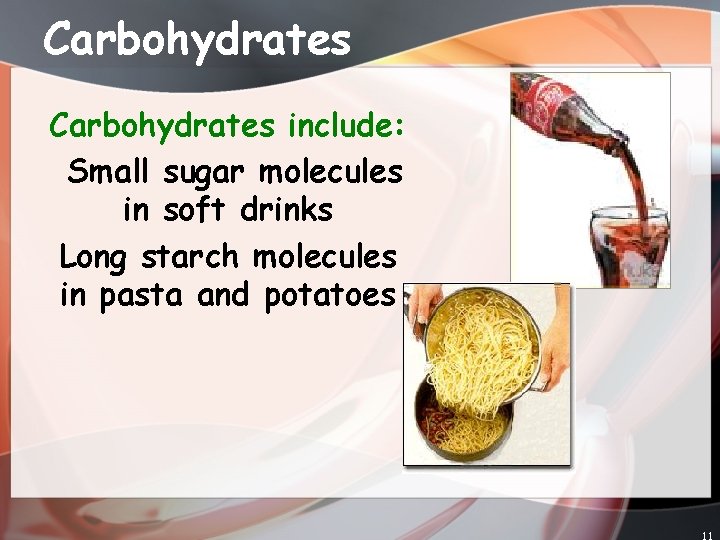
Carbohydrates include: Small sugar molecules in soft drinks Long starch molecules in pasta and potatoes 11
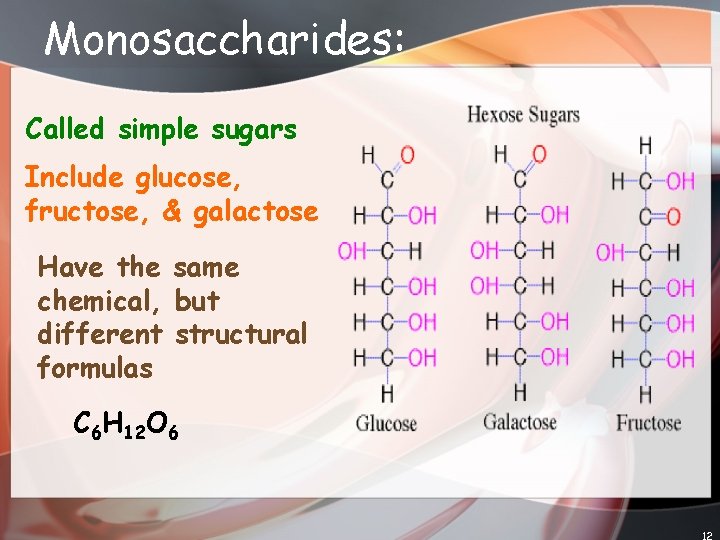
Monosaccharides: Called simple sugars Include glucose, fructose, & galactose Have the same chemical, but different structural formulas C 6 H 12 O 6 12
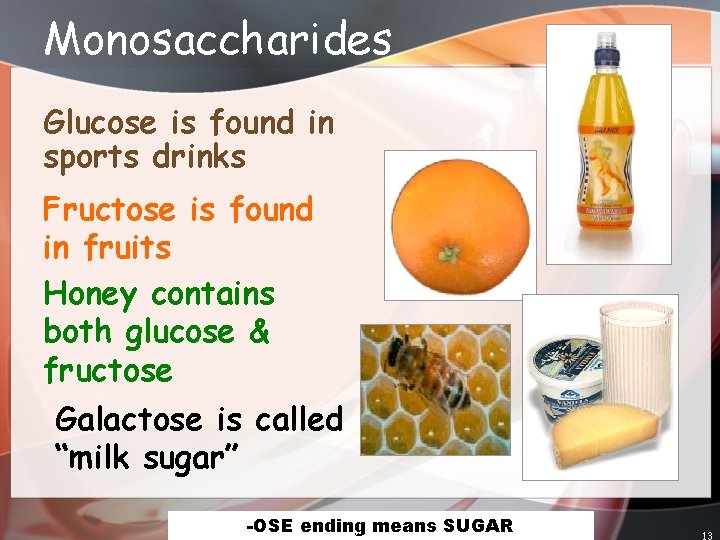
Monosaccharides Glucose is found in sports drinks Fructose is found in fruits Honey contains both glucose & fructose Galactose is called “milk sugar” -OSE ending means SUGAR Copyright Cmassengale 13
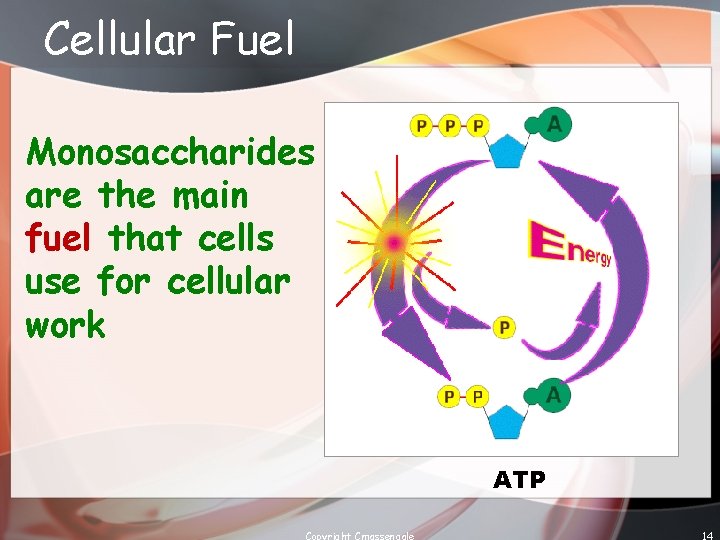
Cellular Fuel Monosaccharides are the main fuel that cells use for cellular work ATP Copyright Cmassengale 14
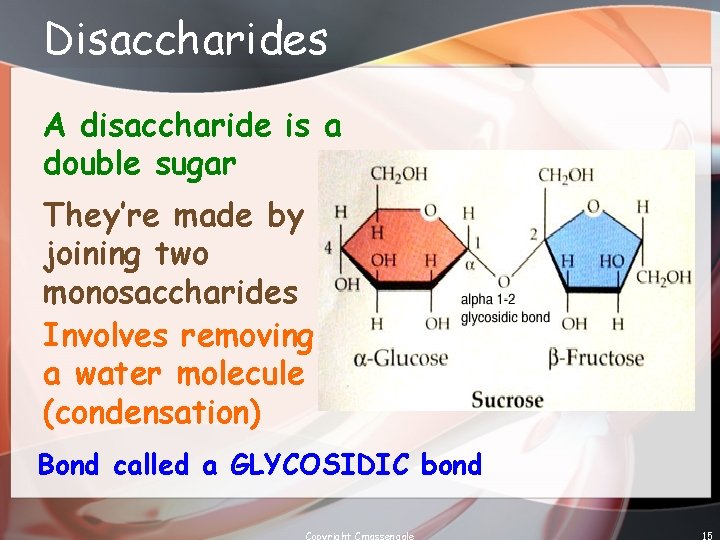
Disaccharides A disaccharide is a double sugar They’re made by joining two monosaccharides Involves removing a water molecule (condensation) Bond called a GLYCOSIDIC bond Copyright Cmassengale 15
Disaccharides Common disaccharides include: ØSucrose (table sugar) ØLactose (Milk Sugar) ØMaltose (Grain sugar ) 16
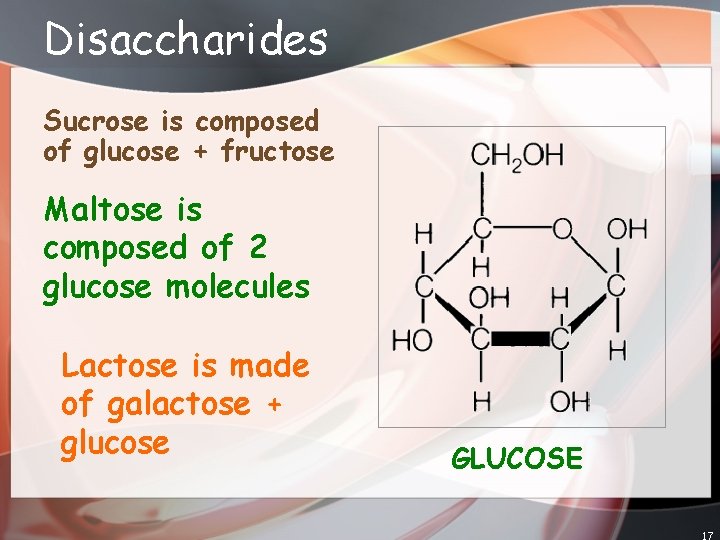
Disaccharides Sucrose is composed of glucose + fructose Maltose is composed of 2 glucose molecules Lactose is made of galactose + glucose GLUCOSE 17
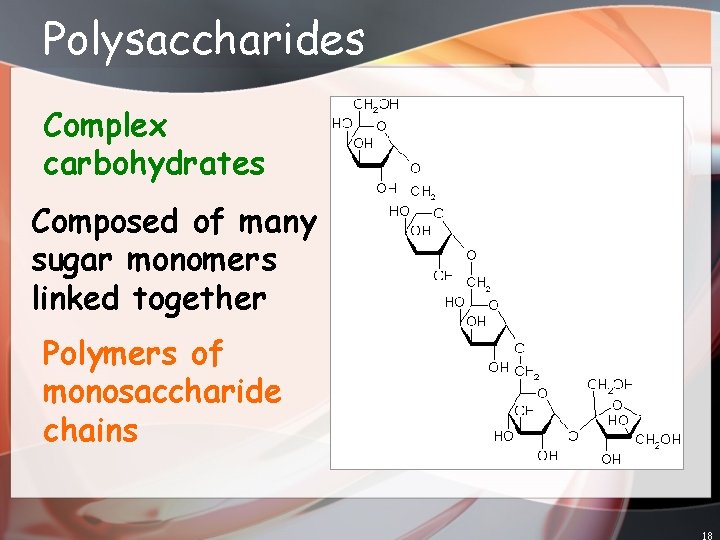
Polysaccharides Complex carbohydrates Composed of many sugar monomers linked together Polymers of monosaccharide chains 18
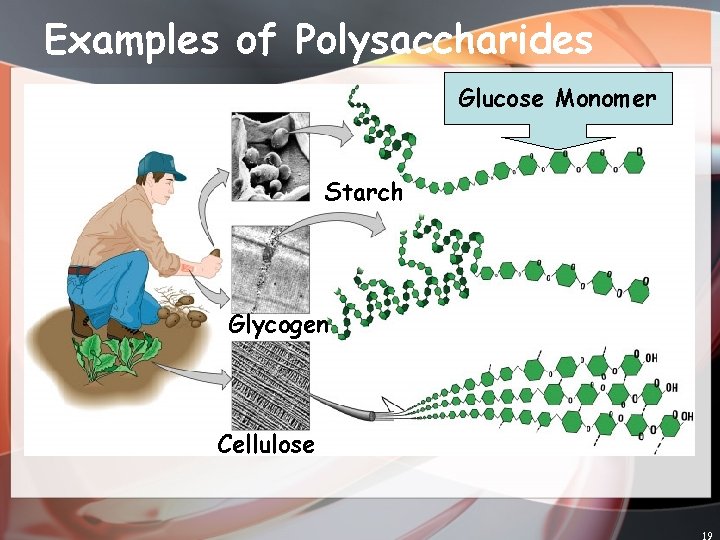
Examples of Polysaccharides Glucose Monomer Starch Glycogen Cellulose 19
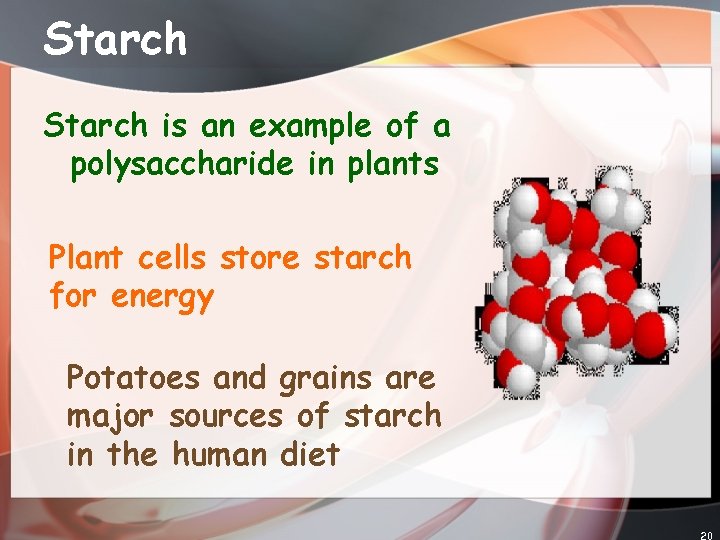
Starch is an example of a polysaccharide in plants Plant cells store starch for energy Potatoes and grains are major sources of starch in the human diet 20
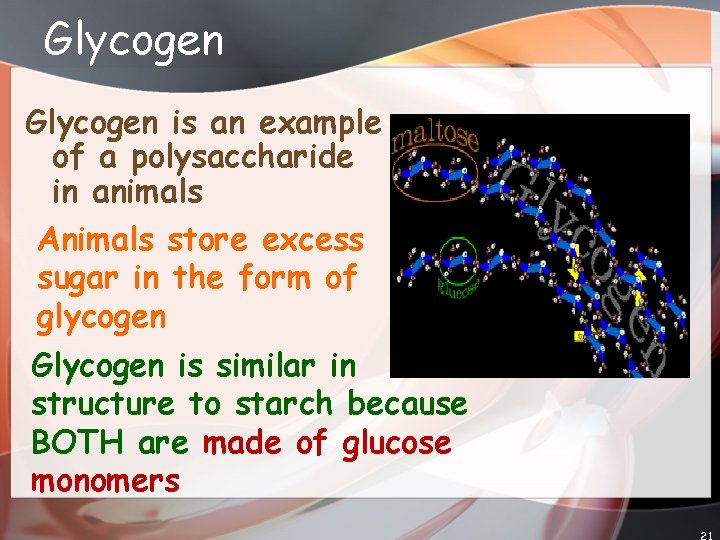
Glycogen is an example of a polysaccharide in animals Animals store excess sugar in the form of glycogen Glycogen is similar in structure to starch because BOTH are made of glucose monomers 21
Cellulose is the most abundant organic compound on Earth It forms cable-like fibrils in the tough walls that enclose plants It is a major component of wood It is also known as dietary fiber 22
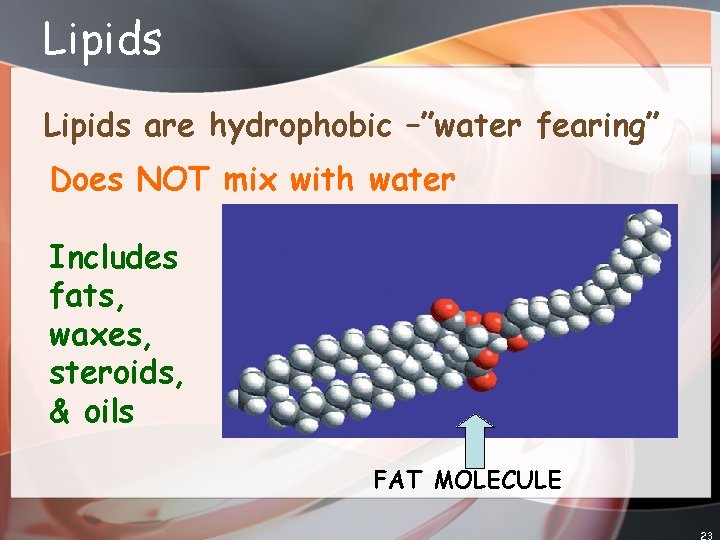
Lipids are hydrophobic –”water fearing” Does NOT mix with water Includes fats, waxes, steroids, & oils FAT MOLECULE 23
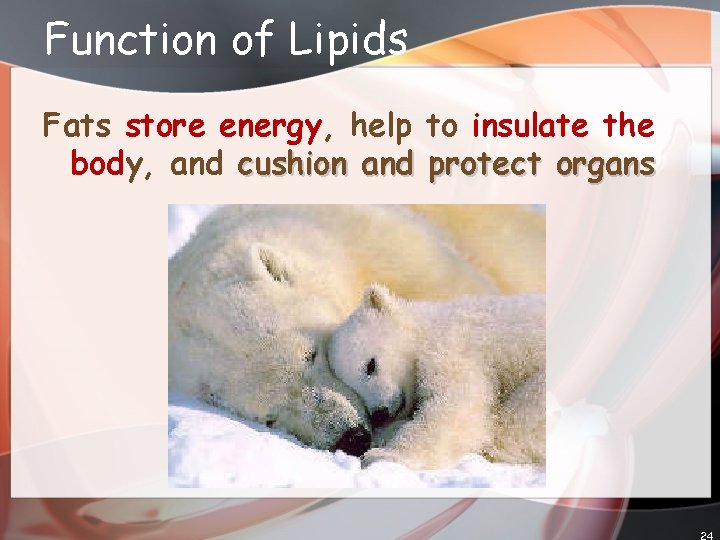
Function of Lipids Fats store energy, help to insulate the body, and cushion and protect organs 24
Types of Fatty Acids Saturated fatty acids have the maximum number of hydrogens bonded to the carbons (all single bonds between carbons) Unsaturated fatty acids have less than the maximum number of hydrogens bonded to the carbons (a double bond between carbons) 25
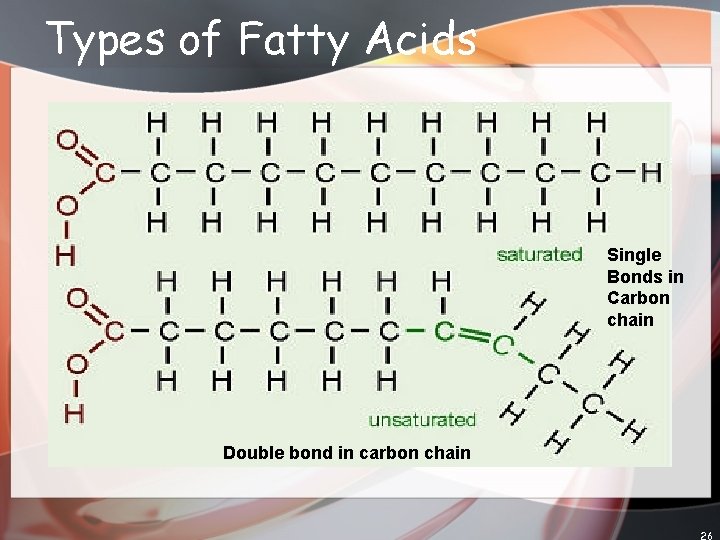
Types of Fatty Acids Single Bonds in Carbon chain Double bond in carbon chain 26
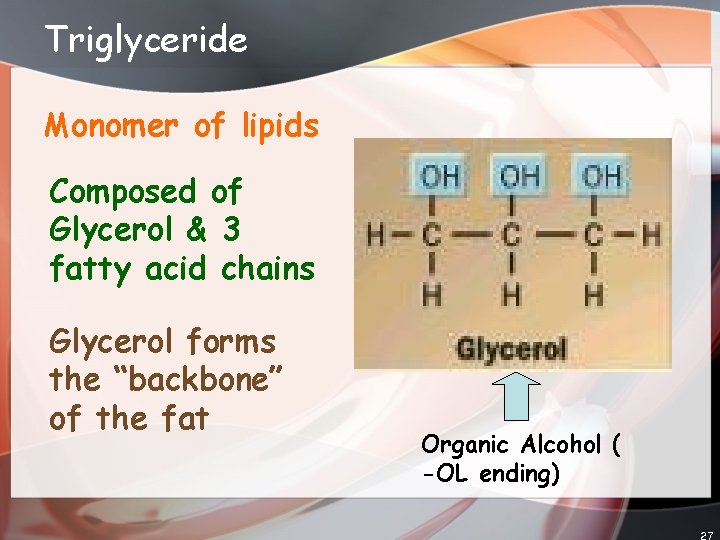
Triglyceride Monomer of lipids Composed of Glycerol & 3 fatty acid chains Glycerol forms the “backbone” of the fat Organic Alcohol ( -OL ending) 27
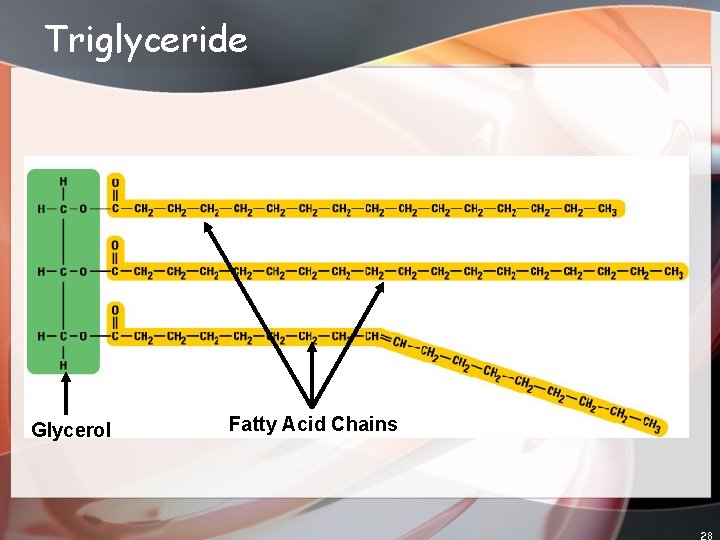
Triglyceride Glycerol Fatty Acid Chains 28
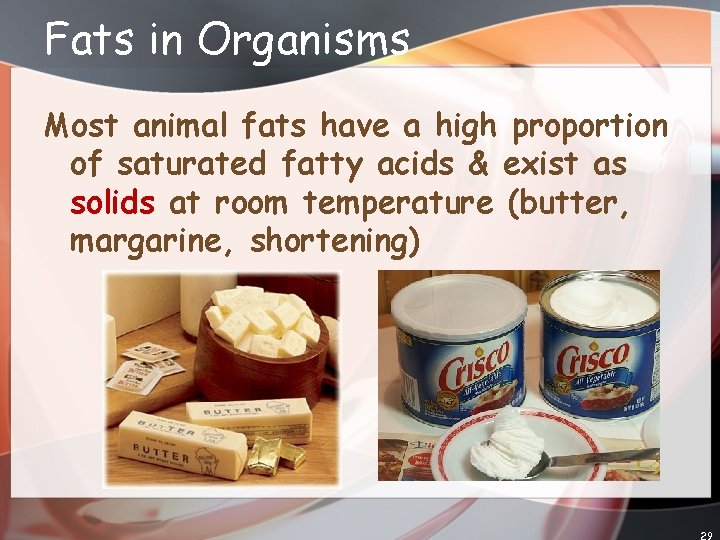
Fats in Organisms Most animal fats have a high proportion of saturated fatty acids & exist as solids at room temperature (butter, margarine, shortening) 29
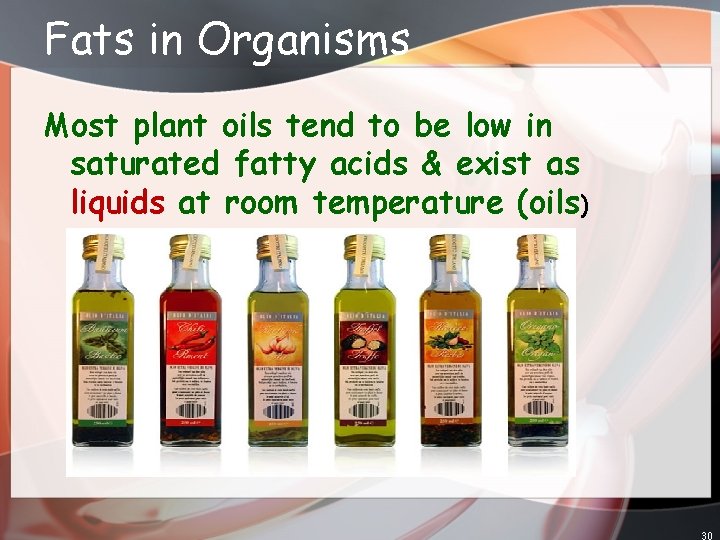
Fats in Organisms Most plant oils tend to be low in saturated fatty acids & exist as liquids at room temperature (oils) 30
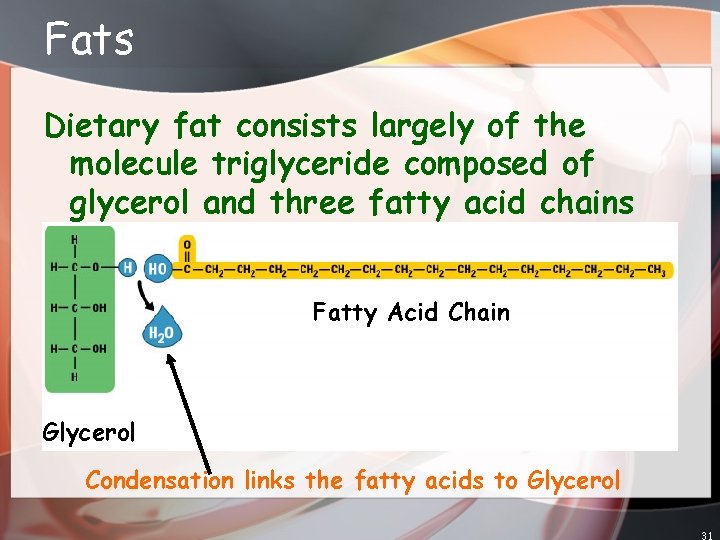
Fats Dietary fat consists largely of the molecule triglyceride composed of glycerol and three fatty acid chains Fatty Acid Chain Glycerol Condensation links the fatty acids to Glycerol 31
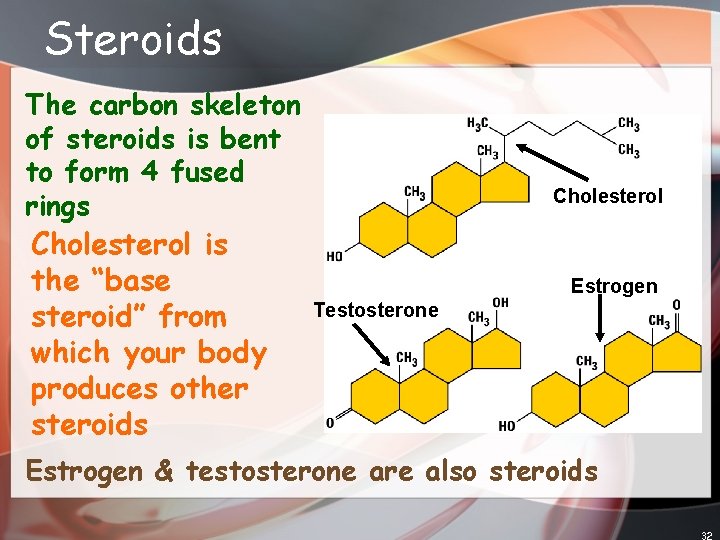
Steroids The carbon skeleton of steroids is bent to form 4 fused rings Cholesterol is the “base steroid” from which your body produces other steroids Cholesterol Estrogen Testosterone Estrogen & testosterone are also steroids 32
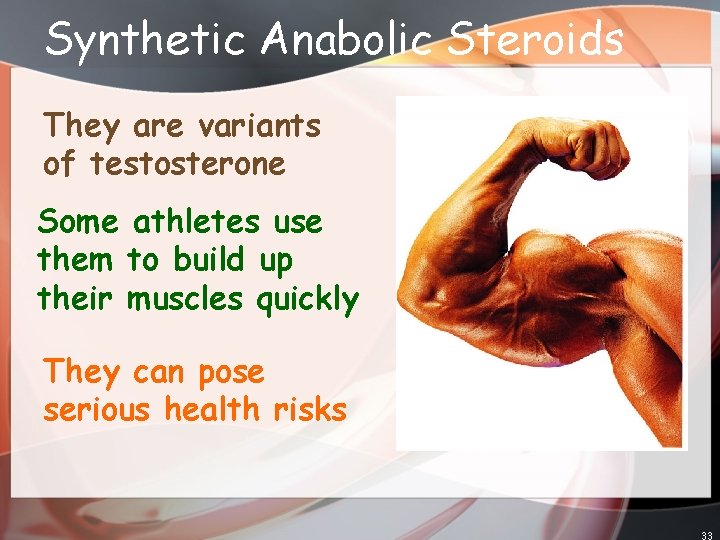
Synthetic Anabolic Steroids They are variants of testosterone Some athletes use them to build up their muscles quickly They can pose serious health risks 33
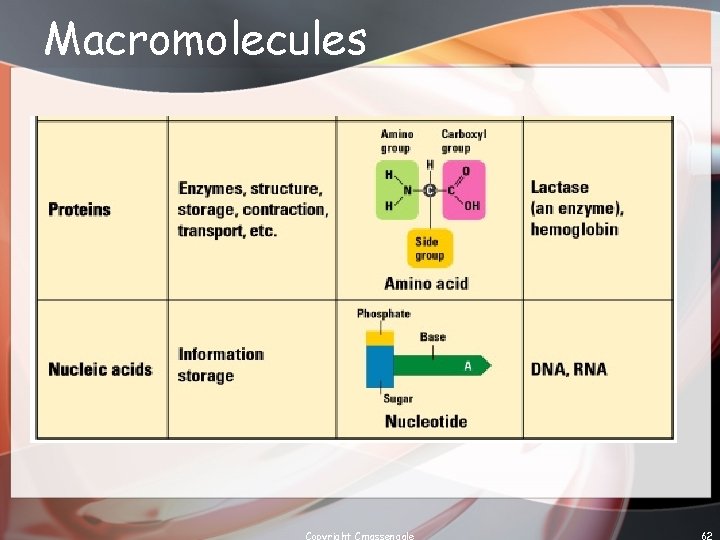
Proteins are polymers made of monomers called amino acids All proteins are made of 20 different amino acids linked in different orders Proteins are used to build cells, act as hormones & enzymes, and do much of the work in a cell 34
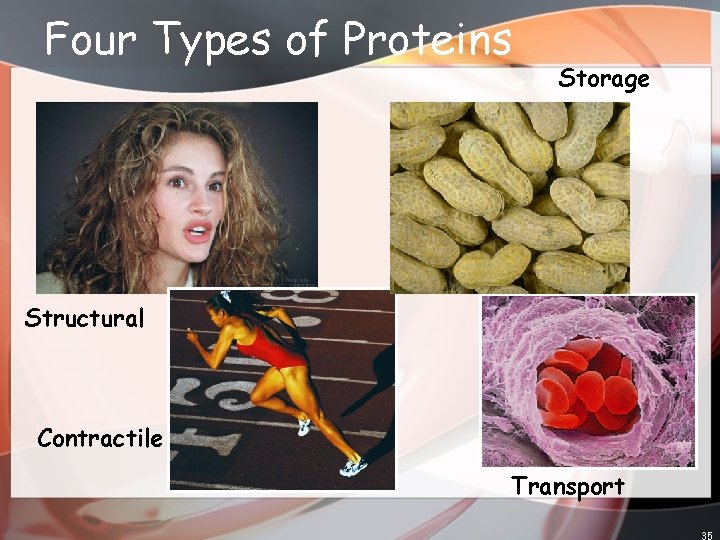
Four Types of Proteins Storage Structural Contractile Transport 35
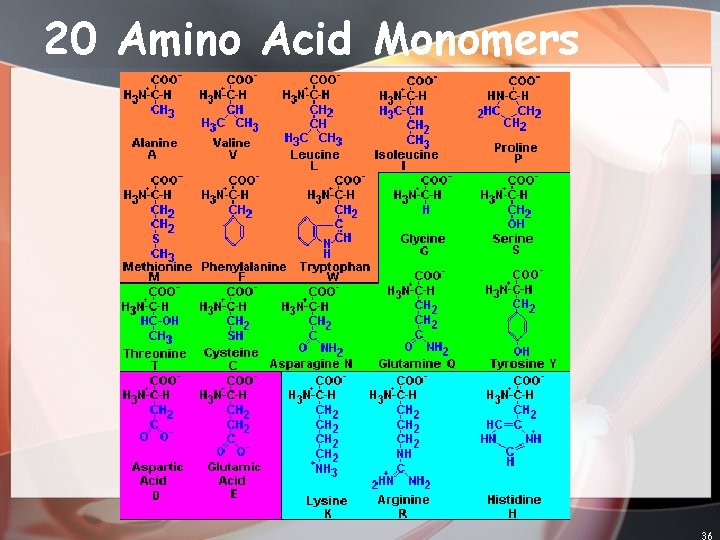
20 Amino Acid Monomers 36
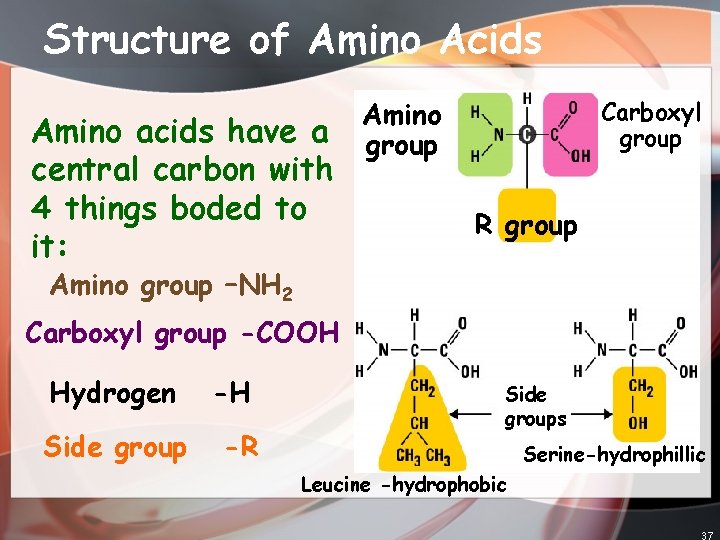
Structure of Amino Acids Amino acids have a central carbon with 4 things boded to it: Amino group Carboxyl group R group Amino group –NH 2 Carboxyl group -COOH Hydrogen Side group -H -R Side groups Serine-hydrophillic Leucine -hydrophobic 37
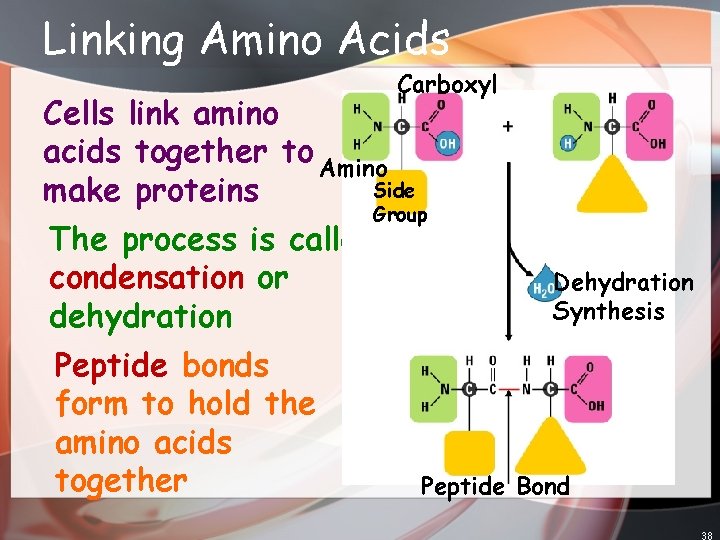
Linking Amino Acids Carboxyl Cells link amino acids together to Amino Side make proteins Group The process is called condensation or dehydration Peptide bonds form to hold the amino acids together Dehydration Synthesis Peptide Bond 38
Proteins as Enzymes Many proteins act as biological catalysts or enzymes Thousands of different enzymes exist in the body Enzymes control the rate of chemical reactions by weakening bonds, thus lowering the amount of activation energy needed for the reaction 39
Enzymes are globular proteins. Their folded conformation creates an area known as the active site. The nature and arrangement of amino acids in the active site make it specific for only one type of substrate. 40
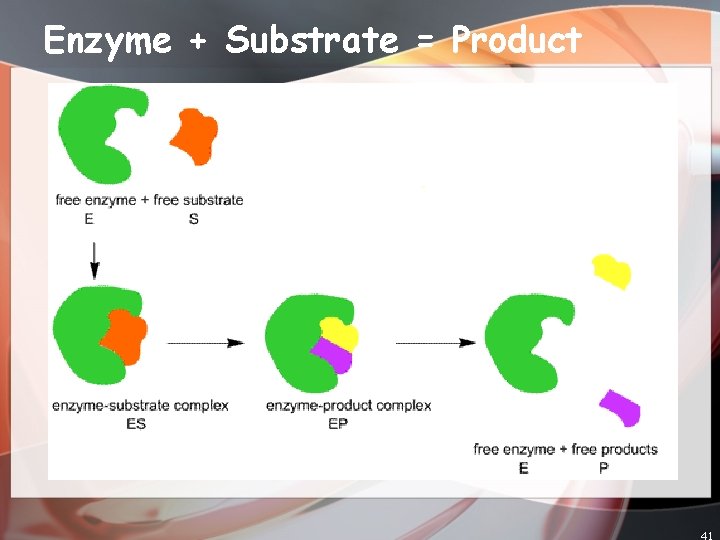
Enzyme + Substrate = Product 41
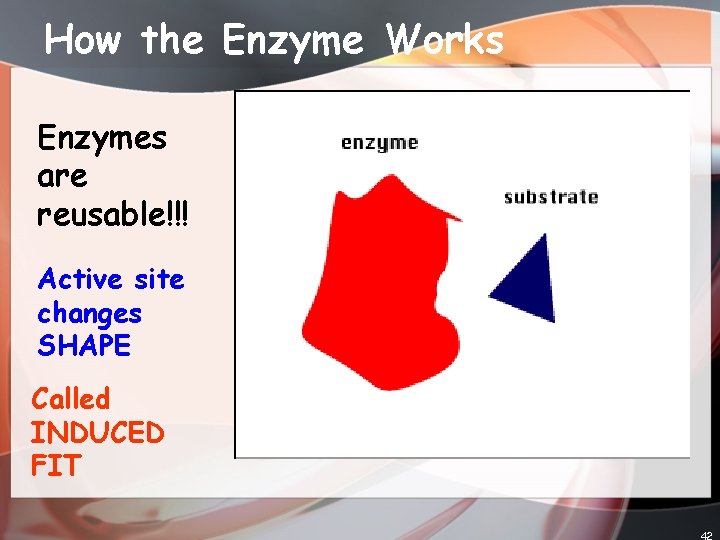
How the Enzyme Works Enzymes are reusable!!! Active site changes SHAPE Called INDUCED FIT 42
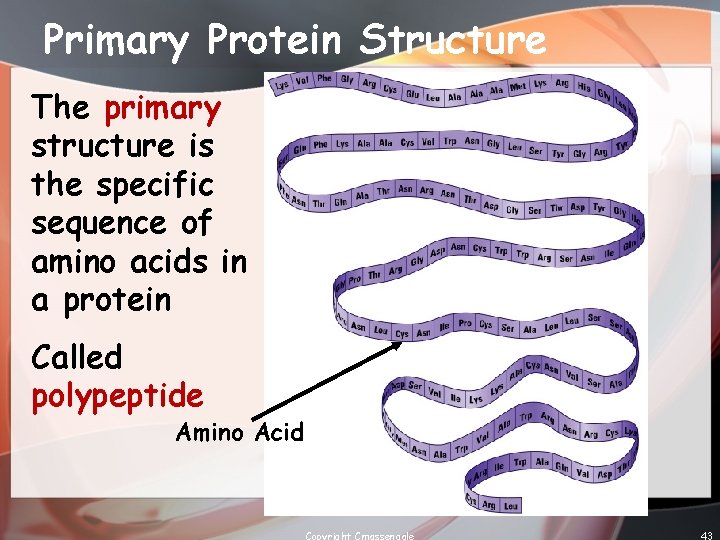
Primary Protein Structure The primary structure is the specific sequence of amino acids in a protein Called polypeptide Amino Acid Copyright Cmassengale 43
Protein Structures Secondary protein structures occur when protein chains coil or fold When protein chains called polypeptides join together, the tertiary structure forms because R groups interact with each other In the watery environment of a cell, proteins become globular in their quaternary structure 44
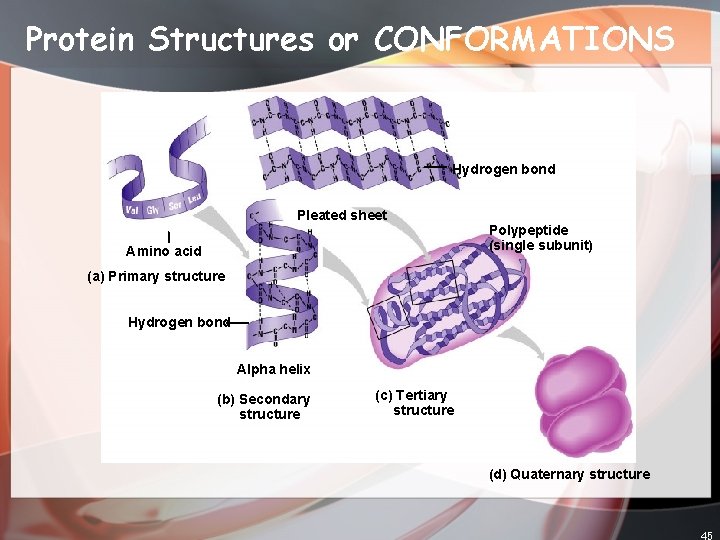
Protein Structures or CONFORMATIONS Hydrogen bond Pleated sheet Amino acid Polypeptide (single subunit) (a) Primary structure Hydrogen bond Alpha helix (b) Secondary structure (c) Tertiary structure (d) Quaternary structure 45
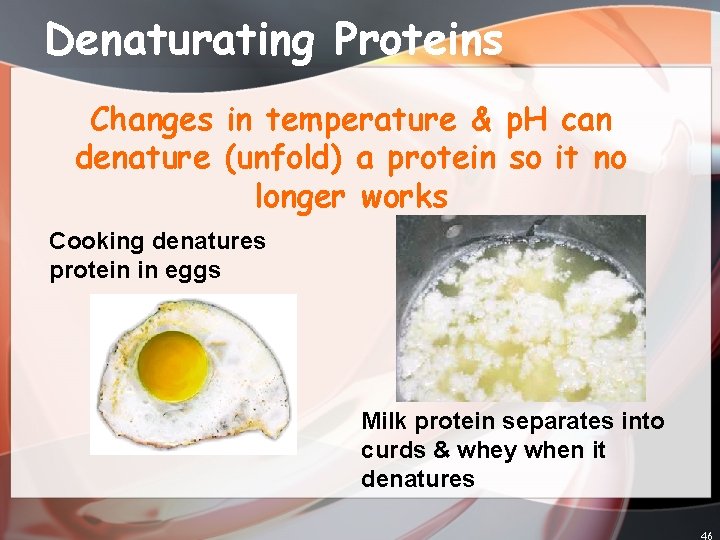
Denaturating Proteins Changes in temperature & p. H can denature (unfold) a protein so it no longer works Cooking denatures protein in eggs Milk protein separates into curds & whey when it denatures 46
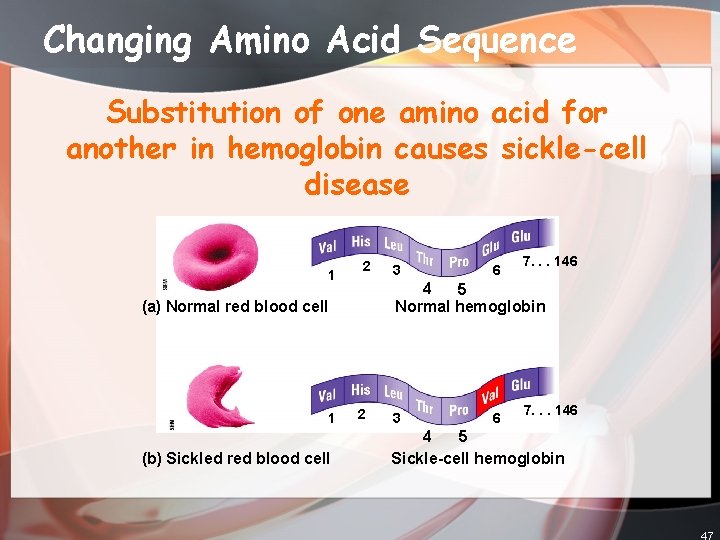
Changing Amino Acid Sequence Substitution of one amino acid for another in hemoglobin causes sickle-cell disease 1 2 (b) Sickled red blood cell 6 7. . . 146 4 5 Normal hemoglobin (a) Normal red blood cell 1 3 2 3 6 7. . . 146 4 5 Sickle-cell hemoglobin 47
Other Important Proteins • Blood sugar level is controlled by a protein called insulin • Insulin causes the liver to uptake and store excess sugar as Glycogen The cell membrane also contains proteins Receptor proteins help cells recognize other cells • • 48
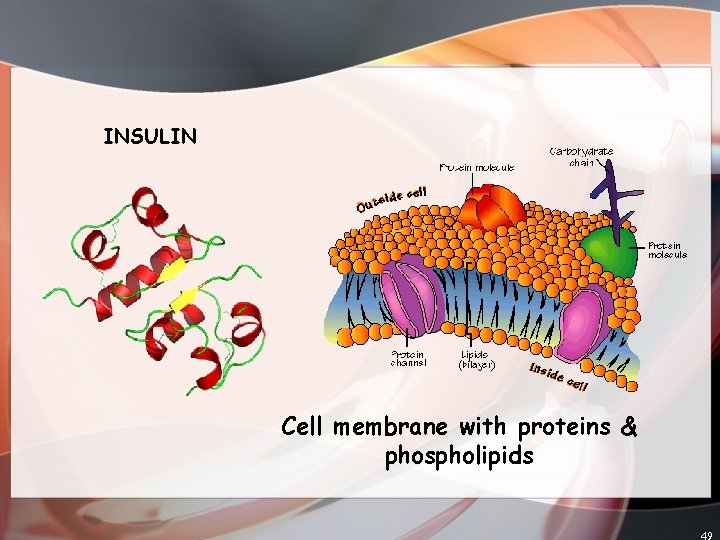
INSULIN Cell membrane with proteins & phospholipids 49
Nucleic Acids Store hereditary information Contain information for making all the body’s proteins Two types exist --- DNA & RNA 50
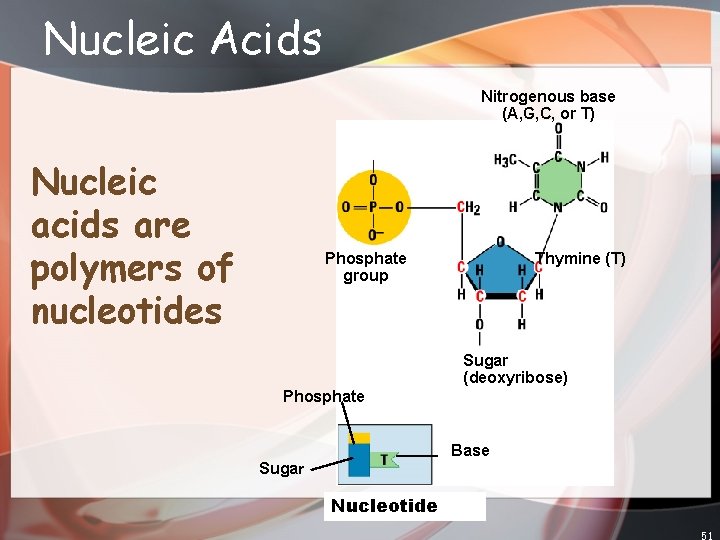
Nucleic Acids Nitrogenous base (A, G, C, or T) Nucleic acids are polymers of nucleotides Phosphate group Thymine (T) Sugar (deoxyribose) Phosphate Base Sugar Nucleotide 51
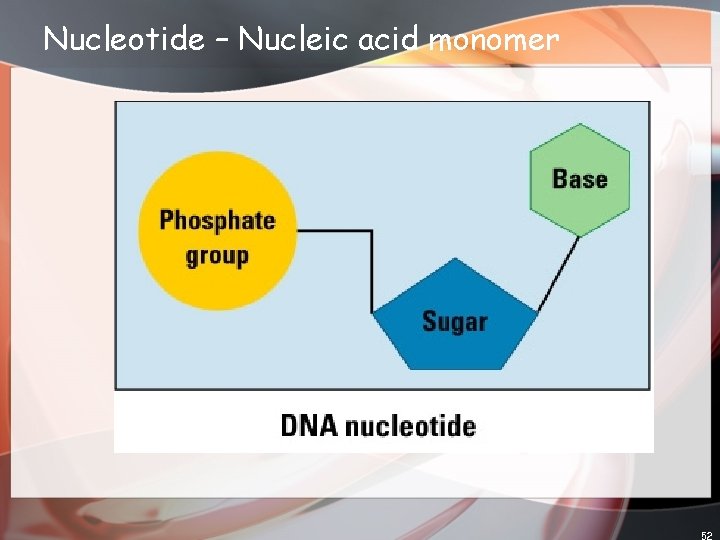
Nucleotide – Nucleic acid monomer 52
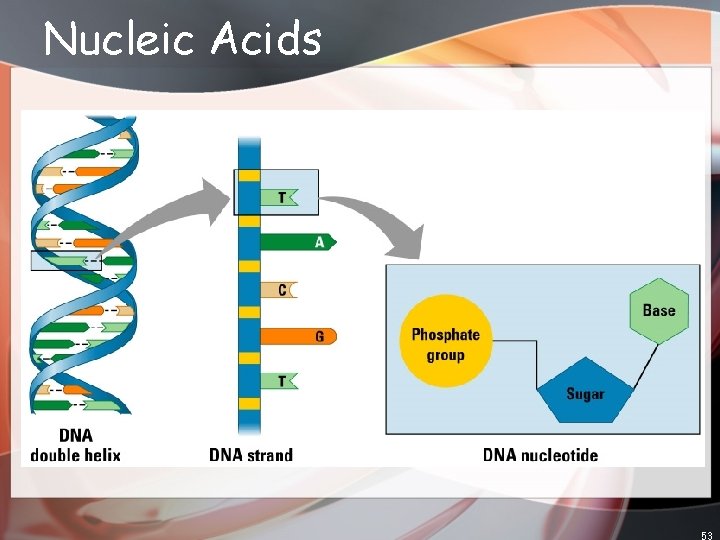
Nucleic Acids 53
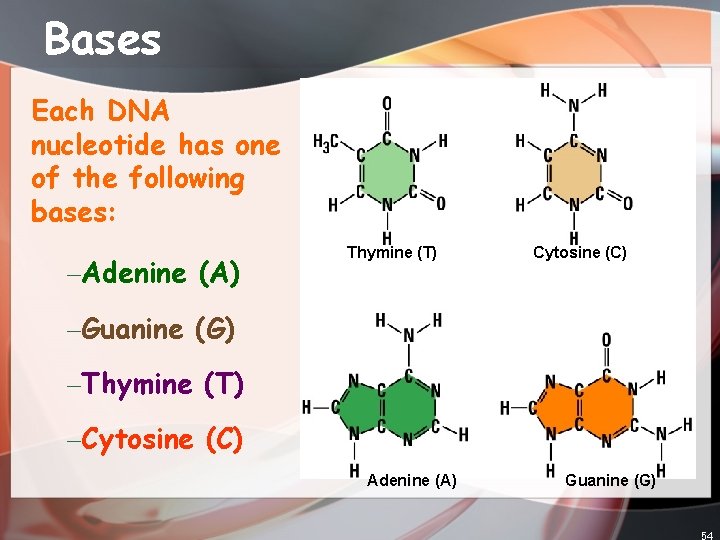
Bases Each DNA nucleotide has one of the following bases: –Adenine (A) Thymine (T) Cytosine (C) –Guanine (G) –Thymine (T) –Cytosine (C) Adenine (A) Guanine (G) 54
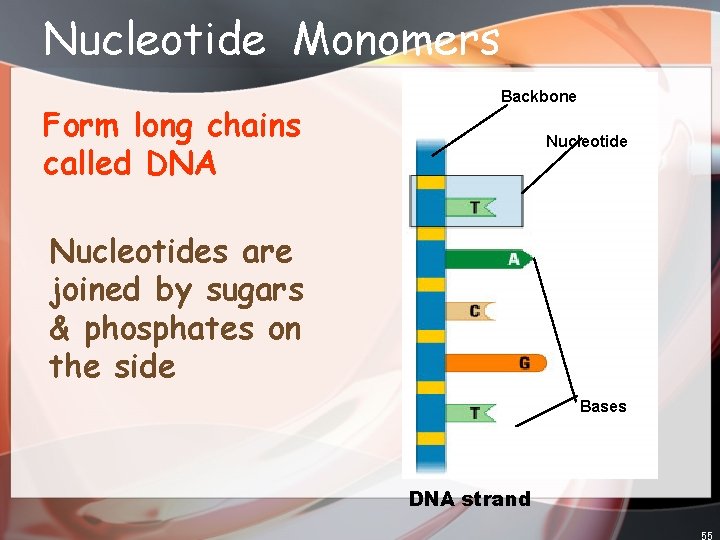
Nucleotide Monomers Form long chains called DNA Backbone Nucleotides are joined by sugars & phosphates on the side Bases DNA strand 55
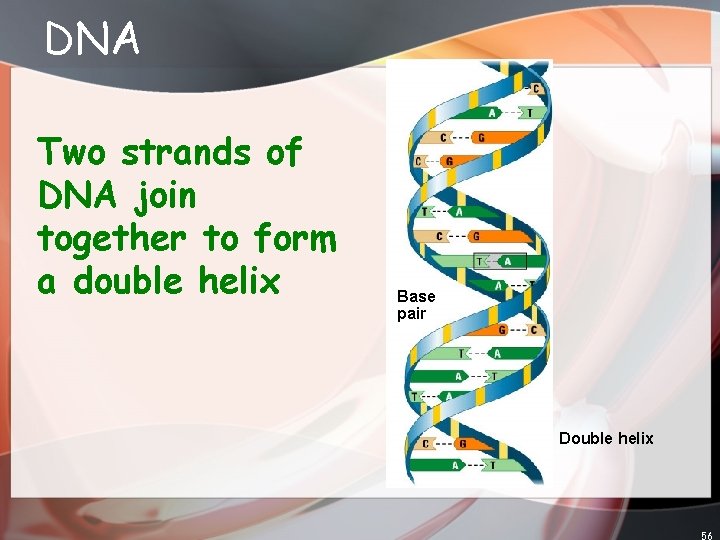
DNA Two strands of DNA join together to form a double helix Base pair Double helix 56
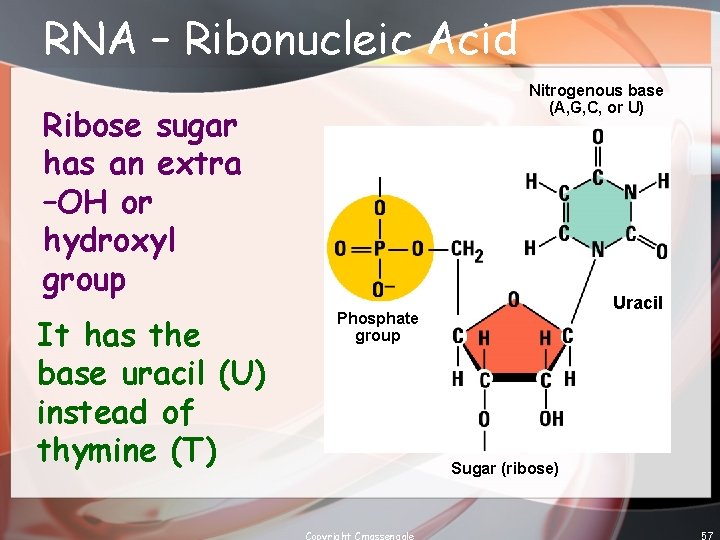
RNA – Ribonucleic Acid Nitrogenous base (A, G, C, or U) Ribose sugar has an extra –OH or hydroxyl group It has the base uracil (U) instead of thymine (T) Uracil Phosphate group Sugar (ribose) Copyright Cmassengale 57
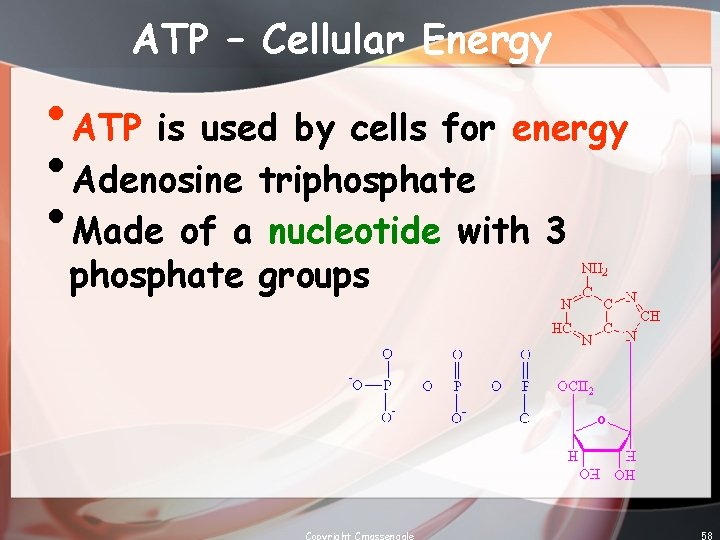
ATP – Cellular Energy • ATP is used by cells for energy • Adenosine triphosphate • Made of a nucleotide with 3 phosphate groups Copyright Cmassengale 58
ATP – Cellular Energy • Energy is stored in the chemical bonds of ATP • The last 2 phosphate bonds are HIGH ENERGY • Breaking the last phosphate bond • releases energy for cellular work and produces ADP and a free phosphate ADP (adenosine Diphosphate) can be rejoined to the free phosphate to make more ATP Copyright Cmassengale 59
Summary of Key Concepts Copyright Cmassengale 60
Macromolecules Copyright Cmassengale 61
Macromolecules Copyright Cmassengale 62
End Copyright Cmassengale 63
- Slides: 63