
Biochemistry of biological fluids BIOCH 472 DR MANSOUR
Biochemistry of biological fluids (BIOCH 472) DR. MANSOUR GATASHEH Biochemistry Department, Science College King Saud University

Class 9: Sweat https: //www. tandfonline. com/loi/ktmp 20

Objectives for this lecture l Describe the formation and function of Sweat
Sweat Fluid l l l plays a critical role in human thermoregulation. sweat glands are play an excretory function similar to renal system by clearing excess: Ø Micronutrient (skin health, excess). Ø Metabolic waste. Ø Toxicants Sweat excretion may lead to perturbations in health, such as micronutrient imbalances.
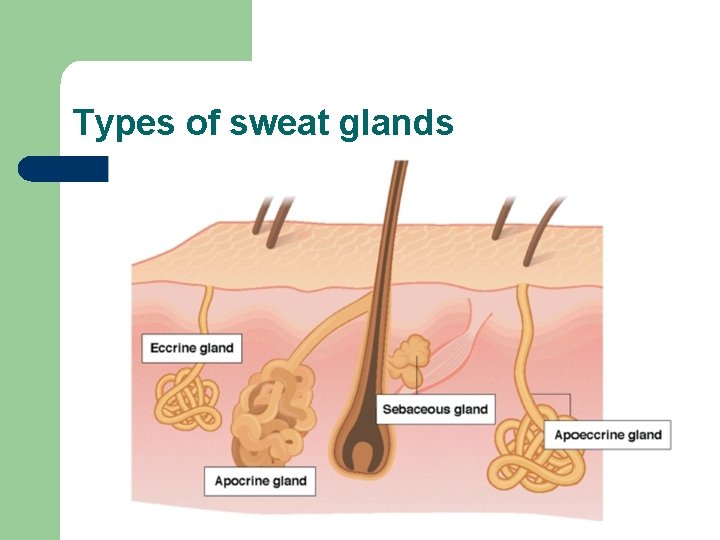
Types of sweat glands
Type of Sweat Glands 1. Eccrine: • small, numerous, highest volume excretion. • found on glabrous (palms, soles) and nonglabrous (hairy) skin. • total number is fixed throughout life, gland density decreases with skin expansion during growth (high in children) • Its sweat is water and Na. Cl.
2. Apocrine: • In axilla, breasts, face, scalp, and the perineum. • Larger, open into hair follicles instead of onto the skin surface. • produce lipid-rich sweat, proteins, sugars, and ammonia. • Its scent glands by producing pheromones (body odor).
3. Apoeccrine: • develop from eccrine sweat glands between the ages of ~8 to 14 years (axillary). • produces high salt water secretions.
4. Sebaceous glands: • not a type of sweat gland. • Associated with hair follicles, present in scalp, forehead, face, and anogenital area. • Absent on the palms of hands and soles of the feet. • Secrete triglycerides, wax esters, cholesterol, and cholesterol esters.
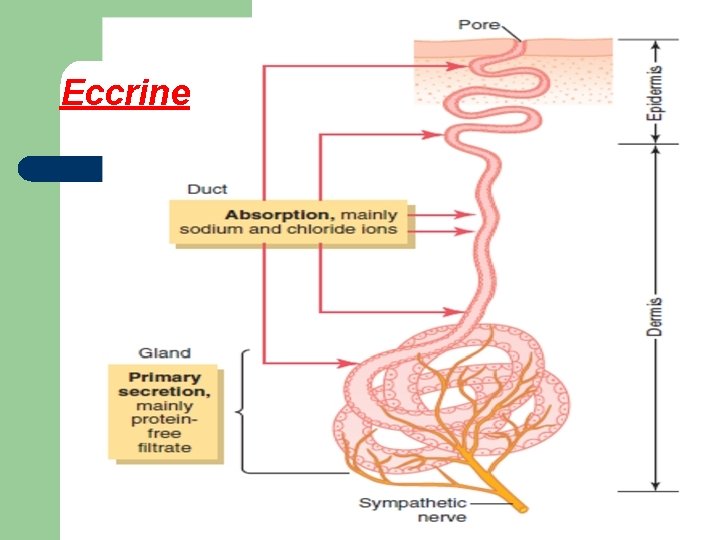
Eccrine
l l Transport and reabsorption of Na is an active process. Eccrine sweat glands respond to: ü increased body core temperature (exercise). ü skin temperature. ü increases in skin blood flow. thermoreceptors is processed by hypothalamus. Catecholamines for neural stimulation of sweating
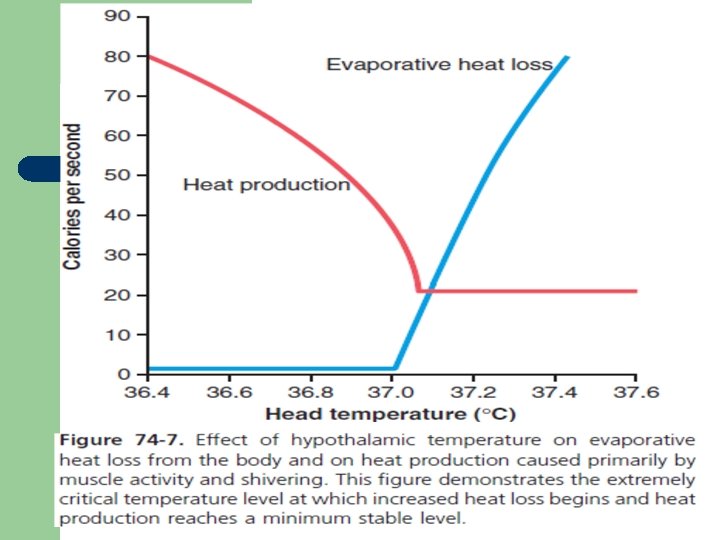
l l dehydration delay the sweating response. Hyperosmolality increases body temperature threshold for sweating. Hypovolemia reduce sweating sensitivity. men exhibit higher sweating rates than women.
Lab Methodology l 1. 2. 3. 4. 5. Main aspects of sweat methodology: skin cleaning/preparation sweat stimulation sweat collection (sweat and skin contaminant) Sample storage analytical technique
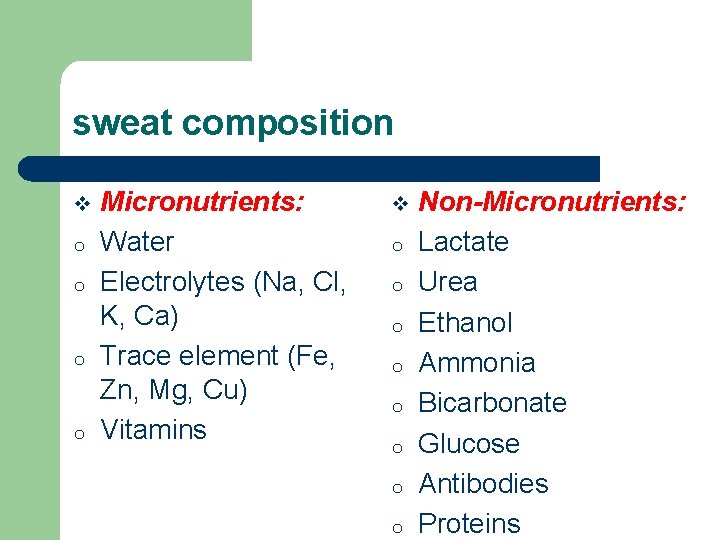
sweat composition v o o Micronutrients: Water Electrolytes (Na, Cl, K, Ca) Trace element (Fe, Zn, Mg, Cu) Vitamins v o o o o Non-Micronutrients: Lactate Urea Ethanol Ammonia Bicarbonate Glucose Antibodies Proteins
Comparison of sweat gland kidney function l l l Na reabsorption in sweat gland is greater than that of the kidneys. Chemicals excreted in sweat have higher concentration that of blood and/or urine. effective cure for hangovers after heavy drinking is to stimulate sweating (via exercise or sauna bathing).
l transport urea across sweat gland, especially in patients with kidney damage, to clear the blood of high urea concentrations.
sweat gland function from conditions l l Reduced sweating include burns and skin grafting sunburn, miliaria rubra, and atopic dermatitis. Hyperhidrosis, excess sweating, occur with: ü primary etiology (fever, pregnancy, menopause). ü pathology (malignancy, endocrine, metabolic, or psychiatric disorder).
![Cystic fibrosis l l Sweat biomarker is the use of sweat [Cl] for the](http://slidetodoc.com/presentation_image_h/16a07a725e3ae3bd376ab74020094e84/image-19.jpg "Cystic fibrosis l l Sweat biomarker is the use of sweat [Cl] for the")
Cystic fibrosis l l Sweat biomarker is the use of sweat [Cl] for the diagnosis of cystic fibrosis. Individuals with cystic fibrosis have higher sweat [Cl] because of a genetic absence of a functioning CFTR (two defective genes, homozygote). In cystic fibrosis the sweat [Cl] >60 mmol/L. Na is also poorly reabsorbed in individuals with cystic fibrosis, being high in sweat.
Reference l Physiology of sweat gland function: The roles of sweating and sweat composition in human health, Lindsay B. Baker, 2332 -8959 (Online) Journal homepage: https: //www. tandfonline. com/loi/ktmp 20
- Slides: 20