
Biochemistry Inborn Errors of amino acid Metabolism One
Biochemistry Inborn Errors of amino acid Metabolism One day or day one you decide. . § Important. § Extra Information. § Doctors slides 436 Biochemistry team 1
OBJECTIVES: By the end of this lecture the students will be able to: • Identify the amino acid degradation and synthesis of non-essential amino acids. • Recognize the metabolic defects in amino acids metabolism that lead to genetic diseases. 2
Inborn Errors EXTRA SLIDE • Inborn errors are divided into : 1. Amino acids inborn errors. 2. Carbohydrate inborn errors. 3. Organic acids inborn errors. 4. Lysosomal storage inborn errors. Recall We have 20 amino acids and divided into essential and non essential depending on the ability of human body to synthesize it. 3

Inborn Errors of amino acid Metabolism • Caused by enzyme or co-factor loss or deficiency due to gene mutation. • Substrate + enzyme Co-factor Product In case of defect enzyme substrate will not react sufficiently thus it might accumulate in the tissues • Types: 1. Phenylketonuria. 2. Maple syrup Urine disease. 3. Albinism. 4. Homocystinuria. 5. Alkaptonuria. ﻳﻌﻨﻲ ﻟﻤﺎ ﺍﻟﻤﺮﻳﺾ ﻳﻜﻮﻥ ﻋﻨﺪﻩ ﻧﻘﺺ ﻓﻲ ﺍﻻﻧﺰﺍﻳﻤﺰ ﺑﻴﺼﻴﺮﻋﻨﺪﻩ ﻓﺎﺋﺾ ﻓﻲ ﺍﻟﻤﺘﻔﺎﻋﻼﺕ ﻭﻧﻘﺺ ﻓﻲ . ﺍﻟﻨﻮﺍﺗﺞ Cofactors Enzyme Defect Yet, no complete loss of activity Substrate Product Excess Deficient (unless there is another source that you can obtain this product from) 4
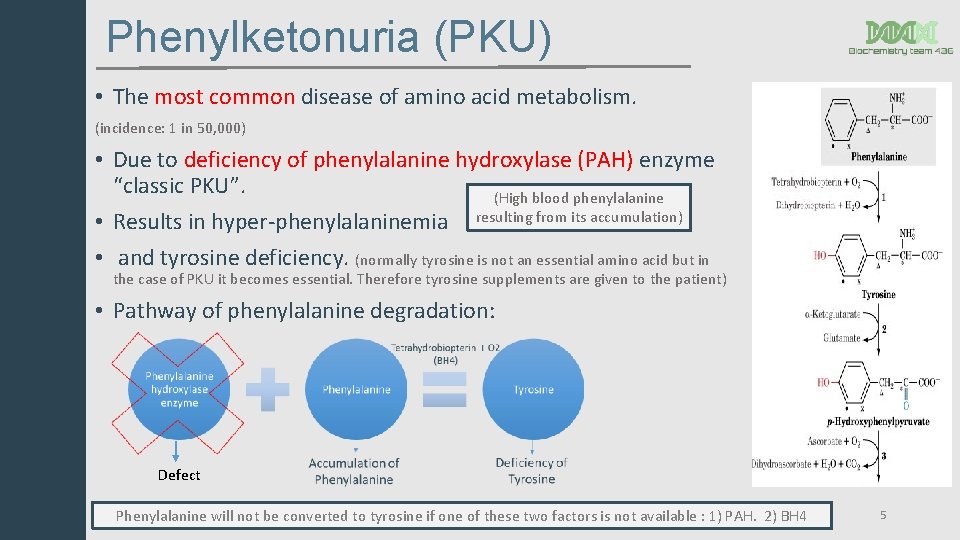
Phenylketonuria (PKU) • The most common disease of amino acid metabolism. (incidence: 1 in 50, 000) • Due to deficiency of phenylalanine hydroxylase (PAH) enzyme “classic PKU”. (High blood phenylalanine • Results in hyper-phenylalaninemia resulting from its accumulation) • and tyrosine deficiency. (normally tyrosine is not an essential amino acid but in the case of PKU it becomes essential. Therefore tyrosine supplements are given to the patient) • Pathway of phenylalanine degradation: Defect Phenylalanine will not be converted to tyrosine if one of these two factors is not available : 1) PAH. 2) BH 4 5
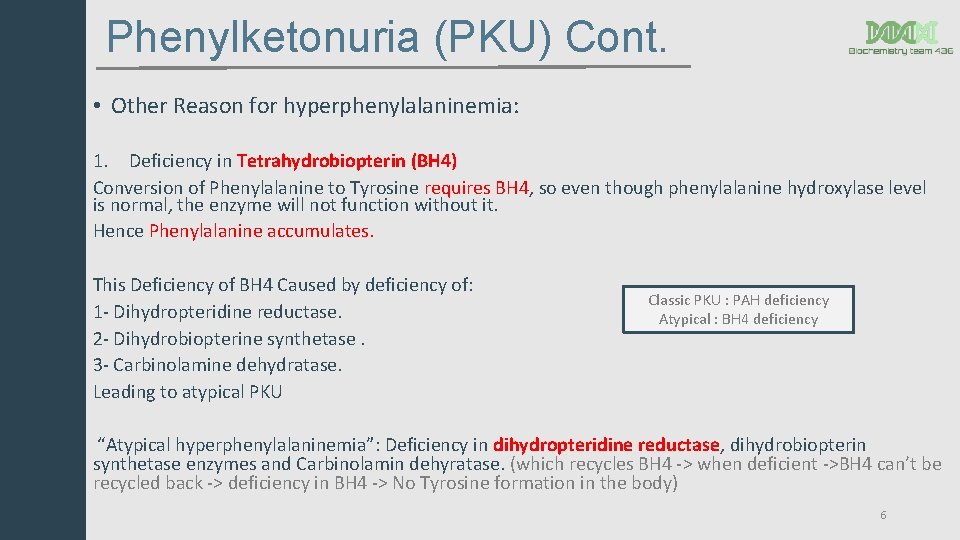
Phenylketonuria (PKU) Cont. • Other Reason for hyperphenylalaninemia: 1. Deficiency in Tetrahydrobiopterin (BH 4) Conversion of Phenylalanine to Tyrosine requires BH 4, so even though phenylalanine hydroxylase level is normal, the enzyme will not function without it. Hence Phenylalanine accumulates. This Deficiency of BH 4 Caused by deficiency of: 1 - Dihydropteridine reductase. 2 - Dihydrobiopterine synthetase. 3 - Carbinolamine dehydratase. Leading to atypical PKU Classic PKU : PAH deficiency Atypical : BH 4 deficiency “Atypical hyperphenylalaninemia”: Deficiency in dihydropteridine reductase, dihydrobiopterin synthetase enzymes and Carbinolamin dehyratase. (which recycles BH 4 -> when deficient ->BH 4 can’t be recycled back -> deficiency in BH 4 -> No Tyrosine formation in the body) 6
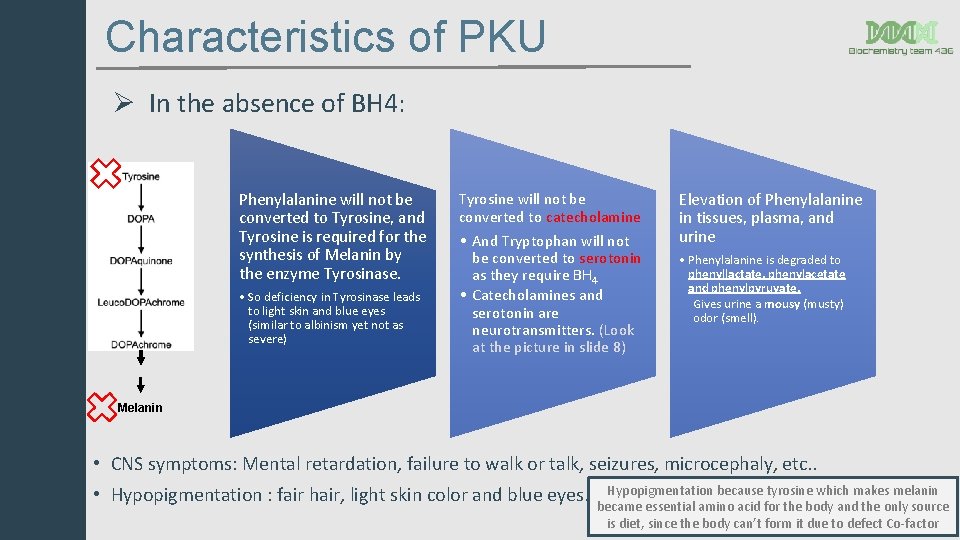
Characteristics of PKU Ø In the absence of BH 4: Phenylalanine will not be converted to Tyrosine, and Tyrosine is required for the synthesis of Melanin by the enzyme Tyrosinase. • So deficiency in Tyrosinase leads to light skin and blue eyes (similar to albinism yet not as severe) Tyrosine will not be converted to catecholamine • And Tryptophan will not be converted to serotonin as they require BH 4 • Catecholamines and serotonin are neurotransmitters. (Look at the picture in slide 8) Elevation of Phenylalanine in tissues, plasma, and urine • Phenylalanine is degraded to phenyllactate, phenylacetate and phenylpyruvate. Gives urine a mousy (musty) odor (smell). Melanin • CNS symptoms: Mental retardation, failure to walk or talk, seizures, microcephaly, etc. . • Hypopigmentation : fair hair, light skin color and blue eyes. Hypopigmentation because tyrosine which makes melanin became essential amino acid for the body and the only source is diet, since the body can’t form it due to defect Co-factor
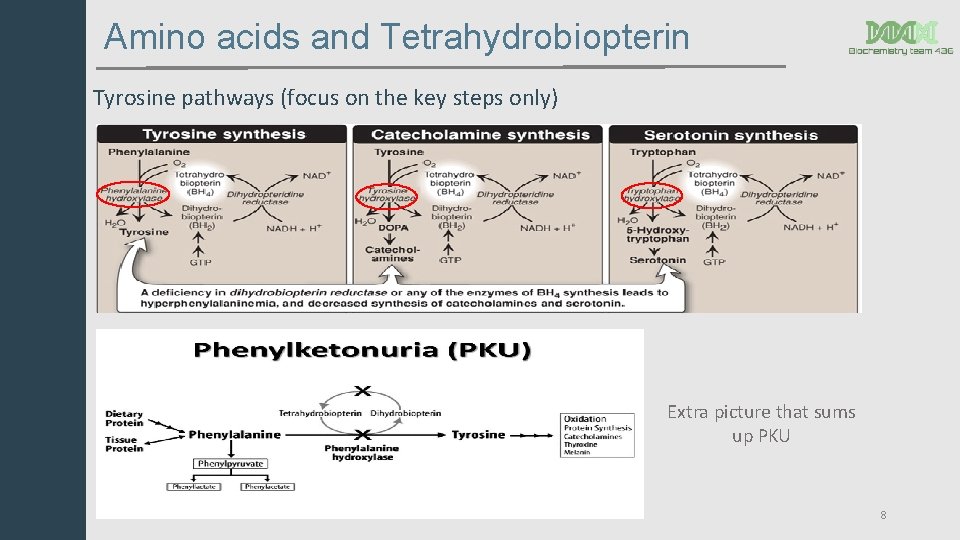
Amino acids and Tetrahydrobiopterin Tyrosine pathways (focus on the key steps only) Extra picture that sums up PKU 8
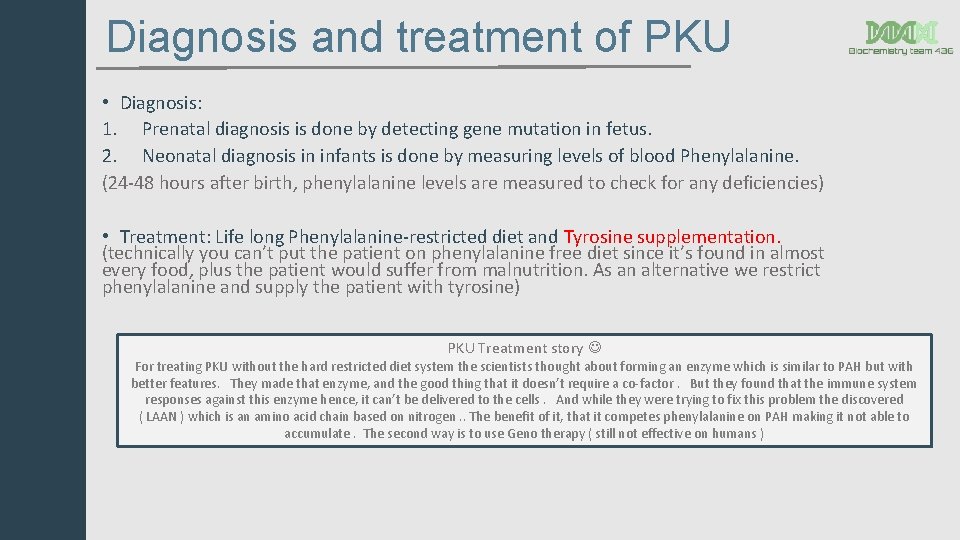
Diagnosis and treatment of PKU • Diagnosis: 1. Prenatal diagnosis is done by detecting gene mutation in fetus. 2. Neonatal diagnosis in infants is done by measuring levels of blood Phenylalanine. (24 -48 hours after birth, phenylalanine levels are measured to check for any deficiencies) • Treatment: Life long Phenylalanine-restricted diet and Tyrosine supplementation. (technically you can’t put the patient on phenylalanine free diet since it’s found in almost every food, plus the patient would suffer from malnutrition. As an alternative we restrict phenylalanine and supply the patient with tyrosine) PKU Treatment story For treating PKU without the hard restricted diet system the scientists thought about forming an enzyme which is similar to PAH but with better features. They made that enzyme, and the good thing that it doesn’t require a co-factor. But they found that the immune system responses against this enzyme hence, it can’t be delivered to the cells. And while they were trying to fix this problem the discovered ( LAAN ) which is an amino acid chain based on nitrogen. . The benefit of it, that it competes phenylalanine on PAH making it not able to accumulate. The second way is to use Geno therapy ( still not effective on humans )

Maple syrup Urine disease • Due to deficiency of branched chain α-ketoacid dehydrogenase (BCKD). • This enzyme decarboxylates leucine, isoleucine and valine. When BCKD is deficient, these amino acids and their keto-acids accumulate in blood. • Symptoms: mental retardation, physical disability, metabolic acidosis, etc. . • Maple syrup odor (smell) of urine. MSUD is mainly due to enzyme deficiency. it’s too rare to have abnormal Co-factor (thiamine) Types • Treatment: Limited intake of leucine, isoleucine and valine causes no toxic effects. (Restrict intake causing less accumulation) Classic type: The most common, due to little or no activity of branched α-ketoacid dehydrogenase. Intermediate and intermittent forms: Higher enzyme activity, symptoms are milder. Thiamine-responsive form: High doses of thiamine increases α-ketoacid dehydrogenase activity. (it’s the intermediate form yet the only difference is that the patient here respond very well and thus treated with thiamine)
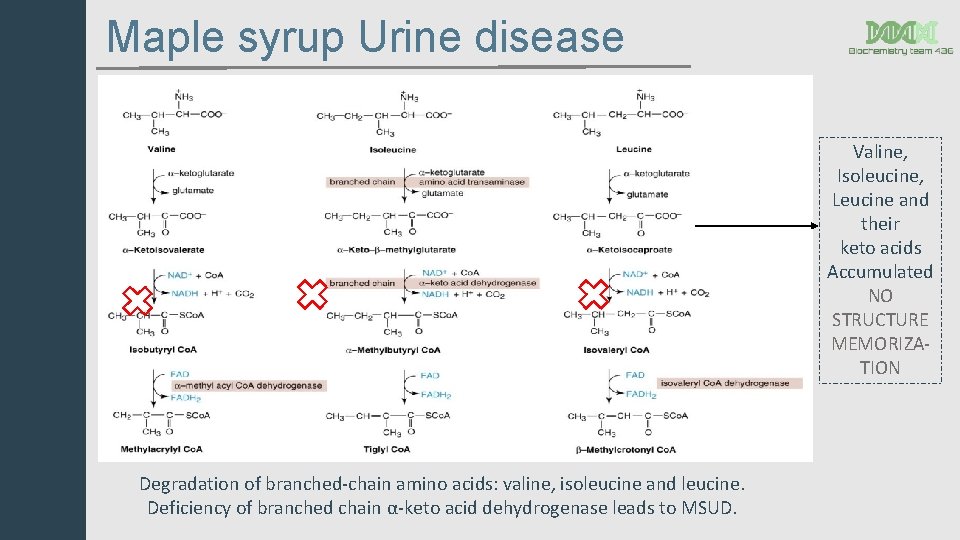
Maple syrup Urine disease Valine, Isoleucine, Leucine and their keto acids Accumulated NO STRUCTURE MEMORIZATION Degradation of branched-chain amino acids: valine, isoleucine and leucine. Deficiency of branched chain α-keto acid dehydrogenase leads to MSUD.
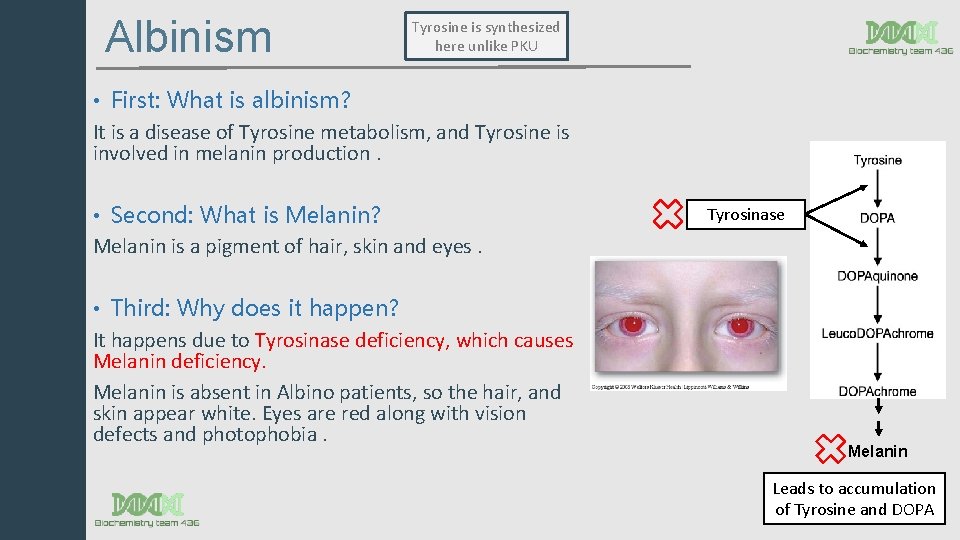
Albinism Tyrosine is synthesized here unlike PKU • First: What is albinism? It is a disease of Tyrosine metabolism, and Tyrosine is involved in melanin production. • Second: What is Melanin? Melanin is a pigment of hair, skin and eyes. • Third: Why does it happen? It happens due to Tyrosinase deficiency, which causes Melanin deficiency. Melanin is absent in Albino patients, so the hair, and skin appear white. Eyes are red along with vision defects and photophobia. Tyrosinase Melanin Leads to accumulation of Tyrosine and DOPA
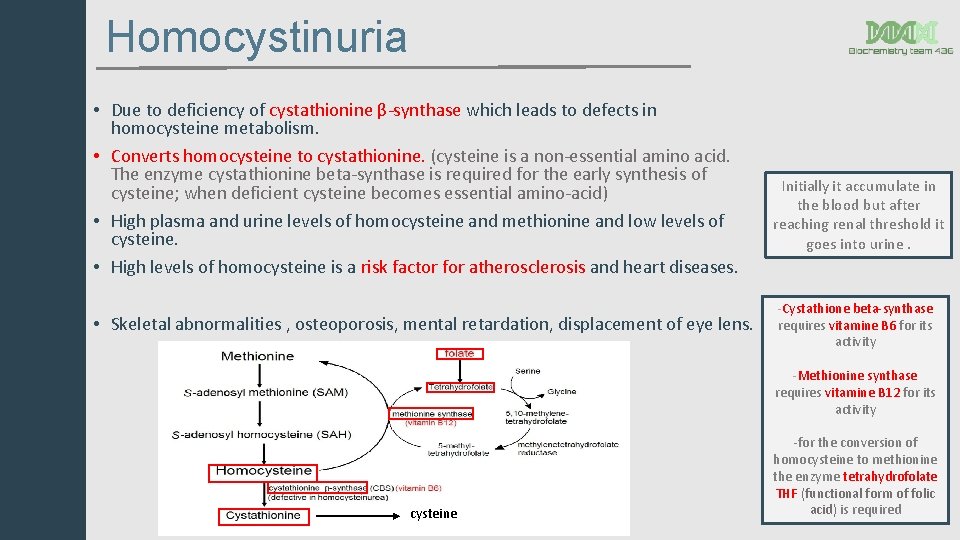
Homocystinuria • Due to deficiency of cystathionine β-synthase which leads to defects in homocysteine metabolism. • Converts homocysteine to cystathionine. (cysteine is a non-essential amino acid. The enzyme cystathionine beta-synthase is required for the early synthesis of cysteine; when deficient cysteine becomes essential amino-acid) • High plasma and urine levels of homocysteine and methionine and low levels of cysteine. • High levels of homocysteine is a risk factor for atherosclerosis and heart diseases. • Skeletal abnormalities , osteoporosis, mental retardation, displacement of eye lens. Initially it accumulate in the blood but after reaching renal threshold it goes into urine. -Cystathione beta-synthase requires vitamine B 6 for its activity -Methionine synthase requires vitamine B 12 for its activity cysteine -for the conversion of homocysteine to methionine the enzyme tetrahydrofolate THF (functional form of folic acid) is required
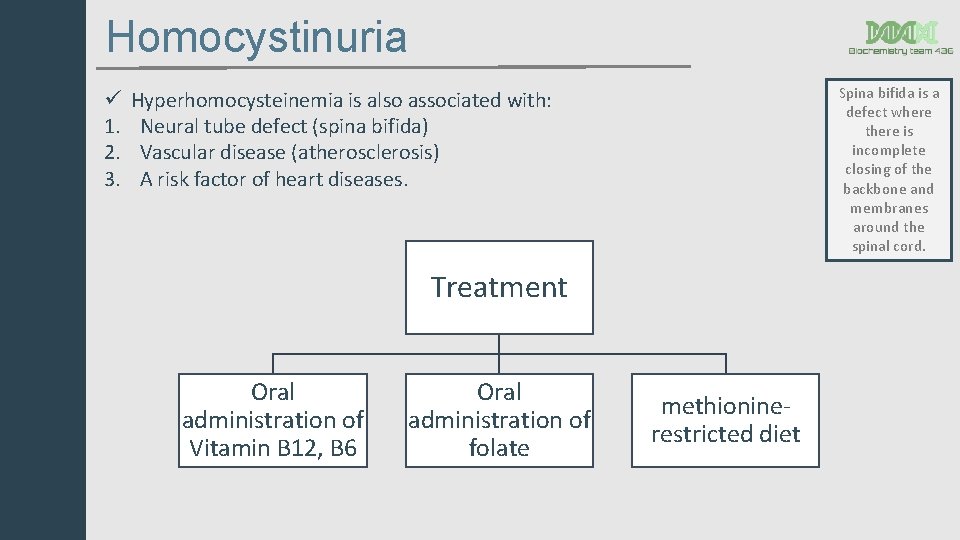
Homocystinuria ü 1. 2. 3. Spina bifida is a defect where there is incomplete closing of the backbone and membranes around the spinal cord. Hyperhomocysteinemia is also associated with: Neural tube defect (spina bifida) Vascular disease (atherosclerosis) A risk factor of heart diseases. Treatment Oral administration of Vitamin B 12, B 6 Oral administration of folate methioninerestricted diet
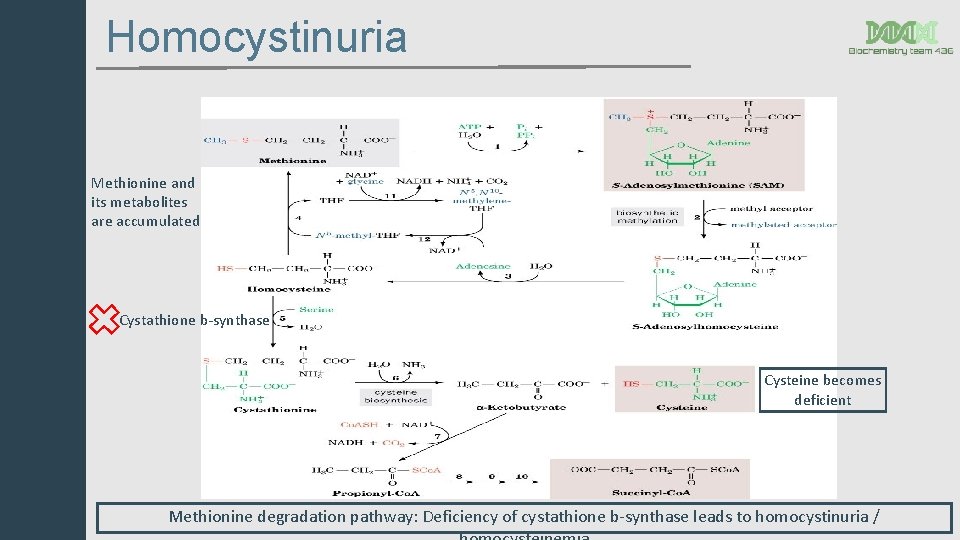
Homocystinuria Methionine and its metabolites are accumulated Cystathione b-synthase Cysteine becomes deficient Methionine degradation pathway: Deficiency of cystathione b-synthase leads to homocystinuria /

Alkaptonuria • A rare disease of Tyrosine degradation. • Due to deficiency of homogentisic acid oxidase. Lead to accumulation of homogentisic acid (molecule produced in the tyrosine degradation pathway) Tyrosine Catecholamine P-Hydroxyphenylpyruvate Melanin This disorder associated with dark urine Challenge : Do you remember how many disorders associated with Tyrosine abnormality in this lecture ? ? ���� Homogentisic acid oxidase Fumarate TCA (tricarboxilc acid) cycle

Characteristics of Alkaptonuria Homogentisic aciduria: elevated homogentisic acid in urine which is oxidized to dark pigment over time. (only symptom during childhood) Arthritis and black pigmentation of cartilage and tissues. (appears later on time; around 40 s) Usually asymptomatic until adulthood. ØTreatment: Restricted intake of Tyrosine and Phenylalanine reduces homogentisic acid and dark pigmentation.
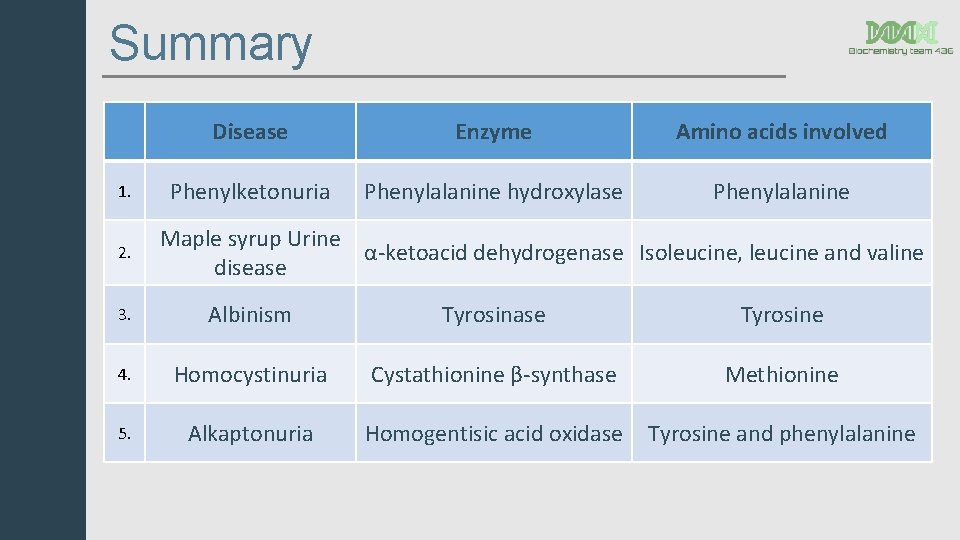
Summary 1. 2. Disease Enzyme Amino acids involved Phenylketonuria Phenylalanine hydroxylase Phenylalanine Maple syrup Urine α-ketoacid dehydrogenase Isoleucine, leucine and valine disease 3. Albinism Tyrosinase Tyrosine 4. Homocystinuria Cystathionine β-synthase Methionine 5. Alkaptonuria Homogentisic acid oxidase Tyrosine and phenylalanine

TEAM MEMBERS TEAM LEADERS • . Rania Alessa • . Mohammad Almutlaq ﻫﺒﻪ ﺍﻟﻨﺎﺻﺮ 19

• Review the notes THANK YOU • Lippincott's Illustrated Reviews: Biochemistry, 6 th E PLEASE CONTACT US IF YOU HAVE ANY ISSUE • @436 Biochemteam • Biochemistryteam 436@gmail. com 20
- Slides: 20