
Biochemistry Electron Transport Chain Respiratory Chain Your patient
Biochemistry Electron Transport Chain (Respiratory Chain) Your patient is someone's mom someone’s wife someone’s best friend. Please study hard. . § Important. § Extra Information. § Doctors slides 1
OBJECTIVES: § By the end of this lecture the students will be able to: • Understand how energy-rich molecules including glucose are metabolized by a series of oxidation-reduction reactions ultimately yielding CO 2 and water. • Explain the process of electron transport chain that releases free energy, which is used for ATP synthesis and heat production. • Recognize the reactions of electron transport chain taking place in mitochondria that are coupled to oxidative phosphorylation. 2
Electron Transport Chain (ETC) Recall: 1 -The ETC happens after krebs cycle. 2 -Most of the ATP is synthesized by this process. 3 -Proteins transport the electrons. 4 - Respiratory chain ETC cellular respiration are the same Another difinition of ETC that Dr. Sumbul mentioned: It’s a process which involves the transfer of electrons to create a proton gradient because it’s the proton gradient that is responsible of generation of ATP not the ETC directly • A system of electron transport that uses respiratory O 2 to finally produce ATP (energy) Which is the purpose of ETC • Located in the inner mitochondrial membrane is metabolized into simple • Final common pathway of metabolism Everything molecules CO 2H 2 O • Electrons from food metabolism are transported to O 2 Such as: Carbohydrates, fat and protenis • Uses maximum amount of body’s oxygen That’s why its called ETC
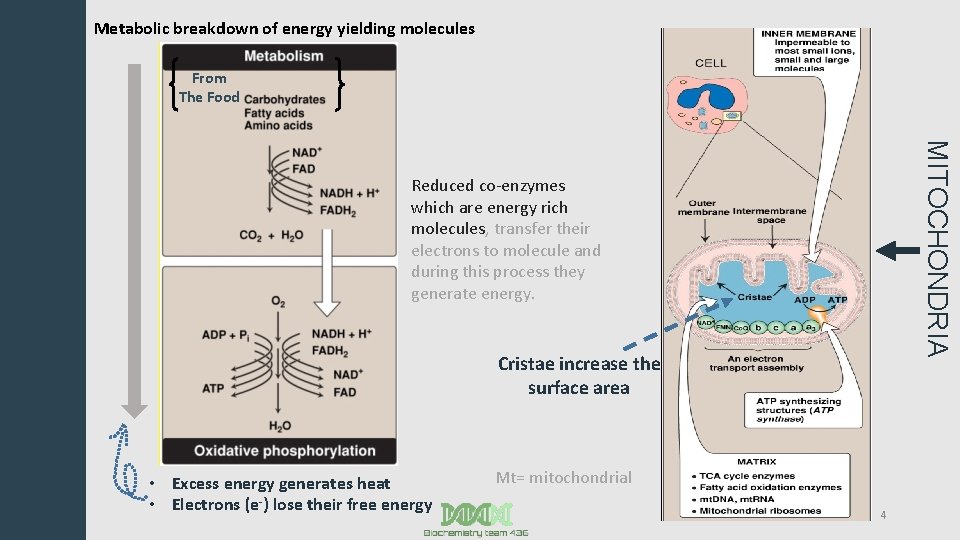
Metabolic breakdown of energy yielding molecules From The Food MITOCHONDRIA Reduced co-enzymes which are energy rich molecules, transfer their electrons to molecule and during this process they generate energy. Cristae increase the surface area • Excess energy generates heat • Electrons (e-) lose their free energy Mt= mitochondrial 4
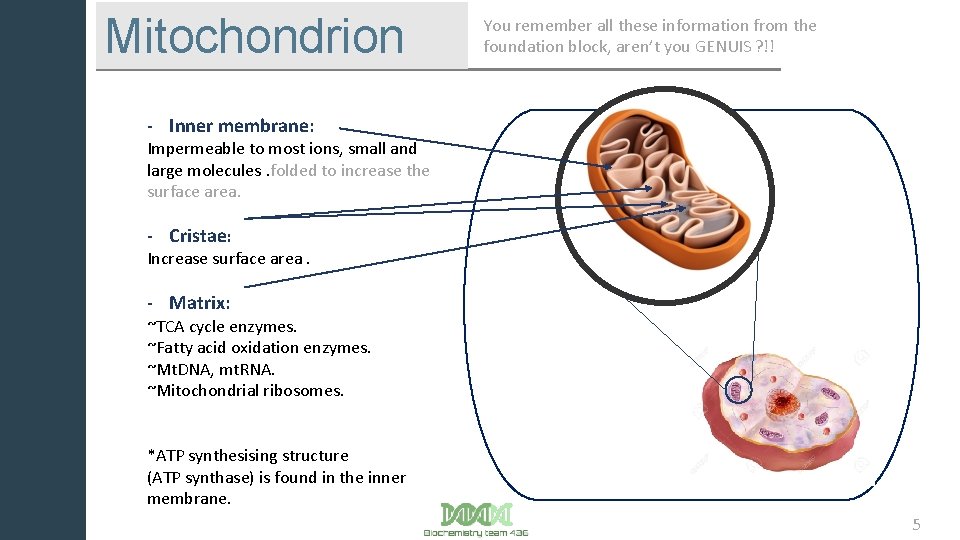
Mitochondrion You remember all these information from the foundation block, aren’t you GENUIS ? !! - Inner membrane: Impermeable to most ions, small and large molecules. folded to increase the surface area. - Cristae: Increase surface area. - Matrix: ~TCA cycle enzymes. ~Fatty acid oxidation enzymes. ~Mt. DNA, mt. RNA. ~Mitochondrial ribosomes. Kk *ATP synthesising structure (ATP synthase) is found in the inner membrane. 5
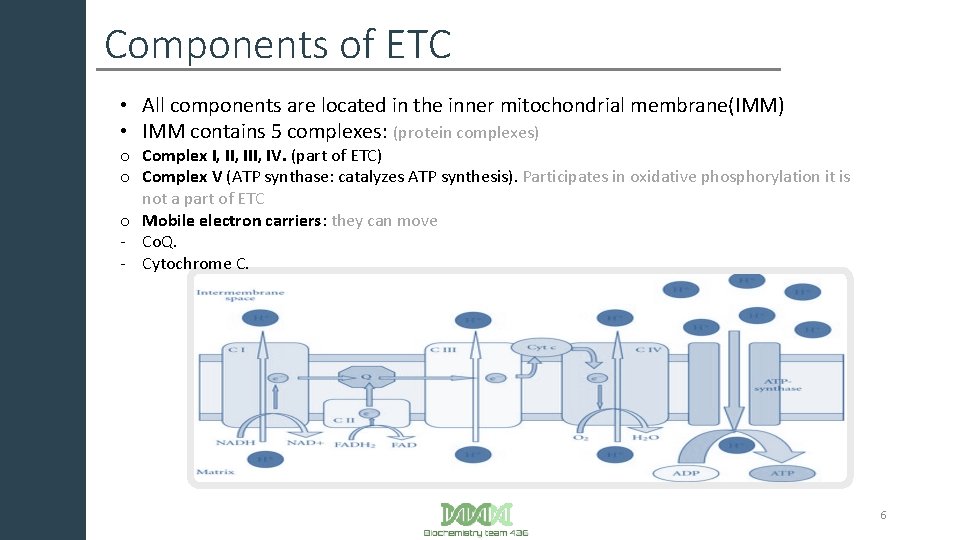
Components of ETC • All components are located in the inner mitochondrial membrane(IMM) • IMM contains 5 complexes: (protein complexes) o Complex I, III, IV. (part of ETC) o Complex V (ATP synthase: catalyzes ATP synthesis). Participates in oxidative phosphorylation it is not a part of ETC o Mobile electron carriers: they can move - Co. Q. - Cytochrome C. 6
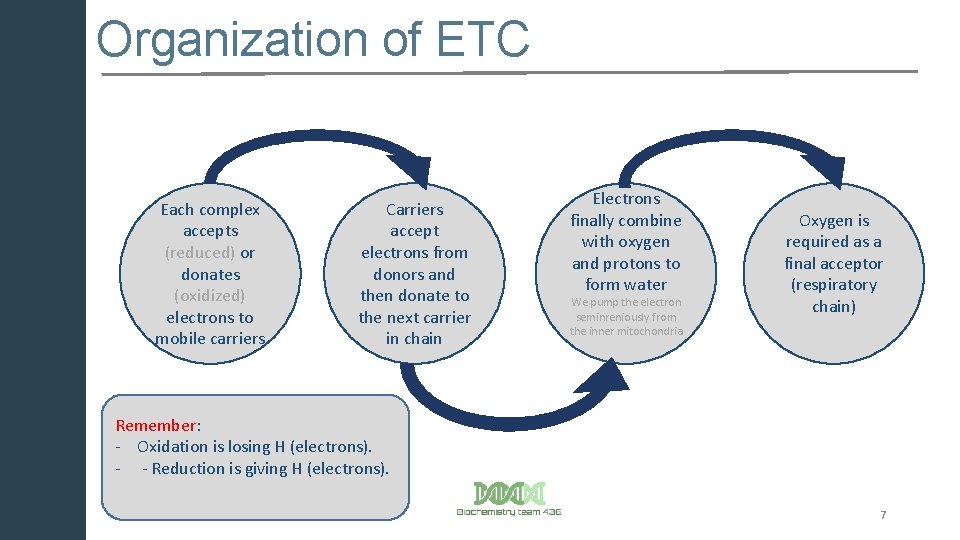
Organization of ETC Each complex accepts (reduced) or donates (oxidized) electrons to mobile carriers Carriers accept electrons from donors and then donate to the next carrier in chain Electrons finally combine with oxygen and protons to form water We pump the electron seminreniously from the inner mitochondria Oxygen is required as a final acceptor (respiratory chain) Remember: - Oxidation is losing H (electrons). - - Reduction is giving H (electrons). 7
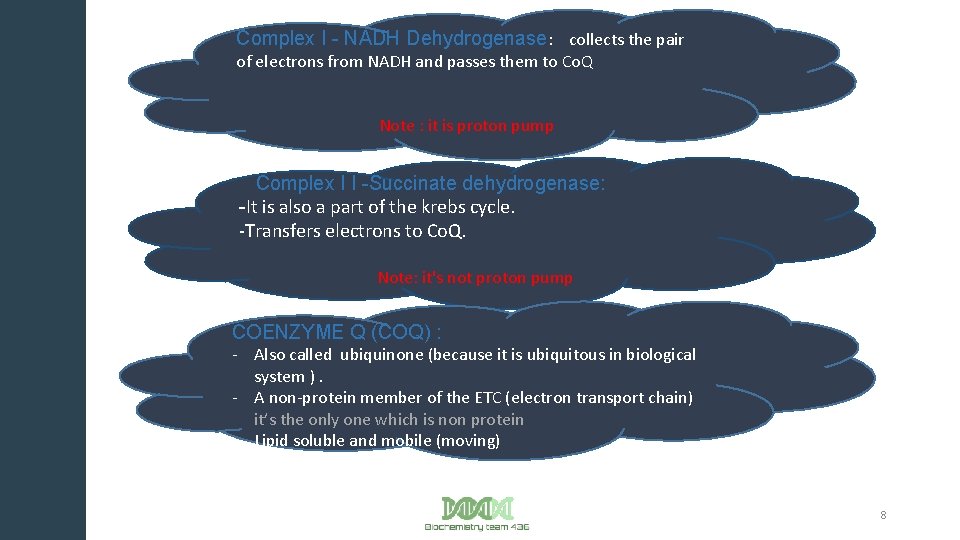
Complex I - NADH Dehydrogenase: collects the pair of electrons from NADH and passes them to Co. Q Note : it is proton pump Complex I I -Succinate dehydrogenase: -It is also a part of the krebs cycle. -Transfers electrons to Co. Q. Note: it's not proton pump COENZYME Q (COQ) : - Also called ubiquinone (because it is ubiquitous in biological system ). - A non-protein member of the ETC (electron transport chain) it’s the only one which is non protein - Lipid soluble and mobile (moving) 8
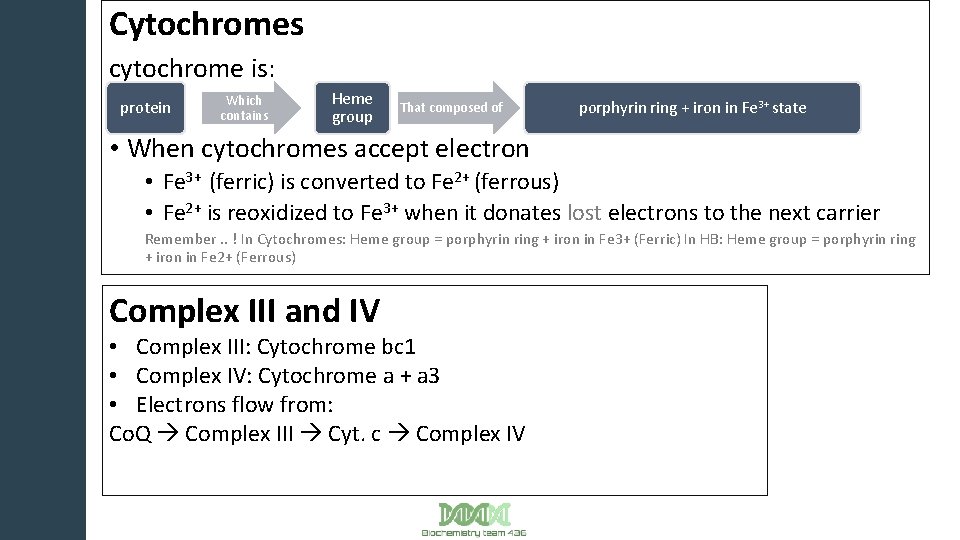
Cytochromes cytochrome is: protein Which contains Heme group That composed of porphyrin ring + iron in Fe 3+ state • When cytochromes accept electron • Fe 3+ (ferric) is converted to Fe 2+ (ferrous) • Fe 2+ is reoxidized to Fe 3+ when it donates lost electrons to the next carrier Remember. . ! In Cytochromes: Heme group = porphyrin ring + iron in Fe 3+ (Ferric) In HB: Heme group = porphyrin ring + iron in Fe 2+ (Ferrous) Complex III and IV • Complex III: Cytochrome bc 1 • Complex IV: Cytochrome a + a 3 • Electrons flow from: Co. Q Complex III Cyt. c Complex IV
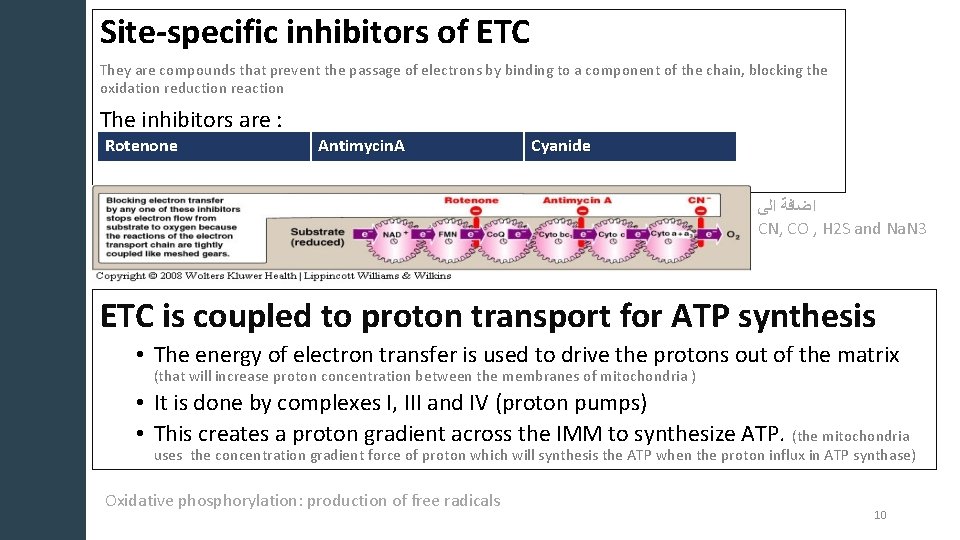
Site-specific inhibitors of ETC They are compounds that prevent the passage of electrons by binding to a component of the chain, blocking the oxidation reduction reaction The inhibitors are : Rotenone Antimycin. A Cyanide ﺍﻟﻰ ﺍﺿﺎﻓﺔ CN, CO , H 2 S and Na. N 3 ETC is coupled to proton transport for ATP synthesis • The energy of electron transfer is used to drive the protons out of the matrix (that will increase proton concentration between the membranes of mitochondria ) • It is done by complexes I, III and IV (proton pumps) • This creates a proton gradient across the IMM to synthesize ATP. (the mitochondria uses the concentration gradient force of proton which will synthesis the ATP when the proton influx in ATP synthase) Oxidative phosphorylation: production of free radicals 10
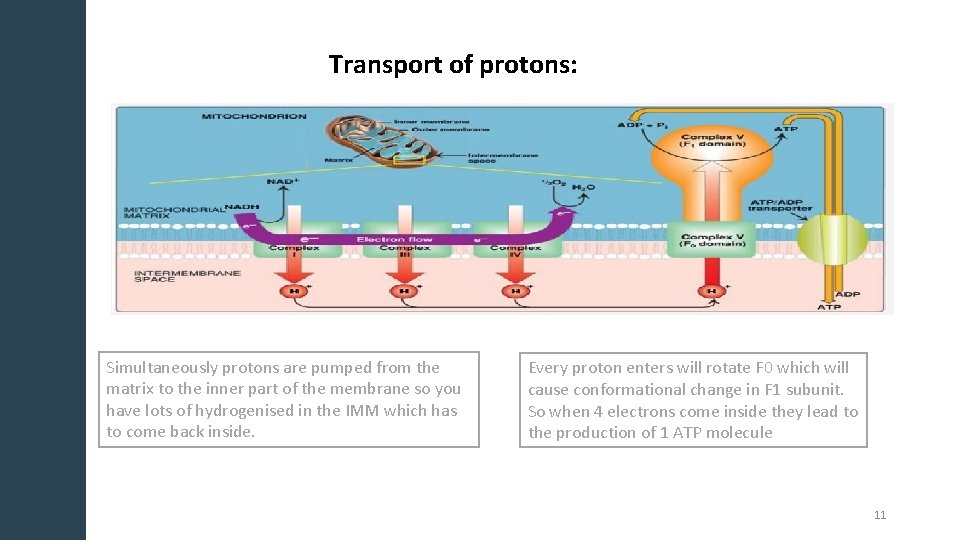
Transport of protons: Simultaneously protons are pumped from the matrix to the inner part of the membrane so you have lots of hydrogenised in the IMM which has to come back inside. Every proton enters will rotate F 0 which will cause conformational change in F 1 subunit. So when 4 electrons come inside they lead to the production of 1 ATP molecule 11
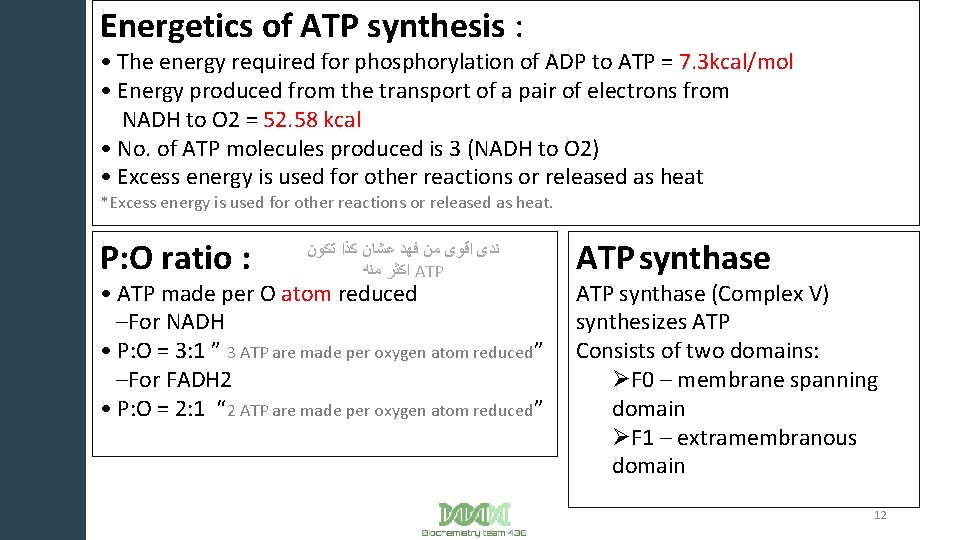
Energetics of ATP synthesis : • The energy required for phosphorylation of ADP to ATP = 7. 3 kcal/mol • Energy produced from the transport of a pair of electrons from NADH to O 2 = 52. 58 kcal • No. of ATP molecules produced is 3 (NADH to O 2) • Excess energy is used for other reactions or released as heat *Excess energy is used for other reactions or released as heat. P: O ratio : ﺗﻜﻮﻥ ﻛﺬﺍ ﻋﺸﺎﻥ ﻓﻬﺪ ﻣﻦ ﺍﻗﻮﻯ ﻧﺪﻯ ﻣﻨﻪ ﺍﻛﺜﺮ ATP • ATP made per O atom reduced –For NADH • P: O = 3: 1 ” 3 ATP are made per oxygen atom reduced” –For FADH 2 • P: O = 2: 1 “ 2 ATP are made per oxygen atom reduced” ATP synthase (Complex V) synthesizes ATP Consists of two domains: ØF 0 – membrane spanning domain ØF 1 – extramembranous domain 12
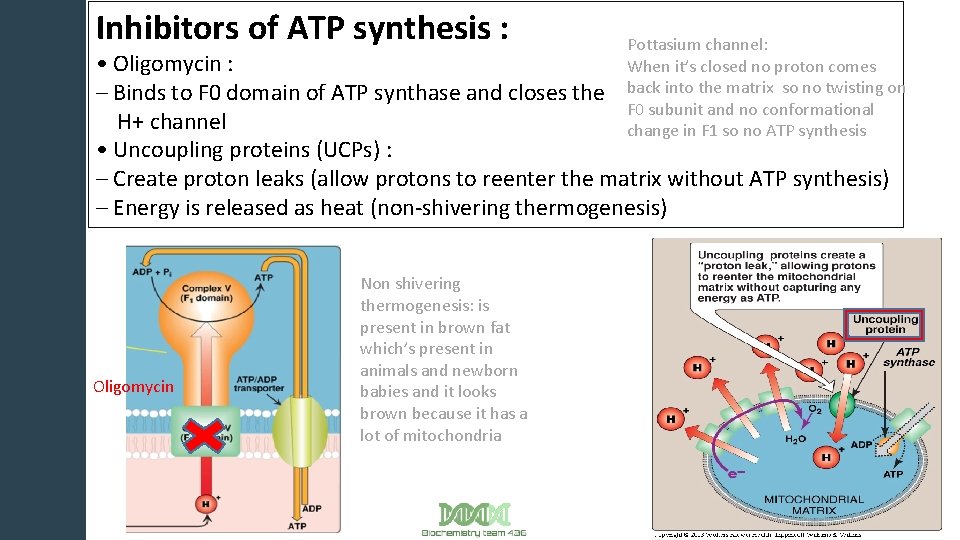
Inhibitors of ATP synthesis : Pottasium channel: When it’s closed no proton comes back into the matrix so no twisting on F 0 subunit and no conformational change in F 1 so no ATP synthesis • Oligomycin : – Binds to F 0 domain of ATP synthase and closes the H+ channel • Uncoupling proteins (UCPs) : – Create proton leaks (allow protons to reenter the matrix without ATP synthesis) – Energy is released as heat (non-shivering thermogenesis) Oligomycin Non shivering thermogenesis: is present in brown fat which’s present in animals and newborn babies and it looks brown because it has a lot of mitochondria 13
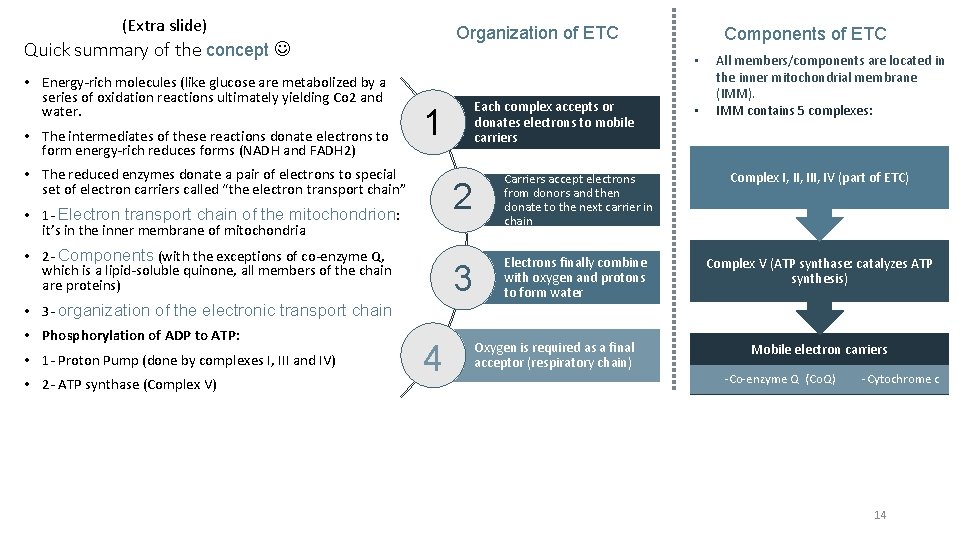
(Extra slide) Quick summary of the concept • Energy-rich molecules (like glucose are metabolized by a series of oxidation reactions ultimately yielding Co 2 and water. • The intermediates of these reactions donate electrons to form energy-rich reduces forms (NADH and FADH 2) Organization of ETC • • 1 - Electron transport chain of the mitochondrion: it’s in the inner membrane of mitochondria • 2 - Components (with the exceptions of co-enzyme Q, which is a lipid-soluble quinone, all members of the chain are proteins) • 3 - organization of the electronic transport chain • 1 - Proton Pump (done by complexes I, III and IV) • 2 - ATP synthase (Complex V) Each complex accepts or donates electrons to mobile carriers 1 • The reduced enzymes donate a pair of electrons to special set of electron carriers called “the electron transport chain” • Phosphorylation of ADP to ATP: Components of ETC 4 • All members/components are located in the inner mitochondrial membrane (IMM). IMM contains 5 complexes: 2 Carriers accept electrons from donors and then donate to the next carrier in chain Complex I, III, IV (part of ETC) 3 Electrons finally combine with oxygen and protons to form water Complex V (ATP synthase: catalyzes ATP synthesis) Oxygen is required as a final acceptor (respiratory chain) Mobile electron carriers -Co-enzyme Q (Co. Q) -Cytochrome c 14
Quiz SAQ MCQ’s: https: //www. onlineexambuilder. com/etcsaq/exam-131861 https: //www. onlineexambuilder. com/electron -transport-chain/exam-131853 https: //www. onlineexambuilder. com/etcextra/exam-131862 Helpful video Both are important. . https: //www. youtube. com/watch? v=xb. J 0 nbzt 5 Kw 15
• Review the notes https: //www. youtube. com/watch? v=xb. J 0 nbzt 5 Kw THANK YOU PLEASE CONTACT US IF YOU HAVE ANY ISSUE • Lippincott's Illustrated Reviews: Biochemistry, 6 th E • @436 Biochemteam • Biochemistryteam 436@gmail. com 17
- Slides: 17