
Biochemistry Ch 6 Biology A The Atoms Elements
Biochemistry Ch. 6 Biology A
The Atoms, Elements and Molecules Chapter 6
Atomic Structure All matter is composed of atoms. Atoms are the building blocks of matter. 3
Atomic Structure Atoms are composed of -protons – positively charged particles -neutrons – neutral particles -electrons – negatively charged particles Protons and neutrons are located in the nucleus. Electrons are found in orbitals surrounding the nucleus. 4
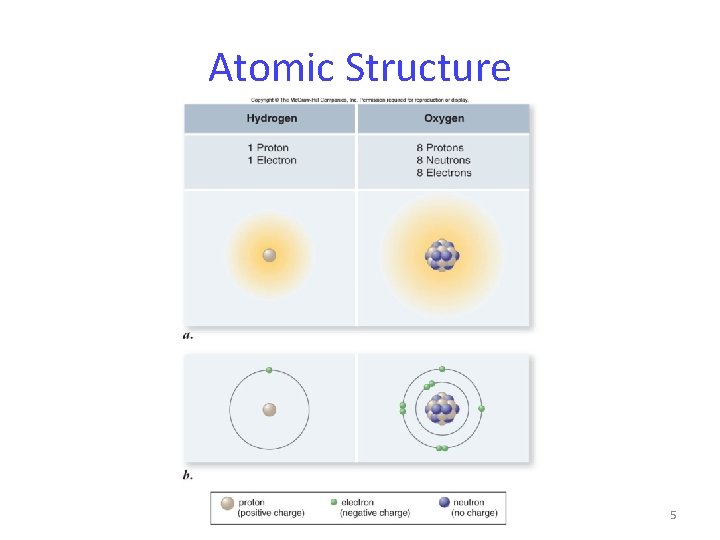
Atomic Structure 5
Atomic Structure Every different atom has a characteristic number of protons in the nucleus. atomic number = number of protons Valence electrons are the electrons in the outermost energy level of an atom. These electrons are what allow atoms to join to make molecules and compounds. 6
Atomic Structure Each proton and neutron has a mass of approximately 1 dalton. The sum of protons and neutrons is the atom’s atomic mass. Isotopes – atoms of the same element that have different atomic mass numbers due to different numbers of neutrons. 7
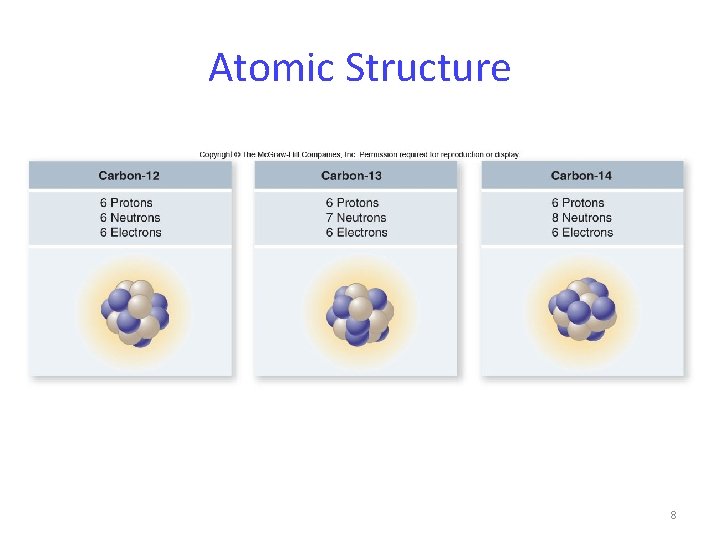
Atomic Structure 8
Elements Atoms with the same atomic number have the same chemical properties and belong to the same element. Elements are made up of the same type of atoms. An element’s chemical properties depend on interactions between valence electrons of different atoms. 9
Elements The Periodic Table arranges all elements according to their atomic number. The table identifies elements with similar chemical properties. There are 92 Naturally occurring Elements. 10
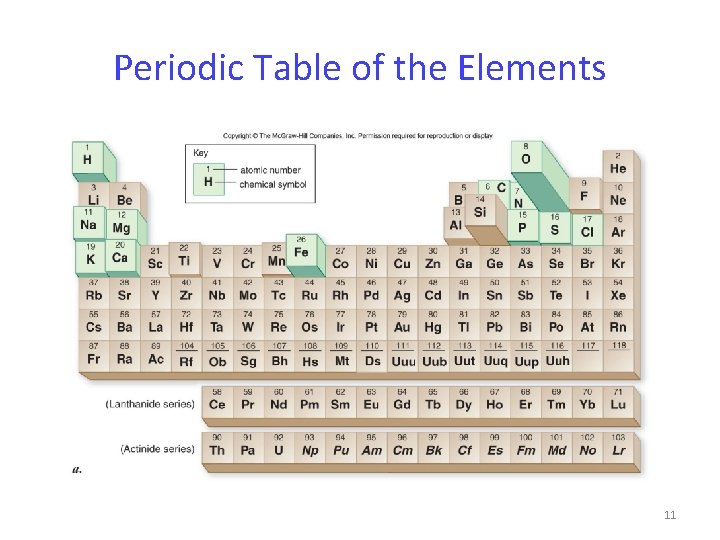
Periodic Table of the Elements 11

Elements Of the 92 naturally occurring elements. Only 12 elements are found in living organisms in substantial amounts. Four elements make up 96. 3% of human body weight: - carbon, hydrogen, oxygen, nitrogen 12
Chemical Bonds Molecules are groups of atoms held together in a stable association. Compounds are molecules containing more than one type of element. Atoms are held together in molecules or compounds by chemical bonds. 13
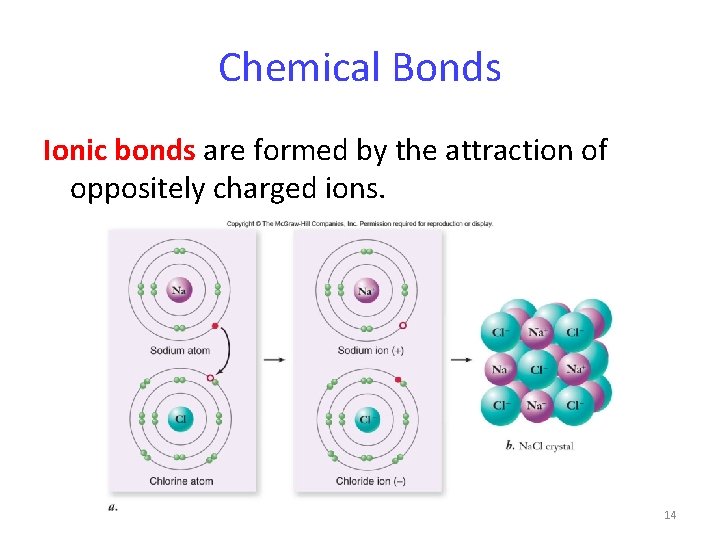
Chemical Bonds Ionic bonds are formed by the attraction of oppositely charged ions. 14
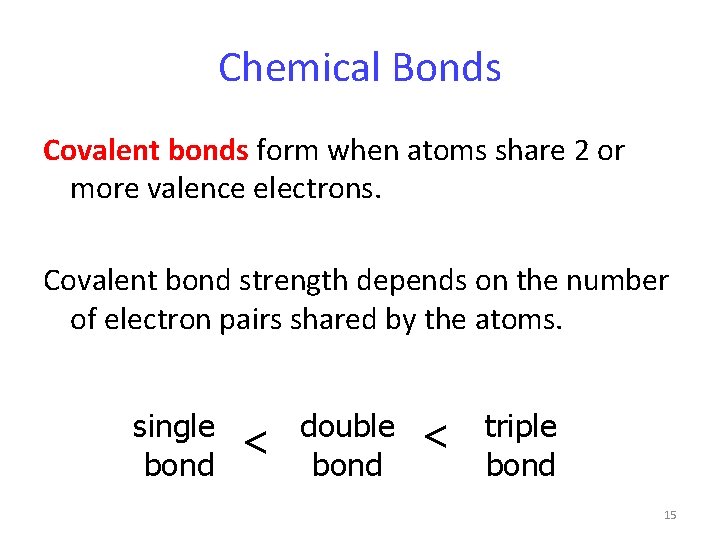
Chemical Bonds Covalent bonds form when atoms share 2 or more valence electrons. Covalent bond strength depends on the number of electron pairs shared by the atoms. single bond < double bond < triple bond 15
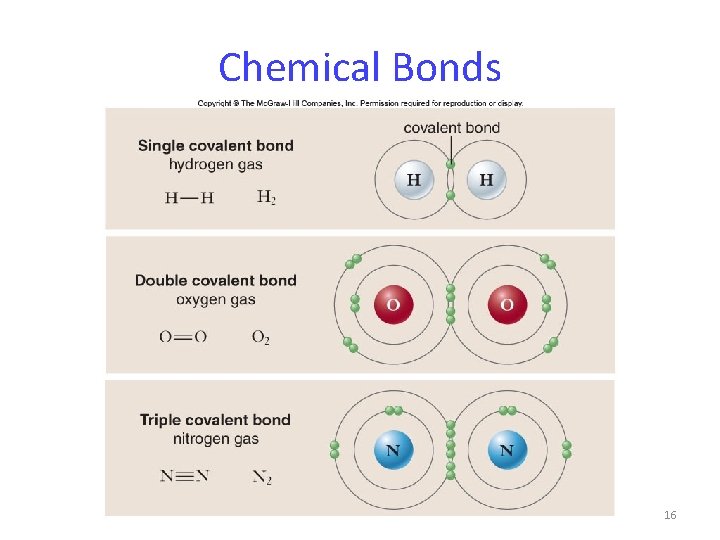
Chemical Bonds 16
Chemical Bonds Electronegativity is an atom’s affinity for electrons. Van der Waals Forces Differences in electronegativity dictate how electrons are distributed in covalent bonds. - nonpolar covalent bonds = equal sharing of electrons - polar covalent bonds = unequal sharing of electrons 17
Chemical Bonds Ch 6. 2 Chemical reactions involve the formation or breaking of chemical bonds. Whether a chemical reaction occurs is influenced by -temperature -concentration of reactants and products -availability of a catalyst (see energy reactions) 18
Chemical Bonds Chemical reactions are written with the reactants first, followed by the products. 6 H 2 O + 6 CO 2 reactants C 6 H 12 O 6 + 6 O 2 products Chemical reactions are often reversible. C 6 H 12 O 6 + 6 O 2 6 H 2 O + 6 CO 2 19
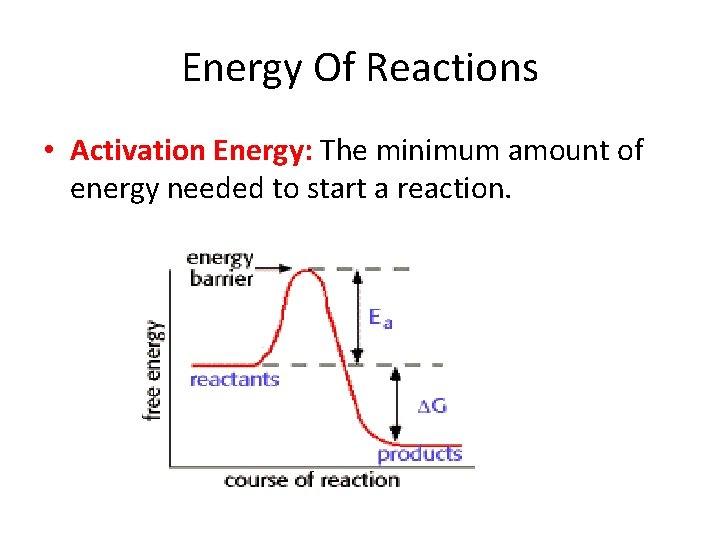
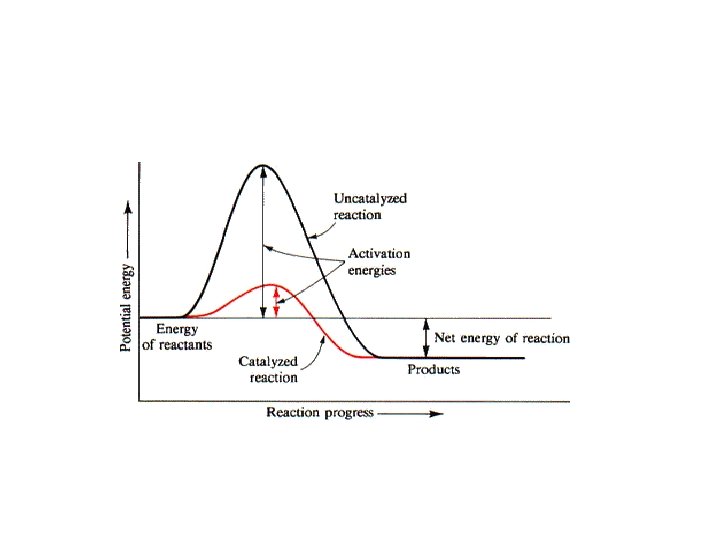
Energy Of Reactions • Activation Energy: The minimum amount of energy needed to start a reaction.

Energy of Reactions
Energy of Reactions • Catalyst is a substance that lowers the activation energy needed to run a reaction. • Catalysts speed up the reaction, sometimes by a thousand times, but do not change the outcome of the reaction and do not become part of the reaction. • The Catalyst is not used up It may be reused. • The amount of product stays the same. • The amount of reactant stays the same.
Energy of Reactions • Enzymes: Special Proteins that function as Biological catalysts. • Most enzymes are specific to one reaction. • Amylase and digestion. Found in saliva. • Helps breakdown the digestion of amylose a component of starch.
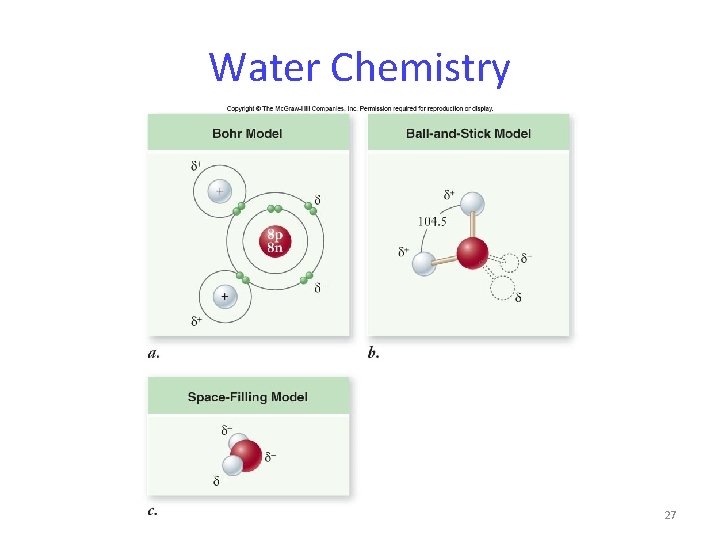
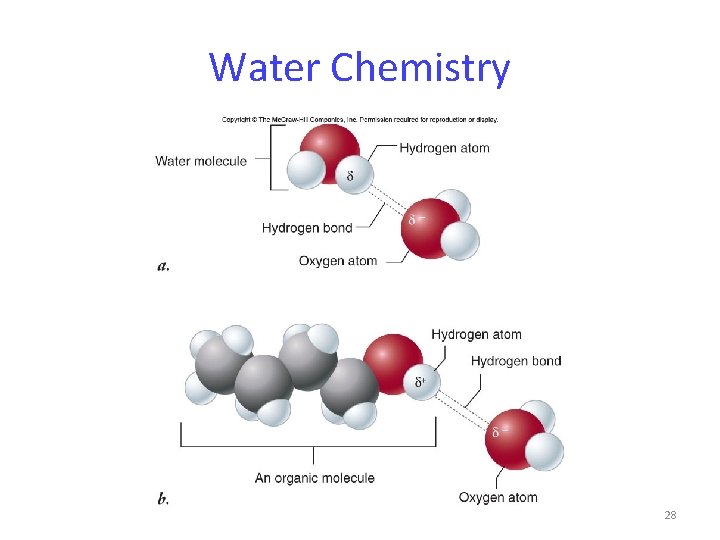
Water Chemistry All living organisms are dependent on water. The structure of water is the basis for its unique properties. The most important property of water is the ability to form hydrogen bonds. 25
Water Chemistry Within a water molecule, the bonds between oxygen and hydrogen are highly polar. Partial electrical charges develop: - oxygen is partially negative - hydrogen is partially positive 26
Water Chemistry 27
Water Chemistry 28
Properties of Water 1. Solid water is less dense than liquid water. - Bodies of water freeze from the top down. 2. Water is a good solvent. - Water dissolves polar molecules and ions. 29
Properties of Water 3. Water organizes nonpolar molecules. - hydrophilic: “water-loving” -hydrophobic: “water-fearing” - Water causes hydrophobic molecules to aggregate or assume specific shapes. 4. Water can form ions. H 2 O OH-1 + H+1 hydroxide ion hydrogen ion 30
Acids and Bases Hydrogen ion (H+1) is the basis of the p. H scale. Greater H+1 concentration --- lower p. H (acidic) Lower H+1 concentration --- higher p. H (basic) 31
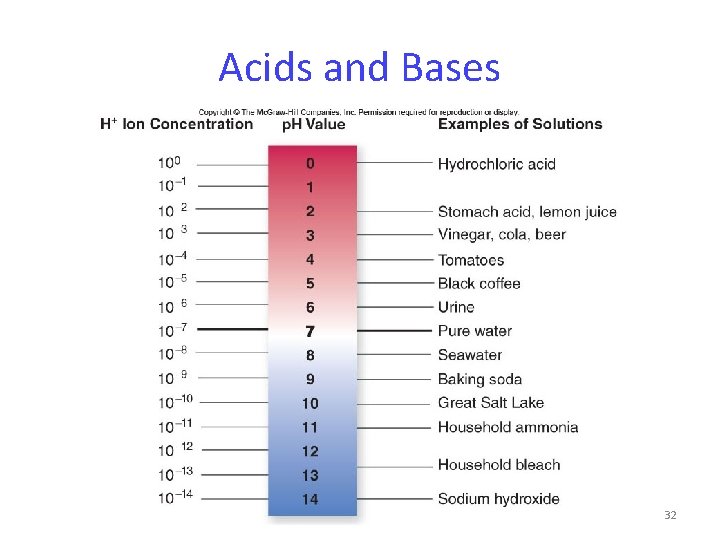
Acids and Bases 32
Acids and Bases Acid: a chemical that releases H+1 ions. Base: a chemical that accepts H+1 ions. Buffer: a chemical that accepts/releases H+1 as necessary to keep p. H constant 33
Carbohydrates Molecules with a 1: 2: 1 ratio of carbon, hydrogen, oxygen -empirical formula: (CH 2 O)n -examples: sugars, starch, glucose C – H covalent bonds hold much energy Carbohydrates are good energy storage molecules. 34
Carbohydrates Glucose -a monosaccharide – single sugar -contains 6 carbons -very important in energy storage -fructose is a structural isomer of glucose -galactose is a stereoisomer of glucose 35
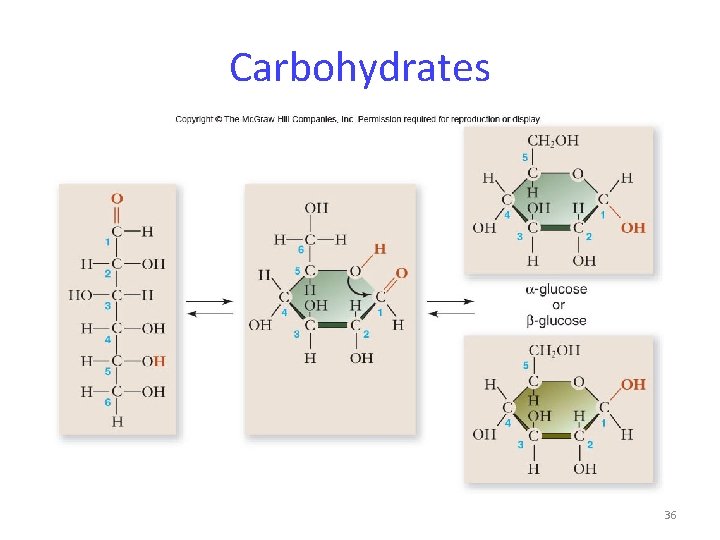
Carbohydrates 36
Carbohydrates Disaccharides -2 monosaccharides linked together by dehydration synthesis -used for sugar transport or energy storage -examples: sucrose, lactose, maltose 37
Carbohydrates Polysaccharides -long chains of sugars -used for energy storage -plants use starch; animals use glycogen -used for structural support -plants use cellulose; animals use chitin 38
Lipids are a group of molecules that are insoluble in water. A high proportion of nonpolar C – H bonds causes the molecule to be hydrophobic. Two main categories: -fats (triglycerides) -phospholipids 39
Lipids Triglycerides (fats) -composed of 1 glycerol + 3 fatty acids Fatty acids are long hydrocarbon chains which may be -saturated -unsaturated -polyunsaturated 40
Lipids Triglycerides -an excellent molecule for energy storage -store twice as much energy as carbohydrates -animal fats are usually saturated fats and are solid at room temperature -plant fats (oils) are usually unsaturated and are liquid at room temperature 41
Lipids Phospholipids -composed of: -1 glycerol -2 fatty acids -a phosphate group Phospholipids contain polar “heads” and nonpolar “tails”. 42
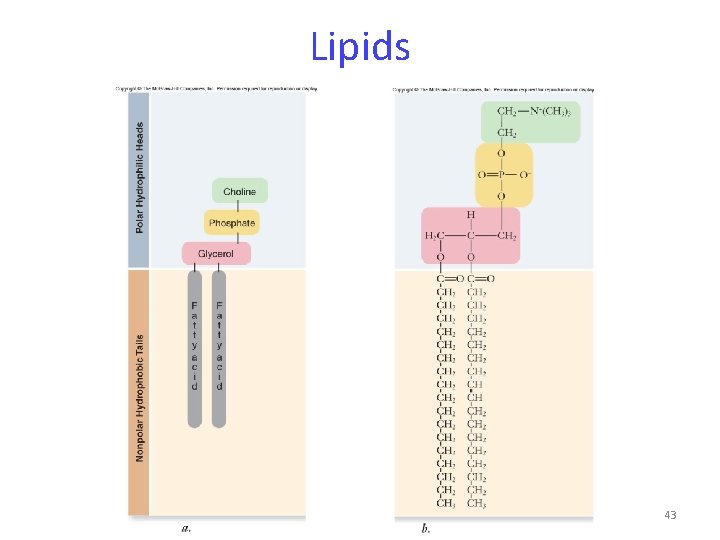
Lipids 43
Lipids Phospholipids spontaneously form micelles or lipid bilayers. These structures cluster the hydrophobic regions of the phospholipid toward the inside and leave the hydrophilic regions exposed to the water environment. Lipid bilayers are the basis of biological membranes. 44
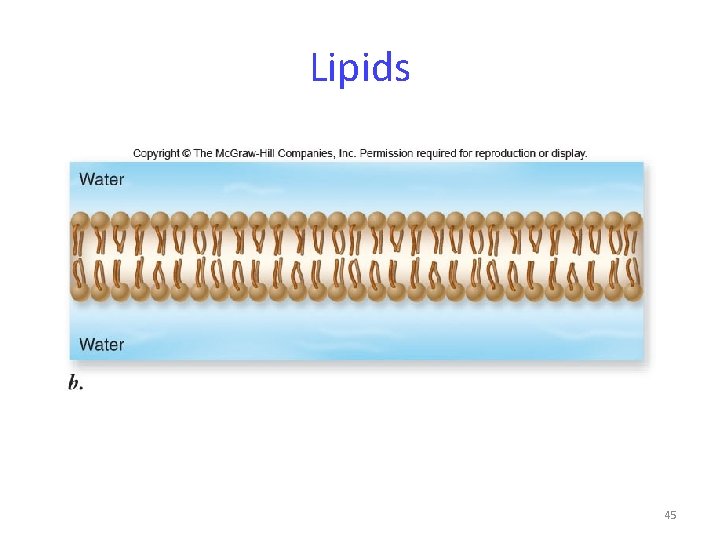
Lipids 45
Proteins are polymers of amino acids. Amino acids -20 different amino acids -joined by dehydration synthesis -peptide bonds form between adjacent amino acids 46
Proteins Protein functions include: 1. enzyme catalysts 2. defense 3. transport 4. support 5. motion 6. regulation 7. storage 47
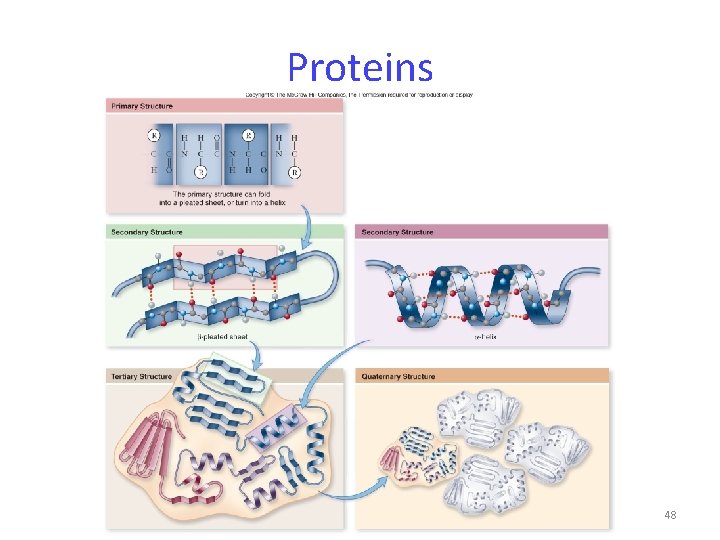
Proteins 48
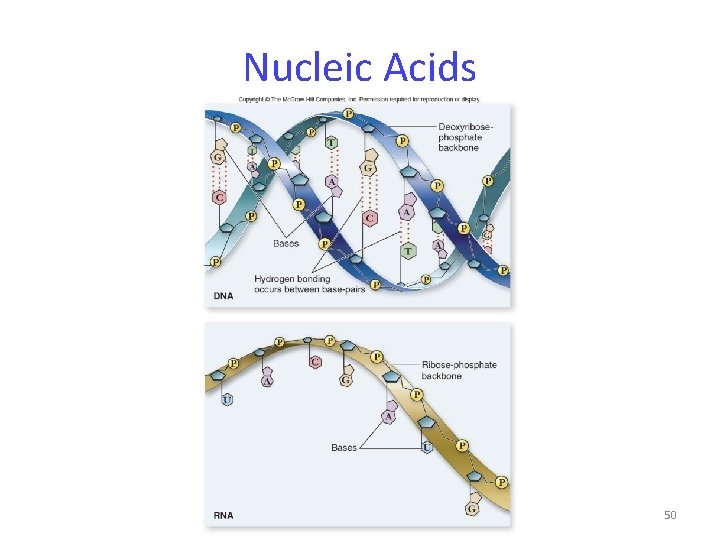
Nucleic Acids Two types: DNA and RNA Functions: specialized for the storage, transmission, and use of genetic information 49
Nucleic Acids 50
Nucleic Acids Nucleic acids are polymers of nucleotides. -nucleotides: sugar + phosphate + nitrogenous base -sugar is deoxyribose in DNA or ribose in RNA -Nitrogenous bases include -purines: adenine and guanine -pyrimidines: thymine, cytosine, uracil 51
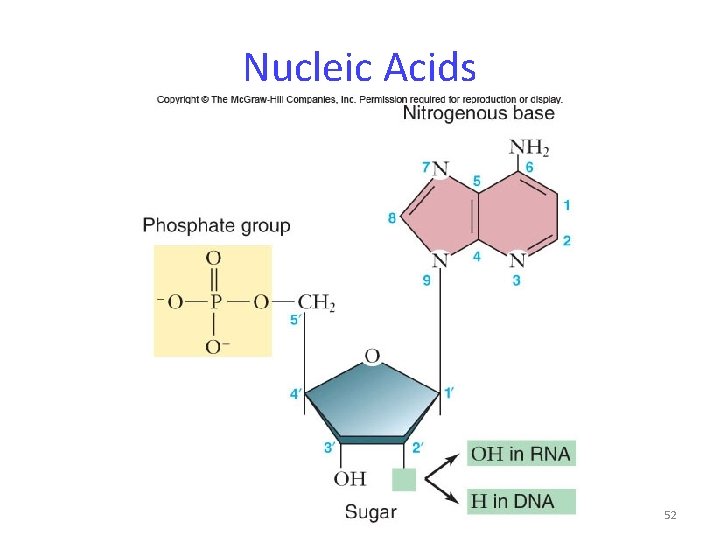
Nucleic Acids 52
Nucleic Acids Other nucleotides -ATP: adenosine triphosphate -primary energy currency of the cell 53
- Slides: 53