
Biochemical Processes of Living Things Cellular Respiration and
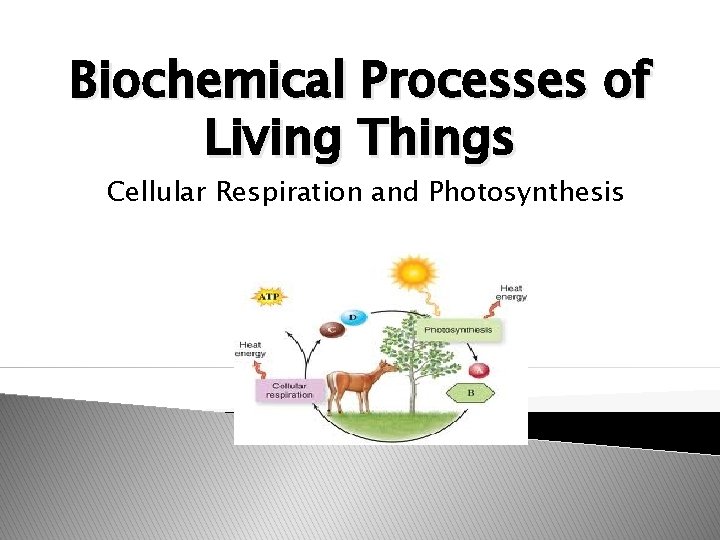
Biochemical Processes of Living Things Cellular Respiration and Photosynthesis
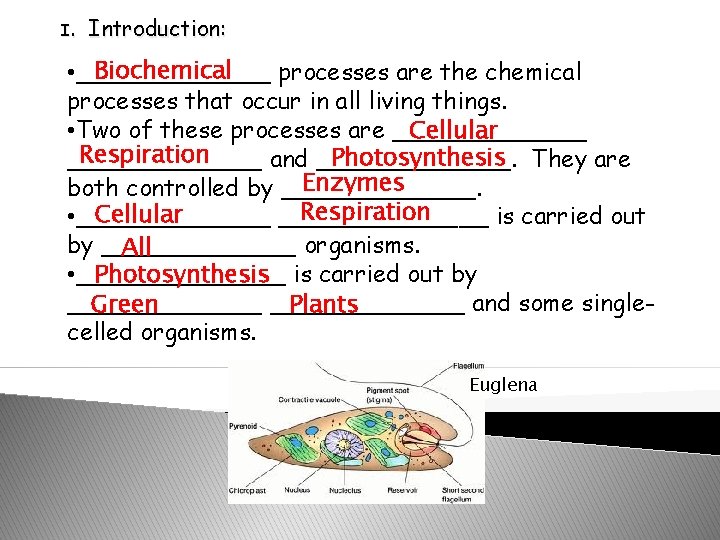
I. Introduction: Biochemical • _______ processes are the chemical processes that occur in all living things. • Two of these processes are _______ Cellular Respiration Photosynthesis They are _______ and _______. Enzymes both controlled by _______. Respiration Cellular • ______________ is carried out by _______ organisms. All • _______ Photosynthesis is carried out by _____________ and some single. Plants Green celled organisms. Euglena
II. Cellular Respiration: • You learned that when you eat foods that are carbohydrates (bread and pasta) they are broken system digestive down by your ______________. simple • They are broken down into ______ sugars ______ (glucose) • The bonds of glucose are then broken by a series of Enzyme controlled reactions ______________ to form energy. • This energy is captured into the bonds of the High ATP Energy Molecule known as ______ (Adenosine Triphosphate) • This energy is used by the organism for it’s ______________ Activities Life
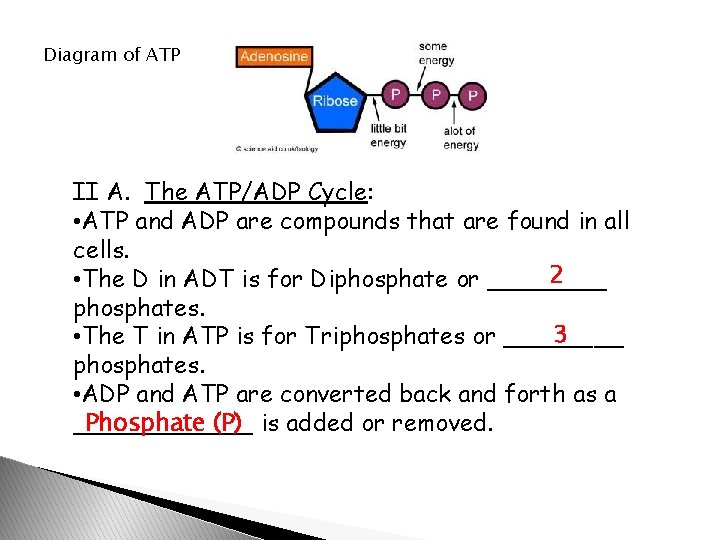
Diagram of ATP II A. The ATP/ADP Cycle: • ATP and ADP are compounds that are found in all cells. 2 • The D in ADT is for Diphosphate or ____ phosphates. 3 • The T in ATP is for Triphosphates or ____ phosphates. • ADP and ATP are converted back and forth as a ______ Phosphate (P) is added or removed.
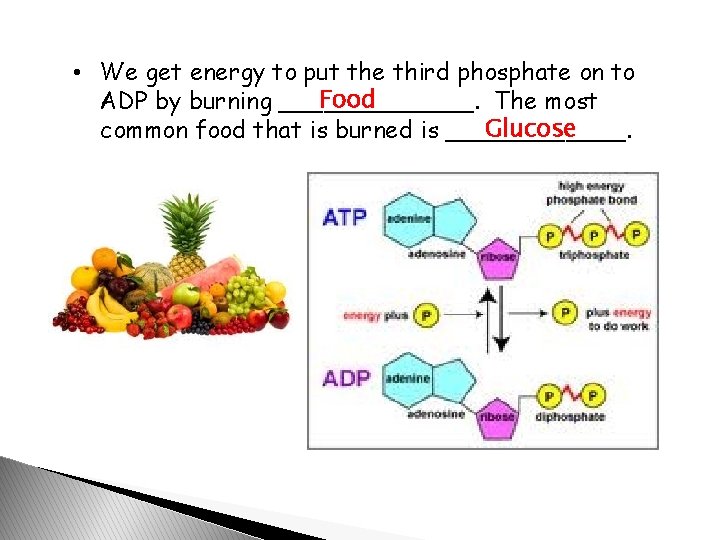
• We get energy to put the third phosphate on to Food ADP by burning _______. The most Glucose common food that is burned is ______.
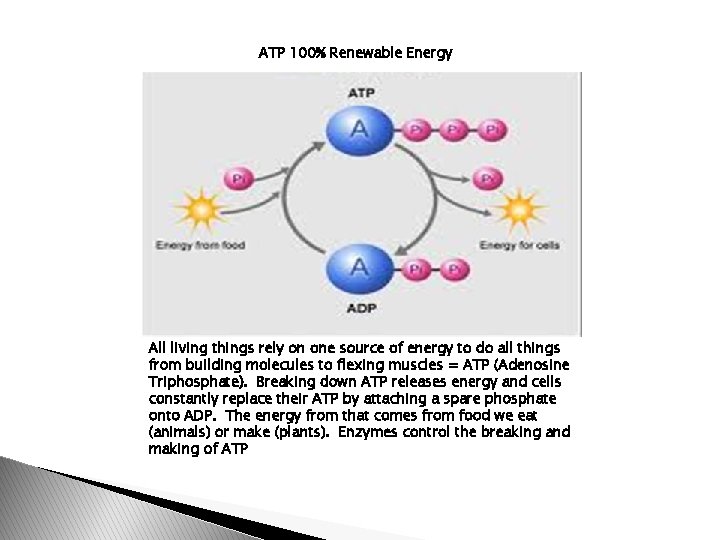
ATP 100% Renewable Energy All living things rely on one source of energy to do all things from building molecules to flexing muscles = ATP (Adenosine Triphosphate). Breaking down ATP releases energy and cells constantly replace their ATP by attaching a spare phosphate onto ADP. The energy from that comes from food we eat (animals) or make (plants). Enzymes control the breaking and making of ATP
II. B Two Types of Respiration: • There are two ways to burn glucose (two types of respiration) • Anaerobic Respiration does NOT use Oxygen ______. This is also called Fermentation ______. Oxygen • Aerobic Respiration USES _______ II. C Anaerobic Respiration (fermentation) Enzymes • Some cells lack the _______ necessary for aerobic respiration and other cells like your muscle cells change to anaerobic respiration when oxygen is lacking
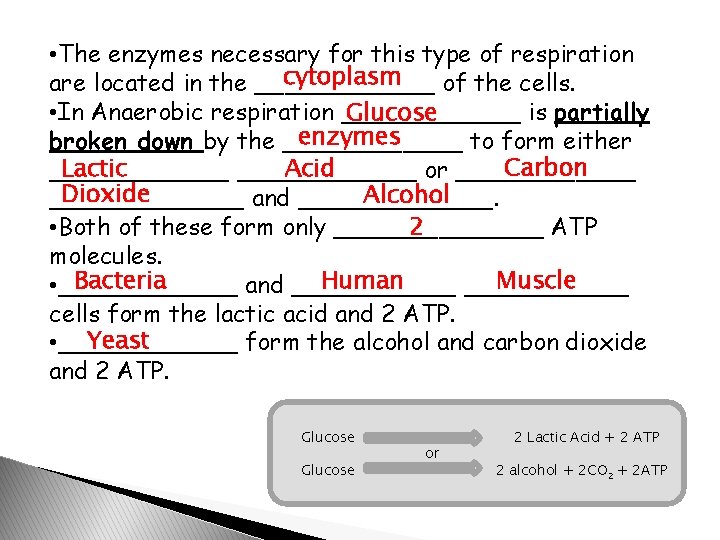
• The enzymes necessary for this type of respiration cytoplasm are located in the ______ of the cells. • In Anaerobic respiration ______ is partially Glucose enzymes broken down by the ______ to form either Carbon Acid Lactic ____________ or ______ Dioxide Alcohol _______ and _______. 2 • Both of these form only _______ ATP molecules. Muscle Bacteria Human • ______ and ___________ cells form the lactic acid and 2 ATP. Yeast • ______ form the alcohol and carbon dioxide and 2 ATP. Glucose or 2 Lactic Acid + 2 ATP 2 alcohol + 2 CO 2 + 2 ATP
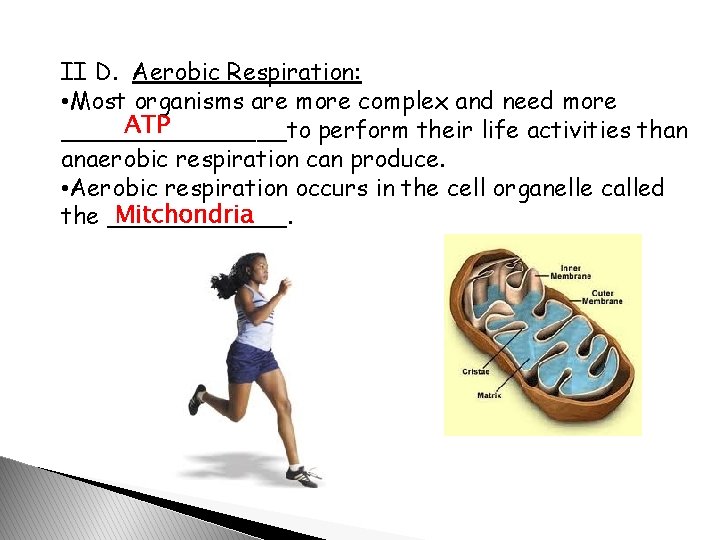
II D. Aerobic Respiration: • Most organisms are more complex and need more ATP ________to perform their life activities than anaerobic respiration can produce. • Aerobic respiration occurs in the cell organelle called Mitchondria the ______.
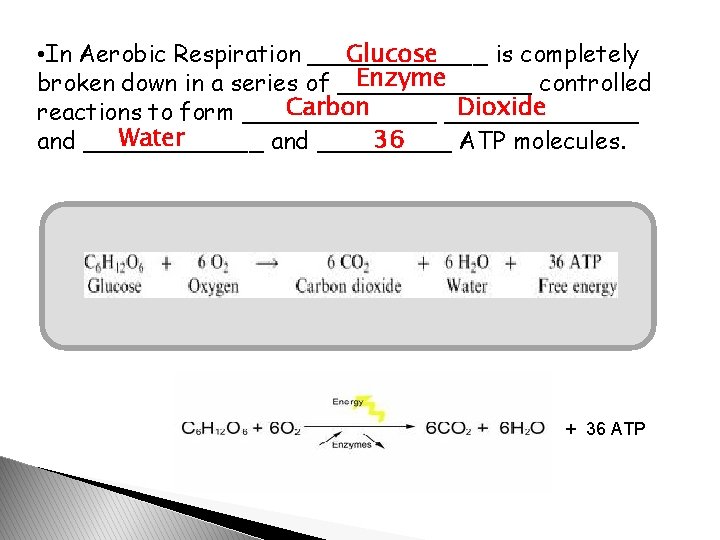
Glucose • In Aerobic Respiration ______ is completely Enzyme broken down in a series of _______ controlled Carbon Dioxide reactions to form _____________ Water 36 and ______ and _____ ATP molecules. + 36 ATP
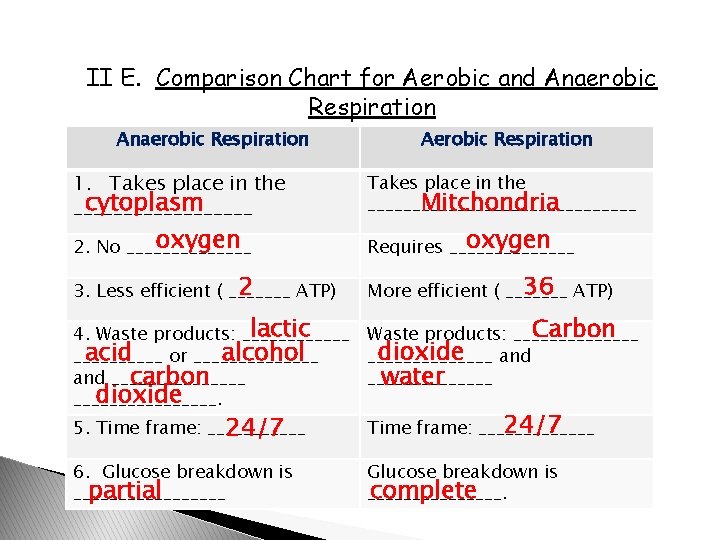
II E. Comparison Chart for Aerobic and Anaerobic Respiration Aerobic Respiration 1. Takes place in the cytoplasm _________ Takes place in the Mitchondria _______________ oxygen 2. No _______ oxygen Requires _______ 2 3. Less efficient ( _______ ATP) 36 ATP) More efficient ( _______ lactic Carbon 4. Waste products: ______________ dioxide and alcohol acid or ______________ and ________ water carbon dioxide ________. 5. Time frame: ______ 24/7 Time frame: _______ 6. Glucose breakdown is partial _________ Glucose breakdown is complete ________.
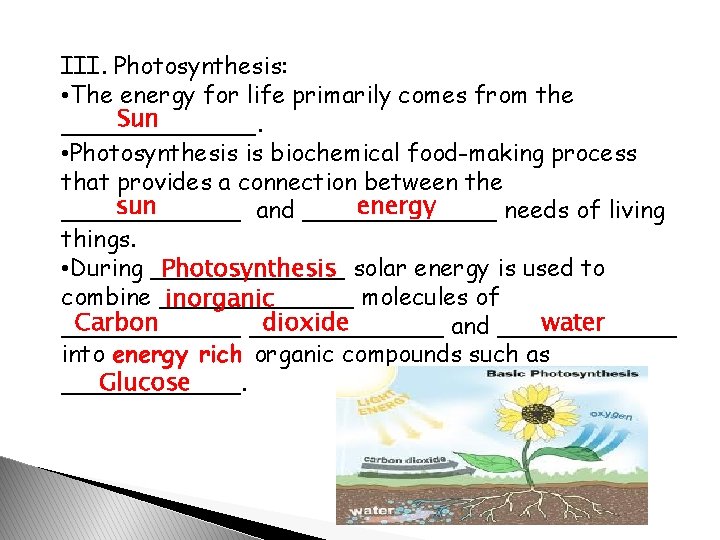
III. Photosynthesis: • The energy for life primarily comes from the Sun _______. • Photosynthesis is biochemical food-making process that provides a connection between the sun energy ______ and _______ needs of living things. • During _______ Photosynthesis solar energy is used to combine _______ molecules of inorganic water Carbon dioxide _____________ and ______ into energy rich organic compounds such as Glucose ______.
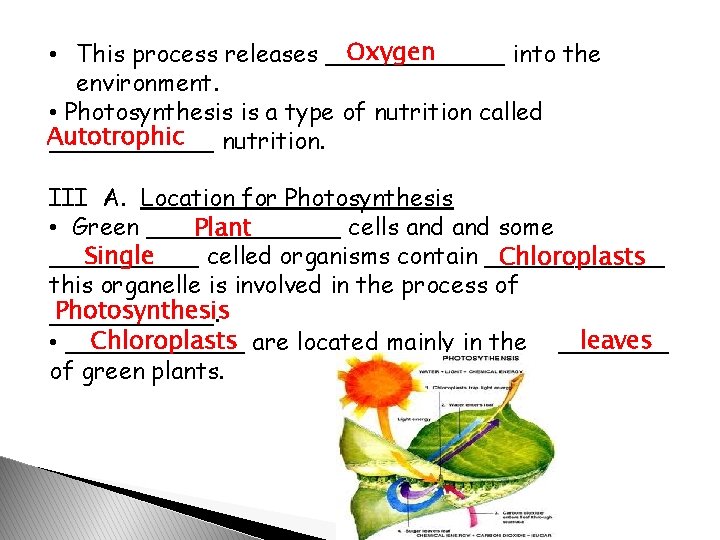
Oxygen • This process releases ______ into the environment. • Photosynthesis is a type of nutrition called Autotrophic ______ nutrition. III A. Location for Photosynthesis • Green _______ cells and some Plant Single _____ celled organisms contain ______ Chloroplasts this organelle is involved in the process of Photosynthesis ______. leaves Chloroplasts are located mainly in the _____ • ______ of green plants.
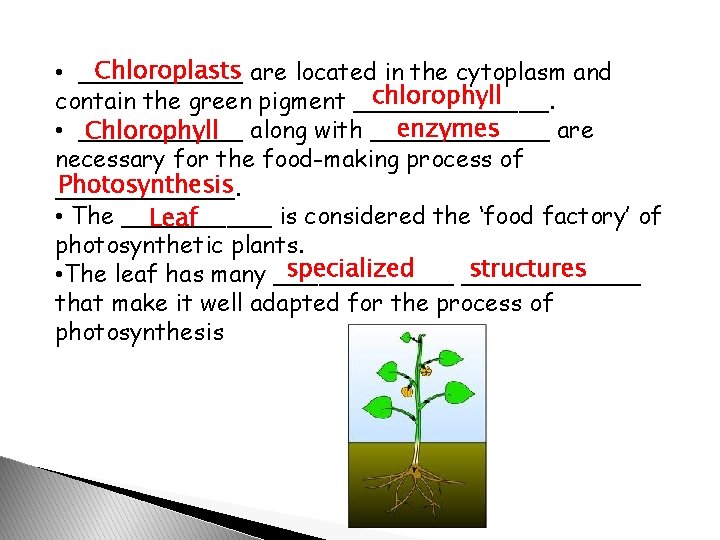
Chloroplasts are located in the cytoplasm and • ______ chlorophyll contain the green pigment _______. enzymes • ______ are Chlorophyll along with ______ necessary for the food-making process of Photosynthesis ______. • The _____ is considered the ‘food factory’ of Leaf photosynthetic plants. structures specialized • The leaf has many ____________ that make it well adapted for the process of photosynthesis
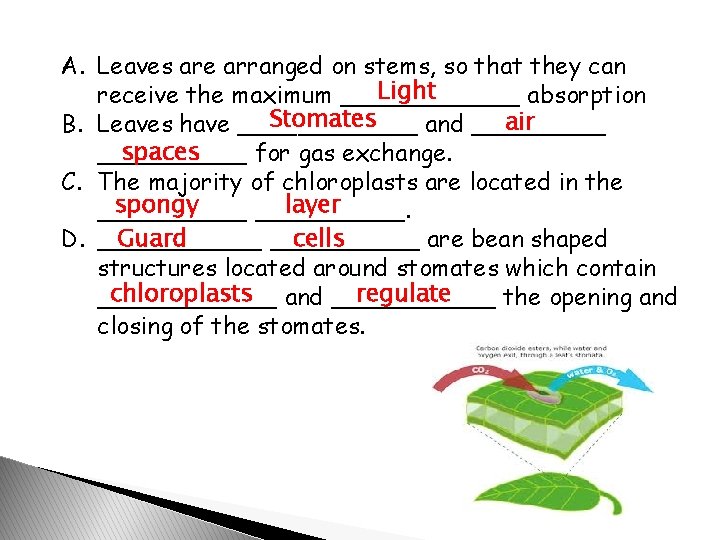
A. Leaves are arranged on stems, so that they can Light receive the maximum ______ absorption Stomates air B. Leaves have ______ and _____ spaces _____ for gas exchange. C. The majority of chloroplasts are located in the spongy layer __________. Guard cells D. ______ are bean shaped structures located around stomates which contain regulate chloroplasts and ____________ the opening and closing of the stomates.
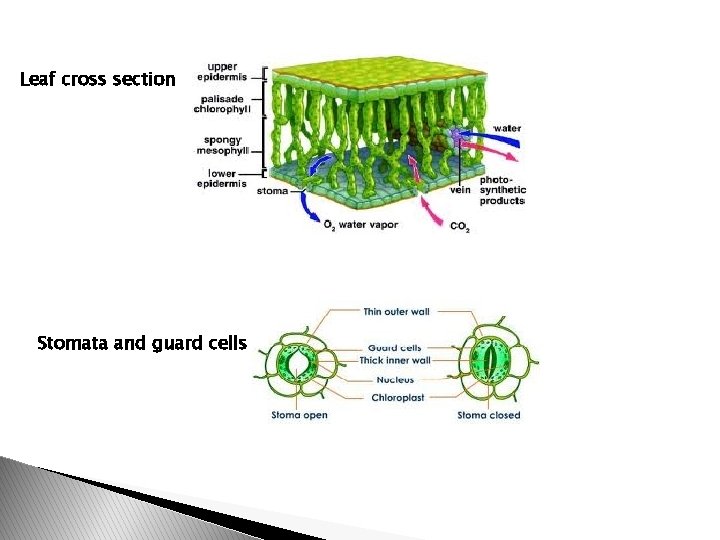
Leaf cross section Stomata and guard cells
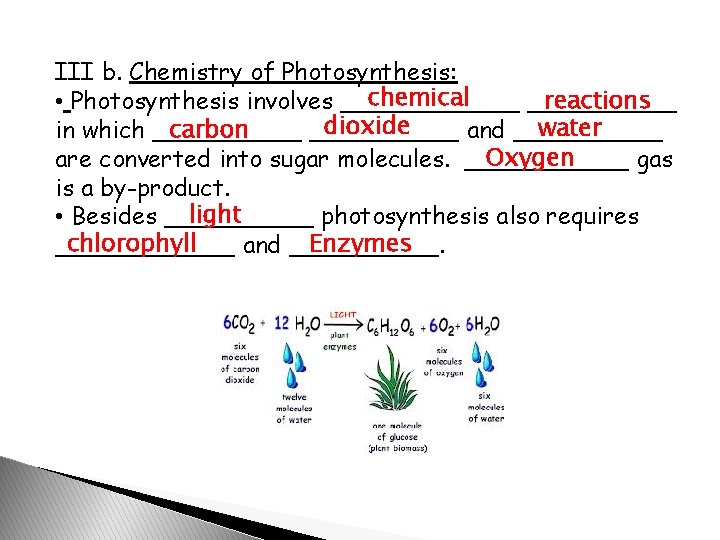
III b. Chemistry of Photosynthesis: chemical reactions • Photosynthesis involves ______ dioxide water carbon in which __________ and _____ Oxygen are converted into sugar molecules. ______ gas is a by-product. light • Besides _____ photosynthesis also requires chlorophyll Enzymes ______ and _____.
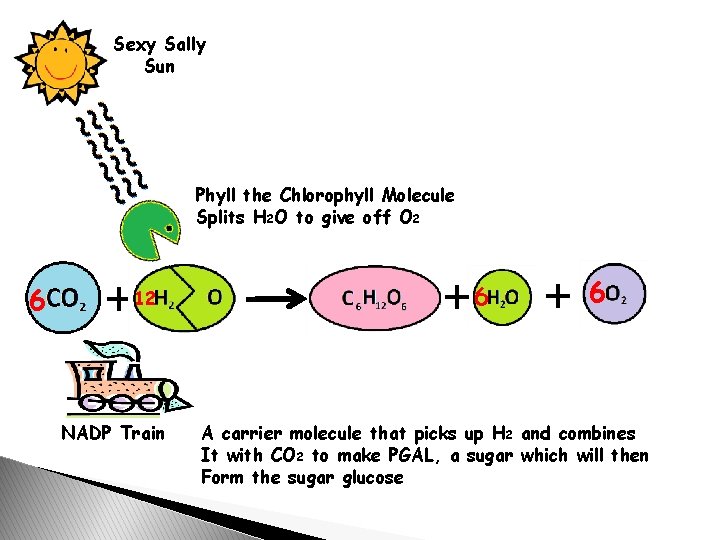
Sexy Sally Sun Phyll the Chlorophyll Molecule Splits H 2 O to give off O 2 6 + 12 NADP Train +6 + 6 A carrier molecule that picks up H 2 and combines It with CO 2 to make PGAL, a sugar which will then Form the sugar glucose
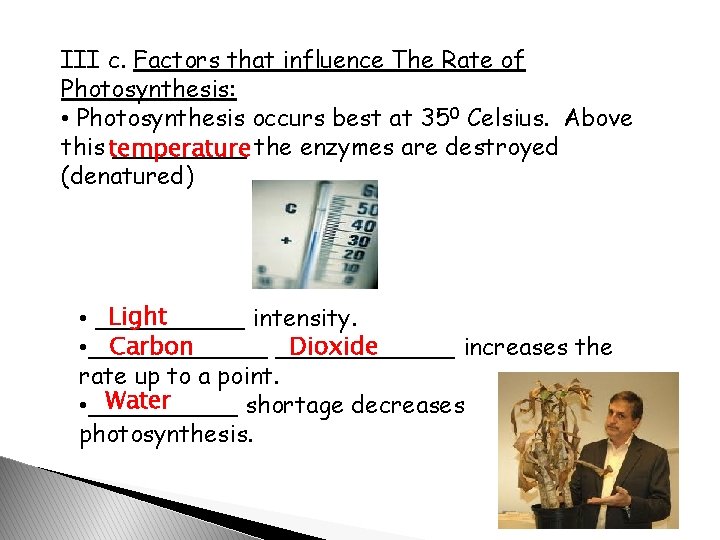
III c. Factors that influence The Rate of Photosynthesis: • Photosynthesis occurs best at 350 Celsius. Above this temperature _____ the enzymes are destroyed (denatured) Light • _____ intensity. Carbon Dioxide • ____________ increases the rate up to a point. Water • _____ shortage decreases photosynthesis.
The End
- Slides: 20