
BIOCHEMICAL METHODS USED IN PROTEN PURIFICATION AND CHARACTERIZATION
BIOCHEMICAL METHODS USED IN PROTEN PURIFICATION AND CHARACTERIZATION
Working with proteins Classical methods for separating proteins take advantage of properties that vary from one protein to the next 1. Crude extract (tissues or microbial cells) 2. Separation and purification of individual components 3. Protein characterization (molecular mass, amino acid composition and sequence)
Purification techniques 1. based on molecular size - dialysis and ultrafiltration - density gradient centrifugation - size-exclusion chromatography) 2. based on solubility of proteins - izoelectric precipitation - salting out 3. based on electric charge - ion-exchange chromatography - electrophoresis

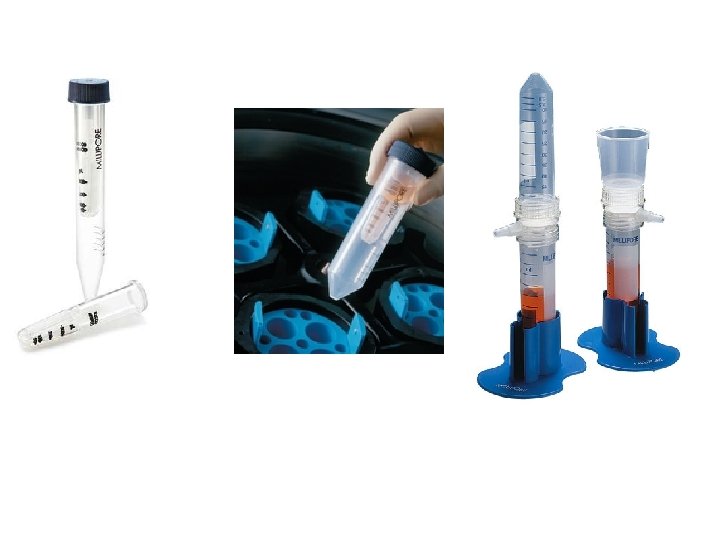
1. Separation procedures based on molecular size Dialysis and ultrafiltration Procedures, that separate proteins from small solutes. Pressure force Membrane enclosing the protein solution is semipermeable, allows the exchange water and small solutes (glucose, salts) pass through the membrane freely but protein do not.

Density gradient (zonal) centrifugation Ø method for separation Test tube with sucrose gradient mixtures of proteins by centrifugation Øproteins in solution tend to sediment at high centrifugal fields Ø in continuous density gradient of sucrose macromolecule sediment down at its own rate Ø the rate of sedimentation is determined by weight, density and shape of macromolecule Separated and concentrated protein
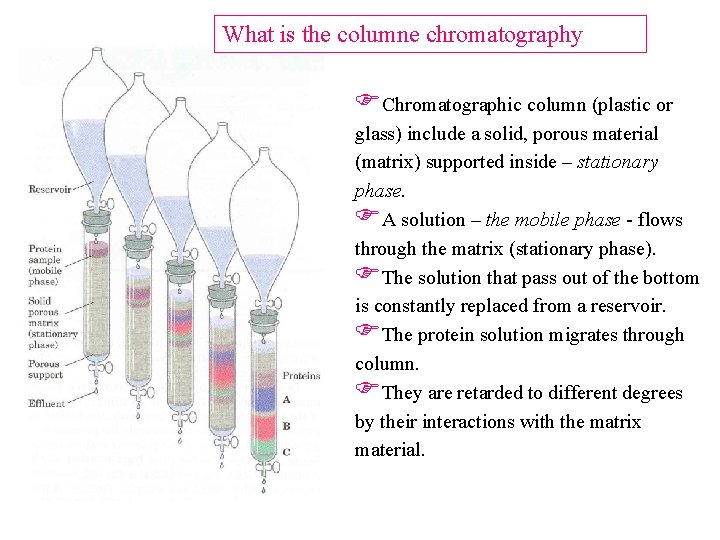
What is the columne chromatography FChromatographic column (plastic or glass) include a solid, porous material (matrix) supported inside – stationary phase. FA solution – the mobile phase - flows through the matrix (stationary phase). FThe solution that pass out of the bottom is constantly replaced from a reservoir. FThe protein solution migrates through column. FThey are retarded to different degrees by their interactions with the matrix material.

Size exclusion chromatography (gel filtration) Method uses porous particles to separate molecules of different size Ø mixture of proteins dissolved in suitable buffer, is allowed to flow by gravity down a column Ø column is packed with beads of inert polymeric material (polysacchride agarose derivative, polyacrylamide derivative), Sephadex, Sephacryl Ø very large molecules cannot penetrate into the pores of the beads, the small molecules enter the pores Ø large molecules are excluded and small proteins are retarded
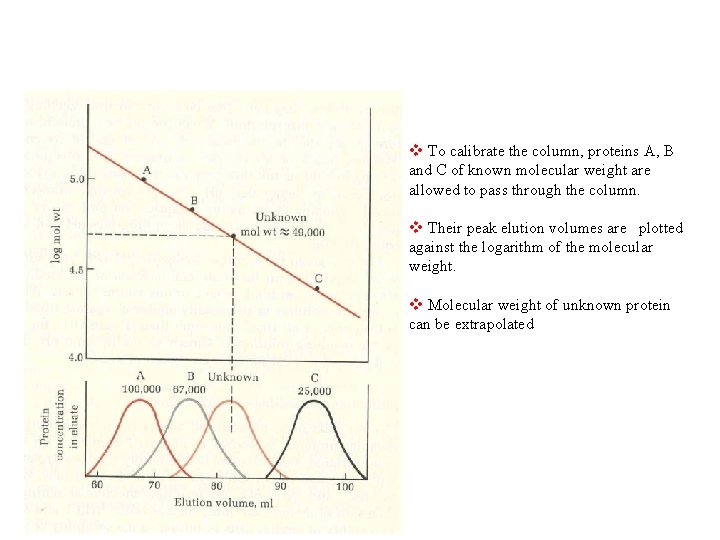
v To calibrate the column, proteins A, B and C of known molecular weight are allowed to pass through the column. v Their peak elution volumes are plotted against the logarithm of the molecular weight. v Molecular weight of unknown protein can be extrapolated
2. Separation procedures based on solubility Isoelectric precipitation Ø Protein itself can be either positively or negatively charged overall due to the terminal amine -NH 2 and carboxyl (-COOH) groups and the groups on the side chain. Ø Protein is positively charged at low p. H and negatively charged at high p. H. The intermediate p. H at which a protein molecule has a net charge of zero is called the isoelectric point of that protein - p. I Ø Protein is the least soluble when the p. H of the solution is at its isoelectric point. Ø Different proteins have different p. I values and can be separated by isoelectric precipitation
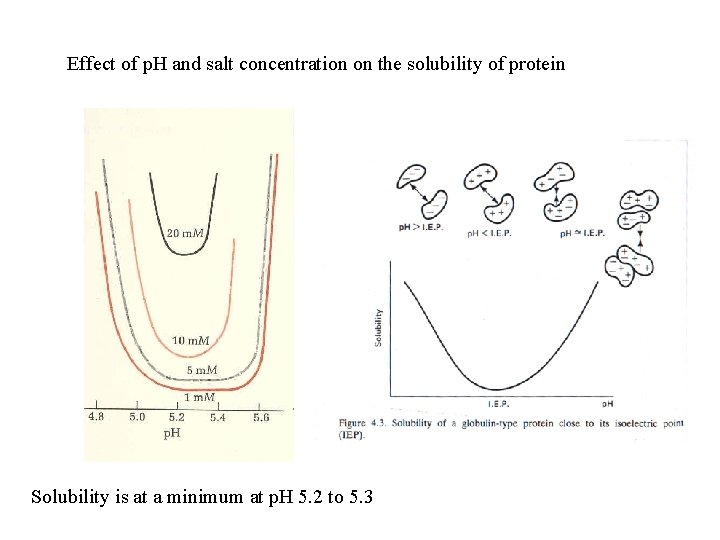
Effect of p. H and salt concentration on the solubility of protein Solubility is at a minimum at p. H 5. 2 to 5. 3
Salting out Ø Neutral salts influence the solubility of globular proteins. Ø Hhydrophilic amino acid interact with the molecules of H 2 O, allow proteins to form hydrogen bonds with the surrounding water molecules. ØIncreasing salt concentrationn: attracted of the water molecules by the salt ions, which decreases the number of water molecules available to interact with protein. Increasing ionic strength decrease solubility of a protein. ØIn general: a) small proteins more soluble than large proteins b) the larger the number of charged side chains, the more soluble the protein c) proteins usually least soluble at their isoelectric points. ØSufficiently high ionic strength completely precipitate a protein from solution. ØDivalent salts [Mg. Cl 2, (NH 4)SO 4] are far more effective than monovalent (Na. Cl)
3. Separation procedures based on electric charge Ø Methods depend on acid-base properties, determined by number and types of ionizable groups of amino acids. Ø Each protein has distinctive acid-base properties related to amino acid composition. Ø Ionizing side chain groups: R-COOH (Glu, Asp) imidazole (His) phenolic OH (Tyr) e-amino (Lys) guanidinyl (Arg)
Electrophoretic methods Ø negatively charged proteins move towards the anode Ø positively charged proteins move towards the cathode Zone electrophoresis v much simple v much greater resolution v require small sample Protein solution on the buffer (p. H 8. 6) is immobilized in a solid support (inert material like cellulose acetate)
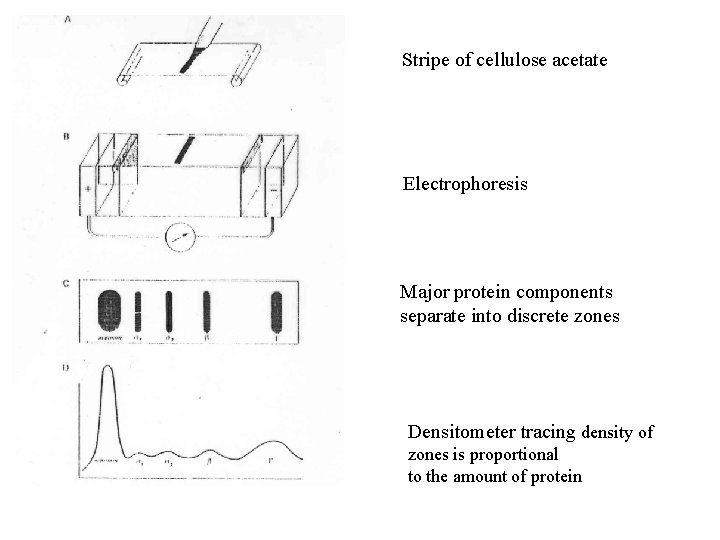
Stripe of cellulose acetate Electrophoresis Major protein components separate into discrete zones Densitometer tracing density of zones is proportional to the amount of protein
Ion-exchange chromatography Material is synthetically prepared derivatives of cellulose diethylaminoethylcellulose (DEAE-cellulose) carboxymethylcellulose (CM-cellulose) • DEAE-cellulose contains (+) charges (p. H 7. 0) anion exchanger • CM-cellulose contains (-) charges (p. H 7. 0) cathion exchanger
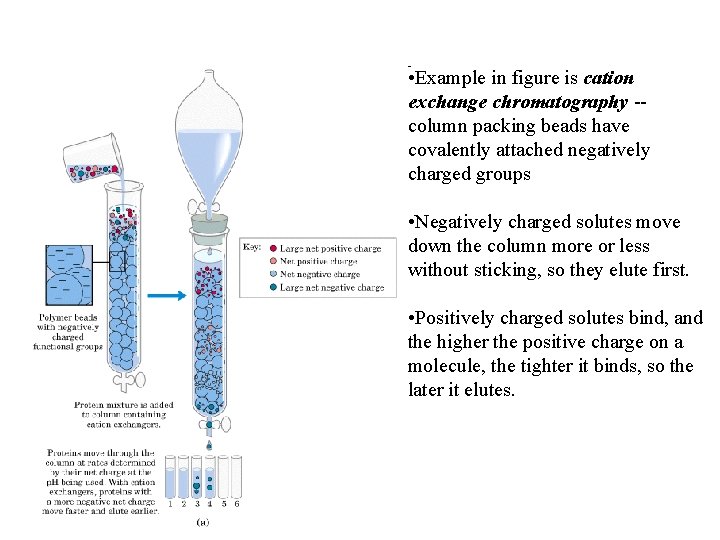
• Example in figure is cation exchange chromatography -- column packing beads have covalently attached negatively charged groups • Negatively charged solutes move down the column more or less without sticking, so they elute first. • Positively charged solutes bind, and the higher the positive charge on a molecule, the tighter it binds, so the later it elutes.
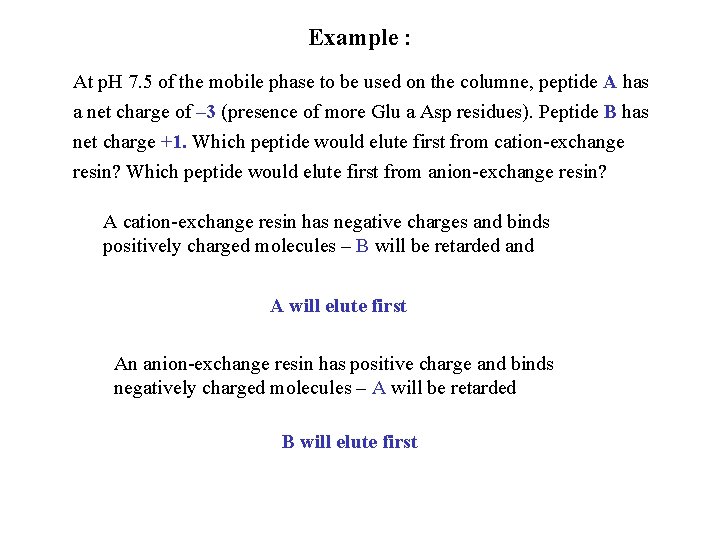
Example : At p. H 7. 5 of the mobile phase to be used on the columne, peptide A has a net charge of – 3 (presence of more Glu a Asp residues). Peptide B has net charge +1. Which peptide would elute first from cation-exchange resin? Which peptide would elute first from anion-exchange resin? A cation-exchange resin has negative charges and binds positively charged molecules – B will be retarded and A will elute first An anion-exchange resin has positive charge and binds negatively charged molecules – A will be retarded B will elute first
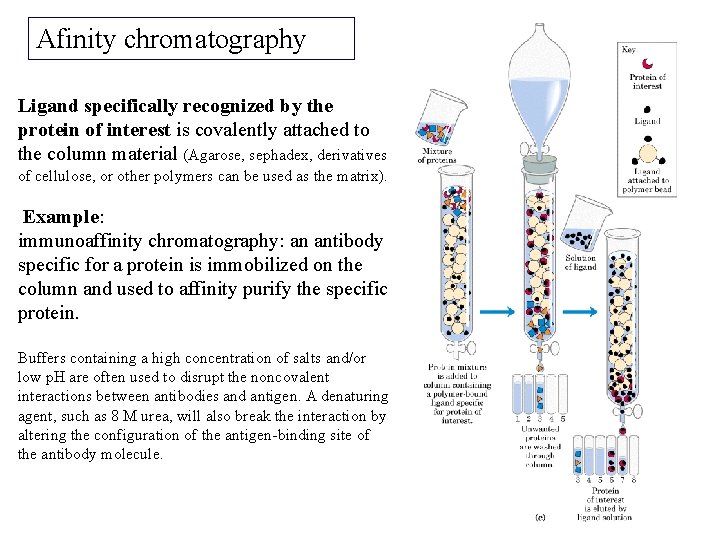
Afinity chromatography Ligand specifically recognized by the protein of interest is covalently attached to the column material (Agarose, sephadex, derivatives of cellulose, or other polymers can be used as the matrix). Example: immunoaffinity chromatography: an antibody specific for a protein is immobilized on the column and used to affinity purify the specific protein. Buffers containing a high concentration of salts and/or low p. H are often used to disrupt the noncovalent interactions between antibodies and antigen. A denaturing agent, such as 8 M urea, will also break the interaction by altering the configuration of the antigen-binding site of the antibody molecule.
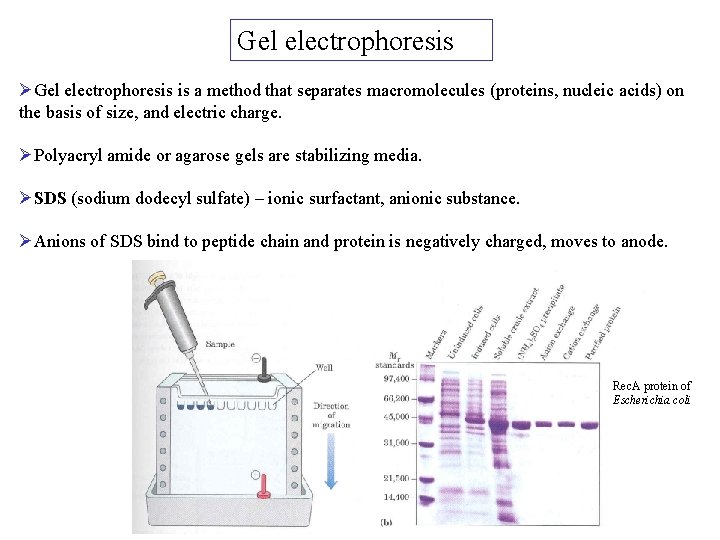
Gel electrophoresis ØGel electrophoresis is a method that separates macromolecules (proteins, nucleic acids) on the basis of size, and electric charge. ØPolyacryl amide or agarose gels are stabilizing media. ØSDS (sodium dodecyl sulfate) – ionic surfactant, anionic substance. ØAnions of SDS bind to peptide chain and protein is negatively charged, moves to anode. Rec. A protein of Escherichia coli
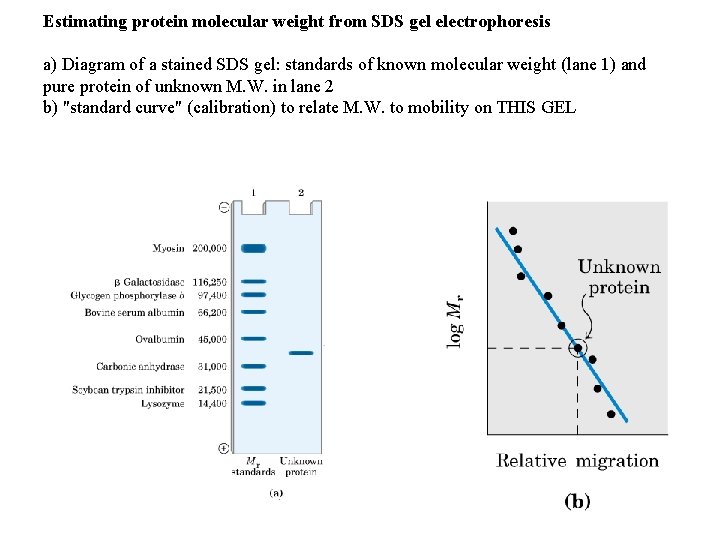
Estimating protein molecular weight from SDS gel electrophoresis a) Diagram of a stained SDS gel: standards of known molecular weight (lane 1) and pure protein of unknown M. W. in lane 2 b) "standard curve" (calibration) to relate M. W. to mobility on THIS GEL

Thank you for your attention
- Slides: 22