
Biochemical Markers of Myocardial Infarction Cardiovascular Block Presented
Biochemical Markers of Myocardial Infarction Cardiovascular Block Presented by: Dr. Rana Hasanato MD, KSFCB

Overview • Myocardial infarction • Time-course of plasma enzyme changes • Cardiac troponins I and T • Creatine kinase (CK-MB) • Myoglobin • Lactate dehydrogenase (LDH) • Aspartate aminotransferase (AST)
MYOCARDIAL INFARCTION Myocardial �Restricted infarction is due to: blood supply (oxygen) to heart tissue (ischemia) damage to heart tissue (infarction) the release of enzymes and other proteins into the blood (markers)
Markers of diagnostic value in MI: �Cardiac troponins I and T �Creatine Kinase (CK-MB) �Myoglobin �Lactate dehydrogenase (LDH) �Aspartate aminotransferase (AST)
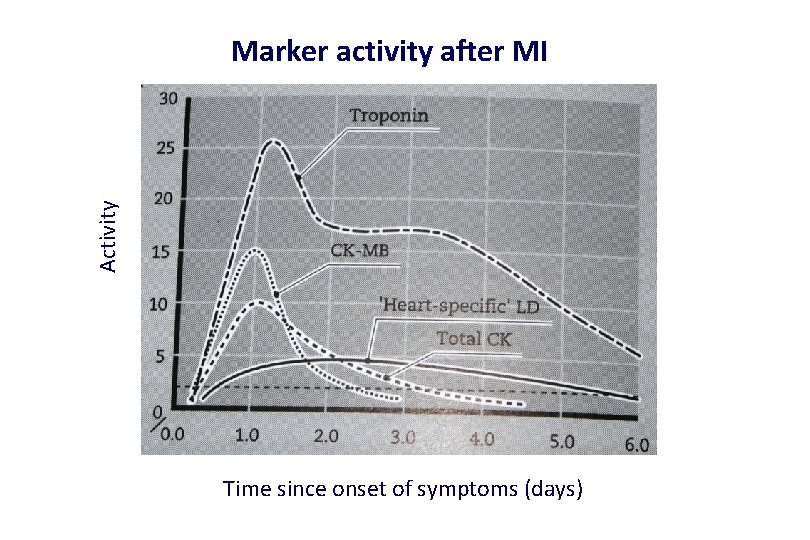
TIME-COURSE OF ENZYME CHANGES Plasma enzymes follow a pattern of activities after a MI The initial lag phase lasts for about 3 hours Enzymes rise rapidly to peak levels in 18 -36 hours The levels return to normal based on enzyme half-life Rapid rise and fall indicates diagnostic value
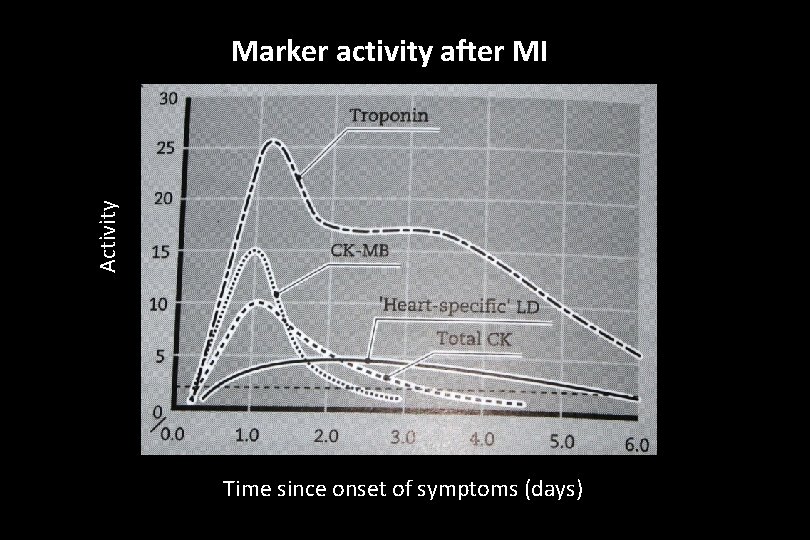
Activity Marker activity after MI Time since onset of symptoms (days)
Blood samples collected after MI: �Baseline (upon admission) �Between 12 to 24 hours after the onset of symptoms
Troponins TROPONINS are structural proteins in cardiac myocytes and in skeletal muscle Involved in the interaction between actin and myosin for contraction c. Tn are mainly bound to proteins, with small amount soluble in the cytosol Two main cardiac troponins (c. Tn): �c. Tn. I: inhibitory protein �c. Tn. T: binds to tropomyosin
c. Tn are structurally different from muscle troponins Highly specific markers for detecting MI Appear in plasma in 3 -4 h after MI Remain elevated for up to 10 days
After a MI, cytosolic troponins are released rapidly into the blood (first few hours) Structurally bound troponins are released later for several days
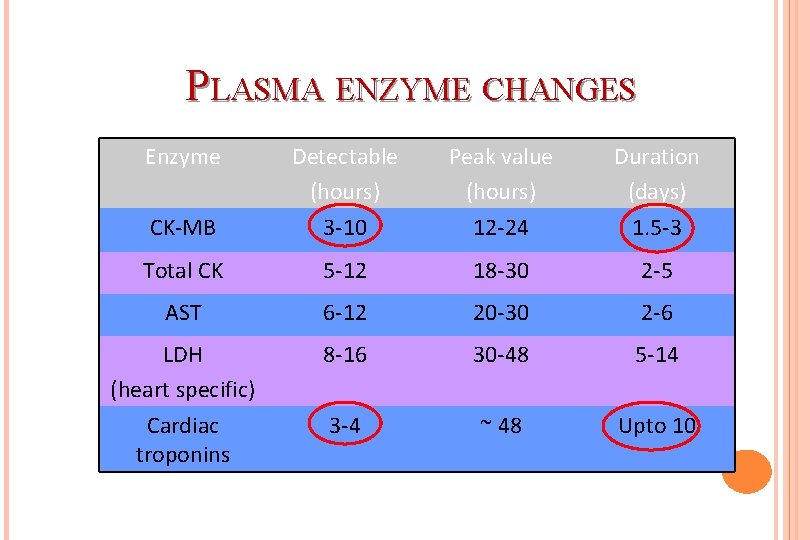
PLASMA ENZYME CHANGES Enzyme CK-MB Detectable (hours) 3 -10 Peak value (hours) 12 -24 Duration (days) 1. 5 -3 Total CK 5 -12 18 -30 2 -5 AST 6 -12 20 -30 2 -6 LDH (heart specific) Cardiac troponins 8 -16 30 -48 5 -14 3 -4 ~ 48 Upto 10
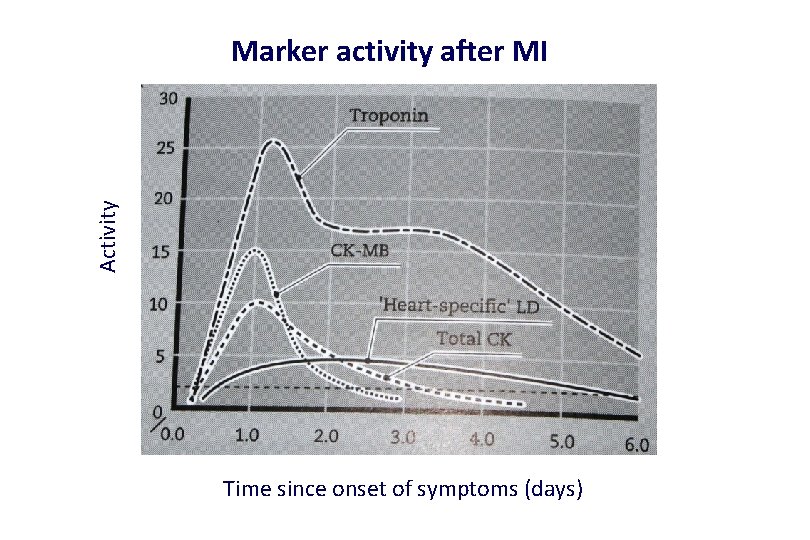
Activity Marker activity after MI Time since onset of symptoms (days)
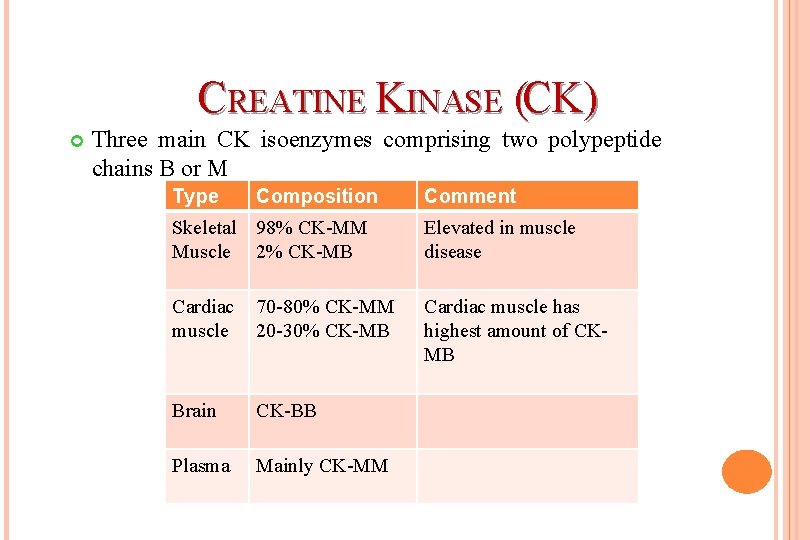
CREATINE KINASE (CK) Three main CK isoenzymes comprising two polypeptide chains B or M Type Composition Comment Skeletal 98% CK-MM Muscle 2% CK-MB Elevated in muscle disease Cardiac muscle 70 -80% CK-MM 20 -30% CK-MB Cardiac muscle has highest amount of CKMB Brain CK-BB Plasma Mainly CK-MM
CK-MB is more sensitive and specific for MI than total CK n n It rises and falls transiently after MI It is required in the following conditions: n When very early evidence of infarction u Post-operative and traumatized patients suspected for MI u Patients suspected of having a second infarct
Activity Marker activity after MI Time since onset of symptoms (days)

MYOGLOBIN Myoglobin is a sensitive marker of cardiac damage It rises very rapidly after the MI at about the same rate as CK-MB Myoglobin is non-specific because it is also elevated in muscle disease

LACTATE DEHYDROGENASE (LDH) LDH increases within 6 -12 h of MI Reaches a max. level in 48 h Remains elevated for 5 -6 days after MI A non-specific marker of tissue injury: �High levels are found in liver, lung, kidney and other diseases
ASPARTATE AMINOTRANSFERASE (AST) AST and ALT are mainly liver enzymes AST is also present in the heart A non-specific marker of MI It is elevated in liver and other diseases
TAKE HOME MESSAGE c. Tn are highly specific to heart muscle damage They remain elevated in plasma longer than CK-MB They have higher sensitivity and specificity than CK-MB They are measured in combination with myoglobin and CK-MB
- Slides: 19