
Biobrick Format more 101 May 21 st 2020
Biobrick Format (& more) 101 May 21 st 2020 Waterloo i. GEM Lab & Design Summary: This presentation will serve to provide an overview into what the biobrick format looks like, the different standards, and how to take a gene of interest (GOI) and make it conform to biobrick format.
Setting the Stage:
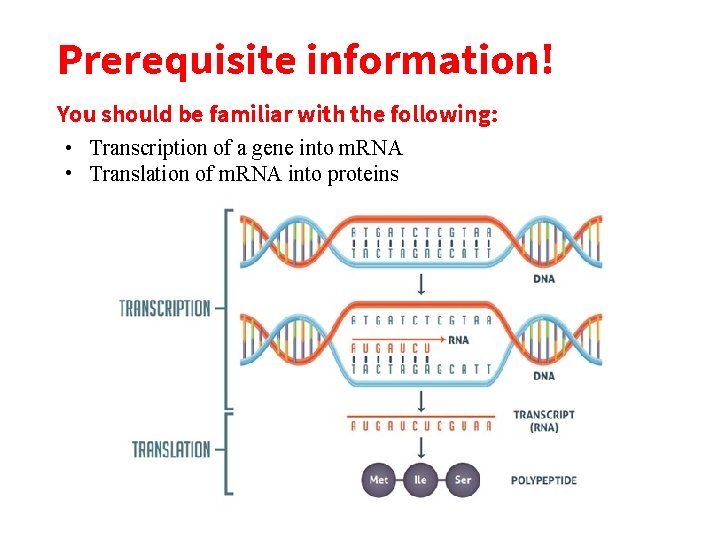
Prerequisite information! You should be familiar with the following: • Transcription of a gene into m. RNA • Translation of m. RNA into proteins
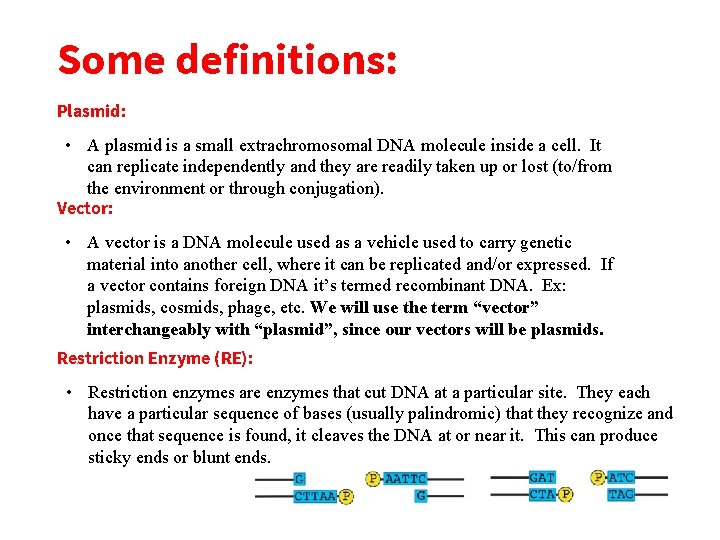
Some definitions: Plasmid: • A plasmid is a small extrachromosomal DNA molecule inside a cell. It can replicate independently and they are readily taken up or lost (to/from the environment or through conjugation). Vector: • A vector is a DNA molecule used as a vehicle used to carry genetic material into another cell, where it can be replicated and/or expressed. If a vector contains foreign DNA it’s termed recombinant DNA. Ex: plasmids, cosmids, phage, etc. We will use the term “vector” interchangeably with “plasmid”, since our vectors will be plasmids. Restriction Enzyme (RE): • Restriction enzymes are enzymes that cut DNA at a particular site. They each have a particular sequence of bases (usually palindromic) that they recognize and once that sequence is found, it cleaves the DNA at or near it. This can produce sticky ends or blunt ends.
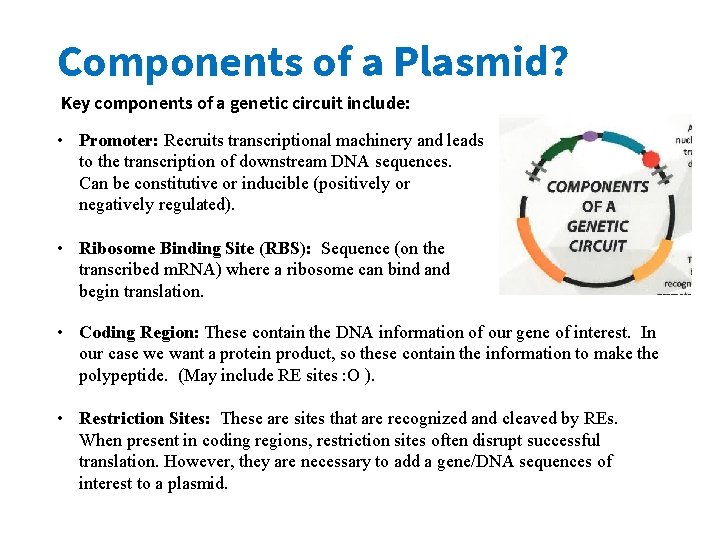
Components of a Plasmid? Key components of a genetic circuit include: • Promoter: Recruits transcriptional machinery and leads to the transcription of downstream DNA sequences. Can be constitutive or inducible (positively or negatively regulated). • Ribosome Binding Site (RBS): Sequence (on the transcribed m. RNA) where a ribosome can bind and begin translation. • Coding Region: These contain the DNA information of our gene of interest. In our case we want a protein product, so these contain the information to make the polypeptide. (May include RE sites : O ). • Restriction Sites: These are sites that are recognized and cleaved by REs. When present in coding regions, restriction sites often disrupt successful translation. However, they are necessary to add a gene/DNA sequences of interest to a plasmid.
Components of a Plasmid? Key components of a genetic circuit include: • Terminator: This is what halts transcription. Needed so that not too much of the plasmid is transcribed (otherwise we may create some products that we don’t want at all). • Selectable Marker: This is typically an antibiotic resistance gene. Since plasmids can readily take up and lose plasmids this is a way to force the cell to keep it. In other words, when we put these bacteria on antibiotic-containing plates we are a providing biological incentive to keep the plasmid. • Origin of Replication (ORI): This is the genetic component that encodes for replication of the plasmid within the cell. Specific ORIs encode for different levels of plasmid within the cell (high to low copy number). This is necessary to maintain the plasmid and create more of it! ALL OF THESE PLASMID COMPONENTS CAN BE FOUND ON THE i. GEM REGISTRY IN BIOBRICK FORMAT/COMPATIBLE WITH ASSEMBLY STANDARDS!
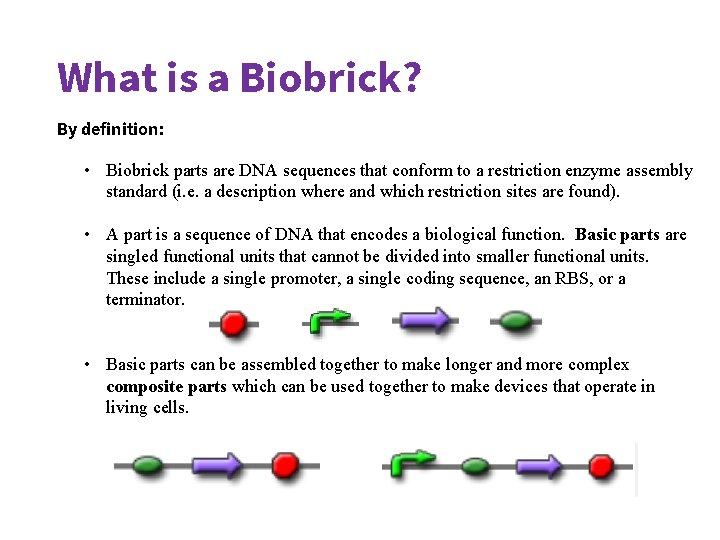
What is a Biobrick? By definition: • Biobrick parts are DNA sequences that conform to a restriction enzyme assembly standard (i. e. a description where and which restriction sites are found). • A part is a sequence of DNA that encodes a biological function. Basic parts are singled functional units that cannot be divided into smaller functional units. These include a single promoter, a single coding sequence, an RBS, or a terminator. • Basic parts can be assembled together to make longer and more complex composite parts which can be used together to make devices that operate in living cells.

What Kind of Biobricks Exist? There a whole bunch of types of parts and devices that exist! • These can include promoters, RBS, protein domains, protein coding sequences, translational units, terminators, DNA, plasmid backbones, plasmids, primers, and composite parts! • There also parts and devices that can differ in their assembly standards. Assembly standards are sets of rules regarding the placement and composition of restriction enzyme sites in the plasmids/part. If something is compatible with an assembly standard it means that there are no unexpected restriction sites within the sequence that would interfere with assembly. This is identified on the registry by: • On the registry, parts are named with the following format: Bba_#####. This can be called the part number.

Biobrick Assembly Standards? What are these assembly standards and what does this look like in a plasmid? • For registry parts, a biobrick part is stored on a plasmid between a prefix and a suffix. For example: (P=prefix, S= suffix, Cm. R= chloramphenicol resistance gene). etc. ! • The part contained within P and S could be any of the aforementioned part types!
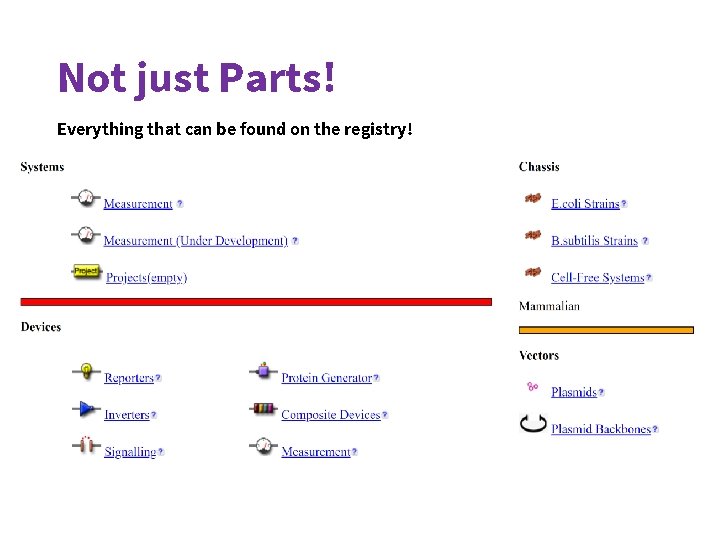
Not just Parts! Everything that can be found on the registry!
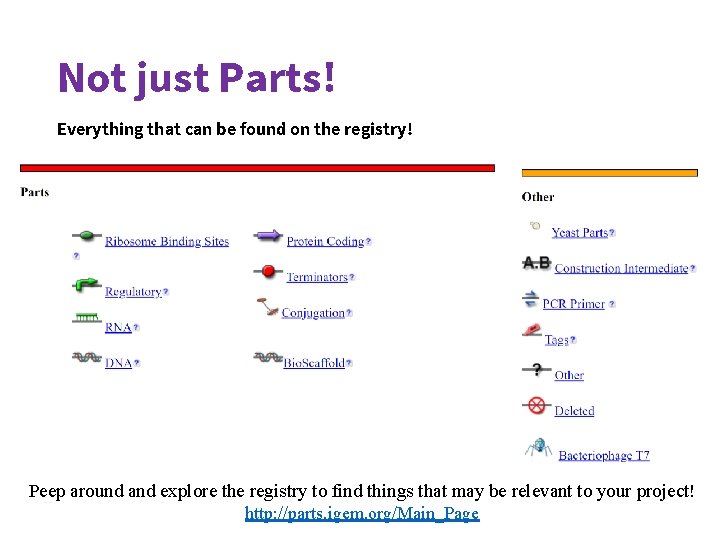
Not just Parts! Everything that can be found on the registry! Peep around and explore the registry to find things that may be relevant to your project! http: //parts. igem. org/Main_Page

Biobrick Assembly Standards? We mentioned prefixes and suffixes. What are they, anyways? • The DNA sequence for parts in the registry starts with the first base and ends with its last base. For example, a protein coding sequence might look like this: “ATG(start codon) ------TAATAA (double stop codon). • The prefix contains one set of restriction enzyme sites. The RE sites used are not found anywhere else in the part or backbone. • The suffix contains another set of restriction enzyme sites. The RE sites found here also not used anywhere else in the part or the backbone. • Prefixes/suffixes allow parts to be combined easily to form larger DNA sequences.
![Biobrick Assembly Standards? First Example: RFC[10] Assembly Standard • This is one of the](http://slidetodoc.com/presentation_image_h/2031f8bb68b28d08c3d2d1637528de05/image-13.jpg "Biobrick Assembly Standards? First Example: RFC[10] Assembly Standard • This is one of the")
Biobrick Assembly Standards? First Example: RFC[10] Assembly Standard • This is one of the first developed and most commonly used. It is now the mandatory assembly standard (other than RFC[1000] which can also be used. The prefix includes: • E = Eco. RI • X= Xba. I The suffix includes: • S= Spe. I • P = Pst I There is also a Not. I site in each the prefix and suffix. S and P cut fragments are compatible with each other. Each cut site fragment is also compatible with itself.
![Biobrick Assembly Standards? First Example: RFC[10] Assembly Standard • This allows us to easily](http://slidetodoc.com/presentation_image_h/2031f8bb68b28d08c3d2d1637528de05/image-14.jpg "Biobrick Assembly Standards? First Example: RFC[10] Assembly Standard • This allows us to easily")
Biobrick Assembly Standards? First Example: RFC[10] Assembly Standard • This allows us to easily assemble different parts together (even though most things are just synthesized now).
![Biobrick Assembly Standards? Pros and Cons of RFC[10] Assembly Standard • There are some](http://slidetodoc.com/presentation_image_h/2031f8bb68b28d08c3d2d1637528de05/image-15.jpg "Biobrick Assembly Standards? Pros and Cons of RFC[10] Assembly Standard • There are some")
Biobrick Assembly Standards? Pros and Cons of RFC[10] Assembly Standard • There are some distinct advantages and disadvantages of using this standard. • Advantages: it is standard, well tested, and documented. The native protein start codon can be preserved while using RBS parts, and there is a large (and growing!) set of parts that use this standard. • Disadvantage: there is no protein fusion possible with RFC[10] assembly. When ligating S and X together, a “scar” is created. A scar is a set of extra bases that occur as a result of ligation of parts. In the scar there is a stop codon, and since it is 8 bp it would cause a frameshift.
Biobrick Assembly Standards? Others? • There a whole bunch of other assembly standards that exist but are not often used. In addition to RFC[10] this includes: • RFC[20] • RFC[23] • RFC[25] • RFC[21] (Bgl. Bricks) • RFC[12] • and RFC[1000] (the other allowed standard for the competition!) • These each have a distinct set of advantages and disadvantages, making them all best suited for their own purposes (no matter how obscure that purpose is). But in the hope of standardizing and generalizing, RFC[10] provides the most general use case. • RFC[1000] utilizes Type IIs REs (they recognize a site and cut a specific distance away). http: //parts. igem. org/Help: Standards/Assembly/Type_IIS
![Biobrick Assembly Standards? A little more complicated: RFC[1000] • There are different prefix and](http://slidetodoc.com/presentation_image_h/2031f8bb68b28d08c3d2d1637528de05/image-17.jpg "Biobrick Assembly Standards? A little more complicated: RFC[1000] • There are different prefix and")
Biobrick Assembly Standards? A little more complicated: RFC[1000] • There are different prefix and suffixes for different parts. • However, it allows for “one pot” reactions to produce your whole composite part.

How the Heck Do We Design a Biobrick? 1. Choosing the desired DNA sequence(s) to be used: • This will be found off online databases and papers that you find when doing literature research! 2. Cut out what you don’t want: • For example, some of your proteins may have signal peptides attached. You may want to take them out for your purposes. 3. Paste the sequences of components to be used together: • Literally paste them together. Then use software to check that they are “in-frame” (that is, they are in the same reading frame, which ensure that they give the expected fused product). 4. Scan for illegal restriction sites: • If you find them, replace one of the codons contained within it to produce a silent mutation. Repeat for all! 5. Codon optimize! 6. Check everything over again!
How the Heck Do We Design a Biobrick? Note! Before any of this, perform a quick BLAST-like search of the registry to make sure no such part already exists. We don’t want to clutter it.

How the Heck Do We Design a Biobrick? 1. Choosing the desired DNA sequence(s) to be used: • This will be found off online databases and papers that you find when doing literature research! • • If only a protein sequence is available, you may need to reverse translate to obtain a DNA sequence. This includes the sequence for any functional domain, linker sequence, affinity tag, or any part of the DNA that contributes to your protein!
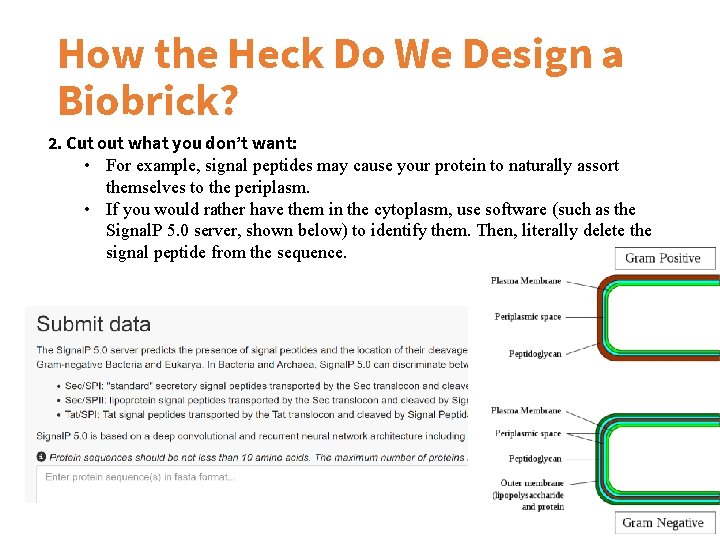
How the Heck Do We Design a Biobrick? 2. Cut out what you don’t want: • For example, signal peptides may cause your protein to naturally assort themselves to the periplasm. • If you would rather have them in the cytoplasm, use software (such as the Signal. P 5. 0 server, shown below) to identify them. Then, literally delete the signal peptide from the sequence.

How the Heck Do We Design a Biobrick? 3. Paste the sequences of components to be used together: • Literally paste them together. Then use software to check that they are “in-frame” (that is, they should be in the same reading frame, which should give the expected fused product). • This is way less fancy than you might think it should be. Literally Ctrl-C Ctrl-V them into the right order, then import that sequence of DNA into a viewer such as Benchling, Snap. Gene, or Geneious. • Then, check the translated products with this software. Check that the sequence of amino acids given matches your expected protein sequence.
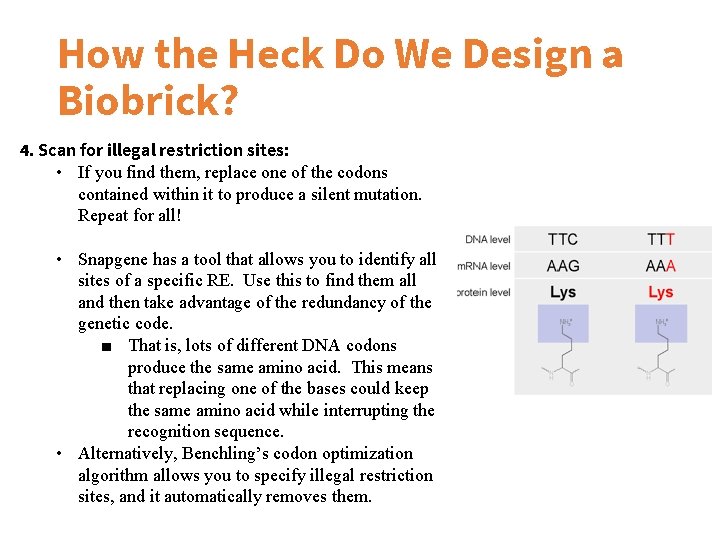
How the Heck Do We Design a Biobrick? 4. Scan for illegal restriction sites: • If you find them, replace one of the codons contained within it to produce a silent mutation. Repeat for all! • Snapgene has a tool that allows you to identify all sites of a specific RE. Use this to find them all and then take advantage of the redundancy of the genetic code. ■ That is, lots of different DNA codons produce the same amino acid. This means that replacing one of the bases could keep the same amino acid while interrupting the recognition sequence. • Alternatively, Benchling’s codon optimization algorithm allows you to specify illegal restriction sites, and it automatically removes them.

How the Heck Do We Design a Biobrick? 5. Codon optimize! • Some organisms have more of a specific t. RNA in the cytoplasm than others, making it faster to recognize one codon than another for the same amino acid. • Codon optimization refers to taking these levels into account for the bacteria we aim to express our sequence in. • Again there are tools in Snap. Gene, Benchling, and even on the websites were you can order synthesized sequences from to do this with automatically. Just run it through and check that it didn’t re-introduce any illegal restriction sites.
How the Heck Do We Design a Biobrick? 6. Check everything over again! • JUST DO IT. • Check the expected translation products and the RE sites! You don’t want to make a mistake and not realize until it doesn’t work in the lab.
Recap/Why Do All This? There are several reasons to use Biobricks and the format: • Biobricks are making it easier to design and assemble the biological pathways needed for engineered organisms to perform a new task. • This is due to the standardization that is inherent to the parts, which is a really important characteristic when trying to engineer biology. It ensures that all the parts are compatible with each other, and when assembled using the standard methods, the result will also conform to the standard! • The registry is a great resource for i. GEM teams to share their work and experience. • It’s also all open source!
APA Citations Help: Parts. (n. d. ). Retrieved July 13, 2020, from http: //parts. igem. org/Help: Parts Help: Standards - Assembly - RFC 10. (n. d. ). Retrieved July 13, 2020, from http: //parts. igem. org/Help: Standards/Assembly/RFC 10 Help: Assembly - 3 A Assembly. (n. d. ). Retrieved July 13, 2020, from http: //parts. igem. org/Help: Assembly/3 A_Assembly Help: Standards - Assembly - Type IIS. (n. d. ). Retrieved July 13, 2020, from http: //parts. igem. org/Help: Standards/Assembly/Type_IIS
- Slides: 27