
BioBased Polyethylene Blends Including NonWood Biomass Materials Bo
Bio-Based Polyethylene Blends Including Non-Wood Biomass Materials Bo Shi and Greg Wideman August 10 -12 2015 © Copyright 2008 Kimberly-Clark Corporation
Agenda Introduction • Environmental sustainability • Bio-based polymer • Filler in plastics • Objective Material preparation • Torrefaction • Milling Thermoplastic processing • Thermoplastic blending • Injection molded articles Conclusion Corporate Research and Engineering

Introduction © Copyright 2008 Kimberly-Clark Corporation
Sustainability: The Global Business Perspective • World Business Council for Sustainable Development (WBCSD) strategy » Dealing with a carbon-constrained economy » Living in a water-constrained world » Encouraging sustainable production and consumption • WBCSD 2050 Vision » Halving carbon emission by 2050 (based on 2005) » Delivering a 4 X to 10 X improvement in resource & material use » Incorporating externality costs: carbon, ecosystem, water… Vision 2050: the New Agenda for Business, WBCSD Corporate Research and Engineering
The World of Bio-Based Polymers • Bio-based & biodegradable polymers » Regenerated and modified natural polymers Cellulose-based: Rayon, cellophane, Lyocell, Tencel, etc. Starch-based: Thermoplastic starch (TPS) Proteins, chitosan, lignin, etc. » Polylactic acid (PLA): from bio-derived monomer » PHA: microbially produced via fermentation • 100% Bio-based and non-biodegradable » Green polyethylene: from sugarcane • Partially bio-based polymers » Polyesters: SORONA™, polyurethane, polyamide, unsaturated polyester » Polybutylene succinate (Bio-PBS): bio-diol or bio-diacid • Non bio-based, 100% biodegradable » PCL, PBS, aliphatic aromatic copolyesters, etc. Corporate Research and Engineering
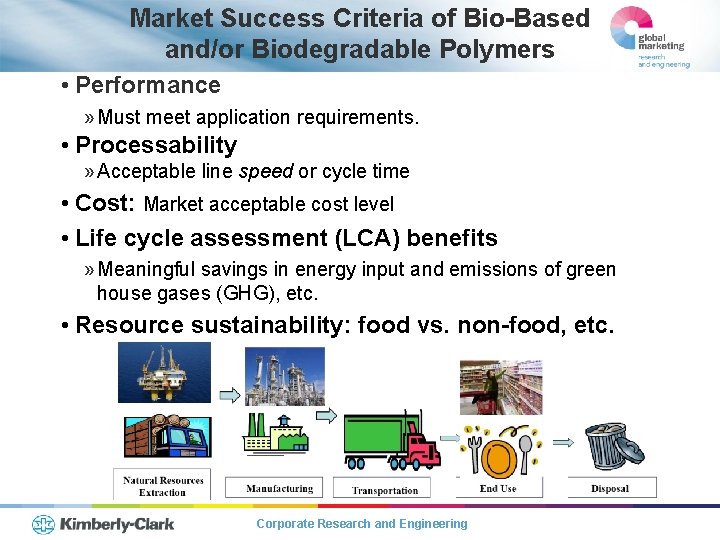
Market Success Criteria of Bio-Based and/or Biodegradable Polymers • Performance » Must meet application requirements. • Processability » Acceptable line speed or cycle time • Cost: Market acceptable cost level • Life cycle assessment (LCA) benefits » Meaningful savings in energy input and emissions of green house gases (GHG), etc. • Resource sustainability: food vs. non-food, etc. Corporate Research and Engineering
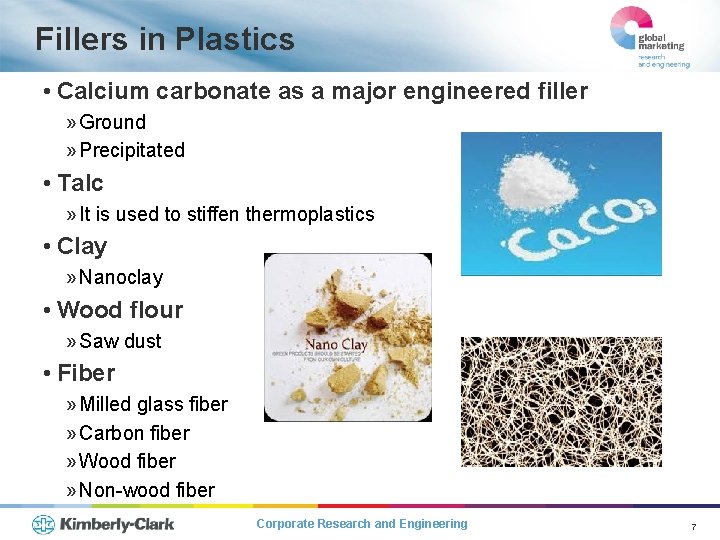
Fillers in Plastics • Calcium carbonate as a major engineered filler » Ground » Precipitated • Talc » It is used to stiffen thermoplastics • Clay » Nanoclay • Wood flour » Saw dust • Fiber » Milled glass fiber » Carbon fiber » Wood fiber » Non-wood fiber Corporate Research and Engineering 7
Objective and Approach • Investigate thermoplastic processability of organic fillers in bio-based polyethylene for rigid packaging applications • Technical approach uses extrusion compounding and injection molding » Non-wood filler preparations o Torrefaction o Milling » Thermoplastic compounding » Injection molded articles » Tests of the injection molded articles Corporate Research and Engineering 8

Material Preparation and Thermoplastic Processing © Copyright 2008 Kimberly-Clark Corporation
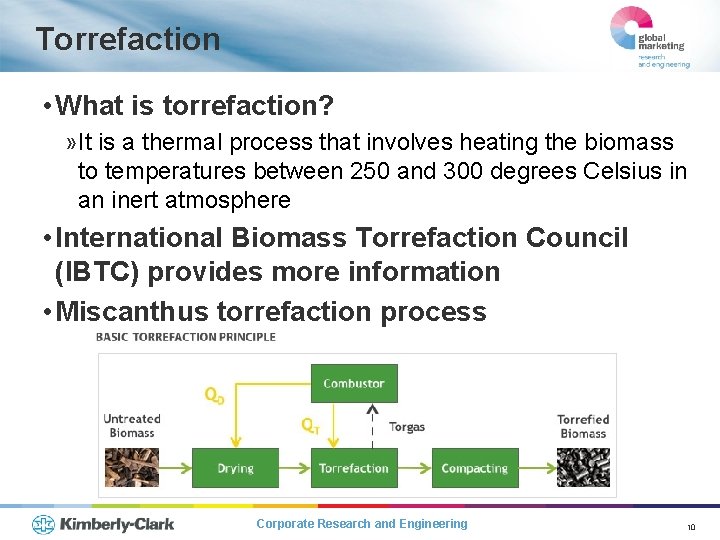
Torrefaction • What is torrefaction? » It is a thermal process that involves heating the biomass to temperatures between 250 and 300 degrees Celsius in an inert atmosphere • International Biomass Torrefaction Council (IBTC) provides more information • Miscanthus torrefaction process Corporate Research and Engineering 10
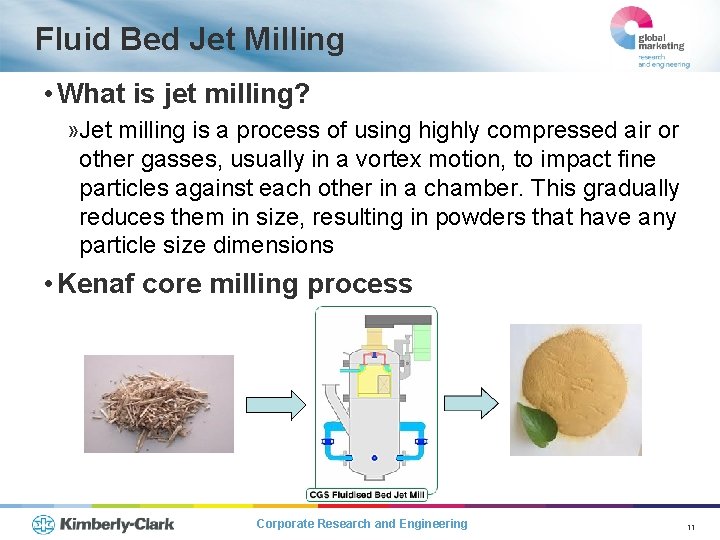
Fluid Bed Jet Milling • What is jet milling? » Jet milling is a process of using highly compressed air or other gasses, usually in a vortex motion, to impact fine particles against each other in a chamber. This gradually reduces them in size, resulting in powders that have any particle size dimensions • Kenaf core milling process Corporate Research and Engineering 11
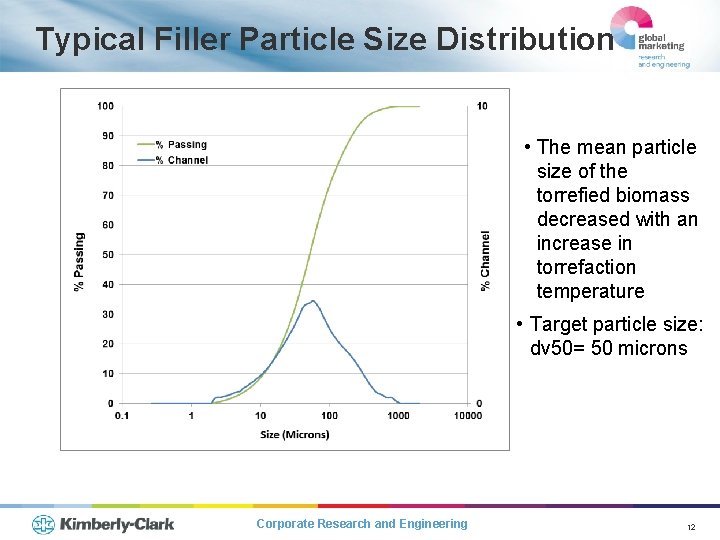
Typical Filler Particle Size Distribution • The mean particle size of the torrefied biomass decreased with an increase in torrefaction temperature • Target particle size: dv 50= 50 microns Corporate Research and Engineering 12

Thermoplastic Blend Technical Feasibility + Synthetic and Renewable Polymer Twin Screw Extrusion Natural Biomass Torrefied Miscanthus or kenaf core Thermo Prism™ USLAB 16 Binary Polymer Blends Injection Boy 22 D Injection Machine Molded Articles 13 Corporate Research and Engineering
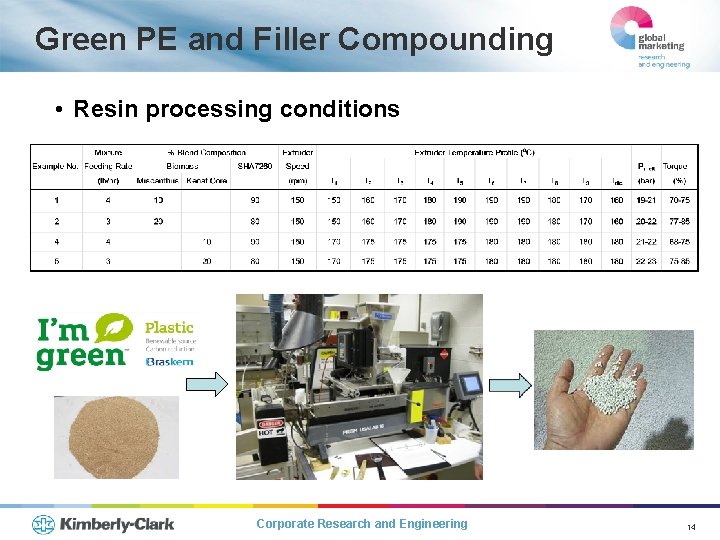
Green PE and Filler Compounding • Resin processing conditions Corporate Research and Engineering 14
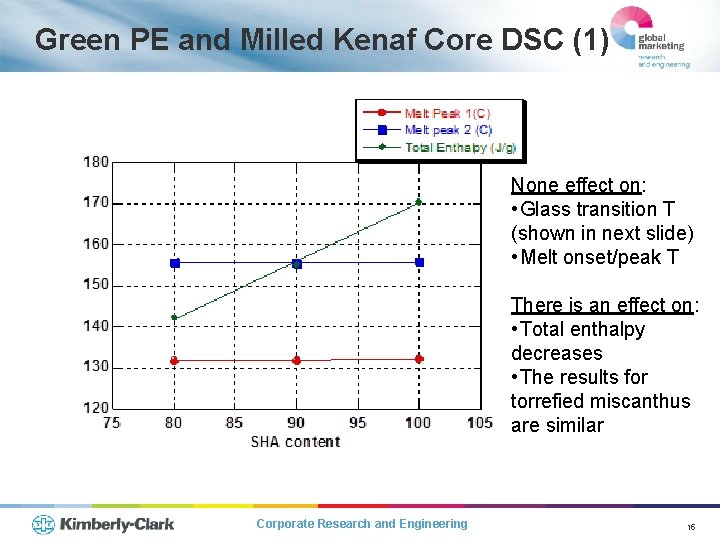
Green PE and Milled Kenaf Core DSC (1) None effect on: • Glass transition T (shown in next slide) • Melt onset/peak T There is an effect on: • Total enthalpy decreases • The results for torrefied miscanthus are similar Corporate Research and Engineering 15
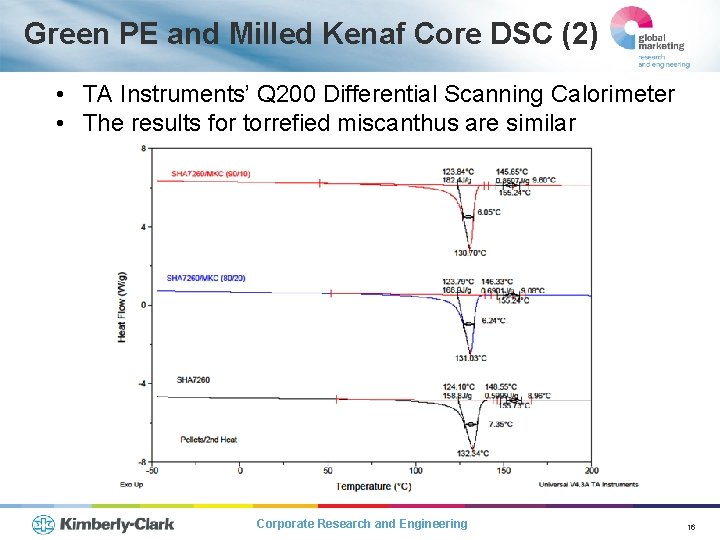
Green PE and Milled Kenaf Core DSC (2) • TA Instruments’ Q 200 Differential Scanning Calorimeter • The results for torrefied miscanthus are similar Corporate Research and Engineering 16
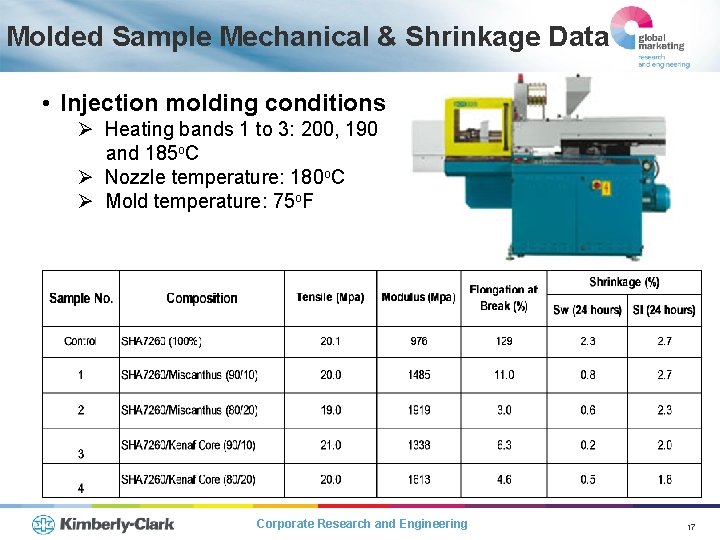
Molded Sample Mechanical & Shrinkage Data • Injection molding conditions Ø Heating bands 1 to 3: 200, 190 and 185 o. C Ø Nozzle temperature: 180 o. C Ø Mold temperature: 75 o. F Corporate Research and Engineering 17
Conclusion © Copyright 2008 Kimberly-Clark Corporation
Melt Extrusion is One of Options… • Bulky non-wood materials such as miscanthus and kenaf core are successfully densified via » Torrefaction » Fluid bed jet milling » Average filler particle size is about 50 microns • Resin compounding didn’t rely on any compatibilizers • Blend thermal properties are not affected significantly by the presence of organic fillers • Injection molded articles made from blends of green PE and miscanthus or kenaf core, respectively • Mechanical properties of injection molded articles » Dimensionally stable » Comparable tensile versus neat green PE » Lower elongation and high modulus versus the neat green PE Corporate Research and Engineering

Questions Corporate Research and Engineering
- Slides: 20