
Bioactivity of Artemisia afra essential oil and extracts
Bioactivity of Artemisia afra essential oil and extracts and their ability to reduce disease symptoms in wheat caused by the Russian wheat aphid. Cawood, M. E. ¹ & Saba, L. ¹ ¹ Department of Plant Sciences, University of the Free State, Bloemfontein, South Africa cawoodme@ufs. ac. za T: 051 401 9111 info@ufs. ac. za www. ufs. ac. za
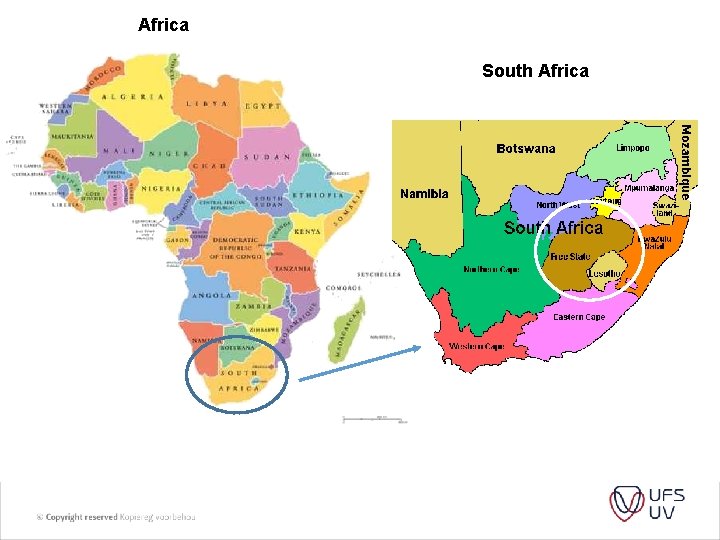
Africa South Africa ABC
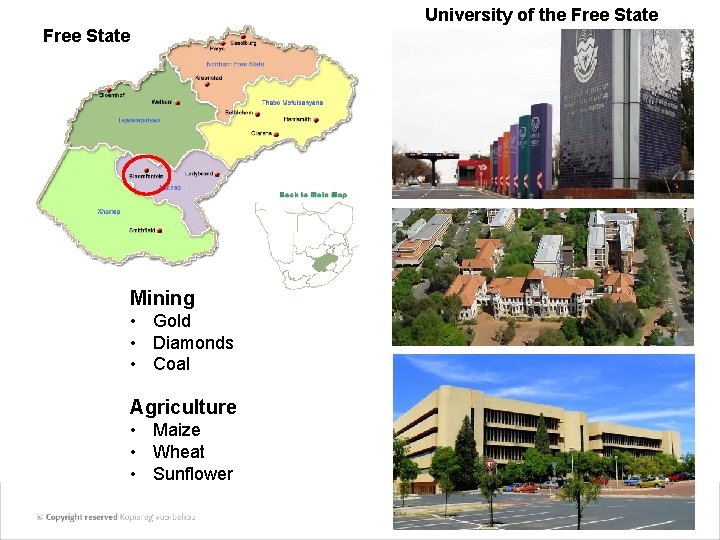
University of the Free State Mining • Gold • Diamonds • Coal Agriculture • Maize • Wheat • Sunflower
Introduction Wheat (Triticum aestivum L. ) ØA major international cereal food crop in the world ØMajor biotic constraints affecting the production of wheat. Russian wheat aphid (Diuraphis noxia) is an important international wheat pest also occurring in South Africa ØSummer rainfall region of the Free State causing major yield losses ØResistant wheat breeding - most successful management strategy ØMore virulent aphid biotypes produce new challenges
Russian wheat aphid biotypes • Four RWA biotypes have been recorded in South Africa ØRWASA 1 – 1978 ØRWASA 2 – 2005, virulent to Dn 1, Dn 2, Dn 3 & Dn 9 ØRWASA 3 - 2009, virulent to Dn 1, Dn 2, Dn 3, Dn 4 & Dn 9 ØRWASA 4 – 2011, virulent to Dn 1, Dn 2, Dn 3, Dn 4, Dn 5 & Dn 9 • New RWA resistant genes must be incorporated into cultivars to help keep resistance and delaying chemical control • Time consuming • Therefore, other effective control methods must be explored: Green Chemistry Natural products
Aim Explore more environmental friendly ways to protect wheat plants from attacks by the RWA Do plants contain bioactive compounds acting as: • natural insecticides • repellent products • ‘plant activators’ in the resistance response of wheat in general (priming)
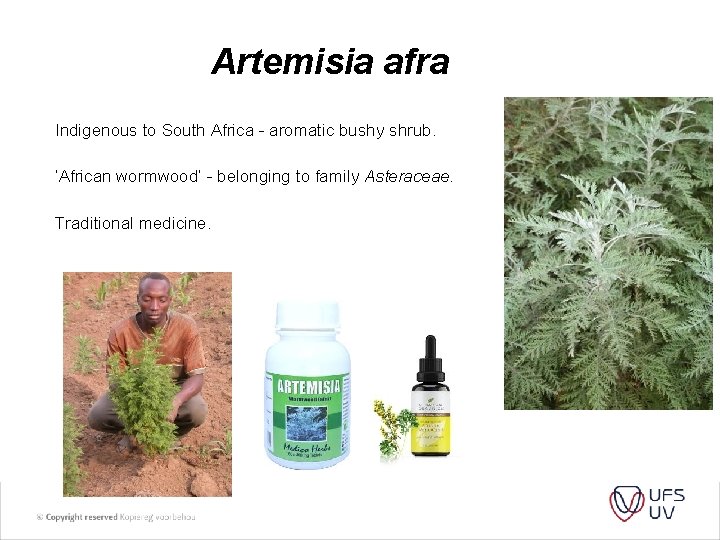
Artemisia afra Indigenous to South Africa - aromatic bushy shrub. ‘African wormwood’ - belonging to family Asteraceae. Traditional medicine.
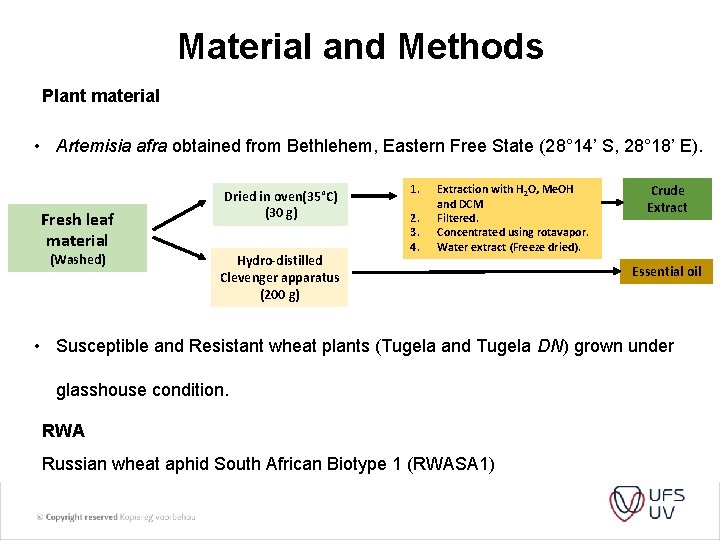
Material and Methods Plant material • Artemisia afra obtained from Bethlehem, Eastern Free State (28° 14’ S, 28° 18’ E). Fresh leaf material (Washed) Dried in oven(35°C) (30 g) Hydro-distilled Clevenger apparatus (200 g) 1. 2. 3. 4. Extraction with H 2 O, Me. OH and DCM Filtered. Concentrated using rotavapor. Water extract (Freeze dried). Crude Extract Essential oil • Susceptible and Resistant wheat plants (Tugela and Tugela DN) grown under glasshouse condition. RWA Russian wheat aphid South African Biotype 1 (RWASA 1)
Material and Methods (identification). Gas chromatography – mass spectrometry (GC-MS) • GC-MS : Perkin Elmer Clarus 500 Gas chromatogram Perkin Elmer Clarus 560 S mass spectrometer • Column used was Zebron ZB-5 ms capillary GC- column • Step gradient method was used to isolate and identify compounds found in essential oil and dichloromethane (Haouari and Ferchichi, 2009) • One µl of essential oil and dichloromethane extract was injected into GC-MS.
Material and Methods (identification). Thin layer chromatography • Plates were developed in tank using the following solvent systems: 1. Chloroform-methanol-water-1% formic acid (65: 35: 5: 1) polar extracts 2. Toluene-Ethyl acetate (93: 7) non-polar extracts • Compounds present on plates were visualized by UV (254 nm and 365 nm) and detection sprays. Detection Sprays p-anisaldehyde 10% vannillin in conc. H₂SO₄ 5% Ferric Chloride Dragendorf 0. 2% DPPH Prepared according to Funk et al. , 1990
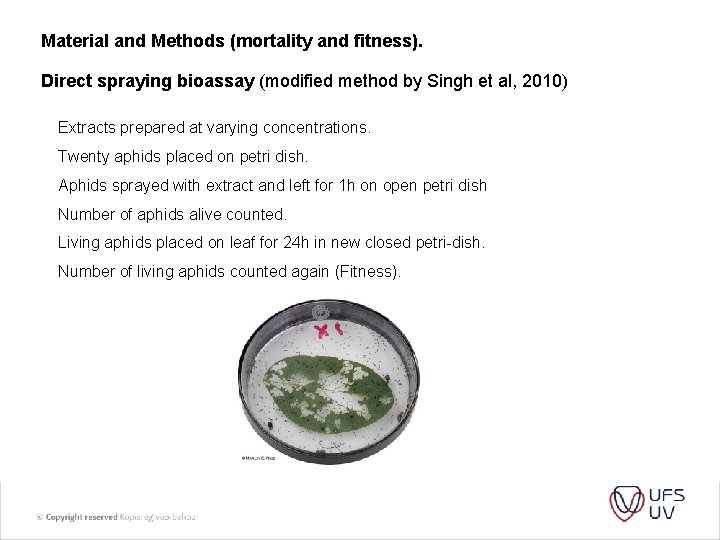
Material and Methods (mortality and fitness). Direct spraying bioassay (modified method by Singh et al, 2010) Extracts prepared at varying concentrations. Twenty aphids placed on petri dish. Aphids sprayed with extract and left for 1 h on open petri dish Number of aphids alive counted. Living aphids placed on leaf for 24 h in new closed petri-dish. Number of living aphids counted again (Fitness).
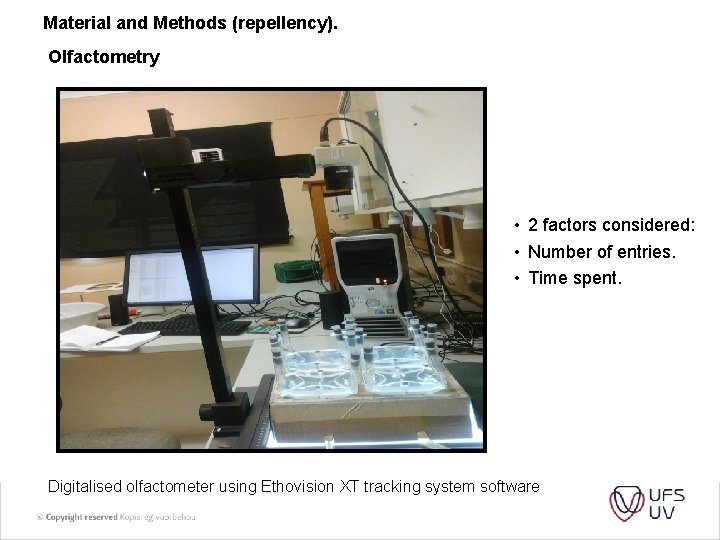
Material and Methods (repellency). Olfactometry • 2 factors considered: • Number of entries. • Time spent. Digitalised olfactometer using Ethovision XT tracking system software
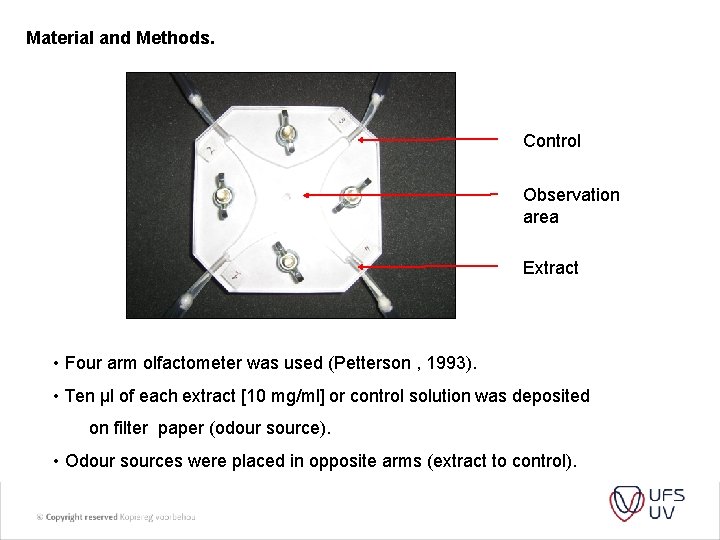
Material and Methods. Control Observation area Extract • Four arm olfactometer was used (Petterson , 1993). • Ten µl of each extract [10 mg/ml] or control solution was deposited on filter paper (odour source). • Odour sources were placed in opposite arms (extract to control).
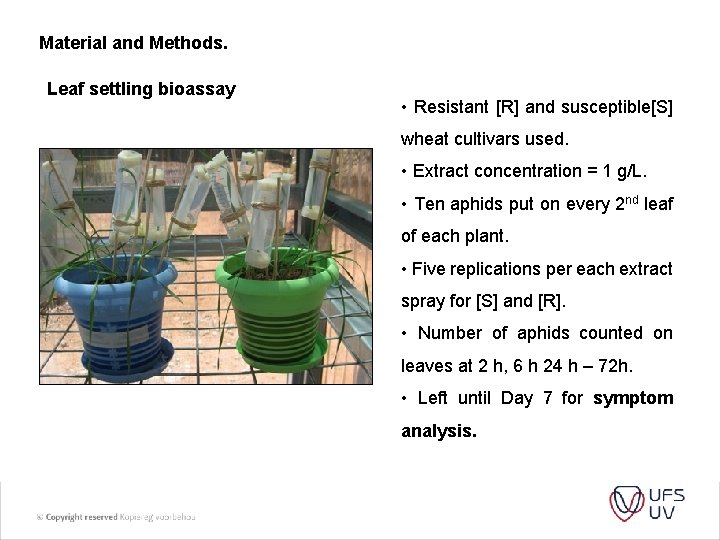
Material and Methods. Leaf settling bioassay • Resistant [R] and susceptible[S] wheat cultivars used. • Extract concentration = 1 g/L. • Ten aphids put on every 2 nd leaf of each plant. • Five replications per each extract spray for [S] and [R]. • Number of aphids counted on leaves at 2 h, 6 h 24 h – 72 h. • Left until Day 7 for symptom analysis.
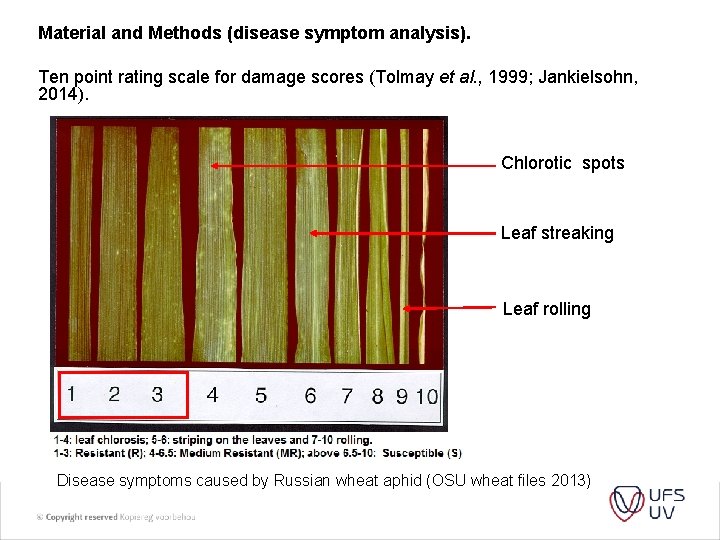
Material and Methods (disease symptom analysis). Ten point rating scale for damage scores (Tolmay et al. , 1999; Jankielsohn, 2014). Chlorotic spots Leaf streaking Leaf rolling Disease symptoms caused by Russian wheat aphid (OSU wheat files 2013)
Statistical analysis of data Olfactometer: Generalized linear model with Binomial distribution (p, n) for olfactometer data, one way analysis of variance (ANOVA) with logistic function. Leaf settling: Average count using trapezoidal rule followed by one way ANOVA (P < 0. 05). Disease rating and symptom analysis: Modified Tolmay et al. , 1999; One way ANOVA Pearson chi-square test (P < 0. 05). Induction of defence responses: ANOVA following t-test statistics and Pvalues associated with comparison. SAS/STAT version 9. 2. NC: SAS [Institute Inc. (2009)] software used.
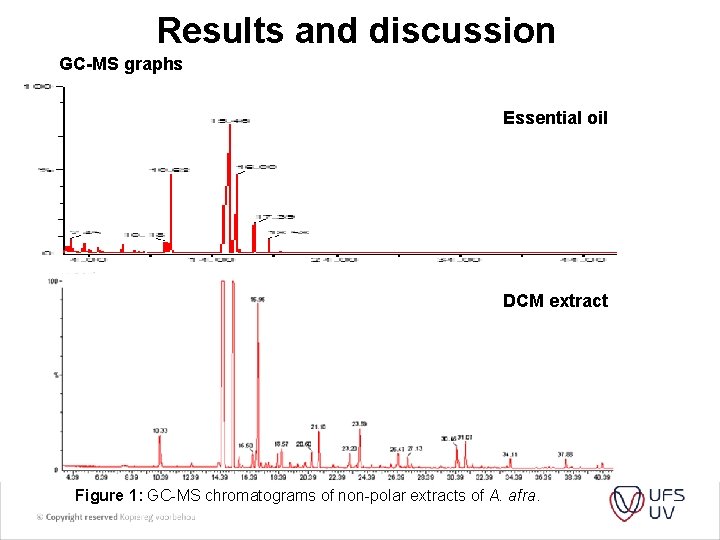
Results and discussion GC-MS graphs Essential oil DCM extract Figure 1: GC-MS chromatograms of non-polar extracts of A. afra.
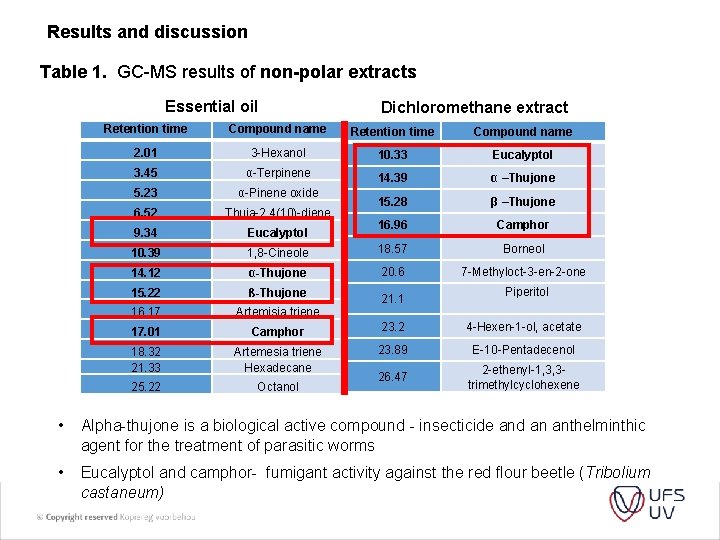
Results and discussion Table 1. GC-MS results of non-polar extracts Essential oil Dichloromethane extract Retention time Compound name 2. 01 3 -Hexanol 10. 33 Eucalyptol 3. 45 α-Terpinene 14. 39 α –Thujone 5. 23 α-Pinene oxide 6. 52 Thuja-2, 4(10)-diene 15. 28 β –Thujone 9. 34 Eucalyptol 16. 96 Camphor 10. 39 1, 8 -Cineole 18. 57 Borneol 14. 12 α-Thujone 20. 6 7 -Methyloct-3 -en-2 -one 15. 22 ß-Thujone 16. 17 Artemisia triene 21. 1 Piperitol 17. 01 Camphor 23. 2 4 -Hexen-1 -ol, acetate 18. 32 21. 33 Artemesia triene Hexadecane 23. 89 E-10 -Pentadecenol 25. 22 Octanol 26. 47 2 -ethenyl-1, 3, 3 trimethylcyclohexene • Alpha-thujone is a biological active compound - insecticide and an anthelminthic agent for the treatment of parasitic worms • Eucalyptol and camphor- fumigant activity against the red flour beetle (Tribolium castaneum)
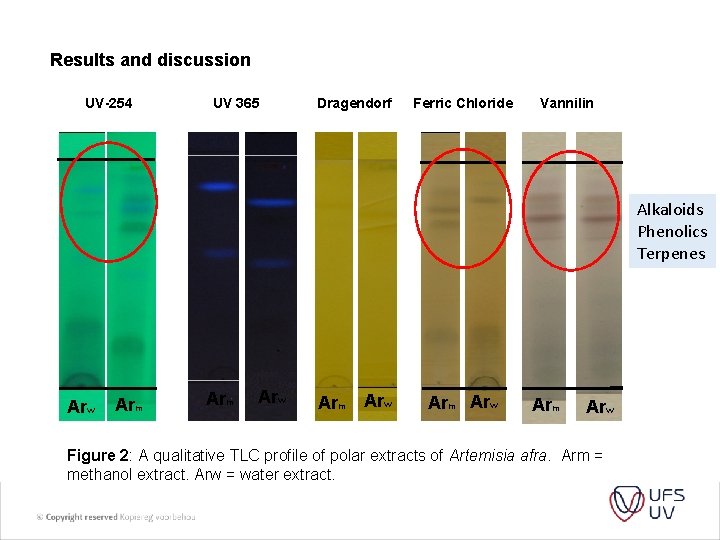
Results and discussion UV-254 UV 365 Dragendorf Ferric Chloride Vannilin Alkaloids Phenolics Terpenes Arw Arm Arw Arm Arw Figure 2: A qualitative TLC profile of polar extracts of Artemisia afra. Arm = methanol extract. Arw = water extract.
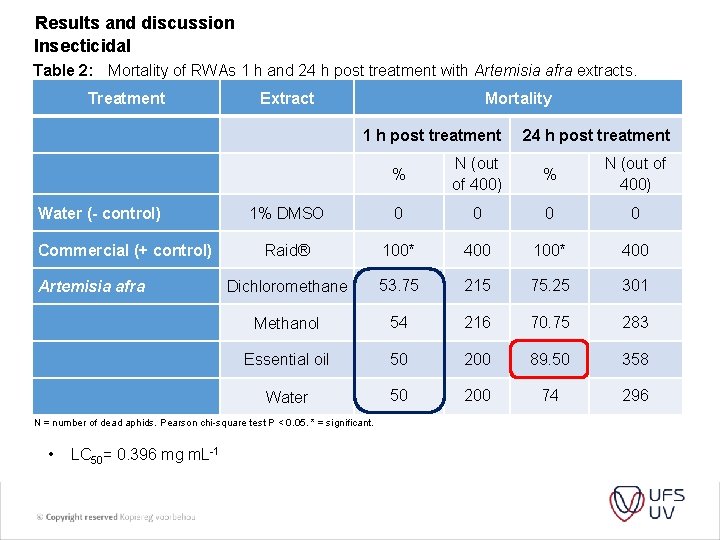
Results and discussion Insecticidal Table 2: Mortality of RWAs 1 h and 24 h post treatment with Artemisia afra extracts. Treatment Extract Water (- control) Commercial (+ control) Artemisia afra Mortality 1 h post treatment % N (out of 400) 1% DMSO 0 0 Raid® 100* 400 Dichloromethane 53. 75 215 75. 25 301 Methanol 54 216 70. 75 283 Essential oil 50 200 89. 50 358 Water 50 200 74 296 N = number of dead aphids. Pearson chi-square test P < 0. 05. * = significant. • LC 50= 0. 396 mg m. L-1 24 h post treatment
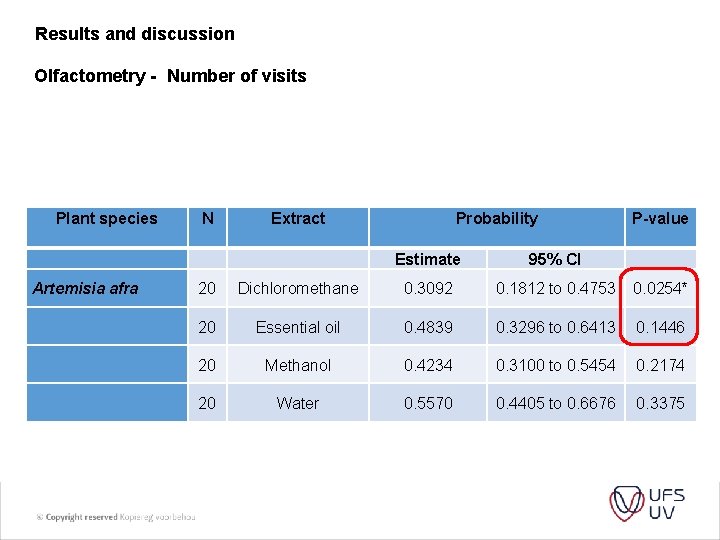
Results and discussion Olfactometry - Number of visits Plant species Artemisia afra N Extract Probability Estimate 95% CI P-value 20 Dichloromethane 0. 3092 0. 1812 to 0. 4753 0. 0254* 20 Essential oil 0. 4839 0. 3296 to 0. 6413 0. 1446 20 Methanol 0. 4234 0. 3100 to 0. 5454 0. 2174 20 Water 0. 5570 0. 4405 to 0. 6676 0. 3375
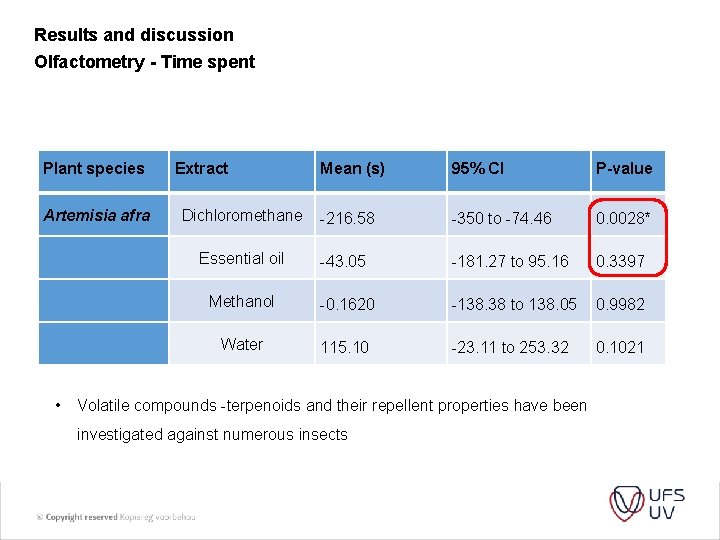
Results and discussion Olfactometry - Time spent Plant species Mean (s) 95% CI P-value Dichloromethane -216. 58 -350 to -74. 46 0. 0028* Essential oil -43. 05 -181. 27 to 95. 16 0. 3397 Methanol -0. 1620 -138. 38 to 138. 05 0. 9982 Water 115. 10 -23. 11 to 253. 32 0. 1021 Artemisia afra • Extract Volatile compounds -terpenoids and their repellent properties have been investigated against numerous insects
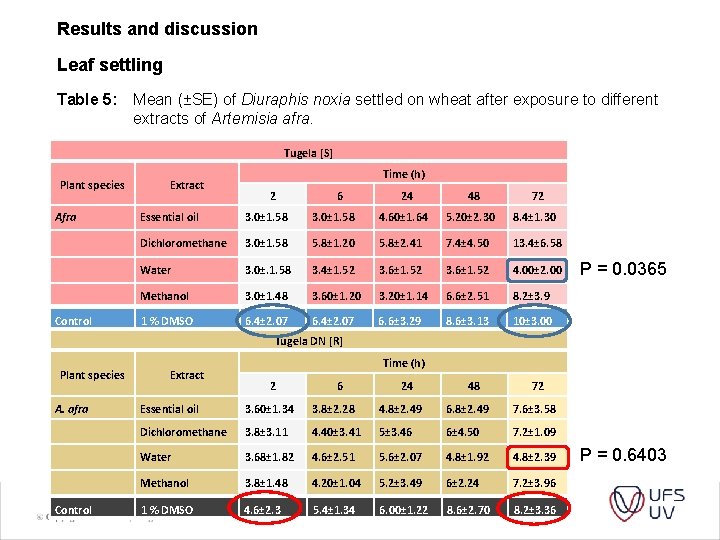
Results and discussion Leaf settling Table 5: Mean (±SE) of Diuraphis noxia settled on wheat after exposure to different extracts of Artemisia afra. Tugela [S] Plant species Extract Time (h) 2 6 24 48 72 Afra Essential oil 3. 0± 1. 58 4. 60± 1. 64 5. 20± 2. 30 8. 4± 1. 30 Dichloromethane 3. 0± 1. 58 5. 8± 1. 20 5. 8± 2. 41 7. 4± 4. 50 13. 4± 6. 58 Water 3. 0±. 1. 58 3. 4± 1. 52 3. 6± 1. 52 4. 00± 2. 00 Methanol 3. 0± 1. 48 3. 60± 1. 20 3. 20± 1. 14 6. 6± 2. 51 8. 2± 3. 9 Control 1 % DMSO 6. 4± 2. 07 6. 6± 3. 29 8. 6± 3. 13 10± 3. 00 P = 0. 0365 Tugela DN [R] Plant species Extract Time (h) 2 6 24 48 72 A. afra Essential oil 3. 60± 1. 34 3. 8± 2. 28 4. 8± 2. 49 6. 8± 2. 49 7. 6± 3. 58 Dichloromethane 3. 8± 3. 11 4. 40± 3. 41 5± 3. 46 6± 4. 50 7. 2± 1. 09 Water 3. 68± 1. 82 4. 6± 2. 51 5. 6± 2. 07 4. 8± 1. 92 4. 8± 2. 39 Methanol 3. 8± 1. 48 4. 20± 1. 04 5. 2± 3. 49 6± 2. 24 7. 2± 3. 96 Control 1 % DMSO 4. 6± 2. 3 5. 4± 1. 34 6. 00± 1. 22 8. 6± 2. 70 8. 2± 3. 36 P = 0. 6403
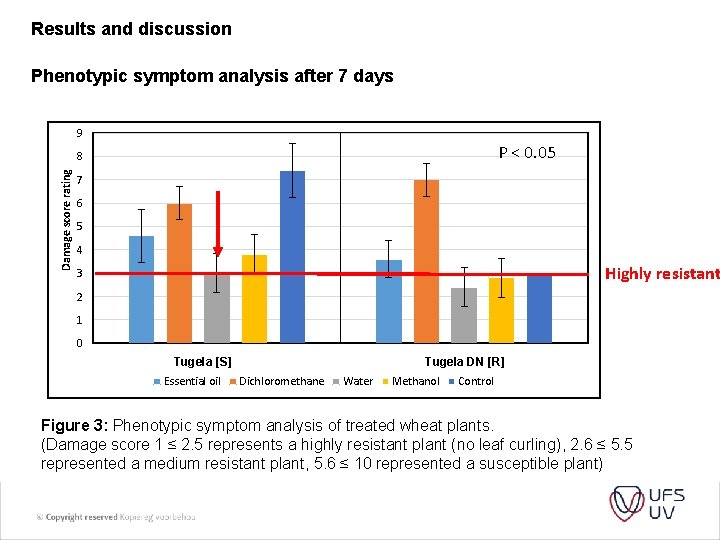
Results and discussion Phenotypic symptom analysis after 7 days 9 P < 0. 05 Damage score rating 8 7 6 5 4 Highly resistant 3 2 1 0 Tugela [S] Essential oil Tugela DN [R] Dichloromethane Water Methanol Control Figure 3: Phenotypic symptom analysis of treated wheat plants. (Damage score 1 ≤ 2. 5 represents a highly resistant plant (no leaf curling), 2. 6 ≤ 5. 5 represented a medium resistant plant, 5. 6 ≤ 10 represented a susceptible plant)
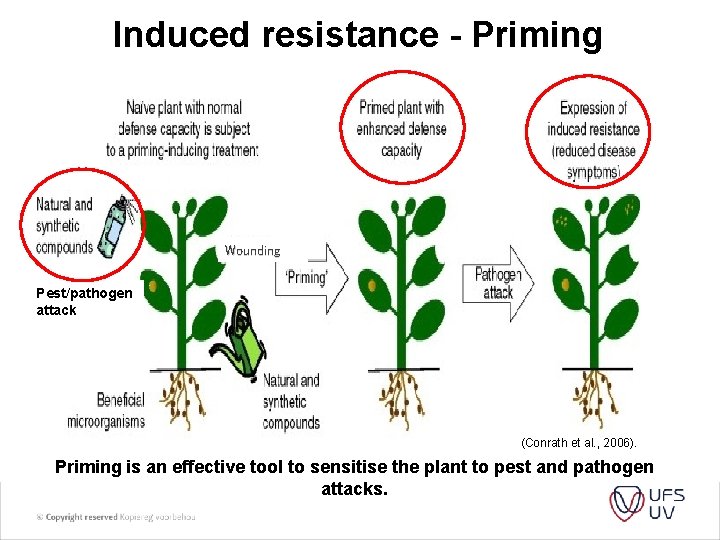
Induced resistance - Priming Wounding Pest/pathogen attack (Conrath et al. , 2006). Priming is an effective tool to sensitise the plant to pest and pathogen attacks.
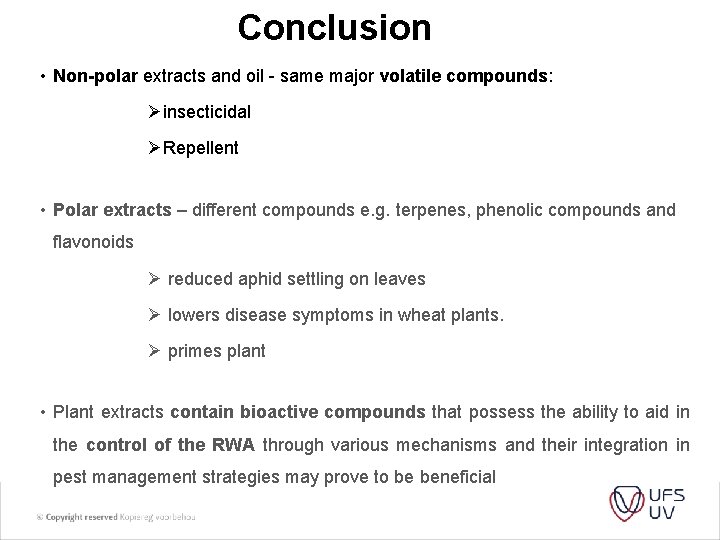
Conclusion • Non-polar extracts and oil - same major volatile compounds: Øinsecticidal ØRepellent • Polar extracts – different compounds e. g. terpenes, phenolic compounds and flavonoids Ø reduced aphid settling on leaves Ø lowers disease symptoms in wheat plants. Ø primes plant • Plant extracts contain bioactive compounds that possess the ability to aid in the control of the RWA through various mechanisms and their integration in pest management strategies may prove to be beneficial
Therefore, extracts of A. afra might be another tool to use in addition to genetic plant defence mechanisms and should be a priority to investigate further in field studies 11/26/2020
Acknowledgements Strategic academic cluster no. 4: Technologies for sustainable crop industries in semi-arid regions
References 1. Battacharya A, Jaiswal A K, Monobrullah M and JP Singh (2010). Effect of selected pesticides on larval mortality of the neuropteran predator, Chrysopa lacciperda Kimmins of the lack insect Kerria lacca. Journal of Asia-pacific entomology 69: 72. 2. Bradford M M (1976). A rapid and sensitive method for the quantitation of microgram quantities of protein utilizing the principle of protein-dye binding. Anal. Biochem. 72: 248 -255. 3. Conrath U, Beckers GJM, Flors V, Garcia-Agustin P, Jakab G, Mauch F, Newman MA, Pieterse CMJ, Poinssot B, Pozo MJ, Pugin A, Schaffrath U, Ton J, Wendehenne D, Zimmerli L and Mauch-Mani B (2006) Priming: getting ready for battle. Molecular Plant-Microbe Interactions Journal. 19: 1062– 1071. 4. Fink W, Liefland Mendgen K (1988) Chitinases and ß-1, 3 -glucanases in the apoplastic compartment of oat leaves (Avena sativa L. ). Journal of Plant Physiology. 88: 270 -275. 5. Haouari M and Ferchichi A (2009) Essential Oil Composition of Artemisia herba-alba from Southern Tunisia. Molecules. 14: 1585 -1594. 5. Zieslin N and Ben-Zaken R (1991). Peroxidase, phenylalanine ammonia-lyase and lignifications in peduncles of rose flowers. Plant Physiol. Biochem. 29: 147 -151. 6. Pettersson, J(1970). An aphid sex attractant. Entomologica Scandinavica, 1: 63– 73. 7. Sommissich IE and Halbrock K(1998). Pathogen defence in plants- a paradigm of biological complexity. Trends Plant sci Rev 3: 86 -90. 8. Prinsloo, G. J (2006). Parasitoids and Aphid Resistant Plants: Prospects for Diuraphis noxia (Kurdjumov) control. Ph. D. thesis, University of the Free State, Bloemfontein, South Africa. pp. 34 -168.

Thank you Baie dankie T: +27(0)51 401 9111 | info@ufs. ac. za | www. ufs. ac. za
- Slides: 30