
Bio Sci 2 B Environment and Human Health

Bio. Sci 2 B - Environment and Human Health • Bruce Blumberg – 2113 E Mc. Gaugh Hall – open office hours – phone 824 -8573 – blumberg@uci. edu • check e-mail and noteboard daily for announcements, etc. . – If you do not have ready access to e-mail or the web speak with me ASAP – Please use the course noteboard for discussions of the material

Rules for freshman seminars • Attendance – at least 8/10 lectures • Participation – Make a presentation – Participate in discussions • Be involved in your own education

Requirements for the oral presentation - presenter • Powerpoint presentation on a topic related to the environment and human health – Please approve it with me in advance – Send out links to the articles, web sites, etc in advance • 30 minutes with time allowed for discussion (max of ~20 slides) – What is the problem of interest – the big picture question – Present background – what is known, what is unknown – Present the story, research, etc – Present an analysis of the story or article • Which parts are credible • Which are suspect • How would you study the problem – Point out a few papers for further reading (reviews, followups, etc)

Requirements for the oral presentation - presenter • Logistics – Prepare presentation and either e-mail to me or bring it on a • CD-ROM • Floppy disk • USB flash memory drive – Or bring your own laptop – Bring light snacks for everyone – I will pay up to $20/class • I would like to post these on course web site – is that OK?

Requirements for the oral presentation listener • READ THE PAPER or article – Think about it – make notes on parts you have questions about – Listen to the speaker • If presentation is unclear, ask the speaker to elaborate • Always feel free to ask questions – we want an open discussion
Blumberg Laboratory http: //blumberg-serv. bio. uci. edu • The role of nuclear hormone receptors in: – development – physiology – endocrine disruption – cancer • Functional genomic approaches to: – identify cellular partners for known genes – define new members of signaling pathways – find downstream target genes – develop new drug targets
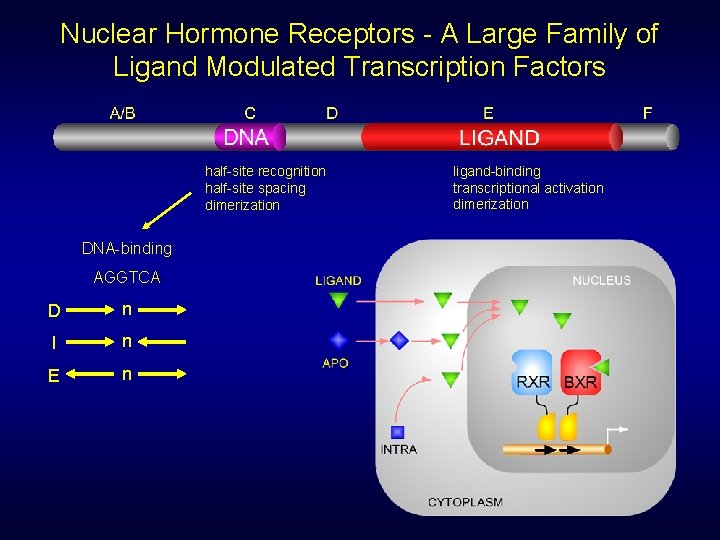
Nuclear Hormone Receptors - A Large Family of Ligand Modulated Transcription Factors half-site recognition half-site spacing dimerization DNA-binding AGGTCA D n I n E n ligand-binding transcriptional activation dimerization
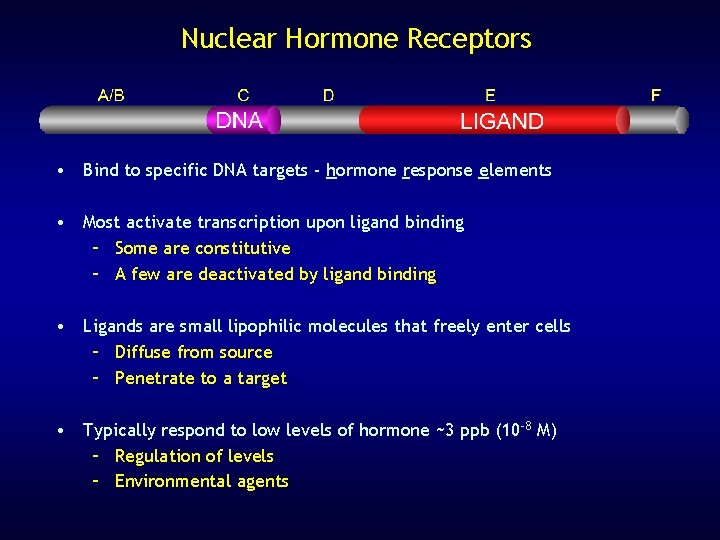
Nuclear Hormone Receptors • Bind to specific DNA targets - hormone response elements • Most activate transcription upon ligand binding – Some are constitutive – A few are deactivated by ligand binding • Ligands are small lipophilic molecules that freely enter cells – Diffuse from source – Penetrate to a target • Typically respond to low levels of hormone ~3 ppb (10 -8 M) – Regulation of levels – Environmental agents
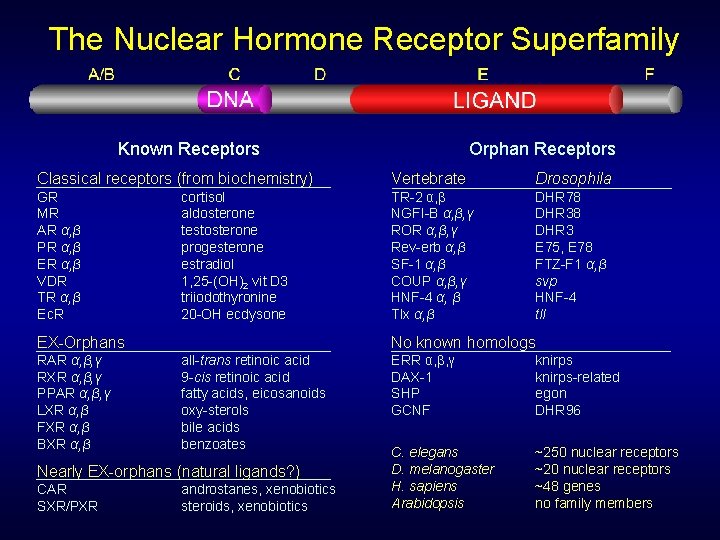
The Nuclear Hormone Receptor Superfamily Known Receptors Orphan Receptors Classical receptors (from biochemistry) Vertebrate Drosophila GR MR AR α, β PR α, β ER α, β VDR TR α, β Ec. R TR-2 α, β NGFI-B α, β, γ ROR α, β, γ Rev-erb α, β SF-1 α, β COUP α, β, γ HNF-4 α, β Tlx α, β DHR 78 DHR 3 E 75, E 78 FTZ-F 1 α, β svp HNF-4 tll cortisol aldosterone testosterone progesterone estradiol 1, 25 -(OH)2 vit D 3 triiodothyronine 20 -OH ecdysone EX-Orphans RAR α, β, γ RXR α, β, γ PPAR α, β, γ LXR α, β FXR α, β BXR α, β No known homologs all-trans retinoic acid 9 -cis retinoic acid fatty acids, eicosanoids oxy-sterols bile acids benzoates Nearly EX-orphans (natural ligands? ) CAR SXR/PXR androstanes, xenobiotics steroids, xenobiotics ERR α, β, γ DAX-1 SHP GCNF knirps-related egon DHR 96 C. elegans D. melanogaster H. sapiens Arabidopsis ~250 nuclear receptors ~20 nuclear receptors ~48 genes no family members
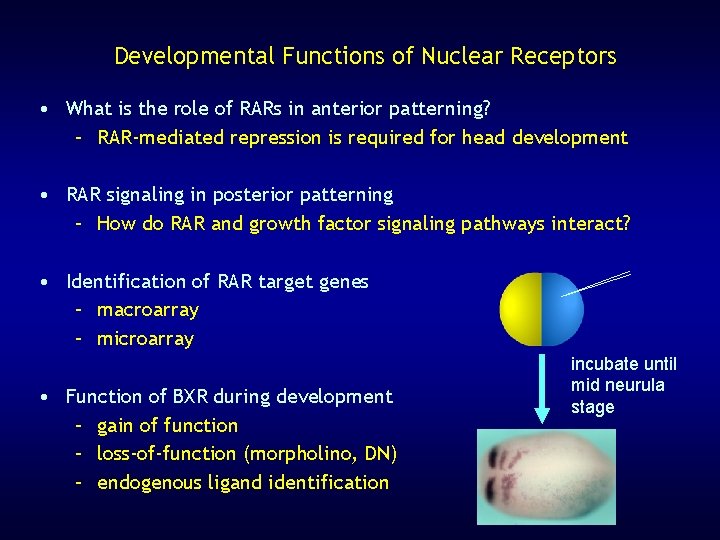
Developmental Functions of Nuclear Receptors • What is the role of RARs in anterior patterning? – RAR-mediated repression is required for head development • RAR signaling in posterior patterning – How do RAR and growth factor signaling pathways interact? • Identification of RAR target genes – macroarray – microarray • Function of BXR during development – gain of function – loss-of-function (morpholino, DN) – endogenous ligand identification incubate until mid neurula stage
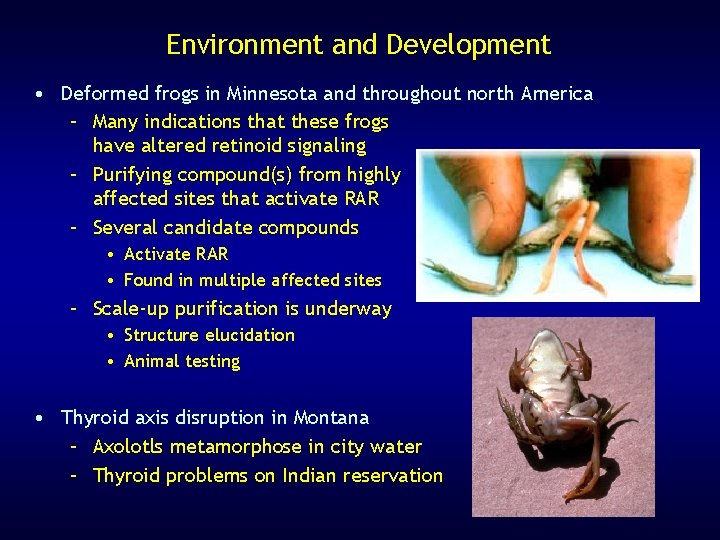
Environment and Development • Deformed frogs in Minnesota and throughout north America – Many indications that these frogs have altered retinoid signaling – Purifying compound(s) from highly affected sites that activate RAR – Several candidate compounds • Activate RAR • Found in multiple affected sites – Scale-up purification is underway • Structure elucidation • Animal testing • Thyroid axis disruption in Montana – Axolotls metamorphose in city water – Thyroid problems on Indian reservation
Solving an ancient mystery • Sometimes science leads us in unexpected directions • We identified a very strangely behaving hormone receptor that is very important in our response to chemicals in foods
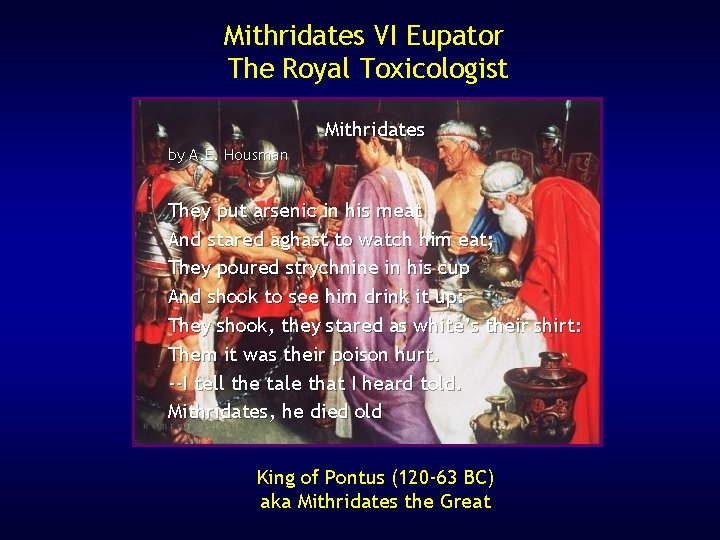
Mithridates VI Eupator The Royal Toxicologist Mithridates by A. E. Housman They put arsenic in his meat And stared aghast to watch him eat; They poured strychnine in his cup And shook to see him drink it up: They shook, they stared as white’s their shirt: Them it was their poison hurt. --I tell the tale that I heard told. Mithridates, he died old King of Pontus (120 -63 BC) aka Mithridates the Great
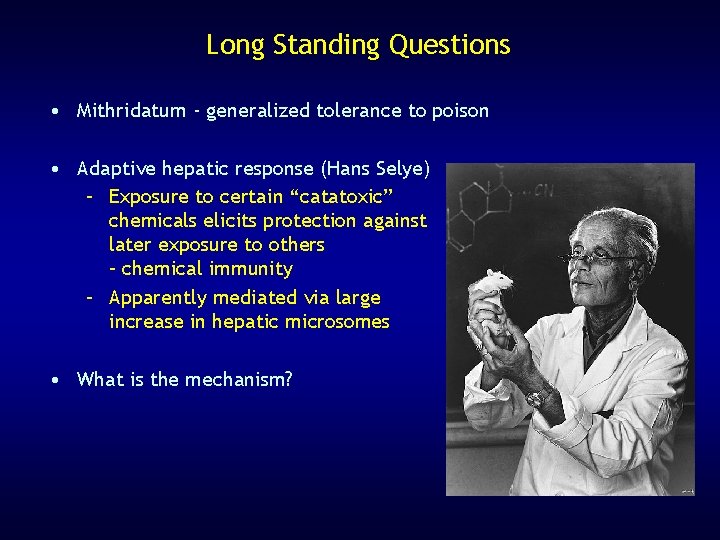
Long Standing Questions • Mithridatum - generalized tolerance to poison • Adaptive hepatic response (Hans Selye) – Exposure to certain “catatoxic” chemicals elicits protection against later exposure to others – chemical immunity – Apparently mediated via large increase in hepatic microsomes • What is the mechanism?
SXR Responds to Many Steroids
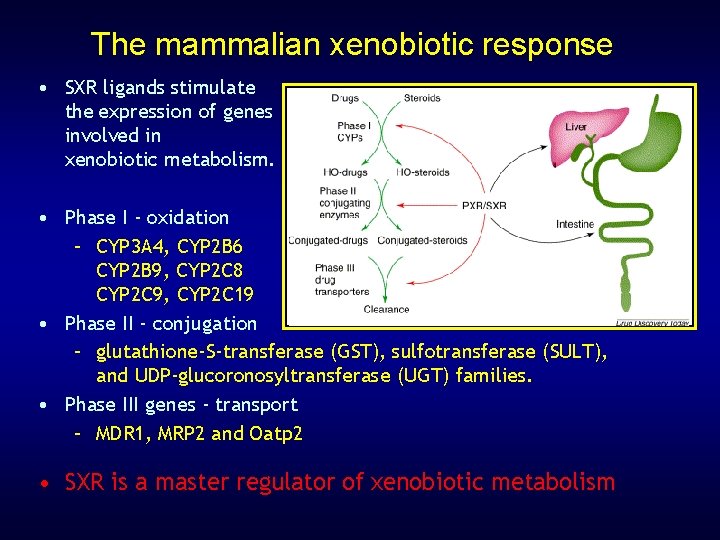
The mammalian xenobiotic response • SXR ligands stimulate the expression of genes involved in xenobiotic metabolism. • Phase I - oxidation – CYP 3 A 4, CYP 2 B 6 CYP 2 B 9, CYP 2 C 8 CYP 2 C 9, CYP 2 C 19 • Phase II - conjugation – glutathione-S-transferase (GST), sulfotransferase (SULT), and UDP-glucoronosyltransferase (UGT) families. • Phase III genes - transport – MDR 1, MRP 2 and Oatp 2 • SXR is a master regulator of xenobiotic metabolism
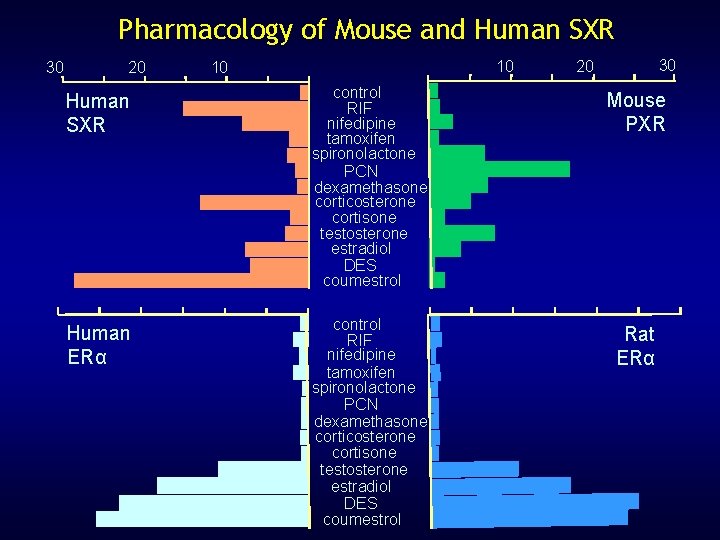
Pharmacology of Mouse and Human SXR 30 20 10 10 30 20 Human SXR control RIF nifedipine tamoxifen spironolactone PCN dexamethasone corticosterone cortisone testosterone estradiol DES coumestrol Mouse PXR Human ERα control RIF nifedipine tamoxifen spironolactone PCN dexamethasone corticosterone cortisone testosterone estradiol DES coumestrol Rat ERα
Model Systems • Effects on animals predict effects on humans – Fundamental assumption: biochemistry, endocrinology and metabolism are the same – Nuclear receptors behave virtually identically across species • Different pharmacology of SXR and PXR suggests that there are important differences in metabolism • These differences may be highly relevant for toxicology (including developmental effects), drug interactions and endocrine disruption • Cross-species extrapolation must account for differences in response of xenobiotic sensors – SXR – CAR
SXR and Endocrine Disruption • SXR regulates the oxidation, conjugation and clearance of ingested steroids and xenobiotics • Activation of SXR may predict effects of suspected EDC – SXR activators may be detoxified by CYP action and not a human risk – But activators may also be toxified by CYP action, increasing the risk. – EDC may have no effect on SXR and therefore more likely to act on other receptors, e. g. ER • Metabolism will play important role in shape of dose response curves – A compound could have effects at low doses but induce its own metabolism at high doses, masking the low-dose effect • SXR is a molecular assay for potential activity of EDCs • Different pharmacology of SXR and PXR suggests that differences in metabolism may exist and be relevant for risk assessment
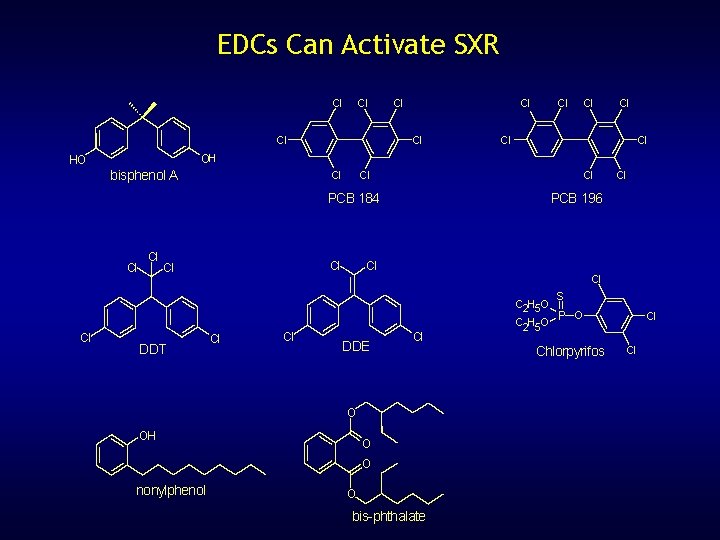
EDCs Can Activate SXR Cl Cl Cl OH HO bisphenol A Cl Cl Cl PCB 184 Cl Cl Cl DDT PCB 196 Cl Cl DDE Cl O OH O O nonylphenol Cl O bis-phthalate S C 2 H 5 O P O C 2 H 5 O Chlorpyrifos Cl Cl
- Slides: 20