
Bio Health Base A Webbased Database and Analysis
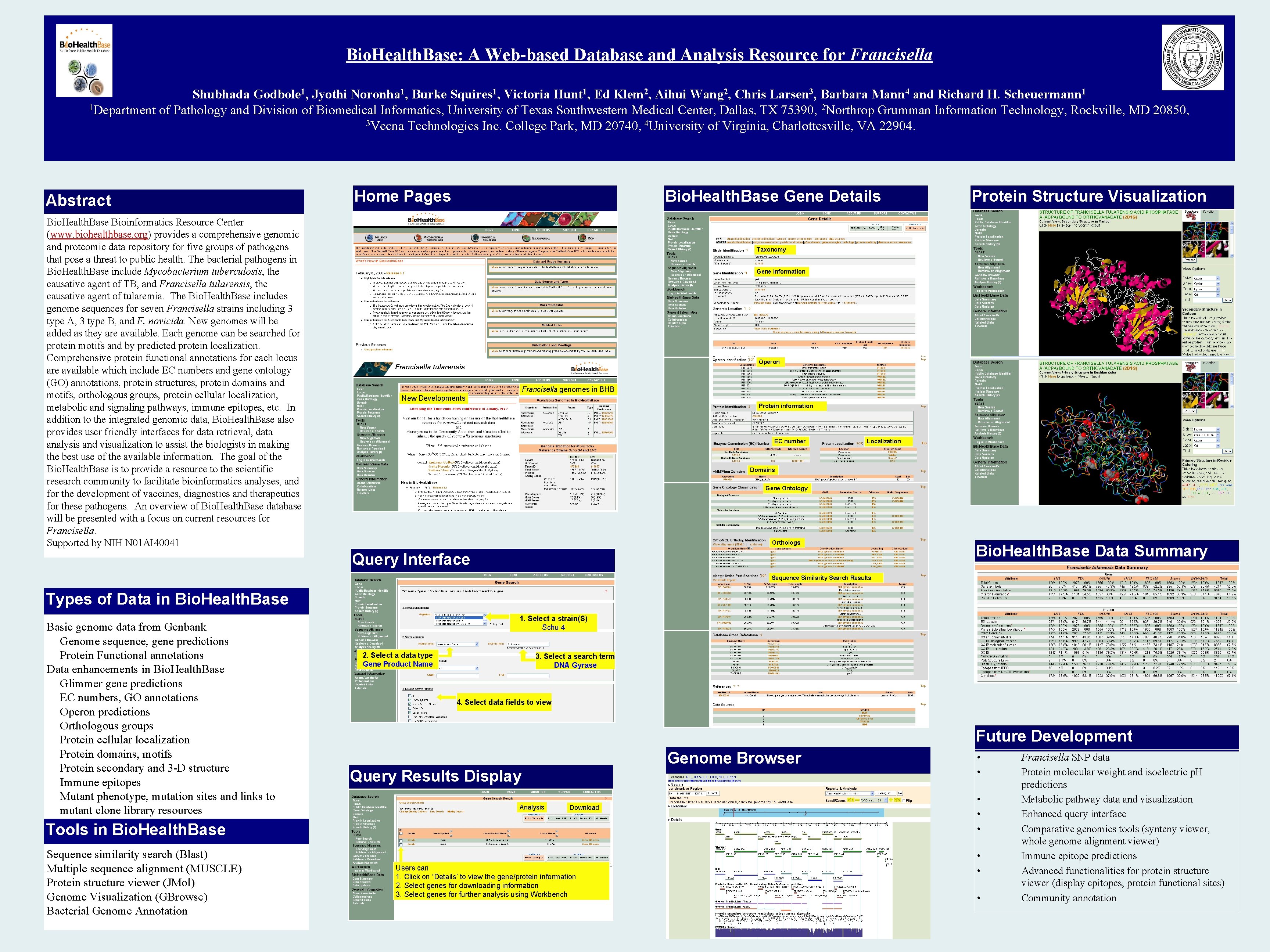
Bio. Health. Base: A Web-based Database and Analysis Resource for Francisella Shubhada Godbole 1, Jyothi Noronha 1, Burke Squires 1, Victoria Hunt 1, Ed Klem 2, Aihui Wang 2, Chris Larsen 3, Barbara Mann 4 and Richard H. Scheuermann 1 1 Department of Pathology and Division of Biomedical Informatics, University of Texas Southwestern Medical Center, Dallas, TX 75390, 2 Northrop Grumman Information Technology, Rockville, MD 20850, 3 Vecna Technologies Inc. College Park, MD 20740, 4 University of Virginia, Charlottesville, VA 22904. Abstract Bio. Health. Base Bioinformatics Resource Center (www. biohealthbase. org) provides a comprehensive genomic and proteomic data repository for five groups of pathogens that pose a threat to public health. The bacterial pathogens in Bio. Health. Base include Mycobacterium tuberculosis, the causative agent of TB, and Francisella tularensis, the causative agent of tularemia. The Bio. Health. Base includes genome sequences for seven Francisella strains including 3 type A, 3 type B, and F. novicida. New genomes will be added as they are available. Each genome can be searched for protein motifs and by predicted protein localization. Comprehensive protein functional annotations for each locus are available which include EC numbers and gene ontology (GO) annotations, protein structures, protein domains and motifs, orthologous groups, protein cellular localization, metabolic and signaling pathways, immune epitopes, etc. In addition to the integrated genomic data, Bio. Health. Base also provides user friendly interfaces for data retrieval, data analysis and visualization to assist the biologists in making the best use of the available information. The goal of the Bio. Health. Base is to provide a resource to the scientific research community to facilitate bioinformatics analyses, and for the development of vaccines, diagnostics and therapeutics for these pathogens. An overview of Bio. Health. Base database will be presented with a focus on current resources for Francisella. Supported by NIH N 01 AI 40041 Home Pages Bio. Health. Base Gene Details Protein Structure Visualization Taxonomy Gene Information Operon Francisella genomes in BHB New Developments Protein information EC number Localization Domains Gene Ontology Orthologs Query Interface Bio. Health. Base Data Summary Sequence Similarity Search Results Types of Data in Bio. Health. Base Basic genome data from Genbank Genome sequence, gene predictions Protein Functional annotations Data enhancements in Bio. Health. Base Glimmer gene predictions EC numbers, GO annotations Operon predictions Orthologous groups Protein cellular localization Protein domains, motifs Protein secondary and 3 -D structure Immune epitopes Mutant phenotype, mutation sites and links to mutant clone library resources 1. Select a strain(S) Schu 4 2. Select a data type Gene Product Name 3. Select a search term DNA Gyrase 4. Select data fields to view Future Development Genome Browser Query Results Display Analysis Download Tools in Bio. Health. Base Sequence similarity search (Blast) Multiple sequence alignment (MUSCLE) Protein structure viewer (JMol) Genome Visualization (GBrowse) Bacterial Genome Annotation Users can 1. Click on ‘Details’ to view the gene/protein information 2. Select genes for downloading information 3. Select genes for further analysis using Workbench • • Francisella SNP data Protein molecular weight and isoelectric p. H predictions Metabolic pathway data and visualization Enhanced query interface Comparative genomics tools (synteny viewer, whole genome alignment viewer) Immune epitope predictions Advanced functionalities for protein structure viewer (display epitopes, protein functional sites) Community annotation

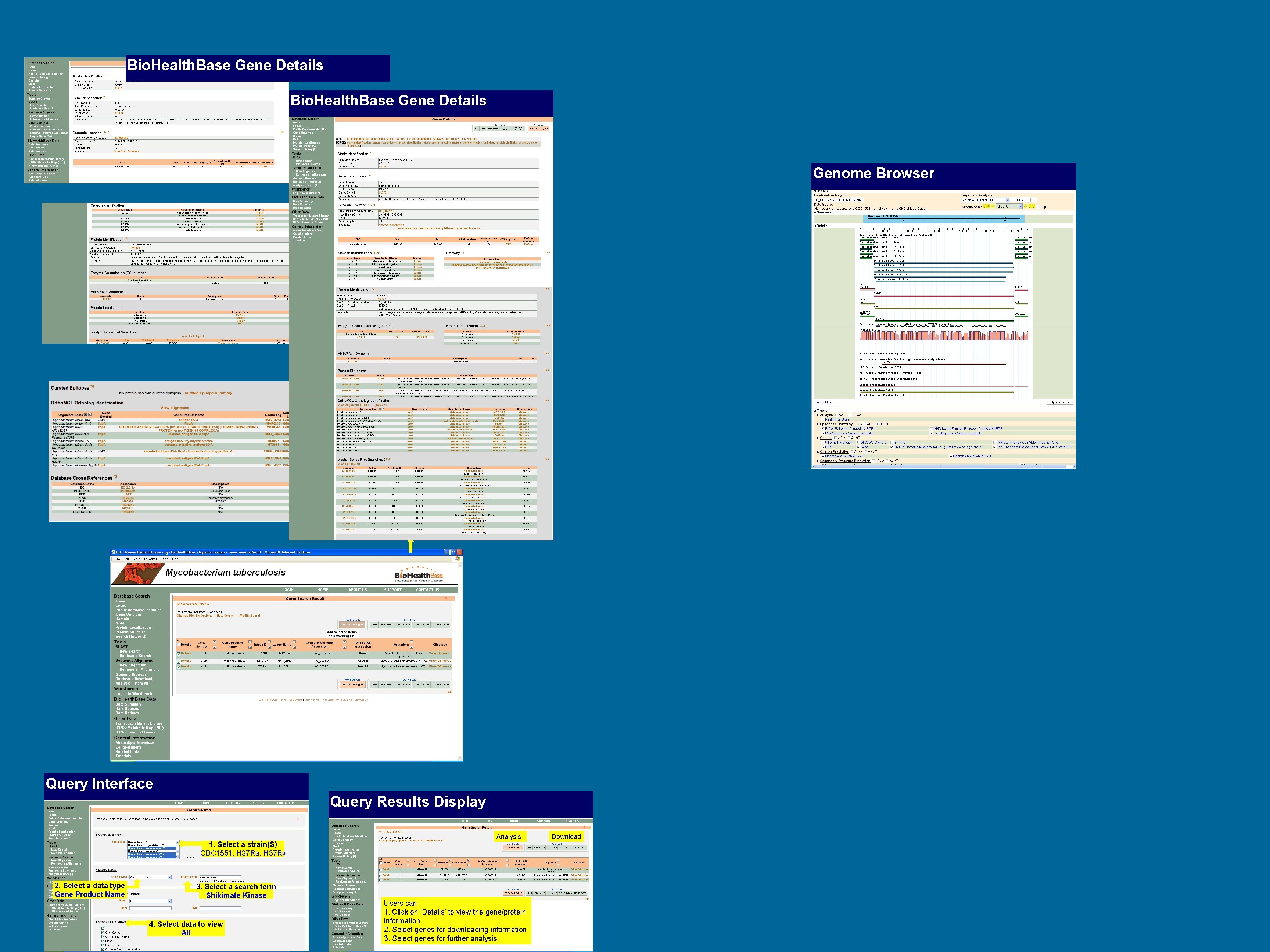
Bio. Health. Base Gene Details Genome Browser Query Interface Query Results Display Analysis 1. Select a strain(S) CDC 1551, H 37 Ra, H 37 Rv 2. Select a data type Gene Product Name 3. Select a search term Shikimate Kinase 4. Select data to view All Users can 1. Click on ‘Details’ to view the gene/protein information 2. Select genes for downloading information 3. Select genes for further analysis Download
- Slides: 3