
Bio Crash Course Plants 29 1 Evolutionary history

Bio Crash Course Plants
29. 1 Evolutionary history of plants • Overview – Multicellular, photosynthetic eukaryotes – Believed to have evolved from a freshwater green alga • Plants and green algae contain chlorophyll a and b • Both store carbohydrates as starch • Both have cell walls of cellulose – 4 evolutionary events in evolution of plants • • Development of embryo protection Development of vascular tissue Development of seeds Development of flowers 29 -2
Evolutionary history of plants cont’d. • Alternation of generations – Characteristic life cycle of plants • Two multicellular stages, each producing the other – One is haploid- gametophyte – The other is diploid- sporophyte • Sporophyte produces haploid spores by meiosis – Each spore develops into a gametophyte • Gametophyte produces gametes by mitosis – After fertilization, the embryo develops into a new sporophyte • In primitive plants the gametophyte is dominant, while in more advanced plants the sporophyte is dominant – Only the sporophyte develops vascular tissue 29 -3
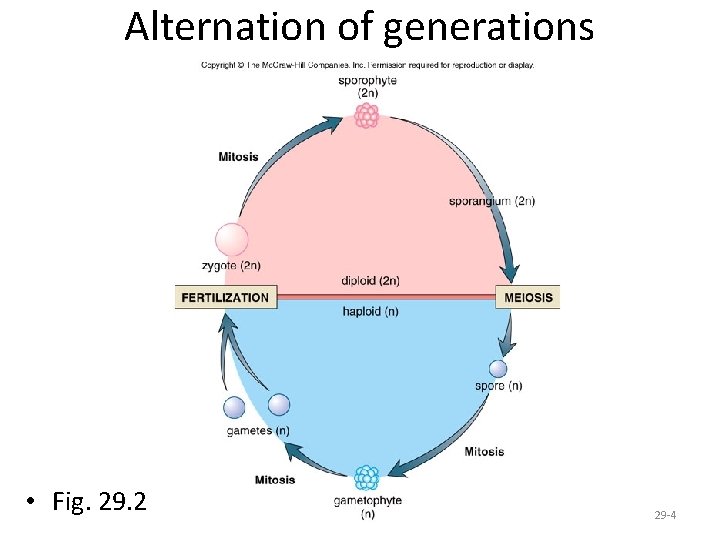
Alternation of generations • Fig. 29. 2 29 -4
29. 2 Nonvascular plants • Overview – Lack vascular tissue-limits size and habitat – Do not have true roots, stems, or leaves – Gametophyte is the dominant generation – Sperm must swim to egg for fertilization – Sporophyte is attached to the gametophyte and derives nourishment from it – 3 separate divisions on nonvascular plants • Mosses, liverworts, hornworts 29 -5
Nonvascular plants cont’d. • Mosses – Reproduce both sexually and asexually • Asexually by fragmentation • Sexually by production of gametes in archegonia and antheridia – Gametophyte has 2 stages • Protonema-branching filaments of cells • Develops leafy shoots at intervals along protonema • Rhizoids anchor moss to substrate – Dependent sporophyte • Consists of foot, stalk, and capsule or sporangium – Produces wind-borne spores – Life cycle is illustrated on the following slide 29 -6
Nonvascular plants cont’d. • Adaptations and uses of nonvascular plants – Can live on bare rock, fences, cracks of sidewalks • Selective advantage to being small and simple – Help convert rocks to soil – Peat moss • Used as fuel • Holds water-used in gardens to improve soil 29 -7
29. 3 Seedless vascular plants • Overview – Ferns and fern allies – Have vascular tissue- xylem and phloem – True roots, stems, and leaves in most – Sporophyte is the predominant life cycle stage • Stage with vascular tissue so can exploit more habitats • Advantage to being diploid- 2 copies of each allele 29 -8
Seedless vascular plants cont’d. • Ferns and their allies – Produce wind-borne spores for dispersal – Spores germinate forming a small gametophyte that is independent from the sporophyte for its nutrition – Swimming sperm travel to archegonium to fertilize egg – Seedless vascular plants formed the swamp forests of Carboniferous period • Compressed to form coal 29 -9
Seedless vascular plants cont’d. • Ferns • Most abundant in warm, moist, tropical regions • Leaves are called fronds – Immature leaves are called fiddleheads – Grow from rhizome • Dominant sporophyte stage – Produces wind-blown spores • Spore germinates and forms small gametophyte – Independent from the sporophyte – Swimming sperm produced by antheridia – Fertilization occurs in archegonia 29 -10
Seedless vascular plants cont’d. • Ferns cont’d. – Adaptations • True roots, stems, leaves • Gametophyte lacks vascular tissue so is water dependent – Sperm also need water film to swim • Sporophytes can spread to drier areas by vegetative reproduction – Rhizomes – Uses of ferns • Floral decorations • Ornamental landscape plants • Some species used as food 29 -11
29. 4 Seed plants • Overview – Gymnosperms and angiosperms are seed plants – Seed contains a sporophyte embryo and stored food • Allows survival until conditions are favorable for germination – Gymnosperms-ovule not completely enclosed by diploid tissue – Angiosperms-ovule completely enclosed within diploid sporophyte tissue (ovary) which becomes a fruit 29 -12
Seed plants cont’d. • Gymnosperms- conifers, gnetophytes, gingkophytes, and cycads – We will use the conifers as our example • Pines, spruces, firs, cedars, hemlocks, redwoods, cypresses • Cone-bearers – Exhibit heterospory • Two types of spores- produce two types of gametophytes, male and female • Pollen grains- male gametophyte • Pollination-deposition of pollen on a female gametophyte • Pollen tube-sperm pass through pollen tube to reach ovule – No water required as it is in previous groups • Female gametophyte develops within ovule • Follow the pine life cycle on the following slide 29 -13
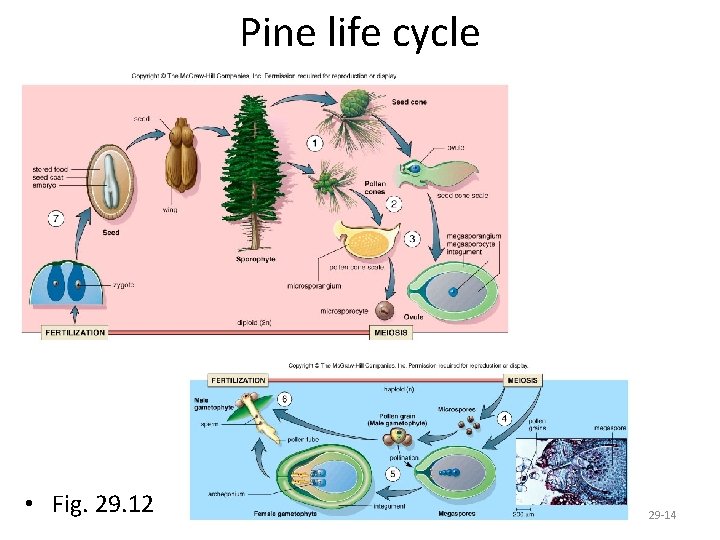
Pine life cycle • Fig. 29. 12 29 -14
Seed plants cont’d. • Adaptations and uses of conifers – Adapted to cold, dry weather – Pollen cones and seed cones are adaptations to land – Needle-shaped leaves have small surface areadecreases water loss • Also have a thick cuticle and recessed stomata – Wood is used in construction and for making paper – Resins are used for production of chemicals 29 -15
Seed plants cont’d. • Angiosperms-flowering plants – Wide range of habitats – Two classes • Monocotyledones- monocots • Eucotyledones-eudicots – Classes are distinguished by • • • Number of cotyledons Number of flower parts Pattern of leaf venation Arrangement of vascular bundles Type of root system – These characteristics are summarized on the following slide 29 -16
Seed plants cont’d. • Angiosperms cont’d. – The flower • Flower parts – Receptacle-tip of stalk that bears flowers – Sepals-modified leaves that protect bud – Petals-modified leaves, may be colorful, collectively called the corolla – Stamens-male reproductive structures » Anther-pollen production » Filament – Carpels-female reproductive structures » Stigma-for reception of pollen » Style » Ovary-ovule production 29 -17
Seed plants cont’d. • Flowering plant life cycle – Illustrated on the following slide – Microsporogenesis produces microspores • Microsporocyte in anther undergoes meiosis- produces 4 haploid microspores-each becomes a pollen grain (male gametophyte) – Inside pollen grain are 2 cells-1 is a tube cell and the other is a sperm cell – Megasporogenesis produces megaspores • Megasporocyte divides by meiosis- produces 4 haploid megaspores-3 will disintegrate leaving 1 functional megaspore – Megaspore divides by mitosis 4 times but in the last division 1 cell doesn’t undergo cytokinesis » Produces an embryo sac (female gametophyte) with 6 haploid cells and 1 large central cell with 2 nuclei 29 -18
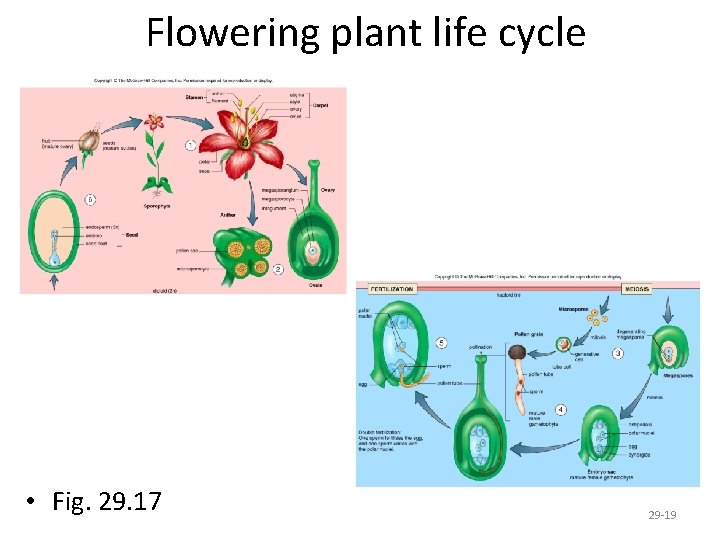
Flowering plant life cycle • Fig. 29. 17 29 -19
Seed plants cont’d. • Life cycle of flowering plants cont’d. – Pollination and double fertilization • Pollen is deposited by wind, insects, birds, etc. on stigma • Pollen grain opens and the tube cell digests a pollen tube down the style • Sperm cell divides once by mitosis to produce 2 sperm • Sperm travel down pollen tube to the embryo sac • 1 sperm fertilizes the ovule (1 of the 6 haploid cells in the embryo sac) and the other 5 break down • The other sperm fertilizes the central cell which becomes the triploid endosperm – Endosperm is food source within the seed 29 -20
9. 1 Plant organs • Plant organs – Roots – Stems – Leaves • Roots – Anchor plant to soil and give support – Absorb water and minerals – Increased surface area for absorption from root hairs • Epidermal extensions – Produce growth hormones – Food storage in herbaceous perrenials 9 -21
Plant organs cont’d. • Stems – Provide structural support for leaves – Contain vascular elements that transport substances through plant body • Water and minerals from roots to leaves • Products of photosynthesis from leaves to other organs for storage – Photosynthetic in some varieties – Water reservoir in succulents – Node- point of attachment of leaf to stem – Internode- regions between nodes 9 -22
Plant organs cont’d. • Leaves – Major synthetic organs in most varieties – Blade- wide portion of leaf – Petiole- stalk that attaches leaf to stem – Axillary bud- bud in upper angle between petiole and stem – Some leaves are specialized for protection, food storage, or prey capture (carnivorous plants) – Deciduous leaves- lost in cold weather – Abcission zone- layer of cells at base of petiole that weakens and allows leaf to drop off 9 -23
9. 2 Plant tissues • Meristem tissue – Embryonic tissue that allows plant to grow throughout life – Apical meristem- in tips of stems and roots – 3 types of primary meristems • Protoderm-gives rise to epidermal tissue • Ground meristem-gives rise to ground tissue • Procambium- gives rise to vascular tissue • Epidermal tissue – Covers surfaces of plant organs – In areas exposed to air, epidermis is covered with waxy cuticle • Protect against water loss and disease 9 -24
Plant tissues cont’d. • Epidermal tissue, cont’d. – Epidermal cells of roots have cytoplasmic extensions called root hairs to increase surface area for absorption – Epidermal cells of leaves and stems may produce hairs for protection – Some epidermal cells are modified as glands for secretion of protective substances – The lower epidermis of eudicots and both surfaces of monocots have epidermal cells called guard cells • Surround stomata and regulate opening and closing for gas exchange – Epidermis in woody plants is replaced by cork • Protective against fungi, bacteria, and animals 9 -25
Plant tissues cont’d. • Ground tissue – Forms bulk of plant body – Contains parenchyma, collenchyma, and sclerenchyma cells • Parenchyma- found in all plant organs and may contain chloroplasts or plastids that store products of photosynthesis • Collenchyma- thick walled cells which form bundles beneath epidermis and give flexible support • Sclerenchyma- cells with thick secondary walls with lignin for structural support; most of these cells are nonliving – Two types of sclerenchymal cells • Fibers-long, slender; ex: hemp fibers • Sclereids-shorter and varied in shape; ex: nut shells, seed coats, and the “grit” in pears 9 -26
Plant tissues cont’d. • Vascular tissue – Specialized for transport of substances through plant body – Two types of vascular tissue- xylem and phloem – Xylem- transports water and minerals • Two types of conducting cells, both nonliving sclerenchymal cells- tracheids and vessel elements • Vessel elements-large, elongated with perforated end plates: align to form a continuous tube • Tracheids-shorter elongated cells with pits • Vascular rays- groups of parenchymal cells that lie outside of tracheids to conduct water and minerals across the width of the plant 9 -27
Plant tissues cont’d. • Vascular tissue, cont’d. – Phloem- transports organic nutrients through plant body • Sieve-tube members form a continuous tube with perforated end walls called sieve plates; cells have cytoplasm but no nuclei • Plasmodesmata are strands of cytoplasm which extend from one sieve-tube member to the next through the sieve plates • Each sieve-tube member has a companion cell which is nucleated; may control functions of both cell types and aid in transport function – vascular tissue extends from roots through stems to leaves • in roots xylem and phloem are located in the vascular cylinder • In the stem it forms vascular bundles • In the leaves it forms leaf veins 9 -28
- Slides: 28