
BIO 260 General Microbiology LaboratoryII Prof Dr Sevgi
BIO 260 General Microbiology Laboratory-II Prof. Dr. Sevgi ERTUĞRUL KARATAY

Antibiogram Tests Antibiogram tests are often used to determine antibiotics and effect doses that can be used to prevent the growth or growth of pathogenic microorganisms. It is important to know the following terms when performing antibiogram tests. Antibiotic: Natural chemicals produced by microorganisms to prevent growth or kill the other microorganisms. There also semi-natural derivatives of these antibiotics produced with laboratory facilities. Antibacterial: Chemical agent acting against bacteria. Antifungal: A substance that acts against eukaryotic yeast and fungi. MIC (MIC / Minimum inhibition concentration): The lowest concentration of antibiotic at which a microorganism dies or stops its development.

Antibiogram Tests Mc. Farland Standard: Microorganisms must be at a certain concentration and turbidity before antibiogram testing. This value is usually set to 0. 5 Mc. Farland density. Values below and above this value are not studied. Bacteriocidal: The substance that kills bacterial cells. Bacteriostatic: The substance that stops the growth of bacterial cells. CLSI: Clinical Laboratory Standards Institute. An organization in the US where antibiogram tests are standardized. ATCC: American Type Culture Collection. DSMZ: Microbial culture collection which located in Germany. Microorganisms of these centers are used as control strains when antibiogram tests are applied.

Antibiogram Tests Antibiogram tests can be performed by various methods. Disc diffusion (Kirby Bauer Method) is one of the most important ones. Although this method is a semi-quantitative method, serial dilution is advantageous and easy to interpret. Its sensitivity is slightly lower than other methods. 1) Disc diffusion method In this method antibiotic impregnated discs are used in certain doses of antibiotics. After incubation, the sensitivity or resistance to the antibiotic is determined by looking at the zone value around the disc.
Antibiogram Tests Application of Disc Diffusion Method: Antibiotic susceptibility is prepared for the microorganism suitable solid medium (Mueller Hinton Agar-MHA) is prepared and poured into petroleum. The turbidity of the 18 -24 hours liquid microorganism culture is adjusted to 0. 5 Mc. Farland. The liquid culture is immersed in the swab and waited until it is absorbed. The process is repeated at least 6 times to spread the microorganisms to the whole agar medium.

Antibiogram Tests The antibiotic discs whose effect will be determined are placed on the surface of the inoculated petri dish according to the size of the petri dish and gently pressed on it with forceps. The petri dish with antibiotic discs is incubated at the temperature and time (37 ºC, 18 -24 hours) at which the microorganism will develop. After incubation, transparent zones of inhibition around the disc on the surface of the petri dish are measured in millimeters, and the measured value is compared to the standard criteria reported by CLSI or EUCAST to determine whether the microorganism is susceptible or resistant to that antibiotic.
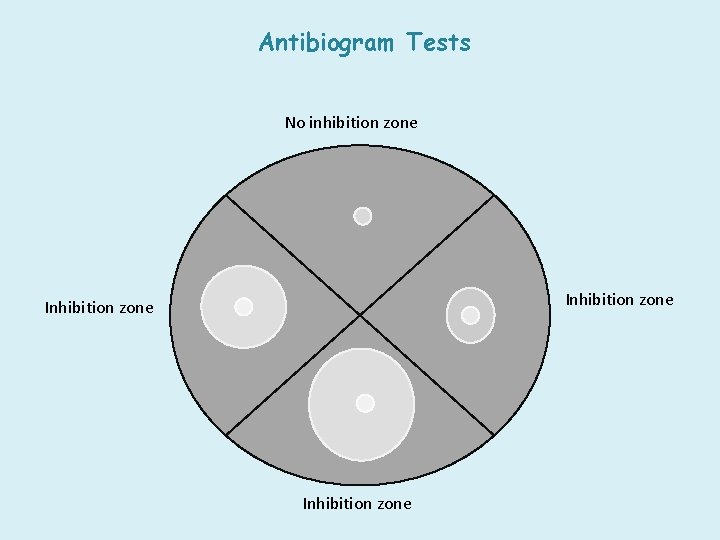
Antibiogram Tests No inhibition zone Inhibition zone
Antibiogram Tests If there is not visible zone, the zone diameter should be given as 6 mm. (Diameter of the disks) Observation a zone in a microorganism does not mean that the microorganism is resistant or susceptible to that antibiotic. Here you need to compare data from the guidelines of organizations such as CLSI, EUCAST. In readings exceeding 18 -24 hours, microorganisms may develop at the site of the antibiotic. This results in false negative results. Therefore, it is very important to carry out the experiment on time.
- Slides: 8