
Bio 260 Chapter 4 cell anatomy Fall 2016
Bio 260 Chapter 4 cell anatomy Fall 2016
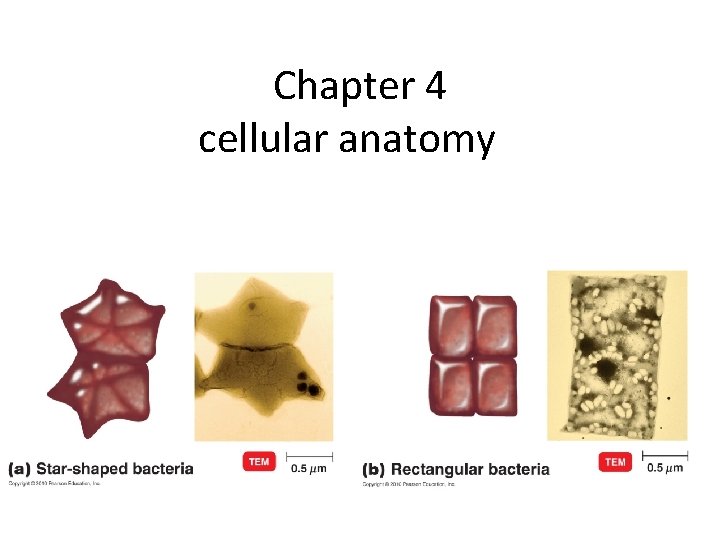
Chapter 4 cellular anatomy
Microscopy Reveals Two Cell Types • Prokaryotic cells (Bacteria, Archaea) – Smaller (1 -5 um); always unicellular – Simpler - no organelles (including NO NUCLEUS) – Where is the DNA? – Nucleoid – just a region • Eukaryotic cells (Eukarya) – Larger (10 -100 um); some multi-celled – More complex – organelles and cytoskeleton – Organelles - many cellular processes take place in membrane-bound compartments – Eg. NUCLEUS containing DNA
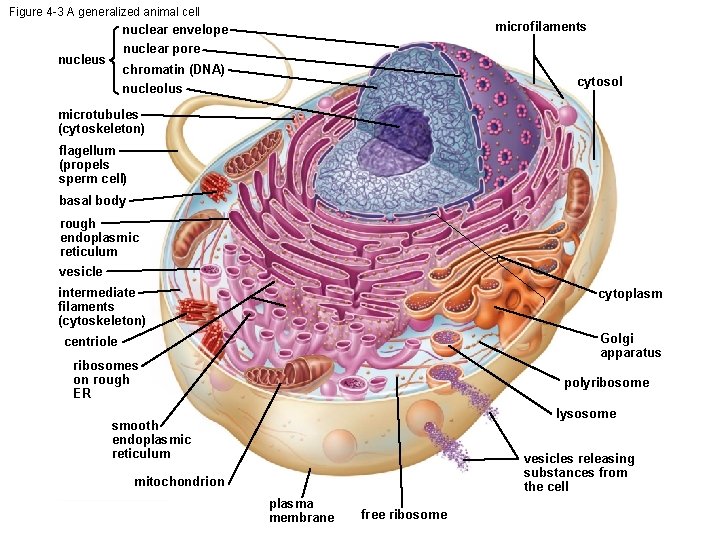
Figure 4 -3 A generalized animal cell microfilaments nuclear envelope nuclear pore nucleus chromatin (DNA) nucleolus cytosol microtubules (cytoskeleton) flagellum (propels sperm cell) basal body rough endoplasmic reticulum vesicle intermediate filaments (cytoskeleton) cytoplasm Golgi apparatus centriole ribosomes on rough ER polyribosome lysosome smooth endoplasmic reticulum vesicles releasing substances from the cell mitochondrion plasma membrane free ribosome
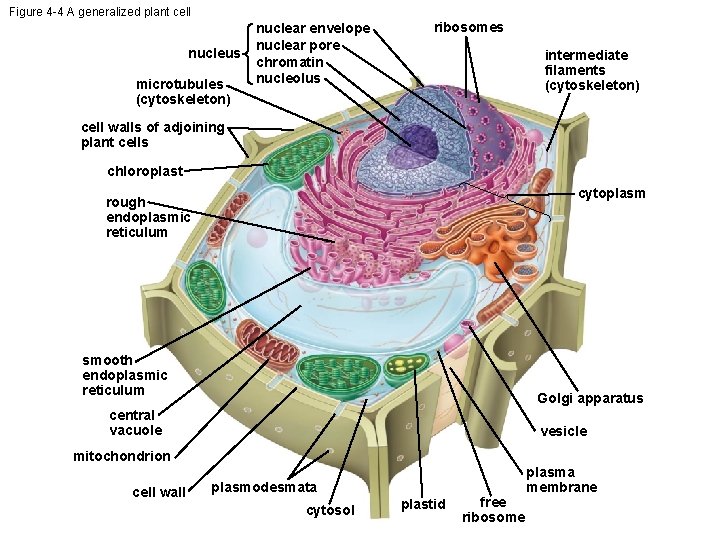
Figure 4 -4 A generalized plant cell nucleus microtubules (cytoskeleton) nuclear envelope nuclear pore chromatin nucleolus ribosomes intermediate filaments (cytoskeleton) cell walls of adjoining plant cells chloroplast cytoplasm rough endoplasmic reticulum smooth endoplasmic reticulum Golgi apparatus central vacuole vesicle mitochondrion cell wall plasmodesmata cytosol plastid free ribosome plasma membrane
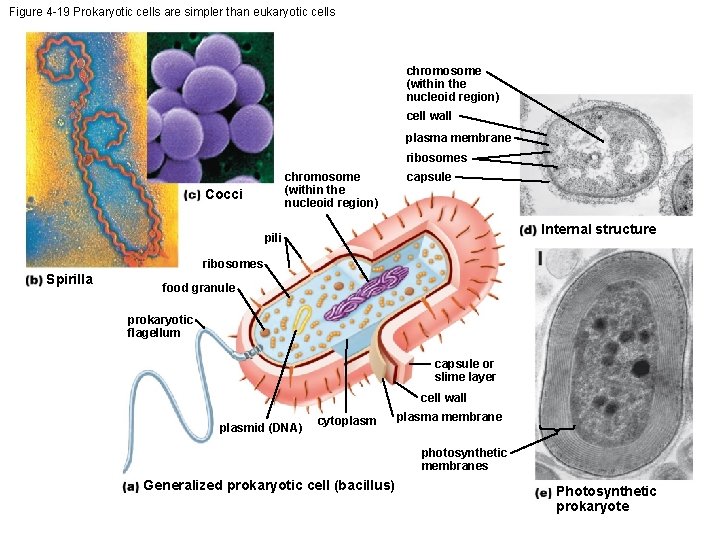
Figure 4 -19 Prokaryotic cells are simpler than eukaryotic cells chromosome (within the nucleoid region) cell wall plasma membrane ribosomes chromosome (within the nucleoid region) Cocci capsule Internal structure pili ribosomes Spirilla food granule prokaryotic flagellum capsule or slime layer cell wall plasmid (DNA) cytoplasma membrane photosynthetic membranes Generalized prokaryotic cell (bacillus) Photosynthetic prokaryote
Clinical implications • Humans vs pathogens – Understanding structure and metabolism • Similarities – How pathogens “trick” our immune system • Differences – Choose drugs and treatments that target unique features of pathogen – consequently harmless to us • Today we focus on structure – Biochemistry behind staining and drug treatment
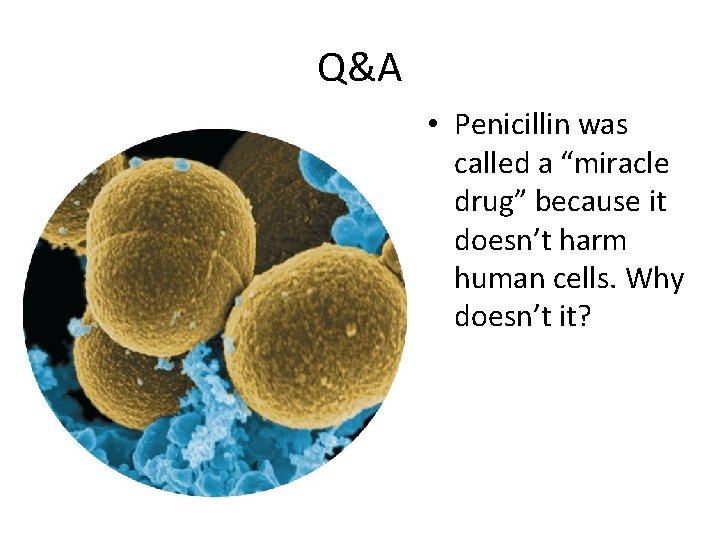
Q&A • Penicillin was called a “miracle drug” because it doesn’t harm human cells. Why doesn’t it?
Prokaryote • What do you know? Eukaryote
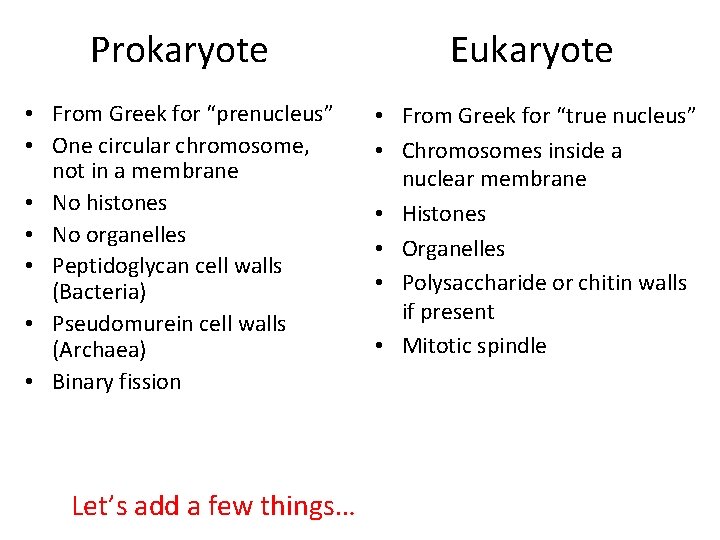
Prokaryote Eukaryote • From Greek for “prenucleus” • One circular chromosome, not in a membrane • No histones • No organelles • Peptidoglycan cell walls (Bacteria) • Pseudomurein cell walls (Archaea) • Binary fission • From Greek for “true nucleus” • Chromosomes inside a nuclear membrane • Histones • Organelles • Polysaccharide or chitin walls if present • Mitotic spindle Let’s add a few things…
Pros and cons of being prokaryotic… • Prokaryotic cells – Advantages: • Smaller size gives high surface area to low volume • Facilitates rapid uptake of nutrients, excretion of wastes • Allows rapid growth – Disadvantages • vulnerability to threats including predators, parasites, and competitors
Prokaryotic cells – size and shape • Average size: • Most bacteria are what shape? Figure 4. 7 a
Prokaryotic cells – size and shape • Average size: 0. 2 – 1. 0 µm 2 – 8 µm • Most bacteria are monomorphic (single shape) – Environment may lead to changes in shape • A few are pleomorphic (many shapes) Figure 4. 7 a
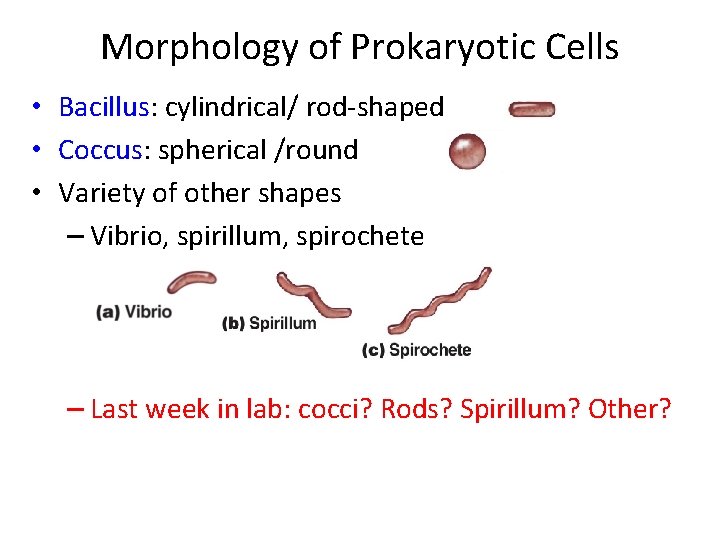
Morphology of Prokaryotic Cells • Bacillus: cylindrical/ rod-shaped • Coccus: spherical /round • Variety of other shapes – Vibrio, spirillum, spirochete – Last week in lab: cocci? Rods? Spirillum? Other?
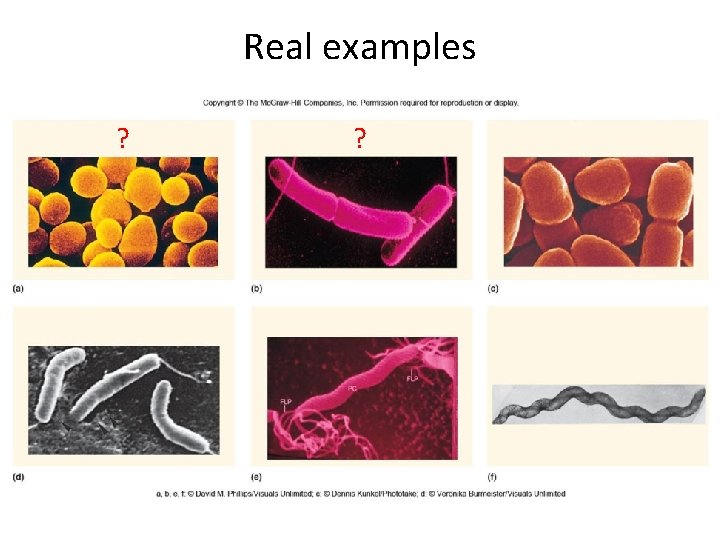
Real examples ? ?
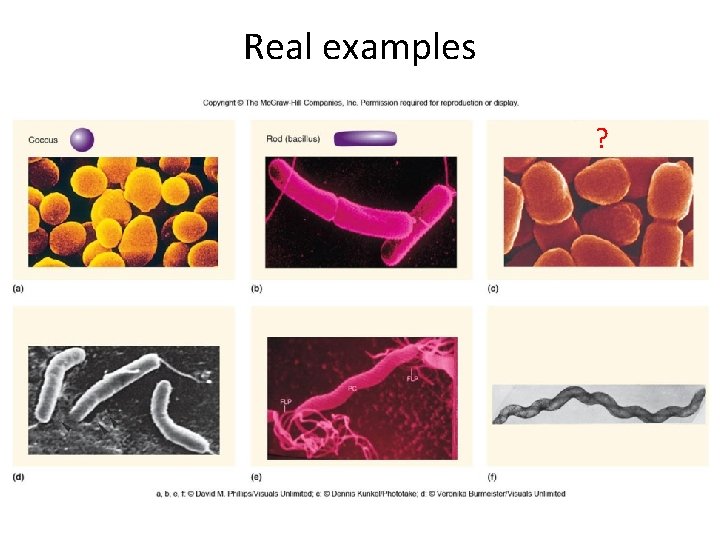
Real examples ?
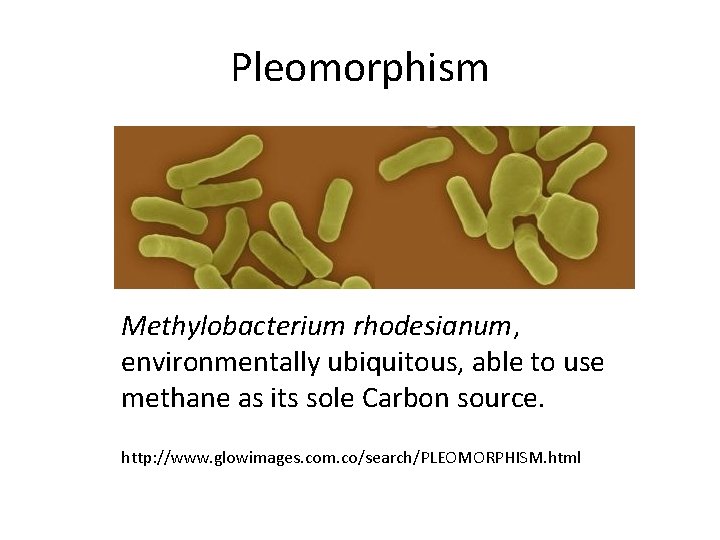
Pleomorphism Methylobacterium rhodesianum, environmentally ubiquitous, able to use methane as its sole Carbon source. http: //www. glowimages. com. co/search/PLEOMORPHISM. html
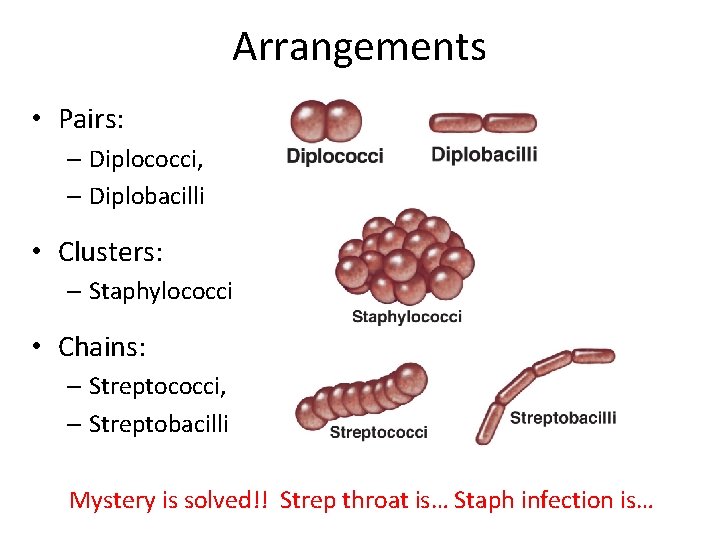
Arrangements • Pairs: – Diplococci, – Diplobacilli • Clusters: – Staphylococci • Chains: – Streptococci, – Streptobacilli Mystery is solved!! Strep throat is… Staph infection is…
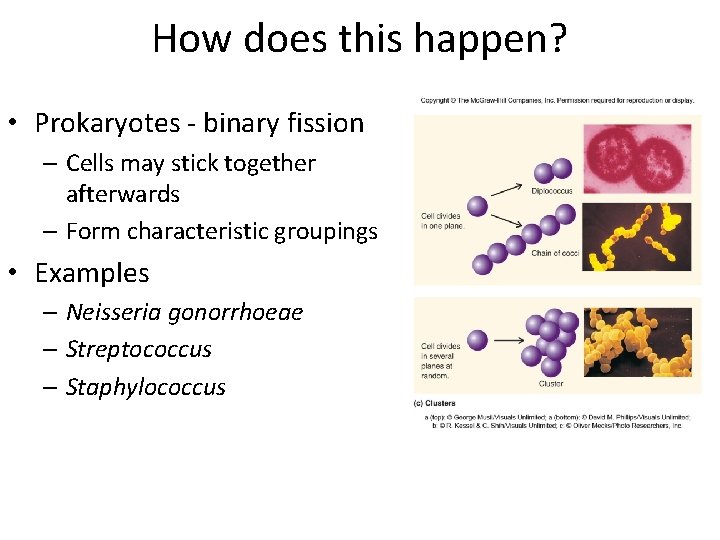
How does this happen? • Prokaryotes - binary fission – Cells may stick together afterwards – Form characteristic groupings • Examples – Neisseria gonorrhoeae – Streptococcus – Staphylococcus
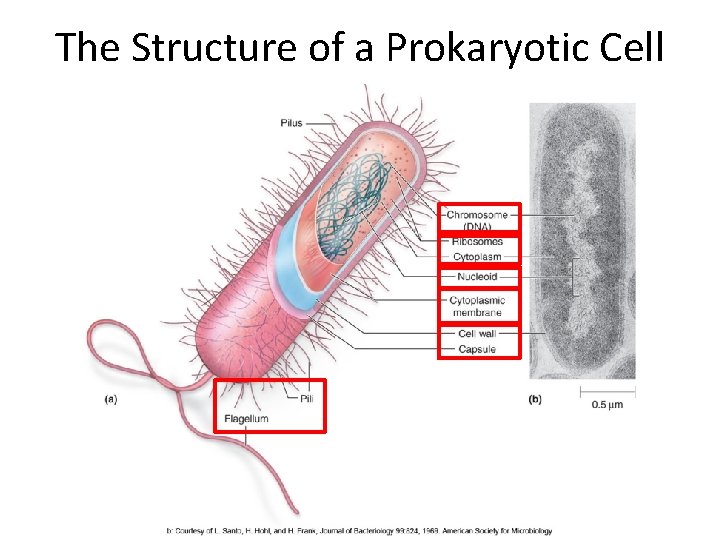
The Structure of a Prokaryotic Cell
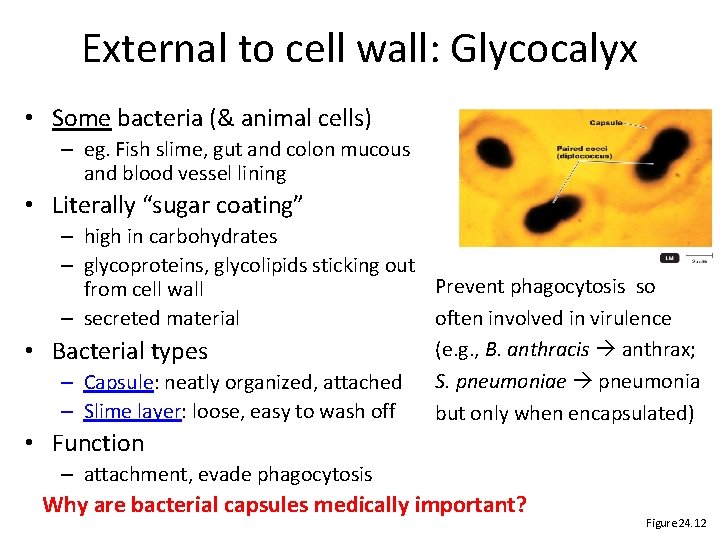
External to cell wall: Glycocalyx • Some bacteria (& animal cells) – eg. Fish slime, gut and colon mucous and blood vessel lining • Literally “sugar coating” – high in carbohydrates – glycoproteins, glycolipids sticking out Prevent phagocytosis so from cell wall What kind of stain would often involved virulence – secreted material youindo? (e. g. , B. anthracis anthrax; • Bacterial types – Capsule: neatly organized, attached S. pneumoniae pneumonia – Slime layer: loose, easy to wash off but only when encapsulated) • Function – attachment, evade phagocytosis Why are bacterial capsules medically important? Figure 24. 12
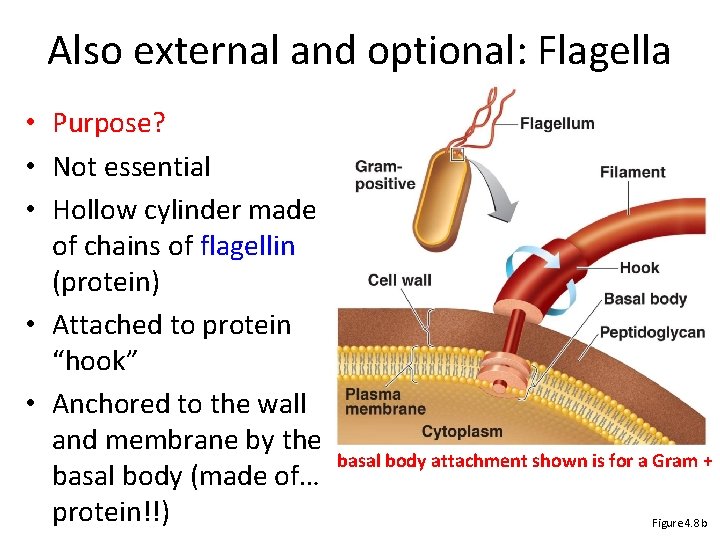
Also external and optional: Flagella • Purpose? • Not essential • Hollow cylinder made of chains of flagellin (protein) • Attached to protein “hook” • Anchored to the wall and membrane by the basal body (made of… protein!!) basal body attachment shown is for a Gram + Figure 4. 8 b
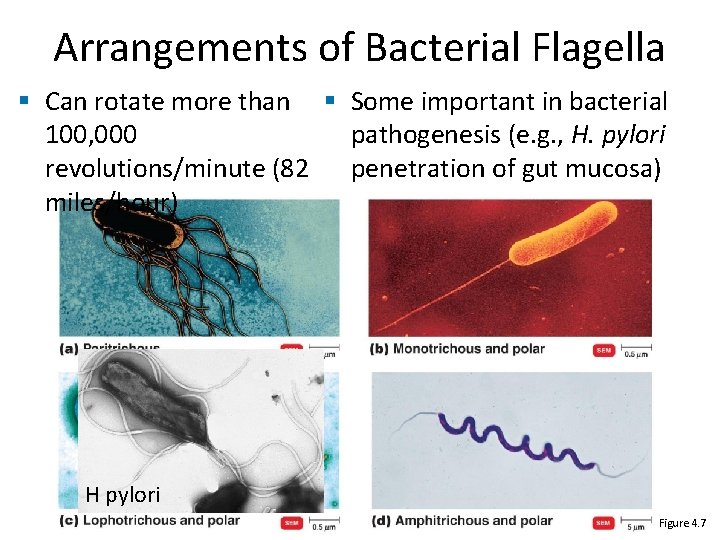
Arrangements of Bacterial Flagella § Can rotate more than § Some important in bacterial 100, 000 pathogenesis (e. g. , H. pylori revolutions/minute (82 penetration of gut mucosa) miles/hour) H pylori Figure 4. 7
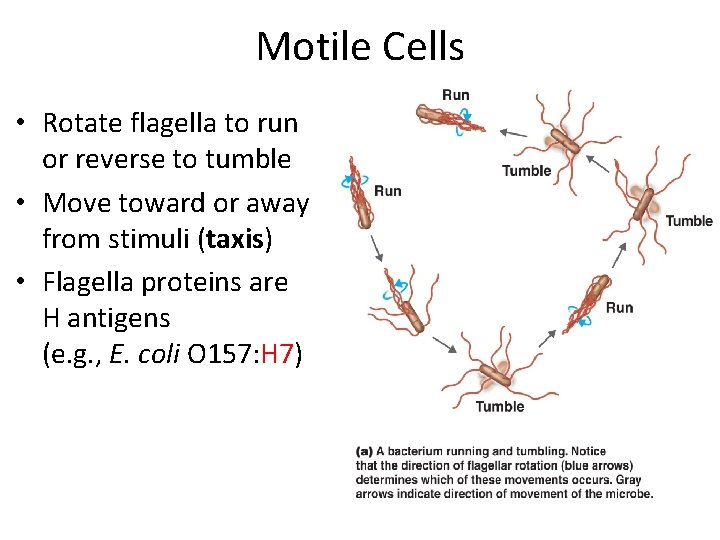
Motile Cells • Rotate flagella to run or reverse to tumble • Move toward or away from stimuli (taxis) • Flagella proteins are H antigens (e. g. , E. coli O 157: H 7)
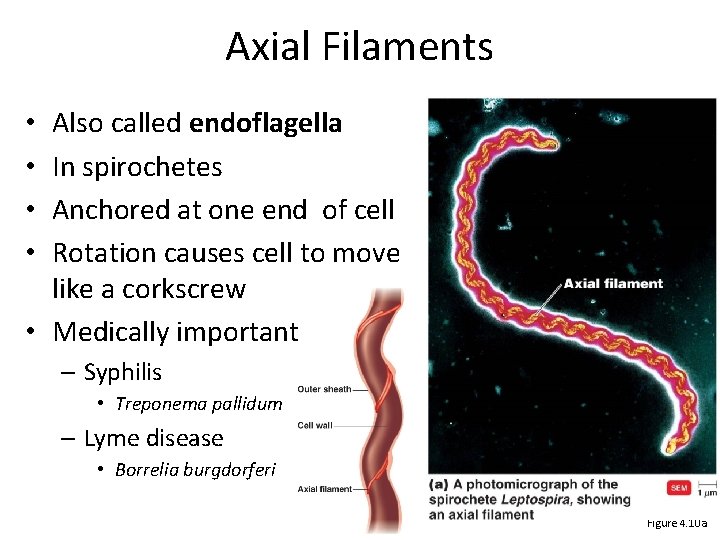
Axial Filaments Also called endoflagella In spirochetes Anchored at one end of cell Rotation causes cell to move like a corkscrew • Medically important • • – Syphilis • Treponema pallidum – Lyme disease • Borrelia burgdorferi Figure 4. 10 a
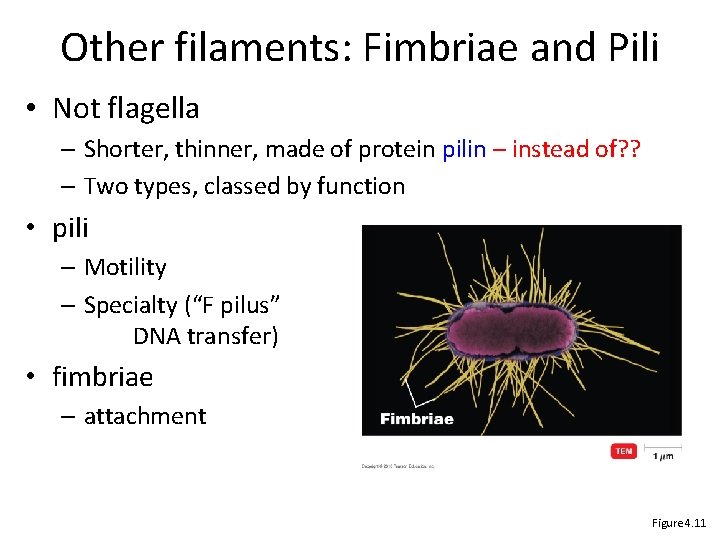
Other filaments: Fimbriae and Pili • Not flagella – Shorter, thinner, made of protein pilin – instead of? ? – Two types, classed by function • pili – Motility – Specialty (“F pilus” DNA transfer) • fimbriae – attachment Figure 4. 11
Practical implications – fimbriae attachment • Pathogens and fimbrae ) – N. gonorrheae – mucous membranes – E coli O 157 – small intestine – Mutant lacking fimbrae virulence? • Biofilm formation – Attachment to environment; rocks, pipes, implants – Usually multiple species • Metabolic symbiosis • Protective • Can be especially resistant to antibiotics or antiseptics
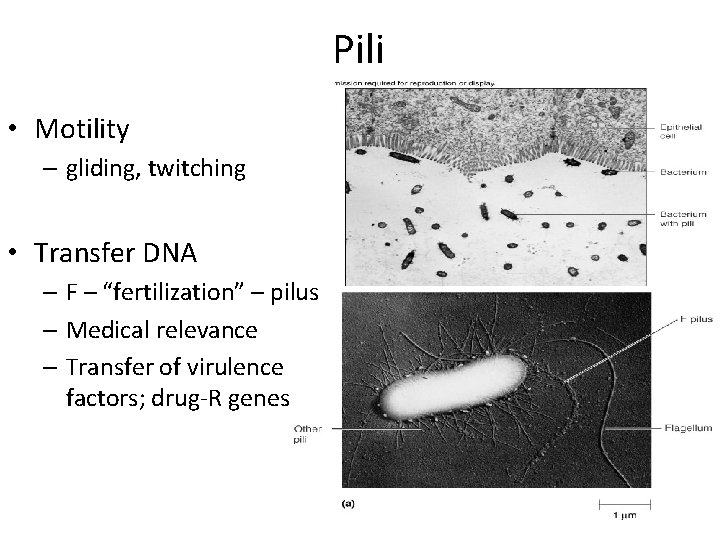
Pili • Motility – gliding, twitching • Transfer DNA – F – “fertilization” – pilus – Medical relevance – Transfer of virulence factors; drug-R genes
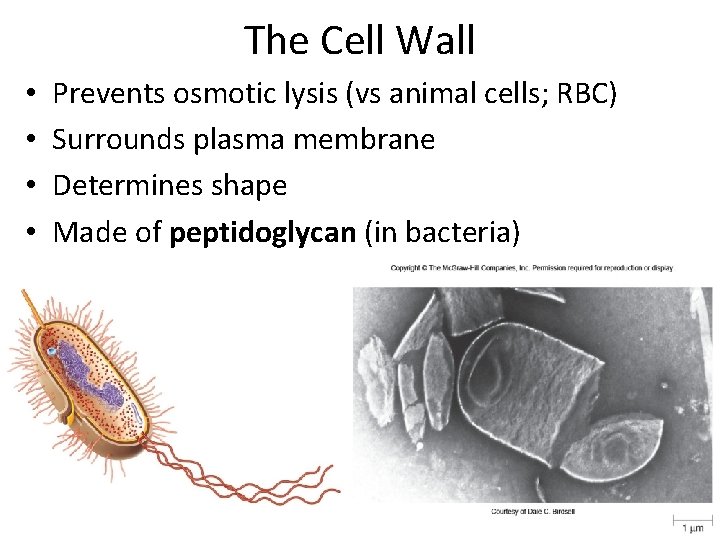
The Cell Wall • • Prevents osmotic lysis (vs animal cells; RBC) Surrounds plasma membrane Determines shape Made of peptidoglycan (in bacteria) Figure 4. 6
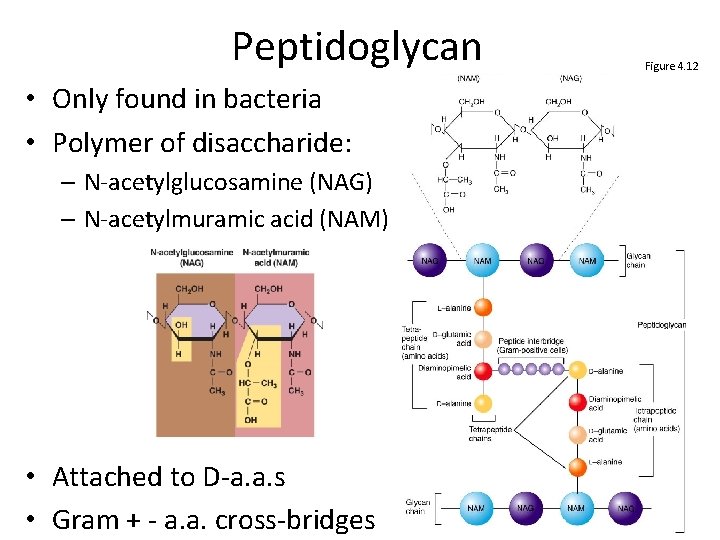
Peptidoglycan • Only found in bacteria • Polymer of disaccharide: – N-acetylglucosamine (NAG) – N-acetylmuramic acid (NAM) • Attached to D-a. a. s • Gram + - a. a. cross-bridges Figure 4. 12
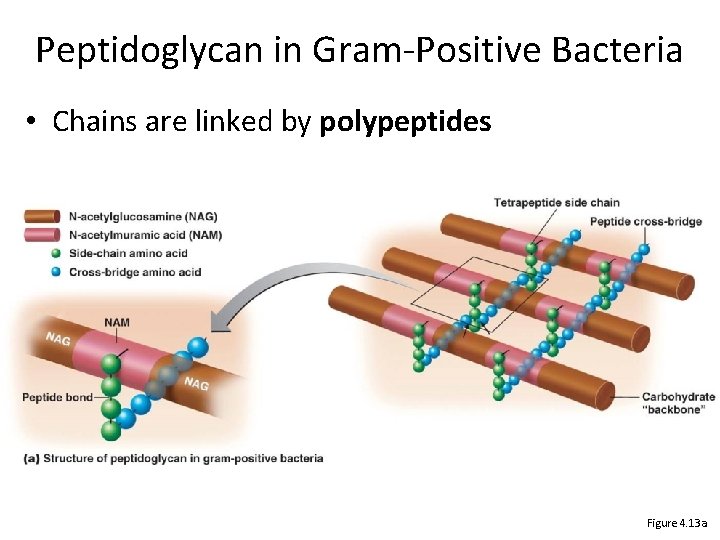
Peptidoglycan in Gram-Positive Bacteria • Chains are linked by polypeptides Figure 4. 13 a
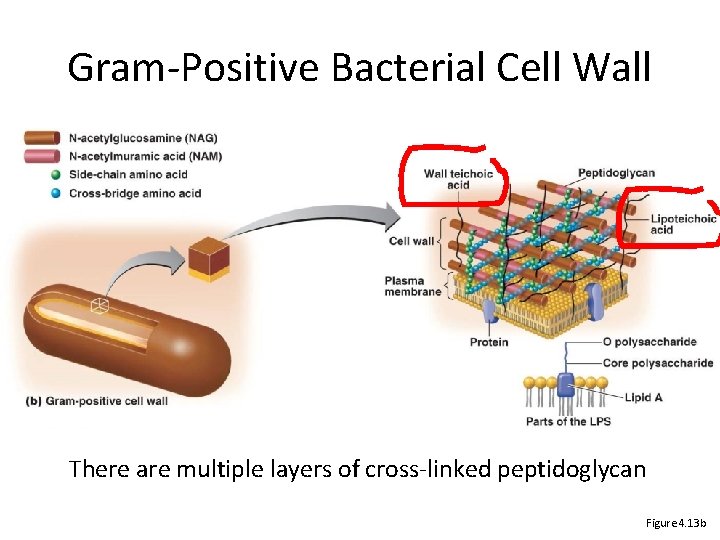
Gram-Positive Bacterial Cell Wall There are multiple layers of cross-linked peptidoglycan Figure 4. 13 b
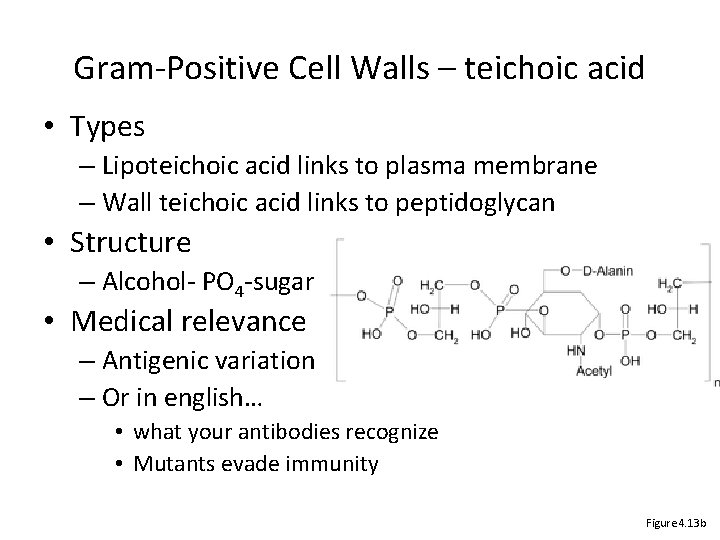
Gram-Positive Cell Walls – teichoic acid • Types – Lipoteichoic acid links to plasma membrane – Wall teichoic acid links to peptidoglycan • Structure – Alcohol- PO 4 -sugar • Medical relevance – Antigenic variation – Or in english… • what your antibodies recognize • Mutants evade immunity Figure 4. 13 b
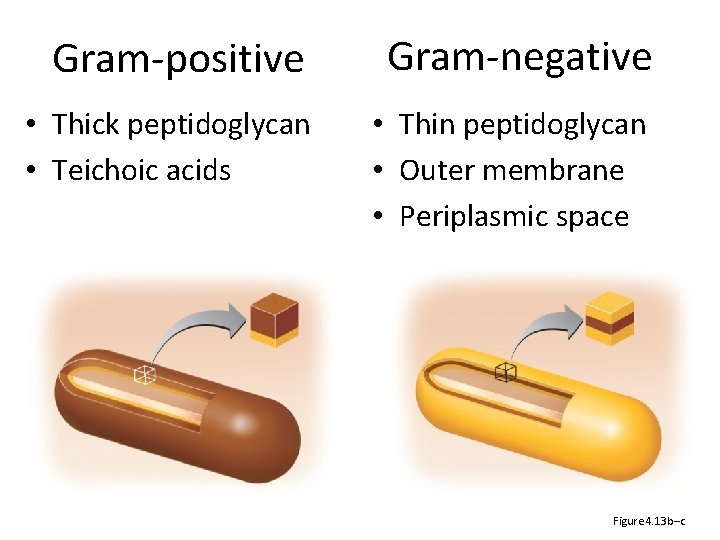
Gram-positive Gram-negative • Thick peptidoglycan • Teichoic acids • Thin peptidoglycan • Outer membrane • Periplasmic space Figure 4. 13 b–c
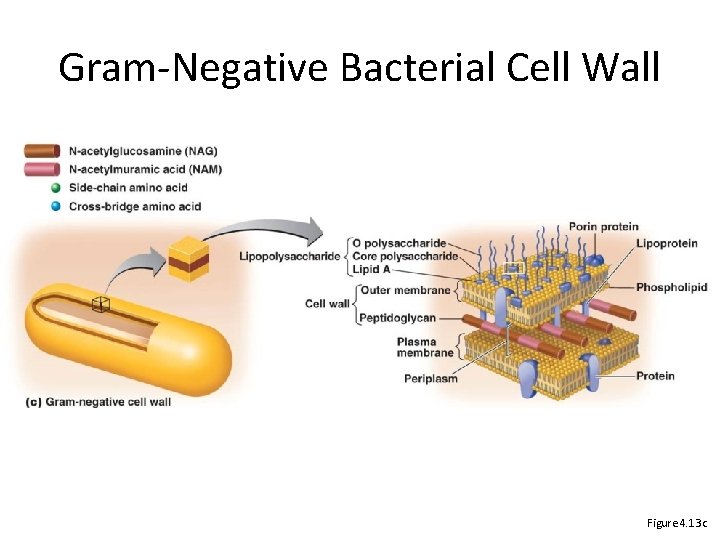
Gram-Negative Bacterial Cell Wall Figure 4. 13 c
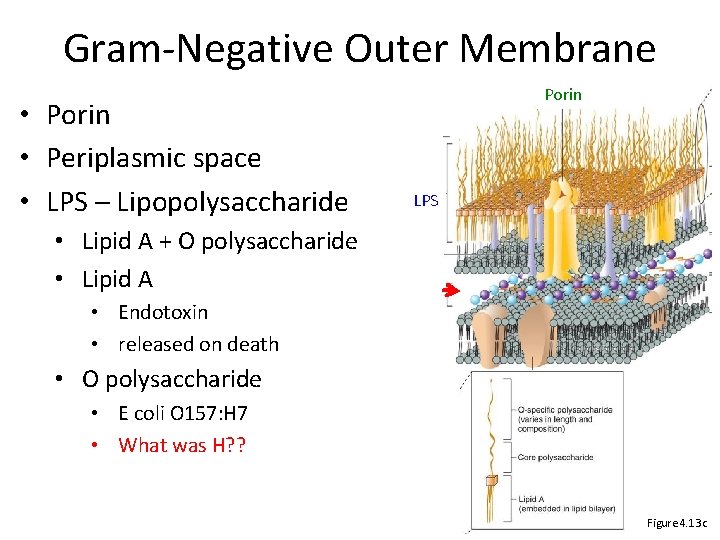
Gram-Negative Outer Membrane • Porin • Periplasmic space • LPS – Lipopolysaccharide Porin LPS • Lipid A + O polysaccharide • Lipid A • Endotoxin • released on death • O polysaccharide • E coli O 157: H 7 • What was H? ? Figure 4. 13 c
peptidoglycan • • What is it made of? Where do you find it? How is it organized in Gram positive bacteria? Is it present in Gram negative bacteria?
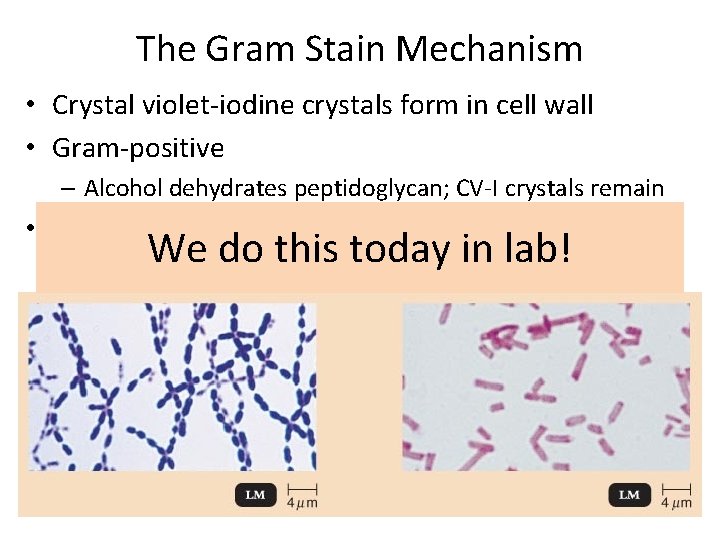
The Gram Stain Mechanism • Crystal violet-iodine crystals form in cell wall • Gram-positive – Alcohol dehydrates peptidoglycan; CV-I crystals remain • Gram-negative We do this today in lab! – Alcohol dissolves outer membrane ; CV-I washes out
Gram and other stains • Differential – categorize bacteria into groups – Gram stain TODAY! – Acid fast • Special – visualize structures – Capsule – Flagella – Endospore THURSDAY!
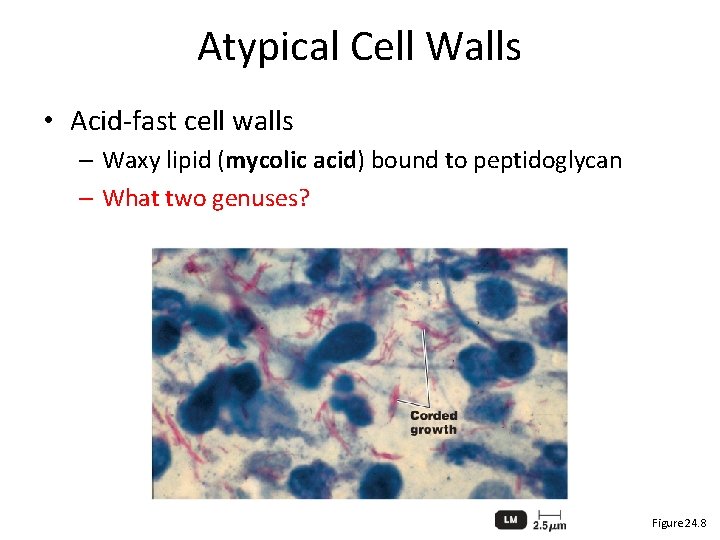
Atypical Cell Walls • Acid-fast cell walls – Waxy lipid (mycolic acid) bound to peptidoglycan – What two genuses? Figure 24. 8
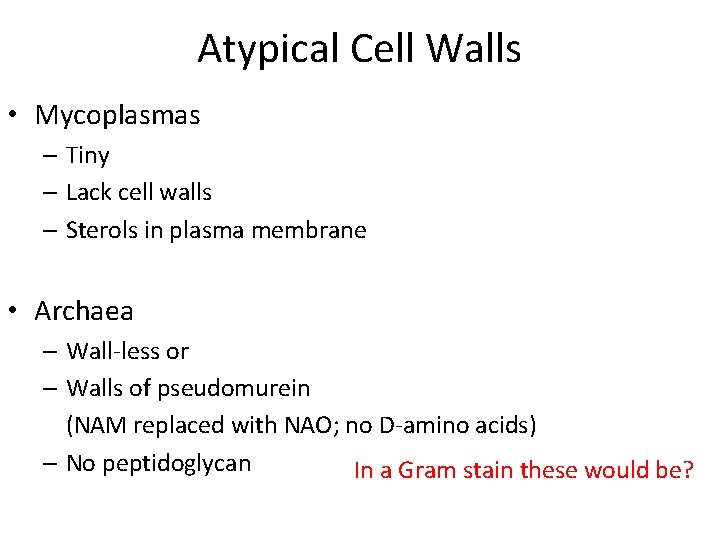
Atypical Cell Walls • Mycoplasmas – Tiny – Lack cell walls – Sterols in plasma membrane • Archaea – Wall-less or – Walls of pseudomurein (NAM replaced with NAO; no D-amino acids) – No peptidoglycan In a Gram stain these would be?
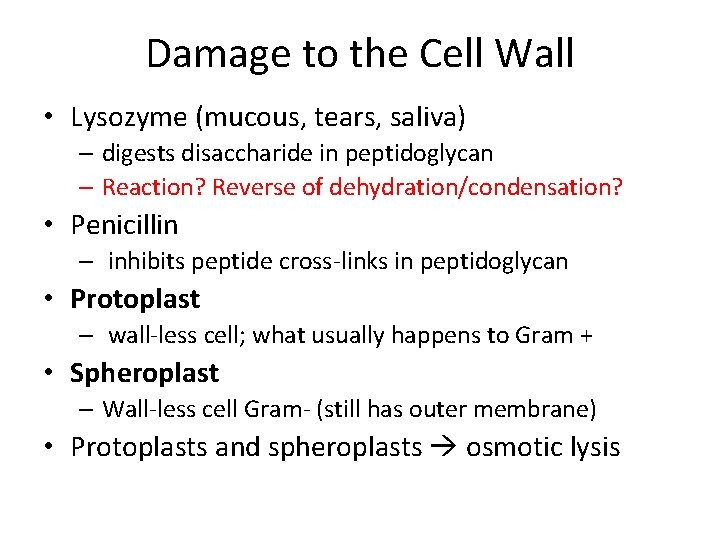
Damage to the Cell Wall • Lysozyme (mucous, tears, saliva) – digests disaccharide in peptidoglycan – Reaction? Reverse of dehydration/condensation? • Penicillin – inhibits peptide cross-links in peptidoglycan • Protoplast – wall-less cell; what usually happens to Gram + • Spheroplast – Wall-less cell Gram- (still has outer membrane) • Protoplasts and spheroplasts osmotic lysis
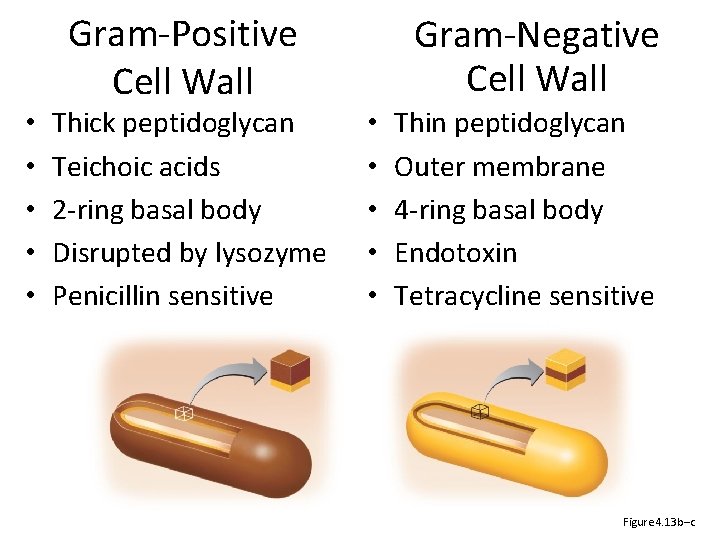
• • • Gram-Positive Cell Wall Thick peptidoglycan Teichoic acids 2 -ring basal body Disrupted by lysozyme Penicillin sensitive Gram-Negative Cell Wall • • • Thin peptidoglycan Outer membrane 4 -ring basal body Endotoxin Tetracycline sensitive Figure 4. 13 b–c
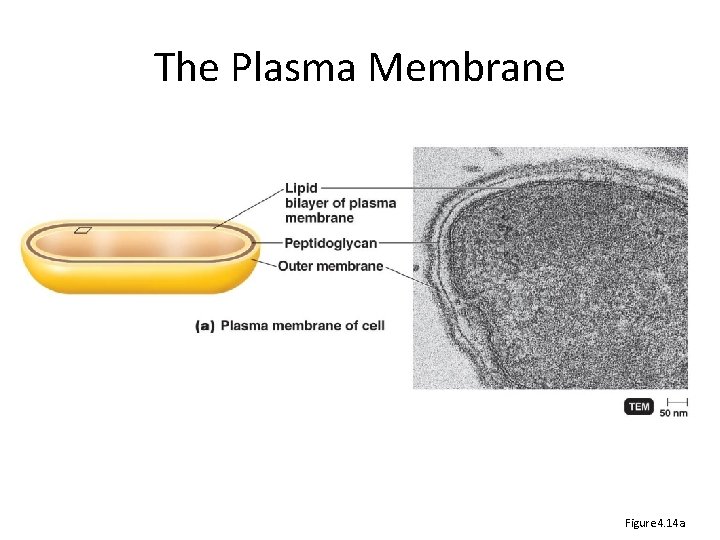
The Plasma Membrane Figure 4. 14 a
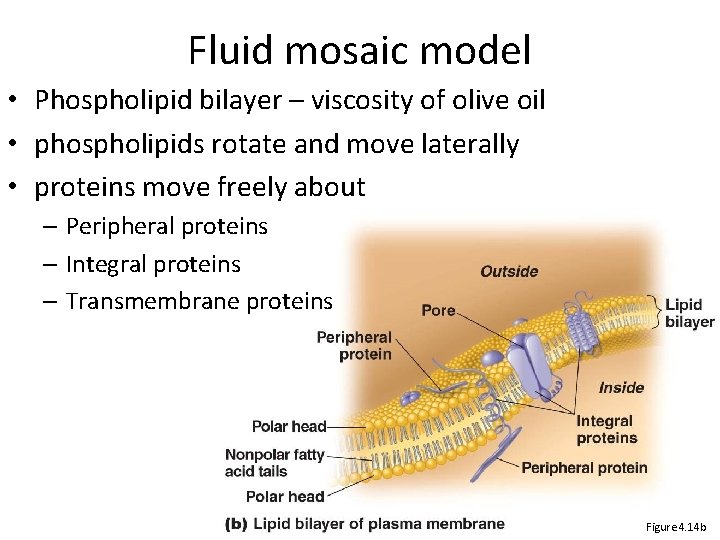
Fluid mosaic model • Phospholipid bilayer – viscosity of olive oil • phospholipids rotate and move laterally • proteins move freely about – Peripheral proteins – Integral proteins – Transmembrane proteins Figure 4. 14 b
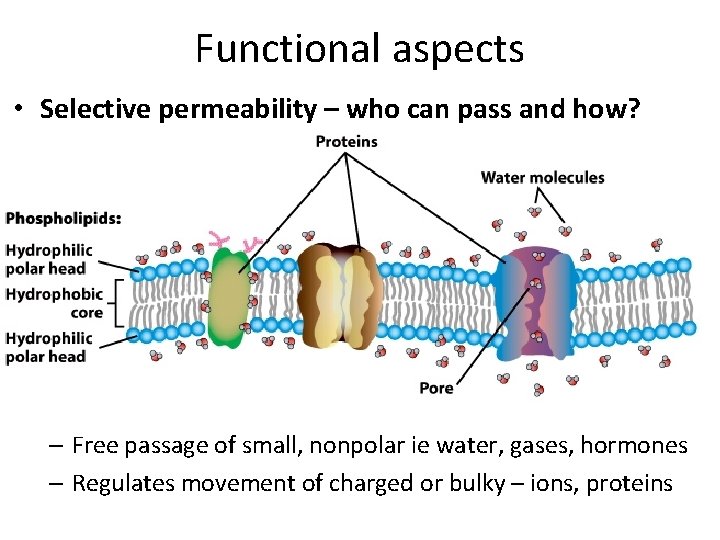
Functional aspects • Selective permeability – who can pass and how? – Free passage of small, nonpolar ie water, gases, hormones – Regulates movement of charged or bulky – ions, proteins
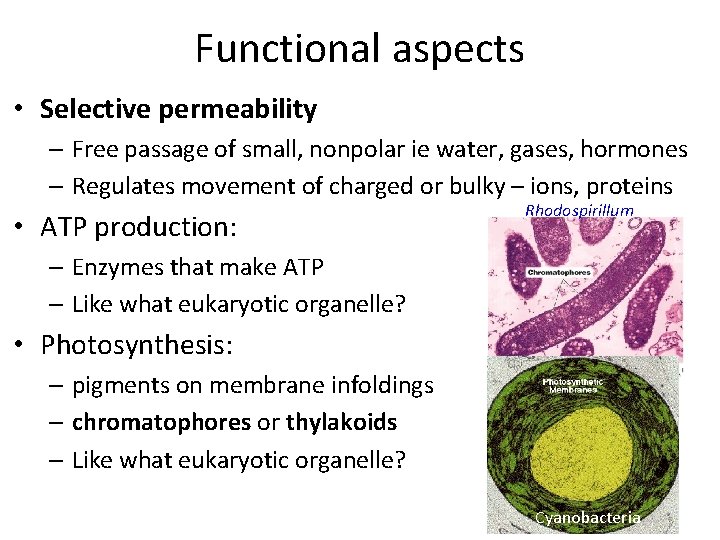
Functional aspects • Selective permeability – Free passage of small, nonpolar ie water, gases, hormones – Regulates movement of charged or bulky – ions, proteins • ATP production: Rhodospirillum – Enzymes that make ATP – Like what eukaryotic organelle? • Photosynthesis: – pigments on membrane infoldings – chromatophores or thylakoids – Like what eukaryotic organelle? Cyanobacteria
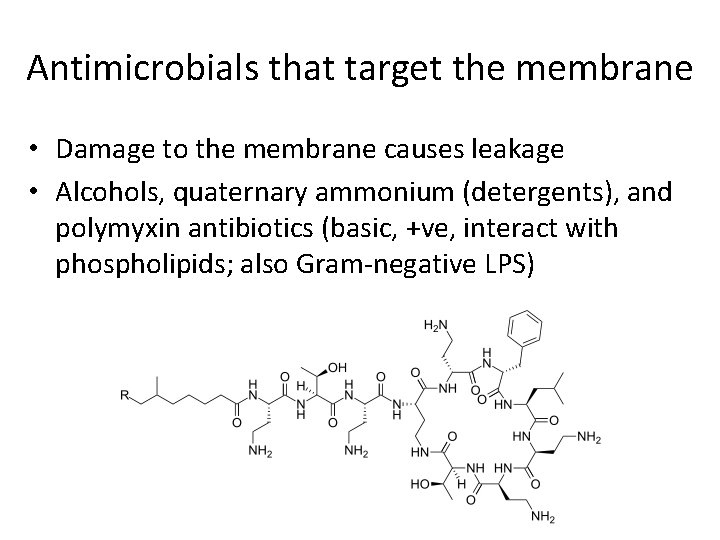
Antimicrobials that target the membrane • Damage to the membrane causes leakage • Alcohols, quaternary ammonium (detergents), and polymyxin antibiotics (basic, +ve, interact with phospholipids; also Gram-negative LPS)
More about membranes • What molecules can cross membranes freely? • What molecules are unable to freely cross?
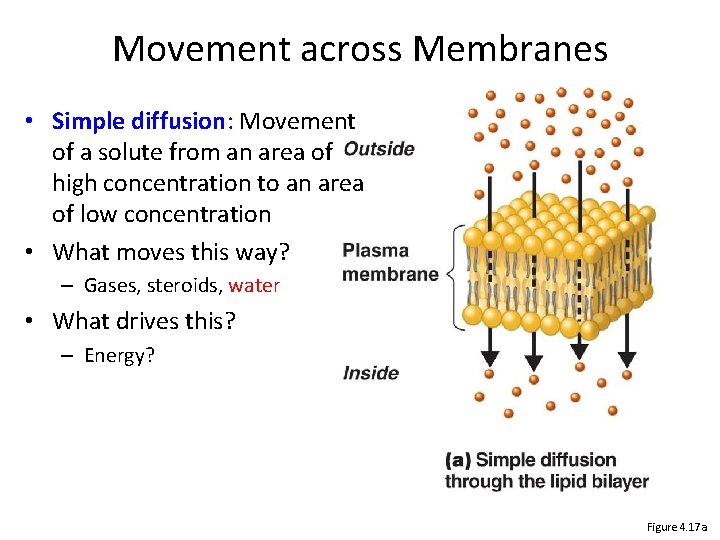
Movement across Membranes • Simple diffusion: Movement of a solute from an area of high concentration to an area of low concentration • What moves this way? – Gases, steroids, water • What drives this? – Energy? Figure 4. 17 a
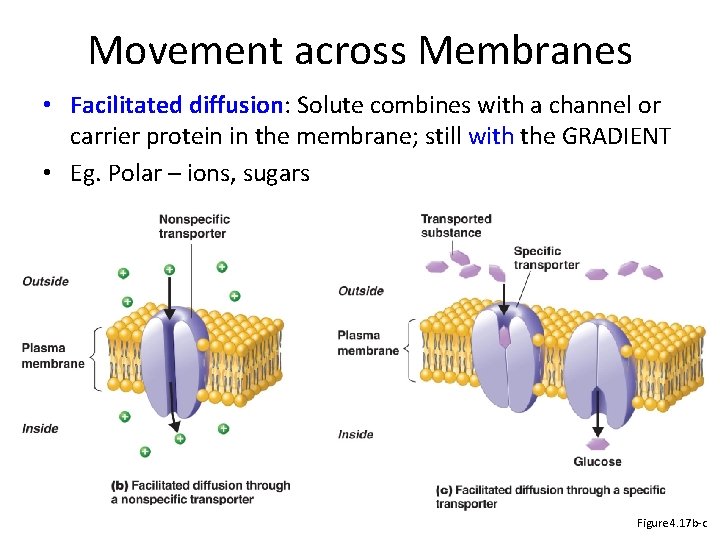
Movement across Membranes • Facilitated diffusion: Solute combines with a channel or carrier protein in the membrane; still with the GRADIENT • Eg. Polar – ions, sugars Figure 4. 17 b-c
Simple vs. facilitated diffusion - what is “facilitating”? - does facilitated require energy? ?
Active transport • Protein channel or carrier • Energy requiring – WHY? • Moving things AGAINST their concentration gradient • Some relevant examples of cargoes – Nutrients - Sugar, amino acid – Protons (in the electron transport chain) – K+ and Na+ in nerve cells
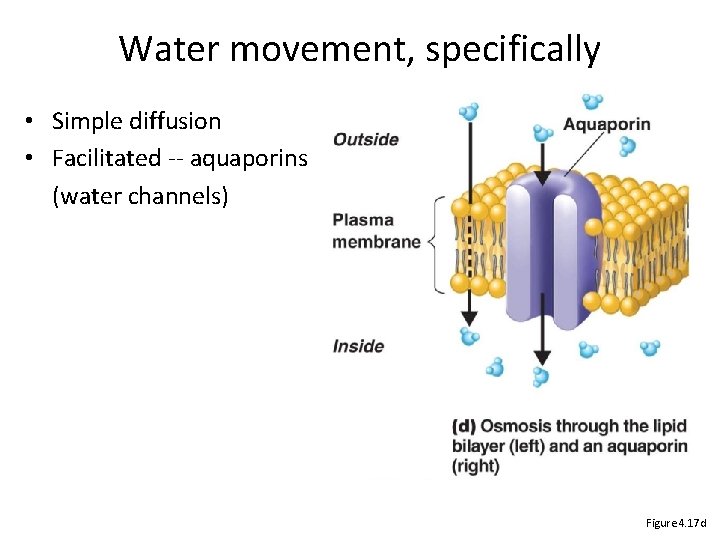
Water movement, specifically • Simple diffusion • Facilitated -- aquaporins (water channels) Figure 4. 17 d
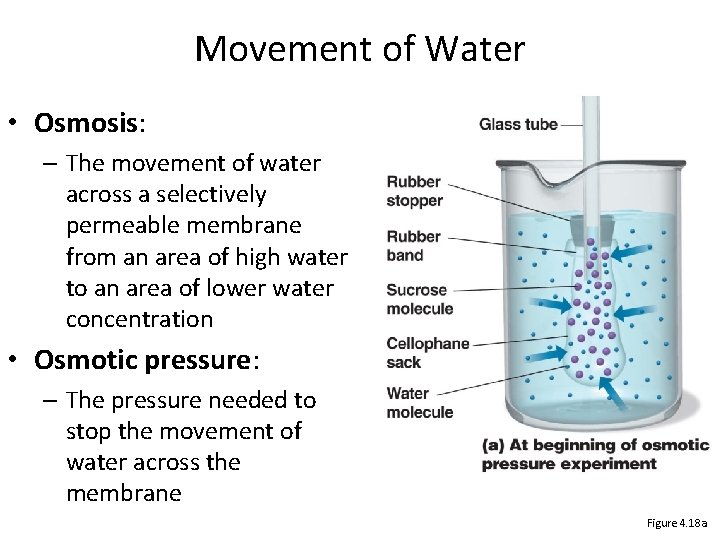
Movement of Water • Osmosis: – The movement of water across a selectively permeable membrane from an area of high water to an area of lower water concentration • Osmotic pressure: – The pressure needed to stop the movement of water across the membrane Figure 4. 18 a
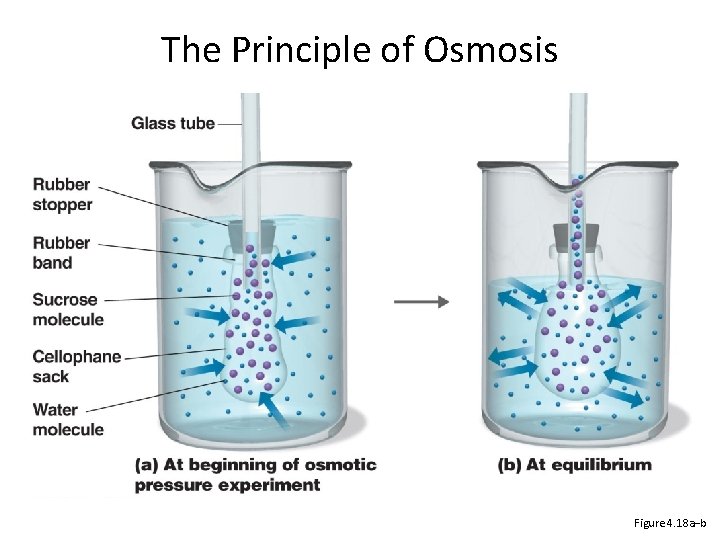
The Principle of Osmosis Figure 4. 18 a–b
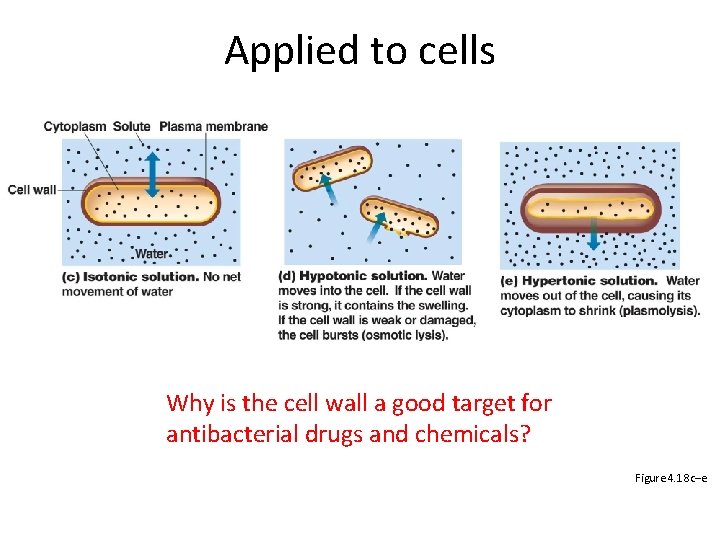
Applied to cells Why is the cell wall a good target for antibacterial drugs and chemicals? Figure 4. 18 c–e
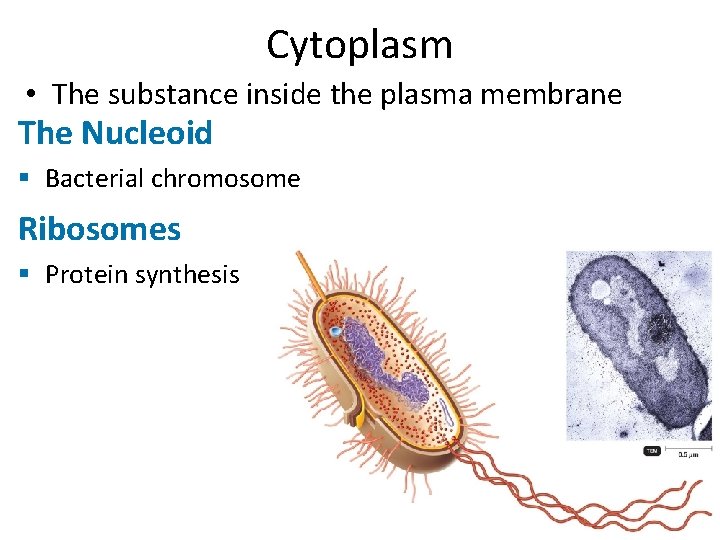
Cytoplasm • The substance inside the plasma membrane The Nucleoid § Bacterial chromosome Ribosomes § Protein synthesis Figure 4. 6
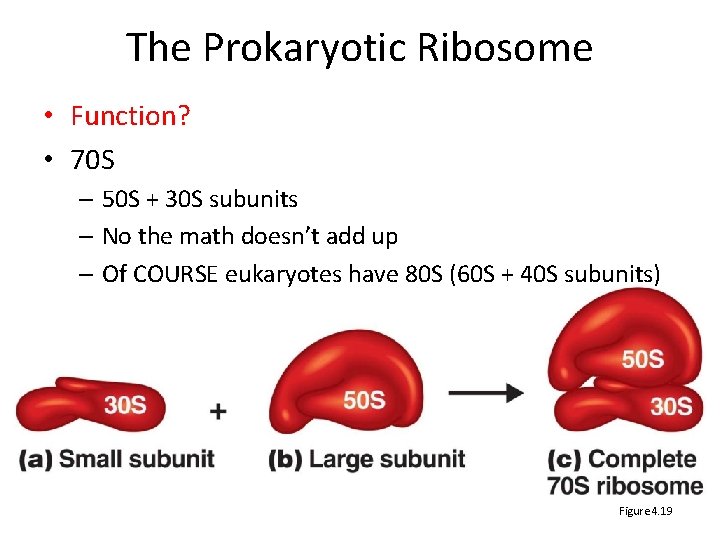
The Prokaryotic Ribosome • Function? • 70 S – 50 S + 30 S subunits – No the math doesn’t add up – Of COURSE eukaryotes have 80 S (60 S + 40 S subunits) Figure 4. 19
3 slides you don’t need to know… • But they’re so cool! • Breaking the dogma around organelles: bacteria do not “usually” have organelles… http: //www. ncbi. nlm. nih. gov/pmc/articles/PMC 2944366/ • Protein “shells” and “nonunit” lipid membrane
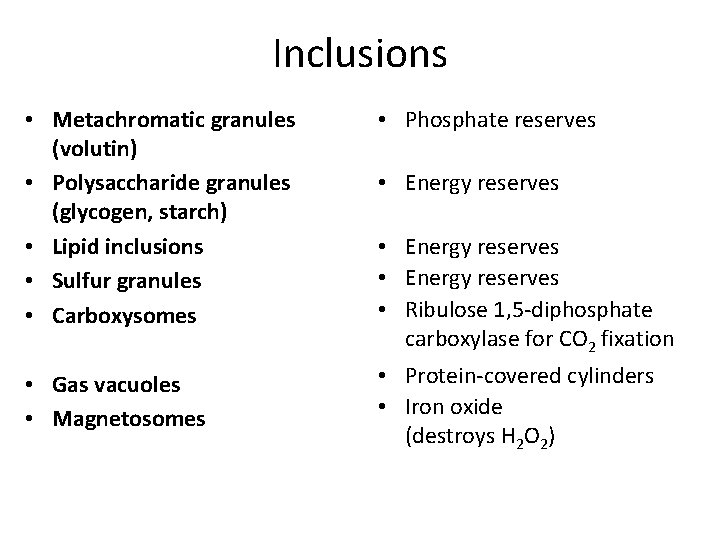
Inclusions • Metachromatic granules (volutin) • Polysaccharide granules (glycogen, starch) • Lipid inclusions • Sulfur granules • Carboxysomes • Phosphate reserves • Gas vacuoles • Magnetosomes • Protein-covered cylinders • Iron oxide (destroys H 2 O 2) • Energy reserves • Ribulose 1, 5 -diphosphate carboxylase for CO 2 fixation
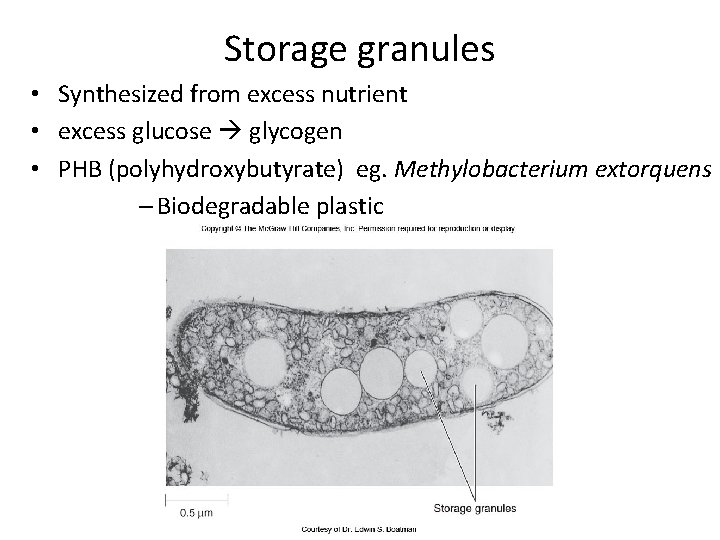
Storage granules • Synthesized from excess nutrient • excess glucose glycogen • PHB (polyhydroxybutyrate) eg. Methylobacterium extorquens – Biodegradable plastic
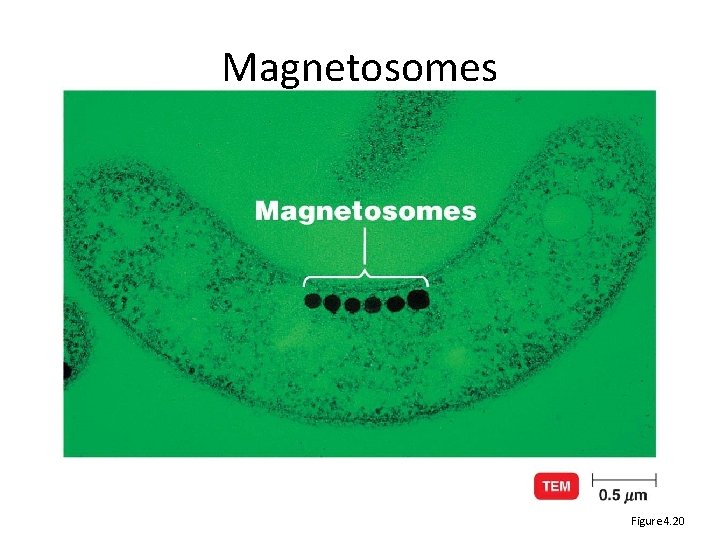
Magnetosomes Figure 4. 20

OK, back to what your regularly scheduled curriculum…
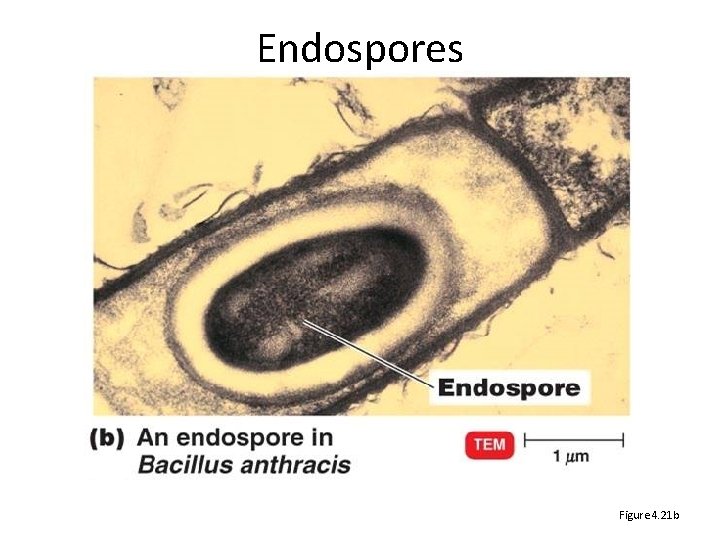
Endospores Figure 4. 21 b
Endospores • Very resistant to heat, desiccation, chemicals…. and TIME – 7, 500 -year old endospores from frozen mud have germinated – 25 - to 40 -million-y-old endospores from gut of bee in amber reportedly germinated • Genuses with many spore-forming species: Bacillus, Clostridium – – Bacillus anthracis - Anthrax – agriculture and bioterrorism Clostridium botulinum - Botulism in canned food Clostridium tetanii - ? what disease ? where are the spores “C-diff” or Clostridium difficile – what and where? • Specialized resting cells formed under unfavorable conditions • Sporulation: Endospore formation during times of stress • Germination: Return to vegetative state
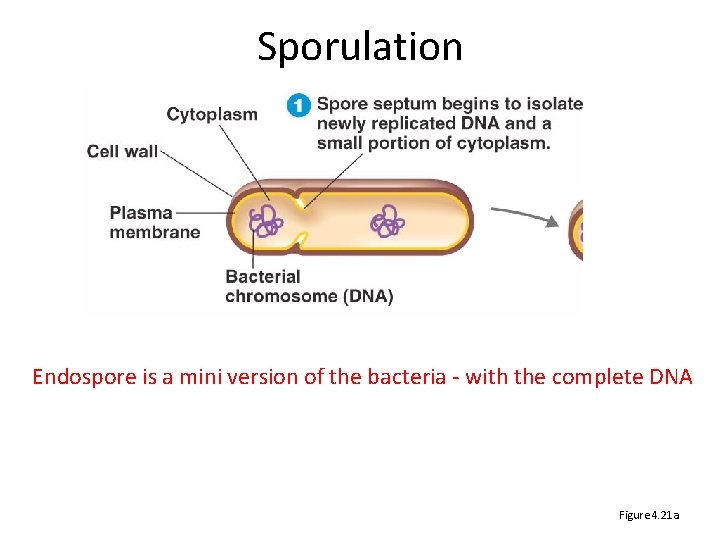
Sporulation Endospore is a mini version of the bacteria - with the complete DNA Figure 4. 21 a
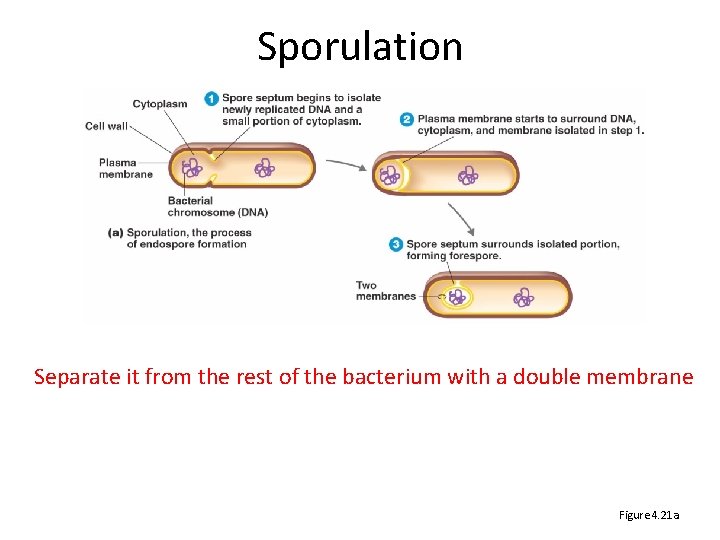
Sporulation Separate it from the rest of the bacterium with a double membrane Figure 4. 21 a
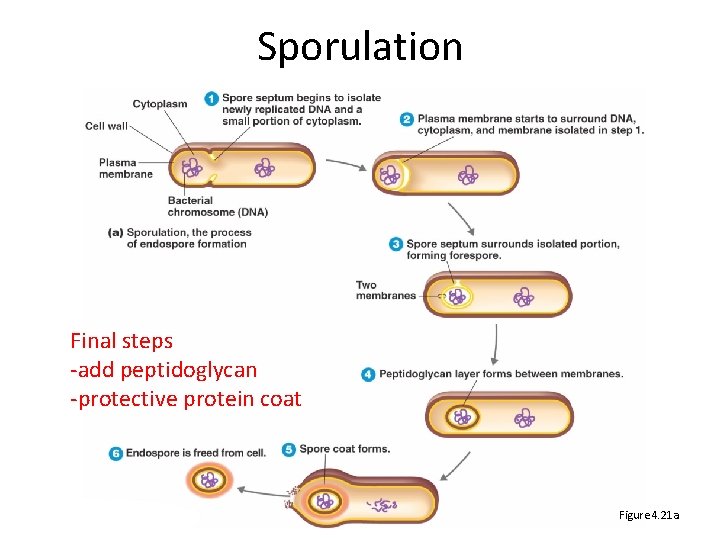
Sporulation Final steps -add peptidoglycan -protective protein coat Figure 4. 21 a
Endospores – what do you know? • Resistant to - ? • Genuses of bacteria that commonly make endospores? • Consider Pasteur’s demonstrations disproving spontaneous generation – How might his results have differed if his laboratory had been housed in a stable?
In lab Thursday! • Endospore stain of your very own!
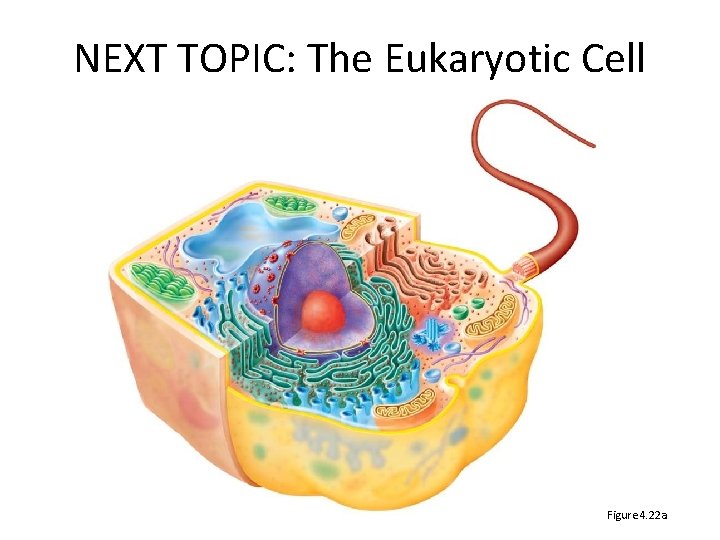
NEXT TOPIC: The Eukaryotic Cell Figure 4. 22 a
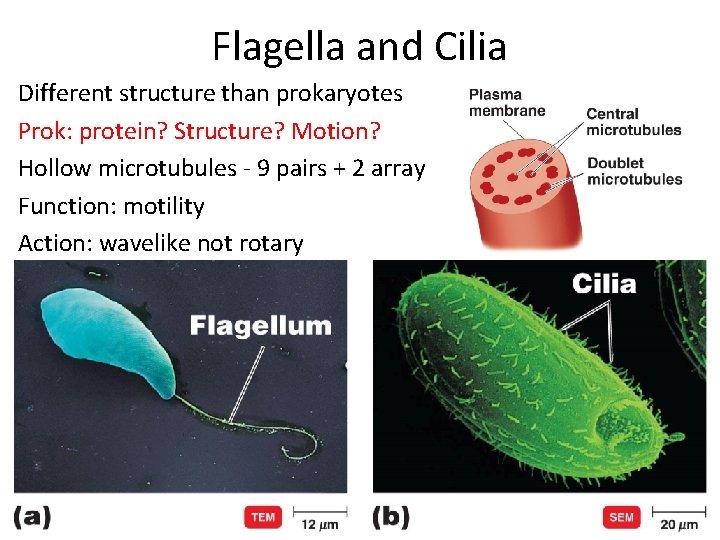
Flagella and Cilia Different structure than prokaryotes Prok: protein? Structure? Motion? Hollow microtubules - 9 pairs + 2 array Function: motility Action: wavelike not rotary Figure 4. 23 a-b
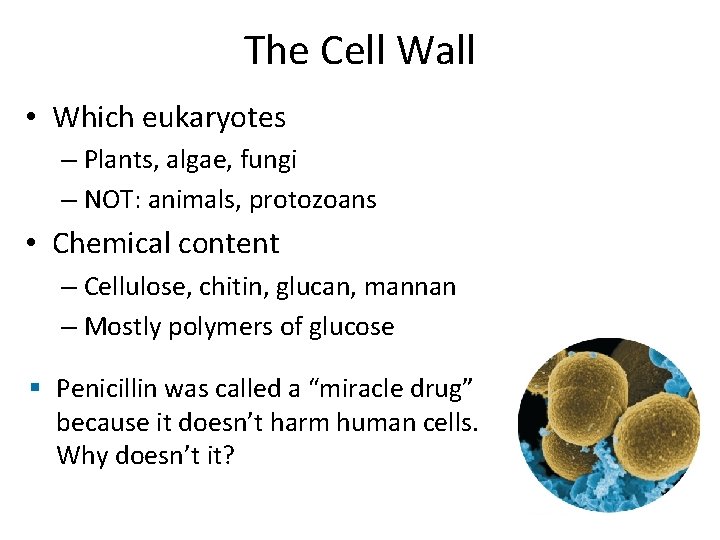
The Cell Wall • Which eukaryotes – Plants, algae, fungi – NOT: animals, protozoans • Chemical content – Cellulose, chitin, glucan, mannan – Mostly polymers of glucose § Penicillin was called a “miracle drug” because it doesn’t harm human cells. Why doesn’t it?
Glycocalyx? • What is it made of? • What are two names for it in the prokaryotes? • Do eukaryotes have one?
Glycocalyx – yes! • Carbohydrates sticking out of plasma membrane • Glycolipids, glycoproteins • eg. Fish slime, gut and colon mucous and blood vessel lining • First line of defense and contact • Targeted by pathogens
The Plasma Membrane - structure • Much like prokaryote’s – Fluid mosaic – Phospholipid bilayer – Peripheral proteins – Integral proteins – Transmembrane proteins • Difference – Sterols – Animal sterols (cholesterol) different from fungal sterols (ergosterol) – Target for antifungal medication
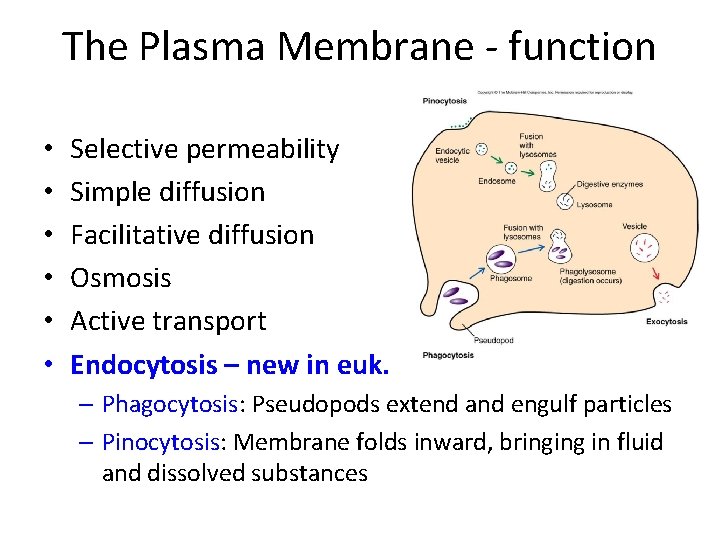
The Plasma Membrane - function • • • Selective permeability Simple diffusion Facilitative diffusion Osmosis Active transport Endocytosis – new in euk. – Phagocytosis: Pseudopods extend and engulf particles – Pinocytosis: Membrane folds inward, bringing in fluid and dissolved substances
Cytoplasm - eukaryotes • Cytoplasm: Substance inside plasma membrane and outside nucleus • Cytosol: Fluid portion of cytoplasm • Cytoskeleton: Microfilaments, intermediate filaments, microtubules • Cytoplasmic streaming: Movement of cytoplasm throughout cells
cytoskeleton • function – Cell shape and movement – Organelle organization and movement – Cell division What type of chemical is the cytoskeleton? (lipid, sugar, protein? )
cytoskeleton • 3 types (size, PROTEIN) – Thin microfilaments (ACTIN) – Medium intermediate filaments (VARIOUS) – Thick microtubules (TUBULIN) • How big? • What shape/organization are the proteins?
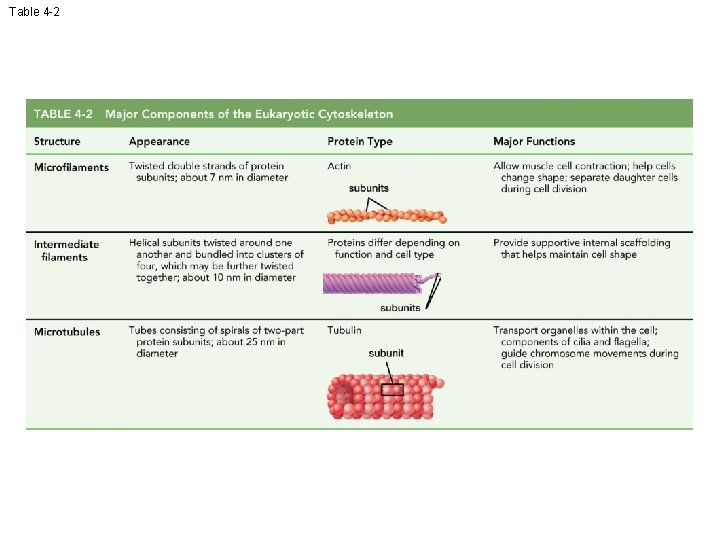
Table 4 -2
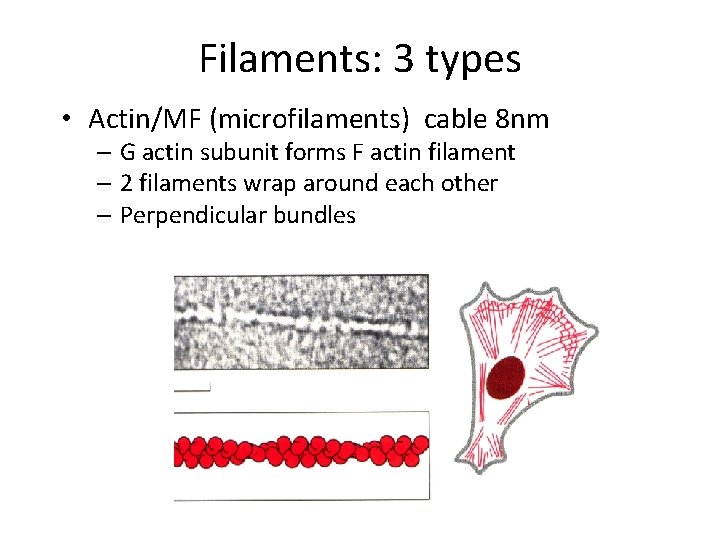
Filaments: 3 types • Actin/MF (microfilaments) cable 8 nm – G actin subunit forms F actin filament – 2 filaments wrap around each other – Perpendicular bundles
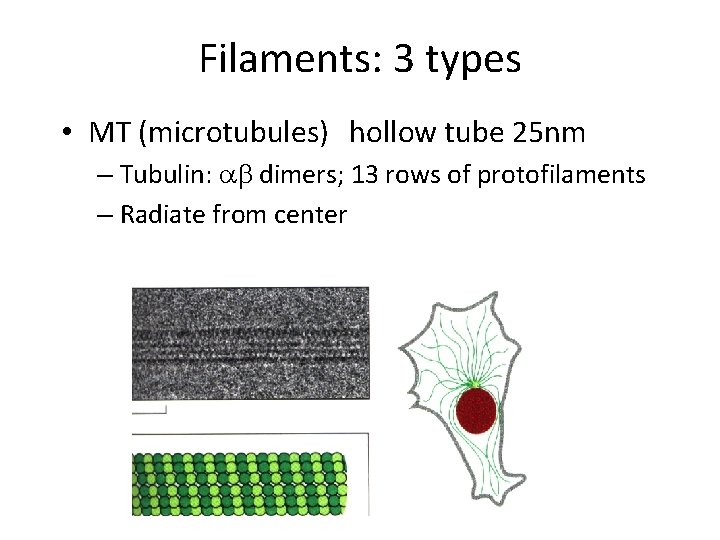
Filaments: 3 types • MT (microtubules) hollow tube 25 nm – Tubulin: ab dimers; 13 rows of protofilaments – Radiate from center
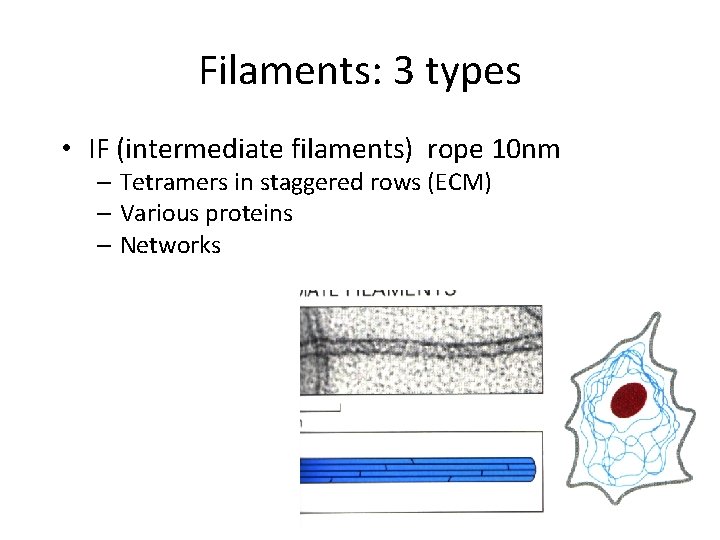
Filaments: 3 types • IF (intermediate filaments) rope 10 nm – Tetramers in staggered rows (ECM) – Various proteins – Networks
Ribosomes • Function?
Ribosomes • Protein synthesis • How big are prokaryotic ribosomes (“S” units)?
Ribosomes • Protein synthesis • 70 S (50 S + 30 S) • Would you expect eukaryotes to be the same? Why or why not?
Ribosomes • Protein synthesis • 70 S (50 S + 30 S) • 80 S (60 S + 40 S subunits) – Membrane-bound: Attached to ER – Free: In cytoplasm • Are there “ 70 S” ribosomes in eukaryotes?
Ribosomes • Protein synthesis • 80 S (60 S + 40 S subunits) – Membrane-bound: Attached to ER – Free: In cytoplasm • 70 S (50 S + 30 S subunits) – In chloroplasts and mitochondria – Like in prokaryotes!
Eukaryotic organelles Nucleus: Contains chromosomes ER: Transport network Golgi complex: Membrane formation and secretion Lysosome: Digestive enzymes Vacuole: Brings food into cells and provides support Mitochondrion: Cellular respiration Chloroplast: Photosynthesis Peroxisome: Oxidation of fatty acids; destroys H 2 O 2 Centrosome: Consists of protein fibers and centrioles
Mostly what’s important How proteins are made Nucleus: Contains chromosomes Endomembrane system: Transport, synthesis and secretion How ATP is made Mitochondrion: Cellular respiration Chloroplast: Photosynthesis
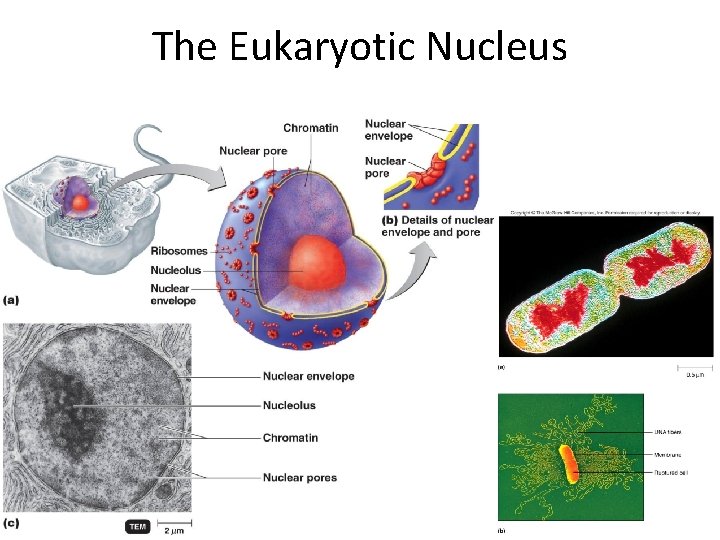
The Eukaryotic Nucleus Figure 4. 24
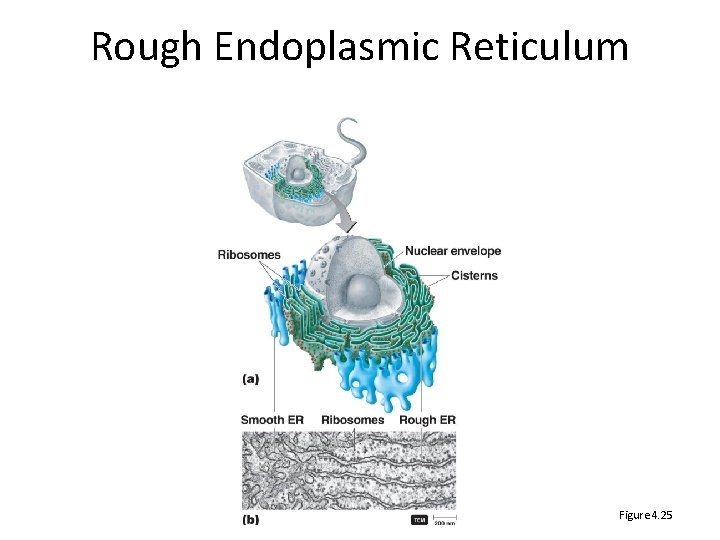
Rough Endoplasmic Reticulum Figure 4. 25
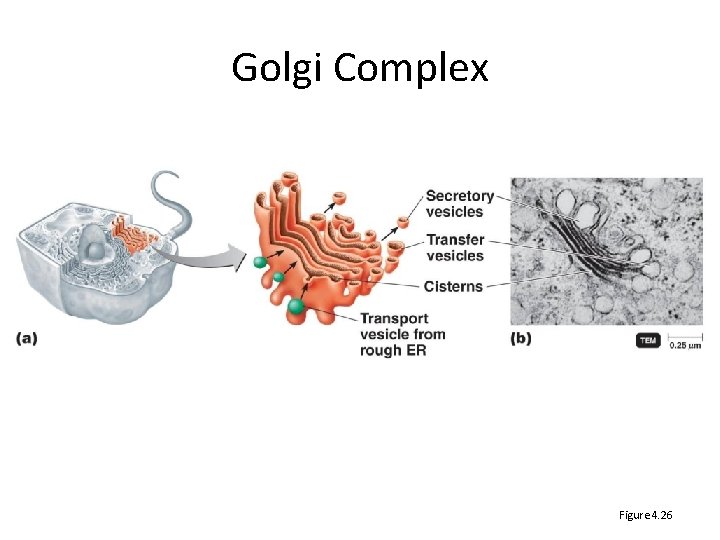
Golgi Complex Figure 4. 26
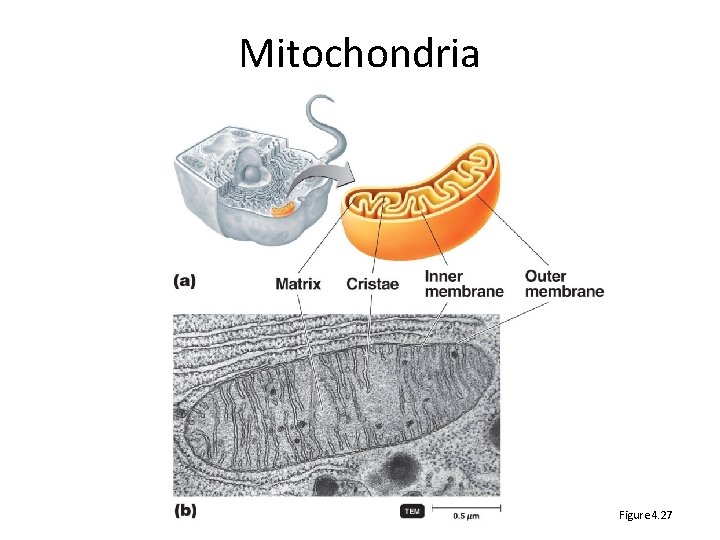
Mitochondria Figure 4. 27
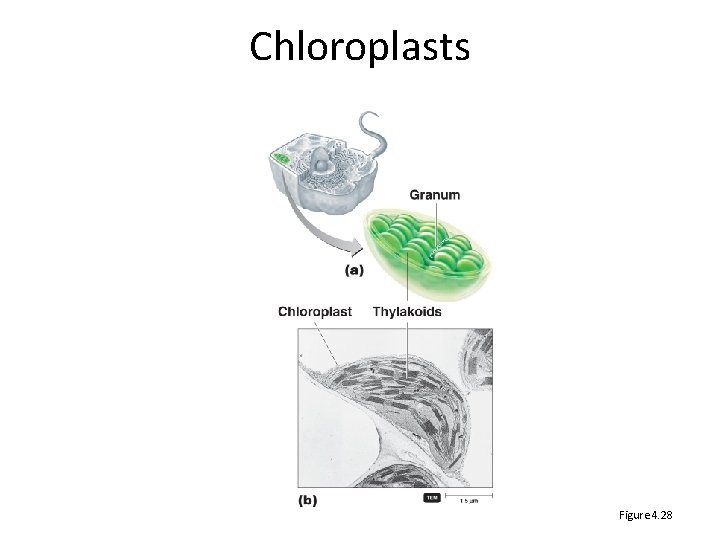
Chloroplasts Figure 4. 28
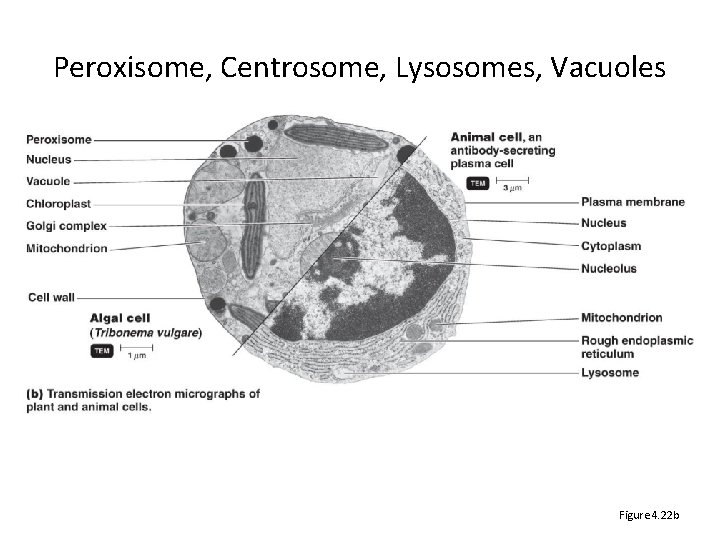
Peroxisome, Centrosome, Lysosomes, Vacuoles Figure 4. 22 b
Make a list • LHS – all the organelles • RHS – what does each one do?
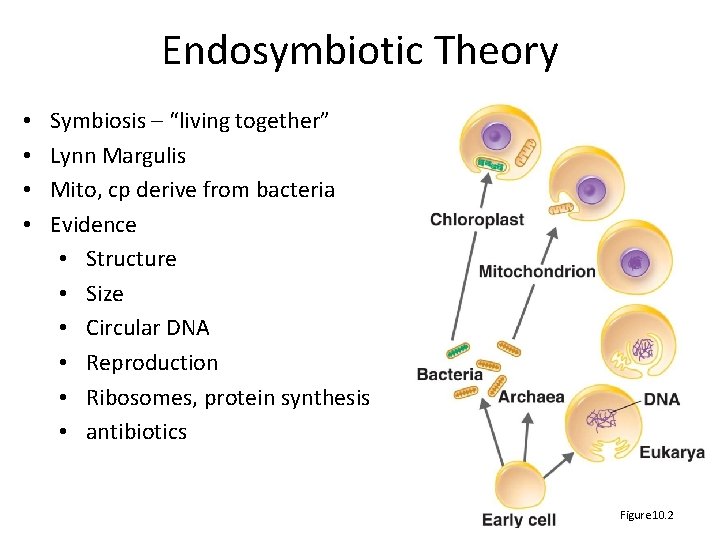
Endosymbiotic Theory • • Symbiosis – “living together” Lynn Margulis Mito, cp derive from bacteria Evidence • Structure • Size • Circular DNA • Reproduction • Ribosomes, protein synthesis • antibiotics Figure 10. 2
Missing links • Living intermediates: organisms alive today that are similar to hypothetical ancestors • Eg. the amoeba Pelomyxa palustris, which lacks mitochondria but hosts aerobic bacteria that do the same thing as mitochondria • At least one species of Paramecium—and a variety of corals, some clams, and snails—harbor photosynthetic algae in their cells
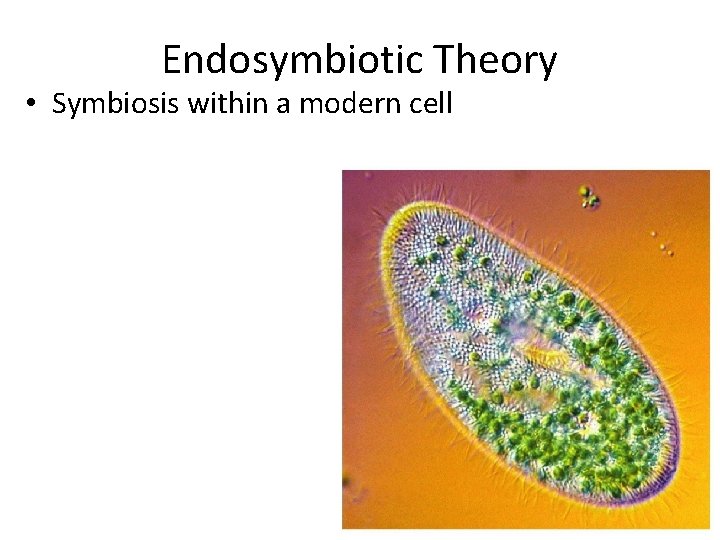
Endosymbiotic Theory • Symbiosis within a modern cell
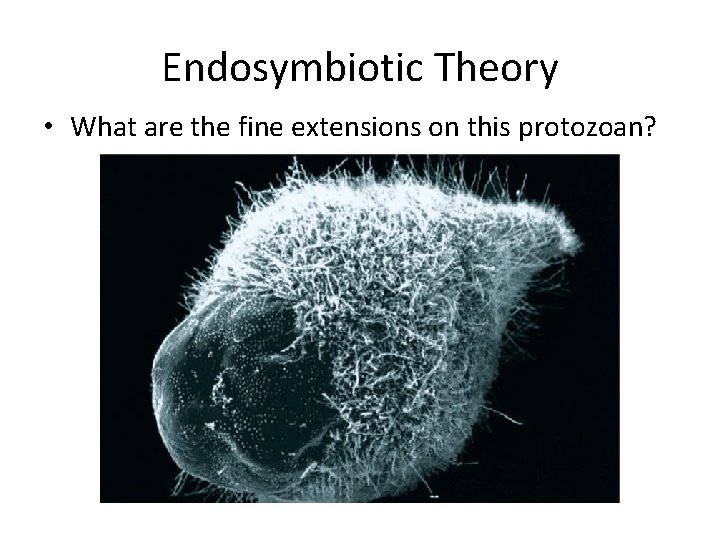
Endosymbiotic Theory • What are the fine extensions on this protozoan?
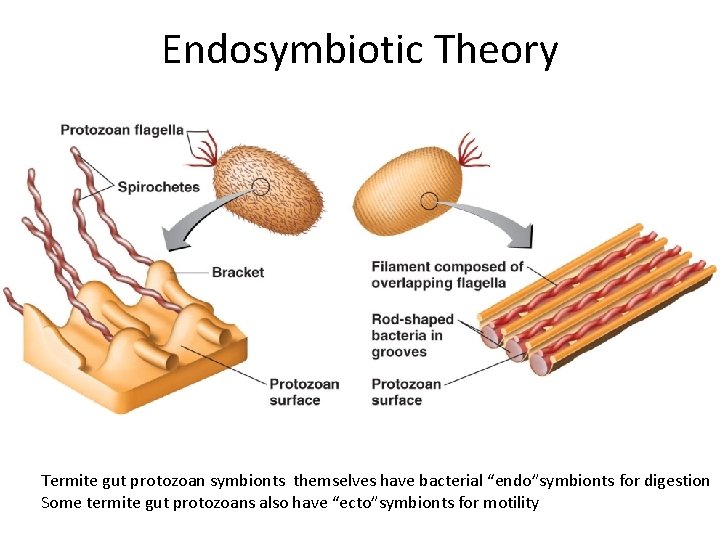
Endosymbiotic Theory Termite gut protozoan symbionts themselves have bacterial “endo”symbionts for digestion Some termite gut protozoans also have “ecto”symbionts for motility
- Slides: 104