
BIO 201 Lab 1 Experiments 1 2 3
BIO 201 Lab 1 Experiments 1, 2, 3 Professor Diane Hilker
Overview I. Exp. 1: Introduction to the Microscope II. Exp. 2: Survey of Microbes III. Exp. 3: Collection of Microbes

I. Exp. 1: Intro. to the Microscope � Purpose: To review the use & care of the compound light microscope Fig. 3. 1 Textbook
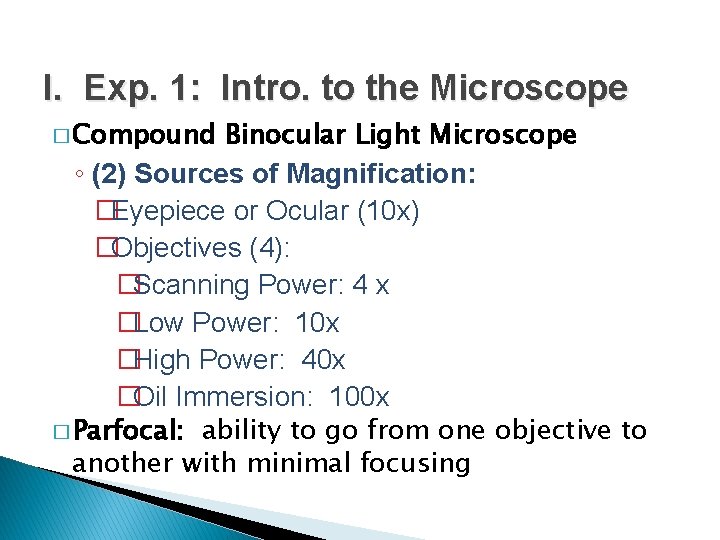
I. Exp. 1: Intro. to the Microscope � Compound Binocular Light Microscope ◦ (2) Sources of Magnification: �Eyepiece or Ocular (10 x) �Objectives (4): �Scanning Power: 4 x �Low Power: 10 x �High Power: 40 x �Oil Immersion: 100 x � Parfocal: ability to go from one objective to another with minimal focusing
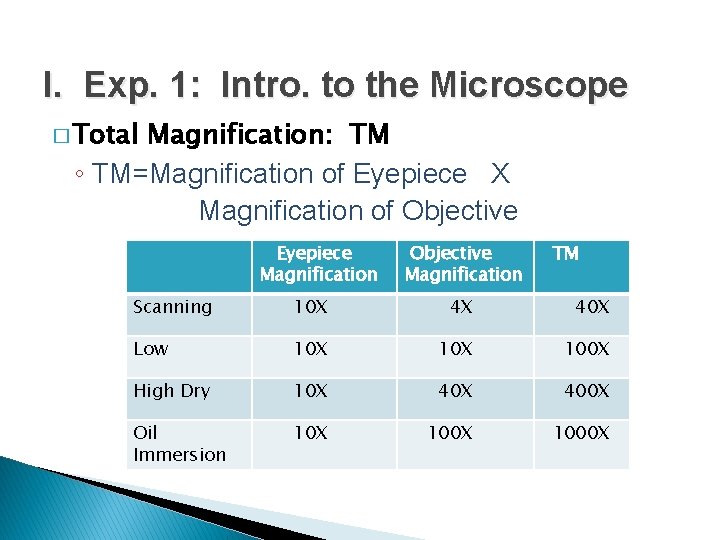
I. Exp. 1: Intro. to the Microscope � Total Magnification: TM ◦ TM=Magnification of Eyepiece X Magnification of Objective Eyepiece Magnification Objective Magnification TM Scanning 10 X 4 X 40 X Low 10 X 100 X High Dry 10 X 400 X Oil Immersion 10 X 1000 X

I. Exp. 1: Intro. to the Microscope � Resolution or Resolving Power (RP) ◦ Ability to distinguish detail clearly ◦ To be able to tell 2 points as separate points and not one point ◦ RP = Wavelength of Light = ------2 X Numerical Aperture 2 NA
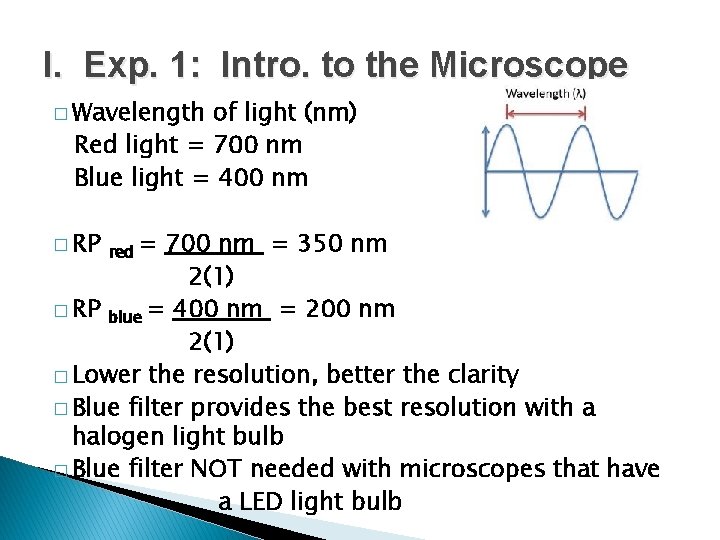
I. Exp. 1: Intro. to the Microscope � Wavelength of light (nm) Red light = 700 nm Blue light = 400 nm � RP red = 700 nm = 350 nm 2(1) � RP blue = 400 nm = 200 nm 2(1) � Lower the resolution, better the clarity � Blue filter provides the best resolution with a halogen light bulb � Blue filter NOT needed with microscopes that have a LED light bulb
I. Exp. 1: Intro. to the Microscope � Numerical Aperture (NA): describes the cone of light that enters the lens so as to see fine detail. Two things make up NA: ◦ Angular Aperture: angle of light as it goes through the lenses & filters of the condenser & into the objective (Constant) ◦ Refractive Index: how light travels through a medium �Refractive Index of Air = 1. 0 �Refractive Index of Oil = 1. 5
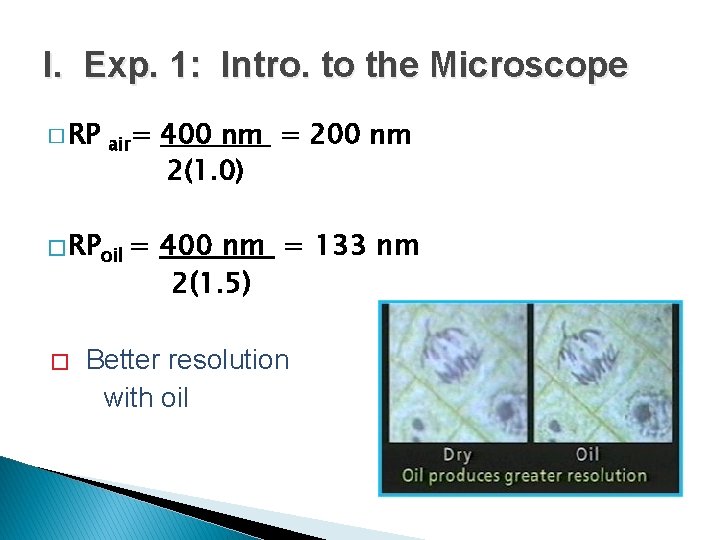
I. Exp. 1: Intro. to the Microscope � RP air= 400 nm = 200 nm 2(1. 0) � RPoil = 400 nm = 133 nm 2(1. 5) � Better resolution with oil
Overview I. Exp. 1: Introduction to the Microscope II. Exp. 2: Survey of Microbes III. Exp. 3: Collection of Microbes
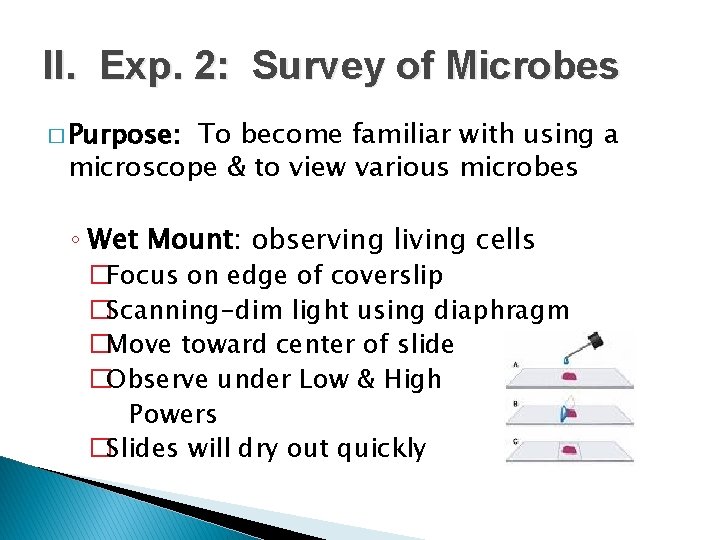
II. Exp. 2: Survey of Microbes � Purpose: To become familiar with using a microscope & to view various microbes ◦ Wet Mount: observing living cells �Focus on edge of coverslip �Scanning-dim light using diaphragm �Move toward center of slide �Observe under Low & High Powers �Slides will dry out quickly

II. Exp. 2: Survey of Microbes � 4 Slides: Largest to smallest microorganisms 1. Pond Water: algae-much variation
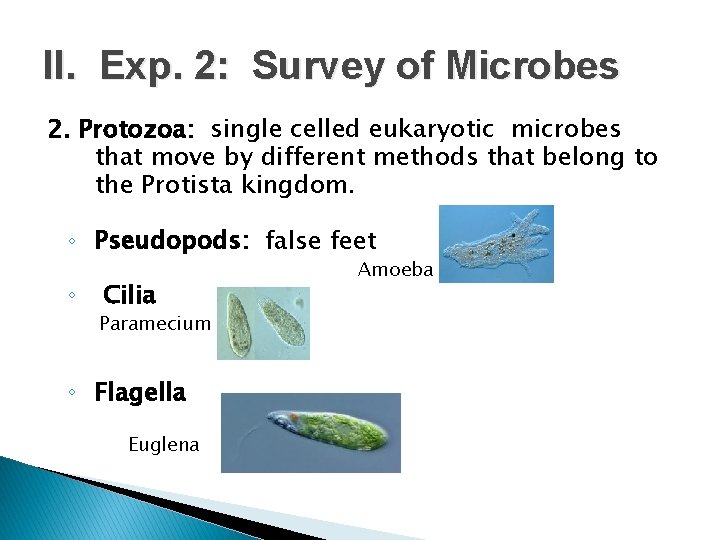
II. Exp. 2: Survey of Microbes 2. Protozoa: single celled eukaryotic microbes that move by different methods that belong to the Protista kingdom. ◦ Pseudopods: false feet ◦ Cilia Paramecium ◦ Flagella Euglena Amoeba
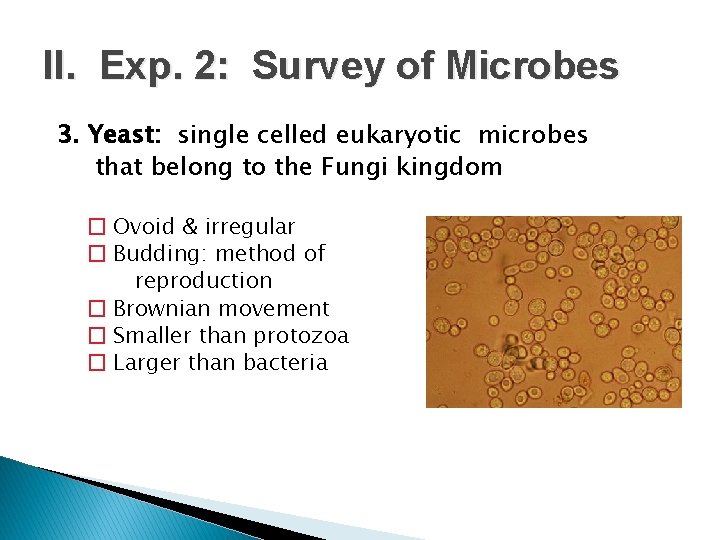
II. Exp. 2: Survey of Microbes 3. Yeast: single celled eukaryotic microbes that belong to the Fungi kingdom � Ovoid & irregular � Budding: method of reproduction � Brownian movement � Smaller than protozoa � Larger than bacteria
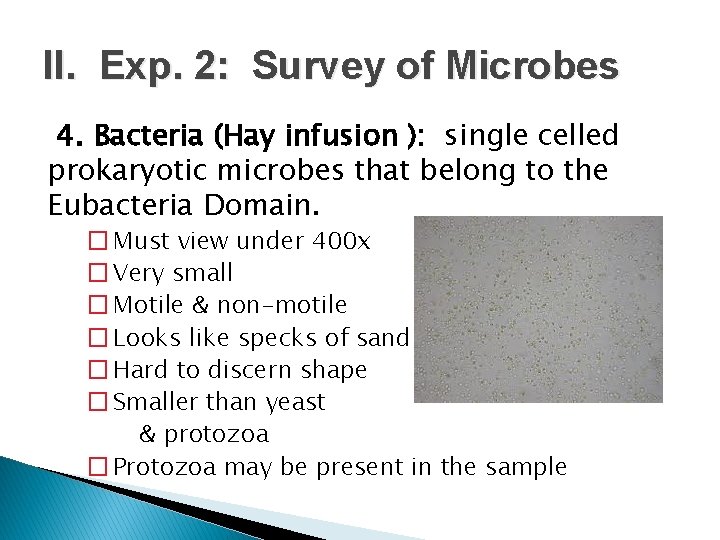
II. Exp. 2: Survey of Microbes 4. Bacteria (Hay infusion ): single celled prokaryotic microbes that belong to the Eubacteria Domain. � Must view under 400 x � Very small � Motile & non-motile � Looks like specks of sand � Hard to discern shape � Smaller than yeast & protozoa � Protozoa may be present in the sample
Overview I. Exp. 1: Introduction to the Microscope II. Exp. 2: Survey of Microbes III. Exp. 3: Collection of Microbes
III. Exp. 3: Collection of Microbes � Purpose: To collect and grow microbes from the environment for observation ◦ Procedure to be described by lab instructor
- Slides: 17