
BIO 101 Life Science Chapter 2 Essential Chemistry
BIO 101: Life Science Chapter 2: Essential Chemistry for Biology Essential Elements Water p. H scale
Why Chemistry? • We (and all the things in the universe) are composed by tens of thousands of chemical compounds. • Tens of thousands of chemical reactions are happening in our body in every second. --- metabolism is the sum-up of all the chemical reactions happening in the living organisms.
Something to begin with: Matter Atom and molecules Elements and compounds A helpful video: https: //www. youtube. com/watch? v=Af. Xx. Zw. NLv. PA
Matter is composed of chemical elements. Ø An element is a substance that cannot be broken down into other substances by chemical reactions. Ø There are 92 naturally occurring elements on Earth. Ø All of the elements are listed in the periodic table.
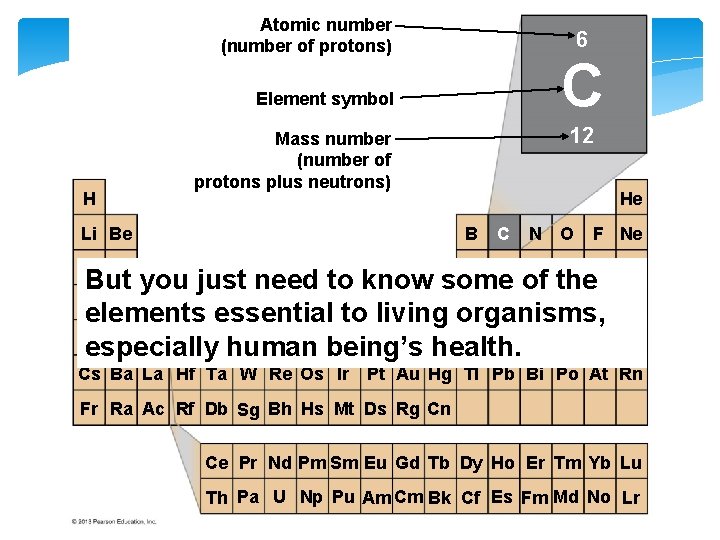
Figure 2. 1 a Atomic number (number of protons) 6 C Element symbol H 12 Mass number (number of protons plus neutrons) He Li Be B Na Mg Al Si P C N O F Ne S Cl Ar But you just need to know some of the K Ca Sc Ti V Cr Mn Fe Co Ni Cu Zn Ga Ge As Se Br elements essential to living organisms, Rb Sr Y Zr Nb Mo Tc Ru Rh Pd Ag Cd In Sn Sb Te I especially human being’s health. Kr Xe Cs Ba La Hf Ta W Re Os Ir Pt Au Hg TI Pb Bi Po At Rn Fr Ra Ac Rf Db Sg Bh Hs Mt Ds Rg Cn Ce Pr Nd Pm Sm Eu Gd Tb Dy Ho Er Tm Yb Lu Th Pa U Np Pu Am Cm Bk Cf Es Fm Md No Lr
Ø Each element consists of one single kind of atom. Ø An atom is the smallest unit of matter that still retains the properties of an element. Ø Elements can combine to form compounds. Ø Compounds are substances that contain two or more elements in a fixed ratio. • Na. Cl (table salt) and H 2 O (water) are examples of common compounds. • There are unlimited numbers of compounds!
Carbon is a kind of element. • A chunk of carbon (coal or diamond) is composed of carbon atoms. • All living things are composed of a “carbon backbone”. • A single carbon atom can form a maximum of 4 chemical bonds. This is one of the reasons it is so versatile. Generally, the molecules containing carbon are considered as “organic”. However, some of the “simple” molecules, like CO 2, are not considered as “organic molecules”. Many organic compounds are synthesized by factories now. For example, plastics and rubbers. --- totally different meaning than “organic food”.

Ø Twenty-five elements are essential to people. Ø Four elements make up about 96% of the weight of most cells: oxygen, carbon, hydrogen, and nitrogen They are the major components of organic molecules and are the most common elements in living organisms. Ø Seven elements make up about 4% of your body: Calcium (Ca), Phosphorus (P), Potassium (K), Sulfur (S), Sodium (Na), Chlorine (Cl), and Magnesium (Mg) Ø Fourteen trace elements make up <0. 01% of your body: Boron (B), Chromium (Cr), Cobalt (Co), Copper (Cu), Fluorine (F), Iodine (I), Iron (Fe), Manganese (Mn), Molybdenum (Mo), Selenium (Se), Silicon (Si), Tin (Sn), Vanadium (V), and Zinc (Zn)
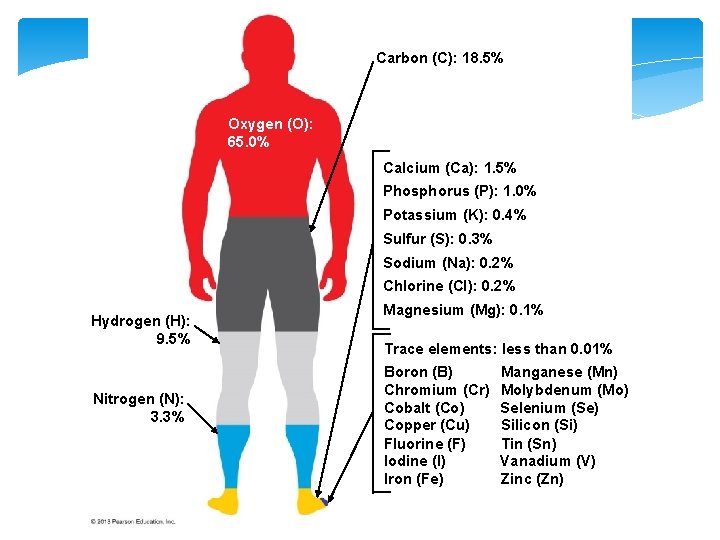
Figure 2. 2 Carbon (C): 18. 5% Oxygen (O): 65. 0% Calcium (Ca): 1. 5% Phosphorus (P): 1. 0% Potassium (K): 0. 4% Sulfur (S): 0. 3% Sodium (Na): 0. 2% Chlorine (Cl): 0. 2% Hydrogen (H): 9. 5% Nitrogen (N): 3. 3% Magnesium (Mg): 0. 1% Trace elements: less than 0. 01% Boron (B) Chromium (Cr) Cobalt (Co) Copper (Cu) Fluorine (F) Iodine (I) Iron (Fe) Manganese (Mn) Molybdenum (Mo) Selenium (Se) Silicon (Si) Tin (Sn) Vanadium (V) Zinc (Zn)
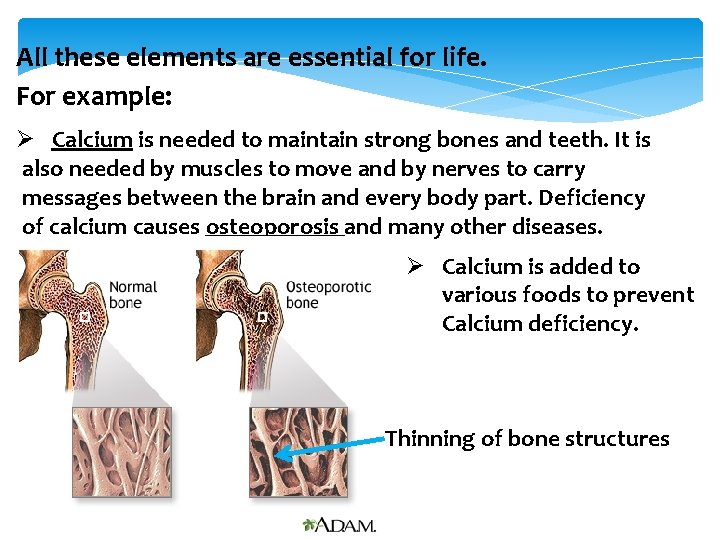
All these elements are essential for life. For example: Ø Calcium is needed to maintain strong bones and teeth. It is also needed by muscles to move and by nerves to carry messages between the brain and every body part. Deficiency of calcium causes osteoporosis and many other diseases. Ø Calcium is added to various foods to prevent Calcium deficiency. Thinning of bone structures
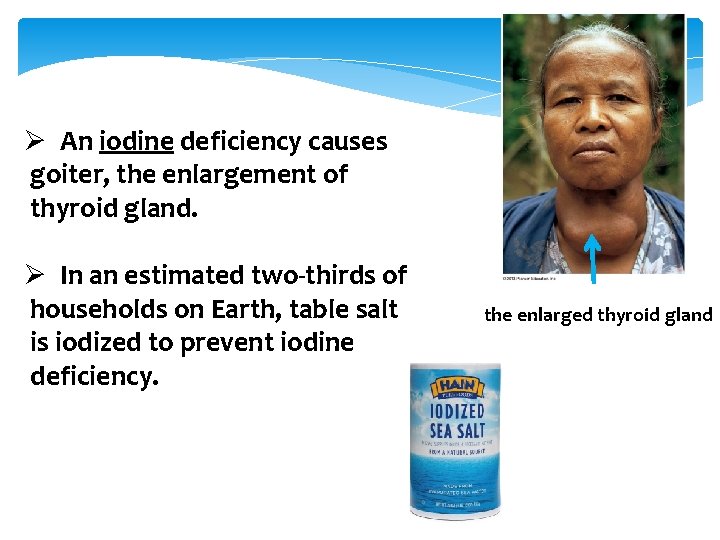
Ø An iodine deficiency causes goiter, the enlargement of thyroid gland. Ø In an estimated two-thirds of households on Earth, table salt is iodized to prevent iodine deficiency. the enlarged thyroid gland
Chemical Bonding and Molecules ØThe atoms inside one molecule are held together by chemical bonds --- the attractions among atoms to hold them together. Ø The formation of chemical bonds involves the distribution and sharing of electrons between atoms – but that is beyond the scope of this class. ØChemical reactions --- the breaking of existing molecules and the forming of new molecules. Ø It means that chemical reactions are in fact the breaking of existing chemical bonds and the forming of new bonds.
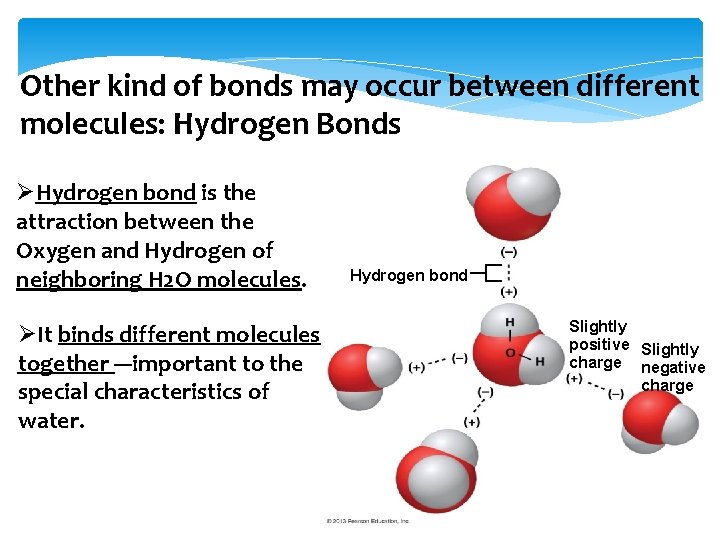
Other kind of bonds may occur between different molecules: Hydrogen Bonds ØHydrogen bond is the attraction between the Oxygen and Hydrogen of neighboring H 2 O molecules. ØIt binds different molecules together ---important to the special characteristics of water. Hydrogen bond Slightly positive Slightly charge negative charge
WATER AND LIFE Some theorize that life on Earth began in water and evolved there for > 3 billion years. Modern life remains tied to water. Water is the single most abundant compound in living things. Your cells are composed of 70– 95% water. The abundance of water is a major reason Earth is habitable.
Water’s Life-Supporting Properties The hydrogen bond is the main reason for most of water’s lifesupporting properties. § Water molecules tend to stick together----cohesion. § Water has a strong resistance to change in temperature --- it needs a lot of energy to melt ice, to change the temperature of water, or to boil it. § Frozen water (ice, solid H 2 O) floats on liquid form of H 2 O. § Water is a common solvent for life.
§ Cohesion is the tendency of molecules of the same kind to stick together. The cohesion of water is because of hydrogen bonding. § Cohesion and adhesion are vital for the transport of water from the roots to the leaves of plants through the process of capillary action. © 2013 Pearson Education, Inc.
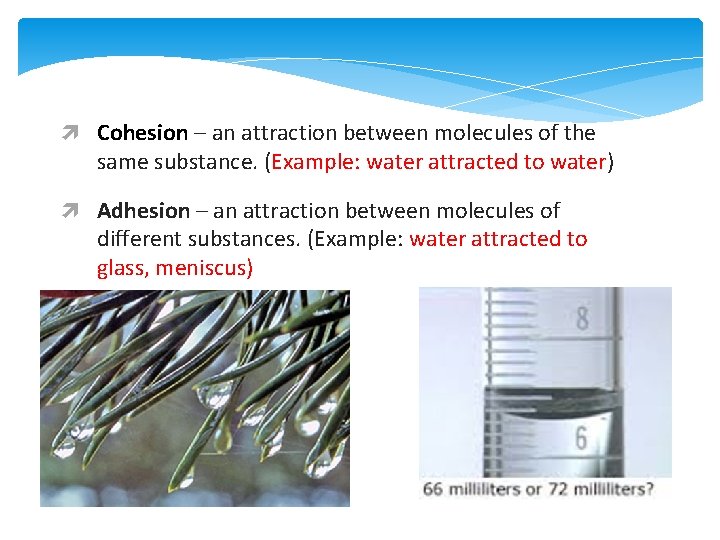
Cohesion – an attraction between molecules of the same substance. (Example: water attracted to water) Adhesion – an attraction between molecules of different substances. (Example: water attracted to glass, meniscus)
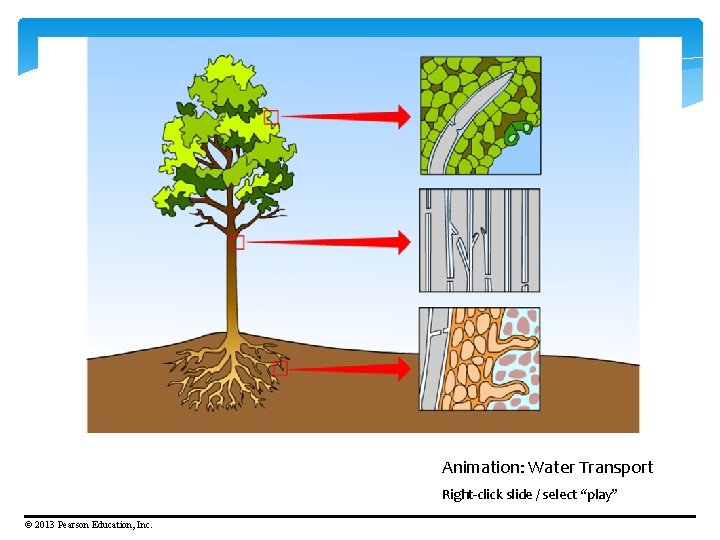
Animation: Water Transport Right-click slide / select “play” © 2013 Pearson Education, Inc.
Because of hydrogen bonding, water has a strong resistance to temperature change----high heat capacity and high heat of vaporization. Water can absorb and store large amounts of heat (energy) while only changing a few degrees in temperature---energy is needed to break the hydrogen bonds.
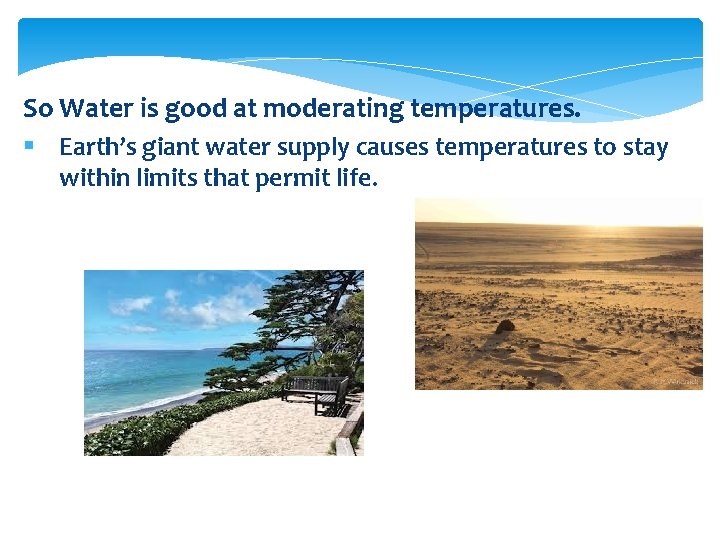
So Water is good at moderating temperatures. § Earth’s giant water supply causes temperatures to stay within limits that permit life.
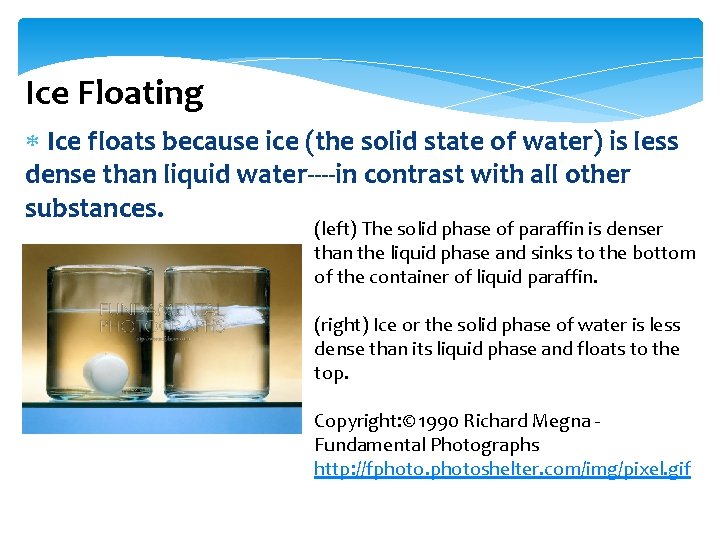
Ice Floating Ice floats because ice (the solid state of water) is less dense than liquid water----in contrast with all other substances. (left) The solid phase of paraffin is denser than the liquid phase and sinks to the bottom of the container of liquid paraffin. (right) Ice or the solid phase of water is less dense than its liquid phase and floats to the top. Copyright: © 1990 Richard Megna Fundamental Photographs http: //fphotoshelter. com/img/pixel. gif
Ice Floating The hydrogen bonds in ice are stable, giving ice a crystal lattice. A chunk of ice has fewer water molecules than an equal volume of liquid water.
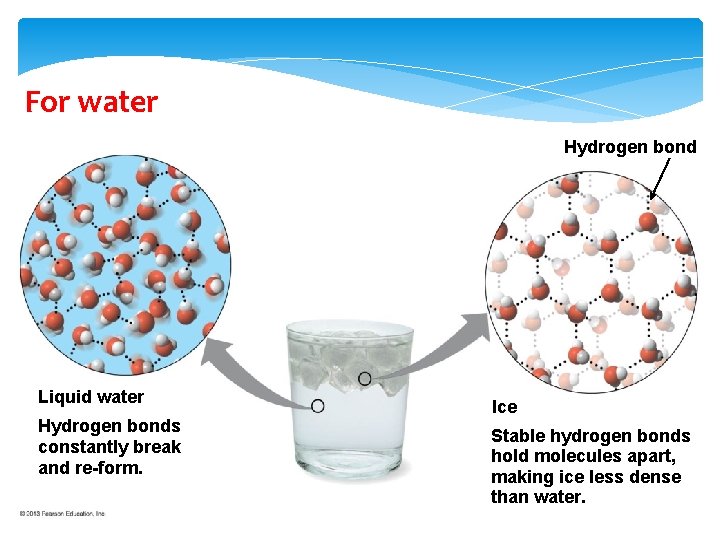
For water Hydrogen bond Liquid water Hydrogen bonds constantly break and re-form. Ice Stable hydrogen bonds hold molecules apart, making ice less dense than water.
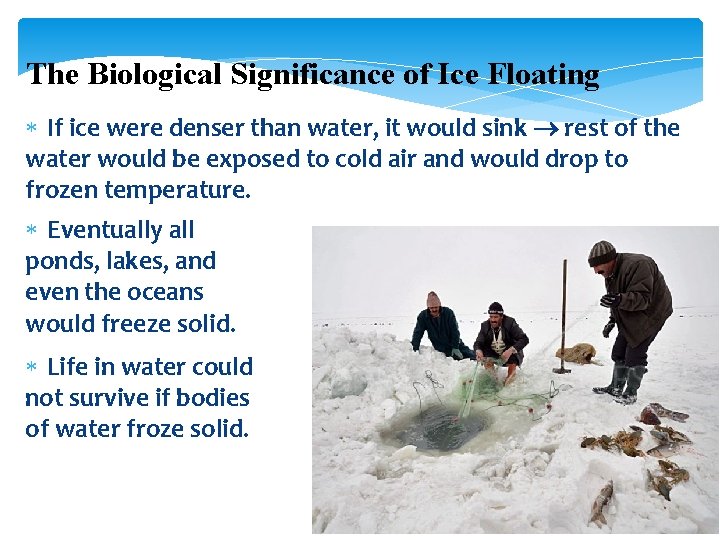
The Biological Significance of Ice Floating If ice were denser than water, it would sink rest of the water would be exposed to cold air and would drop to frozen temperature. Eventually all ponds, lakes, and even the oceans would freeze solid. Life in water could not survive if bodies of water froze solid.
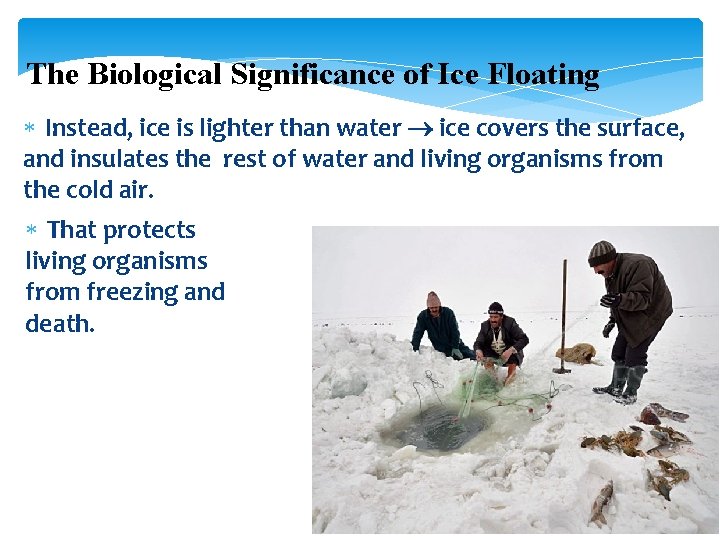
The Biological Significance of Ice Floating Instead, ice is lighter than water ice covers the surface, and insulates the rest of water and living organisms from the cold air. That protects living organisms from freezing and death.
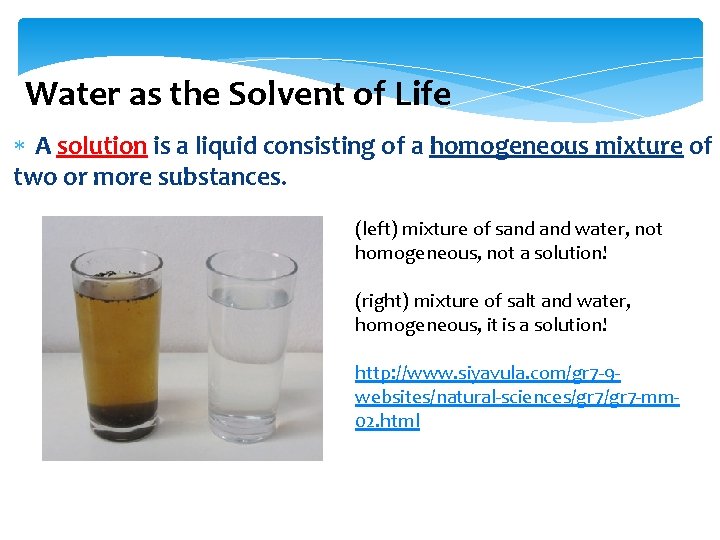
Water as the Solvent of Life A solution is a liquid consisting of a homogeneous mixture of two or more substances. (left) mixture of sand water, not homogeneous, not a solution! (right) mixture of salt and water, homogeneous, it is a solution! http: //www. siyavula. com/gr 7 -9 websites/natural-sciences/gr 7 -mm 02. html
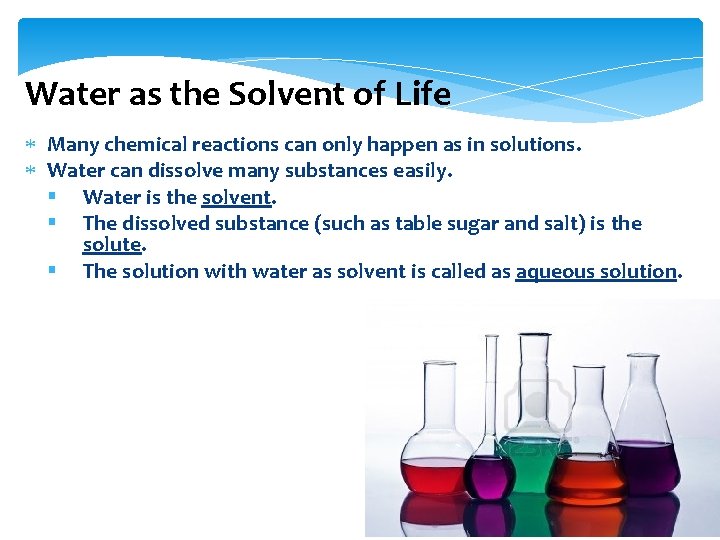
Water as the Solvent of Life Many chemical reactions can only happen as in solutions. Water can dissolve many substances easily. § Water is the solvent. § The dissolved substance (such as table sugar and salt) is the solute. § The solution with water as solvent is called as aqueous solution.
Acids, Bases, and p. H of Solutions p. H is an important parameter of solutions. It measures the relative amount of free hydrogen ions in the water. The p. H scale ranges from 0 to 14. Solutions with p. H < 7 are acidic Solutions with p. H > 7 are basic (alkaline) Solutions with p. H = 7 are neutral Common acidic liquids: vinegar, lemon juice, etc. Common basic liquids: ammonia, bleach, etc.
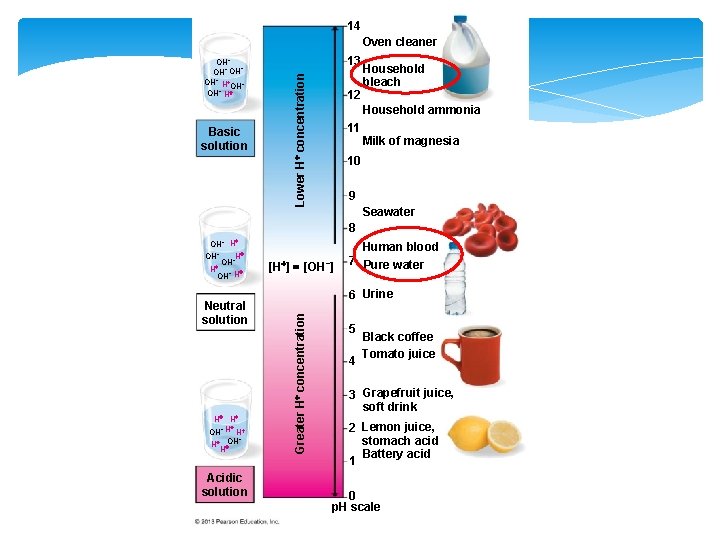
14 Oven cleaner Basic solution 13 Lower H concentration OH− − OH−OH − OH H OH− H 12 Household bleach Household ammonia 11 Milk of magnesia 10 9 Seawater 8 Neutral solution H H OH− H H − OH H H Acidic solution [H ] [OH−] Human blood 7 Pure water 6 Urine Greater H concentration OH− H H OH− − OH H − OH H 5 4 Black coffee Tomato juice 3 Grapefruit juice, soft drink 2 Lemon juice, stomach acid Battery acid 1 0 p. H scale
§ The normal human blood p. H range from 7. 35 to 7. 45. § Even a slight change in p. H can be harmful, even lethal to a living organism. § For most living organisms, a p. H around 7 is acceptable and extreme p. H is dangerous. § The biochemical activities of living tissues frequently affect p. H, yet life depends on maintaining a p. H range that is normal for each tissue or system (homeostasis).
Chapter 2 Expected Learning Outcomes: 1. Know the definition of metabolism. 2. Understand what an element is, and that all matter is composed of elements. 3. Understand the importance of carbon to living organisms. 4. Be able to list the most important elements for humans (slides 8 & 9). This includes major and trace elements. 5. Understand that molecules are composed of atoms, which are “held together” by chemical bonds. 6. Be familiar with the hydrogen bond, and understand that hydrogen bonds affect the characteristics of water, make water crucial to living organisms (slides 15 to 28). 7. Be able to distinguish between cohesion and adhesion and relate these to capillary action. 8. Understand what p. H is, and the endurable p. H for most living organisms (slides 29 -31).
Reading after class: Textbook Chapter 2 “Water and Life”, pages 29 -32 Self-quiz questions 7 and 9, page 35
- Slides: 32