
BINP TauCharm Project E Levichev For the BINP
BINP Tau-Charm Project E. Levichev For the BINP C-Tau team International Workshop on e+e- collisions from Phi to Psi (13 -16 October 2009) IHEP, Beijing 1
Outline 1. Introduction of Crab Waist collision approach 2. Scientific program and specifications 3. Optics 4. FF and QD 0 5. Polarization insertions 6. Energy calibration 2
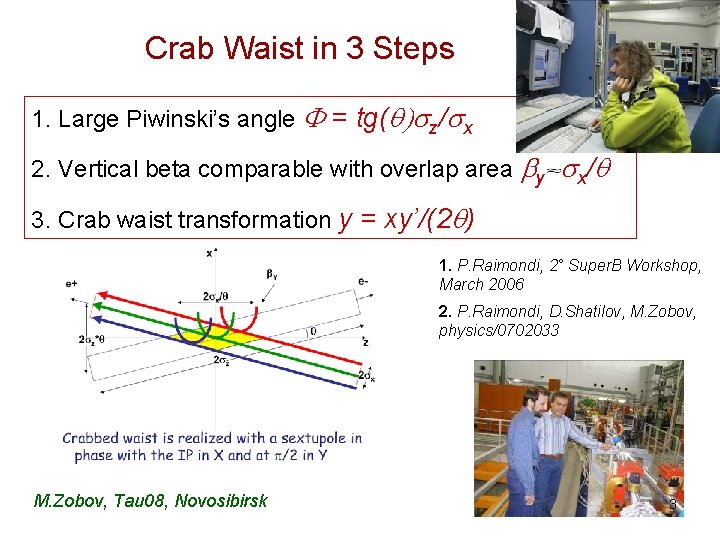
Crab Waist in 3 Steps 1. Large Piwinski’s angle F = tg(q)sz/sx 2. Vertical beta comparable with overlap area by sx/q 3. Crab waist transformation y = xy’/(2 q) 1. P. Raimondi, 2° Super. B Workshop, March 2006 2. P. Raimondi, D. Shatilov, M. Zobov, physics/0702033 M. Zobov, Tau 08, Novosibirsk 3
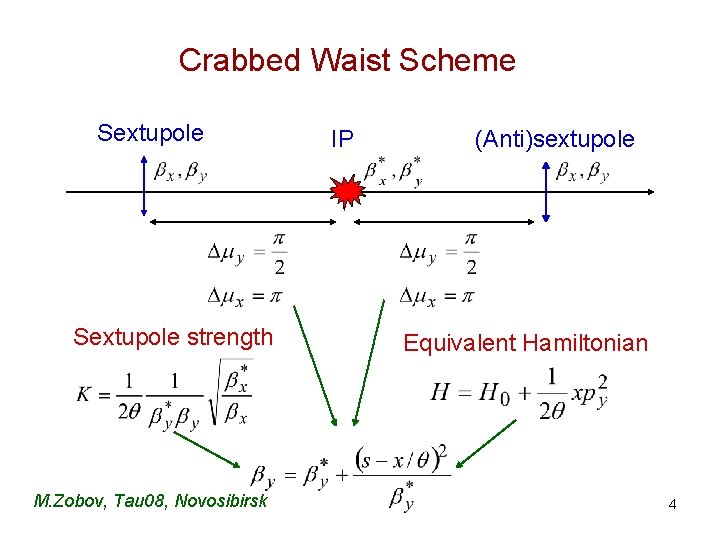
Crabbed Waist Scheme Sextupole strength M. Zobov, Tau 08, Novosibirsk IP (Anti)sextupole Equivalent Hamiltonian 4
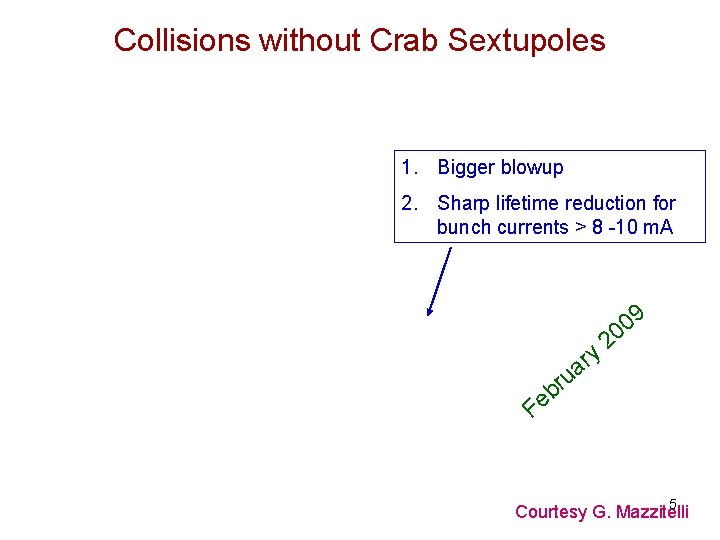
Collisions without Crab Sextupoles 1. Bigger blowup 2. Sharp lifetime reduction for bunch currents > 8 -10 m. A y r a 9 0 20 ru b e F 5 Courtesy G. Mazzitelli
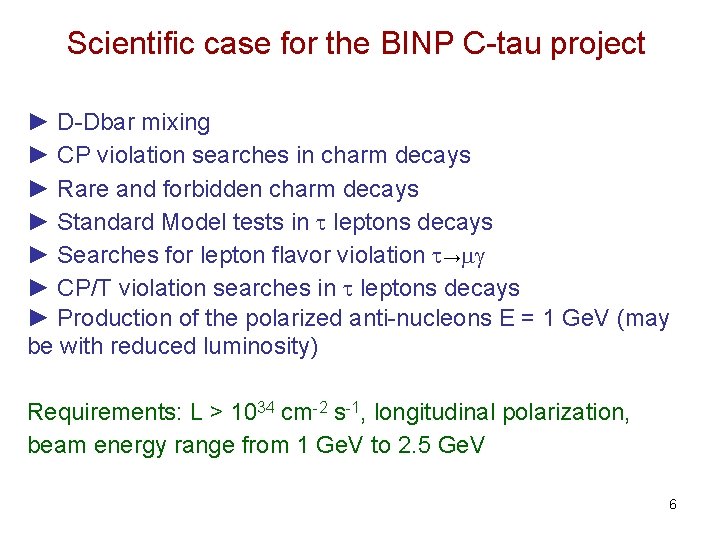
Scientific case for the BINP C-tau project ► D-Dbar mixing ► CP violation searches in charm decays ► Rare and forbidden charm decays ► Standard Model tests in leptons decays ► Searches for lepton flavor violation →mg ► CP/T violation searches in leptons decays ► Production of the polarized anti-nucleons E = 1 Ge. V (may be with reduced luminosity) Requirements: L > 1034 cm-2 s-1, longitudinal polarization, beam energy range from 1 Ge. V to 2. 5 Ge. V 6
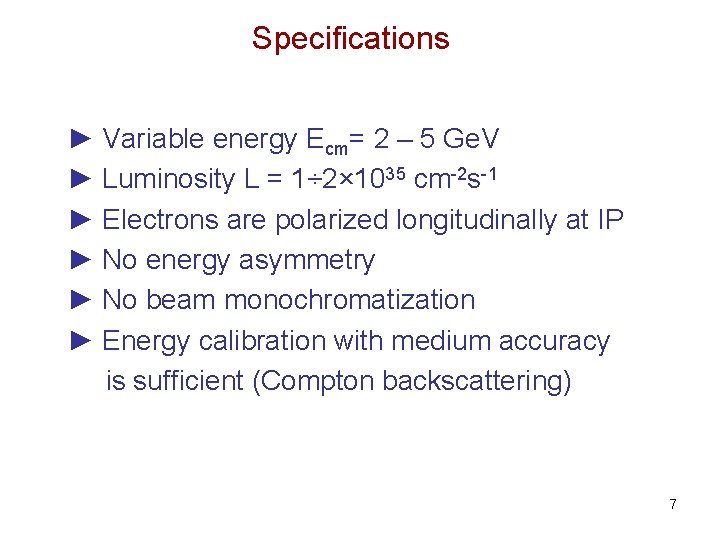
Specifications ► Variable energy Ecm= 2 – 5 Ge. V ► Luminosity L = 1÷ 2× 1035 cm-2 s-1 ► Electrons are polarized longitudinally at IP ► No energy asymmetry ► No beam monochromatization ► Energy calibration with medium accuracy is sufficient (Compton backscattering) 7
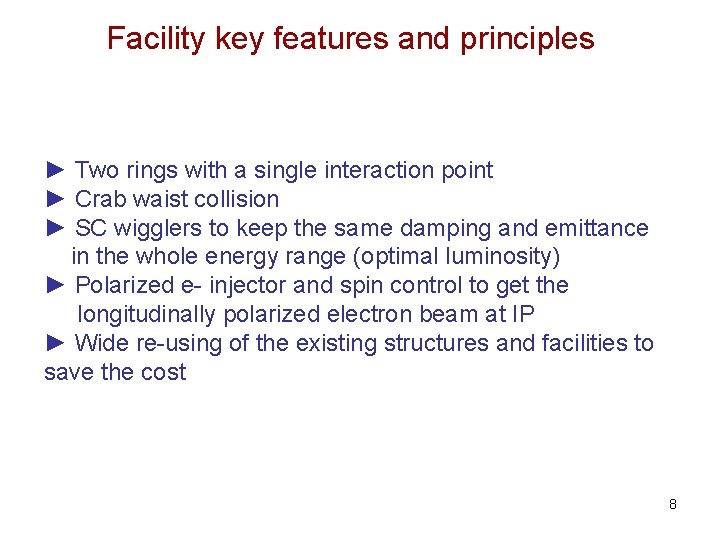
Facility key features and principles ► Two rings with a single interaction point ► Crab waist collision ► SC wigglers to keep the same damping and emittance in the whole energy range (optimal luminosity) ► Polarized e- injector and spin control to get the longitudinally polarized electron beam at IP ► Wide re-using of the existing structures and facilities to save the cost 8
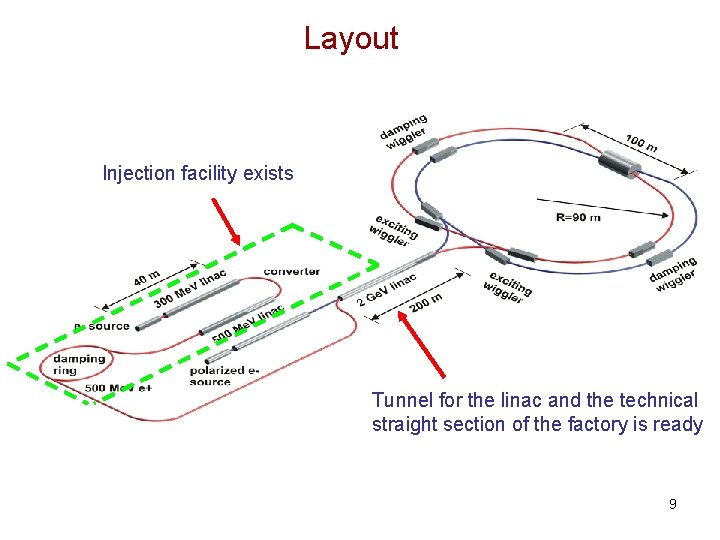
Layout Injection facility exists Tunnel for the linac and the technical straight section of the factory is ready 9
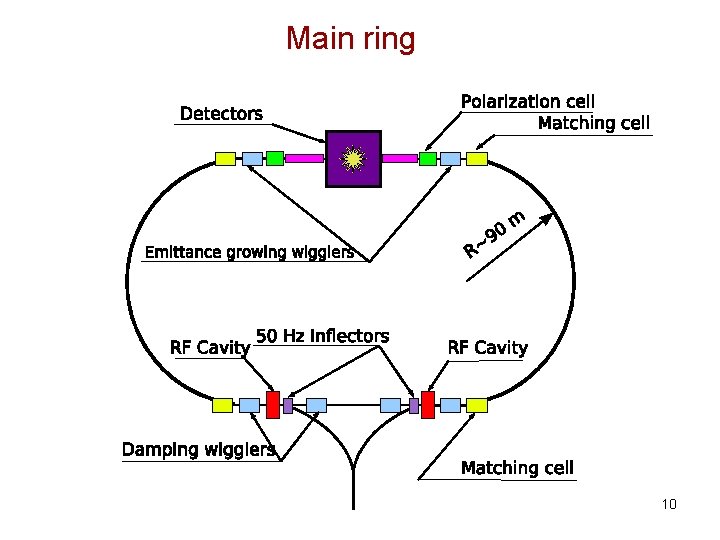
Main ring 10
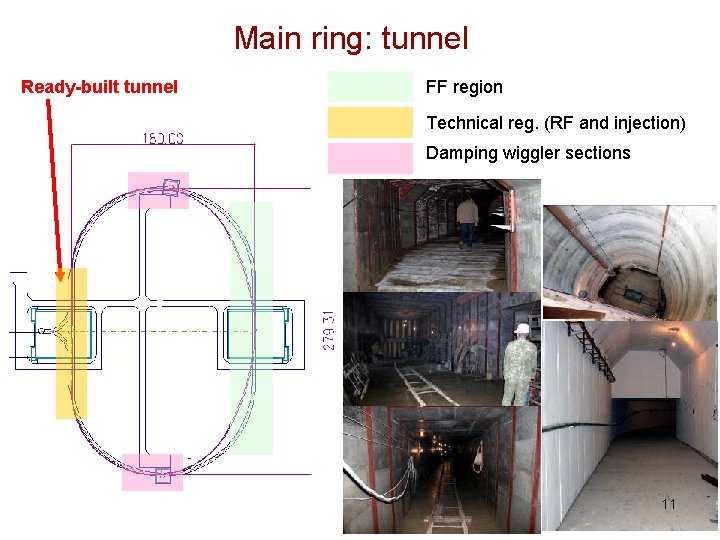
Main ring: tunnel Ready-built tunnel FF region Technical reg. (RF and injection) Damping wiggler sections 11
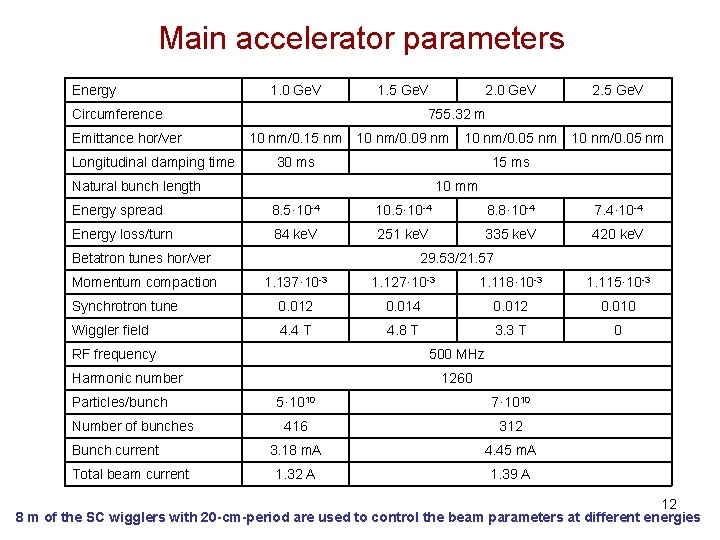
Main accelerator parameters Energy 1. 0 Ge. V 1. 5 Ge. V Circumference Emittance hor/ver Longitudinal damping time 2. 0 Ge. V 2. 5 Ge. V 755. 32 m 10 nm/0. 15 nm 10 nm/0. 09 nm 10 nm/0. 05 nm 30 ms 10 nm/0. 05 nm 15 ms Natural bunch length 10 mm Energy spread 8. 5· 10 -4 10. 5· 10 -4 8. 8· 10 -4 7. 4· 10 -4 Energy loss/turn 84 ke. V 251 ke. V 335 ke. V 420 ke. V Betatron tunes hor/ver Momentum compaction 29. 53/21. 57 1. 137· 10 -3 1. 127· 10 -3 1. 118· 10 -3 1. 115· 10 -3 Synchrotron tune 0. 012 0. 014 0. 012 0. 010 Wiggler field 4. 4 T 4. 8 T 3. 3 T 0 RF frequency 500 MHz Harmonic number Particles/bunch Number of bunches Bunch current Total beam current 1260 5· 1010 7· 1010 416 312 3. 18 m. A 4. 45 m. A 1. 32 A 1. 39 A 12 8 m of the SC wigglers with 20 -cm-period are used to control the beam parameters at different energies
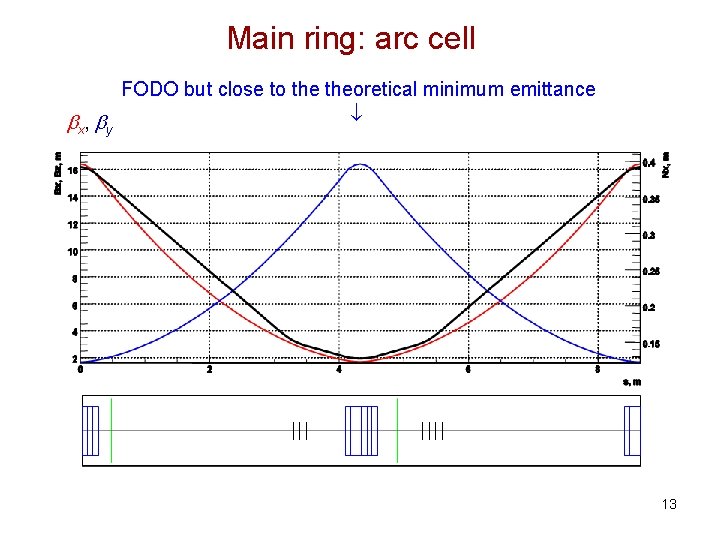
Main ring: arc cell FODO but close to theoretical minimum emittance bx , by 13
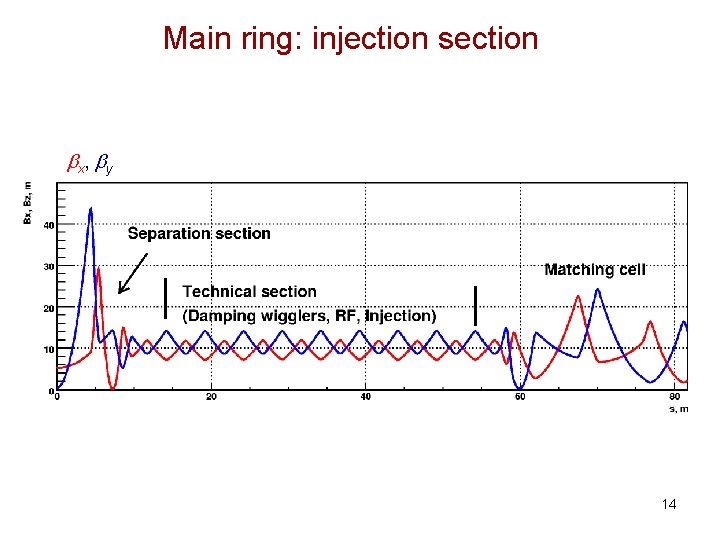
Main ring: injection section bx , by 14
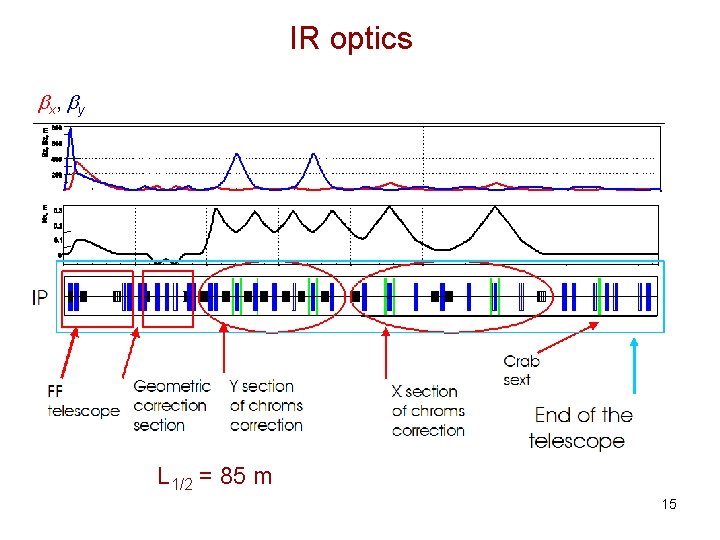
IR optics bx , by L 1/2 = 85 m 15
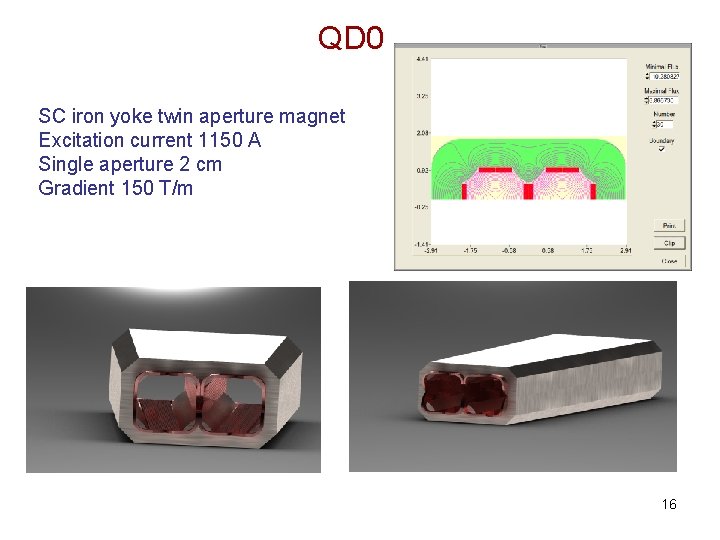
QD 0 SC iron yoke twin aperture magnet Excitation current 1150 A Single aperture 2 cm Gradient 150 T/m 16
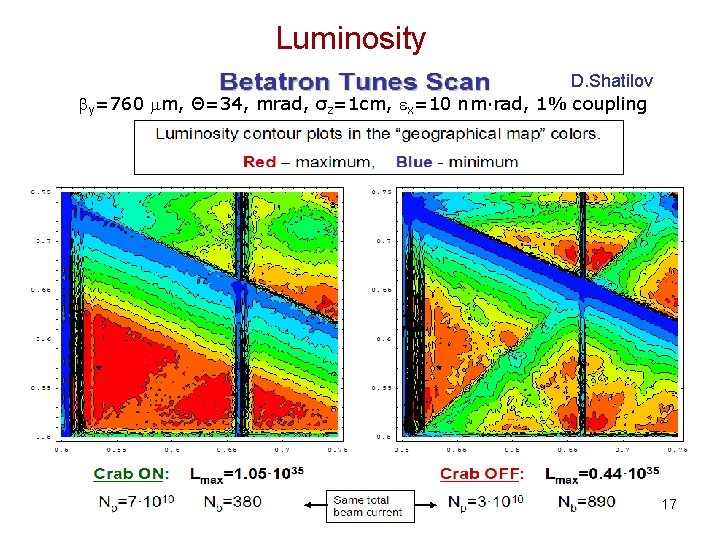
Luminosity D. Shatilov y=760 mm, Θ=34, mrad, σz=1 cm, x=10 nm·rad, 1% coupling 17
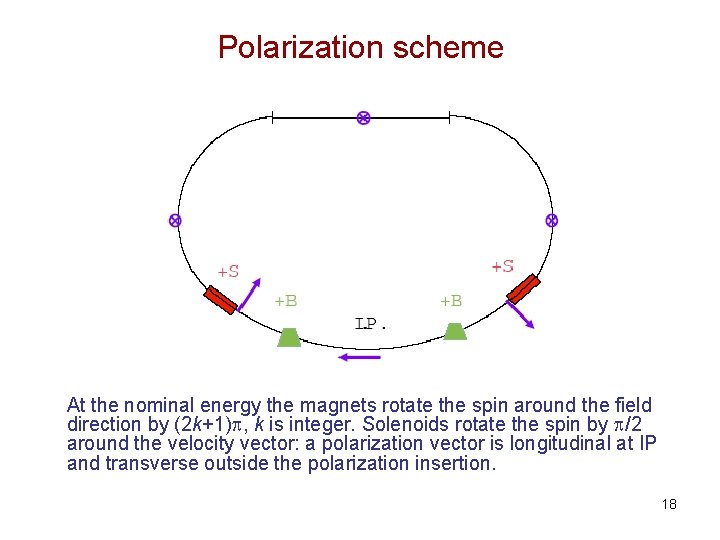
Polarization scheme At the nominal energy the magnets rotate the spin around the field direction by (2 k+1) , k is integer. Solenoids rotate the spin by /2 around the velocity vector: a polarization vector is longitudinal at IP and transverse outside the polarization insertion. 18
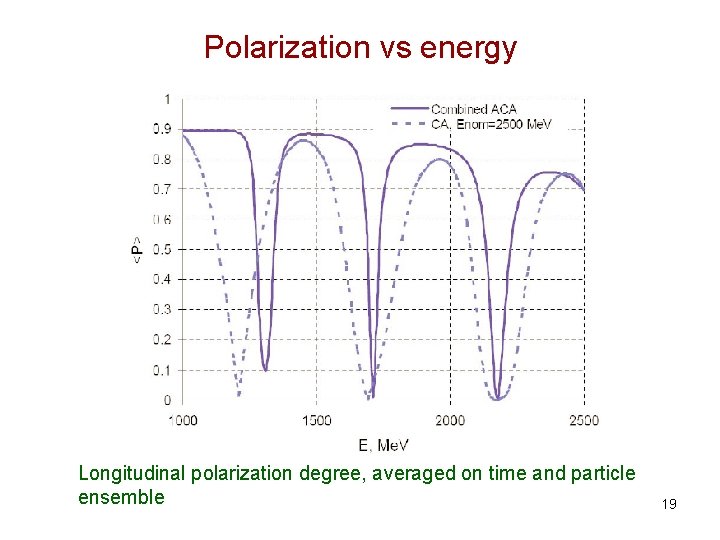
Polarization vs energy Longitudinal polarization degree, averaged on time and particle ensemble 19
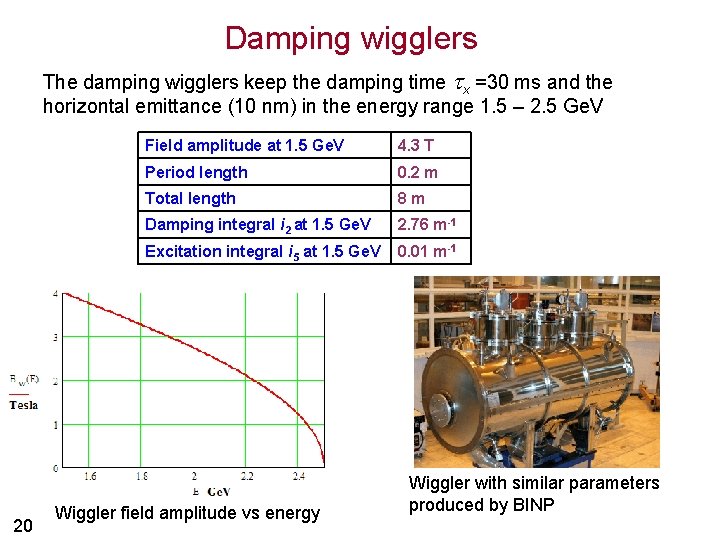
Damping wigglers The damping wigglers keep the damping time tx =30 ms and the horizontal emittance (10 nm) in the energy range 1. 5 – 2. 5 Ge. V 20 Field amplitude at 1. 5 Ge. V 4. 3 T Period length 0. 2 m Total length 8 m Damping integral i 2 at 1. 5 Ge. V 2. 76 m-1 Excitation integral i 5 at 1. 5 Ge. V 0. 01 m-1 Wiggler field amplitude vs energy Wiggler with similar parameters produced by BINP
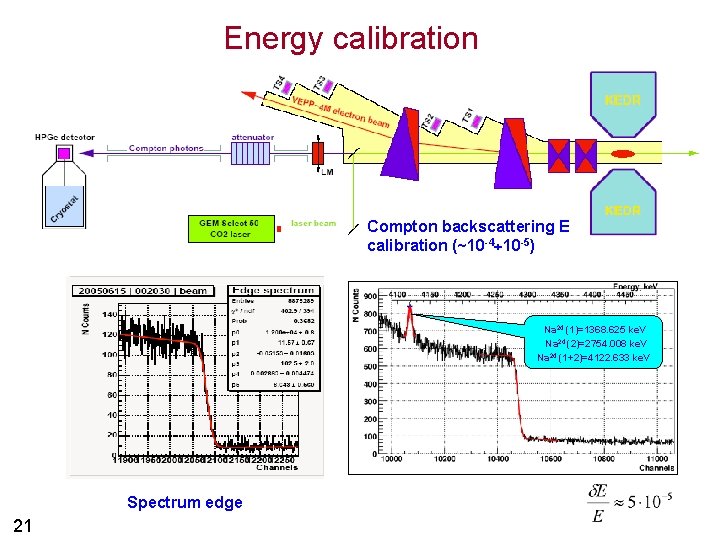
Energy calibration Compton backscattering E calibration (~10 -4 10 -5) Na 24 (1)=1368. 625 ke. V Na 24 (2)=2754. 008 ke. V Na 24 (1+2)=4122. 633 ke. V Spectrum edge 21
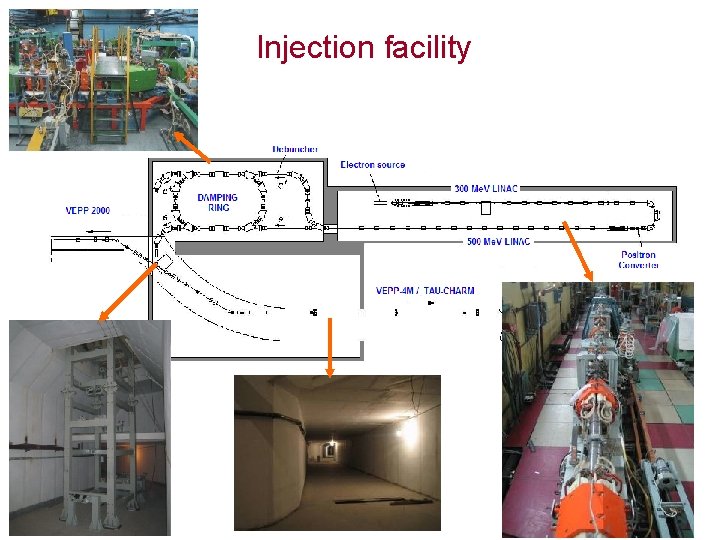
Injection facility 22
Injection facility upgrade • Today: • 2 1010 e-/pulse (1. 5% conversion) 3 108 e+/pulse • 50 Hz = 1. 5 1010 e+/s • • • Upgrade: e- current increase ( 3) Better focusing in positron linac ( 1. 5) Debuncher usage ( 2) = 1. 35 1011 e+/s • Reserve: electron energy can be increased by 100 Me. V ( 1. 3) 23
Summary ► Crab Waist collision seems a very promising idea to enhance a circular colliders luminosity beyond the present value by factor of 10100 without current increase. Three projects (Super. B, Super. KEKB and BINP-Super. CT) adopt CW as a basic idea of design. ► CW approach was successfully proved experimentally at DAFNE in the end of 2008 ► Novosibirsk Super. CT project is under way. The key issues like IR design, DA optimization, polarization scheme, QD 0 design, etc. seem solved successfully ► In the end of 2009 we hope to prepare a CDR of the project and in 2010 clear the project funding with Russian Government. In parallel a TDR will be prepared 24
- Slides: 24