
Binomial Theorem Do you see anything 1 ab
Binomial Theorem
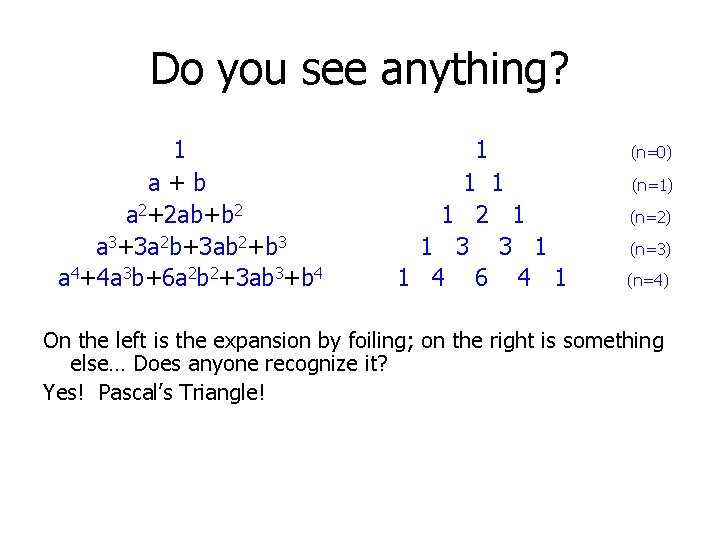
Do you see anything? 1 a+b a 2+2 ab+b 2 a 3+3 a 2 b+3 ab 2+b 3 a 4+4 a 3 b+6 a 2 b 2+3 ab 3+b 4 1 1 2 1 1 3 3 1 1 4 6 4 1 (n=0) (n=1) (n=2) (n=3) (n=4) On the left is the expansion by foiling; on the right is something else… Does anyone recognize it? Yes! Pascal’s Triangle!
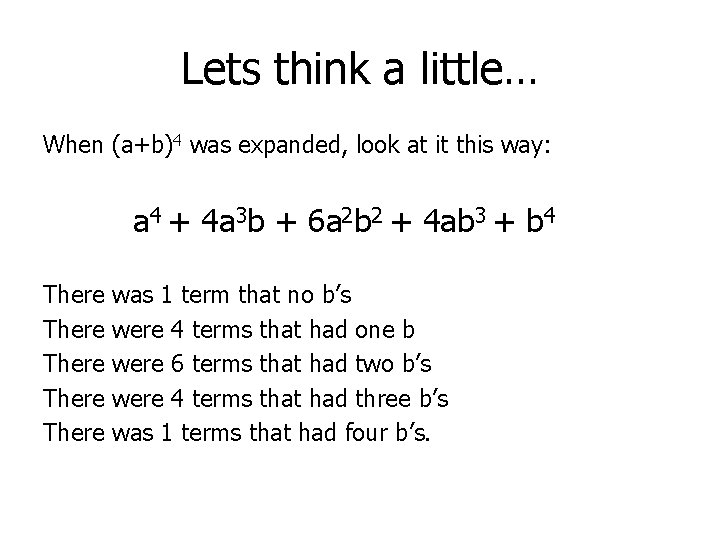
Lets think a little… When (a+b)4 was expanded, look at it this way: a 4 + 4 a 3 b + 6 a 2 b 2 + 4 ab 3 + b 4 There There was 1 term that no b’s were 4 terms that had one b were 6 terms that had two b’s were 4 terms that had three b’s was 1 terms that had four b’s.
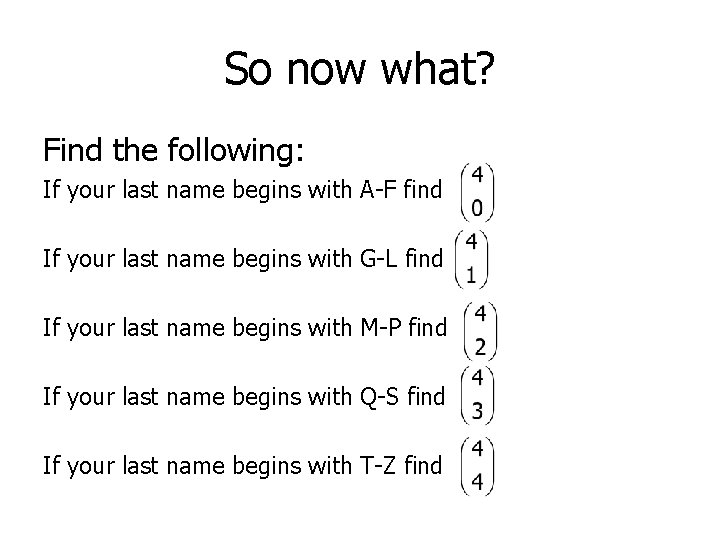
So now what? Find the following: If your last name begins with A-F find If your last name begins with G-L find If your last name begins with M-P find If your last name begins with Q-S find If your last name begins with T-Z find
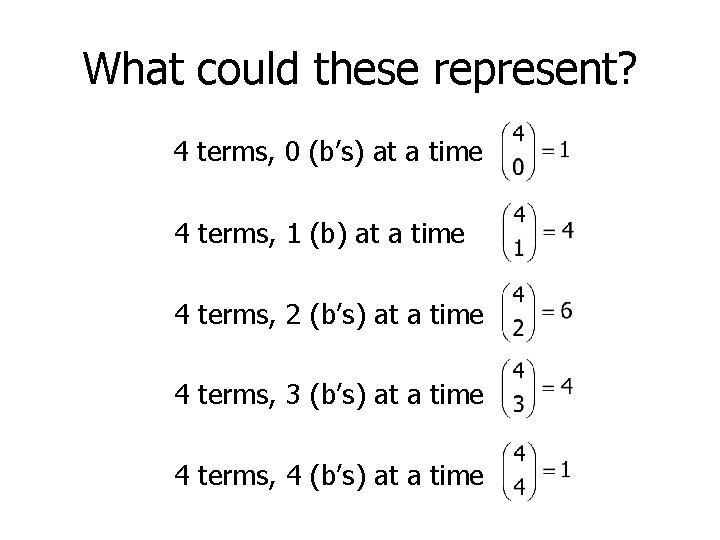
What could these represent? 4 terms, 0 (b’s) at a time 4 terms, 1 (b) at a time 4 terms, 2 (b’s) at a time 4 terms, 3 (b’s) at a time 4 terms, 4 (b’s) at a time
Notice anything? That formula allows you to find all the coefficients for a particular row. You found the coefficients for the expansion of (a+b)4 power. Now, what would the coefficients of row 7 be? What do you think would be the easiest way to find it?

Binomial Theorem This all leads us to Binomial Theorem, which allows you to expand any binomial without foiling. Is it better? Depends on the situation, but it is a good process to understand. It is all about patterns! Here is The Binomial Theorem
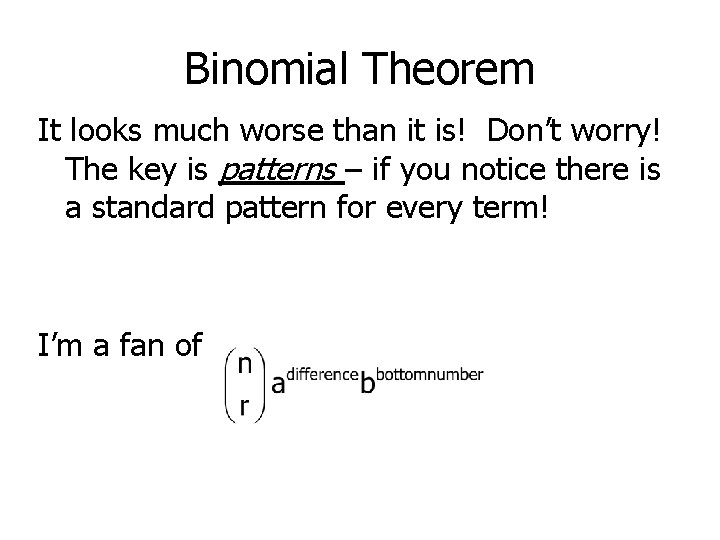
Binomial Theorem It looks much worse than it is! Don’t worry! The key is patterns – if you notice there is a standard pattern for every term! I’m a fan of
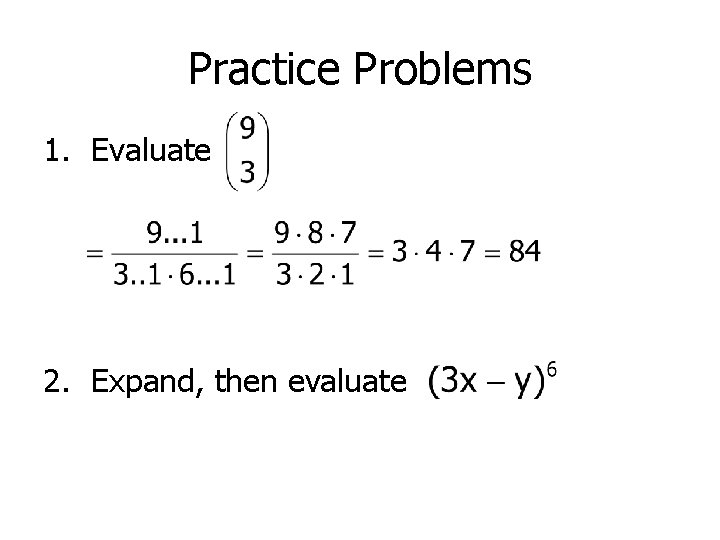
Practice Problems 1. Evaluate 2. Expand, then evaluate
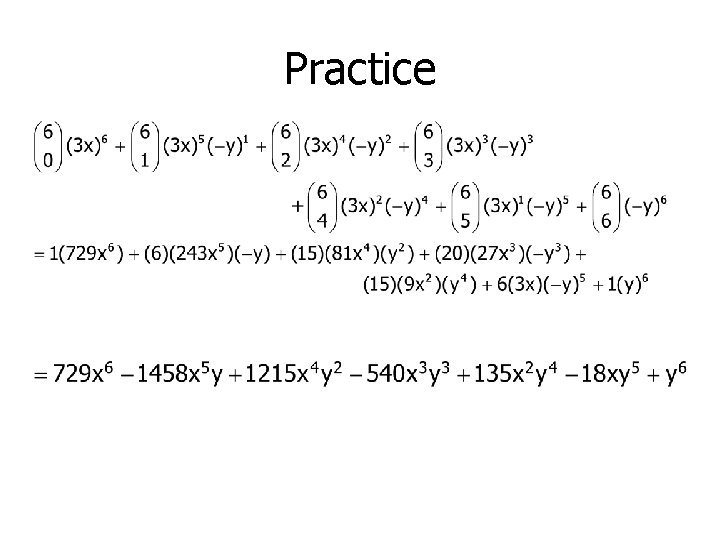
Practice
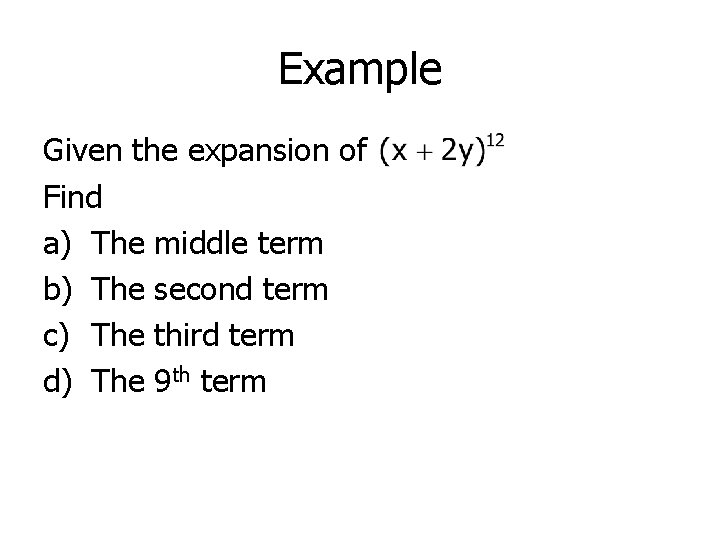
Example Given the expansion of Find a) The middle term b) The second term c) The third term d) The 9 th term
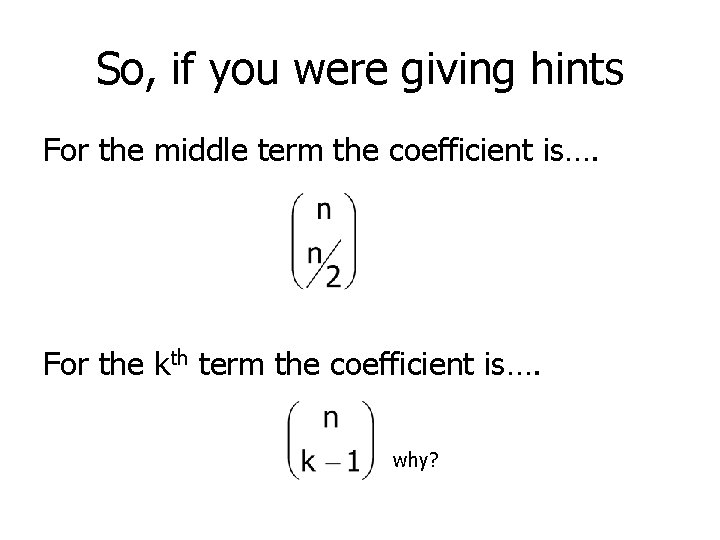
So, if you were giving hints For the middle term the coefficient is…. For the kth term the coefficient is…. why?
Resources • Hubbard, M. , Roby, T. , (? ) Pascal’s Triangle, from Top to Bottom, retrieved 3/1/05 from http: //binomial. csuhayward. edu/Pascal 0. html • O'Connor, J. J. , Robertson, E. F. , (1999) Blaise Pascal. Retrieved 2/26/05 from http: //www-groups. dcs. stand. ac. uk/~history/Mathematicians/Pascal. html • Weisstein, Eric W. (? ) Pascal’s Triangle, Retrieved 2/26/05 from http: //mathworld. wolfram. com/Pascals. Triangle. html • Britton, J. (2005) Pascal’s Triangle and its Patterns, Retrieved 3/2/05 http: //ccins. camosun. bc. ca/~jbritton/pascal. html • Katsiavriades, Kryss, Qureshi, Tallaat. (2004) Pascal’s Triangle, Retrieved 2/26/05 from http: //www. krysstal. com/binomial. html • Loy, Jim (1999) The Yanghui Triangle, Retrieved 3/1/05 from http: //www. jimloy. com/algebra/yanghui. htm • http: //mathforum. org/workshops/usi/pascal_handouts. html
- Slides: 13