
Binomial Distributions 1 Binomial Setting u Fixed number

Binomial Distributions 1
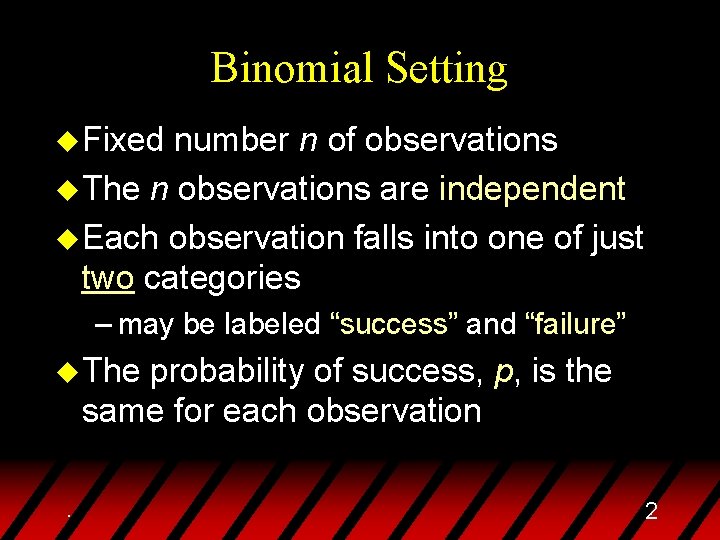
Binomial Setting u Fixed number n of observations u The n observations are independent u Each observation falls into one of just two categories – may be labeled “success” and “failure” u The probability of success, p, is the same for each observation . 2
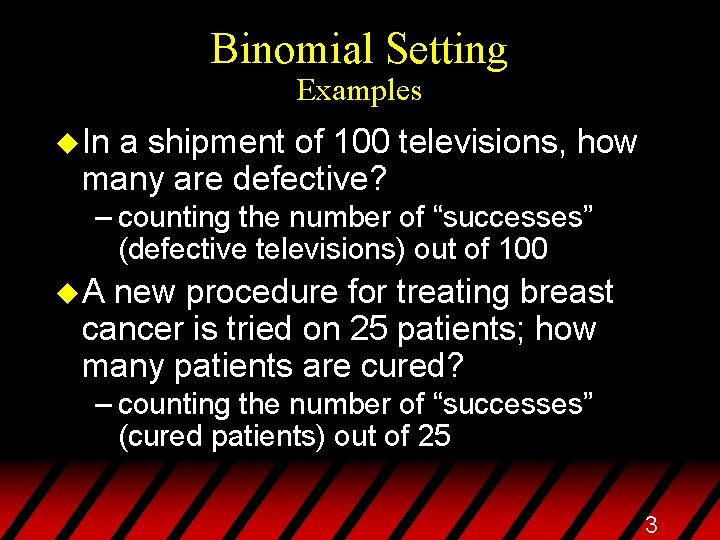
Binomial Setting Examples u In a shipment of 100 televisions, how many are defective? – counting the number of “successes” (defective televisions) out of 100 u. A new procedure for treating breast cancer is tried on 25 patients; how many patients are cured? – counting the number of “successes” (cured patients) out of 25 3
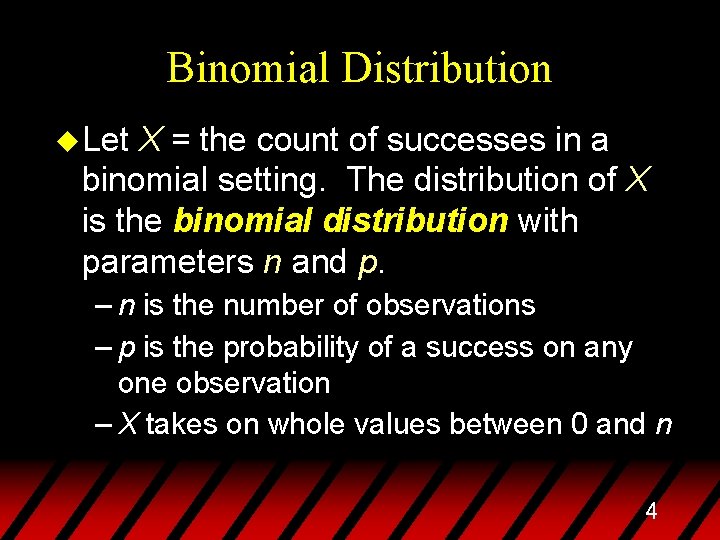
Binomial Distribution u Let X = the count of successes in a binomial setting. The distribution of X is the binomial distribution with parameters n and p. – n is the number of observations – p is the probability of a success on any one observation – X takes on whole values between 0 and n 4
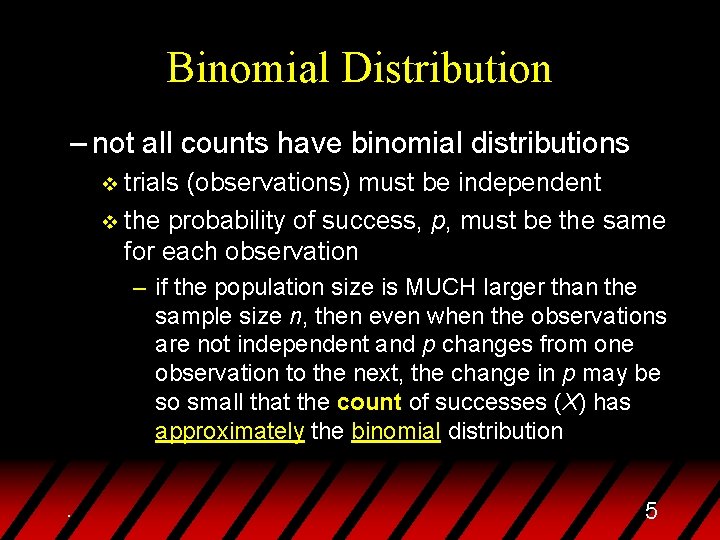
Binomial Distribution – not all counts have binomial distributions v trials (observations) must be independent v the probability of success, p, must be the same for each observation – if the population size is MUCH larger than the sample size n, then even when the observations are not independent and p changes from one observation to the next, the change in p may be so small that the count of successes (X) has approximately the binomial distribution. 5

Case Study Inspecting Switches An engineer selects a random sample of 10 switches from a shipment of 10, 000 switches. Unknown to the engineer, 10% of the switches in the full shipment are bad. The engineer counts the number X of bad switches in the sample. 6
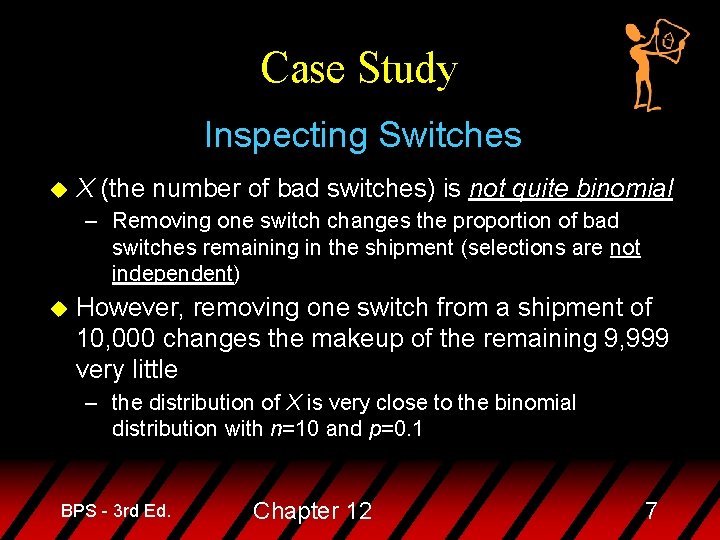
Case Study Inspecting Switches u X (the number of bad switches) is not quite binomial – Removing one switch changes the proportion of bad switches remaining in the shipment (selections are not independent) u However, removing one switch from a shipment of 10, 000 changes the makeup of the remaining 9, 999 very little – the distribution of X is very close to the binomial distribution with n=10 and p=0. 1 BPS - 3 rd Ed. Chapter 12 7
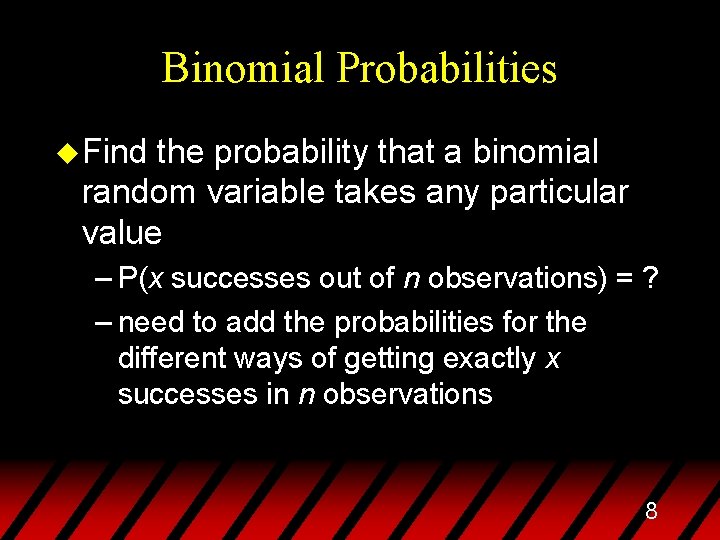
Binomial Probabilities u Find the probability that a binomial random variable takes any particular value – P(x successes out of n observations) = ? – need to add the probabilities for the different ways of getting exactly x successes in n observations 8
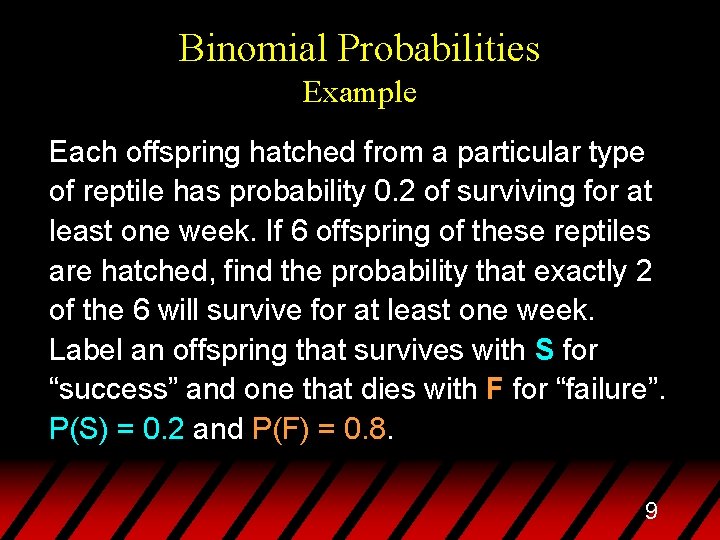
Binomial Probabilities Example Each offspring hatched from a particular type of reptile has probability 0. 2 of surviving for at least one week. If 6 offspring of these reptiles are hatched, find the probability that exactly 2 of the 6 will survive for at least one week. Label an offspring that survives with S for “success” and one that dies with F for “failure”. P(S) = 0. 2 and P(F) = 0. 8. 9
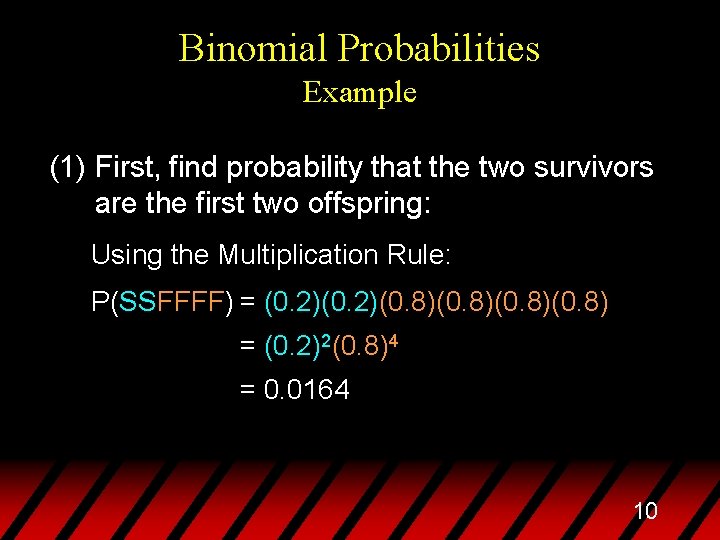
Binomial Probabilities Example (1) First, find probability that the two survivors are the first two offspring: Using the Multiplication Rule: P(SSFFFF) = (0. 2)(0. 8)(0. 8) = (0. 2)2(0. 8)4 = 0. 0164 10
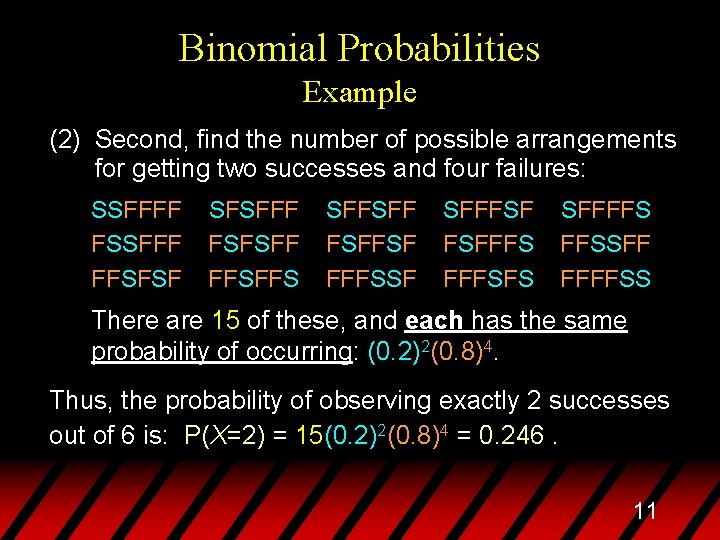
Binomial Probabilities Example (2) Second, find the number of possible arrangements for getting two successes and four failures: SSFFFF FSSFFF FFSFSFFF FSFSFF FFSFFSFF FSFFSF FFFSSF SFFFSF FSFFFSFS SFFFFS FFSSFF FFFFSS There are 15 of these, and each has the same probability of occurring: (0. 2)2(0. 8)4. Thus, the probability of observing exactly 2 successes out of 6 is: P(X=2) = 15(0. 2)2(0. 8)4 = 0. 246. 11
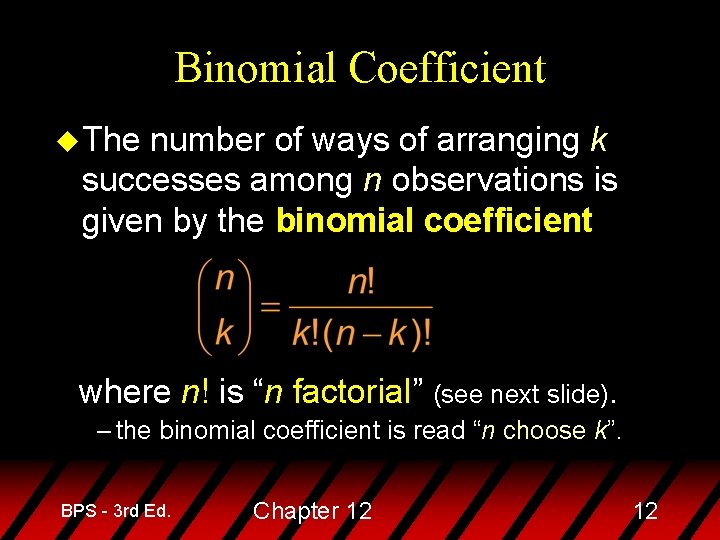
Binomial Coefficient u The number of ways of arranging k successes among n observations is given by the binomial coefficient where n! is “n factorial” (see next slide). – the binomial coefficient is read “n choose k”. BPS - 3 rd Ed. Chapter 12 12
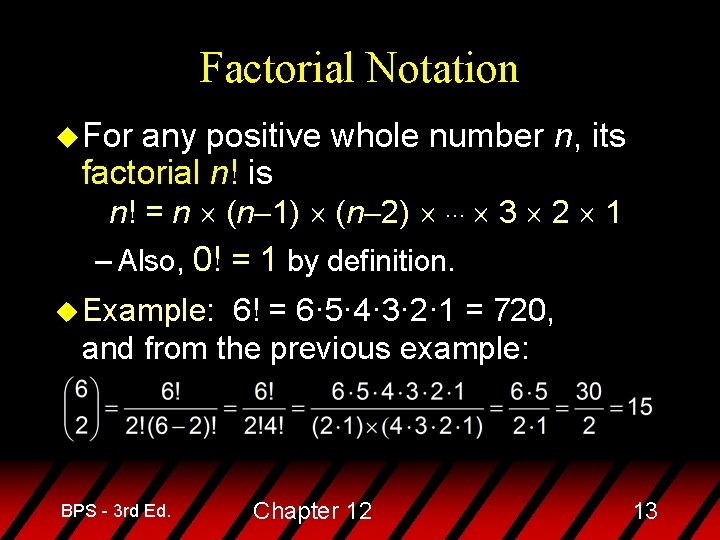
Factorial Notation u For any positive whole number n, its factorial n! is n! = n (n 1) (n 2) 3 2 1 – Also, 0! = 1 by definition. u Example: 6! = 6· 5· 4· 3· 2· 1 = 720, and from the previous example: BPS - 3 rd Ed. Chapter 12 13
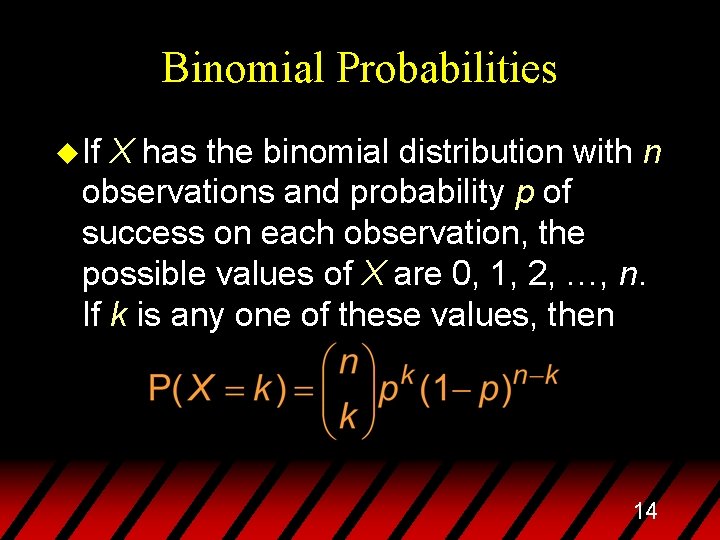
Binomial Probabilities u If X has the binomial distribution with n observations and probability p of success on each observation, the possible values of X are 0, 1, 2, …, n. If k is any one of these values, then 14
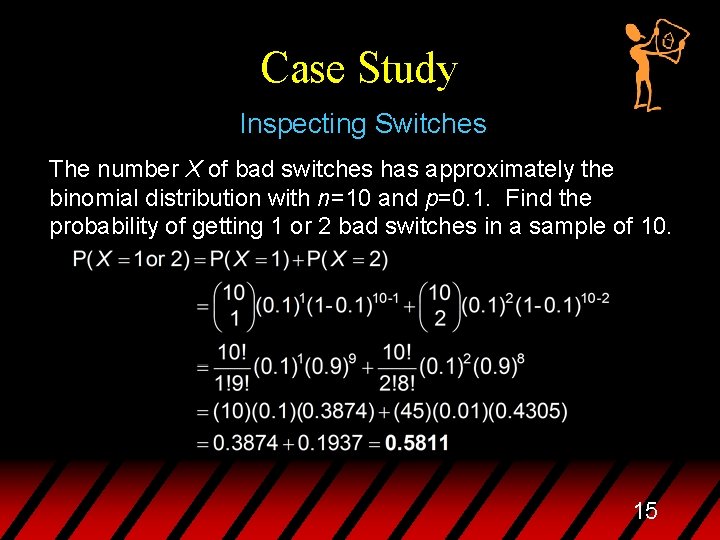
Case Study Inspecting Switches The number X of bad switches has approximately the binomial distribution with n=10 and p=0. 1. Find the probability of getting 1 or 2 bad switches in a sample of 10. 15
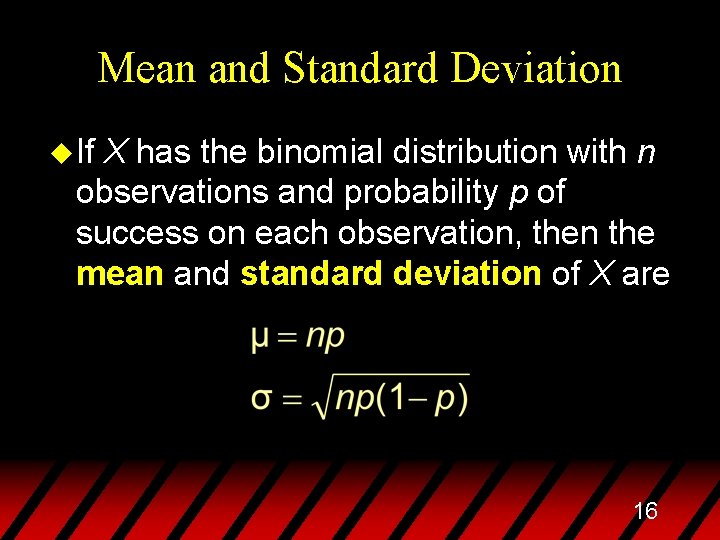
Mean and Standard Deviation u If X has the binomial distribution with n observations and probability p of success on each observation, then the mean and standard deviation of X are 16
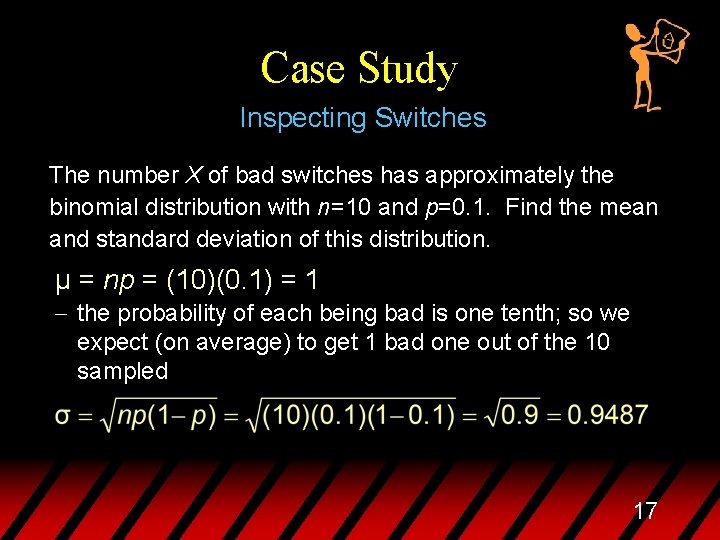
Case Study Inspecting Switches The number X of bad switches has approximately the binomial distribution with n=10 and p=0. 1. Find the mean and standard deviation of this distribution. µ = np = (10)(0. 1) = 1 the probability of each being bad is one tenth; so we expect (on average) to get 1 bad one out of the 10 sampled 17

Thank you
- Slides: 18