
Binocular Stereo Vision Properties of human stereo vision
Binocular Stereo Vision Properties of human stereo vision Marr-Poggio-Grimson multi-resolution stereo algorithm CS 332 Visual Processing Department of Computer Science Wellesley College
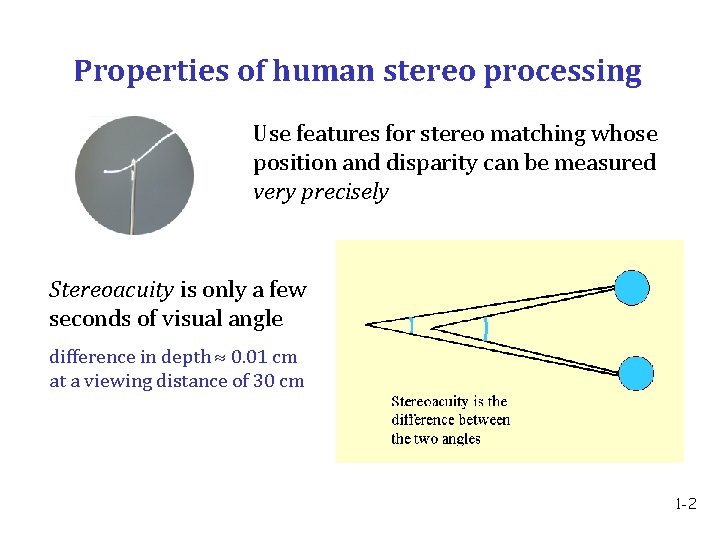
Properties of human stereo processing Use features for stereo matching whose position and disparity can be measured very precisely Stereoacuity is only a few seconds of visual angle difference in depth 0. 01 cm at a viewing distance of 30 cm 1 -2

Properties of human stereo processing Matching features must appear similar in the left and right images For example, a left stereo image cannot be fused with a negative of the right image… 1 -3
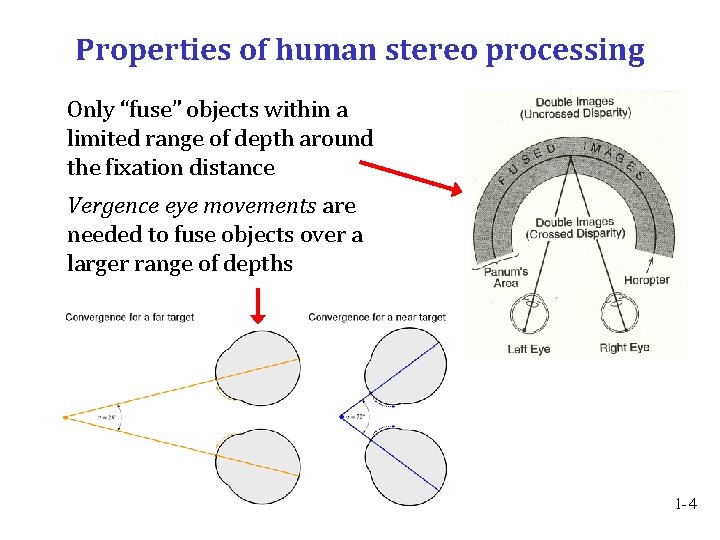
Properties of human stereo processing Only “fuse” objects within a limited range of depth around the fixation distance Vergence eye movements are needed to fuse objects over a larger range of depths 1 -4
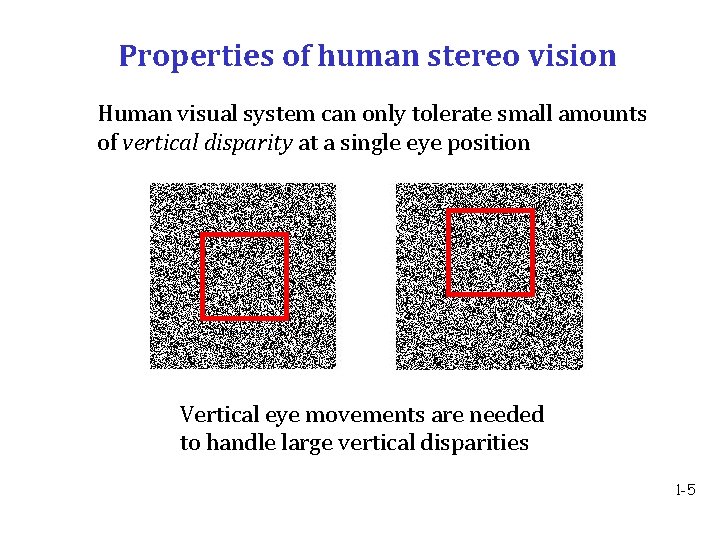
Properties of human stereo vision Human visual system can only tolerate small amounts of vertical disparity at a single eye position Vertical eye movements are needed to handle large vertical disparities 1 -5
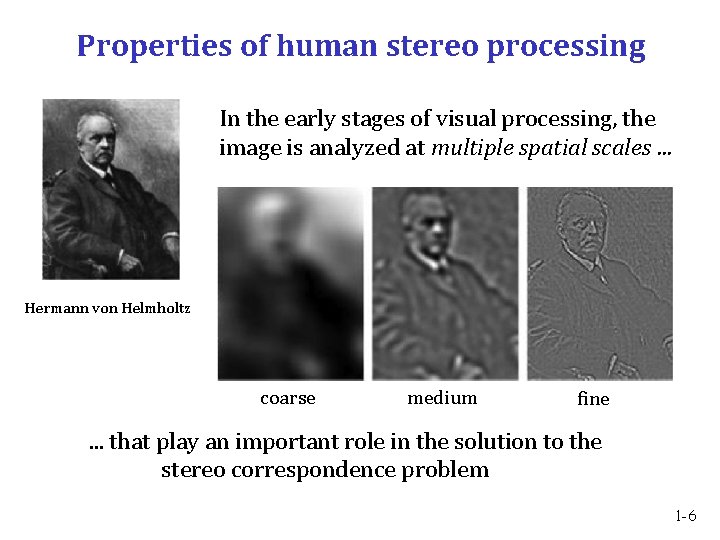
Properties of human stereo processing In the early stages of visual processing, the image is analyzed at multiple spatial scales … Hermann von Helmholtz coarse medium fine . . . that play an important role in the solution to the stereo correspondence problem 1 -6
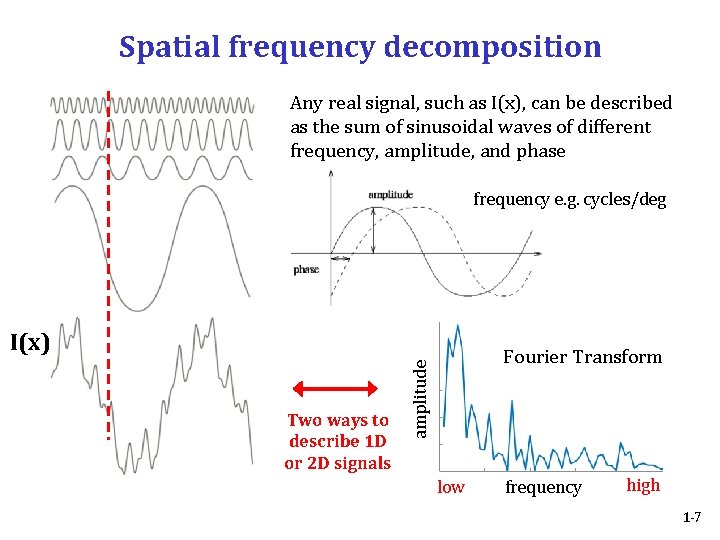
Spatial frequency decomposition Any real signal, such as I(x), can be described as the sum of sinusoidal waves of different frequency, amplitude, and phase frequency e. g. cycles/deg I(x) amplitude Two ways to describe 1 D or 2 D signals Fourier Transform low frequency high 1 -7
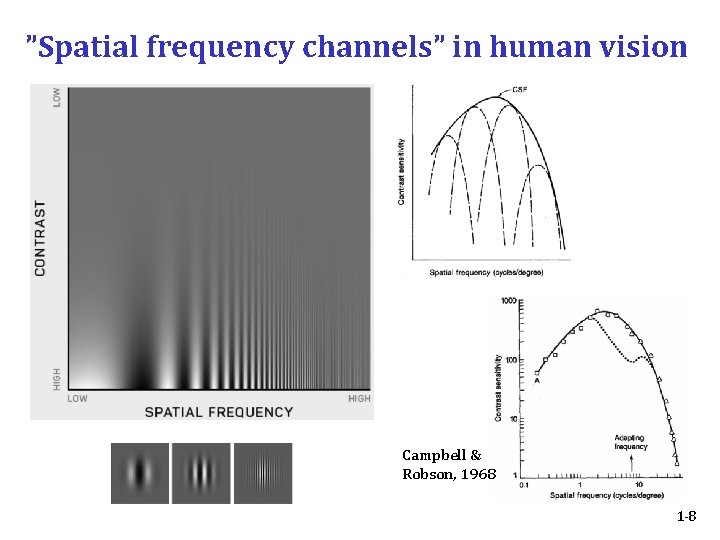
”Spatial frequency channels” in human vision Campbell & Robson, 1968 1 -8
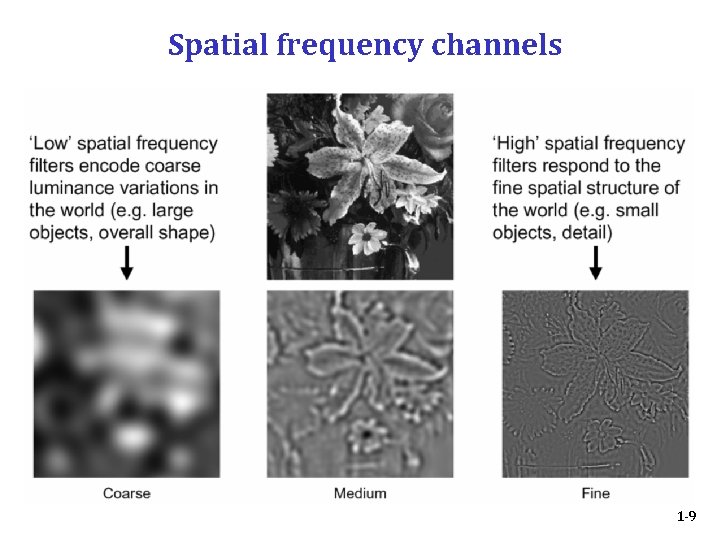
Spatial frequency channels 1 -9
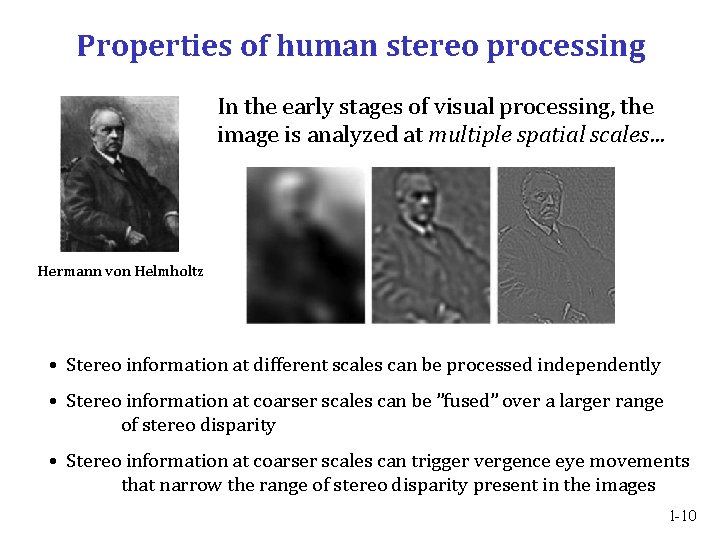
Properties of human stereo processing In the early stages of visual processing, the image is analyzed at multiple spatial scales… Hermann von Helmholtz • Stereo information at different scales can be processed independently • Stereo information at coarser scales can be ”fused” over a larger range of stereo disparity • Stereo information at coarser scales can trigger vergence eye movements that narrow the range of stereo disparity present in the images 1 -10
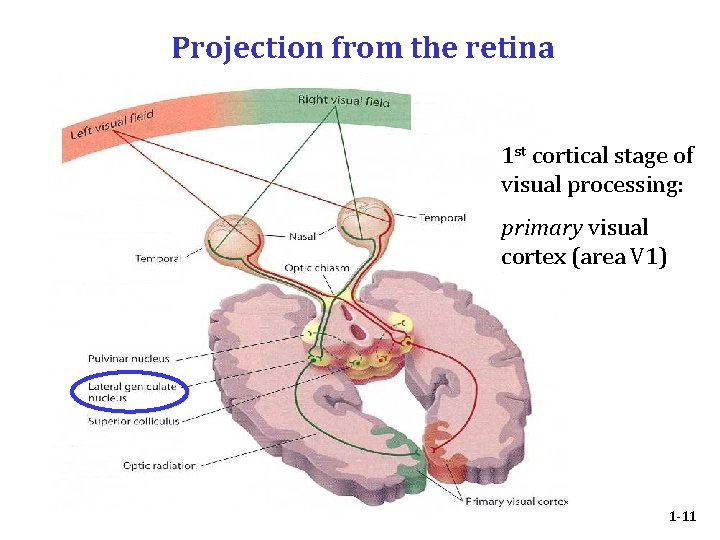
Projection from the retina 1 st cortical stage of visual processing: primary visual cortex (area V 1) 1 -11
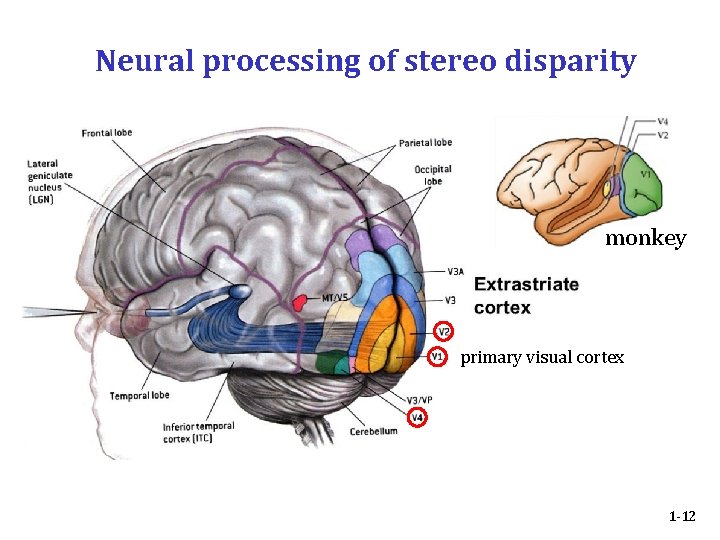
Neural processing of stereo disparity monkey primary visual cortex 1 -12
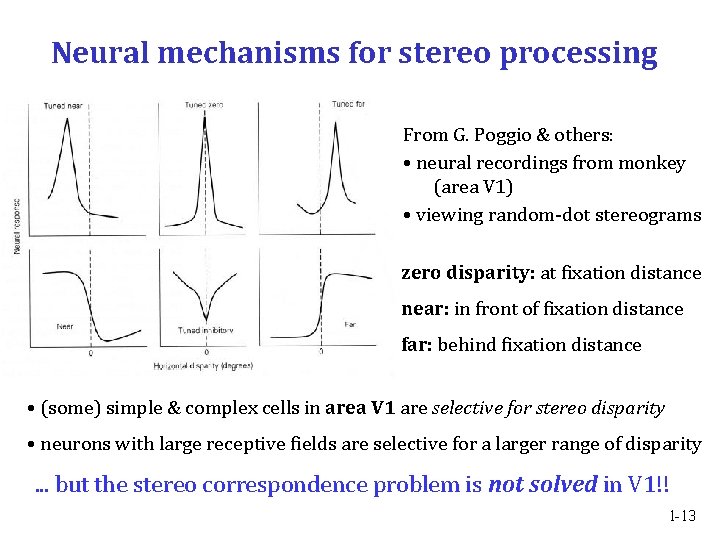
Neural mechanisms for stereo processing From G. Poggio & others: • neural recordings from monkey (area V 1) • viewing random-dot stereograms zero disparity: at fixation distance near: in front of fixation distance far: behind fixation distance • (some) simple & complex cells in area V 1 are selective for stereo disparity • neurons with large receptive fields are selective for a larger range of disparity . . . but the stereo correspondence problem is not solved in V 1!! 1 -13
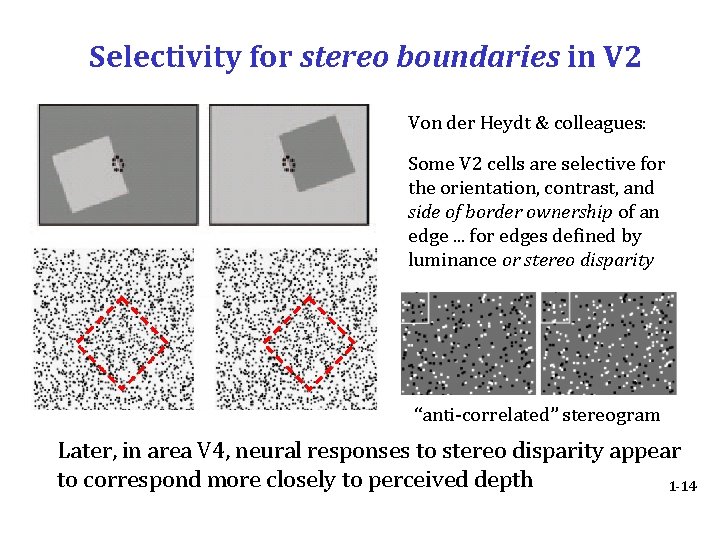
Selectivity for stereo boundaries in V 2 Von der Heydt & colleagues: Some V 2 cells are selective for the orientation, contrast, and side of border ownership of an edge. . . for edges defined by luminance or stereo disparity “anti-correlated” stereogram Later, in area V 4, neural responses to stereo disparity appear to correspond more closely to perceived depth 1 -14
In summary, some key points… • Image features used for matching: ~simple, precise locations, similar between left/right images • At single fixation, match features over a limited range of horizontal & vertical disparity • Eye movements used to match features over larger range of disparity • Stereo matching performed at multiple scales ~independently, disparity range depends on scale • Neurons selective for different ranges of stereo disparity, multiple processing stages V 1 V 2 V 4 1 -15
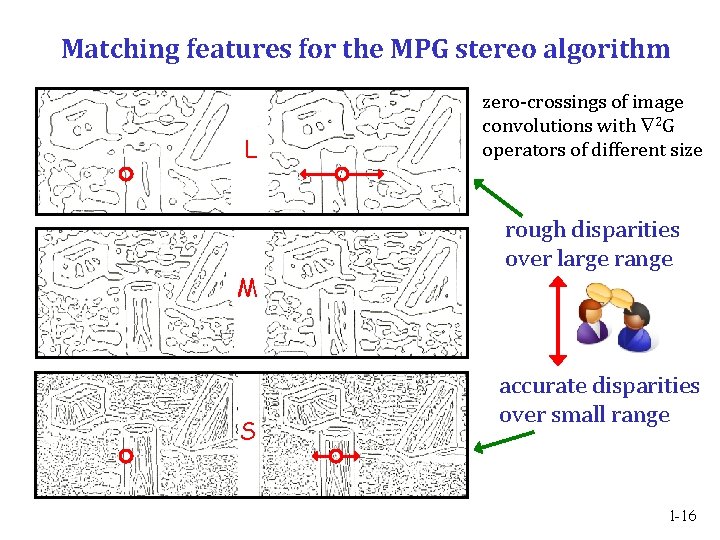
Matching features for the MPG stereo algorithm L M S zero-crossings of image convolutions with 2 G operators of different size rough disparities over large range accurate disparities over small range 1 -16
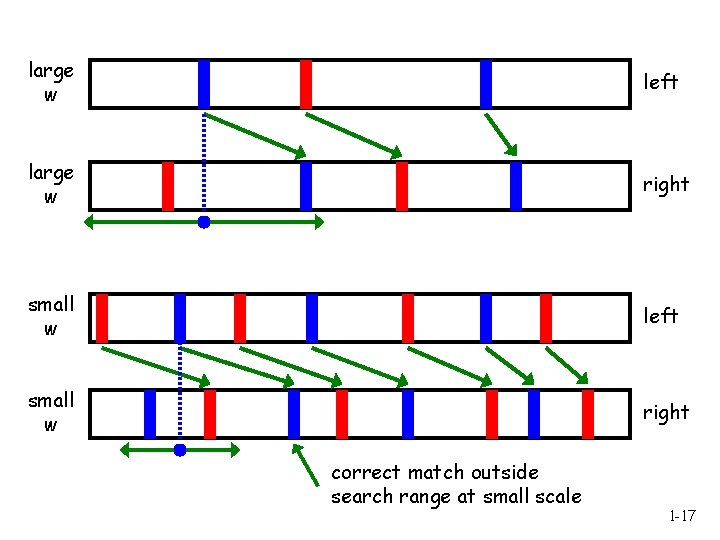
large w left large w right small w left small w right correct match outside search range at small scale 1 -17
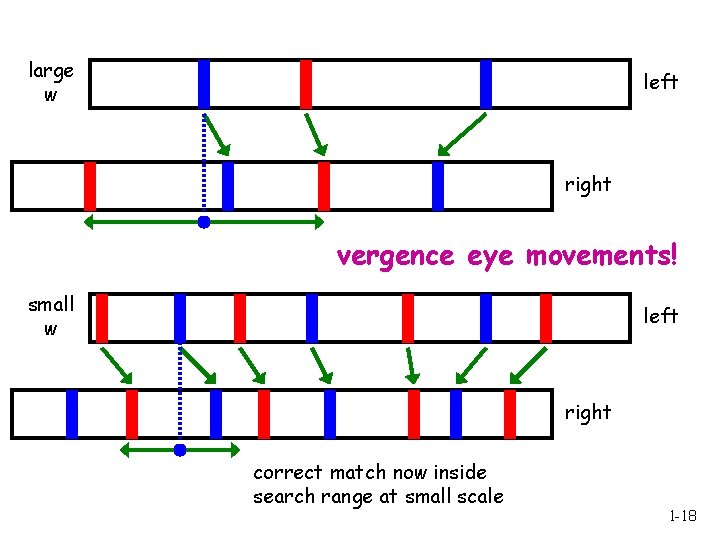
large w left right vergence eye movements! small w left right correct match now inside search range at small scale 1 -18
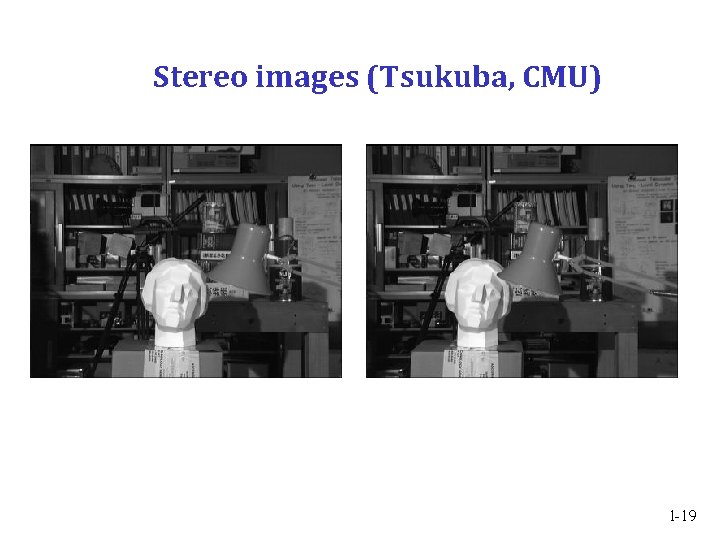
Stereo images (Tsukuba, CMU) 1 -19
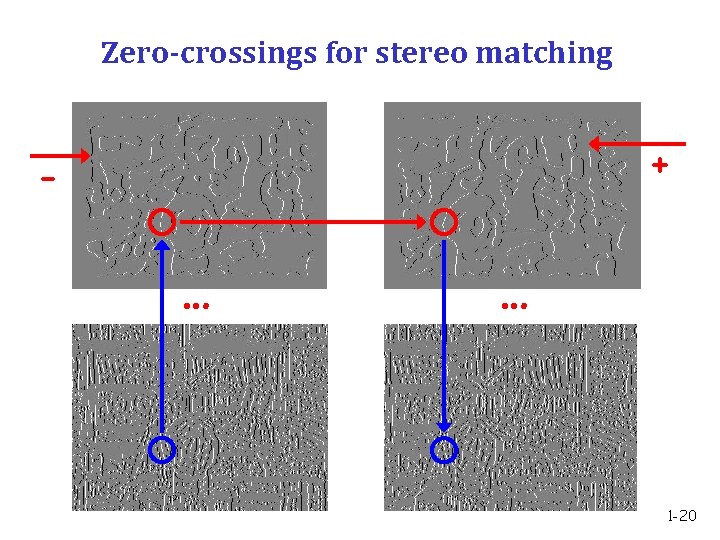
Zero-crossings for stereo matching + - … … 1 -20
Simplified MPG algorithm, Part 1 To determine initial correspondence: (1) Find zero-crossings using a 2 G operator with central positive width w (2) For each horizontal slice: (2. 1) Find the nearest neighbors in the right image for each zero-crossing fragment in the left image (2. 2) Fine the nearest neighbors in the left image for each zerocrossing fragment in the right image (2. 3) For each pair of zero-crossing fragments that are closest neighbors of one another, let the right fragment be separated by δinitial from the left. Determine whether δinitial is within the matching tolerance, m. If so, consider the zero-crossing fragments matched with disparity δinitial m = w/2 1 -21
Simplified MPG algorithm, Part 2 To determine final correspondence: (1) Find zero-crossings using a 2 G operator with reduced width w/2 (2) For each horizontal slice: (2. 1) For each zero-crossing in the left image: (2. 1. 1) Determine the nearest zero-crossing fragment in the left image that matched when the 2 G operator width was w (2. 1. 2) Offset the zero-crossing fragment by a distance δinitial, the disparity of the nearest matching zero-crossing fragment found at the lower resolution with operator width w (2. 2) Find the nearest neighbors in the right image for each zero-crossing fragment in the left image (2. 3) Fine the nearest neighbors in the left image for each zero-crossing fragment in the right image (2. 4) For each pair of zero-crossing fragments that are closest neighbors of one another, let the right fragment be separated by δnew from the left. Determine whether δnew is within the reduced matching tolerance, m/2. If so, consider the zero-crossing fragments matched with disparity δfinal = δnew + δinitial 1 -22
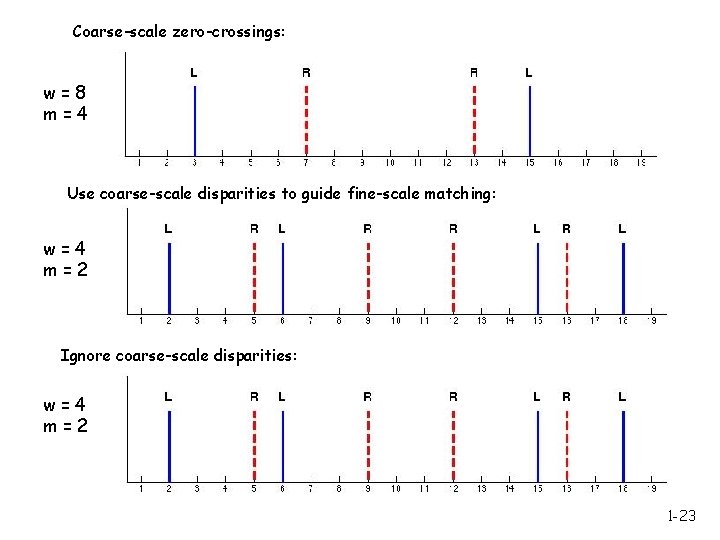
Coarse-scale zero-crossings: w=8 m=4 Use coarse-scale disparities to guide fine-scale matching: w=4 m=2 Ignore coarse-scale disparities: w=4 m=2 1 -23
- Slides: 23