
Binocular Stereo Vision MarrPoggioGrimson multiresolution stereo algorithm CS
Binocular Stereo Vision Marr-Poggio-Grimson multi-resolution stereo algorithm CS 332 Visual Processing Department of Computer Science Wellesley College 1 -
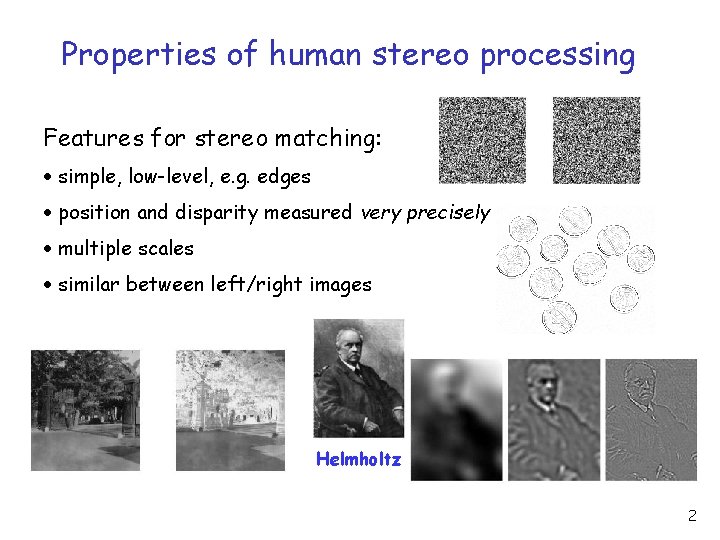
Properties of human stereo processing Features for stereo matching: simple, low-level, e. g. edges position and disparity measured very precisely multiple scales similar between left/right images Helmholtz 2

Properties of human stereo processing • At single fixation position, match features over a limited range of horizontal & vertical disparity • Eye movements used to match features over larger range of disparity • Neural mechanisms selective for particular ranges of stereo disparity 3
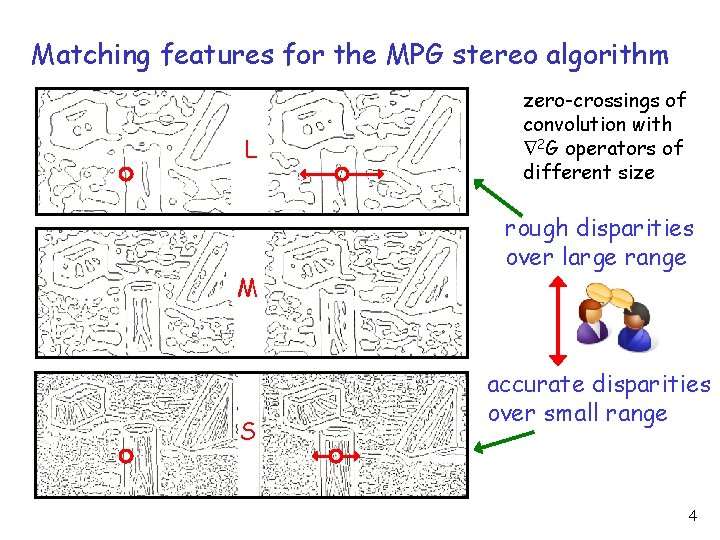
Matching features for the MPG stereo algorithm L M S zero-crossings of convolution with 2 G operators of different size rough disparities over large range accurate disparities over small range 4
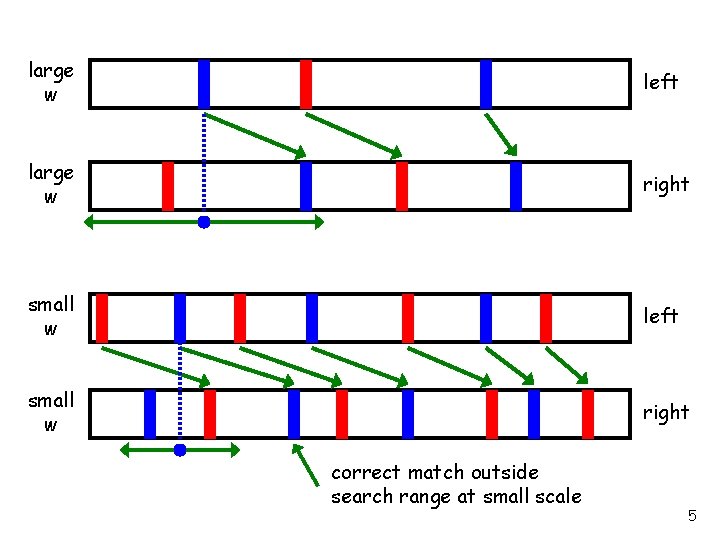
large w left large w right small w left small w right correct match outside search range at small scale 5
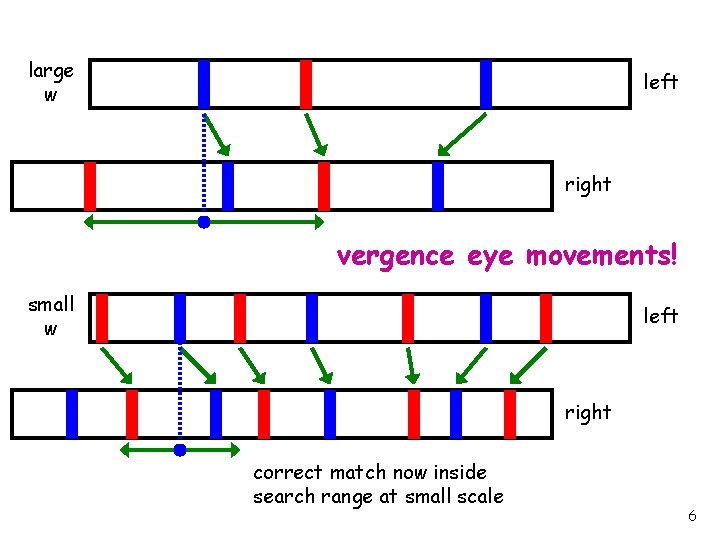
large w left right vergence eye movements! small w left right correct match now inside search range at small scale 6
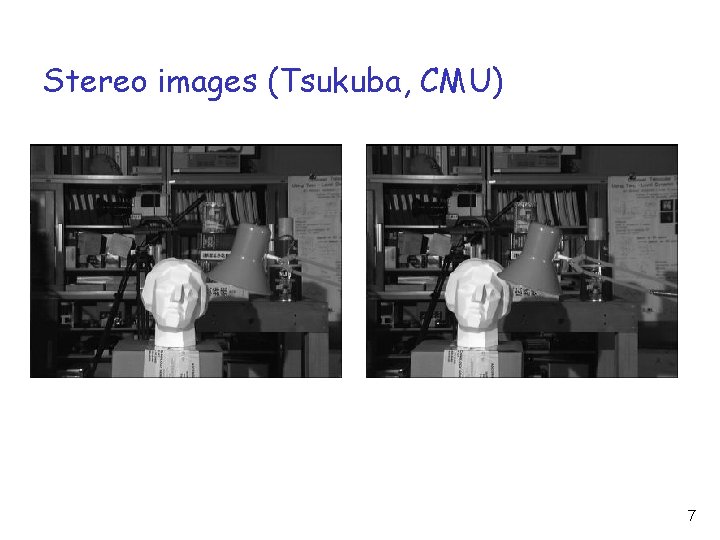
Stereo images (Tsukuba, CMU) 7
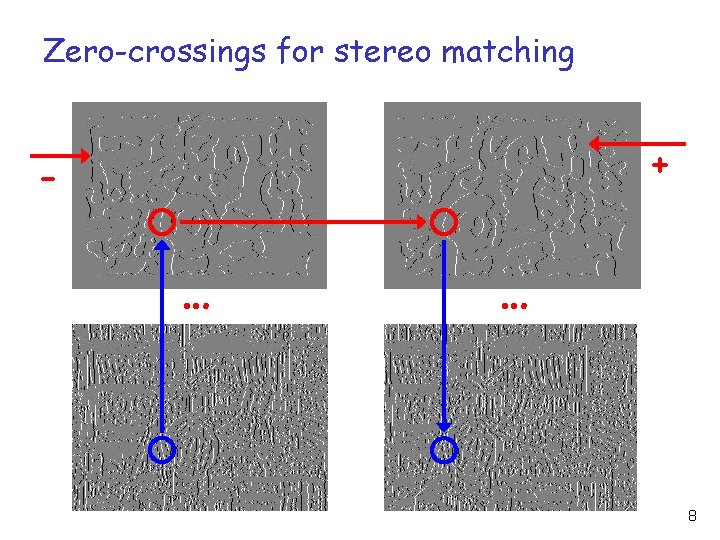
Zero-crossings for stereo matching + - … … 8
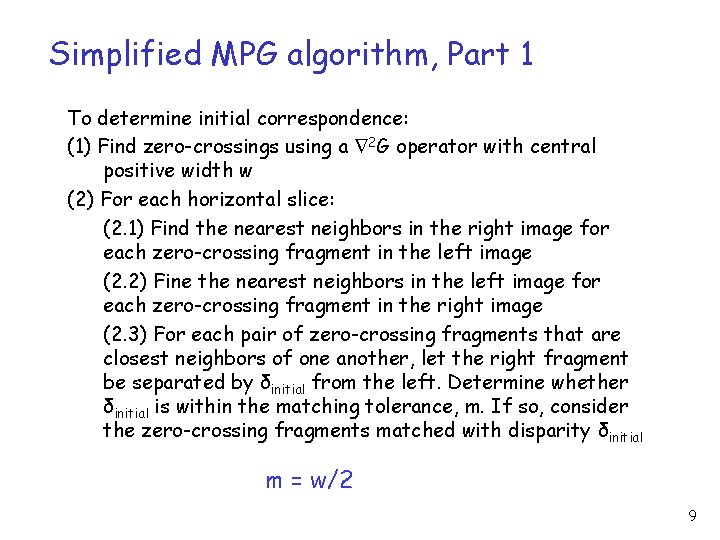
Simplified MPG algorithm, Part 1 To determine initial correspondence: (1) Find zero-crossings using a 2 G operator with central positive width w (2) For each horizontal slice: (2. 1) Find the nearest neighbors in the right image for each zero-crossing fragment in the left image (2. 2) Fine the nearest neighbors in the left image for each zero-crossing fragment in the right image (2. 3) For each pair of zero-crossing fragments that are closest neighbors of one another, let the right fragment be separated by δinitial from the left. Determine whether δinitial is within the matching tolerance, m. If so, consider the zero-crossing fragments matched with disparity δinitial m = w/2 9
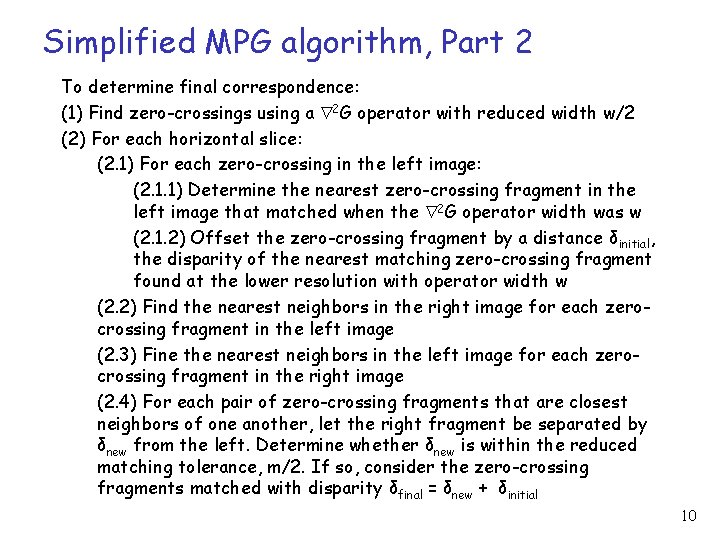
Simplified MPG algorithm, Part 2 To determine final correspondence: (1) Find zero-crossings using a 2 G operator with reduced width w/2 (2) For each horizontal slice: (2. 1) For each zero-crossing in the left image: (2. 1. 1) Determine the nearest zero-crossing fragment in the left image that matched when the 2 G operator width was w (2. 1. 2) Offset the zero-crossing fragment by a distance δinitial, the disparity of the nearest matching zero-crossing fragment found at the lower resolution with operator width w (2. 2) Find the nearest neighbors in the right image for each zerocrossing fragment in the left image (2. 3) Fine the nearest neighbors in the left image for each zerocrossing fragment in the right image (2. 4) For each pair of zero-crossing fragments that are closest neighbors of one another, let the right fragment be separated by δnew from the left. Determine whether δnew is within the reduced matching tolerance, m/2. If so, consider the zero-crossing fragments matched with disparity δfinal = δnew + δinitial 10
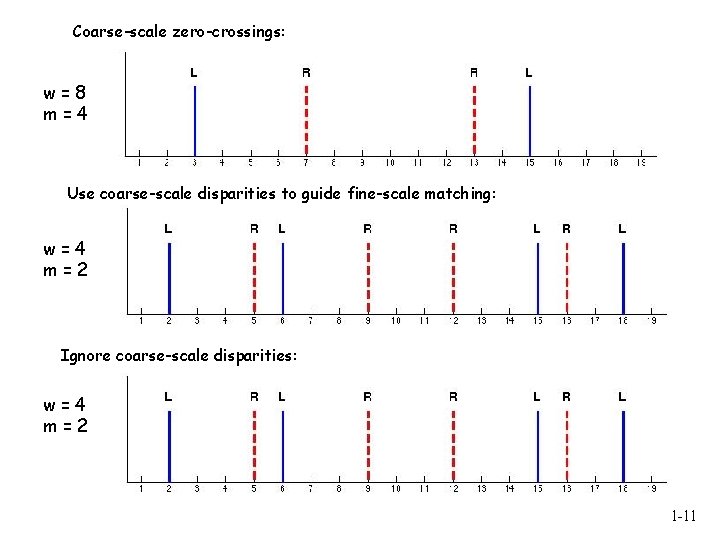
Coarse-scale zero-crossings: w=8 m=4 Use coarse-scale disparities to guide fine-scale matching: w=4 m=2 Ignore coarse-scale disparities: w=4 m=2 1 -11 11
- Slides: 11